Overnight, unexpectedly, snow fell, making for a delightful slush-fest this afternoon, one that I have to brave in order to walk the dog and neither one of us is gleeful about it, especially me, who can’t find his snow boots and must stroll in wee leather sneakers, ha ha, squish.
The snow, it’s not so bad, a solid inch and half or two, and the sun sliced through before I had to actually pull out the shovel and clear the sidewalk, the kind of toil that kills hundreds of hale men via heart attacks each year. (There’s no way I’m dying from shoveling snow. Manure maybe, snow, no.) Yet, as noted, it’s slushy out there, which beats crunchy. That stuff sticks for days and mocks you as you scrape windshields and, yes, shovel like a chain-gang prisoner.
Snow on Christmas Eve — how can you complain? While this powder is so slight that it won’t really make for the dreamy, coveted white Christmas — get ready for tomorrow’s brown Christmas — it’s still a tiny treat that shouts seasonal sentimentality. I’m getting misty already.
Friends are flung cross-country, from California to Florida, and the immediate family absconded to a Cancun resort for the holidays in order to swim and sweat. So I am, once again, a solo character in this festive narrative. It suits me well.
We opened presents on Sunday and a fine bounty was had, including a giant bottle of my beloved Monkey 47 gin, which goes down smooth if you ignore the price tag. My brother loves 19th century Russian playwright Anton Chekhov, so I got him a finger puppet of him as a stocking stuffer. It was that kind of Xmas exchange — practical and comical.
So snow. I get it. I got it. The tree is lit. Tonight I’m going to either rewatch the classic ‘70s noir “Chinatown” (I’m reading a book about the making of it) or pop a gummy and watch “The Wizard of Oz,” which seems positively made for gummies. Cubby the dog will be my companion. And I will pour a Monkey 47 and truly have a Christmas on ice. Cheers to all.
In these mid-summer doldrums, a few rambling thoughts that amount to nothing in particular …
Best sentence all summer: “Her lipstick is a philosophically incomprehensible shade of chalky orange.” (From “Eve’s Hollywood” by Eve Babitz.)
I have yet to read a memoir that didn’t bore me silly or raise an eyebrow or two. Nabokov’s “Speak, Memory” is a possible exception, and “Eve’s Hollywood” definitely is. I’m skeptical of minutiae only the writer cares about, like how their father flew planes in World War II and their sister married an alcoholic son of a bitch. I can hardly believe a word of what the authors say, especially when they do things like insert direct quotes they muttered as toddlers, forty years after the fact. (See: Mary Karr’s aptly titled “The Liars’ Club.”) It’s all magnificent hooey.
I’m sleeping like crap. Nothing new, but I’m locked in a stretch of relentless insomnia. I called my doctor and he gave me a low dose of Lunesta. It’s done nothing, even when I take more than the prescribed amount (whoopsie). I pop Benadryl and a dorky over the counter sleep aid as well. I’m all drugged up and I still don’t nod off till 4 or 5 or 6. Then I sleep till 9 and awake vaguely refreshed with murder on the mind. I feel like a Stephen King character.
Kamala’s got me revved. For now. The initial blast of flowers and fireworks — her spontaneous honeymoon — is about over, and now she must face the music … er, the monster. Trump, a hopeless buffoon, bigot and playground bully, will meet his match in the debates. Kamala will be the buzzsaw that Trump’s ignorant, lying face encounters and it will be beautiful. That ear boo-boo Trump’s so proud of will be shown for the nothing it is, except symbolic and specious martyrdom. He keeps blathering about the American “bloodbath.” Yes, indeed.
As always, I’ve been watching lots of classic movies from early and midcentury Hollywood — the Golden Age of pictures when men were either gruff or suave (and glistening with pomade) and women were silky and soft-focus, radiating unreachable glamor. Black and white was king and the best pics were positively charged with swoony cinematography and dazzling chiaroscuro. Those were the days. (And I’m someone who name-checks “Alien” and “Jaws” among his favorite films, alongside “All About Eve” and “The Big Sleep.”) Recent viewings: “The Big Heat,” a crackerjack 1953 crime thriller by Fritz Lang, starring Glenn Ford and Gloria Grahame, who gets a pot of scalding coffee tossed in her face by Lee Marvin and has to wear a giant bandage for half the movie; the unbearably charming Cary Grant and Irene Dunne in the 1937 screwball marriage/divorce romp “The Awful Truth,” which features the brilliant dog Skippy, who also plays Asta in the great “Thin Man” films; and 1955’s “The Big Knife,” where a fist-tight Jack Palance is a movie star sucked into the manipulative corruptions of fame. A rabid Rod Steiger noshes the scenery like it’s beef jerky. And that’s just three oldies I’ve recently watched (I’ve seen them all before). They beat the living crud out of big, dopey summer blockbusters any day.
I bought a hair dryer. I swear to god. It cost $15. It screams like Janis Joplin.
I’m never not reading a book or two. These are a few new titles I got my grubby paws on:
Mike Nichols’ 1966 film of Edward Albee’s corrosive play “Who’s Afraid of Virginia Woolf?” remains a dish-rattling, drink-spilling, daggers-in-your-ears delight, all marital earthquakes and social Molotov cocktails. (Cocktails. Of course.) Booze is big in that cracked portrait of a long-wed couple on the rocks. (On the rocks. Of course.) And you get a contact high reading the riveting “Cocktails with George and Martha: Movies, Marriage, and the Making of ‘Who’s Afraid of Virginia Woolf?’” by Philip Gefter, who capably captures the play’s serrated edges, dubious morality and verbal drive-bys, as well as the behind-the-scenes hoopla of making a controversial movie with a controversial couple, no less than Richard Burton and Elizabeth Taylor — Hollywood nitroglycerin. It’s a bracing blast of theater and cinema history.
“Headshot” is by a woman named Rita Bullwinkel. Let’s get that out of the way. (There, done.) This slim, tightly coiled novel is also a muscular debut, damp with the blood and sweat of a passel of female teenage boxers, zesty characters realized with pointillist panache. Time-leaping and fragmentary, the girls’ stories are told in intense vignettes for a scrappy scrapbook of pugilistic profiles that pounds with humanity and life. If not quite a K.O. — more tonal and rhythmic variety would shake things up — the book is a fleet-footed contender.
With irksomely precocious flair — at 35, he’s a wizardly wunderkind — poet Kaveh Akbar conjures worlds of art and ideas in his radiant fiction debut “Martyr!” Reeking agreeably of auto-fiction, this dense but delectably readable novel is about an Iranian-American poet scouring past and present, life, death and love with the insight of an artist and the squishy heart of the wounded. Gorgeous language propels you through its lush, gently philosophical thickets. And despite some muddled mysticism near the end — I’m allergic to spiritual allegory — “Martyr!” had me pleasantly reeling.
Lorrie Moore’s a personal favorite and her latest fiction is the knottily named “I Am Homeless If This is Not My Home.” Like all her books, tangy prose festoons the pages (a bite-size sample: “Fluorescent light rinsed the room.”). Yet the novel, with its arch surreal touches, rubbed me wrong. The narrative, centered on a man and his dying brother, is gawky, with sharp elbows and knobby knees. Plus, there’s heaps about chemo, cancer and croaking, and I’m not in a hospice mood. The novel just won the National Book Critics Circle award for fiction, so call me bonkers. In this rare instance, Moore is less.
Not for the feint of heart but perhaps for suckers for sentiment, the bleak memoir “Molly” — breathlessly written by Molly’s husband, Blake Butler, a noted novelist of thrillers — starts with her gunshot suicide and continues with another bang, the crack of bared emotion and tell-all candor. This is the story of Butler and Molly Brodak’s three-year marriage, a melding of art and nature and words and, in her case, bouts of inconsolable darkness. Brodak, a published poet and author who said “I simply wasn’t good enough,” killed herself three weeks before her 40th birthday, in 2020. “Molly” is so much about her and her devastating secrets, yet equally about Butler’s clawing to the other side of grief through deep (and verbose) psychic excavation. He includes Molly’s suicide note (“I don’t love people. I don’t want to be a person”), along with the frantic blow-by-blow action of finding her body in a favorite field of theirs. These passages are tough-going, not only for the forensic particulars, but for Butler’s writerly histrionics as well; he pants on the page. A cult sensation, tugging readers to and fro like emotional taffy and kicking critics into superlative overdrive, “Molly” is a divisive read, by turns lovely, wincing and overheated. It is the first book I’ve read that opens with the phone number for the national suicide hotline.
Onstage, John Turturro is a frothing, frenetic vortex, spewing barbed-wire invective, spittle flying, making you cringe and laugh all at once. He’s Mickey Sabbath, retired puppeteer, devout deviant, a 60-ish sybarite of unbound lusts, a Vesuvian id raging in the night (and day and morning). I recently saw this crackling Off Broadway performance of “Sabbath’s Theater,” adapted from Philip Roth’s acclaimed, notoriously naughty novel, and while the small cast is a marvel, it’s Turturro as Sabbath who harnesses the show’s electric eros, whipping us along on a ride of pathos-kissed perversion. Everyone — he too — leaves exhausted.
‘Home Alone’ 2023
In the “classic” Christmastime movie “Home Alone,” a little brat played by little brat Macaulay Culkin — in one of the most implausible plot twists in cinema history — is accidentally left behind when his family goes to the airport to fly to Paris for the holidays. So Culkin is all by his lonesome in the big empty house, until two bungling burglars show up … and yada-yada. This year I’m that little brat, home alone for the holidays, my friends flung around the country, and my immediate family jetting to Madrid on Christmas Day. With my parents passed, I’m left with Cubby the magic dog, a pair of impish cats, and, if I get lucky on Xmas Eve, when goodies will be gifted, a tiny tank of swirling Sea-Monkeys, my Proustian madeleine conjuring the age of Pet Rocks and the Fonz. I’m a loner at heart. I spent 10 Christmases solo in Texas, so this is actually my comfort zone. Leftovers, tipples of egg nog, a CBD gummy, a great old movie. I’m set. It might even snow. And there, the tableau is complete.
Mamet’s mad
Though repulsed by his latter-day conversion to all things alt-right, I will listen to nearly anything playwright/screenwriter/director David Mamet preaches about the craft of writing. The Pulitzer Prize-winning playwright (“Glengarry Glen Ross”) has written a zillion books about writing and directing theater and film, as well as penned movies like “The Verdict,” “The Untouchables” and “Wag the Dog,” and written and directed 10 of his own movies, from “House of Games” to “Homicide.” Mamet’s been through the Hollywood wringer, and he’s pissed. His new memoir, out this week, is “Everywhere an Oink Oink: An Embittered, Dyspeptic, and Accurate Report of Forty Years in Hollywood.” I just got it, and though not quite a swashbuckling thrill through the fraught Hollywood jungle (see William Goldman for that), it’s peppered with Mamet’s signature biting commentary. Producers are venal scum (“Are none of you idiots paying attention?”). Race and gender are never off limits. Errant grumpiness is rampant (“If you put cilantro on it, Californians will eat cat shit”). And fascinating insights into arcane movie lore abound. Mamet can be astringent, but anyone who calls “School of Rock” a “wonderful” picture can’t be all bad.
Packing my bags
So, Sicily it is. My next journey is a return to Italy — no! To Sicily. For locals, the distinction is vital. I quote: “People from Sicily consider themselves Sicilians first and Italians second. Though Sicily is a part of Italy [the big island beneath the boot] the region has its own culture, traditions and dialect, and Sicilians are incredibly proud of their heritage.” I go in February, after the chilly holidays, before the heat sets in, and before spring religious rites flourish. The history-drenched capital Palermo is home base, with day trips to the ghoulish catacombs and the dazzling mosaics of Monreale Cathedral, plus food and culture tours and lots in between. Tips? Phone lines are open …
Fido’s funk
It’s raining and the dog went on a walk and got damp and now he smells like a giant corn chip. He’s needed a bath for some time, and the drizzle has activated a slightly fetid doggy odor that happens to recall a processed dipping snack. Pass the Ranch?
Small talk with your various professionals, be it a masseuse or barista, is standard social glue. I gab with my barber extensively about world travel, for instance, swapping tales of our latest journeys to pass the otherwise awkward time. It’s chop and chat. (Most guys at the barbershop jaw about sports. Tedium crystallized.)
Things are different with your doctor, unless it’s with your therapist, where talk isn’t cheap but it is profuse. With medical doctors small talk is spotty, because the climate is so clenched, so clinical. For one, they always seem to be in a tizzy, a nerve-wracking rush. Two, it’s hard to shoot the breeze when they’re asking you to turn your head and cough.
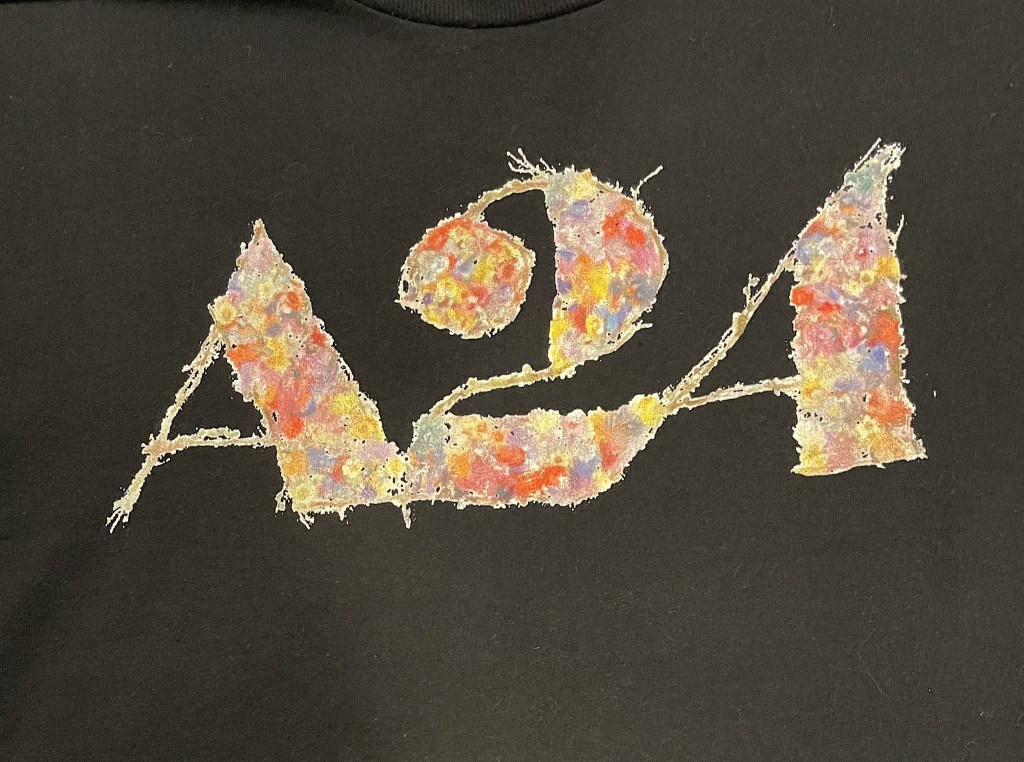
I had the biannual appointment with my primary care physician the other day, and I came away thinking how cool he is. After prattle about my prostate, gab about my gall bladder, and talk of a tetanus booster, he eyed my t-shirt and said, “That’s a great studio.” I had to look down to remember I was wearing my A24 shirt that looks like this:
A24, if you’re wondering, is the hot indie film distributor right now. The boutique shop — which (shockingly) scored a Best Picture Oscar this year with “Everything Everywhere All At Once” — is a mighty machine, celebrating 11 years in the biz with brazen and peculiar taste. Ambitiously art-oriented, A24 pushes cult films that garner lavish critical kudos and discerning viewing audiences.
Movies like: “Ex Machina,” “Midsommar,” “Hereditary,” “Uncut Gems,” “The Tragedy of Macbeth,” “Aftersun,” “The Florida Project,” “Talk to Me” and more.
And TV shows like: “Euphoria,” “Beef,” “The Idol,” “Ramy,” “Irma Vep,” “Ziwe” and more.
The good doc and I fell into a spontaneous groove, both of us animated by the splendor that is A24. We agreed that the ending of “The Witch” was spectacular and the ending of “Midsommar” sputtered.
His favorite A24 movie is “The Lighthouse,” with Robert Pattinson and Willem Dafoe, and he loves “The Whale,” which snagged Brendan Fraser a Best Actor Oscar. I told him I like “The Witch” more than the mind-boink of “The Lighthouse,” both films directed by visionary wunderkind Robert Eggers. He was okay with that. He just nodded, knowingly.
So, yeah, A24 is badass. Dr. So and So digs it. I dig it. But I guess the point is me and my professional — a guy who actually used a stethoscope on me — forged a small connection. Everyone likes movies, and most everyone can chat them up. This, however, was specific, downright micro. It was like talking about a tiny kebab kiosk in the slimmest side streets of Istanbul that only the savviest tourist would know about.
And then reality barged in. Suddenly, the nurse entered and jabbed me with a tetanus shot, and my fellow A24 fan was gone, vanished in the weird smelling ether of the doctor’s office.
Fade to black. Roll credits. We’ll always have “The Witch.”
1. Even through my teens, my two grandmas, bless their long-dead hearts, called me Chrissy, and I didn’t mind a bit (unless it was in front of my friends, then I turned a scorching shade of fuck me). Today, one of my best friends, an unassailable lady in Texas, occasionally calls me Chrissy or even Chrissy Poo in endearing texts. Born Christopher, I’ve always gone by Chris, but that’s a unisex name, and for those of you with monikers like Jamie, Terry, Jessie, Charlie, etc., you know it can get sticky. Sometimes at my newspaper gigs, I’d get hate mail addressed “Dear Sir or Madam.” But that was rare. Readers could pretty much tell I was a guy, because my reviews often had an acid tang, a little banner that said: dick. Two of my favorite names for girls are Samantha and Alexis, which of course become Sam and Alex. I almost named a pet rat Samantha. When my sister-in-law calls the dog my way, she’ll chirp, “Go see Chrissy!” I don’t blush. I kind of like it. If it’s good enough for old Cubby, it’s good enough for me.
2.If I got a bunch of dogs, these are some of the names I would give them: Bongo, Mamet, Alvy, Corn Pop, Gatsby, Heddy, Akira, Brando, Phoebe, Takeshi, Willa, Uncle Johnny, J.D. and, my favorite, Kaboom. I don’t think a single one of the dogs would be pleased with me. Too bad. That’s just for starters. (Growing up we had a little black poodle named Itai, which is Japanese for “ouch.” Just think how he felt.)
Corn Pop and Bongo going at it.
3.I just retired my 2-year-old Apple AirPods — the first generation earbuds that pop out of your head when you sneeze — and replaced them with snuggier AirPods Pro: 2nd Generation, and I made a vital sonic discovery. It’s one that many of you probably already know (this Luddite lags in the world of aural ecstasy). And that’s that the pods furnish remarkablybetter sound quality when used for movies and videos than plain Apple Music tunes. I do my listening on a MacBook Air, be it music, podcasts, YouTube or films. I’ve watched three movies with the new pods (including the enthralling if baffling “Arrival,” a film that pushes me even closer to hating sci-fi) and the audio excellence — sumptuous, immersive, surround-soundy — has me giddy. Even a 1950s Billy Wilder flick cranked out sound like I was in a fine, classic movie theater that actually gave a spit about its presentation. Power to the pods.
4.I once worked with a masterly, natural-born writer named Michael Corcoran, who was the newsroom’s resident curmudgeon, bristling maverick and trenchant culture critic. Now retired, the award-winning scribe, who’s also a friend, maintains a beguiling blog whose lead entry is as incisive as it is infamous, a biting takedown of his hometown Austin, TX, titled “Welcome to Mediocre, Texas.”
“Only the mediocre are always at their best, someone said, which could be why Austin is so damn proud of itself,” Corcoran begins, and continues:
“There are two cities in the U.S. that truly matter: New York and L.A. Everywhere else is bullshit. Austin is cool and fun and artistic and — most importantly, easy — but that doesn’t make it a great city. The things that make a town a city — rapid transit, a great art museum, Chinatown, pro sports — Austin is without. We’ve got L.A.’s traffic, but no one who can greenlight a project bigger than a Chili’s commercial.”
Read the full rant HERE, especially if you’re reflexively enamored with Central Texas’ ego-tropolis, which a visitor I know once compared to Sacramento and Stockton.
1.One of my least favorite things in the world, after e-scooters and ravers, is sweating. Which means I am not a happy fellow. Why? Right. Because I am sweating. And rather a lot, swamp-ass and all. Somehow I thought it’d be a swell idea to take a brisk walk in the 92-degree blech of midsummer. The light sweat I produced outside — a mere film — quickly metastasized into a profuse drenching once inside. Forty minutes later, in powerful AC, it has yet to subside. How bad is it? The dog is licking me avidly, like I’m a giant piece of beef jerky.
2.House of Terror — how kicky is that for the name of a major tourist attraction? It’s real, and it’s not a ride at your local carnival. This daunting museum is in Budapest, where I head this fall, and it isn’t about ghouls and goblins. Or, well, it sort of is. Per its description: “It contains exhibits related to the fascist and communist regimes in 20th-century Hungary and is also a memorial to the victims of these regimes, including those detained, interrogated, tortured or killed in the building.” History writ large. And horrible. I’m so there, with solemn intentions, despite the thrilling name.
3.Just finished Paul Harding’s newish novel “This Other Eden” on the dazzling strength of his first book, the 2009 Pulitzer Prize-winning “Tinkers,” which is uniquely mesmerizing. “Eden” limns Black American history in its many facets, including, troublingly, eugenics. Harding is an uncompromising stylist, forging gorgeous, gem-cut prose that’s sometimes too infatuated with itself, yet nevertheless tells a fascinating story. Harding writes like few others — Cormac McCarthy and Faulkner come to mind — but he can stumble on his own lush verbiage. He is a flawed master.
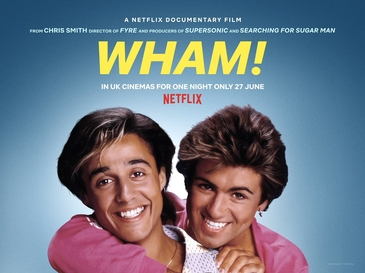
4.The new documentary about massive but short-lived Brit pop duo Wham! — aptly titled “Wham!” — is out on Netflix, and the trailer promises a bubbly, bubblegummy, bing-bang time (“Wake Me Up Before You Go-Go,” anyone?). The movie, a giddy romp directed by crack documentarian Chris Smith, isn’t, alas, as brawny as frontman George Michael’s uncrackable Aqua Net helmet. It’s strictly for googly-eyed fans who can’t be bothered with pop music history, laser-focusing on bandmates’ Michael and Andrew Ridgeley’s frolicsome BFF status and their improbable rise from cheesy teen wannabes to slick arena-fillers. Critically missing in this narrow nostalgia trip is cultural context, as if Wham! exploded in an ‘80s vacuum, with little competition and no help from juggernauts like MTV. And it doesn’t even footnote Michael’s untimely, and seismic, death as a solo artist. Wham! Bam! Thud.
5. Speaking of the dog (see #1), Cubby was recently shorn like a poor gray sheep, which I documented here. The good news: his hair is growing back in the summer swelter. He no longer resembles a fuzzy Pringles can — he’s not so tubular — and he’s stopped nipping the parts that were so short, pink flesh was exposed. He’s returning to his bushy self, and his attitude is boinging back — a little cocky, vain with a scruffy bedhead sheen, and as fierce around the UPS folk as one can be behind a closed door. His yawps and barks still shatter glassware, but that’s OK. Pretty soon he’s going to look like Slash again and the process will start all over. Our little lamb chop.
6.Then there’s this: I was strolling in the summer heat (see #1 again) and some shitty beat-up compact sedan roared past me, easily doing 50 to 60 in a residential 25 zone. Startled (and pissed), I yelled, “Slow down!” The driver flipped me off and I reflexively returned the gesture. He barreled into oblivion. Then I thought: Smart. That’s a good way to get yourself killed. Jackass might have a gun, might want to turn around and use it. Sweating like a madman, I kept walking, ruffled, looking at the world in a slightly different shade.
Sometimes when the days are slow and long and hot, I can just sort of geek-out and ponder random things related to my passions. Welcome to today, in which I spent a preposterous amount of time ticking off some of my favorite films that have one-word titles, from “Casablanca,” to “Goodfellas.”
It was a pointless exercise — massively pointless — but it was fun jogging my memory and eventually putting down a litany of terse titles, which always seem a bit more evocative than longer titles. As a lark, I chose 50 great films almost entirely off the top of my pointy head, and present them here in no order whatsoever. (Now it’s your turn.)
There are many more — “Bullitt,” “Contempt,” “Up,” “Repulsion,” “Gaslight,” “Slacker,” “Clueless,” “Thief,” “Locke” — but I wanted to keep the list at a tidy 50. I’d be here till Labor Day if I rounded up all the great single-title movies. But feel free to share your own.
You’ll notice I’ve made some glaring omissions of highly acclaimed films that simply don’t astonish me, and sometimes even rankle: “Fargo,” “Gladiator,” “Vertigo,” “Unforgiven,” “Zodiac” and “Casino.” Argue with me all you want, please.
Today was a two-errand day. I was picking up a modern classic potboiler at the library — the one about a ginormous great white shark that terrorizes the bejesus out of a New England beach town — and I was getting my periodic pedicure at the salon. I dubbed the day “ ‘Jaws’ and claws” to amuse myself. (Mission accomplished.)
The book I got really is “Jaws,” Peter Benchley’s 1974 blockbuster that spawned Spielberg’s famous film and a million petrified beachgoers around the world. As a kid, I lived in beachy Santa Barbara when both were released, and I fantasized about flesh-shredding teeth and ominous dorsal fins to unhealthy degrees. It terrified me, and I loved it.
First I worshipped the movie, which I saw at age 7, then I snatched my parents’ mass market paperback of Benchley’s novel and gobbled it up at age 8. I savored those pages, slashing with vivid, violent writing that helped turn me onto reading for a lifetime.
I still own that cracked, yellowed paperback, but it’s packed away with other mementos. So, on a whim, I hit the library up for its copy. I quickly located some of my favorite passages, ones that haunted — and excited — me as a young reader.
Just like my own copy
Can you handle it? This horrifying scene is from the opening of the book, when a young woman — recall her from the movie — takes a skinny-dip in the moon-dappled ocean.
“The fish smelled her now, and the vibrations — erratic and sharp — signaled distress. The fish began to circle close to the surface. Its dorsal fin broke water, and its tail, thrashing back and forth, cut the glassy surface with a hiss. …
“At first, the woman thought she had snagged her leg on a rock or a piece of floating wood. There was no initial pain, only one violent tug on her right leg. She reached down to touch her foot, treading water with her left leg to keep her head up, feeling in the blackness with her left hand.
“She could not find her foot. She reached higher on her leg. Her groping fingers found a nub of bone and tattered flesh. She knew that the warm, pulsing flow over her fingers in the chill water was her own blood. Pain and panic struck together. The woman threw her head back and screamed a guttural cry of terror.
“This time the fish attacked from below. It hurtled up under the woman, jaws agape. The great conical head struck her like a locomotive, knocking her up out of the water. The jaws snapped shut around her torso, crushing bones and flesh and organs into a jelly.”
Now, as a young boy, this was about as stupendously visceral as prose could get. (And I omitted the rest of the violence for reasons of taste and space.) “A nub of bone and tattered flesh” — I reread that line over and over, shocked, thrilled, gobsmacked.
Even today, these opening pages stun. Getting the book at the library, I was hoping Benchley’s eloquence would strike me again, and it did. That’s why I shared some here.
Call him a hack or a mercenary, but you’d be wrong. Benchley’s a savvy craftsman, expert at tension and thrills, not to mention a vibrant stylist with a painterly (think Francis Bacon) flair. His humans, from Quint to Brody, pop off the page even if the world he confects for them occasionally brushes pulp.
I’m not going to reread the entire novel, which is remarkably short at 278 pages, but it was fun revisiting a book that so influenced my cultural life.
Why “Jaws,” why now? Well, I’m reading an excellent new book about the history of Hollywood and the Academy Awards called “Oscar Wars,” and I’m deep in the chapter focusing on the making of “Jaws” (as well as “Barry Lyndon,” “Dog Day Afternoon,” “One Flew Over the Cuckoo’s Nest” and “Nashville” — 1975 was a hell of a year in American film.)
The lore is notorious: Making the movie “Jaws” was a prolonged ordeal and near-disaster for all involved, including a 26-year-old Steven Spielberg, who was sure his nascent career was finished. We know how that turned out.
If the movie “Jaws” remains one of my all-time favorites — in a crowded field that includes “Heat,” “All About Eve,” “Sweet Smell of Success,” “Manhattan,” “City Lights,” “Seven Samurai,” “Duck Soup” and on and on — the novel “Jaws” is more of a sentimental gem. It’s dear to my heart for reasons that go beyond art. On a nostalgic level, it has — yes, I’ll say it — sunk its teeth in me. And it won’t let go.
In my 30s, a pair of well-meaning coworkers nominated me for a title in a big-city glossy magazine that makes me blush even as I type this so many years later.
The magazine was a strenuously vapid thing, slathered in food and lifestyle pap, all of it mawkishly upbeat. To attract page after Technicolor page of blaring ad copy, it was shamelessly obsessed with ratings and lists: Best Barbecue! Best Campsites! Best Burgers! Best Places to Get Off!
City magazines with ample ad revenue are like that. They traffic in pretty pictures of manicured affluence, catering to the beauty-salon and doctor’s office crowds. Without being trendy themselves — they are woefully unhip — they try to manufacture trends. Only dingbats actually pay money for the periodical, which is so cloying, you could barf.
That said, I admit up front that I participated in this paragon of sub-journalism. My coworkers nominated me for one of those knuckleheaded lists: the city’s Most Eligible Bachelors. I was flattered. I was humbled. I was mortified.
The magazine editor phoned me for a preliminary interview. And I blurted: no. I rejected the nomination. It was way out of my comfort zone. I wasn’t so desperate for a date. And this introvert definitely didn’t need the exposure, my bewildered mug spread next to an ad for the hottest tanning salon or 40 sparkly, smiley real estate agents.
I thanked my deflated pod-mates, the lovely Sarah and Sharon, and also apologized. I was being ungracious, but I didn’t have the stomach for it.
My dis was apparently a big deal. Friends expressed dismay. My disappointed mother scolded me like I was eight. The topper: Ira Glass of “This American Life” called for a possible segment — man turns down most eligible bachelor nomination, how zany is that? — that, fortunately, never panned out.
And yet, I’m only human.
Forward a year: Same routine, but this time, for better or worse, I caved. I did it. I’m not sure why. I was strafed by anxiety. But I thought, what the hell, man up.
During the in-office interview with the editor, I explained my job (movie critic, which I said wasn’t nearly as glamorous as it’s cracked up to be), noted my hobbies (world travel, books, film, drinks, drums), and things I’m not so crazy about (dancing, reggae). Asked the inevitable question of what I look for in a woman (sigh), I said something like someone bookish, worldly and intellectually curious (what a dope).
This is the story of someone quite bashful scraping himself out of his dark, lonesome shell. A comment the editor solicited for the article from one of my dearest friends, Courtney, included these bits: “His eccentricities are very endearing … Once he lets you in, you discover a kind-hearted soul.”
Yeah. That might be a bit much. But there I was in this glossy magazine with nine other “most eligible bachelors,” practically shaking in my boots with self-consciousness. Each of us filled a full color page, with no ads. In the photo, my head is enormous.
The issue hit the stands (and the beauty salons and doctors’ offices) and I braced for the worst. But instead: crickets. No one called, emailed, berated me, ridiculed me, asked me on a date, nothing. Disappointment? No, massive relief.
I guess the moral of this tale is to get out of your self-defined — and in my case, distinctly neurotic — safe zones and take a chance on something new, even alien. I ate a whole cobra in Vietnam and got detained by Hezbollah in Beirut. A cheesy little spread in a city magazine is comparably nothing. Really. Nothing.
Take a risk. It might be gut-wrenching. It might be exhilarating. Or it might be … crickets.