A Motörhead memory, small but indelible

Fresh in my teens, I went to a tiny club in Berkeley, Ca., to see legendary heavy metal band Motörhead — a trio of hirsute dirtbags that rocked with the subtlety of a meat grinder.

I was a Motörhead newbie, green, callow, had only heard the raunch ’n’ rollers for the first time barely a year earlier. My deflowering was “Iron Fist,” Motörhead’s fifth record. It practically castrated me. 

There I was, surely the youngest fan, along with my friends, in the closet-size club, a bit nervous amidst the cramped crowd of big, gnarly headbangers, scary-looking dudes with hippie hair and satanic glares. We kind of pressed ourselves against a back wall waiting for the show to start, innocents among animals. 

And then something wild happened. Who did I see playing pinball on a rusty old machine but Motörhead bassist and lead singer Lemmy. The only person with him was a leggy blonde straight out of Playboy.

Now, Lemmy was a formidable, even fearsome presence, especially to a sheepish fanboy from the burbs. An icon of British metal, the towering singer seemed to have stepped out of central casting as a skull-crunching rocker, a road-worn biker from “Mad Max,” or a snaggletoothed pirate: leather jacket, black skin-tight jeans, bullet belt, cowboy boots, long greasy hair and scraggly muttonchops that hardly concealed two marble-size moles that many mistook for huge warts. 

Lemmy drank and smoked fiendishly, and it would eventually kill him. His voice was a burnt-to-a-crisp croak. He didn’t play his bass, he mauled it, strumming it violently like a guitar, making the bulk of the distorted noise the band produced. One of their albums is titled “Everything Louder Than Everyone Else.” An understatement, and a promise. 

(Incidentally, see the 2010 documentary, “Lemmy: 49% Motherfucker. 51% Son of a Bitch.”) 

Excited and wide-eyed, I wondered what Lemmy was doing out there and not backstage committing all things illegal and squalid. Giddy dorks, my friends and I tried to figure what to do. Soon enough, I was the one who screwed up the courage to approach him.

So I went. And I, gulp, asked for his autograph.

He glanced down at me and, gruff, calm, unsmiling, said, “This is my time.” His voice was a gravel road of unknowable debauchery and spilled Jack Daniel’s. “See me after the show,” he added, a nice touch even if it was just a sop.

This is not why some rock stars suck. This is why some rock stars rule.

Chastened but exhilarated, I returned to my friends who asked what happened. Their faces read awe and disappointment. The girl out of Playboy snickered. 

Nightclub shows like that, with three bands on the bill, and a late start time for the headliners, round midnight, meant we couldn’t really hang out afterward and hope Lemmy would be waiting with a Sharpie to sign an autograph. It was a wash and I knew it. Still, I had exchanged a few words with the man himself.

The show itself is a blur now, though the set list is archived online. (I cannot believe they didn’t play “Ace of Spades,” the band’s signature song.) But that encounter with Lemmy is branded in my brain. “This is my time.” I can still hear it in Lemmy’s smoke-charred voice, and it’s beautiful. Like watching a molten volcano, or surviving a shark attack.

Motorhead. That’s Lemmy on the right.

Metallic memories

I was 14 the first time I saw Metallica in concert. It was 1983 in a tiny nightclub called the Keystone Berkeley, in Berkeley, California, in the San Francisco Bay Area, where Metallica was formed and where its members still reside. The club, a bona fide hole, was famous for showcasing the Grateful Dead in its heyday. I won’t mention that again.

Metallica was plumping its debut album, the indie-label thrash classic “Kill ‘Em All,” and was sandwiched on a bill between locals Exodus and headliner Raven, a so-so British metal act with a singer that shrieked like a banshee, screeching songs like “Hell Patrol” on an album called (sigh) “Rock Until You Drop.” (After Metallica’s epic, local-heroes set, Raven finally hit the stage at 1 a.m., well past my bedtime. We split.)

Before they went on, the four members of Metallica hung out in the clammy, smoke-swirled venue, drinking beer and flirting with female fans. I snapped a few pictures of the band, using a now-obsolete Vivitar pocket camera with a 110 film cartridge and a mighty flash. I’m sure they were thrilled.

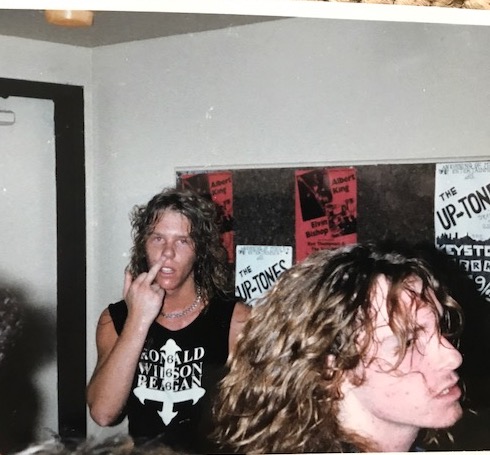
Here’s singer-guitarist James Hetfield and drummer Lars Ulrich:

IMG_0768.JPG
James Hetfield and friend.


LARS.JPG
Drummer Lars Ulrich, making silly to the kid with the camera.

What’s nuts is how young they were, how young we all were. Hetfield and Ulrich are five years older than me, making them 19 or 20 at this show. Hetfield still had zits. Ulrich, at 5-feet-6-inches, looked like a little kid. And yet, though we didn’t know it then, despite the universal excitement over their first record (and we’re talking vinyl record), these guys were about to break big, over the decades becoming one of the most significant arena rock bands of its time. (Hetfield’s reported net worth today: $300 million. Back then: $21.50 and a scuffed skateboard.)

I have more of a visual than aural memory of the concert, but it’s safe to say Metallica mostly played songs from the 10-track “Kill ‘Em All” — “The Four Horsemen,” “Seek & Destroy,” “Whiplash” — plus their usual encore of Diamond Head’s catchy “Am I Evil?,” which was a huge influence on Ulrich.

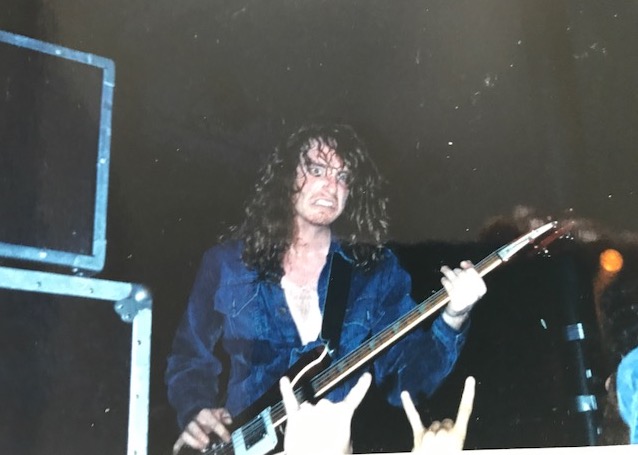
It was, of course, a sweaty, head-banging affair, the lip of the micro stage a crush of raging, testosteronic catharsis. The band matched the fury, hair-lash for hair-lash, so much so that teeth-gnashing bassist Cliff Burton was taken off stage for a lengthy breather. The rumor was that he almost passed out. It was that kind of show.

IMG_0764.JPG
Cliff Burton in one of his better moods.


IMG_0766.JPG
A mid-set break backstage. Hetfield gives me the peace sign up his nostril and Burton relaxes as best he can. Burton was killed three years later in a tour-bus accident.

In a six degrees of Metallica trip, I eventually learned that Ulrich and I shared the same drum teacher, an affable, infinitely tolerant 25-year-old named Jeff Campitelli, who also happens to be a spectacular musician. (In 2008, Rolling Stone named him one of the 50 best drummers.) To Jeff’s dismay, neither Ulrich or I knew the drum rudiments, which, says one pro, “are the building blocks for every drum beat, fill, or pattern that you could ever play.” We were not highly evolved drummers.

At the time, Jeff was in a Bay Area pop trio called The Squares, whose guitarist was none other than Joe Satriani, who has, of course, gone on to guitar-hero megastardom. Among other big-time gigs, Campitelli still plays with Satriani, whose former guitar pupils include Charlie Hunter, Steve Vai and a fellow named Kirk Hammett. 

Hammett, you may know, plays the axe for a little band called … Metallica.