No baloney about Bologna

Strolling and gawking among the glass-encased medical curiosities, from a face smothered in smallpox pustules to deformed conjoined twins, I was thinking of tortellini. Specifically, tortellini in brodo, stuffed pasta curls boiled and served in a zesty meat broth. Dinner. Yes. That’s what I was thinking.

I was at the Museo delle Cere Anatomiche — the anatomical museum — in Bologna, Italy, last week, and not even the bulging tumors and gleeful spreads of glistening guts could suppress my appetite for the city’s star cuisine. 

Tortellini in all its shapes and sizes, broths and sauces, is but one of the celebrated dishes in Bologna, which is renowned as Italy’s rightful food capital, or “La Grassa,” the well-fed or, more directly, the tubby. It’s one of the reasons I chose to go there. That and twisted, amputated limbs.

And, well, pasta bolognese. And Parmesan. And the world’s finest balsamic vinegar. And, naturally, Mortadella, which would almost pass as American baloney (Bologna, baloney — you see?) if it weren’t for the spots of white fat that marbles the Italian variety, as well as the way it’s sliced, paper-thin, like prosciutto. Oscar Mayer can only weep in shame.

Tortellini in brodo. Pasta ‘bellybuttons’ swimming in hearty meat broth.

It was a foodie trip, based in the region of Emilia-Romagna in northern Italy. The area’s medieval capital of Bologna is the seventh most populous city in Italy, and a mere thirty-minute train from Florence. The region boasts the city of Parma, known for Parmesan cheese and Parma ham, as well as the headquarters for such auto royalty as Ferrari and Lamborghini.

But sports cars don’t impress me — they’re like appliances, refrigerators or blenders, no matter if they’re painted a neon-pee yellow and can go 200 mph. So I skipped them for Modena, a small city (that has a Ferrari museum) best known for opera and balsamic vinegar (and, OK, Ferrari). 

The ancient, rustic region is where I booked a long lunch and balsamic “experience” that happened to take place deep in the wintry countryside on a sprawling family estate where mom, dad, son, daughter and cousin each produce their own balsamic vinegars, totally artisanal, completely blue ribbon. To reach the marketplace, a balsamic must be officially approved in strict quality control tastings by experts. These folks pass with a neat, and humble, familial pride. 

I was with a genial group of about ten fellow travelers. We feasted. Salumi (a spread of Italian deli meats), Parmesan of various ages, ricotta, risotto, quiche and more. We drizzled homemade, world-class balsamic on all of it. There was wine, too. Stuffed, we easily got our money’s worth (about $90). A long, edifying tour of the balsamic-making process — like wine, it’s made of grapes — preceded the pig-out. Ask me about the thick, tangy, reddish-brown liquid and I could likely answer with cocky erudition. 

Back to the university town of Bologna — it was more than I expected. My hotel was a twenty-second lope to the main city square, the yawning Piazza Maggiore, the kind of history-encrusted space that has you marveling as you sip a beer at a sidewalk cafe. 

The centerpiece is the Basilica of San Petronio, a stunning slab of Italian Gothic whose construction began in 1390 (the facade remains unfinished, the slackers). I can do a full-blown travelogue here, but we know how that goes — like listening to someone carry on about their “crazy” dream last night. Really, it was mostly about the food, and a breathtaking cocktail bar, Le Stanze Càfe, designed with real ancient frescoes, where I had lovely libations as I drank in the dazzling decor. 

I will say the anatomical museum, filled with miserable disease and morbid delights, created specifically for university medical students (yet it’s free for anyone), was a highlight of my stay. Human anomalies, freak shows, mystifying medical malformations, the two-headed, the three-legged, the Elephant Man fascinate me. It’s not amusing; generally it’s appalling. But curiosity is piqued, wonder is conjured, pathos pours forth. I kind of love it.

Thing is, I might love tortellini more.

Meat and cheese plate during a food tour in Bologna. That’s Mortadella on the left.

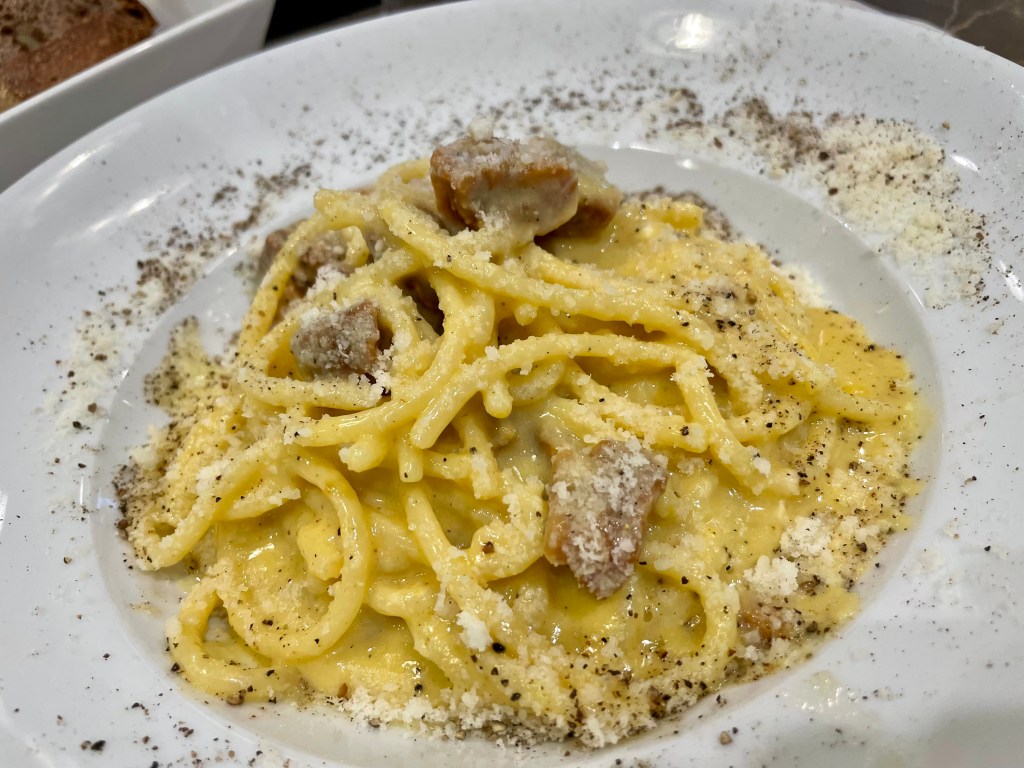
Pasta bolognese, a signature dish in Bologna. Noodles topped with beef, pork, wine, carrots, etc. Dynamite.

At the anatomical museum. Don’t worry. They’re made of wax.

A flaneur in Florence

The frivolities in my life are legion, but travel isn’t one of them, despite how trivial a far-flung journey might seem — or ultimately be. (Most trips soar. Some sink.) 

In three weeks I head to Florence, Italy. Though I’ve been there twice, the last visit was in the Paleolithic Age. I wanted something mellow, somewhat familiar, distinctly European, with lots of marble, museums, manicotti, and mustaches on both men and women.

The city is a cornucopia of artistic abundance: Michelangelo’s David; Donatello’s bittier David; the Uffizi, that Renaissance eruption of Botticelli to da Vinci; Ghiberti’s bronze doors; Brunelleschi’s dome; the locals’ luxuriant facial hair.

I was last in Italy in March 2022, ferrying between Rome and Naples, the latter a bracing revelation, rough-hewn and bristling with a singular urban snap. As novelties go — serpentine side streets, graffiti, killer Neapolitan pizza — it sort of kicked Rome’s ass. In July I swanned to beautiful Buenos Aires. In October, magical Madrid.

Florence seemed like a good middle-ground — encrusted in a glorious past but not overly exotic; grand but not overwhelmingly vast. It’s not like going to jostling Taipei, say, or sunbaked Algeria, which I hear is majestic. Yet Forbes did name Florence the most beautiful city in the world in 2010.

No, this would be a week luxuriating in western art, architecture, food, drink, scenery, inhaling the rarefied air of undiluted enchantment. I imagine me a self-styled flaneur, strolling the cobblestones, gilded walking stick in one hand, tipping my top hat to passersby with the other. And then I snap out of it and pinch the bridge of my nose.

Florence is not massive. So I’m making at least one day trip to Central Tuscany, namely Siena and San Gimignano, medieval towns cluttered with Gothic architecture and honeycombed with history. The region is also a wellspring of Chianti, and tippling some of the red elixir from the source is essential.

I have made five restaurant reservations in Florence, from a traditional trattoria to a Michelin-star bistro. I will eat pasta and pizza and exist — and subsist — a bit like Stanley Tucci, without the bald pate and skinny chinos (but with the dashing scarf). I might also employ a larger vocabulary of superlatives than just, “This is so good” when I taste something delicious.

And though Tucci meets up, and hams it up, with lots of local hosts, he makes it appear he is his own man, ambling the streets of Italy, the stylish flaneur (that word again), when really, of course, he’s accompanied by a small battalion of producers and technicians taping him all the way.  

If life were only like that. I travel solo most of the time, by choice. But once in a while it might be nice to have a crew of professional sycophants at your beck and call, filming you, powdering your nose, providing the background about everyone you’re about to meet and everywhere you’re about to go so you appear super smart and amply informed. 

I do what I can. I read books, watch Tucci and Bourdain, comb the net, view movies. In the end, I’m still alone, tramping about the glittering city, whose promise is assured. I think that’s pretty cool. And I think that’s quite enough.  

Italy finito, beautifully

As I write this, 35,000 feet in the sky on a jet back to the States from nine fine days in Italy, I’m swollen with that cruddy reverse homesickness in which you miss the place you visited instead of your actual home. Rome and Naples were wonderful and I wasn’t ready to leave and I wanna go back. I’ve got the home-bound blues.

Still, my last rueful day in Rome was brilliant, quite literally — balmy mid-60s, cloudless, cerulean skies, sunglass weather. The kind of conditions that make people dress way too skimpily for the actual temperature. I was perfect in jeans, a light jacket and t-shirt. The guy in the short-shorts and tank top, not so much. 

Especially if he wanted to get into the Pantheon, the almost 2,000-year-old Roman temple turned Catholic church, where modest dress is a must. Leaders, popes and artists, including Raphael, are buried in the cylindrical building, which is famous for its oculus (or big hole) at the tip of its dome, shooting down a thick beam of sunlight like a celestial Bat-Signal.

Our lovely tour guide in Naples told us he gets chills whenever he enters the shrine. I did not get chills, but I was aptly awed by the ambient beauty and unimaginable feats of engineering. So often in Italy, if you regard your surroundings for just a moment, astonishment floods in and you wonder what hit you. It’s called the sublime.

I didn’t care if I found it or not, but fate planted an unmistakable sign in front of me — a literal street sign — so I ambled over to the vacantly majestic Trevi Fountain, where mugging selfie dolts and preening sun-worshippers congregate on days like this, as if Nicola Salvi’s pompous 1735 fountain is a swimming pool or the beach and not just a glorious repository for Bernini-style sculpture. I do respect this extravagant splash machine, but it’s a brief pitstop, not a gawk spot, despite its iconic role in Fellini’s “La Dolce Vita,” a personal favorite. 

A local beer, a prosciutto and mozzarella sandwich, and a cappuccino later, I headed to the Vatican for a guided tour of the Vatican Museum, a riot of artistic riches. Our tour guide barely made it on time, and my mood was starting to curdle. But she materialized at last, a petite Italian who used a plush Woodstock doll dangling from a stick in lieu of the boring old tourist-group flag for us to follow amid the crushing, claustrophobic crowds (many of them terrible teenagers, lolling, laughing and leering). 

She gave each of us little radios with ear buds so we could hear her literate narration of highlights in the museum. But the contraptions were on the fritz, all buzz, fizz and crackle — sonic flatulence that drowned out her spiels about each grand piece of art, from writhing statues of men and lions and Raphael’s “The School of Athens,” to the visual commotion of Michelangelo’s peerless Sistine Chapel ceiling. The works spoke for themselves.

As we finished, I asked the guide for the nearest taxi line, and she warned me to be careful with them, that they quote outlandish prices and don’t use the meter. And so it was. I approached a driver and told him my address and he promptly said it would cost 40 euros because of, you know, that zany Tuesday traffic. I scoffed and said, “You’re crazy,” and he responded, “You’re crazy.” Genius.

I hailed a passing cab, got in, and paid 14 euros back to my hotel, where I wound down, went out and ate pasta, sipped wine, and, reflecting on the past nine days, sighed: perfetto. Which in English translates simply as: damn