9 best films of 2019 (so far)

In no particular order, the movies I’m excited about at the year’s half-way point …
Climax-Banner.jpg

“Climax”

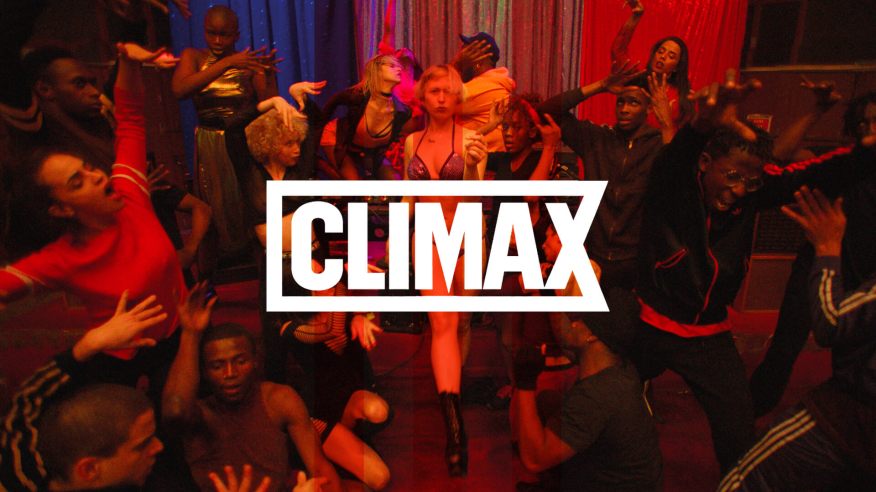
Puckishly sadistic, Gaspar Noé and Lars von Trier remain cinema’s great pessimists, glib nihilists and gleeful provocateurs. Look, without flinching, at Noé’s masterwork “Irréversible” or von Trier’s “Antichrist” and you’ll see my point. With the head-spinning, hallucinogenic swirl of body (and camera) movement that is “Climax,” Noé takes his visual and thematic tics past the edge of woozy chaos. When an extraordinarily talented dance troupe’s party is ruined by a bowl of LSD-spiked punch, hell uncorks with fury. What was a glorious pageant of writhing bodies becomes a descent into a violent nightmare of screeching, thrashing individuals trying to relocate reality. The camera rides a liquid wave of neon hues, racing and corkscrewing down halls and weaving through rooms. Frequently indulgent and meandering, with no real characters or story, just sensation and electro-shock, the film is pure immersion, a sustained climax. I didn’t say it was pleasant. But it is novel, and queerly riveting. And purely Noé. Watch the trailer HERE.

last_black_man_in_san_francisco_ver3.jpg

“The Last Black Man in San Francisco”

At once arty, elegiac, poetic and tough-minded, this is a tale, a beautiful reverie, that strikes on topics of race and class and gentrification with sparks and lyricism and primary-color Spike Lee sizzle. It’s something singular, and it slowly intoxicates with its emotional and sociological depths. Following Jimmie Fails (played by the actor of the same name — he’s as charismatic as a young Don Cheadle) as he presses to reclaim the giant Victorian home of his grandfather, the film is both a call to honoring blood bonds and a plaintive hymn to a troubled city. Joe Talbot directs (and co-writes) with soaring vision and intense feeling. The result is dire, daring, dreamy. Trailer HERE.

honeyland.jpg

“Honeyland”

In this gorgeously observational documentary, weathered, middle-aged Hatidze lives in the rocky Macedonian mountains, where she cares for her ailing mother and tends to several beehives that produce honey for a tenuous livelihood. A large, rowdy family moves next door and decides to try beekeeping, but without expertise, they flail and almost comically get stung more than they harvest the sweet goo. Tensions arise between the neighbors, but this achingly humanistic look at an exotic if seriously impoverished way of life is mostly a portrait of Hatidze, a steely, lonely woman who has as much soul as those mountains can contain. The doc won a record three awards at Sundance 2019, including for its ravishing cinematography. Trailer HERE.

mustang.jpg

“The Mustang”

Breaking a horse is a bitch. Triple the challenge if it’s a rearing, snorting wild desert mustang. That’s what Roman (Matthias Schoenaerts) is tasked with as a violent criminal in a Nevada prison program in which convicts break mustangs for auction, preparing them for work in law enforcement. “We’re not training these horses for little kids’ birthdays and pony rides,” growls Bruce Dern’s crusty bossman, who knows both man and horse require an especially prickly strain of tough-love. If Laure de Clermont-Tonnerre’s feature debut falls into a formulaic groove — the apex of the depiction of trust-building between human and wild horse remains Carroll Ballard’s 1979 “The Black Stallion” — the film doesn’t flinch from gritty, violent twists. The dangerous dance between Roman and his horse Marcus retains tension, as the two captives, both scrappy and obstinate, circle each other in a face-off that could end in injury and defeat, or mutual respect and friendship. Roman’s frustration boils — “Just fucking listen to me!” he snaps. “I’m not going to hurt you! You hear me, you stupid animal!” — and it’s no surprise the horse is listening. Trailer HERE.

her smell.jpg

“Her Smell”

Elisabeth Moss’ performance in this shambolic punk-rock portrait is as athletically interior as it is exterior, spiked with physical fits and spasms like a lunatic child in a druggy tantrum. In my favorite performance of the year, Moss plays Becky, volatile front-woman of a female punk band she’s struggling to keep together between coke binges and flame-throwing hissy fits. The actress stirs up a cackling, hand-flinging cauldron of Courtney Love, Blanche DuBois, Charles Manson and Gena Rowlands in “A Woman Under the Influence.” It’s all raw-nerve, and Moss commits to her anti-heroine in a self-immolating blaze. She’s as shattering as this ballsy, surprisingly sensitive film by writer-director Alex Ross Perry. Trailer HERE.

Booksmart-Movie-2019-900x506.jpg

“Booksmart”

Barreling forth with raunchy vigor and unbridled zest, this breakneck coming-of-age comedy, actress Olivia Wilde’s impressive directorial debut, screams fun. Almost literally: There’s a lot of screaming — in surprise, horror and explosive joy. An amplified spin on school-days greats — “Dazed and Confused,” John Hughes’ oeuvre and last year’s “Lady Bird” and “Eighth Grade” — “Booksmart” piles on twists with a sharp, knowing eye that zooms in on the timely and topical, from female power and LGBTQs, to bullying and the corrosive effects of cliques, and, duh, the liberating if daunting pull of sexual exploration. Starring a terrific Beanie Feldstein and Kaitlyn Dever as boundary-pushing besties, who learn, in a fleeting haze, that maybe bongs are as fun as books. Trailer HERE.
46084844_685873568460655_5249823622087835648_n.jpg

“Gloria Bell”

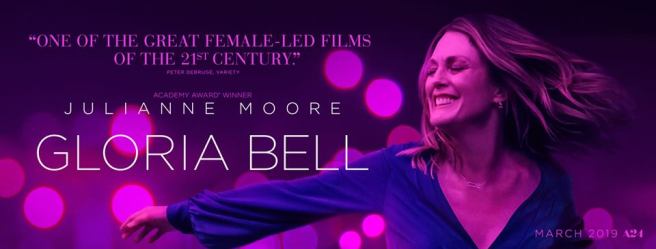
A glowing Julianne Moore — is there a more radiant actress? — assumes the title role in this sweet, ebullient, slightly melancholic snapshot of a middle-aged divorced woman seeking love and connection in modern Los Angeles. A touching remake of the 2013 Chilean film “Gloria,” by the writer-director of that movie, Sebastián Lelio, the movie follows its wise, free-spirited character onto her favorite place, the dance floor, where she finds romance with a nice guy (a fine, empathetic John Turturro) and all the attendant delights, complications and disappointments of love. No matter how sore things get, Gloria’s joie de vivre stays infectious. Trailer HERE.
NON FICTION.jpg

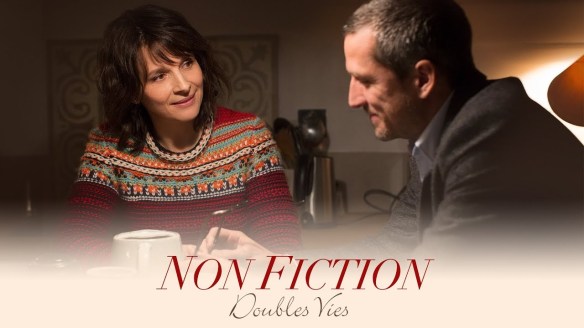
“Non-Fiction”

French writer-director Olivier Assayas‘ dramedy is a tireless, tonic gabfest that had me speed-reading the flurry of subtitles more than drinking in the warm faces and colors of the bustling scenes. That’s no complaint. The profusion of words — intelligent, eloquent, biting — brim with ideas, humor, pain and pathos, for an enveloping artful experience. You want to know the fork-tongued characters, led by an enchanting Juliette Binoche, because of the literary, arty cosmos in which these writers, editors and actors orbit. It’s heady and human: They’re just people, with all of our people-ly problems, and it’s more exciting than you think. Part tart publishing-world satire, part feast of infidelity, part anatomy of midlife crises, “Non-Fiction” is light on plot, more enmeshed in ideas about love and life, loyalty between friends and lovers, and, in a topical concession, a pointed conversation about new media vs. the printed word. It’s like a Gallic Woody Allen comedy, without the tootling clarinet and stammering, gesticulating neuroses. Trailer HERE.

souveneir.jpg

“The Souvenir”

Not an easy film, Joanna Hogg‘s elusive, divisive relationship drama is boobytrapped with qualities that repel people from the arthouse. It’s glacial, elliptical, remote. It makes you work with loosely hanging scenes, a jagged structure and oblique characterizations. I broke a small sweat trying to solder the plot together, identify with the actors and figure out where Hogg was taking me. The entry point is young film student Julie, played with winsome diffidence by Honor Swinton Byrne. Julie’s lover Anthony (Tom Burke) is a heroin addict, a secret until it’s not, which inevitably snarls their relationship. The story is mostly scenes of the couple muddling through their unconventional, occasionally off-putting upper-middle-class affair. With drugs. And spats. And sex. And dinner parties. And the making of a student film. And an IRA bombing. Somehow, Hogg’s disparate elements crazily fall together. Trailer HERE.


The best performance of the year (so far)

Writer-director Alex Ross Perry and actress Elisabeth Moss have a special relationship: He puts her through the wringer and she acts her guts out. 

In two films, this year’s “Her Smell” and 2015’s “Queen of Earth” — deep-dish psychological studies of women flailing and wailing on the verge — the result is explosive symbiosis, a convulsive give and take between a director who lays out a vision and lets his muse run with it at breathtaking velocity. 

p16645992_v_v8_aa

Run she does, maybe too far, too fast (as some have argued). Moss’ performance in “Her Smell” is athletically interior and exterior, jagged with physical fits and spasms like a lunatic child having a druggy temper tantrum. It’s my favorite performance of the year so far. 

Moss plays Becky, volatile front-woman of a female punk band she’s struggling to keep together between coke binges and flame-throwing hissy fits. The actress stirs up a hot, cackling cauldron of Courtney Love, Blanche DuBois, Charles Manson and Gena Rowlands in “A Woman Under the Influence.” It’s all raw-nerve, and Moss commits to her anti-heroine in a self-immolating blaze.

Eyes drizzling mascara, teeth gnashing, arms and hair thrashing, lipstick smeared with a paint-roller, Moss spews apoplectic, apocalyptic poetry in what’s less a performance than a detonation of eye-popping possession. It’s an electric and crazily entertaining one-woman show, the kind Oscar never sees and wouldn’t know what to do with anyhow.

09-elisabeth-moss-her-smell-4

What grabs you is the devotion Moss brings to both Becky in “Her Smell” and the more quietly unhinged, clinically depressed Catherine in “Queen of Earth.” Dramatically different than her more contained, yet reliably strong women in “Mad Men,” “The Handmaid’s Tale” and “Top of the Lake,” these characters are solipsistic, narcissistic, unbalanced, straight-up unwell. 

Director Perry grants them close-up, single-take soliloquies that are so chiseled they avoid becoming indulgent workshop exercises. The camera eye stares Moss down, never letting her off the hook. Moss gives right back. You watch shaken, exhilarated.

It’s important to note Moss isn’t performing in a vacuum, despite the fact the characters, especially punker Becky, would make arresting (abrading?) Off-Broadway solo turns. Both films have slight but linear stories — they are the definition of soul-baring character examinations — populated with superb co-stars, from the bandmates and manager (Eric Stoltz, wonderful to see you) in “Her Smell” to the great, flinty Katherine Waterston as Moss’ increasingly estranged best friend in “Queen of Earth.”

Without other players, Moss’ fascinating creations would just be feral, foundering head cases bouncing off the walls and slipping into oblivion. Her cast-mates keep Becky and Catherine in reality, our world. They are friends and antagonists, yang to Moss’ yin, and they haul her from the edge.

Still, what this formidable actress pulls off on her own, between her and the camera, is remarkable. With scary conviction, she summons wrenching human meltdowns in all their grim and glorious beauty.

images

“Her Smell” and “Queen of Earth” are on DVD and several streaming outlets. 

“Her Smell” trailer HERE.

“Queen of Earth” trailer HERE.

Defending the unsung thrill of ‘Miami Vice’

It came on TV, caught my eye, and had me entranced all over again. 

Michael Mann’s virtuoso 2006 crime drama “Miami Vice,” streaming on Netflix, will hook you hard — that is, if you connect with the under-appreciated film. I do — I gave it four stars in my original review in a large daily newspaper — and I stand by it, despite a host of haters who can’t see masterly filmmaking for Colin Farrell’s facial stubble.

So I come to defend “Miami Vice.” Major publications — Rolling Stone, Entertainment Weekly, The Boston Globe, Variety — praised the film, with New York Times critic Manohla Dargis calling it “glorious entertainment” and extolling its cutting-edge digital camerawork. Still, unaccountably, the movie holds only a 45% rating at Rotten Tomatoes. Insanity.

At the end of 2009, the critics of Time Out New York chose “Miami Vice” as #35 of the 50 best films of the decade. That’s great, but I would place it higher than that. 

miami-vice-featured.jpg

It’s now something of a cult film, especially among younger critics and filmmakers. Harmony Korine notes how much it influenced his riotously outré “Spring Breakers.” One critic wisely said the film is a visual meditation on “failure and futility” and — I love this — “one of the most expensive art films ever made.”

Another critic, perhaps more to the point, wrote that the movie “has just laid the foundations for a new order of action films.” Indeed. 

This is my rave review from July 2006, a rebuke to the benighted:

Awash in the blacks and blues of a fresh bruise, Michael Mann’s “Miami Vice” plays hard and mean to thrilling, often harrowing effect. Mann, who was an executive producer of the influential 1980s television series on which the movie is ever-so-loosely based, obliterates the glib sunshine and pastel glamour of the show to forge a dark, frighteningly real universe of undercover law enforcement and globalized crime. 

It delivers what no other movie this summer has or likely will: the pure pleasure of watching an intricate, perfectly calibrated machine kick, shoot and crank with dazzling power and efficiency.

That might sound heady for a movie called “Miami Vice,” a title that instantly evokes Reagan-era gilt and South Beach deco. Don Johnson in a white linen blazer/pink T-shirt ensemble and an equally suave Philip Michael Thomas amid a backdrop of neon, glass bricks and palm trees — those soft-rock memories should be dispensed with. Instead, brace for an unflinching contemporary crime drama that makes no concessions to pop nostalgia or mocking remakes such as the no-brow “Starsky and Hutch.”

People forget that TV’s “Miami Vice” was more than its stylish, trend-making veneer, but a crack cop drama presenting sophisticated criminal situations through intelligent, movie-worthy writing that delved deep into character and emotion. Mann takes that as his springboard for a surprisingly emotional character-driven thriller that takes itself so seriously, there’s hardly a smile in the two-hour-plus epic.

51BH2nHmp+L._SX355_.jpg

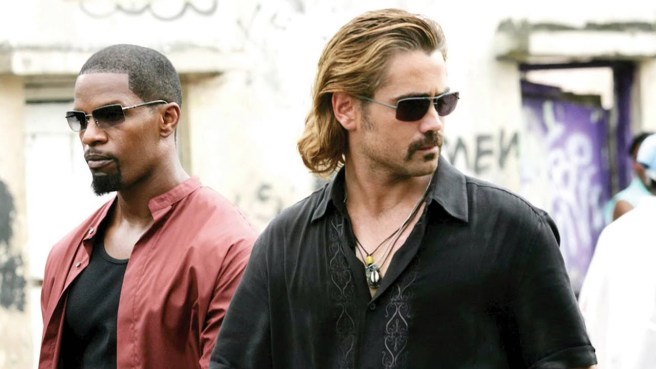
While the plot is as rudimentary as a “Miami Vice” TV episode — vice cops Sonny Crockett (Colin Farrell) and Ricardo Tubbs (Jamie Foxx) go undercover for the FBI to unravel a multi-tentacled, international drug ring — Mann laces it with the themes and macho philosophy he’s so obsessively explored in similarly expert crime pictures “Manhunter,” “Thief,” “Heat” and “Collateral.” 

His heroes are really antiheroes who dwell in the shadows of film noir, be it James Caan’s riven criminal in “Thief,” Tom Cruise’s solitary hitman in “Collateral” or a superb Farrell as an undercover agent who drifts dangerously over the line.

The complicated loner wavering between right and wrong — the blurring of human duality — fascinates Mann and has always been his subject. These men (Mann’s is a fiercely male-centric universe) are vessels for ideas and themes about choosing a way of life and pursuing it with as much iron-willed integrity the world will allow.

This is the loner’s existential struggle, which he carries out with a heavy heart and pensive mind. Working in either crime or law, he’s acutely aware of his mortality and life’s cruel vagaries. “Time is luck,” Farrell tells the woman (Gong Li) he falls in love with, as her life skids out. The same line is said in “Manhunter” — “Time is luck. I know the value of our days” — as well as “Heat,” when Robert De Niro’s career thief muses, “I know life is short, whatever time you get is luck.” (Sharp-eared Mann fans might also notice the reuse in “Vice” of the nicknames “sport,” from “Manhunter,” and “slick,” from “Heat.”)

Helicopters slash the skyline and power boats knife the ocean. High-tech surveillance gadgets crackle and heavy artillery blasts. Within the dizzying action and disorienting nation-hopping, a whip-fast Foxx and a brooding Farrell, who smolders with long, Johnsonesque hair and unchecked stubble, stand sturdy.

The actors’ chemistry is sufficient and both men cut intense, sympathetic figures, whether they are taking down scum — the movie crawls with furry creeps and bald thugs — or making passionate love to their women. Mann’s lingering depictions of sex are the epitome of adult intimacy rarely seen in a Hollywood film.

maxresdefault.jpg

There’s not a dud in the superlative cast: Li’s flinty fatale, Naomie Harris as Foxx’s cop girlfriend, John Ortiz as the drug middleman and Luis Tosar as the drug kingpin. Mann’s dialogue, funny and profane, has a hard, urban pop, and the soundtrack ripples with interesting choices, from spare electric guitar and moody synthesizers to songs by Moby and Audioslave.

How “Miami Vice” is put together is as compelling as the story and characters. A notorious perfectionist, Mann demands technical verisimilitude, nailing the intricacies of how criminals and cops think and operate, down to their clothes, words and twitches.

He and cinematographer Dion Beebe return to the handheld high-definition video they used in “Collateral,” bringing a grainy, documentary vibe to the action that’s unnerving. It’s non-style taken to high style, soaked in ocean blues and inky nocturnal blacks. There’s not a wasted shot.

Since 1995’s “Heat,” Mann has been our greatest living action-crime director, edging ahead of past giants Sidney Lumet, William Friedkin and John Frankenheimer. The technical bravura and artistic depth Mann brings to his films staggers. He respects his craft and his audience. “I ain’t playin’!” blurts a character in “Vice.” Neither is Mann.

School sucks. ‘Eighth Grade’ doesn’t.

Her chin and forehead dappled with continents of acne — I thought I spotted an inflamed Australia — 13-year-old Kayla is stuck in the excruciating pangs of adolescent metamorphoses. A smidge pudgy with rumpled long blonde hair, she is awkwardly pretty, a butterfly half-jammed in her chrysalis, squirming to soar. Her two front teeth, jumbly-crooked and slightly bucky, will break your heart.

Kayla, played by a preternaturally perfect Elsie Fisher, is the can’t-keep-your-eyes-off lead in Bo Burnham’s indie hit “Eighth Grade,” and she’s a compendium of teen neuroses, a raw nerve that keeps getting pinged. 

06-eighth-grade-review.w710.h473.jpg

I kept wincing, re-feeling those awful transitional days, the insecurities, the free-floating dread, the fluttering anxiety — and the irrepressible excitement of the new.

But that’s not the movie’s point. “Eighth Grade” isn’t about me and my cohorts’ feathered hair, terrycloth polos, flared corduroy Levi’s and those giant combs hanging out our back pockets. Or the flubbed first kisses and mortifying social fumbles. 

As Owen Gleiberman puts it in Variety: “The beauty of ‘Eighth Grade’ is that it’s highly specific and generational. It’s the first movie to capture, in a major way, the teenage experience of those who have only existed on this planet during the digital era.”

In other words, it’s not about us geezers and our times bridging, torturously, eighth-grade and high school. It’s about today’s kids, like my niece, who’s exactly in Kayla’s fashionably beat-up sneakers. She’s 13. She’s glued to her phone. I wish her good luck.  

It’s about forging one’s individuality amidst willful clones who gussy up their insecurities in narcotizing conformity. Kayla, a hero for our times, I truly believe, lives by her words, the dictums she professes on the videos she so bravely records on her phone. It doesn’t always work out, but watch her grow stronger after each posting. 

180711-eighth-grade-se-144p_9d56164edc5f4b008454709c80c2a77a.fit-760w

For all the bracing, spot-on scenes in Burnham’s dynamic debut — the movie is really a 90-minute reel of the smashingly real — I picked out my favorite midway through. Kayla is alone in bed at night and she’s surfing a kaleidoscopic stream of videos, social media, Instagram and whatever kids sift at no attention-span speeds. The music, playing loudly on the soundtrack, is sublime.

It’s the most affecting use of Enya’s 1988 harp-heavy hit “Orinoco Flow (Sail Away)” I’ve ever heard. The scene actually redeems the woozy, New Agey song. Lush, lyrical and frenetically up-to-the-minute, the sequence is a masterpiece of visual-aural agreement. It weirdly moved me, and it encapsulates the undeniable artistry, the tender emotional truth of this excellent film. For a brief moment, Kayla soars. 

See the trailer for “Eighth Grade” HERE.

Filming life in fascinating fragments

Too many worthy films flitter aimlessly in the ether, small and micro titles that never reach the local whatever-plex and go straight to DVD or get lost in streaming’s infinitely accommodating democracy (see, for one, Joe Swanberg’s hidden comic gem “Win It All” on Netflix). Sometimes the films get lucky, becoming cult revelations (“Wet Hot American Summer,” anyone?). Yet so often they go poof, vanishing into cinematic oblivion.

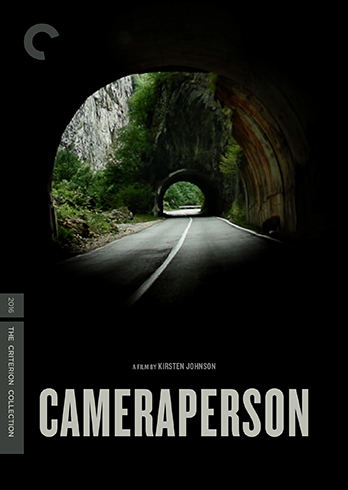
One of those small movies is “Cameraperson,” Kirsten Johnson’s transfixing, deeply personal free-form documentary, which is doing quite well, thank you. The 2016 film, peculiar and pretty wonderful, played minimally, and then, oh-so sneakily, debuted on DVD.

853_DVD_box_348x490_original.jpg

I don’t even remember how I heard about “Cameraperson.” It’s that kind of discovery, unique and hushed, like a hot, under-the-radar new restaurant, or a monkey’s paw. Remarkably, I located the movie at the library, just sitting there patiently, new, unsullied, waiting to be taken home like a shelter dog.

But “Cameraperson” is no mistreated mongrel. In fact, it’s laureled with widespread acclaim, earning a 99% rating at Rotten Tomatoes and shiny critical bouquets like “brilliant“ and “masterpiece.“ And none other than The Criterion Collection (which takes such good care of its superbly tasteful catalog that I bought a t-shirt) issued the DVD and Blu-Ray of the film. That’s prestige.

But what is “Cameraperson”? It’s a curio of whole-cloth originality, a globe-hopping cinematic scrapbook assembled from Johnson’s 25 years as a non-fiction cinematographer for other directors. She shot, among many docs, Michael Moore’s “Fahrenheit 9/11” and Laura Poitras’ “Citizenfour,” both of which won Oscars for best documentary.

But this is her movie, so personal that she calls it “my memoir.” It could also be called a vivid, living career diary, a collage of unvarnished outtakes from numerous docs that she handpicked and wove together with a crazy-quilt method that’s not always obvious.

Zigzagging and hopscotching from subjects and locations, a visual essay emerges. Artful connections and startling juxtapositions happen. Panoramically, with spare narration — her debt to Frederick Wiseman is palpable — Johnson captures multitudes: from a mossy-toothed shepherd strolling with his wooly charges, to bristling backstage drama at a Brooklyn boxing bout; from a fraught Nigerian maternity ward complete with yawping, slime-coated newborns, to shots of lightning in rural Missouri, punctuated by Johnson’s own camera-shaking sneezes. “These are the images that have marked me and leave me wondering still,” she says in the film’s opening note.

There is so much more.

Jumpy Liberian street scenes. Interviews with former rebel warriors who give testimonies of combat horrors. A panning shot of a Yemen prison for Al-qaeda fighters. A rickety, joyful Ferris wheel ride in Kabul. Grim visuals of Guantanamo Bay, Wounded Knee and Tahrir Square, places far removed from peace. A Christian-themed ballet performed by little girls in Colorado Springs. Far-flung centers of protest and massacre, mass rape and public executions. A visit with Johnson’s mother, who suffers from Alzheimer’s. Chirpy frolics with Johnson’s adorable twin toddlers, who are enthralled by a dead bird.

Though beauty abounds — there’s even splendor in a Bosnian martyrs’ cemetery — not all of Johnson’s shots are the master compositions you’d expect from a seasoned camera artist, and that might be the point. Many of the visuals are haphazard, shaky and seemingly random, like she’s busy setting up a shot or gathering all-important “coverage.”

You might also say the pictures are achingly authentic, quivering in the raw, glinting moment; that they are human, all too human.

cameraperson.jpg
Kirsten Johnson and friends