A Motörhead memory, small but indelible

Fresh in my teens, I went to a tiny club in Berkeley, Ca., to see legendary heavy metal band Motörhead — a trio of hirsute dirtbags that rocked with the subtlety of a meat grinder.

I was a Motörhead newbie, green, callow, had only heard the raunch ’n’ rollers for the first time barely a year earlier. My deflowering was “Iron Fist,” Motörhead’s fifth record. It practically castrated me. 

There I was, surely the youngest fan, along with my friends, in the closet-size club, a bit nervous amidst the cramped crowd of big, gnarly headbangers, scary-looking dudes with hippie hair and satanic glares. We kind of pressed ourselves against a back wall waiting for the show to start, innocents among animals. 

And then something wild happened. Who did I see playing pinball on a rusty old machine but Motörhead bassist and lead singer Lemmy. The only person with him was a leggy blonde straight out of Playboy.

Now, Lemmy was a formidable, even fearsome presence, especially to a sheepish fanboy from the burbs. An icon of British metal, the towering singer seemed to have stepped out of central casting as a skull-crunching rocker, a road-worn biker from “Mad Max,” or a snaggletoothed pirate: leather jacket, black skin-tight jeans, bullet belt, cowboy boots, long greasy hair and scraggly muttonchops that hardly concealed two marble-size moles that many mistook for huge warts. 

Lemmy drank and smoked fiendishly, and it would eventually kill him. His voice was a burnt-to-a-crisp croak. He didn’t play his bass, he mauled it, strumming it violently like a guitar, making the bulk of the distorted noise the band produced. One of their albums is titled “Everything Louder Than Everyone Else.” An understatement, and a promise. 

(Incidentally, see the 2010 documentary, “Lemmy: 49% Motherfucker. 51% Son of a Bitch.”) 

Excited and wide-eyed, I wondered what Lemmy was doing out there and not backstage committing all things illegal and squalid. Giddy dorks, my friends and I tried to figure what to do. Soon enough, I was the one who screwed up the courage to approach him.

So I went. And I, gulp, asked for his autograph.

He glanced down at me and, gruff, calm, unsmiling, said, “This is my time.” His voice was a gravel road of unknowable debauchery and spilled Jack Daniel’s. “See me after the show,” he added, a nice touch even if it was just a sop.

This is not why some rock stars suck. This is why some rock stars rule.

Chastened but exhilarated, I returned to my friends who asked what happened. Their faces read awe and disappointment. The girl out of Playboy snickered. 

Nightclub shows like that, with three bands on the bill, and a late start time for the headliners, round midnight, meant we couldn’t really hang out afterward and hope Lemmy would be waiting with a Sharpie to sign an autograph. It was a wash and I knew it. Still, I had exchanged a few words with the man himself.

The show itself is a blur now, though the set list is archived online. (I cannot believe they didn’t play “Ace of Spades,” the band’s signature song.) But that encounter with Lemmy is branded in my brain. “This is my time.” I can still hear it in Lemmy’s smoke-charred voice, and it’s beautiful. Like watching a molten volcano, or surviving a shark attack.

Motorhead. That’s Lemmy on the right.

Bro, brah, blah.

Despite the fact that my barber called me “bro” no fewer than twelve times — a word he’s never said in the four years I’ve patronized him — yesterday was fine and productive, a whiff of autumn in the air that had me breaking into brassy musical numbers on the sidewalk, à la Gene Kelly. 

The day went like this: My podiatrist speared a cortisone shot in my foot; it bled like a Tarantino movie, and I marveled at the carnage. I picked up Renata Adler’s great cult novel “Speedboat” at the library. And for lunch I tucked into an elephantine deli sandwich that about made me upchuck thanks to its gut-busting enormity. I felt ill the rest of the day and loved every bite of it. 

I also got a haircut, which brings us back to bro. Besides that it’s the go-to vocabulary of jocks, frat boys, rappers and illiterates who actually think they sound “street,” I don’t know why I loathe that word so much.

I just know that my barber suddenly using/abusing the modified noun out of nowhere was deeply distressing. He even did those lame hip-hop gestures — arms wide, hands contorted in faux-gang signage — as he said “bro” and — yes, it happened — “Yo, bro.”

What was going on? Four years and not once has he stooped to this phony street jive. I’m guessing he’s in his late thirties or early forties, too old for bro, fist-bumps and even, I’m afraid, “dude.” (The less said about “brah” the better.) Married with two young kids, my barber, who I’ll call Miles, doesn’t drink alcohol, so picking this up at a keg-soaked rager is at best categorically implausible. 

(Amusing aside: When Miles did those hip-hop hand gestures he was holding scissors, making him look like Freddy Krueger cackling for the kill. I kind of wish he killed me.)

Of course “bro” is simply short for “brother,” but it sounds like the utterance of monosyllabic dolts. It is largely the verbal currency of very young men and we should cut them some slack until they acquire a full grasp of the English language. Like now.

In the case of Miles, when he says bro with that oblivious grooviness, he’s suddenly reduced to a kid — a bro — himself. Maybe that’s the point, that slang keeps you young at heart. Heaven knows I’ve retained some embarrassing slang in my life, much that’s unprintable in a family blog. 

Miles might be on to something. He’s like a millennial Vanilla Ice, still trying to keep it real even at the risk of fatuity. I might not be a fan of whatever happened to him since I last saw him a month ago, but he’s still a good guy, a mighty barber and a voluble conversationalist (we talk world travel exclusively). It appears, I have to say, that our bromance rolls on.

All about Eve

It is the impoverished soul who has yet to encounter the unbridled bliss that is Eve Babitz’s prose. I’ve written about her several times, but I seem to be on a Babitz kick this summer (when am I not?), and my proselytizing propensities are in full whack. 

There. I said it. I am enamored with Babitz’s writing, and this lust just won’t go away. Last month I reread her infamous 1972 semi-fictionalized memoir “Eve’s Hollywood” and that kick-started my crush on her hip, shaggy, archly observant wordsmithery.

Babitz was Joan Didion with a jolt of sex, drugs, rock ’n’ roll and, crucially, a sense of humor. She’s the cool Didion, the one who laid Jim Morrison, among a murderers’ row of L.A. badasses — “she seduced seemingly everyone who was anyone in Los Angeles” — and swanked her way through the megalopolis’ mega-scenes with abundant beauty and ample talent (she was also an accomplished artist). 

Her memoirs and novels depict “a glamorous and unapologetically wild world.” And a privileged one, too. Her godfather was Igor Stravinsky. She was romantically entwined with Steve Martin and Harrison Ford. Reader, you are forgiven for getting a wee jealous about her oversaturated life. Me, I wilt.

And it’s this bounty that keeps you reading, carried as it is with earthy writing whose low-slung easiness pops at every turn with a hilarious throwaway detail. “She was a phenomenal writer,” declared LitHub, “the kind people hate the most, the kind that doesn’t have to toil or sweat to turn out something that’s not only decent but often extraordinary. Eve was not a great writer in spite of her unseriousness but because of it.”

Some summers ago, I compiled a blog entry entirely of quotes from Babitz’s fizzy, funny novel “Sex and Rage.” A few brief samples, a sliver of what the book, as slim as it is, contains:

“In the hurricane, the waves were fifteen feet high and roared like lions and volcanoes.”

“He smelled like a birthday party for small children, like vanilla, crêpe paper, soap, starch, and warm steam and cigarettes. Anyone would have liked being hugged by him.”

“She felt as though she’d been in front of a firing squad that had changed its mind.”

Her work is so much more than this. I’d have to transcribe whole pages to do it justice. It’s wily, droll, dry but juicy, real and loaded. And you will laugh. 

Four years ago, I wrote about this book: “Babitz’s raffish auto-fiction, whose subtitle, ‘Advice to Young Ladies Eager for a Good Time,’ is a brazen come-on. It’s so saucy, such unfiltered fun, and the writing so ablaze, resisting it would be dumb self-denial.”

In 2018, I read the Babitz novel “L.A. Woman,” and wrote, “Soaked in sunsets and squalor, glamor and grit, ‘LA. Woman’ traces the squiggly trajectory of a young Jim Morrison groupie through the titular city with a constant stream of poetics and epiphany. It’s funny and mean. It’s about Los Angeles. And life. I gobbled it up in a gulp, like a gumdrop.” 

So, yeah, I dig Eve. Without being her proxy pitchman — Babitz died in 2021, age 78 — I recommend these books: “Eve’s Hollywood,” “Sex and Rage” and “I Used to Be Charming: The Rest of Eve Babitz.” Take a bite.

Or don’t. Remain unenlightened. I don’t care. And Eve, that snarky libertine, certainly wouldn’t either. She’d shrug, chuckle a plume of smoke, then carry on waxing rhapsodic about her capacious life in her crazy city, not a care in the world.

Pet sounds

The animals have it made. They just don’t know it.

Oblivious to their Edenic existence — room, board, vet care, treats, belly rubs — they try my charity and patience with animal trickery, inbred cunning that might serve them in the wild, but I doubt it. Tossed outside, the dog and two cats would eat twigs and weeds and cry for their mommies. That scratching at the door? I’m sure I don’t know.

When they’re not noisome they’re noisy, yawping dissonant arias that would make Yoko Ono reconsider her entire career. Every so often I am startled by the sound of hell’s maw bellowing tortured damnation. It’s just the cat.

While the cats whine constantly, the dog often breathes with the labored wheeze of a Sleestak, the reptilian humanoids from the “Land of the Lost.” He sounds about 100 and sneaks Pall Malls. And he barks at strangers with a fury so committed, you want to reward him with a meatball. But you don’t, because his outbursts are teeth-clinchingly annoying. Told to shut up, he replies: yap!

The male cat in particular, gray and greedy and shameless, is an air-raid siren of plaintive meows, begging for food then stealing that of his push-over sister. The other day I Frisbeed a small plate at him and missed. He gave me the stink eye and stalked haughtily to the other room, where he probably contemplated murder and mackerel.

Cubby the curly mutt is my pal, a boy and his dog and all that. We get along with a fellowship of such purity you could throw up. We’re like bros, even though I hate bros. He doesn’t know this.

The cats are another deal. They’re sweet and affectionate, but it’s hard to get close to creatures that prefer aloof entitlement to purry snuggles. One cat hibernates in the attic all day, zonked, and the other one is on call strictly for food, any food. (This is flagrant feline stereotyping, I know. My ex and I had a cat named Jesse who would play fetch with bottle caps and sleep on your head.)

Watching the animals in repose, on their back or curled up like a large ball of yarn, must be what it’s like when your small child finally falls asleep after a day of tantrums and slobber. Suddenly there’s a still angel in your midst, halo shimmering, mouth miraculously shut. Shhh.

Oft-seen shot of Cubby, blissfully at rest.


Happy August

The summer heat wave, all solar blaze and dragon’s breath, sizzles on without a whisper that it will break soon. It was 95 degrees at noon today, and still I braved a quick walk that was as pleasant as licking dynamite. I was sopped afterwards, but AC and a brawny desk fan evaporated the wet in 45 minutes or so. Summer. Yum! 

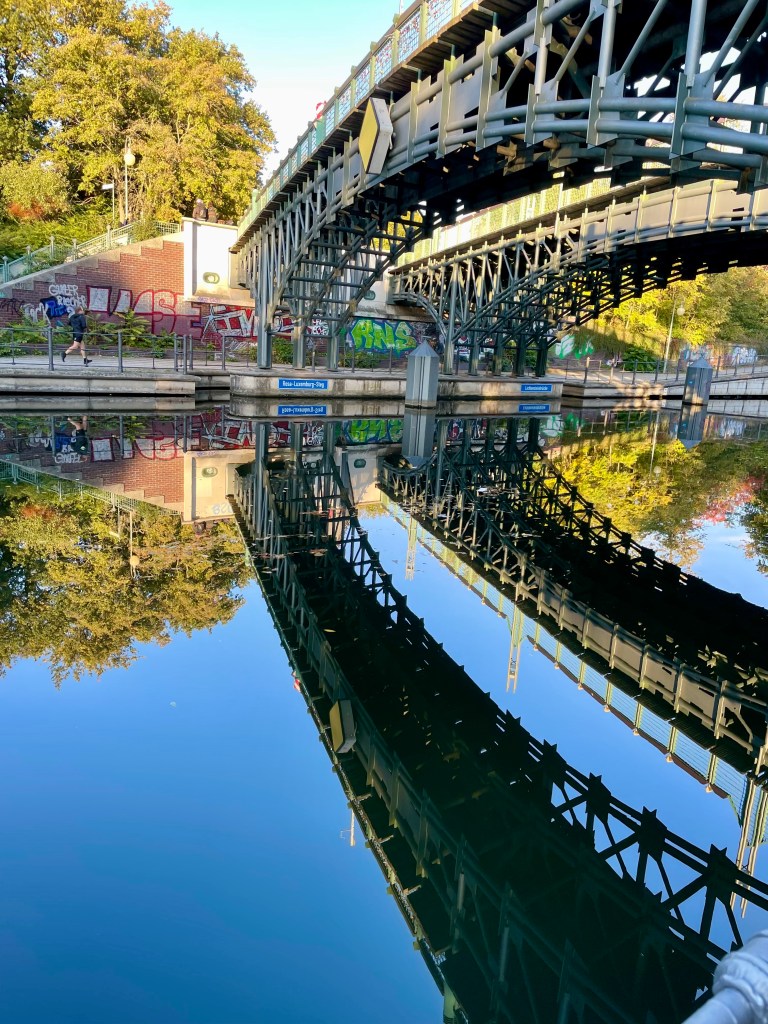
The whole time walking all I could think was: August 1st — yes. Summer’s last lap. Though September is unduly warm, it rarely hits the 90s and I get giddy waiting for it. In fall, the air smells different, earthy. Breezes are brisk, just like the cliché. The sun softens, goes fuzzy like a peach. I get to wear jeans. I take a trip (Berlin in October). Of course, there’s Halloween. So great for kids, so embarrassing for participating grown-ups. Everyone’s infantilized. And there’s Thanksgiving … yeah, well. 

When I walk, it’s an obstacle course of flora. I duck below the low-hanging branches of curbside trees and hopscotch around front yards flush with foliage curling over the sidewalk. It’s all so lush, the greenery, that I hate to say I can’t wait for it to shrivel and die in the cold. It is pretty and life-affirming, but sporting a jacket beats it anytime. The heat is my kryptonite; the chill my vitalizing spinach. (Mixed metaphors — Superman and Popeye. Apologies.) 

Ironically, workers are installing a fancy heater in the dining room today, which, if it wasn’t such a happy prelude to the cold, would be insanely counterintuitive. 

I wonder when the heater will be needed? When will we drop to 50, 40 degrees? When will we stop sweating? When will it be dark by 6 p.m.? When will all those plants die?

Tomorrow, please.

A tossed salad of topics, memoirs to movies

In these mid-summer doldrums, a few rambling thoughts that amount to nothing in particular …

Best sentence all summer: “Her lipstick is a philosophically incomprehensible shade of chalky orange.” (From “Eve’s Hollywood” by Eve Babitz.)  

I have yet to read a memoir that didn’t bore me silly or raise an eyebrow or two. Nabokov’s “Speak, Memory” is a possible exception, and “Eve’s Hollywood” definitely is. I’m skeptical of minutiae only the writer cares about, like how their father flew planes in World War II and their sister married an alcoholic son of a bitch. I can hardly believe a word of what the authors say, especially when they do things like insert direct quotes they muttered as toddlers, forty years after the fact. (See: Mary Karr’s aptly titled “The Liars’ Club.”) It’s all magnificent hooey.

I’m sleeping like crap. Nothing new, but I’m locked in a stretch of relentless insomnia. I called my doctor and he gave me a low dose of Lunesta. It’s done nothing, even when I take more than the prescribed amount (whoopsie). I pop Benadryl and a dorky over the counter sleep aid as well. I’m all drugged up and I still don’t nod off till 4 or 5 or 6. Then I sleep till 9 and awake vaguely refreshed with murder on the mind. I feel like a Stephen King character.

Kamala’s got me revved. For now. The initial blast of flowers and fireworks — her spontaneous honeymoon — is about over, and now she must face the music … er, the monster. Trump, a hopeless buffoon, bigot and playground bully, will meet his match in the debates. Kamala will be the buzzsaw that Trump’s ignorant, lying face encounters and it will be beautiful. That ear boo-boo Trump’s so proud of will be shown for the nothing it is, except symbolic and specious martyrdom. He keeps blathering about the American “bloodbath.” Yes, indeed.

As always, I’ve been watching lots of classic movies from early and midcentury Hollywood — the Golden Age of pictures when men were either gruff or suave (and glistening with pomade) and women were silky and soft-focus, radiating unreachable glamor. Black and white was king and the best pics were positively charged with swoony cinematography and dazzling chiaroscuro. Those were the days. (And I’m someone who name-checks “Alien” and “Jaws” among his favorite films, alongside “All About Eve” and “The Big Sleep.”) Recent viewings: “The Big Heat,” a crackerjack 1953 crime thriller by Fritz Lang, starring Glenn Ford and Gloria Grahame, who gets a pot of scalding coffee tossed in her face by Lee Marvin and has to wear a giant bandage for half the movie; the unbearably charming Cary Grant and Irene Dunne in the 1937 screwball marriage/divorce romp “The Awful Truth,” which features the brilliant dog Skippy, who also plays Asta in the great “Thin Man” films; and 1955’s “The Big Knife,” where a fist-tight Jack Palance is a movie star sucked into the manipulative corruptions of fame. A rabid Rod Steiger noshes the scenery like it’s beef jerky. And that’s just three oldies I’ve recently watched (I’ve seen them all before). They beat the living crud out of big, dopey summer blockbusters any day.

I bought a hair dryer. I swear to god. It cost $15. It screams like Janis Joplin.


A book blooms, a Rose wilts

Axl Rose is about as douchey a rock star as they get. This is comically, semi-tragically revealed in a long article written by John Jeremiah Sullivan for GQ and included in “Pulphead,” a collection of his essays from 2011. Last week, the book was named  # 81 on the best 100 books of the past 25 years list in The New York Times.

As I was reading the Rose profile, “The Final Comeback of Axl Rose,” Guns N’ Roses’ familiar songs thwumped through my head, be it “It’s So Easy” to “Paradise City.” The music — hard, transgressive and nasty-catchy — has few metal peers.

GNR owns many great songs, almost all of them on their debut “Appetite for Destruction.” On a later album is the ballad “November Rain,” one of the band’s worst songs (next to their godawful cover of Dylan), yet beloved by millions. Pandering and juvenile, it’s a big sloppy dog kiss about a laughably clichéd love affair. (Google the lyrics. They’re shocking.) 

“November Rain” is as cotton-candy as a fawning celebrity profile by Maureen Dowd in the Times, or a Nancy Meyers rom-com, but in soft-focus with buckets of moody rain. Gummy, cloying. You want to gag.

Still, GNR fans regard it a masterpiece. They are distressingly mistaken. 

Metal power ballads are always troublesome. Most are dreadful. Take Poison’s “Every Rose Has Its Thorn” to Def Leppard’s “Love Bites” and all the synth-soaked dreck in between. (They’re not all bad: “Dream On” by Aerosmith, “Nothing Else Matters” by Metallica, “Wanted Dead or Alive” by Bon Jovi.)

“November Rain” is worse than all that. It’s flat-out embarrassing, a soapy tearjerker that only jerks something unprintable here. Slash is metal guitar royalty, but even his virilely earnest solo belongs on a Yacht Rock cruise to Night Ranger Island.

Though he notes it in passing, Sullivan doesn’t express an opinion of “November Rain,” which is too bad because he’d probably decimate it with atomic wit. (Unless  he likes it, then we’d have a serious discussion.)

Amazingly, “Rain” isn’t even GNR’s worst song. That would go to the above mentioned Dylan cover, “Knockin’ on Heaven’s Door,” in which Axl Rose torments then strangles the classic tune to screeching death. It has to be the most mangled and irresponsible cover song in rock history. (The band also managed to muck-up Paul McCartney’s “Live and Let Die” in an overblown, histrionic rendition for which they clearly thought they were ideally heavy, but missed the point entirely.)

What I’m getting at in a wildly circuitous way is that you should read “Pulphead,” for its offhand humor, literary punch, throwbacks to New Journalism, and overall entertainment value. 

John Jeremiah Sullivan with ‘Pulphead’

Sullivan’s prose and approach favorably remind me of fellow culture essayist Chuck Klosterman. Pages are paved in irreverence. Laser insights tango with lacerating opinions. Laughs are plentiful. And you’re all the smarter for reading them.

Like so many witty essays that graze the indulgent — be it Sullivan, Klosternan, Eve Babitz or the late Michael Corcoran —  they’re delightfully devastating. And there’s the kick. 

P.S.: After some 35 years, a cornrow-headed Axl Rose is still trying to keep together an iteration of GNR for recording and touring. I have no idea how that’s going. But I do know that in 2018, Rose appeared in an episode of “New Looney Tunes” as himself, singing an original song “Rock the Rock.” In 2021, Rose again appeared as himself in a cartoon, this time “Scooby-Doo and Guess Who?”

Perfect. One of rock’s natural cartoon characters has actually become one.

Axl in his 1980s heyday.

The ‘best’ books of the last 25 years

Think of the hundreds — no, the thousands upon thousands — of books published in the United States from Jan. 1, 2000 to today (elbow nudge: that’s 25 years). Mounds, mountains, miles of bound pulp, if you consider only traditional paper books that you flip the pages of and place on neatly arranged shelves, while ignoring their electronic ilk. 

Now, pick the best books from that teetering heap, or actually the 100 best books, both fiction and non-fiction. That’s the gargantuan task The New York Times has undertaken this week in its selection of “The 100 Best Books of the 21st Century So Far.” 

We’re talking the smartest, zestiest, funniest, fiercest, most important and most influential tomes over the past 25 years. A gallery of luminaries — writers, actors, critics, editors and more — voted, and you can find them and the whole Times project here, including the final list of the 100 “best” books. 

It’s pure gimmickry. It’s subjective folly. It’s a game. Let’s play.

I’ll give you a taste. Here are the Times’ top 10 picks (spoiler alert): 1. “My Brilliant Friend” by Elena Ferrante. 2. “The Warmth of Other Suns” by Isabel Wilkerson. 3. “Wolf Hall” by Hilary Mantel. 4. “The Known World” by Edward P. Jones. 5. “The Corrections” by Jonathan Franzen. 6. “2666” by Roberto Bolaño. 7. “The Underground Railroad” by Colson Whitehead. 8. “Austerlitz” by W.G. Sebald. 9. “Never Let Me Go” by Kazuo Ishiguro. 10. “Gilead” by Marilynne Robinson.

It’s a robust mix, though heavy on the historical, I think. The top 11-20 is a bit lighter, with titles like Junot Díaz’s funny “The Brief Wondrous Life of Oscar Wao” and Michael Chabon’s delightful “The Amazing Adventures of Kavalier & Clay” (yet it also includes Joan Didion’s grief journal “The Year of Magical Thinking”).

Conveniently, the project provides an online tool that makes it easy to tally how many books you’ve read from its mega-compilation. Me, I’ve read 39 of the 100 chosen titles — not great, not bad. But it’s not a contest. I won’t list all of them here. Instead, I’ve picked five of my favorite books from my personal tally, a peek into my pea brain and what I look for between covers.

  1. “The Human Stain” by Philip Roth — A disgraced professor is smeared by a career-crushing lie all while he’s weighted by his own monumental secret in this shattering portrait of America in 1998. Roth propels the story with tart literary gusto and his patented moral vehemence. One of his best.

2. “The Amazing Adventures of Kavalier & Clay” by Michael Chabon — Gleefully spanning lands and history, this teeming picaresque is about a magician and an escape artist who figure out life by creating globe-trotting comic books. But that’s just a sliver of their “amazing adventures.” Chabon, who won a Pulitzer for his 600-page romp, uses every trick in the book to entertain and edify, and handily succeeds. 

3. “Behind the Beautiful Forevers” by Katherine Boo  — An unvarnished plunge into the slums — and humanity — of Mumbai, India. An award-winning journalist, Boo’s unflinching but empathetic reporting is both devastating and bracing. It sticks with you like a troubling dream.

4. “The Road” by Cormac McCarthy — Biblical, apocalyptic, rife with death, despair and cannibalism, McCarthy’s unrelenting opus takes us through hell with ash, blood and savagery, and stingy glints of light. A Pulitzer winner, this riveting knockout is all about being human in the abyss.

5. “Gilead” by Marilynne Robinson — This deeply spiritual Pulitzer-winning novel almost defies description. An epistolary story told in the forms of journals and memoirs, it showcases Robinson’s otherworldly command of language and astute thinking about the divine. Not the easiest read, it still blew me away.

Rounding up to 10: “My Brilliant Friend” by Elena Ferrante; “White Teeth” by Zadie Smith; “The Corrections” by Jonathan Franzen; “Outline” by Rachel Cusk; “Train Dreams” by Denis Johnson.

Tripped up on trips

One of the more jackassy things I’ve done lately is buy a small stack of books about Berlin, where I travel to in October, and buy a smaller stack of books about Hong Kong, where I’ve rather rashly decided I will travel to in January. That means I’m planning two big trips at once and it’s not financially healthy nor psychologically joyful. It’s kind of driving me crazy. It’s what is called, in polite society, a dick move.

I’m getting greedy. Or antsy. My wanderlust is in labor, twin trips ready to pop out. Travel is one of my prime passions, and when it’s piqued, I gotta scoot. Move over Berlin, Hong Kong is a’calling. 

After marinating for weeks in all things Berlin, I’m now thinking about Hong Kong more than the German capital. Honestly, I haven’t even read all my Berlin books and here I am scouring hotels on an overpopulated island with precarious ties to China. It’s like I’m leapfrogging, snarfing down dessert before the second course has even arrived.

Before I decided on Berlin, I made two false starts in my annual travel plans. I bought a ticket to Santiago, Chile, why I’m not quite sure. I scuttled that. Toronto (wha?) was next, until I ditched that idea, too. Then somehow Berlin — massive history, fine fall weather, beer, bratwurst and beer — zapped in my brain like a neon laser in a sweaty, druggy East Berlin club. Haven’t been there in many years, I mused, let’s check it out as a real adult, which is an entirely relative concept.

Berlin. Cool. Right on. My brother’s coming. Six days. It will be a blast.

And then Marrakesh beckoned. That’s right. 

In the midst of planning Berlin, the travel bug — a venomous, cackling black widow — bit again. It left an awful, itchy wound that somehow led me to Morocco’s great, dusty, tout-teeming desert carnival, even though I’ve been there before, if briefly. I stocked up on Marrakesh guides from the library. I viewed YouTube travelogues. I re-watched Hope and Crosby’s “Road to Morocco” (not really, but now I want to; it’s sublimely funny). 

But Marrakesh quickly proved a desert mirage. That place is hard work — posh but primitive, hagglers hectoring you incessantly, too many redundant souks or bazaars, and, this one gets me right here, open animal abuse, from chained-up performing monkeys to broken-down donkeys. I’m in no mood for a personal PETA patrol.

Back to square one in planning trip number two, which, recall, is preposterous as I’m still shaping up Berlin. So I decamp to the attic, where I read and research trips. The attic is my hermitage, my retreat, my man cave (wait, scratch that last one). After I nixed Marrakesh, I brainstormed places to go in January: Singapore, Taiwan, Croatia, Switzerland, Brussels, even Slovenia. Fail, all. 

I alighted on Hong Kong for myriad reasons: cool, dry winter weather, world-class cuisine, zesty street culture, neon insanity amid forests of skyscrapers and breathtaking mountains, island getaways, ravishing exoticism, Jackie Chan. 

And so I juggle two journeys, one in fall, one in winter. I try to keep my angst in check — the costs! the logistics! — and I think I’m holding it together.

“Boo-hoo,” you say. 

“Such problems,” you cluck.

I know, I know, I reply, face the shade of a ripe radish.