Ready, set …

Right about now I have a squirming urge to bolt, to unshackle from the boring and banal, to hop a jet and vacate this place somewhere faraway, to get the hell out of here, to go go go. Sure, Mexico City was only six weeks ago, a distant, wondrous dream doused in humanity and habanero, but plans must be made when that itch called wanderlust screams for scratching.

And so I plan. And I move fast. And I’ve picked where to go next. And, greedily, I’ve chosen two discrete destinations for early 2026. And they’re probably not what you would think.

Because they’re not what I would think, either. Marseille, Aix-en-Provence and Arles in Southern France happen the first week of February. Then, in a whiplash turnaround, I hit Nashville, during the first week of March. 

Nashville? you ask. Me, too. 

In an abbreviated checklist, what the country musical capital has going for it: a slew of top-tier southern food restaurants, like the legendary Prince’s Hot Chicken (extra spicy fried fowl); the Country Music Hall of Fame Museum; the National Museum of African American Music; pour-happy whiskey distilleries; vibrant ‘hoods, including the hip, boho East Nashville, where I’m staying; and of course neon-bedazzled Broadway, where practically every bar — miles of them — is a honky-tonk or a venue hosting crunchy Americana in lieu of touristic cowboy hats.

The Strip slash Honky-Tonk Highway, as it’s alternately dubbed, is also where I will urgently avoid the famed flotillas of inebriated bachelorette bashes that turn the avenue into a twerking, tongue-flashing parade of sorority swillers. In pink cowboy boots, to boot. They should rename it Hell’s Highway.

Nashville’s blinding Broadway

Now, to France. Despite the grungy reputation of Marseille — France’s second largest city, animated by African and Italian immigrants, graffiti, a picturesque port and world-class cuisine — the character-rich, seaside region has found its footing in recent years as a must-do destination. 

It’s “the underrated city in the South of France that should be on your bucket list,” toots Condé Nast Traveller, calling it an “untamed labyrinth, the dusty-rouge Mediterranean Port City” that delivers everything from grand cathedrals to transcendent bouillabaisse, Marseille’s iconic seafood stew.  

And it’s affordable. For instance, my hotel, the whimsical Mama Shelter Marseille, is less than $100 a night, and it’s no dump. It has personality, pizzaz and a penchant for partying. (Grandpop here is bringing earplugs just in case.)

From Marseille I’ll catch under-an-hour train rides to Aix and Arles. These quaint, leafy, cobblestoned villages in Provence are where Roman ruins — ogle the gaping 2,000-year-old Arles Amphitheater, home to bullfights today — dot the stomping grounds of great painter Cézanne and great paint-eater Van Gogh. Both towns exude Old World charisma, naked charm and uninterrupted beauty. I’ll spend a day in each, then rail back to the grit, graffiti and gormandizing of Marseille.  

And then, sigh, my journeys will be complete for the first part of 2026, and I won’t embark on another one (or two!) till fall, when the weather cools and, critically, my wallet recovers. Wanderlust is an incurable disease and I’m inflamed and afflicted. I do what I can about it. Which invariably comes down to go

Marseille’s famous Vieux Port 

Getting stuffed on the bounty of Mexico City

Twenty-two tacos. That’s all I could devour over seven days in Mexico City before I hit taco fatigue, a malady that beats Montezuma’s revenge by a long shot. (I was gratefully spared that gastrointestinal massacre.) Too many tacos — poor me. But it happened: I burned out on the tortilla-wrapped meats and spices, even though they were otherworldly delicious. Al pastor remains a gastronomic god.

I knew I peaked during an exhaustive nighttime taco tour, which included a pitstop for a heady mezcal tasting. I could only devour seven of the tacos served — including a rather average one at the only taco stand in the world to earn a coveted Michelin star — and had to pass, bloatedly, on the final two. (That would have been nine tacos in three hours, if you’re counting.) I simply couldn’t finish, unless my tour mates wanted to see the feeble American provide a gut splash on the sidewalk. 

During my week in Mexico City, I wasn’t on a journey to eat as many tacos as possible. There was no quota. From the start, I wanted to leave room for an array of local delicacies, street food to fine dining, enchiladas to empanadas. Mission accomplished. Pizza even slipped into the plan. Thanks to its strong European tang, the city is famed for its prodigious pies. It was amazing.

The city surprises like that. CDMX, as they call it, is a sizzling melange of cultural influences, a vibrant swirl of art, cuisine, architecture (note the heavy Euro inspiration), lovely people, dogs, parks, museums (only second in the world for the sheer number of them, after London), sports, and, crap, a serious and grueling traffic problem. Don’t get me started. No, do. Some Uber rides took an hour, stop-starting, for just a few miles. The Ubers were nearly all dusty, dented beaters, but they muscled through and delivered. The streets — as clean as Tokyo. And there are no public trash cans. Pride reigns.

Located in the center of Mexico, the megalopolis sits 7,350 feet above sea level, which makes it higher than Denver, with thin air and temperate climes. It teems with life — 22 million people live there. That’s a lot of humanity, not to mention the multitude of pleased and pampered pups I saw all over the city.

I usually take wads of pictures of camera-happy hounds on my travels, but I only snapped a few this time. Here’s one, among a smattering of shots, a taco-y taste of CDMX. 

In line at the Frida Kahlo Museum. I forgot her name.
Frida Kahlo looking pensive, near the museum. The city bursts with street art.

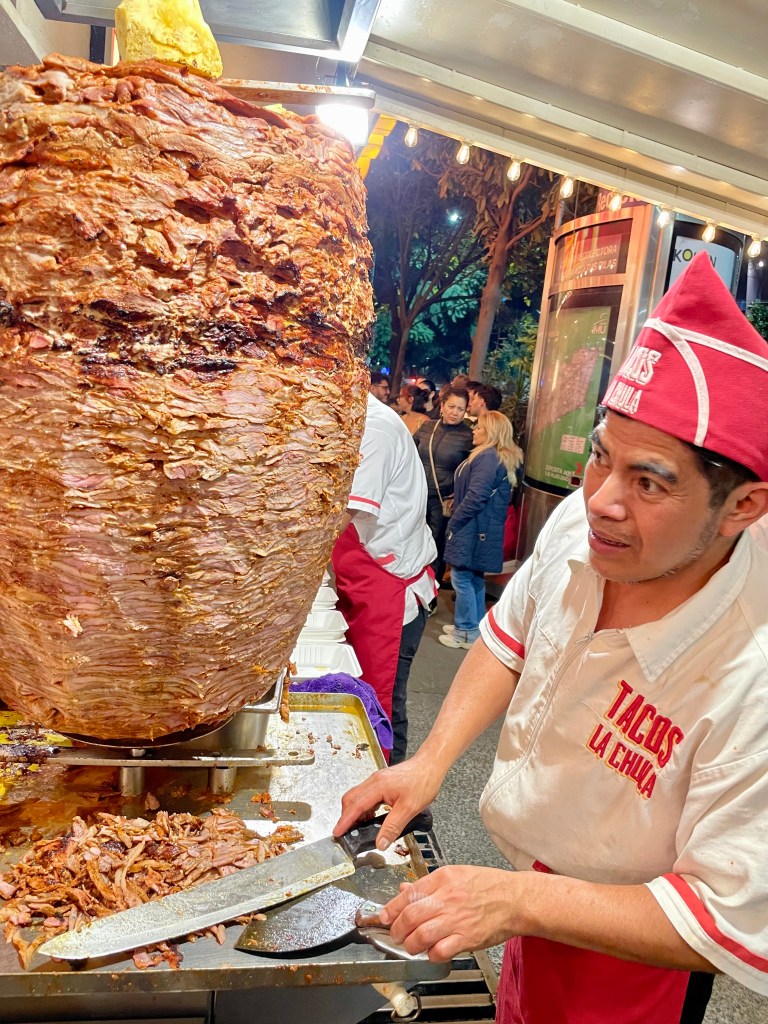
Cooking up one of my favorites, pork tacos al pastor.

Al pastor up close. That’s marinade, not blood.

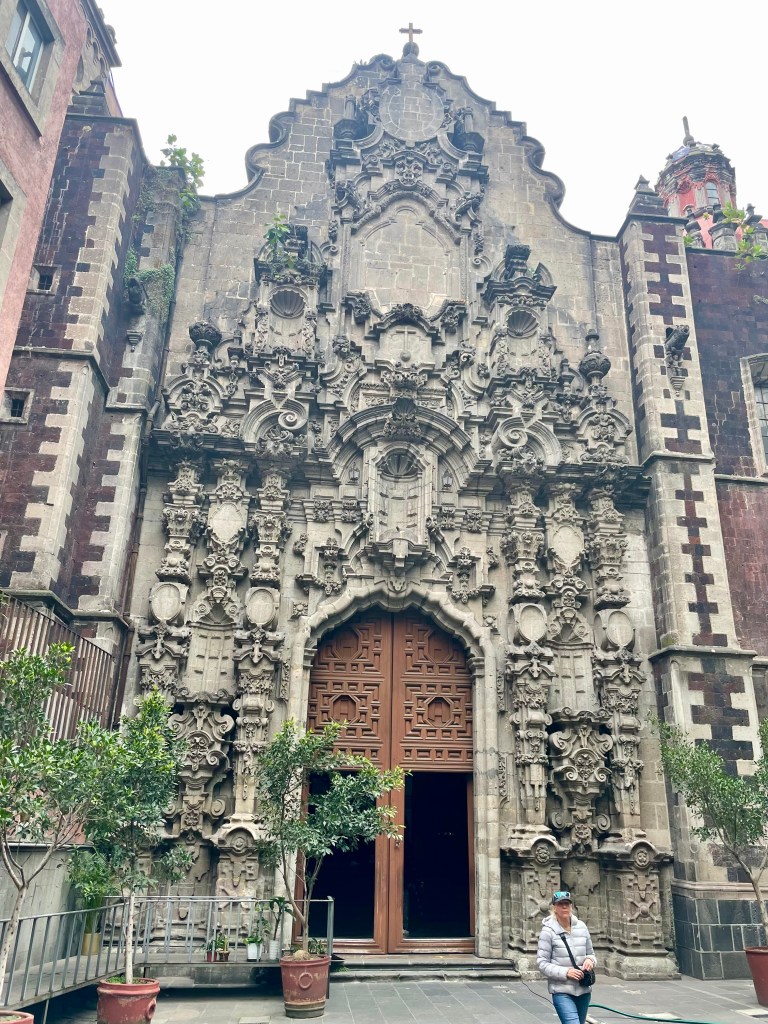
A cathedral in the City Centro.

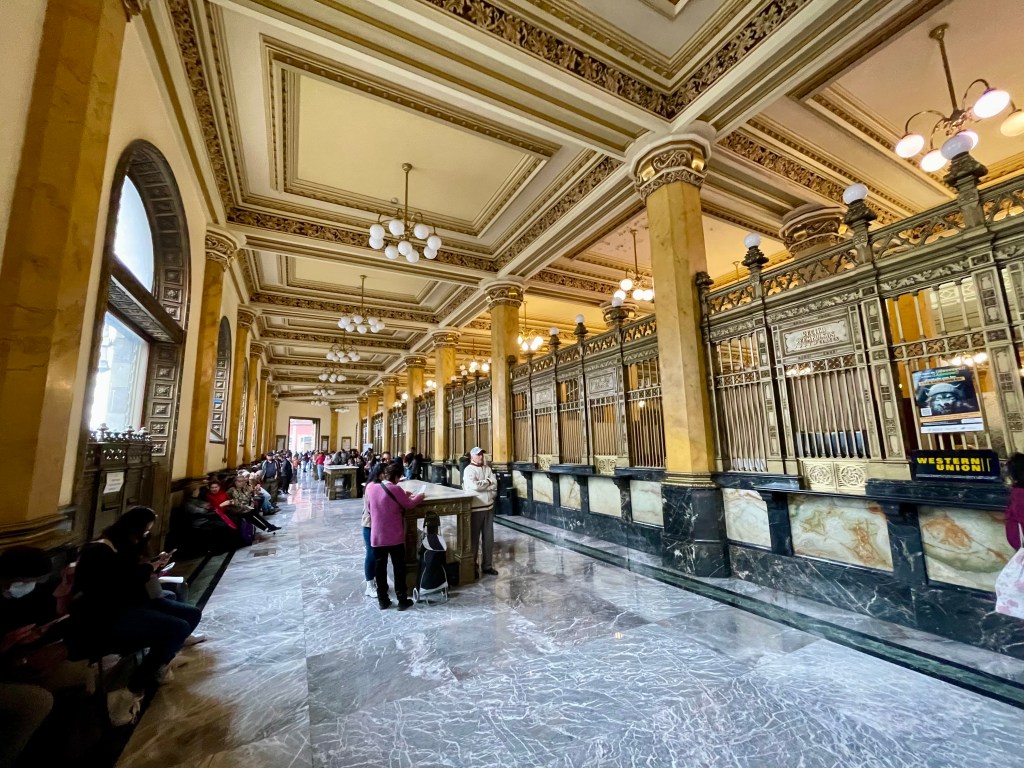
The famous interior decor of the main post office.

The ludicrous circus-like spectacle of lucha libre: wrestling theater. The crowd of 7,000 goes wild at the backflipping, body-stomping, mask-wearing rivalries. It kind of gave me a headache, in a good way.

One of the better pizzas I’ve ever had, even in Italy. Perfection.

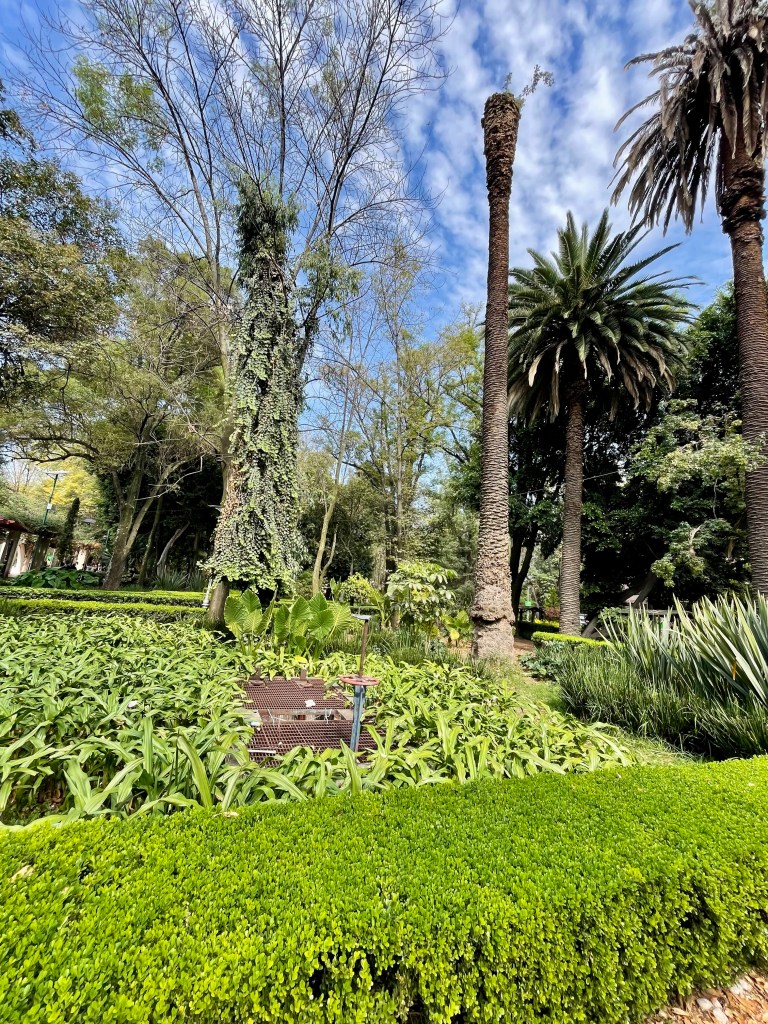
A typical park smack in the city. Joggers, yoga, musicians, dogs, salsa dancers.

Palace of Fine Arts (Palacio de Bellas Artes)

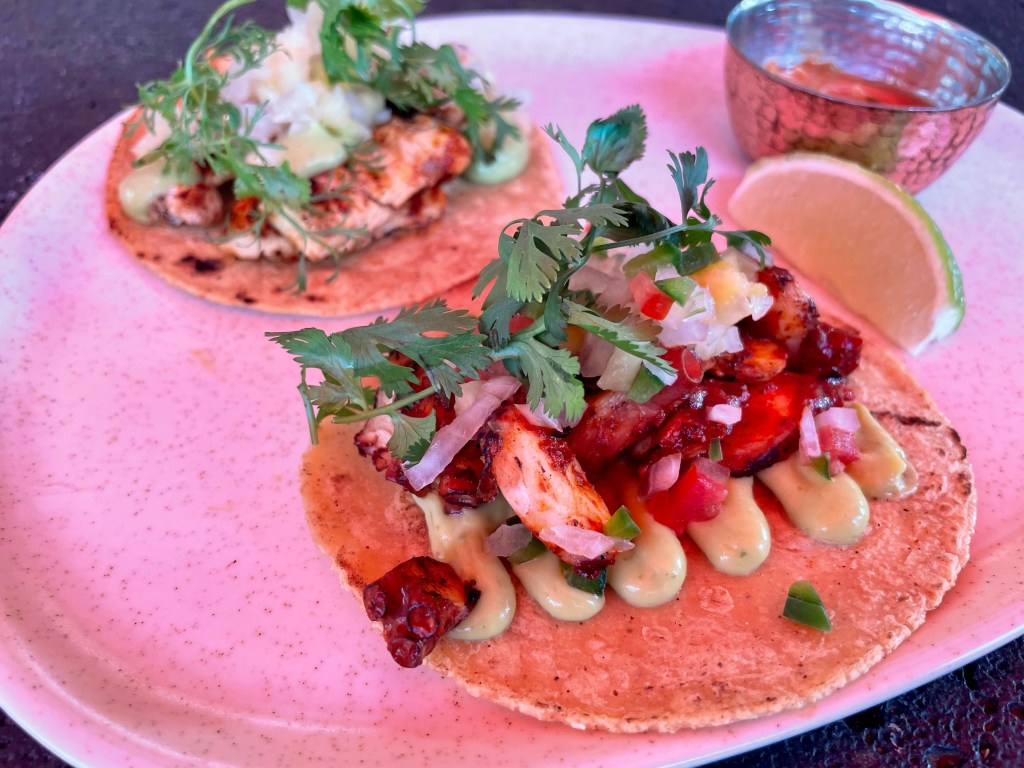
Rear is chicken taco al pastor. Front is octopus al pastor. Awesome.

Breakfast before a three-hour tour of the astounding Museum of Anthropology.

A random facade in City Centro.

Large tortilla chip with guacamole. On top: grasshoppers. Yes, delicious.

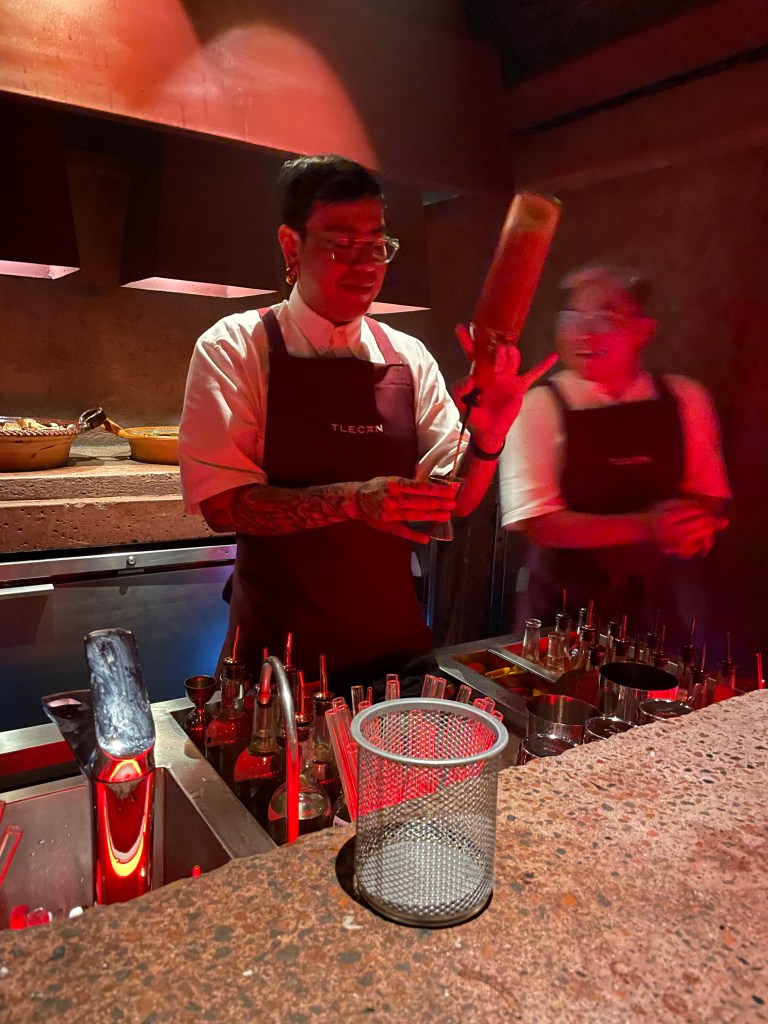
Making me a killer cocktail at Tlecān mezcal bar. It’s ranked #23 in the World’s 50 Best Bars 2025 and #3 in North America’s 50 Best Bars 2025. It, like Mexico City, lives up to the hype. Ultra-modern with a hearty, heartfelt nod to history.

Revving up for Mexico

With a trip to Mexico City planned for early November, I’ve been flipping through a couple of travel guides to see what I’m in for. (I smell tacos al pastor. Dog-ear that page!)

The place is ginormous, the sixth largest city in the world and the most populous city in North America, with 22 million people. I plan to weep as I inevitably get lost in the grand sprawling Spanish-speaking metropolis. What’s the Spanish word for “mommy”?

Yes, I am going to eat tacos on an epic scale and drink tequila and mezcal with stupid abandon and avoid the sun while lapping up kaleidoscopic art and archeological thingamabobs and trying to figure out why everyone’s so batshit about Frida Kahlo. 

There’s a Kahlo museum set in her childhood home or some such, but I’m more interested in the massive murals painted by her lecher hubby Diego Rivera — he had more mistresses than murals. Either way, it’ll be an art orgy.

I’m staying in the leafy, shady, unspeakably bougie La Condesa neighborhood, where a gorgeous park resides and is evidently the city’s dog capital, which makes me serene about the fact my hotel is charging me two year’s salary for a six day stay. Perros! 🐶

But my canine pals are just a bonus on a trip that promises heaps of highlights, be it the spectacular, art-stuffed Palacio de Belles Artes or insane, masked Lucha Libre wrestling; the lavish Catedral Metropolitana or self-explanatory Museum of Tequila and Mezcal. And, of course, street tacos out the wazoo.  

I really don’t know what to expect. When I was 14 we took a cruise down the Pacific Coast of Mexico, strictly beach stops — Cabo, Mazatlan, Acapulco. But Mexico City is a landlocked, high-altitude megalopolis teeming with fine dining, clubs, bars, galleries, museums and such. (Like any major city, it also has unfortunate pockets of crime and squalor that shouldn’t be ignored.) 

Mexico City. What am I doing? I ask that before almost every journey — Budapest, huh? — and almost always return enlightened, brightened. It’s about discovery, learning, seeing, and in this case, a lot about tacos al pastor. I’m seriously considering taking a $70 class on how to make these scrumptious finger foods while I’m there.

That sound you hear is me turning pages in my guide books with increasing excitement, the revelations and expectations. It’s all part of the trip — an expedition of the known and the unknown blended in a zesty imperative: show me what you’ve got.

Palacio de Belles Artes

I hate everything

“I wish I was like you/Easily amused”  — Nirvana, “All Apologies”

Someone just pointed out — sooo boringly — how I don’t like anything. It’s an asinine statement that can only come from the congenitally cheery extrovert who unthinkingly likes almost everything, no matter how lame and degrading it is. These are the loud laughers and knee-slappers. Ha! What a hoot! The kind that still thinks “SNL” is funny.

It’s true, I’m a rough critic with shades of the pessimistic and a tendency toward the comparatively negative. I’m a dark spirit with high standards and a low tolerance for mediocrity and pure crap. I try many things. I am usually gravely disappointed.

Too many people like too many things. It’s as if they like everything. I consider myself discriminating. I don’t need, nor want, to like everything. Most things are middling or overrated, and I feel like a chump for investing time in them. I once interviewed a critic at the San Francisco Chronicle, and he admitted that most shows, films and concerts he sees are worth two out of four stars. I nodded wisely. 

And so, I’m labeled a hater.

Just because I find Taylor Swift numbingly average, think team sports are boring and obnoxious, abhor nearly every Wes Anderson and Quentin Tarantino movie, and am convinced the American version of TV’s “The Office” is grating and unfunny and not a whisker near the greatness of the British original. And Marvel: like daggers in my eyes.

Call me cranky, call me what you will.

But I’m not having it. 

There’s so much I do love, such as, in no order: 

World travel, books, reading, writing, drumming, snow skiing, romance, vintage BMX, animals, “Breaking Bad,” the Beatles, Philip Roth, stellar art museums, Iranian cinema, Paris, cold weather, big cities, director Michael Mann, “Hacks,” old film noirs and screwball comedies, Beethoven, architect Frank Gehry, ice cream, Radiohead, the Marx Brothers, “Top Chef,” David Bowie, nice people, the singer Mitski, rollercoasters, “The White Lotus,” Toni Morrison, boygenius, Martin Short, “SCTV,” an inspired cocktail, a great meal, Al Pacino, and — surprise — Anderson’s “Rushmore” and Tarantino’s “Pulp Fiction” … and so on and so forth. I could rattle off superlatives all day.

I should just keep my mouth shut, because too often my opinions suck the oxygen out of the room. People simply can’t believe I don’t think “The Wire” or Springsteen are unvarnished genius (they’re not). But below the negativity gurgles a sparkling river of all that I praise to a degree of adoration, even obsession.

Nope.

When I was a theater critic, years ago, readers complained about my cynicism to the point that my editors did a scientific breakdown of how many negative reviews I had given as opposed to my positive reviews. The result was 84 percent positive. People, I think, like to cling to the negative response, all that contradicts their self-righteously proclaimed passions that they protect like little bunnies. Free Britney!

Still, it is true I find dissing unworthy cultural totems liberating, a perverse pastime, and I’m not alone in this (see: Larry David). More things that make me recoil: Donna Tartt’s overrated novel “The Goldfinch,” souped-up cars, dinner parties, Harry Potter, bros (frat, finance, tech, gym, etc.), most tattoos, Kanye, that 40-year-old skateboarder … 

Bah. 


Lennon & McCartney in 3D

As surprising as it may be, especially for this recovering metalhead, the Beatles are unshakably my favorite musical entity, be it Mozart to Metallica (a pair that shares far more in common than you might think) and beyond. 

I adore almost every damn thing the Beatles recorded (OK, I can skip “All Together Now”) and marvel endlessly at their unsurpassed songcraft, sappy lullabies to psychedelic loopings, to the point of becoming overwhelmed and misty-eyed. Their music moves me like a great Vermeer or Turner, an old Woody Allen or Chaplin flick, a sumptuous Bolognese, or a beautiful woman.

It’s nothing new, this affection. As a toddler, I was singing along to “Yellow Submarine” with my dad and having a ball (I have it on tape). But it’s been roused as I read Ian Leslie’s new book, “John & Paul: A Love Story in Songs, a head-first spelunking into the two main Beatles’ musical/artistic/personal relationship as they composed some of their greatest tracks: “Yesterday,” “In My Life,” “Eleanor Rigby,” “Strawberry Fields Forever,” “A Day in the Life,” “Hey Jude.” It examines a plethora of terrific tunes, but places 43 under the microscope. Forty-three!     

Animated by fact and folklore, the book, which I admit I haven’t finished, begins in the beginning: how the boys met, formed early bands and honed their chops in German nightclubs. Yeah, yeah (She loves you, yeah, yeah) — that’s old news to Beatlemaniacs. It gets more interesting when John and Paul’s creative minds miraculously meld and songs start to pour forth in gorgeous, gobsmacking cataracts. 

The author launches with the somewhat green “Come Go with Me” in the late 1950s, strikes upon “Please Please Me,” with plenty of songs in between, and finally hits the stratosphere with “Ticket to Ride” and “We Can Work It Out.” It’s all joyride from there as the Beatles — George and Ringo included, of course, though they’re mere cameos — orbit Earth for seemingly ever. (But hardly. The Beatles lasted roughly 10 years, 1960-1970.)

Expectedly, Paul is painted as the pretty, peppy one, John the caustic, callous one. Yet both are endowed with bristling intelligence and an ample sense of play and worldly curiosity. They are autodidacts of the most ravenous kind, and they devour anything that has to do with art, literature and music. 

Their love of the American songbook, R&B and rock n’ roll is insatiable. And what they learn from them — doo-wop flourishes, country-western twang — dazzles. Their debt to Elvis and Dylan is bottomless.

The book is overstuffed with factoids, from the deep influence of Timothy Leary and LSD on the mid-career John song “Tomorrow Never Knows” to Paul asking George Martin for the kind of biting strings from the film “Psycho” for “Eleanor Rigby” — a masterpiece that Paul wrote at age 23.

It also doesn’t shunt on the group’s tour escapades, drug dabblings, interpersonal jealousies, and other gossipy gum drops. The book gleams with facets. Even at this early stage, Lennon and McCartney feel like brothers. My brothers. 

“John & Paul” is marvelous musicology, mind-blowing and wads of fun. It is my book of the summer, and I still have yet to reach “I Am the Walrus,” “Get Back,” “The Ballad of John and Yoko,” and, with terrible longing, yes, Paul’s heart-yanking “The End.”

Green with ennui

The Chicago River is a goopy green, a mossy Monet, the emerald algae cast of a veggie power shake. As I spluttered down its tributaries last week on a boat tour highlighting the city’s ample architectural gems, I noticed the murky waters as much as the man-made wonders. I’m dorky like that.

Of course, Chicago actually dumps green dye into its giant river on St. Patrick’s Day in a festive gesture of verdant overkill. To my eye, the river hardly needs it. It’s already an “Exorcist”-ish hue of those minty Shamrock confections served at McDonald’s around St. Patty’s, the ones I loved as a kid but that I would probably barf up now.

What was I doing in Chicago? Nothing. And everything. And yet nothing. Just kicking about the Windy City — those storied gusts are a billowy reality — to cash in some flight credits that were soon to expire. I hadn’t been to the city in seven years, and I enjoyed it the first time: Millennium Park, the Art Institute, a foodie tour, the thickets of neck-craning architecture, a terrific play, actual cooked pig face at award-winning restaurant The Girl and the Goat. 

I’d be fibbing if I said last week’s visit lived up to the one in 2018. This was a journey of diminishing returns, and I’m not totally sure why. The weather, wind and all, was sublime. The food, from tortellini filled with lamb cheese at Monteverde to the double smashburger and Red Snapper cocktail at hip gin joint Scofflaw, met Chicago’s lofty culinary standards.

But something was missing. When I glance back at photos from the previous trip I see discovery, the shock of the new, a frisson of excitement. Looking at the few pics I took this time around I see ho-hummery, just another big bustling city — one crunched and ravaged with road work on every block, potholes and the plain pits. 

Chicago lost some of its sizzle. My highly acclaimed “luxury” hotel was worn, calling for renovation and more accurate PR. (It sold Pringles in the lobby shop.) I kind of shuffled through the two marquee museums, one of which, the Art Institute, boasts masterpieces of world eminence, hoping the good paintings would come to me, instead of vice-versa. A few did, many did not.   

But the few-days journey wasn’t a total bust. Peaks include my feast at Monteverde restaurant, whose server couldn’t have been more zealously attentive and helpful; a walking tour of indoor architectural pearls (which I almost ditched, I was feeling so listless) that knocked me out; the invigorating American Writers Museum, wondrously clogged with words words words; that Scofflaw brunch of burger and cocktail; and a factory tour of the Goose Island Beer Co., with deep pours of complimentary suds. 

Still, oddly, overall, my mood remained a shriveled azure. I was down. Now I ponder the big spearmint Chicago River, shades of grass and Tiffany glass. 

And I think, with Kermit in mind: It’s not easy being green. It’s also, I might add, not easy being blue. Blue like Lake Michigan, that oceanic mass kissing a faceted, world-class city, the one where I was doing nothing, and everything.

The Chicago River dyed Day-Glo green on St. Patty’s Day, like battery acid.

The drudgery, and joy, of writing

Last month or so, I was reading a terrific book about the making of the classic movie “Chinatown” titled “The Big Goodbye: ‘Chinatown’ and the Last Years of Hollywood,” by Sam Wasson, and I had to grin at this quote from legendary screenwriter Robert Towne: “So much of writing is trying to avoid facing it.”

That’s hardly the most original thing uttered about the writer’s penchant for procrastination and craven dread of the blank page — Hemingway summed it up: “There is nothing to writing. All you do is sit down at a typewriter and bleed.” — but it was a reassuring reminder that cooking up stuff for a readership, a nervously performative act, isn’t always a joyride, or particularly easy. It can be a grind. It can be depressing. It can sap the soul. 

But it can also be exhilarating and, when things are flowing, a blast. Well, let’s not get carried away. How about … satisfying? Said great journalist Russell Baker: “I’ve always found that when writing is fun, it’s not very good. If you haven’t sweated over it, it’s probably not worth it.”

I don’t know how you reconcile that dichotomy, the yin and yang of good and rotten, delight and drudgery, but they seem to jibe. There’s a fruitful friction. Good days, bad days, middling days. (That last line? Lazy writing. Bad writing. I left it there as a specimen of what can go wrong.) 

I always want to write, but once I sit down and face the empty page that sneers, “Go ahead, try and fill me,” I tend to constrict, choke, unless I’m especially inspired and know how I’ll begin and where I’m (generally) going. Those days are the exception. Right now, I’m winging it. I had that Robert Towne quote in my head and started riffing. (Help!) 

There’s no map. There’s only this: Get it down. The prose may be raw and bloody — embarrassing, eye-sizzling — but the ideas matter and the words, those painstakingly chosen few, will be chiseled out of the viscous blob of verbiage. Editors are helpful at this stage, and I’ve worked with many who have saved my prolix ass. But here on this free-floating blog I’m on my own. I am judge, jury, executioner. And I probably should have executed that sentence. 

Point is, writing, like any creative endeavor, is a messy enterprise, hard to do but at times truly rewarding (I have ten journalism awards that bear that out, he crowed). You have to dive in head first, and toil to make a splash. Taking pride in your work is mandatory — read tons, write multiple drafts, and use spell check for chrissakes — the only way you’ll do anything worth a damn.

First you must conquer that blank page, which requires actually facing the music, not dodging it, as Towne noted. I’m working on a writing project that I approach tentatively, with baby steps, not because I’m indolent but because I am, frankly, a little scared. 

There’s a cure for that. It’s simple yet courageous: Sit down, stare at the page, and bleed.

You must win the staring contest with the blank page. Despair is likely. So is reward.

Into the elusive mind of David Lynch (R.I.P.)

Indelible auteur, quiet crackpot, polite polymath, gentle genius, David Lynch, known mostly for his string of indescribable movies, died today at age 78. A lifelong, unrepentant chain-smoker, the artist/visionary announced he had emphysema last year, and defiantly declared he would not relinquish the pleasures of a good cigarette. And so …

In 2007, on the release of a new film and new book by Lynch, I interviewed him in Austin, Texas. This is how it went: 

Watching a David Lynch movie, you might reasonably think its maker is living somewhere deep in the clouds. Speaking to Lynch only confirms this conceit, but in a charming, even sweet way.

Lynch, creator of some of the most willfully strange, and darkest, American cinema of the past 30 years, comes across as a crypto-naif — a polite, soft-spoken Midwestern gent wearing the mantle of a sophisticated abstract artist obsessed by dark, disturbing and unknowable things. It’s hard to reconcile the voice you hear on the phone — that of a pocket-protector accountant — with the father of “Eraserhead,” “Blue Velvet,” “Twin Peaks” and “Mulholland Drive.”

But cognitive dissonance is the currency of Lynch’s weirdly wonderful, inveterately arcane body of work. Take a look at his new film “Inland Empire.” The three-hour movie and my conversation with Lynch affirm the artist’s unbending faith in the abstract. Abstraction trumps the literal, he reasons, because it gives viewers a participatory role, allowing them to unriddle the conundrums he puts forth.

Lynch refuses to plumb the meaning of his work, asking audiences to approach the films with no prior baggage or knowledge. Which makes our job simpler, as it eases the obligation to write about what the sprawling “Inland Empire” is about.

Some facts: Lynch wrote “Inland Empire” as he went. He shot on digital video for the first time, making him an outspoken convert to the medium. He pieced a lot of it from previous projects, including 2002’s “Rabbits,” a nine-part, 50-minute short featuring actors wearing giant rabbit heads. 

“Inland Empire” stars Laura Dern, who also co-produced, Jeremy Irons and Harry Dean Stanton, and features a handful of cameos. It is a difficult movie.

Lynch, 60, is on the road plumping the new film and his new book “Catching the Big Fish: Meditation, Consciousness and Creativity.” In the slight and gnomic book, the Montana native shines a light on his 30-year devotion to transcendental meditation and its scuba-like potential to let practitioners dive many fathoms into consciousness and make otherwise unavailable discoveries in the mind’s darkest depths.

This, Lynch says, is where he finds his ideas. Lynch recently began the David Lynch Foundation for Consciousness-Based Education, which is aimed at teaching children transcendental meditation, a monument to his creative wellspring.

I recently spoke to Lynch.

The long, piecemeal process of making “Inland Empire” is becoming legend. Can you explain its unusual gestation period?

Well, it was a little bit unusual, but still the same, because it all starts with ideas. I got an idea that started when Laura Dern told me she was my new neighbor and her saying we have to do something together again. Thinking about that, things started rolling out and I started catching ideas and then I would write those ideas down and a scene appeared. Instead of keeping going and writing an entire script, I saw this as a stand-alone thing, not thinking in terms of a feature film at all. We got people together and shot that scene. Then I got an idea for another scene, unrelated to that first scene.

What was that first scene?

I don’t say, because I don’t want to putrefy the experience. Sometimes when people know a bunch of things they just start thinking about that. For me, I like to go into a film not knowing anything and letting it just happen. So I was shooting scene by scene, not thinking it was a feature until a bunch of ideas came that united the things that had come before. At that point I wrote much more and we shot in a more traditional way. Everything comes from ideas.

Watching “Inland Empire” is an often jarring experience and it does feel cobbled together from totally independent ideas. You’ll be in one scene or situation, then suddenly those darn rabbit-headed people pop up again. It’s discombobulating, but I assume you have a master plan holding the logic together.

Well, everything comes from ideas. And every idea starts talking to you and somehow things get together and the whole feels correct. 

Why are you having ideas about people wearing giant rabbit heads?

Why does any idea come along? And why do we fall in love with them? Ideas that you fall in love with and think about and feel start speaking to you in a way that feels correct for the thing. If they’re abstract, you don’t always have a way of putting them into words that make the same feeling. That’s the beauty of cinema. Cinema can conjure things that can’t be said in words, except maybe by the great poets. They can stay abstractions. Many times in a film something pops up and then later the same thing pops up in a continuation. It’s the way stories unfold. It’s just the way it goes.

It sounds very organic put that way, but a critic might argue, “Yeah, you have a lot of ideas, but not all of them are thought through. You put the rabbit people in a satirical sitcom, but now what?”

I understand 100 percent, Chris. But if you just willy-nilly put things in, what is the point? The ideas start feeling correct even though you don’t know the whole story yet. A thing starts happening where the whole thing starts making sense, and it’s saying something for you, and it’s feeling correct. That’s how it goes with all the films. You may not know everything at the beginning, but you’re working on a script and it unfolds. It’s a huge gift, all these ideas holding together for you the filmmaker. And so you go like that, all pumped up with enthusiasm, feeling it and knowing it for yourself. Then you translate that through cinema and you’re rockin.’

Much of “Inland Empire” is easy to follow. Still, one might wonder what it’s about. Your official plot synopsis is just a single phrase: “A woman in trouble.”

That’s what it’s about. Obviously there’s more than that, and it’s there in the film. It’s not that I have fun not telling people things. The analogy I always say is that there are books where the author is long since dead and all that remains is the work. And you read it and the author isn’t around to ask questions of and you make sense of it yourself. To me, there’s a joy in that.

Do you mind that it sometimes seems like your ideas are vaulted in your head, inaccessible to everyone else?

No, because I think if it feels correct for one human being, chances are it can feel correct for others. When it’s abstract the correct feeling can come out in different interpretations. It’s like a long line of viewers stepping up to an abstract painting and each viewer getting a different feeling. If you wanted everybody to get the same thing you would make no room to dream. When things get abstract it’s open to whatever. Viewers know much more than they give themselves credit for. After a film, they go get a cup of coffee and talk to their friends, and before they know it they’re arguing over interpretations. All this stuff comes out, showing that they kind of internally knew (what was going on).

So you don’t mind asking a lot of your audience, particularly with the new film, which is nonlinear, opaque and a whopping three hours long? As one critic has written, it can leave an audience “baffled to the point of numbness.”

Some might feel that way, but if you talk to 10 people, all 10 won’t feel that way. It’s the viewer.

You’ve recently — and eagerly — joined the digital video revolution, and in Austin we have filmmaker Robert Rodriguez, who’s been evangelical about the medium’s virtues.

He’s a hero-champion. Digital video is a runaway train. Look at what people are taking still photos with now and you’ll see what’s happening with all of cinema. It’s digital and it’s here. There’s an opportunity for more and more people to let their voice out and realize their ideas. Freedom.

“Inland Empire” has a meta, film-within-a-film quality, echoing ideas of Hollywood, fame and moviemaking that you explored and critiqued in “Mulholland Drive.”

In a way the films are companion pieces.

That’s exactly how I felt. Can you elaborate?

No.

What are some of your obsessions? Lately you’ve gravitated to ideas about identity, split personas and parallel lives.

What I love are ideas, but not all ideas. How come certain people fall in love with certain ideas? It’s just the way they are. When you’re in love with an idea it’s such a beautiful thing. Then you know what you’re going to do and you can really enjoy the doing and translate that to a medium. It’s not like I say, “OK, I’m going to do something about an identity thing.” You get some ideas and later you realize, “Oh, it’s about that.”

In “Catching the Big Fish,” you are very generous sharing how you feel about transcendental meditation and how it’s transformed you. How has it affected your art?

One definition of human beings I’ve heard is we’re “humanoids reflecting the Being.” The Being is an ocean, unbounded, infinite, eternal, at the base of all matter and all mind. This ocean of pure consciousness, of bliss consciousness — creativity, intelligence, love, energy — is there and always has been there. It’s a human thing to learn how to contact this field and grow in it. And that means growing in creativity and energy. 

The side effect of experiencing that deepest level is negative things start to recede, dissolve. That’s like stress, anger, fear, sorrow, depression all going. So beautiful for the artist or for any human being. It affects all avenues of life, and big understanding starts to come, appreciation for things and people. It’s so important to expand this consciousness and get yourself better equipped to catch ideas at a deeper level and understand them more. 

As I put in the book, the artist doesn’t have to suffer to show suffering. Let the characters do the suffering. People say artists should suffer, they get ideas from suffering and all this. The more the artist is suffering, the less he or she can do. Real depression, real anger are a killer to creativity. So if you really want an edge, really want to do what you really believe in doing and have the power to have huge stressful situations come off your back like water off a duck’s back, just expand this bliss consciousness. The Being, this beautiful, beautiful, beautiful unified field — unity — expand that. Transcending is the only experience that utilizes the full brain.

Wow, whoa. You have your own coffee now, David Lynch Signature Cup. It seems a little gimmicky.

See, there’s the thing. There’s another expression: “The world is as you are.” There are lots of people who have their own coffee and there’s not a problem. We can do anything we want. So to put out a coffee that’s a good coffee to me is a beautiful, beautiful thing. I do love coffee, so roll it out.

Is it a special coffee; did you hand-pick it?

It tastes good to me. It’s the coffee I drink. It’s organic. It’s all fair trade. It’s a beautiful, beautiful thing.

***

Lynch on Lynch

In a game of free-association, I asked Lynch to offer a brief comment — or a single word — about some of his best-known works:

ERASERHEAD (1977): “My most spiritual film.”

THE ELEPHANT MAN (1980): “When I first heard the title an explosion went off in my brain, and I said, ‘That’s it.’ It was a true blessing to get that movie.”

DUNE (1984): “Heartache.”

BLUE VELVET (1986): “Hidden things.”

TWIN PEAKS (TV series, 1990) : “The mystery of the woods.”

WILD AT HEART (1990): “True love in Hell.”

THE STRAIGHT STORY (1999): “Forgiveness and brotherly love.”

MULHOLLAND DRIVE (2001): “A wondrous, hopeful dream of love.”

All about Eve

It is the impoverished soul who has yet to encounter the unbridled bliss that is Eve Babitz’s prose. I’ve written about her several times, but I seem to be on a Babitz kick this summer (when am I not?), and my proselytizing propensities are in full whack. 

There. I said it. I am enamored with Babitz’s writing, and this lust just won’t go away. Last month I reread her infamous 1972 semi-fictionalized memoir “Eve’s Hollywood” and that kick-started my crush on her hip, shaggy, archly observant wordsmithery.

Babitz was Joan Didion with a jolt of sex, drugs, rock ’n’ roll and, crucially, a sense of humor. She’s the cool Didion, the one who laid Jim Morrison, among a murderers’ row of L.A. badasses — “she seduced seemingly everyone who was anyone in Los Angeles” — and swanked her way through the megalopolis’ mega-scenes with abundant beauty and ample talent (she was also an accomplished artist). 

Her memoirs and novels depict “a glamorous and unapologetically wild world.” And a privileged one, too. Her godfather was Igor Stravinsky. She was romantically entwined with Steve Martin and Harrison Ford. Reader, you are forgiven for getting a wee jealous about her oversaturated life. Me, I wilt.

And it’s this bounty that keeps you reading, carried as it is with earthy writing whose low-slung easiness pops at every turn with a hilarious throwaway detail. “She was a phenomenal writer,” declared LitHub, “the kind people hate the most, the kind that doesn’t have to toil or sweat to turn out something that’s not only decent but often extraordinary. Eve was not a great writer in spite of her unseriousness but because of it.”

Some summers ago, I compiled a blog entry entirely of quotes from Babitz’s fizzy, funny novel “Sex and Rage.” A few brief samples, a sliver of what the book, as slim as it is, contains:

“In the hurricane, the waves were fifteen feet high and roared like lions and volcanoes.”

“He smelled like a birthday party for small children, like vanilla, crêpe paper, soap, starch, and warm steam and cigarettes. Anyone would have liked being hugged by him.”

“She felt as though she’d been in front of a firing squad that had changed its mind.”

Her work is so much more than this. I’d have to transcribe whole pages to do it justice. It’s wily, droll, dry but juicy, real and loaded. And you will laugh. 

Four years ago, I wrote about this book: “Babitz’s raffish auto-fiction, whose subtitle, ‘Advice to Young Ladies Eager for a Good Time,’ is a brazen come-on. It’s so saucy, such unfiltered fun, and the writing so ablaze, resisting it would be dumb self-denial.”

In 2018, I read the Babitz novel “L.A. Woman,” and wrote, “Soaked in sunsets and squalor, glamor and grit, ‘LA. Woman’ traces the squiggly trajectory of a young Jim Morrison groupie through the titular city with a constant stream of poetics and epiphany. It’s funny and mean. It’s about Los Angeles. And life. I gobbled it up in a gulp, like a gumdrop.” 

So, yeah, I dig Eve. Without being her proxy pitchman — Babitz died in 2021, age 78 — I recommend these books: “Eve’s Hollywood,” “Sex and Rage” and “I Used to Be Charming: The Rest of Eve Babitz.” Take a bite.

Or don’t. Remain unenlightened. I don’t care. And Eve, that snarky libertine, certainly wouldn’t either. She’d shrug, chuckle a plume of smoke, then carry on waxing rhapsodic about her capacious life in her crazy city, not a care in the world.

Sole asylum

So we’re wandering through the smashing Henry Taylor exhibit at the Whitney Museum in Manhattan and, like that, flash-bam, my right foot spontaneously combusts. It burns and sizzles. I seize up and sit down like a premature geriatric. Wincing happens. Cursing occurs. And yet nothing diminishes the pleasures of the show one bit. The art is exquisite — raw, funny, moving. I’m between awe and ow.

The foot becomes an issue. The pain, the throb, the burn. And we still have miles to trek through the unforgiving corridors of the city. The day is young, and it is often excruciating.

A day later, I call the podiatrist. An X-ray of my right foot is taken. I wait in the doctor’s minute room, slouching on the elevated exam bench, whose thin tissue covering crunches at the tiniest move, like aluminum foil, or tracing paper.

The doctor at last enters, assistant in tow, and she asks me to denude the offending foot. As I peel off my sock, I intone dramatically, “Behold the monstrosity.”

She laughs. I was expecting a scream. My foot is an objectively ghoulish sight. 

Pro that she is, the doc instantly unriddles what’s before us, which is, in all its homeliness, sort of poignant. It’s something Cubist, maybe Surrealist. Perhaps a strain of elephantiasis.

What’s really happening is a honking medley of maladies: a bunion, a hammertoe and a flat foot. Hearing this, blinking dumbly, I inquire about a wholesale foot replacement, say, a grocery cart wheel, or a deer hoof.

Ignoring me, she administers a very gnarly cortisone shot into my toe while her assistant sprays a freezing liquid on the entry area so I don’t shriek like Axl Rose. The needle goes in deep. And deeper. I swear I hear the crunch of bone. A choir of angels sings.

Amazingly, my foot feels instantly better. The burn is extinguished. The doctor cautions that the cortisone could last a week, two months, forever, we don’t know. I’ll take any of those. She has me order an $11 toe splint from Amazon and suggests I buy fancy insoles. She checks to see if my insurance will cover the insoles she can provide, at $450, but, no, of course not. They will not foot the bill.

I sort of hobble out of the podiatrist’s office. My foot feels so much better. I’m walking on air. I’m about to do a little jig, until, out in the sunshine, I realize what a heel I’d be. One step at a time. One step at a time.

Eerie and incandescent, my X-rayed foot, a web of symptoms.