How ‘Jaws’ ate me alive

Today was a two-errand day. I was picking up a modern classic potboiler at the library — the one about a ginormous great white shark that terrorizes the bejesus out of a New England beach town — and I was getting my periodic pedicure at the salon. I dubbed the day “ ‘Jaws’ and claws” to amuse myself. (Mission accomplished.)

The book I got really is “Jaws,” Peter Benchley’s 1974 blockbuster that spawned Spielberg’s famous film and a million petrified beachgoers around the world. As a kid, I lived in beachy Santa Barbara when both were released, and I fantasized about flesh-shredding teeth and ominous dorsal fins to unhealthy degrees. It terrified me, and I loved it. 

First I worshipped the movie, which I saw at age 7, then I snatched my parents’ mass market paperback of Benchley’s novel and gobbled it up at age 8. I savored those pages, slashing with vivid, violent writing that helped turn me onto reading for a lifetime. 

I still own that cracked, yellowed paperback, but it’s packed away with other mementos. So, on a whim, I hit the library up for its copy. I quickly located some of my favorite passages, ones that haunted — and excited — me as a young reader.

Just like my own copy

Can you handle it? This horrifying scene is from the opening of the book, when a young woman — recall her from the movie — takes a skinny-dip in the moon-dappled ocean. 

“The fish smelled her now, and the vibrations — erratic and sharp — signaled distress. The fish began to circle close to the surface. Its dorsal fin broke water, and its tail, thrashing back and forth, cut the glassy surface with a hiss. …

“At first, the woman thought she had snagged her leg on a rock or a piece of floating wood. There was no initial pain, only one violent tug on her right leg. She reached down to touch her foot, treading water with her left leg to keep her head up, feeling in the blackness with her left hand.  

“She could not find her foot. She reached higher on her leg. Her groping fingers found a nub of bone and tattered flesh. She knew that the warm, pulsing flow over her fingers in the chill water was her own blood. Pain and panic struck together. The woman threw her head back and screamed a guttural cry of terror.

“This time the fish attacked from below. It hurtled up under the woman, jaws agape. The great conical head struck her like a locomotive, knocking her up out of the water. The jaws snapped shut around her torso, crushing bones and flesh and organs into a jelly.” 

Now, as a young boy, this was about as stupendously visceral as prose could get. (And I omitted the rest of the violence for reasons of taste and space.) “A nub of bone and tattered flesh” — I reread that line over and over, shocked, thrilled, gobsmacked. 

Even today, these opening pages stun. Getting the book at the library, I was hoping Benchley’s eloquence would strike me again, and it did. That’s why I shared some here. 

Call him a hack or a mercenary, but you’d be wrong. Benchley’s a savvy craftsman, expert at tension and thrills, not to mention a vibrant stylist with a painterly (think Francis Bacon) flair. His humans, from Quint to Brody, pop off the page even if the world he confects for them occasionally brushes pulp.

I’m not going to reread the entire novel, which is remarkably short at 278 pages, but it was fun revisiting a book that so influenced my cultural life.

Why “Jaws,” why now? Well, I’m reading an excellent new book about the history of Hollywood and the Academy Awards called “Oscar Wars,” and I’m deep in the chapter focusing on the making of “Jaws” (as well as “Barry Lyndon,” “Dog Day Afternoon,” “One Flew Over the Cuckoo’s Nest” and “Nashville” — 1975 was a hell of a year in American film.)

The lore is notorious: Making the movie “Jaws” was a prolonged ordeal and near-disaster for all involved, including a 26-year-old Steven Spielberg, who was sure his nascent career was finished. We know how that turned out.

If the movie “Jaws” remains one of my all-time favorites — in a crowded field that includes “Heat,” “All About Eve,” “Sweet Smell of Success,” “Manhattan,” “City Lights,” “Seven Samurai,” “Duck Soup” and on and on — the novel “Jaws” is more of a sentimental gem. It’s dear to my heart for reasons that go beyond art. On a nostalgic level, it has — yes, I’ll say it — sunk its teeth in me. And it won’t let go.

Farewell, Fido

“I don’t want to be buried in a pet sematary/I don’t want to live my life again!”

“Pet Sematary,” the Ramones 

I once had a pet rat named Becky. After two and a half years of feisty play and impish scampering, tug of wars and belly tickles, she got terminal cancer and I had to put her down. I placed her remains in a decorated wooden box, dug a hole in the hard Texas dirt, and buried her in my backyard.

I repeated this ritual with three other pet rats — Phoebe, Tammy, LaShonda — and it shattered me every time. My yard became a veritable pet cemetery, a rodent resting place, and each grave should have cautioned me: Never again. I didn’t learn.

I also buried a blue betta fish named Alvy in the ad hoc graveyard. He thrived for four swishing years in a big sparkling bowl. I nestled the old man in a matchbox and set him in the ground, saluting him for his gratifying longevity. I miss the fish.

If you care one lick, laying your pet to rest is undiluted trauma. The platitude holds: pets are family, loving and adored, like hairy children who only live to their teens, if that. So integral are they to our lives, you swear they speak English and read minds. (I’m convinced Cubby the dog is really a tiny man in a dog suit. I keep looking for a zipper.) 

And so we honor them in death as in life, with a sentimental flourish and teary respect. Or at least we do in the modern age. There was a time when “people disposed of their dead pets in the river, or might have sold their bodies for meat and skin,” notes a CNN essayist. I know of modern folks subjecting their late Spots and Trixies to taxidermy, which is not only creepy, it’s selfish and disrespectful and twisted. 

Burial and cremation are popular send-offs. Barcelona, Spain, is set to open its first pet cemetery next year, with plans to carry out 7,000 animal cremations a year. Why? “Constant public demand,” they say. Barcelona is home to 180,000 dogs alone. Surely there’s just as many cats. (Rats? I bet.)

In 1983, Stephen King published the popular horror novel “Pet Sematary” about some macabre happenings surrounding a buried cat that is resurrected, or some such nonsense. The book spawned a 1989 movie (with “cemetery” also intentionally misspelled for plot purposes), which featured a cat-chy theme song by the Ramones.

The book and film helped spread the idea of the pet cemetery. And yet pet cemeteries are not some freaky esoteric brainchild of ghoul-meister King. There’s one in London’s Hyde Park, founded in 1881. New York’s legendary Hartsdale pet cemetery was founded in 1896, followed by Paris’ Cimetière des Chiens in 1899. 

About a hundred years later, I founded my own pet cemetery, at age 6, in my family’s pretty and serene Japanese-style garden in Santa Barbara. (This preceded the rat resting place by decades.) Surrounded by bamboo, moss and a statuary fountain, the graveyard contained goldfish, salamanders and other mostly water-bound critters. I’ve been at this a while.

On film, celebrated director Errol Morris made his debut with the acclaimed 1978 documentary “Gates of Heaven,” about the pet cemetery business and the souls who rely on it. It’s alive with vivid characters who are wrenchingly emotional about their dearly departed four-leggers.

Critic Roger Ebert, who named the film one of his 10 all-time favorites, wrote about “the woman who speaks of her dead pet and says, ‘There’s your dog, and your dog’s dead. But there has to be something that made it move. Isn’t there?’ 

“In those words,” Ebert writes, “is the central question of every religion.”

That pretty much says it all.

Becky the rat, at play.
Becky at rest.

Dodged a bullet — for now

Health scares have a sly way of wrecking your day, your week, even your month. 

Say you’re awaiting test results, as I was this past week. Each day you wait to hear from the doctor is a kind of water torture, drip drip drip, as you check your phone and email every hour, every minute, to see what the verdict is: Am I sick, or in the clear? It’s aggravating. It’s terrifying.

For six days I’ve been lightheaded, my heart’s been racing, my stomach’s a mess, and I’ve been socked with depression and free-floating angst. I’ve been great fun to be around. Even the dog’s avoiding me.

Last Wednesday, I underwent a pretty invasive procedure to test for a pretty pernicious malady, and it took the doctor till today, Tuesday, to get back to me with results. I’ve been walking around like an anxiety-racked zombie for almost a week. 

At 1 p.m. local time, the goddam doctor called with the report: “Good news,” he said, in a semi-chipper tone. Let’s just keep an eye on it for now, he went on, come to my office for a quick chat, then go ahead with your May trip to Scotland. (Actually, he has no idea about Scotland. I just added that for cheery effect.)

Jesus Christ. I exhaled the breath I’d been holding for 144 hours and made him repeat the words “good news.” I see him Thursday. I may hug him, or bring him an ice cream cone.

The body bites. Its chances of betraying you — indeed, attacking you — are about 98.9 percent. We’re not all doomed, unless you consider dying doomed. But not all of us will be struck with dementia, MS, cancer, heart disease, diabetes, Parkinson’s, you name it. Some will croak in their sleep; some will get smooshed by a speeding autopilot Tesla. 

We live on borrowed time, and I apologize for the gloom (and the cliché). For now, though, it’s good, or at least steady, news for many of us. Rejoice. I am — well, as best as this born pessimist can. I get encouraging news, cheer, then fall back into the abyss of: What does it all mean?

Enough. Bullet dodged. For now. Let’s party. 

Raging with Roth

Last weekend, we hit a panel discussion at the Philip Roth festival in the late novelist’s hometown of Newark, New Jersey. We left it walking on intellectual air. Not smugly, but smilingly. It was heady and engrossing. Fun, funny and fascinating.

Called Philip Roth Unbound, the festival was a three-day celebration of all things Roth, from bus tours around his old Newark haunts to numerous panels parsing the formidable genius that gifted us “Portnoy’s Complaint,” “American Pastoral” and “Sabbath’s Theater,” to name some obvious masterpieces. (Need more? How about “The Human Stain” and “Everyman.”)

Our panel was irresistibly titled “Letting the Repellent In: Philip Roth and the Art of Outrage” — right up my twisted alley. A short description from the festival: 

“[A] panel on the cathartic power of discomfort. With each new novel, Roth predictably delighted and shocked readers with his frank depictions of human frailty and immorality. No aspect of behavior was spared his withering critical eye — sex, gender, race and religion were all fair game.”

I love it.

The panelists, all novelists, were a youngish quartet of publishing stars, award winners and best-sellers: Ayad Akhtar, Susan Choi, Gary Shteyngart and my personal favorite, Ottessa Moshfegh. They comprised a supergroup of sizzling hot writers, gathered to chat up Roth, his transgressive themes, techniques, cultural impact, and personal influence on each writer. 

I won’t recap the 90-minute discussion, but I will say that Choi was supremely poised and verbally chiseled; Akhtar, as moderator, navigated the discussion with shrewd erudition; Shteyngart labored to entertain with cussing and comic schtick, including some mugging (he was often very funny); and Moshfegh, coming across as a cerebral introvert and a smidge neurotic, was refreshing in her sometimes spacey reflections. 

To be surrounded by diehard Roth fans was heartening. Too often I feel that Roth is marginalized. He’s either too dirty, too angry, too offensive or too smart. His books aren’t easy; they are verbally dense, lashed in skeins of urgent ideas about life, marriage, love, sex, Jewishness, morality, death, politics, art. They are mean, unsparing, philosophically violent, crude, passionate and hilarious.

Few writers — Saul Bellow is one — could graze such dazzling complexity, that Rothian exuberance, that volcanic, (sometimes literally) orgasmic prose. “American Pastoral” (1997) is one of my top two favorite novels. It sucked my breath away with its relentless moral and artistic propulsion. It should be banned by sheer dint of how good it is.

“Sabbath’s Theater” — described by one critic as “Roth’s coarsest, frankest, and most exhilarating novel, showing off Roth’s linguistic verve, and his unparalleled ability to stare unblinkingly into the psyche of a depraved scoundrel” — is mandatory reading, a master text of style, for anyone pursuing the art of fiction. (I’m about to read it again.)

Roth died at 85, in 2018, without winning the Nobel Prize (though he received many awards, including the Pulitzer). In later years, he was regularly shortlisted, but was likely too incendiary for the milquetoast committee. Every October I would check the paper to see if it was his turn, then throw it down, crushed, livid. Bellow won it in 1976. Faulkner in 1948. Toni Morrison in 1993. Roth would fit right in that company of trailblazing masters. 

Maybe he was just too much much. Roth fans are zealous and jealous, and to see the capacity crowds at the festival, chatty and excited, reminded me the great one lives on. Or at least his challenging ideas and coruscating wit live on. We at least have that. 

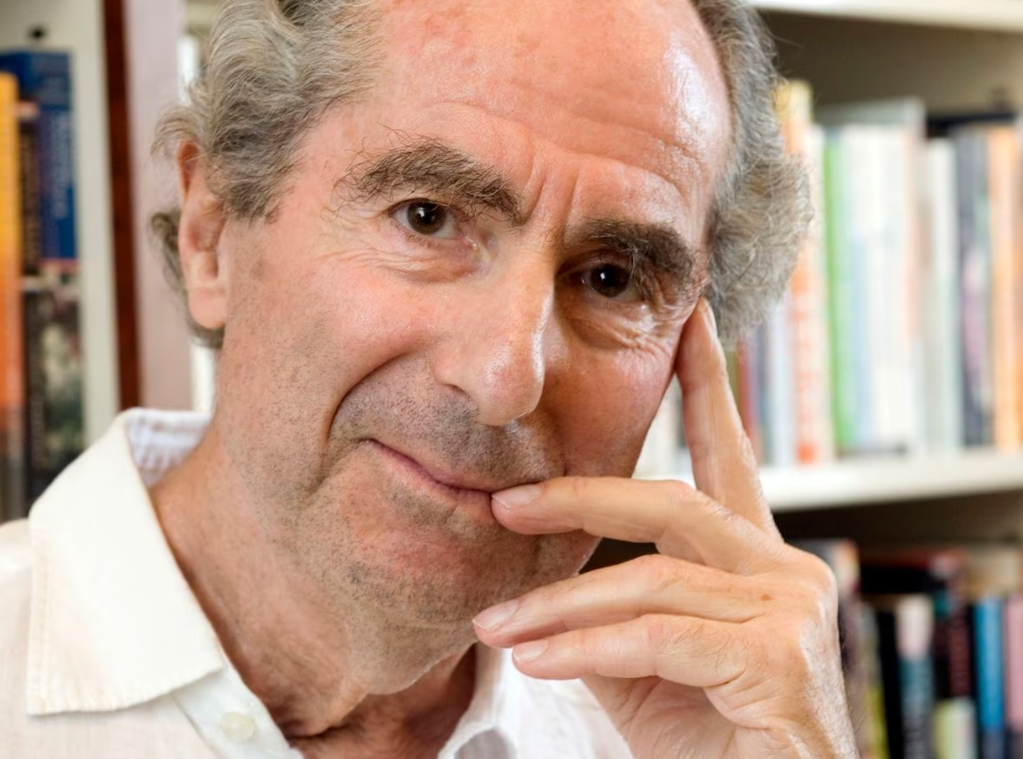
Philip Roth. Such a dirty, furious, brilliant mind.

Clearing out the museum of Mom

Florence was a gas. I got back a few days ago and I’m still huffing the trip’s fragrant fumes and, I admit, getting a little high. It was an idyllic sojourn: the friendliest, prettiest people; piquant pizzas and pleasing piazzas; huge marble slabs of history; staggering art; so much gelato you could vomit. And dogs — a festival of dogs.

I’m leaving on a jet plane yet again in a week, but this one isn’t for vacation; it’s for vacating. My brother and I are going to the San Francisco Bay Area to clear out my late ole Mom’s condo and put it on the market. We are vacating the abode of its current renter and as much furniture and stuff as we can in a short stretch of time, about six days. It could be a herculean errand, or it might snap into place like Legos.

Mom passed in late 2019, so this isn’t really a mournful visit, though it is naturally tinged with blue-hued rue. Ghosts, memories, love and misses. We have to riffle through reams of photos — that’ll be fun and painful and snoringly tedious — and decide what things we want and what can hit the curb. My brother can’t wait to get his grubby hands on this damn metallic rabbit Mom placed next to the toilet. It’s probably spattered in urine.

Save for that weird rabbit, there’s nothing original about any of this. It’s just another life stage, a serial speed bump that most of us have to go through. My turn. Yawn. 

Yet we’re going to make the most of it, dammit, back in the Bay Area bosom we grew up in. From the San Francisco airport, we’re beelining it to our favorite restaurant in Chinatown, House of Nanking, a bustling joint we used to line-up for before they expanded a bit. I like their zesty food so much — especially the Nanking Sesame Chicken — and the surly, snappish owner, that I still wear one of their neon-bright t-shirts. 

Then it’s down to business. For a while. 

We’ve planned other sidelights to sustain our spirits and energy. Like a special dinner at chef /author Alice Waters’ legendary Chez Panisse in Berkeley. This is quintessential farm-to-table California cuisine, which Waters practically invented. I’ve eaten there before. It’s spectacular, an institution. My brother, the foodie who’s been to them all, says it’s his favorite restaurant. We’re spoiling ourselves. We’ve also slated a day and dinner in Napa. Boo-hoo for us. 

Still, getting real, the trip won’t be fun; a few good meals can’t blot out the grim reality of the situation. Fortunately, Mom left a fastidiously tidy home, decorated with utmost taste and artistic flair. (We will be plundering her artwork and art books for sure.) She had class, and we want to honor that by doing this dirty work with a soupçon of respect.

We’re dismantling a life, in a way, dislodging and dispersing things that defined a real person. And we’re a part of it. My travel photographs adorn a wall. A painting my brother made of David Bowie adorns another wall. And so on. 

I think of the place as a museum of Mom — meticulous, magnificent —  carefully curated, painstakingly, and with inexpressible love. We have our work cut out for us. 

Quote of the day: Exactly how I feel about it

“Boy, when you’re dead, they really fix you up. I hope to hell when I do die somebody has sense enough to just dump me in the river or something. Anything except sticking me in a goddam cemetery. People coming and putting a bunch of flowers on your stomach on Sunday, and all that crap. Who wants flowers when you’re dead? Nobody.” — Teen philosopher Holden Caulfield

Dying for our sins, and for Italian food

Like many Catholic countries, Italy is crawling with crucifixes, and Florence, where I’ve been for four days so far, is inescapably swept up in the cross craze. The objects, often beautiful pieces of art, are bloody, baroque, humdrum and horrific — a whole cross-section. 

Jesus died on the cross and we know that wasn’t pleasant. Naked, nailed, speared, bleeding, suffocating … you get the picture.

I do too. But what I don’t get is the exuberant, even perverse glorification of Christ’s grisly death. I sort of understand the symbolic power of it all — God willed it — yet wonder why people wear one of history’s worst torture devices around their necks. (And I wonder why so many heavy metal bands are morbidly obsessed with them. Dude!)

Speaking of bodily torment, today I stumbled on the rabidly popular sandwich stand All’Antico Vinaio — the kind of place with lines out the door — where I had been hoping to go but had no idea where it was. Pure kismet. This was after I took in a sprawling and mind-altering M.C. Escher (he sounds like a Dutch rapper) exhibit at the Museum of the Innocents, whose name has guilt written all over it. I didn’t know Pink Floyd was so into Escher, but it makes almost comical sense.

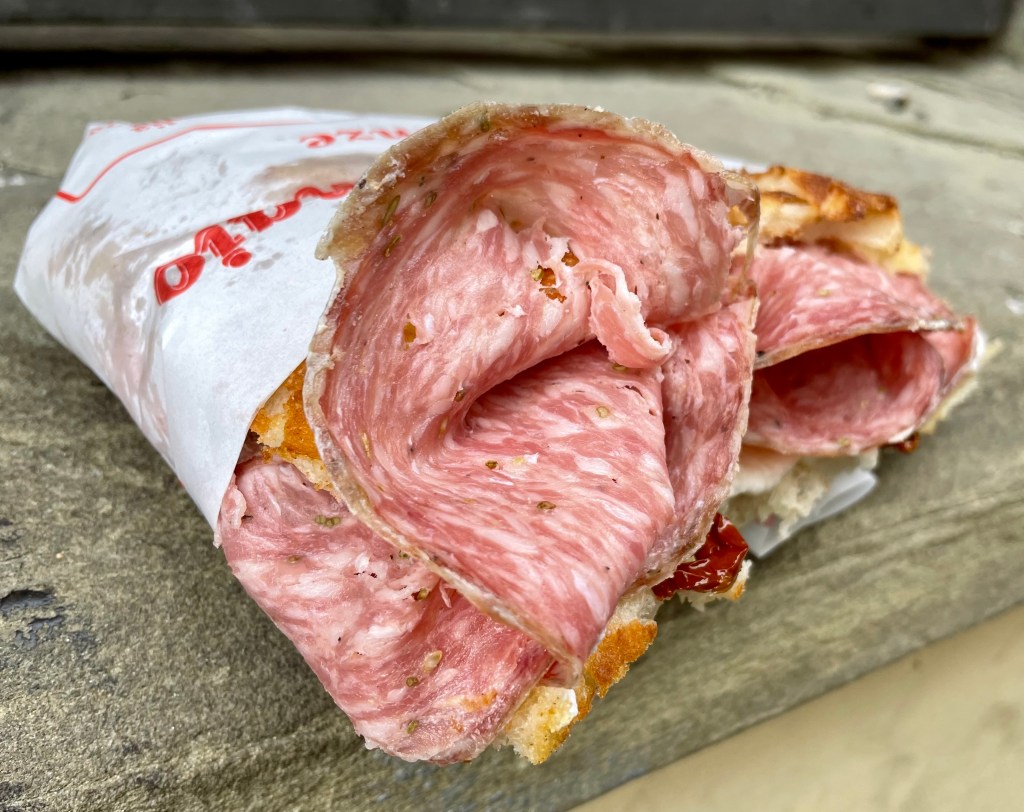
I couldn’t read the big menu board at the sandwich place — Italian and all — but I finally settled on the Firenze for seven euros, or just over seven bucks. The baseball mitt-sized meal consists of six heart attacks worth of salami, creamed parmesan and sun-dried tomatoes, stuffed between thinly sliced focaccia. It was fantastic, popping with flavor, and totally unfinishable. The pigeons had a frenzied feast.

The night’s meal is typically the highlight of the day and must be meticulously researched. For dinner I went to an old-school trattoria — defined as an “Italian restaurant serving simple food” — that ratings aggregates go gaga for. Even Michelin backs this joint. It was fine, but mostly wound up being overrated by dint of its noble, been-there-forever history. The giant glass of house wine was a plus at a meager four euros. I maybe eat one or two steaks a year and I ordered a sirloin (Florence is famous for superior steaks) and a seven-euro salad that was actually a few floppy, naked leaves worth about 15 cents. 

The steak was solid, but it dawned on me: As yummy as they are, steaks are like pancakes — they get boring about half-way through. I was glad I didn’t get a true “Florentine” steak that so many diners got and chewed on for like an hour. Those meats are the size of the cut from the opening credits of “The Flintstones,” a slab so big it tips over Fred Flintstone’s car.

As far as Florentine greatest hits, the other day I visited the awesome 17-foot-tall marble nudist David, by Michelangelo. I didn’t mention it before, but here’s a peek (it’s almost obligatory, isn’t it?):

One of the hottest books of the year is cool to the touch

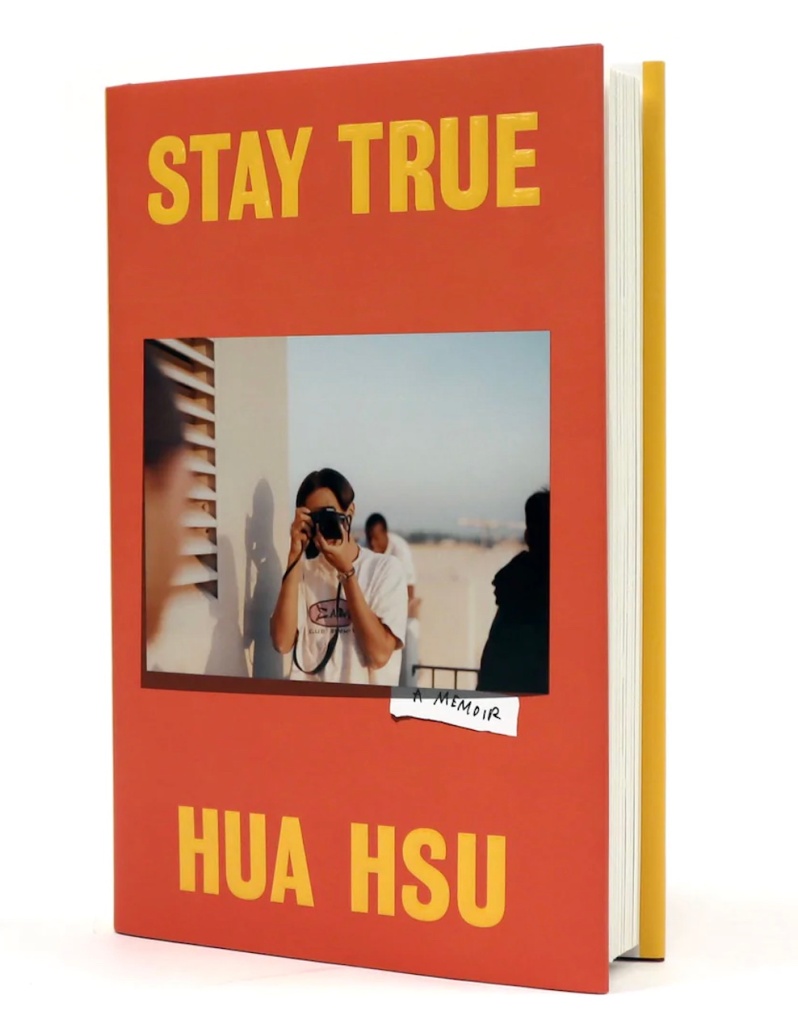
Funny how you can admire a book without fully liking it. That’s the case with the lavishly overpraised memoir “Stay True” by New Yorker writer Hua Hsu, which was named one of the 10 best books of the year by The New York Times and made book reviewers get all moist.  

It’s a baffling response to a book whose prose contains no electricity, no buzz. A book that rather lies there, dry, ho-hum and humorless. 

And yet Hsu reveals authorial gifts by showing what even a mildly engaging story can do: carry you along with raw pathos, stripped of punch and pyros. Though the book sputters at the half-way point — Hsu’s early years at UC Berkeley in the ‘90s aren’t as novel or riveting as he thinks they are — it occasionally grazes the profound with ranging reflection that delivers a spurt of substance. 

Still, missteps abound. Women, for instance, are almost totally absent for most of the book, noted in passing by first names only, granted the vaporous texture of ciphers. I don’t recall one speaking, even when Hsu at last finds a dimly sketched girlfriend.

Not even his Asian identity issues (he’s Taiwanese American), his mania for alt-music, or especially the zines he publishes pop off the page. These are exciting topics, but we’re left thirsting. While a huge fan, I find most New Yorker writing to be self-consciously restrained and prim. Staff writer Hsu suffers from a chronic case of New Yorker-itis.

But at least it feels real, which memoirs like Mary Karr’s aptly titled “The Liars’ Club” definitely do not. Which makes “Stay True” also aptly titled. (I find pretty much all memoirs to be 15-20% made up — there’s simply no way such decades-spanning reportage can be true — but that’s pulp for another blog.)

This book is about friendship and the violent loss of it and the hole it leaves. Hsu meets his friend Ken —  who’s mostly depicted as a one-dimensional cut-out — at college and they become best bros (Ken is in a frat, something initially anathema to the “outsider” Hsu). Ken is soon ripped from the narrative and we’re supposed to be crushed. 

But the loss of a character we barely knew is treated with a remove that makes it hard to share an emotional wallop. Believing otherwise, Hsu writes: “I was a storyteller with a plot twist guaranteed to astound and destroy.”

Not quite. “Stay True” misses its mark, but by feet, not yards. A few sentences jiggle with magic — “Their beats sounded like death rearranging furniture in the underworld,” Hsu notes about a rap group — and the closing passages of this slim volume emanate a cathartic warmth that’s AWOL in the gangly prose of the first 100-plus pages.

In the end, Hsu wants the truth to pierce. Here, it merely pinches. 

***

Ten books I really liked this year:

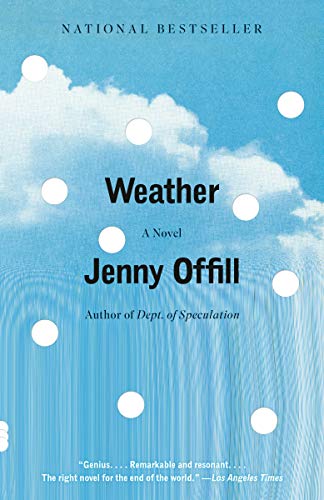
“Asymmetry” (Lisa Halliday); “Eleven Kinds of Loneliness” (Richard Yates); “The Copenhagen Trilogy” (Tove Ditlevsen); “Heat 2” (Michael Mann and Meg Gardiner); “Either/Or” (Elif Batuman); “How Should a Person Be?” (Sheila Heti); “Weather” (Jenny Offill); “Wildlife” (Richard Ford); “A Manual for Cleaning Women” (Lucia Berlin); “The Idiot” (Elif Batuman).  

Going out in a blaze

There’s the scratch and sizzle of a striking match. Then the blue-orange blaze that ignites the shrouded body, which is wreathed in marigolds. Then … foof! … all is rising flame and billowing smoke. The corpse begins to burn. It will do so for hours, until all that remains is a heap of ash and bone.  

I witnessed such sacred funeral pyres on the Ganges in India and on the Bagmati River in Nepal some years ago. I didn’t stumble upon them; I sought them out as quasi-spiritual pilgrimages. My slightly morbid, slightly practical fascination with death led me there. Beholding the ritualized smoke and fire, I felt privileged and humbled.

What I didn’t feel was awed. Death is deeply quotidian to this non-believer. There is nothing mystical, magical or celestial about it. Ashes to ashes, dust to dust, with no heaven, hell or afterlife to follow. Pardon the party-poopery.

Seeing these holy spectacles, my thoughts toggled between where the spirit goes (er, nowhere) and the fact that I was simply watching large bonfires almost beautiful in their pageantry. Any psychic weight was emotional — these were real, beloved humans — and philosophical — what does it mean? — and not, at last, spiritual. 

I’m brought to these memories by a spread in today’s Times about the only public open-air funeral pyre in the U.S., located in the small, dusty town of Crestone, Colorado. The story follows an 81-year-old resident from the last stages of his illness to his outdoor cremation:

“He knew his body would be wrapped into a simple shroud, carried on a wooden stretcher into an enclosure, and placed on a platform a few feet from the ground,” the story goes. “His sons and his wife would light the fire and watch his body burn for several hours. The next day, they would collect the ashes.”

While pyres are rare, cremation in the States is hot stuff. In a statistical shift, more than half of Americans are cremated after death, and you can be sure that’s how I’m getting out of here. Embalming is for chumps, religious beliefs be damned, and casket funerals are so much ceremonial claptrap — wasteful, ghoulish, quixotic. (You can read about far more creative and eco-friendly ways to be put to rest here and here.)

The Hindus have it down. Across Asia they practice communal, public pyres that almost anyone can chance upon and witness. They are solemn. Tears are shed. But for some reason they are not private family affairs, but rather regal roasts for all to see. Crestone, Colorado, is on to something.

Yet as much as I respect it, that’s not for me. Let me say — family, listen — I do not want to be burned on a communal funeral pyre for public consumption. A high-tech, high-temperature crematorium is just fine, and afterward, as I’ve said, do what you will with my ashes. I suggest salt and pepper shakers. 

What I saw in India and Nepal was real and powerful, despite my spiritual doubts that border on irreverent. I’m of two minds, the sacred and the profane, but a bit closer to one than the other. Guess.

Funeral pyre, Nepal

‘Tis the season to chillax

2020 bit, hard. Somehow 2021 was just as rotten. 2022 looms — turn the page and all that. Don’t hold your breath. It’s going to be another shit show.

What’s been on the menu of wonderfulness? In short: family deaths, illness, Covid and its spawn-of-Satan variants, political/racial/social outrages, chronic insomnia, that gnarly pimple on my forehead last summer — the usual maelstrom. 

Complaining about, even inventorying, these things is by now beyond trite. So we saunter ahead and seek purpose and palliatives, things that distract and dull the pain. 

Like … hell, I don’t know. A stiff drink? (Yep.) Christmas carols? (Bah!) How about just a mindset adjustment, a way of looking at the world in a soft-focus haze rather than the cold, klieg-light glare we’re currently deploying? 

Things are pretty bad, but for most of us, most of the time, they’re not catastrophically bad, are they? Maybe they are. I’ve had my share of catastrophes in these gloomy times — some bad, some badder — and yet I’ve still found resilience, wisps of hope.

It’s a matter of focus and self-possession. If at all possible, we need to mellow. Take a deep breath wrapped in a sigh. We’re starting to hit the I’m-over-this-shit button, yet we’re in for more bone-cracking cold. Hang tight. But not too tight.

Maybe this is a call for self-improvement. For our quirks and foibles — our hideous flaws — to get tweaked and kneaded into something softer and more accepting. And more helpful.   

Me, for instance. I own a roiling anger that springs from fighting life, resisting and pushing, sparking off it, flint-like. I strain and recoil, writhe and seethe. It isn’t helping. I need to cork it. Clonazepam does only so much. 

I don’t do New Year’s resolutions — hardly a novel stance — but if I did one it would be to ride the next wave with the mettle and determination of that young surfer who got her arm bit off by a shark but keeps on shredding half-pipes like nothing ever happened. Limbs are missing. Still, we carry on.