“She notes that her husband’s family used bacon slices as bookmarks.” — from a review of Anne Glenconner’s memoir “Lady in Waiting,” in The Times
Good question
“What Do I Buy My Stepmother Who I Kind of Hate?” — Amy Sedaris’ advice column in New York magazine
Great — or grody
“Cocktails Are Sandwiches. Now Deal with it.” — headline on trend piece in Grub Street, in which drinks taste like subs, paninis and hoagies
Say again?
“I love being immersed in water, but I don’t like being wet.” — actress Tracee Ellis Ross in The Times
Tea-bagging, literally
“The pet I’ll never forget: Moon the gorgeous, stupid doberman, who scalded his testicles in hot tea” — headline inThe Guardian(from a funny essay here)
“The idea of meeting someone in a library, in the aisle of a bookstore or while reading on the subway, for instance, remains stubbornly high on the list of many people’s romantic fantasies.” — from The New York Times (link below)
I admit there are few things more alluring to me than an attractive woman reading a book or browsing in (or working at) a book shop or library. It’s a smashing combo, a kind of electrifying alchemy that I can’t quite explain.
For instance, in the 1946 noir “The Big Sleep,” I’ve always been partial to the bespectacled bookshop proprietress played by Dorothy Malone than to Bogart’s famous glamor squeeze Lauren Bacall — a nerdy example of my bookish bent.
My personal history of amore is lucky with literature. There was blue-eyed Guen, who brought on our first date a copy of David Mamet’s “Writing in Restaurants,” just for me. Laura, who made my knees buckle from afar, was toting the poems of Herman Hesse (we were soon a couple).
One of my biggest crushes was on the girl who worked at the hippest book store in Austin. Then there was the woman who, after a little wine, insisted we go browse the local used book store and buy each other a volume. Now we’re talking.
On the flip-side, I once invited a date to my place. She looked around at the Rothko print and various vintage movie posters, all without comment. Then she eyed my bookshelves and scoffed, “You have way too many books.” Deal-breaker!
Like movies, books are crucial to me, and a shared passion for them is just that — shared passion. It’s something in common, hot to the touch, and can be the bedrock of something more intense, meaningful and feverish.
All this was stirred up reading the above mentioned story in the Times titled “Is Reading the Hottest Thing You Can Do as a Single Person?” (Answer: yes.)
“When you read the list of Trump’s purported lies, they are absolutely incredible. His claims aren’t just false; they’re transparently, incandescently stupid. This was not a sophisticated effort to overturn the election. It was a shotgun blast of obvious falsehoods.” — David French, The New York Times
“By the time I was in high school, I hated everything, had nothing nice to say, and kept all my positive aspirations squeezed tightly inside a tortured fist of perfectionism.” — Ottessa Moshfegh, author and novelist
Today was a two-errand day. I was picking up a modern classic potboiler at the library — the one about a ginormous great white shark that terrorizes the bejesus out of a New England beach town — and I was getting my periodic pedicure at the salon. I dubbed the day “ ‘Jaws’ and claws” to amuse myself. (Mission accomplished.)
The book I got really is “Jaws,” Peter Benchley’s 1974 blockbuster that spawned Spielberg’s famous film and a million petrified beachgoers around the world. As a kid, I lived in beachy Santa Barbara when both were released, and I fantasized about flesh-shredding teeth and ominous dorsal fins to unhealthy degrees. It terrified me, and I loved it.
First I worshipped the movie, which I saw at age 7, then I snatched my parents’ mass market paperback of Benchley’s novel and gobbled it up at age 8. I savored those pages, slashing with vivid, violent writing that helped turn me onto reading for a lifetime.
I still own that cracked, yellowed paperback, but it’s packed away with other mementos. So, on a whim, I hit the library up for its copy. I quickly located some of my favorite passages, ones that haunted — and excited — me as a young reader.
Just like my own copy
Can you handle it? This horrifying scene is from the opening of the book, when a young woman — recall her from the movie — takes a skinny-dip in the moon-dappled ocean.
“The fish smelled her now, and the vibrations — erratic and sharp — signaled distress. The fish began to circle close to the surface. Its dorsal fin broke water, and its tail, thrashing back and forth, cut the glassy surface with a hiss. …
“At first, the woman thought she had snagged her leg on a rock or a piece of floating wood. There was no initial pain, only one violent tug on her right leg. She reached down to touch her foot, treading water with her left leg to keep her head up, feeling in the blackness with her left hand.
“She could not find her foot. She reached higher on her leg. Her groping fingers found a nub of bone and tattered flesh. She knew that the warm, pulsing flow over her fingers in the chill water was her own blood. Pain and panic struck together. The woman threw her head back and screamed a guttural cry of terror.
“This time the fish attacked from below. It hurtled up under the woman, jaws agape. The great conical head struck her like a locomotive, knocking her up out of the water. The jaws snapped shut around her torso, crushing bones and flesh and organs into a jelly.”
Now, as a young boy, this was about as stupendously visceral as prose could get. (And I omitted the rest of the violence for reasons of taste and space.) “A nub of bone and tattered flesh” — I reread that line over and over, shocked, thrilled, gobsmacked.
Even today, these opening pages stun. Getting the book at the library, I was hoping Benchley’s eloquence would strike me again, and it did. That’s why I shared some here.
Call him a hack or a mercenary, but you’d be wrong. Benchley’s a savvy craftsman, expert at tension and thrills, not to mention a vibrant stylist with a painterly (think Francis Bacon) flair. His humans, from Quint to Brody, pop off the page even if the world he confects for them occasionally brushes pulp.
I’m not going to reread the entire novel, which is remarkably short at 278 pages, but it was fun revisiting a book that so influenced my cultural life.
Why “Jaws,” why now? Well, I’m reading an excellent new book about the history of Hollywood and the Academy Awards called “Oscar Wars,” and I’m deep in the chapter focusing on the making of “Jaws” (as well as “Barry Lyndon,” “Dog Day Afternoon,” “One Flew Over the Cuckoo’s Nest” and “Nashville” — 1975 was a hell of a year in American film.)
The lore is notorious: Making the movie “Jaws” was a prolonged ordeal and near-disaster for all involved, including a 26-year-old Steven Spielberg, who was sure his nascent career was finished. We know how that turned out.
If the movie “Jaws” remains one of my all-time favorites — in a crowded field that includes “Heat,” “All About Eve,” “Sweet Smell of Success,” “Manhattan,” “City Lights,” “Seven Samurai,” “Duck Soup” and on and on — the novel “Jaws” is more of a sentimental gem. It’s dear to my heart for reasons that go beyond art. On a nostalgic level, it has — yes, I’ll say it — sunk its teeth in me. And it won’t let go.
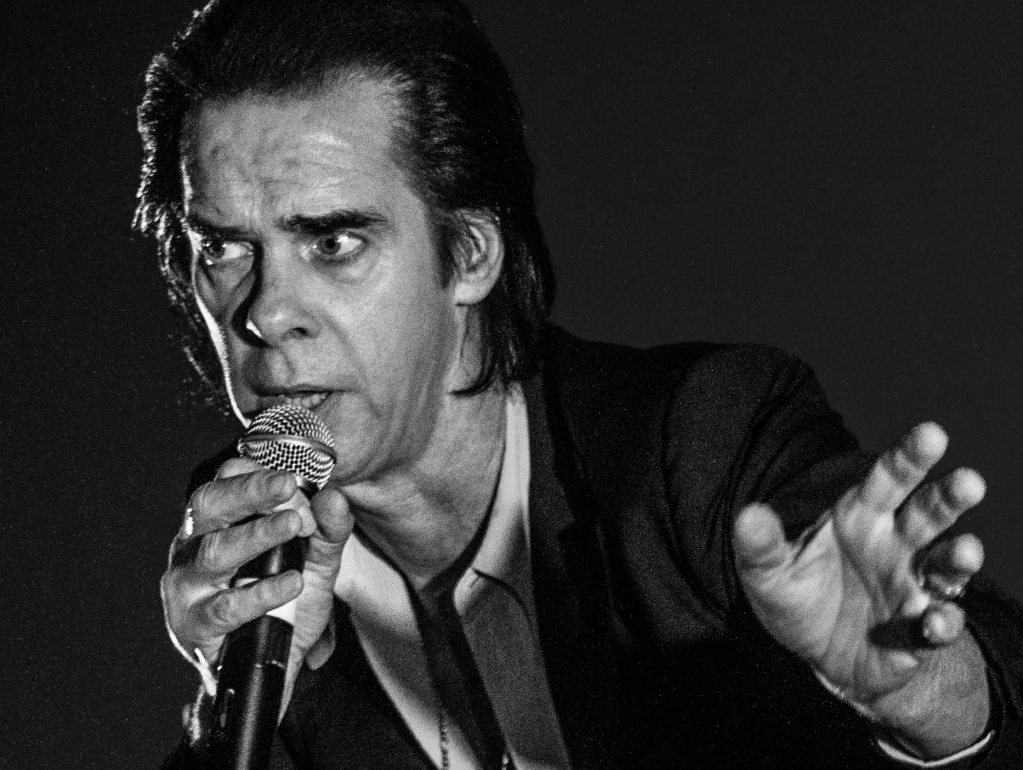
Nick Cave — Australian musician, composer, filmmaker, writer, artist, actor, all-around Renaissance man, with slick black hair and natty suits hanging off a long, pencil-thin frame — runs a sage, funny and heartbreakingly sincere advice column on his website The Red Hand Files. His counsel is so sharp and impassioned, you wonder: What can’t the guy do? I bet he can fly.
Recently, a precocious 13-year-old boy wrote in, asking this: “How do I live life to its absolute fullest, and not waste my potential? Especially as a creative. Also, what is a great way to spiritually enrich myself, in general, and in my creative work?”
I relished Cave’s response so much, I am excerpting a chunk of it here.
These are, to me, words to live by:
“Read. Read as much as possible. Read the big stuff, the challenging stuff, the confronting stuff, and read the fun stuff too. Visit galleries and look at paintings, watch movies, listen to music, go to concerts — be a little vampire running around the place sucking up all the art and ideas you can. Fill yourself with the beautiful stuff of the world. Have fun. Get amazed. Get astonished. Get awed on a regular basis, so that getting awed is habitual and becomes a state of being.”
“Boy, when you’re dead, they really fix you up. I hope to hell when I do die somebody has sense enough to just dump me in the river or something. Anything except sticking me in a goddam cemetery. People coming and putting a bunch of flowers on your stomach on Sunday, and all that crap. Who wants flowers when you’re dead? Nobody.” — Teen philosopher Holden Caulfield
Talking on the phone with my Dad once in my early twenties, I used the word “funner” as an adjective and, stickler that he was, he busted me.
“That’s not a word,” he intoned.
Oh. I sat there chastened, my cheeks pink.
I was a burgeoning word freak but Dad was the authority, the maestro, a journalist and wordsmith for decades who loved dissecting language, adored puns (he was the worst!), and collected clichés with a far-flung dream of making a board game out of all the hoary, hackneyed maxims, platitudes and banalities he scribbled down on everything from receipts to cocktail napkins.
Say something nakedly trite and he would call you out — ha! — scramble for a pencil and jot down the howling cliché you dared utter. Can you imagine what kind of game that would be? Either brilliant. Or inordinately annoying. Anyway, it never came to be.
Back to “funner.” Apparently that isn’t a real word. At least according to my father. And that has stuck ever since. I never say “funner.” Yesterday my brother used the word “funnest” and I pulled a Dad and said that’s not a word. My brother gave me the stink-eye and started making a voodoo doll of me.
But I was wrong. Sort of.
Here’s what the New Oxford American Dictionary says: “The comparative and superlative forms funner and funnest should only be used in very informal contexts, typically speech.”
That’s good news — informal contexts, typically speech. Just how I used funner.
However, an online teacher says this: “The next time students ask why they can’t say ‘funner,’ I say it’s because ‘fun’ was originally only a noun and the -er and -est forms are not commonly accepted. Stick to ‘more fun’ and ‘the most fun.’ ”
And another site avers: “There’s something funny about the word funner. It has the sound of a word twisted for the sake of a game of Scrabble, and any mention of it is liable to draw the response of, ‘Do you mean more fun?”
No! I mean funner! There, I said it, so many years later. Funner.
So, Dad, on this count you might have been off. I’m using funner as an adjective — better late than never. And with that phrase I’ve given you a moldy cliché for your board game, which would have surely been the funnest game of clichés ever.
Language is always evolving, especially between the formal and the colloquial. Take “over” vs. “more than,” for example. Both are now used to mean more than if used before a number or quantity, as in “This cost over four dollars.” That once was a stylistic no-no, but increasingly “over” is an acceptable substitute.
I’m a word nerd. Love the language, love quips, innuendos, alliteration, even puns, which come tragically easy to me. I like big hairy words that have tentacles and teeth.
I do indeed find words fun. I find writing funner. I find finishing writing funnest of all.




 GNASHING.