Jotting down life

I’ve been journaling since 1994, and the unrelieved banality of my journals not only disappoints me, it lances me, makes me realize how crushingly uneventful, how downright nondescript, my life has mostly been. 

Or has it?

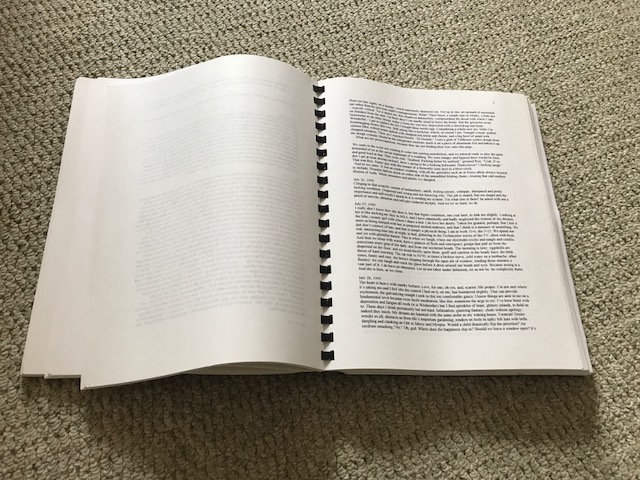
Of course there are highs and lows recorded in the reams of pages I clutch and possess with paternal jealousy, some on paper, such as Moleskin notebooks, but most in digital files stored on my well-backed-up laptop. 

That much verbiage can’t be all bad, and some of it, I humbly admit, is pretty all right. I’ve lived loudly. I’ve loved amply. I’ve travelled widely. I’ve won awards. I engage my myriad interests. And my friends and family are tops.

Rereading some old entries has triggered surprise and delight at a deft phrase, a funny observation, a jolting memory, or a nostalgic or sentimental rush. And none of it is performative; it’s for me and me only.

I have perused past journals raptly, and felt a strange exhaustion afterward, as if the words exhilarated me, hauling me through a woozy time-warp. Like: getting violently ill twice in Thailand in ’95; the great break-up of ’01; being shortlisted for a Pulitzer in ’06; Mom’s death in ’19; Dad’s passing the following year; and so much more.

I’ve done a decent job filling life’s canvas and, with equal fervor, filling pages about it all. This is starting to sound like a valediction, like I’m in hospice or something. That’s hardly the case. I’m merely musing, and that’s what journaling is about — navel-gazing, woolgathering, reflection and introspection. It’s capturing the milestones and the millstones, the highlights and the lowlights.

Almost always it’s simple recording, dull, everyday stenography. Like this I typed yesterday: “I lie in bed, trying to wrest another hour or so of sleep from the morning, and all it amounts to is tossing and turning and amplified anxiety, ugly thoughts and visions. It is torture.”

It can be dark, indulgent, meaningless, like the above. Even so, getting it down is the heart of the process. Journaling is purging, an irrigation of the brain and pipes of the soul. If lucky, it provides fuel for future scribblings. 

Some of my journals, printed and bound

A famous writer says to “mine your journals” for essay and blog material, something I’ve taken to heart. Dreary daily bulletins can be spun into content, stories, little narratives. Sometimes they are inspired, like gold; other times (too often), they’re gruel. 

So now when I return to this post’s opening graph, I think it’s all wrong. My journals aren’t reserves of the uneventful and the nondescript — the banality of drivel — but contain just enough substance of a full life. 

I’m no journaling master. And I obviously haven’t mastered this life thing. Last week in the airport, on the way to Scotland, I did some journaling. I’ve plucked a snippet from that entry, a sentiment that holds true for that trip, for writing, and for life as a whole:

“I still don’t know what in the hell I’m doing. I really don’t.”

How ‘Jaws’ ate me alive

Today was a two-errand day. I was picking up a modern classic potboiler at the library — the one about a ginormous great white shark that terrorizes the bejesus out of a New England beach town — and I was getting my periodic pedicure at the salon. I dubbed the day “ ‘Jaws’ and claws” to amuse myself. (Mission accomplished.)

The book I got really is “Jaws,” Peter Benchley’s 1974 blockbuster that spawned Spielberg’s famous film and a million petrified beachgoers around the world. As a kid, I lived in beachy Santa Barbara when both were released, and I fantasized about flesh-shredding teeth and ominous dorsal fins to unhealthy degrees. It terrified me, and I loved it. 

First I worshipped the movie, which I saw at age 7, then I snatched my parents’ mass market paperback of Benchley’s novel and gobbled it up at age 8. I savored those pages, slashing with vivid, violent writing that helped turn me onto reading for a lifetime. 

I still own that cracked, yellowed paperback, but it’s packed away with other mementos. So, on a whim, I hit the library up for its copy. I quickly located some of my favorite passages, ones that haunted — and excited — me as a young reader.

Just like my own copy

Can you handle it? This horrifying scene is from the opening of the book, when a young woman — recall her from the movie — takes a skinny-dip in the moon-dappled ocean. 

“The fish smelled her now, and the vibrations — erratic and sharp — signaled distress. The fish began to circle close to the surface. Its dorsal fin broke water, and its tail, thrashing back and forth, cut the glassy surface with a hiss. …

“At first, the woman thought she had snagged her leg on a rock or a piece of floating wood. There was no initial pain, only one violent tug on her right leg. She reached down to touch her foot, treading water with her left leg to keep her head up, feeling in the blackness with her left hand.  

“She could not find her foot. She reached higher on her leg. Her groping fingers found a nub of bone and tattered flesh. She knew that the warm, pulsing flow over her fingers in the chill water was her own blood. Pain and panic struck together. The woman threw her head back and screamed a guttural cry of terror.

“This time the fish attacked from below. It hurtled up under the woman, jaws agape. The great conical head struck her like a locomotive, knocking her up out of the water. The jaws snapped shut around her torso, crushing bones and flesh and organs into a jelly.” 

Now, as a young boy, this was about as stupendously visceral as prose could get. (And I omitted the rest of the violence for reasons of taste and space.) “A nub of bone and tattered flesh” — I reread that line over and over, shocked, thrilled, gobsmacked. 

Even today, these opening pages stun. Getting the book at the library, I was hoping Benchley’s eloquence would strike me again, and it did. That’s why I shared some here. 

Call him a hack or a mercenary, but you’d be wrong. Benchley’s a savvy craftsman, expert at tension and thrills, not to mention a vibrant stylist with a painterly (think Francis Bacon) flair. His humans, from Quint to Brody, pop off the page even if the world he confects for them occasionally brushes pulp.

I’m not going to reread the entire novel, which is remarkably short at 278 pages, but it was fun revisiting a book that so influenced my cultural life.

Why “Jaws,” why now? Well, I’m reading an excellent new book about the history of Hollywood and the Academy Awards called “Oscar Wars,” and I’m deep in the chapter focusing on the making of “Jaws” (as well as “Barry Lyndon,” “Dog Day Afternoon,” “One Flew Over the Cuckoo’s Nest” and “Nashville” — 1975 was a hell of a year in American film.)

The lore is notorious: Making the movie “Jaws” was a prolonged ordeal and near-disaster for all involved, including a 26-year-old Steven Spielberg, who was sure his nascent career was finished. We know how that turned out.

If the movie “Jaws” remains one of my all-time favorites — in a crowded field that includes “Heat,” “All About Eve,” “Sweet Smell of Success,” “Manhattan,” “City Lights,” “Seven Samurai,” “Duck Soup” and on and on — the novel “Jaws” is more of a sentimental gem. It’s dear to my heart for reasons that go beyond art. On a nostalgic level, it has — yes, I’ll say it — sunk its teeth in me. And it won’t let go.

The reluctant bachelor

In my 30s, a pair of well-meaning coworkers nominated me for a title in a big-city glossy magazine that makes me blush even as I type this so many years later. 

The magazine was a strenuously vapid thing, slathered in food and lifestyle pap, all of it mawkishly upbeat. To attract page after Technicolor page of blaring ad copy, it was shamelessly obsessed with ratings and lists: Best Barbecue! Best Campsites! Best Burgers! Best Places to Get Off!

City magazines with ample ad revenue are like that. They traffic in pretty pictures of manicured affluence, catering to the beauty-salon and doctor’s office crowds. Without being trendy themselves — they are woefully unhip —  they try to manufacture trends. Only dingbats actually pay money for the periodical, which is so cloying, you could barf. 

That said, I admit up front that I participated in this paragon of sub-journalism. My coworkers nominated me for one of those knuckleheaded lists: the city’s Most Eligible Bachelors. I was flattered. I was humbled. I was mortified.

The magazine editor phoned me for a preliminary interview. And I blurted: no. I rejected the nomination. It was way out of my comfort zone. I wasn’t so desperate for a date. And this introvert definitely didn’t need the exposure, my bewildered mug spread next to an ad for the hottest tanning salon or 40 sparkly, smiley real estate agents.

I thanked my deflated pod-mates, the lovely Sarah and Sharon, and also apologized. I was being ungracious, but I didn’t have the stomach for it. 

My dis was apparently a big deal. Friends expressed dismay. My disappointed mother scolded me like I was eight. The topper: Ira Glass of “This American Life” called for a possible segment — man turns down most eligible bachelor nomination, how zany is that? — that, fortunately, never panned out. 

And yet, I’m only human.  

Forward a year: Same routine, but this time, for better or worse, I caved. I did it. I’m not sure why. I was strafed by anxiety. But I thought, what the hell, man up. 

During the in-office interview with the editor, I explained my job (movie critic, which I said wasn’t nearly as glamorous as it’s cracked up to be), noted my hobbies (world travel, books, film, drinks, drums), and things I’m not so crazy about (dancing, reggae). Asked the inevitable question of what I look for in a woman (sigh), I said something like someone bookish, worldly and intellectually curious (what a dope).

This is the story of someone quite bashful scraping himself out of his dark, lonesome shell. A comment the editor solicited for the article from one of my dearest friends, Courtney, included these bits: “His eccentricities are very endearing … Once he lets you in, you discover a kind-hearted soul.”

Yeah. That might be a bit much. But there I was in this glossy magazine with nine other “most eligible bachelors,” practically shaking in my boots with self-consciousness. Each of us filled a full color page, with no ads. In the photo, my head is enormous.

The issue hit the stands (and the beauty salons and doctors’ offices) and I braced for the worst. But instead: crickets. No one called, emailed, berated me, ridiculed me, asked me on a date, nothing. Disappointment? No, massive relief. 

I guess the moral of this tale is to get out of your self-defined — and in my case, distinctly neurotic — safe zones and take a chance on something new, even alien. I ate a whole cobra in Vietnam and got detained by Hezbollah in Beirut. A cheesy little spread in a city magazine is comparably nothing. Really. Nothing.  

Take a risk. It might be gut-wrenching. It might be exhilarating. Or it might be … crickets. 

Best. Teacher. Ever.

Reading the short bubbly novel “The Prime of Miss Jean Brodie” by Muriel Spark, I’m reminded of my own most extraordinary high school teacher back in California so many years ago. 

In the book, Miss Brodie is a 30-ish instructor of teenage girls in Edinburgh, Scotland, with unorthodox teaching ways that fellow teachers sniff at as “experimental methods.” Weeding out her sharpest pupils from the dolts, Miss Brodie selects six girls to be “the crème de la crème” — the Brodie set.

“Determined to instill in them independence, passion, and ambition, Miss Brodie advises her girls, ‘Safety does not come first. Goodness, Truth, and Beauty come first. Follow me.’”

Miss Brodie goes on: “Art and religion first; then philosophy; lastly science. That is the order of the great subjects of life, that’s their order of importance”

At that, memories tumble forth of how my junior year English teacher, Mrs. Lisa Condon, laser-focused on art, literature, theater, poetry and all things high culture. And how she quietly cherry-picked certain students to be her, for lack of a better word, pets — the Condon set. She knew who would soar amid her unconventional efforts and those who would muddle through a fog of half-assed disinterest.

I went to an unremarkable high school in the flush suburbs of the East Bay near San Francisco, notable for its cloying rah-rah school spirit (Go Wolves!) and outstanding mediocrity, from academics to sports (Go Wolves?). The place sort of asphyxiated your teenage soul.

But there were exceptions in the form of a few teachers — colorful, charismatic, quirky characters who jumpstarted their subjects to phosphoric life. They’d challenge with an uncompromising affection for the material and the students. To name a few, there was Mr. Church, Mr. Weigardt, Mr. Nelson and, above all, the fearsome Mrs. Condon.

Mrs. Condon — always in flowing floral skirts, straight brown hair down her back, peasant blouses, no makeup — was soft but a fierce taskmaster. She could scare the snot-nosed adolescence out of you and make you a college-poised pupil in the first couple weeks of class. Each week we had to write a long essay. They took me five hours, every time. For midterms, we had to memorize the verbatim definitions of 125 vocabulary words.

Mrs. Condon was no martinet. She was warm and human, if tightly wound. She hewed to principle. She knew how things should be done and expected us to follow. There was little room for compromise. At 32, she was in her prime. 

On that crummy campus, her room was an oasis of art, civilization, rules and manners. She was dedicated to culturing us, wiping the philistine smirks off our faces, getting the gears in our sex-addled heads whirring. We studied Picasso, Dalí, Blake, Hemingway, Van Gogh, Dante, DeKooning, even lyrics by Iron Maiden and Pink Floyd. There was so much more. My head exploded. (She later added classical music to her syllabus. I would have killed for that. She would have broken down and cracked open the glories of Beethoven and Mahler with passion and ferocious intelligence and her students would weep.)

And woe to those who didn’t keep up. Mrs. Condon kicked out a jock when he couldn’t identify the ongoing famine in Ethiopia (he was back in class the next day), and ejected a cheerleader for cheating on the weekly vocabulary test (she never returned).

An unreconstructed Berkeley free-spirit, she maintained a rebellious streak — a “Question Authority” bumper sticker was posted by her desk for all to see and ponder — and actually told me what teachers to avoid or enroll with.

Mrs. Condon was a force. None of my college professors grazed her instructional power. Working at my second newspaper job in my mid-20s, I wrote her a note to thank her for the cultural exposure, no matter how demanding, that she instilled in me. She wrote me back, warmly pleased I was still writing. 

A couple years before that, while in college, I ran into Mrs. Condon at a San Francisco Ballet production of Stravinsky’s “Rite of Spring.” It was an awkward reunion, clumsy and blushing and impromptu and all, but nice nonetheless. I can only think she chalked up my attendance as a small triumph. I hope so. 

“What were the main influences of your school days? Were they literary, political, or personal?” a character asks one of the Brodie set in the novel.

The girl responds: “There was a Miss Jean Brodie in her prime.”

I’d say the same, but in my version: “There was a Mrs. Lisa Condon in her prime.”

The Tao of Nick Cave

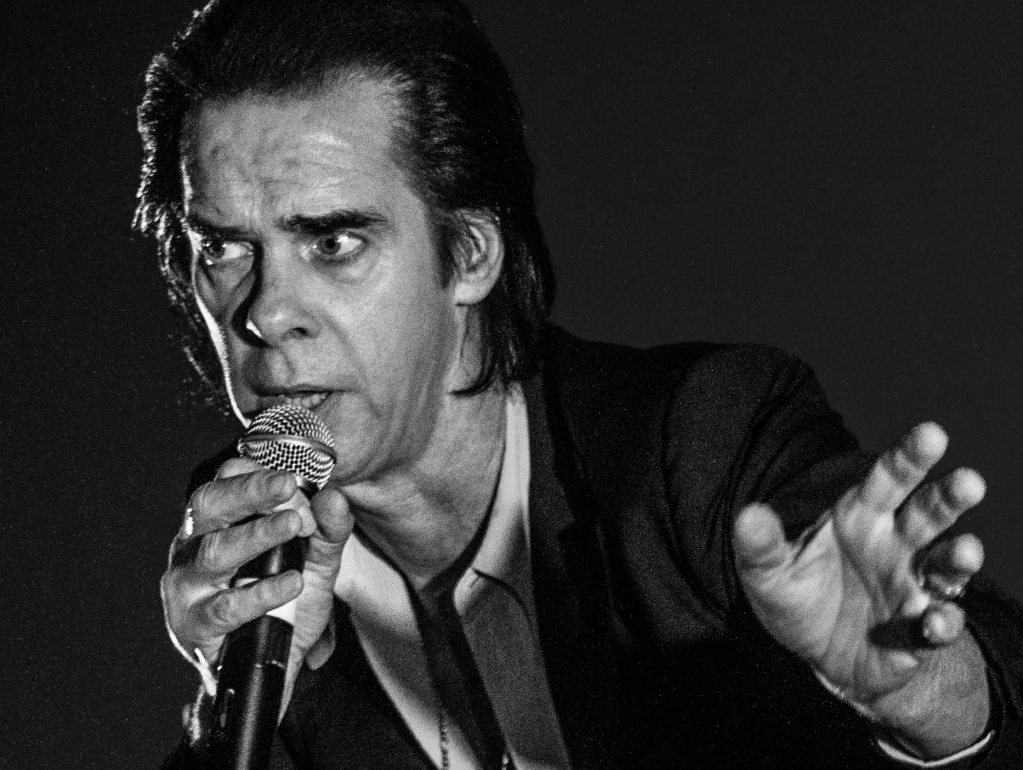
Nick Cave — Australian musician, composer, filmmaker, writer, artist, actor, all-around Renaissance man, with slick black hair and natty suits hanging off a long, pencil-thin frame — runs a sage, funny and heartbreakingly sincere advice column on his website The Red Hand Files. His counsel is so sharp and impassioned, you wonder: What can’t the guy do? I bet he can fly.

Recently, a precocious 13-year-old boy wrote in, asking this: “How do I live life to its absolute fullest, and not waste my potential? Especially as a creative. Also, what is a great way to spiritually enrich myself, in general, and in my creative work?”

I relished Cave’s response so much, I am excerpting a chunk of it here.

These are, to me, words to live by:

“Read. Read as much as possible. Read the big stuff, the challenging stuff, the confronting stuff, and read the fun stuff too. Visit galleries and look at paintings, watch movies, listen to music, go to concerts — be a little vampire running around the place sucking up all the art and ideas you can. Fill yourself with the beautiful stuff of the world. Have fun. Get amazed. Get astonished. Get awed on a regular basis, so that getting awed is habitual and becomes a state of being.”

Nick Cave — bard, baritone, Bad Seed, badass.

Raging with Roth

Last weekend, we hit a panel discussion at the Philip Roth festival in the late novelist’s hometown of Newark, New Jersey. We left it walking on intellectual air. Not smugly, but smilingly. It was heady and engrossing. Fun, funny and fascinating.

Called Philip Roth Unbound, the festival was a three-day celebration of all things Roth, from bus tours around his old Newark haunts to numerous panels parsing the formidable genius that gifted us “Portnoy’s Complaint,” “American Pastoral” and “Sabbath’s Theater,” to name some obvious masterpieces. (Need more? How about “The Human Stain” and “Everyman.”)

Our panel was irresistibly titled “Letting the Repellent In: Philip Roth and the Art of Outrage” — right up my twisted alley. A short description from the festival: 

“[A] panel on the cathartic power of discomfort. With each new novel, Roth predictably delighted and shocked readers with his frank depictions of human frailty and immorality. No aspect of behavior was spared his withering critical eye — sex, gender, race and religion were all fair game.”

I love it.

The panelists, all novelists, were a youngish quartet of publishing stars, award winners and best-sellers: Ayad Akhtar, Susan Choi, Gary Shteyngart and my personal favorite, Ottessa Moshfegh. They comprised a supergroup of sizzling hot writers, gathered to chat up Roth, his transgressive themes, techniques, cultural impact, and personal influence on each writer. 

I won’t recap the 90-minute discussion, but I will say that Choi was supremely poised and verbally chiseled; Akhtar, as moderator, navigated the discussion with shrewd erudition; Shteyngart labored to entertain with cussing and comic schtick, including some mugging (he was often very funny); and Moshfegh, coming across as a cerebral introvert and a smidge neurotic, was refreshing in her sometimes spacey reflections. 

To be surrounded by diehard Roth fans was heartening. Too often I feel that Roth is marginalized. He’s either too dirty, too angry, too offensive or too smart. His books aren’t easy; they are verbally dense, lashed in skeins of urgent ideas about life, marriage, love, sex, Jewishness, morality, death, politics, art. They are mean, unsparing, philosophically violent, crude, passionate and hilarious.

Few writers — Saul Bellow is one — could graze such dazzling complexity, that Rothian exuberance, that volcanic, (sometimes literally) orgasmic prose. “American Pastoral” (1997) is one of my top two favorite novels. It sucked my breath away with its relentless moral and artistic propulsion. It should be banned by sheer dint of how good it is.

“Sabbath’s Theater” — described by one critic as “Roth’s coarsest, frankest, and most exhilarating novel, showing off Roth’s linguistic verve, and his unparalleled ability to stare unblinkingly into the psyche of a depraved scoundrel” — is mandatory reading, a master text of style, for anyone pursuing the art of fiction. (I’m about to read it again.)

Roth died at 85, in 2018, without winning the Nobel Prize (though he received many awards, including the Pulitzer). In later years, he was regularly shortlisted, but was likely too incendiary for the milquetoast committee. Every October I would check the paper to see if it was his turn, then throw it down, crushed, livid. Bellow won it in 1976. Faulkner in 1948. Toni Morrison in 1993. Roth would fit right in that company of trailblazing masters. 

Maybe he was just too much much. Roth fans are zealous and jealous, and to see the capacity crowds at the festival, chatty and excited, reminded me the great one lives on. Or at least his challenging ideas and coruscating wit live on. We at least have that. 

Philip Roth. Such a dirty, furious, brilliant mind.

My big birthday wish list (aren’t I worth it?)

My birthday’s fast approaching. Here’s what you can get me (thanks!):

1. The hefty new book “Oscar Wars: A History of Hollywood in Gold, Sweat, and Tears” by New Yorker staffer Michael Schulman. It sounds frivolous, and a lot of it surely is, but it also promises a chunky serving of cultural history about the loved and lambasted Academy Awards, dusted with tidbits, like the similarities between two of my all-time favorite movies, “All About Eve” and “Sunset Boulevard.” Reviews say it’s compulsively readable, if you’re into that stuff, and I am. The damn thing costs $40. 

2. Monkey 47 — A deliciously complicated and original gin that’s out of my price range by a good 30 dollars. I generally wait to get this bottle as a gift. So I say to you: Go for it!

3. A pair of Black Ghost sneakers from Italian brand Oliver Cabell. They run a gulping $270 (that’s with a $68-off promotion code). But these “fashion-forward” kicks are true beauts: top-notch black leather matched with clear rubber outsoles — not white, black or gum, but clear. They’ll probably rack me with flesh-shredding blisters, but what’s searing pain in the name of unspeakable hotness?

4. Dinner for two at four-star, impossible-to-get-into restaurant Le Bernardin in New York, where you can nosh an eight-course tasting menu with caviar and langoustines for a piddling $298 per person. I promise you a doggy bag. Maybe.

5. A round-trip ticket to Istanbul in the fall. Expensive, you say? Hey, economy class is just fine. I like pretzels.

6. Any ritzy anti-aging serum that’s not hawked by Gwyneth Paltrow or Jennifer Lopez, those obscenely compensated airbrushed quacks. I’ve got a couple of crow’s feet that are absolutely mocking me. 

7. I chose seven gifts because my birthday lands on April 7. It’s a neat number, and a lucky one, too. But it’s awfully small. So how about $700 in cash, please. Cool.

Best. Birthday. Ever!

One of the hottest books of the year is cool to the touch

Funny how you can admire a book without fully liking it. That’s the case with the lavishly overpraised memoir “Stay True” by New Yorker writer Hua Hsu, which was named one of the 10 best books of the year by The New York Times and made book reviewers get all moist.  

It’s a baffling response to a book whose prose contains no electricity, no buzz. A book that rather lies there, dry, ho-hum and humorless. 

And yet Hsu reveals authorial gifts by showing what even a mildly engaging story can do: carry you along with raw pathos, stripped of punch and pyros. Though the book sputters at the half-way point — Hsu’s early years at UC Berkeley in the ‘90s aren’t as novel or riveting as he thinks they are — it occasionally grazes the profound with ranging reflection that delivers a spurt of substance. 

Still, missteps abound. Women, for instance, are almost totally absent for most of the book, noted in passing by first names only, granted the vaporous texture of ciphers. I don’t recall one speaking, even when Hsu at last finds a dimly sketched girlfriend.

Not even his Asian identity issues (he’s Taiwanese American), his mania for alt-music, or especially the zines he publishes pop off the page. These are exciting topics, but we’re left thirsting. While a huge fan, I find most New Yorker writing to be self-consciously restrained and prim. Staff writer Hsu suffers from a chronic case of New Yorker-itis.

But at least it feels real, which memoirs like Mary Karr’s aptly titled “The Liars’ Club” definitely do not. Which makes “Stay True” also aptly titled. (I find pretty much all memoirs to be 15-20% made up — there’s simply no way such decades-spanning reportage can be true — but that’s pulp for another blog.)

This book is about friendship and the violent loss of it and the hole it leaves. Hsu meets his friend Ken —  who’s mostly depicted as a one-dimensional cut-out — at college and they become best bros (Ken is in a frat, something initially anathema to the “outsider” Hsu). Ken is soon ripped from the narrative and we’re supposed to be crushed. 

But the loss of a character we barely knew is treated with a remove that makes it hard to share an emotional wallop. Believing otherwise, Hsu writes: “I was a storyteller with a plot twist guaranteed to astound and destroy.”

Not quite. “Stay True” misses its mark, but by feet, not yards. A few sentences jiggle with magic — “Their beats sounded like death rearranging furniture in the underworld,” Hsu notes about a rap group — and the closing passages of this slim volume emanate a cathartic warmth that’s AWOL in the gangly prose of the first 100-plus pages.

In the end, Hsu wants the truth to pierce. Here, it merely pinches. 

***

Ten books I really liked this year:

“Asymmetry” (Lisa Halliday); “Eleven Kinds of Loneliness” (Richard Yates); “The Copenhagen Trilogy” (Tove Ditlevsen); “Heat 2” (Michael Mann and Meg Gardiner); “Either/Or” (Elif Batuman); “How Should a Person Be?” (Sheila Heti); “Weather” (Jenny Offill); “Wildlife” (Richard Ford); “A Manual for Cleaning Women” (Lucia Berlin); “The Idiot” (Elif Batuman).