Following an acute infection diagnosed on Easter, my appendix is just super. A regimen of antibiotics, a pill as chunky as a grave adult multi-vitamin, has snuffed the appendicitis, vaporized the pain and eased worries. But not all worries. No, of course not.
The surgeon who’s my supervising physician cheered my improvement but cautioned that the infection could return in three weeks, three months, a year, who knows. He’s suggested preventative surgery relatively soon to snip out that hateful organ.
Such dreamy thoughts for the quarantine — just what I or anybody needs right now. Boy, when this all blows over, I get to have belly surgery!
Surgery sucks and so does house arrest, but distractions are plenty. Sort of. Not really. I toggle between reading and writing and watching the occasional movie (“Little Women,” “The Lighthouse,” “La Collectionneuse”).I spit words into my journal, take a brisk walk, shop for books online, practice my French (lie!), donate money to animal causes and ponder the meaning of life, this stuffy, neutered, unmoored version of it.
Chat with friends on FaceTime, you say. I don’t do FaceTime, yet I had to with my doctor a few times to discuss my ailment — his idea. It was my first time, my iPhone deflowering, if you will, and I cannot say I wasn’t mortified. It went swell.
The appendix episode has lightly anchored this adrift vessel for now, furnished a focus, given me something to gnaw on, something to be more anguished about.
My journal jots reflect some of the days’ monotony, some of the dread of what’s out there (COVID-19, a maniacal leader) and what’s inside me: “I’m cured. I am not cured. This thing, I fear, will return like a cancer,” I wrote yesterday about my pesky malady. I muse about the pets with withering boredom: “The gray cat’s eyes weep and glisten with viscous slop that congeals into a tar-like goop.” And I note time’s quarantine creak: “Grinding forth, the day leaves skid marks.” One entry reads simply: “Blech.”
Chalky-gray is the new black. Specificity has fled. Vagueness as an existential condition is unsettling. Stasis lurks. We waft, not run. Atrophy, hovering near, sees its chance.
Where are we headed? That’s the burning question, one I’m not sure I want answered.
Lorrie Moore astonishes, still, her writing shiny, poetic and brainy, the best kind of literature. It’s massively, richly human, striking each note, from humor to horror and all in between. She’s a blistering deterrent for ever trying to commit fiction. If I can’t be that good, I don’t want to be anything — that’s my thinking. My stabs at fiction have been leaden, lame, laughable.
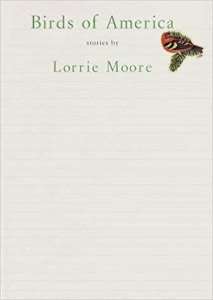
I am re-reading Moore’s acclaimed story collection “Birds of America.” On its release in 1998, a writer friend and I were both reading the book, and I told him that her writing made me jealous, defeated. “Oh, not me,” he said. “It inspires me.” (That from the guy who was a two-time Pulitzer Prize finalist in his early 20s.)
Today Moore’s ecstatic prose inspires me, too, provides oomph, a kick to my motivational motor, spurring me to tap the keys and say something, anything. That can be dangerous. If it’s any good, most writing is. (I know — that’s axiomatic.)
What I mean is, I can write stuff so sloppy, witless and rancid that it’s actually toxic — it wounds and discourages. Then I can pick up a book by Moore or her peers (say, Alice Munro or Tobias Wolff) and be pacified by sheer beauty and slashing craft and get revved again at the possibilities — the old can of spinach.
Moore’s written four story collections: “Self-Help,” “Birds of America,” “Bark” and the brand-new anthology “Collected Stories” from the prestigious Everyman’s Library Contemporary Classics. And three novels: “Anagrams,” “Who Will Run the Frog Hospital?” and “A Gate at the Stairs.”
I read the latter and liked it, but I don’t remember much about it. “Birds of America” is different. It’s stickier, droller, more dynamic, more prismatic. It’s spiky, empathic, bright and cynical. Though she’s no maximalist, less isn’t Moore:Her words contain worlds. (And her titles are often titillations: “Which Is More Than I Can Say About Some People”; “People Like That Are the Only People Here.”)
I forgot to mention the stories are also crackingly funny. Moore’s effortless humor, mostly of a mordant strain, ribbons through the dramas organically. She’s no stand-up comedian like novelist Gary Shteyngart, who’s forced and erratic. With sociological rigor, she locates the dark laughs baked in the everyday.
She is particularly good at the jolt-laugh of the unexpected:
“The next time Bill saw her, it was on her birthday, and she’d had three and a half whiskys. She exclaimed loudly about the beauty of the cake, and then, taking a deep breath, she dropped her head too close to the candles and set her hair spectacularly on fire.”
And she’s bracing when she goes darkly wise:
“This is what he knows right now, with dinner winding up and midnight looming like a death gong: life’s embrace is quick and busy, and everywhere in it people are equally lacking and well-meaning and nuts.”
My next book purchase will be “Bark,” Moore’s 2014 story collection, which I find hard to believe I don’t already own. I’ve put it off, sure that it can’t touch the brilliance of “Birds,” that it’s a disappointment in waiting. But revisiting her masterpiece blots out doubt. How can it be weak or wan? It can’t, I say. It can’t.
Thanks to the collective corona cloistering, I’ve been ordering books online, greedily. With libraries and bookshops closed, I’m buying used books from third-party sellers on Amazon and new titles from New York indie institution McNally Jackson.
Unquenchably, I’m ingesting words in the yawning vacuum of self-quarantine. Reading is nearly as nourishing as food. This is what’s on my literary plate.
I met “Birds of America” author Lorrie Moore at a book signing for that acclaimed 1998 story collection, and she wasn’t the most jolly person in the room. She was frosty to her gathered admirers, but I don’t hold that against her. Moore’s edge informs her tart, smart fiction, which is also infused with emotional immediacy and pocked with laughs. With stories like the award-winning “People Like That Are the Only People Here,” the book is a contemporary classic that hasn’t aged a whit.
Death looms these grim days, though mortality is always on the mind of this moody Cassandra. Long ago I read the updated edition of “The American Way of Death,” Jessica Mitford’s definitive 1963 exposé of the funeral racket, and I’m back at it, if not for the dazzling reportage and head-shaking stats — upshot: funeral peddlers are exploitative swindlers — then for purely great writing that makes a dismal subject pop. The book is not only essential muckraking, but lavish literary satire, nipping at a venal industry with the toothy, pit bull wit of Pauline Kael. This tangy volume is one big reason I will be cremated and thrown to the wind.
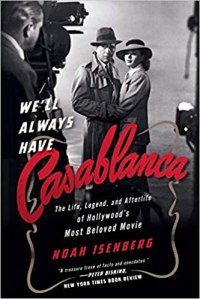
While rereading books like the above, I’m also rewatching some favorite flicks, including “Casablanca,” the evergreen masterpiece in which every element of fine filmmaking miraculously falls into place. I love a good movie book so I clicked on Noah Isenberg’s “We’ll Always Have ‘Casablanca’: The Legend and Afterlife of Hollywood’s Most Beloved Movie,” the gawky title of which tells you just what you’re delving into. I haven’t cracked it yet, but I’m hoping for historical Hollywood gold on par with the recent knockout “The Big Goodbye: ‘Chinatown’ and the Last Years of Hollywood.”
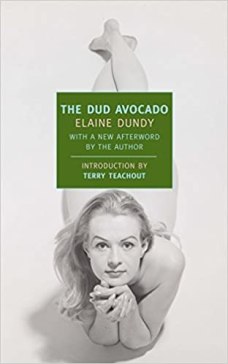
Dreaming about Paris, I tripped upon the site for fabled English-language bookshop Shakespeare and Company, that grand, musty emporium on the Left Bank,where I scrolled staff recommendations for Paris-set stories. Never mind its racy cover, I was lured to Elaine Dundy’s cult comic classic “The Dud Avocado,” a romp tracing the libertine escapades of a comely young American woman in the French capital who yearns to exist out loud. Called a “timeless portrait of a woman hell-bent on living,” the novel seems unlikely to disappoint this thwarted traveler pining for Paris. On the note of cult classics, “Airships,” Barry Hannah’s award-winning collection, promises “20 wildly original, exuberant, often hilarious stories that celebrate the universal peculiarities of the new American South.” The book hasn’t arrived yet, but it’s highly anticipated after being called “one of the most revered short story collections of the past 50 years, remaining a vital text in the history of the American short story.” And this snippet from it makes me sort of love it already: “What a bog and labyrinth the human essence is … We are all over-brained and over-emotioned.”
Raymond Chandler’s crackling and complex detective noir “The Big Sleep” scorches with style. The novel, a total delight, introduces private eye Philip Marlowe, literature’s great existential antihero, a shrugging loner with a gun, cigarettes and devastating wit. Chandler crams it with so many ravishing lines, images, similes, he elevates pulp to high literature. Marlowe, all slow-burn aplomb, speaks and thinks like the consummate smart-aleck tough: “I don’t mind if you don’t like my manners,” he grumbles. “They’re pretty bad. I grieve over them during the long winter evenings.”
“Death Comes for the Archbishop” is a western in priest’s clothing. Set in the mid-1800s, Willa Cather’s elegant epic about a gentle French bishop spreading Catholicism through Mexico and its southwest territories braids American history with lush spirituality and, at times, a mean Cormac McCarthy crunch. The title is a major spoiler, like Tolstoy’s “The Death of Ivan Ilyich,” but Cather knew what she was doing, and the foregone conclusion hits hard — and beautifully. Her eloquence is breathtaking, and the glistening lyricism comes out of nowhere to stun. Here Cather describes two men running through the desert: “They coursed over the sand with the fleetness of young antelope, their bodies disappearing and reappearing among the sand dunes, like the shadows that eagles cast in their strong, unhurried flight.”
Like many of you, we are grumblingly housebound during the seismic spread of the coronavirus, aka the Trump Pandemic, a little scared, a lot curious, shuffling clenched and downcast in a novel world of social paralyzation and dystopian edicts, woozy with the surreal and unthinkable. Enter: takeout, Amazon, streaming movies, books we should have read eons ago, board games, bottomless web surfing, asphyxiating boredom, idle nose picking, staring contests, etc.
The end is nigh.
Or not.
Yes, bars, restaurants and even Starbucks are shuttering, and it’s a cataclysmic cluster-boink. I can’t even get a haircut now, so by July I’m going to look like Weird Al Yankovic.
But if you have the gall, guts and lunacy, there are ways out. Like zooming to far-off lands that may well be (yes, they will be) infected. Peek yearningly at PlanMoreTrips, a new site that promises, with a pinch of perversity, to “Find the Best Corona Virus Flight Deals,” like: a $137 roundtrip from New York to Lima, Peru; a $43 roundtrip from Dallas to Las Vegas; or a $231 roundtrip from New York to Barcelona.
Lima, Peru
All of that makes me want to travel badly; I strain at my leash. But it’s a globalcrap-storm out there. I don’t want to go to Paris when the D’Orsay and the Louvre and Frenchie restaurant and my three favorite cinemas in the Latin Quarter are closed. (Though I still kinda really do.) And of course I don’t want to get ill or make anyone else sick. So we sit. We stew. We play Scrabble. Shit.
Now for some random, corona-free stuff (just what you were waiting for) …
— Cubby the hirsute hound finally got a haircut. In puppy parlance, he was groomed. While his body is shorn and tiny now, almost tubular, like a Pringles can, the Baron Munchausen beard and mustache remain, rather regally. And all that hair removal revealed something we always suspected was there, but never saw: a bright pink butthole. Sorry, but it’s true. And it’s strangely alarming, yet delightful too. He’s got one! He’s even less freakish than we thought! Good boy.
—Spring dispirits for many reasons. Besides sunshine and heat and bugs and pollen, and everybody chirping about such delirious wonderfulness (they’re all wack), there are insane allergies some of us contend with. Actually, I combat them daily, through all climes, so I can’t blame the new season, as much as I detest it. (Did I mention swimming pools, barbecues and shorts?) Thing is, my allergy meds barely work, if at all. Runny nose, watery eyes are my main symptoms, and they could not vex me more. I’ve tried an array of meds. This week I’m moving on to Flonase. Can anyone vouch for this pricey nasal spray? (Gross, right?)
—Timely thought: “Either God can do nothing to stop catastrophes like this, or he doesn’t care to, or he doesn’t exist. God is either impotent, evil, or imaginary. Take your pick, and choose wisely.” — Sam Harris, author of “The End of Faith”
— Serious film fans know Werner Herzog — prolific auteur of mind-tweaking features (“Fitzcarraldo,” “Aguirre, the Wrath of God”) and consciousness-rattling documentaries (“Grizzly Man,” “Cave of Forgotten Dreams”) — as a brilliant iconoclast, Germanic chaser of “ecstatic truth,” and venerated pop culture polymath (he’s voiced himself on “The Simpsons” and plays a villain in the “Star Wars” series “The Mandalorian”). This week, he’s interviewed in a New York Times Magazine Q&A under the unsurprisingly prickly headline “Werner Herzog has never thought a dog was cute.”It’s typically profound and brain-expanding. “How do we give meaning to our lives?” Herzog says. “That question has been lingering over my work and life. That’s what I’ve been pursuing for a very long time.” And from there, he’s off.
— The other day, Yahoo!, the oddly antiquated web server, rapped my knuckles with a stern warning to be a nice boy. An admonitory email landed in my rarely used Yahoo! mailbox, part of which reads:
“It has come to our attention that you may have violated the terms of service on Yahoo! Please reread the terms and cease any use of your account that may violate them. If your use of your account is brought to our attention again, we may terminate it without further notice.”
I’m shaking in my sneakers, big bad Yahoo! (Thank you for providing the exclamation point I otherwise would have furnished in that sentence.) My crime: replying to a couple of comments on a Trumpian news story on the site, which unaccountably attracts a large, semi-literate, far-right readership. The comments, dumb as dirt, borderline racist, the usual vile cant, set off my volcanically anti-Trump triggers and, helplessly, I typed some half-baked responses, teeth grit, smoke poofing from orifices.
Perhaps stooping to the commenters’ level, I called them ignorant hillbillies who should skitter back down the holes they crawled out of — or some such balderdash of which I am not proud. I used no curse words (wait, isn’t “hillbilly” an expletive?) and hardly drew outside the lines. Yahoo! is having none of it. I broke the rules. I upset some Neanderthals and a corporate legal department. To the corner I go. Such a bunch of … yahoos.
Anyone who has ever tried to write a novel knows what an arduous task it is, undoubtedly one of the worst ways of occupying oneself. You have to remain within yourself all the time, in solitary confinement. It’s a controlled psychosis, an obsessive paranoia manacled to work completely lacking in the feather pens and bustles and Venetian masks we would ordinarily associate with it, clothed instead in a butcher’s apron and rubber boots, eviscerating knife in hand.”
— Olga Tokarczuk, from her Booker-winning novel “Flights,” a luminous series of human and existential journeys revealed in shards and fragments. A supernova of imagination and intellect.
The Polish author won the 2018 Nobel Prize in Literature.
— In New Orleans next month, I’m forgoing the vaunted National WWII Museum for the more mischievously skeevy Museum of Death, a labyrinth of the gross and ghoulish and other alliterative G’s (ghastly, grisly … ). Body bags, coffins, car accident photos, Manson family ephemera, cannibalism — and, well, I’m making a poor case for my mental stability. Why not do both museums? Because I’m booked for a cemetery tour (I know, I know), a paddleboat cruise on the Mississippi, a French Quarter tour and a hop through the Dixie Brewery, which is $5 compared to the war museum’s nearly $30 entry, which is twice as much as Museum of Death tickets. And, really, aren’t both museums monuments to mortality in their ways? (Plus, I’ve seen “Saving Private Ryan.” It didn’t go well.)
— People slap flashy stickers and decals all over their laptops, without realizing the machines are not skateboards and are anything but billboards of hip. A Dell? Fine. A Mac? Plain vandalism.
— Best movie from the ‘70s I recently re-watched: rattling rock melodrama “The Rose,” starring an atomic Bette Midler, shrill and crazy, on a Criterion DVD. Directed by Mark Rydell, the tipsy tragedy, loosely based on Janis Joplin’s hasty flame-out, was shot by storied cinematographer Vilmos Zsigmond, with assistance on the feral concert scenes from lens legends Conrad Hall, László Kovács and Haskell Wexler. Toni Basil choreographed Midler’s bestial gyrations. The movie, a buckling downer, holds up rapturously. (Watch it with “A Star is Born.” Discuss.)
— I saw the trailer for the new Wes Anderson movie, “The French Dispatch.” My eyes bled. My mind sizzled in its teeny brain-pan. Once upon a time, Anderson was one of our most exciting young filmmakers (“Bottle Rocket,” “Rushmore.”) He’s now one of our most exasperating. And cloying. And irritating. And incurably cutesy.
— “All gunfighters are lonely. They live in fear. They die without a dime or a woman or a friend.” — Burt Lancaster, philosophizing in 1957’s otherwise poky “Gunfight at the O.K. Corral.” Sometimes I wonder: Am I a gunfighter?
— I liked but didn’t love Oscar history-maker “Parasite,” Bong Joon-ho’s catchy Korean comedy-thriller-horror flick. It swept the Academy Awards, becoming the first foreign-language movie to win Best Picture, which I’m all for. But the movie doesn’t explode. It’s not “Crash” or “Green Book” bad, somehow and embarrassingly snatching top honors — not even close. It is, simply, the most overrated movie of 2019. I placed it #8 on my top 10 list. It is very good. And I am so happy it shut-out “Once Upon a Time … in Hollywood,” patently one of the year’s worst films. For those who haven’t seen “Parasite” but have followed its triumphs, I’m afraid some shade of disappointment is possible.
— Peter Schjeldahl of The New Yorker is one of the sharpest art critics I’ve read, and one of the lushest, most literate prose stylists around. Gifted as he is, he still says things like, “I’ve toiled all my life, in vain, to like myself.” He adds, “Writing is hard, or everyone would do it.” It is humbling.
— This is the most poignant line I’ve read in a book in some time: “There is a species of moth in Madagascar that drinks the tears of sleeping birds.” It’s from Jenny Offill’s deep and droll new novel “Weather.” I also liked this: “I’m too tired for any of it. The compromise is that we all eat ice cream and watch videos of goats screaming like women.”
— Winter is fast receding. Son of a bitch.
— I noted above that “Saving Private Ryan” and I had a dubious relationship upon its 1998 release. As a full-time movie critic, I gave the summer blockbuster two stars out of four. I recently located my love letter to the film, part of which reads:
“The World War II epic ‘Saving Private Ryan’ begins with a screen-size image of the American flag. The banner ripples in the breeze with patriotic solemnity, as John Williams’ score puffs its chest and gives a stern salute to our tear ducts.
“Dissolve to a scene of soft-focus Americana plucked from Norman Rockwell, featuring a family borrowed from a life insurance commercial. As this ideal of scrubbed, middle-class solicitude walks quietly toward a white cross in a military cemetery, the screen fairly creaks with labored pathos. You start to wonder if you’re watching a parody of a Steven Spielberg movie.
“Actually, it’s an inadvertent self-parody, for this is a Spielberg movie, his latest and most contrived attempt at serious adult filmmaking. Despite its unflinching (almost desperate) depiction of battlefield carnage, ‘Saving Private Ryan’ is marred by mawkish indulgence and counterfeit drama, Spielberg’s twin weaknesses. The man can’t help it: He lards the film with freeze-dried sentiment, tingle-inducing declarations and cello cues. The considerable gore is largely separate from the main story; it’s a bombastic stage setter.”
Books and movies. I do a lot of both during the hibernating winter months. I’ve plowed through some good books so far this season, with more to come …
Stripped-down realism is so refreshing. That’s what Elizabeth Strout’s cold-water splash “Olive, Again” delivers in the return of the author’s forever-stubborn, wryly splenetic septuagenarian Olive Kitteredge, reluctant heroine of the eponymous, Pulitzer-winning novel from 2008 (“Olive Kitteredge”). The matte finish of ordinary life somehow glistens in these prosaic pages, as Olive and her kin and the locals of small Crosby, Maine, get on with life with all the grace they can muster. Amid the deceptive, lulling ordinariness emerges Olive, who gives just about everyone a pain in the ass.
“God, Olive, you’re a difficult woman,” says a suitor. “You are such a goddamn difficult woman, and fuck all, I love you. So if you don’t mind, Olive, maybe you could be a little less Olive with me, even if it means being a little more Olive with others. Because I love you, and we don’t have much time.” The truth as prod — perfect.
Unfailingly elegant, with literary punch and panache, Christopher Isherwood’s classic 1964 “A Single Man” follows George, a gay, British, middle-aged English professor in suburban Southern California, as he manages life after the death of his partner. Solitude reigns, though George experiences symphonic emotions, from fury to attraction, all in finely wrought descriptives. Called a “lyric meditation on life as an outsider,” the novel is at once explosively alive and exquisitely melancholy.
In Kevin Wilson’s quirky, arguably gimmicky, new novel “Nothing to See Here,” the main attractions are 10-year-old twins who self-combust when stressed or agitated. Right: they go up in flames. Yet the young author doesn’t belabor the peculiarity, mingling a heavy heart with a breezy tone that depicts events in buoyant deadpan. And while the conflagrations are certainly a metaphor for something, I’m not sure what that is. (Wilson’s fires are more light than enlightening.)
When the twins’ caretaker Lillian first witnesses one of their freak shows, she shakes off the shock and mildly observes, “Then, like a crack of lightning, she burst fully into flames, her body, a kind of firework, the fire white and blue and red all at once. It was beautiful, no lie, to watch a person burn.”
The book is clearly some fun, though it’s braided with furrowed, moving passages about taking care of people, avoiding pain and erasing past hurts. “How did anyone keep this world from ruining them?” Lillian wonders. “I wanted to know. I wanted to know so bad.”
Garth Greenwell’s fawned-over “Cleanness” is more than its homoerotic parts, excuse the imagery, though it certainly is that, too. This novel (or is it a story collection?) sketches a psychosexual character study of an American teaching in Bulgaria, sifting through his cluttered past of intimacies. We see (smell, feel) it all in a journey of desire, love and loss.
This follow-up to Greenwell’s adored “What Belongs to You” falters a bit in a cluster of sex scenes dominating the final stories. It becomes repetitive, fetishistic, rather dull. And yet you don’t give up, because the writer knows exactly how to lull you, with a masterly, agreeable control that’s never pushy.
On the nightstand now: The brand-new “The Big Goodbye: ‘Chinatown’ and the Last Years of Hollywood” by crack showbiz historian Sam Wasson. Propulsive prose, staggering detail and wise reflection turn this history into a 3D pop-up book of period L.A., pinballing from the Manson murders and its impact on hot auteur Roman Polanski (who would, of course, helm “Chinatown”), to the creative relationship between Jack Nicholson and screenwriting eminence Robert Towne and the very seeds of SoCal noir. And that’s just up to page 70.
Concerned largely with the making of a quintessential masterwork of ‘70s film, the book promises to be “the defining story of the most colorful characters in the most colorful period of Hollywood history” and is being compared to classic, unflinching making-of studies “The Devil’s Candy”and “Easy Riders, Raging Bulls.”
I read in bars. It’s spectacularly geeky behavior, but as I often haunt bars alone, white pages peppered with black typography make excellent company. If it’s early and bar seating is available, I’ll even brazenly crack my laptop at a corner stool and read and write. I haven’t spilled a drink on the laptop yet, knock on formica.
I don’t know many loners (why is everyone so umbilically peoplely?), so my bar-book habit isn’t totally understood. Once, while I was relaxed and swimming in words, a colleague razzed me for reading The New Yorker in a neon-drenched corner of a Texas dive bar. I told him to buzz off and returned to an exceptionally chucklesome Shouts & Murmurs. Not exactly high drama, but the point is: Some just don’t get it.
And I get that. If I wasn’t such an insatiable reader — I bring reading material everywhere (I even read a book on line at Disneyland) — I’d regard someone with a book and a beer in a bar as exotic, or sad, possibly pretentious. “Reading a book seems to say: ‘I’m going to be here all evening, drinking this one light beer, so please rescue me from a lifetime of loneliness before I go home to the cats who will someday eat my corpse,’” quips The Daily News.
Funny. But what that misses is what a bold gesture reading alone in public is, and not a piteous one. Bar readers know they appear out of place, irretrievably nerdy, kind of lame. But they also know what they’re doing: enjoying two of their favorite things — words and wine; Tom Wolfe and Tom Collins — in a refuge away from home, where, despite the hermetic aspect of the reading experience, one is still surrounded by the healthy buzz of other beings. The book (or magazine or newspaper), after all, can easily be put down — unlike phones with most people, who are truly and perversely debilitated by their devices.
“The person at the bar reading a leather-bound copy of ‘Great Expectations’ isn’t pathetic,” Thrillist avers, helpfully. “They’re mysterious and brooding and potentially full of more intricate webs of life-challenging secrets than a YA section at Barnes & Noble. All this is diminished if you are reading from an iPad. Or anything by Dan Brown.” (Those last two lines are funny because they’re true.)
And yet another critic of sipping a White Russian while nipping some Dostoyevsky on a barstool calls reading in bars a “standoffish, even hostile gesture. It signifies that you have little interest in celebrating or commiserating with your fellow patrons.”
So what and boo-hoo. And anyway, that writer’s observational faculties are comical at best, foolhardy at worst. A “hostile gesture” — reading? Maybe if you’re poring over “Mein Kampf,” “Dianetics,” or “Fifty Shades of Grey.” But a book can be an invitation, a conversation starter (especially if you’re reading any of the above titles). And it beats people-watching or glazing over the Times Square spread of LCD TVs.
Unless it’s you and your child cuddled in bed, or an author appearance at a bookshop event, reading’s a solitary experience. A book, a beer and I. That’s why I’ve never understood the allure of book clubs (note the smooth segue to our next topic), those small-talk nightmares all about chit-chat and socializing and rarely about the book selected by an unreliable committee.
I already have a long list of books I really want to read without being assigned something I might kind-of sort-of want to read in a circumscribed period of time. In other words: homework.
“Nearly everyone who’s been in a book club has a bone to pick with them,” writes SFGate. “Big personalities dominate the discussion. You’re expected to read a thousand-page brick in a single month. The books you pick are too literary, or not literary enough. Janice didn’t pitch in for wine and cheese.”
So there is this: As part of a verifiable “introvert revolution” springs the Silent Book Club, an actual book club often called “Introvert Happy Hour.” It started in San Francisco eight years ago with two gal pals reading together in a bar. It now boasts 180 chapters worldwide.
“The concept is simple yet revolutionary: Members meet up at a bar, a library, a bookstore or any venue that will host them. Once the bell rings, silent reading time commences. After an hour, the bell rings again,” NPR writes.
“Other than that, there are no rules. Liberated from the orthodoxy of traditional book clubs, participants can bring whatever they’d like to read and chat about anything, before and after the designated reading time.”
Yes, but, it’s still a club, and I’m not partial to organized bodies, be it team sports or religion. So this one, despite its fresh, sensible rules, will have to be a pass. I simply don’t understand why strangers feel the need to congregate and read together.
People are needy things, squeezed by social pressures and expectations, FOMO (fear of missing out) syndrome, and other insecurities. For me, loneliness isn’t the goal; solitude is. I extract myself from others for a while, book in one hand, beer in the other. Call it eccentric. Call it snooty. I call it peace. I call it bliss.
One of the best books I read last year was the pungent novel “Fleishman is in Trouble” by Taffy Brodesser-Akner. Studded with surgical social perceptions, mordant laughs and vibrating relevance, it’s dubbed a “timely exploration of marriage, divorce, and the bewildering dynamics of ambition.” If you’re married, or divorced, beware: It has teeth.
I attended a recent discussion and Q&A with Brodesser-Akner, led by one of her editors at The New York Times Magazine and complemented by a full house of admiring readers. The discursive confab was funny, at times boisterous, always sharp.
The author is well-known for her smart and sassy celebrity profiles in the NYT Magazine. Among her most famous, and infamous, subjects are Bradley Cooper, Tom Hanks and Gwyneth Paltrow. Some interviewees have not been taken by her resulting articles, but, as a one-time celebrity profiler, I had to applaud when she said that she couldn’t care less what her subjects think of what she’s written about them; she cares only what her editors and her readers think. Truth first, feelings second. Or even sixth.
Brodesser-Akner’s novel — a smash bestseller, award-winner and named a best book of 2019 by numerous publications — is being turned into a TV series for FX that she is writing with utmost fidelity to the source, she says.
With a showy, dimply smile, big laugh and swift, expansive wit, Brodesser-Akner regaled some 100 fans, chatting about her book’s characters and motivations, responses to the novel, the jump from journalism to fiction, family, parenthood, marriage and TV writing.
Some snippets:
— “I always just wanted to be a writer. I always wanted to make my money writing. I went to film school because I wanted to be a writer and that program had no math or science requirements, which fit my educational criteria. I fell into journalism when I found out after college that they didn’t just hire you to write screenplays. I looked in The New York Times, which used to have a robust jobs section, and there was a job there for a magazine called Soaps In Depth. And I got a job there. A year later, because of my tremendous productivity and my rapport with my subjects [she laughs], I was approached by a larger soap opera magazine.” [From there, she contracted with GQ and the Times.]
—About writing personality and celebrity profiles: “You come in with the stakes being pretty low. Profiles have been so done to death that all you have to do is make sure they’re true, and then you can experiment with them. It’s like what they say about chefs and roast chicken: When chefs all get together they make for each other roast chicken, because that’s the thing you’re supposed to show from this place of plainness what you can do with it. And that’s how I think of profiles: the roast chicken of journalism.”
—On midlife, a looming theme in the novel: “Midlife is pretty shocking. I did not know how confusing it would be at this particular age. It’s like a second adolescence. But at least when I was an adolescent I thought I knew what I was doing. Now I know enough to know that I don’t. And there’s the constant strains of contentment and being distraught being in line with each other. It’s the way I feel about the suburbs. I can walk down the block and think, ‘This is beautiful. Wait, what kind of person finds this beautiful?’ That’s middle-age for me.”
—About turning “Fleishman is in Trouble” into a nine-episode TV series: “I am writing it now, and it is very hard to write television. They want it very faithful to the book, at least for the first season. They talk about a second season because that’s all they can do. That’s all TV executives do. They’re sharks; they can only swim forward. They want it to mimic the book as much as possible, which sounds easy and it is not. What’s hard about it is if you think about what my specific skills are — when there is no story, I can still write a story. I came to prominence on a story about Nicki Minaj in which I went to interview her and she remained asleep for the duration. I wrote 6,000 words about it. It was a rollercoaster.”
—On going from magazine to fiction writing: “Magazine to fiction writing was amazing. Because the book was like a profile — that’s how I kept it in my head, it’s just a long profile that I’m making up. The hardest part of it was, whereas I think I’m a decent observer of people, to make people up and then have to observe them is to kind of deny what is so amazing about people, which is that they always contradict themselves and they’re unpredictable. Whereas creating something is to make up a series of predictable things.”
— “When I decided to write (the novel), I had this gut feeling of: ‘Oh, this is the one.’”


 She is particularly good at the jolt-laugh of the unexpected:

 Raymond Chandler’s crackling and complex detective noir “The Big Sleep” scorches with style. The novel, a total delight, introduces private eye Philip Marlowe, literature’s great existential antihero, a shrugging loner with a gun, cigarettes and devastating wit. Chandler crams it with so many ravishing lines, images, similes, he elevates pulp to high literature. Marlowe, all slow-burn aplomb, speaks and thinks like the consummate smart-aleck tough: “I don’t mind if you don’t like my manners,” he grumbles. “They’re pretty bad. I grieve over them during the long winter evenings.”



 GNASHING.