Summer playlist

Next to the excellent book about the Beatles I just finished, I’ve been staying intellectually nourished this summer with a spate of lush art, from musical earworm discoveries to great movies revisited. These are some highlights so far:

My brother turned me on to the rambunctious novel “The Death of Bunny Munro, and I don’t know if I should thank him or break his thumbs. Outrageous and splendidly salacious, the book, a dark comic romp, is by Nick Cave, the singer, performer, screenwriter and all-around Renaissance man, who looks like a dapper, raven-haired cadaver with a ghoulish gothic cast. Bunny, the protagonist, has just lost his wife to suicide. He decides to take his 9-year-old son, Bunny Jr., on a rambling, sex-fueled road trip that becomes a pervert’s picaresque filled with carnal catharsis and lessons learned for innocent but brilliant Junior, who appears to be on the spectrum. The novel pops with blazing  prose, twisted laughs and, as one critic put it, “grotesque beauty.” This Bunny goes down the rabbit hole and never comes up for air.

Released in 2007, “There Will Be Blood” retains its status as a cinematic landmark and holds up awesomely years later, getting better on each viewing. The New York Times recently named it the third best movie of the 21st century so far, behind the number two slot, the flatly unworthy “Mulholland Drive.” Paul Thomas Anderson’s strange, majestic saga of greed, faith, misanthropy, violence and of course crude oil is anchored terrifyingly by Daniel-Day Lewis working his acting sorcery for one of the great performances of male tyranny. He’s a monster, and he’s mesmerizing. Johnny Greenwood’s eerie, atonal score is as epic as the gorgeous visuals, and lends the film much of its woozy, unsettling power. There’s so much grandeur going on, you have to ask: How did they do it?

I tend to be way behind on new popular music. (Olivia Rodrigo who?) Mostly I just ignore it, and then it takes years for an ancient song to wind its way to my virgin ears, and then it’s a revelation (and a slight embarrassment). Like, I just discovered the 2018 album by the inimitable Mitski, “Be the Cowboy,” which was slavered over by every critic and named the best record of that year many times over. I’m especially infatuated with two songs, “A Pearl” and “Me and My Husband,” neither of which were the album’s hits or standouts. But they’re little jewels to me, each just over two minutes long. Mitski, a Japanese American with a made-up stage name, plays with piano, synthesizers, horns and her trademark guitar on the album, which has been frequently called genre-defying, but is firmly modern pop, with an outré twist. I won’t get all music critic-y and deconstruct my two favorite songs, saying only that “A Pearl” is dreamlike and yearning and rather heart-tugging, while “Me and My Husband” is funky with perhaps terribly ironic lyrics about a marriage. Or not. 

They are practically begging to die. So it seems amid a coterie of big wave surfers whose only aim in life is to locate the wickedest, most ferocious waves possible, get on their surfboards and hit the water and ride roaring barrels. That’s what ace documentarian Chris Smith captures in his transfixing HBO series “100 Foot Wave,an unlikely plunge into foam and fury and a beautiful human portrait of a tribe of surfers who salivate at the sight of an unforgiving ocean that dares them to take it on. The nominal star is middle-aged master Garrett McNamara, who leads the surfers from massive swells in Portugal — you cannot believe how enormous the waves are — to the far reaches of the Pacific. It’s season three in the series, but start anywhere, because the drama — from gnarly surfing to nasty wipeouts — is everywhere. Watch with a glass of wine. Your adrenaline is going to skyrocket, in the best way.

I hate everything

“I wish I was like you/Easily amused”  — Nirvana, “All Apologies”

Someone just pointed out — sooo boringly — how I don’t like anything. It’s an asinine statement that can only come from the congenitally cheery extrovert who unthinkingly likes almost everything, no matter how lame and degrading it is. These are the loud laughers and knee-slappers. Ha! What a hoot! The kind that still thinks “SNL” is funny.

It’s true, I’m a rough critic with shades of the pessimistic and a tendency toward the comparatively negative. I’m a dark spirit with high standards and a low tolerance for mediocrity and pure crap. I try many things. I am usually gravely disappointed.

Too many people like too many things. It’s as if they like everything. I consider myself discriminating. I don’t need, nor want, to like everything. Most things are middling or overrated, and I feel like a chump for investing time in them. I once interviewed a critic at the San Francisco Chronicle, and he admitted that most shows, films and concerts he sees are worth two out of four stars. I nodded wisely. 

And so, I’m labeled a hater.

Just because I find Taylor Swift numbingly average, think team sports are boring and obnoxious, abhor nearly every Wes Anderson and Quentin Tarantino movie, and am convinced the American version of TV’s “The Office” is grating and unfunny and not a whisker near the greatness of the British original. And Marvel: like daggers in my eyes.

Call me cranky, call me what you will.

But I’m not having it. 

There’s so much I do love, such as, in no order: 

World travel, books, reading, writing, drumming, snow skiing, romance, vintage BMX, animals, “Breaking Bad,” the Beatles, Philip Roth, stellar art museums, Iranian cinema, Paris, cold weather, big cities, director Michael Mann, “Hacks,” old film noirs and screwball comedies, Beethoven, architect Frank Gehry, ice cream, Radiohead, the Marx Brothers, “Top Chef,” David Bowie, nice people, the singer Mitski, rollercoasters, “The White Lotus,” Toni Morrison, boygenius, Martin Short, “SCTV,” an inspired cocktail, a great meal, Al Pacino, and — surprise — Anderson’s “Rushmore” and Tarantino’s “Pulp Fiction” … and so on and so forth. I could rattle off superlatives all day.

I should just keep my mouth shut, because too often my opinions suck the oxygen out of the room. People simply can’t believe I don’t think “The Wire” or Springsteen are unvarnished genius (they’re not). But below the negativity gurgles a sparkling river of all that I praise to a degree of adoration, even obsession.

Nope.

When I was a theater critic, years ago, readers complained about my cynicism to the point that my editors did a scientific breakdown of how many negative reviews I had given as opposed to my positive reviews. The result was 84 percent positive. People, I think, like to cling to the negative response, all that contradicts their self-righteously proclaimed passions that they protect like little bunnies. Free Britney!

Still, it is true I find dissing unworthy cultural totems liberating, a perverse pastime, and I’m not alone in this (see: Larry David). More things that make me recoil: Donna Tartt’s overrated novel “The Goldfinch,” souped-up cars, dinner parties, Harry Potter, bros (frat, finance, tech, gym, etc.), most tattoos, Kanye, that 40-year-old skateboarder … 

Bah. 


Celebrities in the hot, hot, hot seat

If you haven’t watched “Hot Ones,” you have to watch “Hot Ones.” 

A blazing and blistering (literally) plunge into bar-food sadomasochism, the long-running YouTube show is a micro-budget showcase for today’s brightest stars to brave the burn of some of the cruelest hot sauces known to sear the flesh off your tongue. If you want to see A-list actors and musicians writhe in their most tortured, vulnerable, teary-eyed human condition — with extra-spicy schadenfreude drizzled on top — this show’s for … well, all of us.

It goes like this: Hello, Superstar. Now, as we chat, bite into that sauce-daubed wing. Chew. Squint. Fan your mouth. Weep. Curse. Cough. Choke. Guzzle ice water. Go on about how you can’t feel your mouth. Cough some more. Bite. Chew. Cry. Tell the host he’s a son of a bitch, or worse, for subjecting you to this. 

The celebs, always great sports, do this while answering smart, probing questions about their life, work and latest projects from the host, who has diligently done his homework about their past and present. And who clearly has callouses on his tongue, for he rarely even sniffles at the nuclear scorch of sauces with names like “The Spicy Shark” and the annihilating “Da’ Bomb Beyond Insanity.”  

The setup: Host Sean Evans, bald, beaming and boyish, invites a celebrity guest to nibble hot wings with him and engage in a very casual interview. They sit at hightop tables, with chicken wings and a row of 10 hot sauce bottles aligned in order of lethal heat. Guests — who’ve included Dave Grohl, Jennifer Lawrence, Jake Gyllenhaal, Cate Blanchett, Colin Farrell, Margot Robbie, Billie Eilish and heaps more — may seem calm, but their trepidation from watching prior episodes of three-alarm distress bleeds through. 

But on they go, biting hotter and hotter wings until they can barely take it anymore. They try to laugh it off as snot, spit and tears involuntarily spray from taxed orifices. Meanwhile, a composed Sean, he of the steel maw, keeps asking them questions. (“The show with hot questions and even hotter wings,” goes the tagline.) 

Gordon Ramsay gets burned, and is NOT happy.

That’s when many of our sweet superstars shred their chaste public personas and begin cussing at him for putting them through the gauntlet of fire. Sean chuckles apologetically, but not too apologetically. Tissues, milk, ice water are the guests’ paltry balms. Such mortal salves can only do so much. Chef Gordon Ramsay, crimson-faced, spluttered 128 expletives as he burned in “Hot Ones” hell. The show is about 24 minutes.

This makes for excellent lowbrow comedy. I don’t know why, but watching Gal Godot (“Wonder Woman”) do a magnificent spit-take while trying to douse the flames in her mouth is strangely funny. So is seeing Shaquille O’Neal gargling a gallon of milk and begging for “ice cube ChapStick.” Or Charlize Theron, clearly suffering, saying, “I like spice, but this is like somebody being an asshole.”

It’s a contest of will. And pain thresholds. And stamina. And sweat. And good humor. And, really, just why-the-hell-not fun.

Celebrities, those paragons of poise, in (harmless) agony. Bliss. 

Feel the burn here

Bonus track: A highlight reel of guests frothing at the host for setting them on fire, here.

Flicks and the physician

Small talk with your various professionals, be it a masseuse or barista, is standard social glue. I gab with my barber extensively about world travel, for instance, swapping tales of our latest journeys to pass the otherwise awkward time. It’s chop and chat. (Most guys at the barbershop jaw about sports. Tedium crystallized.)

Things are different with your doctor, unless it’s with your therapist, where talk isn’t cheap but it is profuse. With medical doctors small talk is spotty, because the climate is so clenched, so clinical. For one, they always seem to be in a tizzy, a nerve-wracking rush. Two, it’s hard to shoot the breeze when they’re asking you to turn your head and cough. 

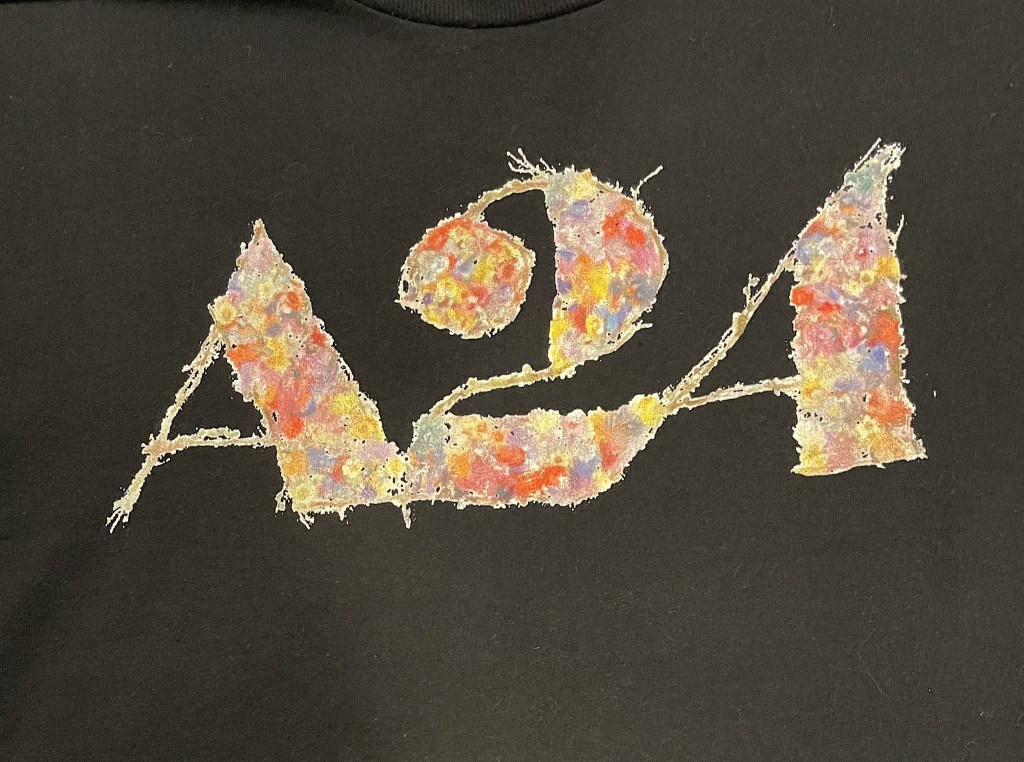
I had the biannual appointment with my primary care physician the other day, and I came away thinking how cool he is. After prattle about my prostate, gab about my gall bladder, and talk of a tetanus booster, he eyed my t-shirt and said, “That’s a great studio.” I had to look down to remember I was wearing my A24 shirt that looks like this:

A24, if you’re wondering, is the hot indie film distributor right now. The boutique shop — which (shockingly) scored a Best Picture Oscar this year with “Everything Everywhere All At Once” — is a mighty machine, celebrating 11 years in the biz with brazen and peculiar taste. Ambitiously art-oriented, A24 pushes cult films that garner lavish critical kudos and discerning viewing audiences. 

Movies like: “Ex Machina,” “Midsommar,” “Hereditary,” “Uncut Gems,” “The Tragedy of Macbeth,” “Aftersun,” “The Florida Project,” “Talk to Me” and more

And TV shows like: “Euphoria,” “Beef,” “The Idol,” “Ramy,” “Irma Vep,” “Ziwe” and more.

The good doc and I fell into a spontaneous groove, both of us animated by the splendor that is A24. We agreed that the ending of “The Witch” was spectacular and the ending of “Midsommar” sputtered. 

His favorite A24 movie is “The Lighthouse,” with Robert Pattinson and Willem Dafoe, and he loves “The Whale,” which snagged Brendan Fraser a Best Actor Oscar. I told him I like “The Witch” more than the mind-boink of “The Lighthouse,” both films directed by visionary wunderkind Robert Eggers. He was okay with that. He just nodded, knowingly.

So, yeah, A24 is badass. Dr. So and So digs it. I dig it. But I guess the point is me and my professional — a guy who actually used a stethoscope on me — forged a small connection. Everyone likes movies, and most everyone can chat them up. This, however, was specific, downright micro. It was like talking about a tiny kebab kiosk in the slimmest side streets of Istanbul that only the savviest tourist would know about. 

And then reality barged in. Suddenly, the nurse entered and jabbed me with a tetanus shot, and my fellow A24 fan was gone, vanished in the weird smelling ether of the doctor’s office.

Fade to black. Roll credits. We’ll always have “The Witch.”

Life, in no particular order

1. I don’t do dragons. I think they’re silly. For all their fiery tantrums and wing-flapping fury, I can’t take them seriously. Humans ride on their scaly backs like they’re horsies and fly through the sky. I crack up whenever I see that. 

So needless to say I’m not watching HBO’s “House of the Dragon” or Amazon’s “The Lord of the Rings: The Rings of Power,” big ticket fantasy orgies that by turns bore and baffle me. I don’t even know if “Rings of Power” features dragons — halitosis-impaired Smaug looms large in Tolkien’s Hobbit-verse — but I also don’t do elves or wizards, Orcs or even swords, so I’m pretty much locked out of those good times. 

But I’m not a complete dragon-phobe. My favorite dragon movie is easily “Reign of Fire,” starring Christian Bale and a bald Matthew McConaughey as gnarly post-apocalyptic dragon slayers. If you haven’t seen it, do. It’s a blast. McConaughey chews on a big fat cigar throughout. There’s fire and volcanic sludge and dragons all over the place. It’s also pretty grim. And nobody rides a dragon.

2. My brother and his wife just got back from Madrid — precisely where I am headed 20 days from now. No conspiracies, no subtext, we just happened to agree that Spain’s capital is the place to be this month, this year, right now.

What’s great is that I sent the lovely couple on a sort of expedition to scope the city, suss out all the hot tapas bars and cocktail bars, the most electric neighborhoods, what sights to see and what to skip. 

And they delivered resoundingly, finding me a better hotel in a livelier area, several hip restaurants and bars, a shrine to Goya, and a slew of invaluable practicalities. Teamwork! High five! Madrid is famous for its blaring all-night carousing. You still hear people banging bongos in the street at five in the morning. I land on Halloween. I hope it’s batshit. 

3. The ongoing saga of my misadventures in sneaker shopping — the subject of a prior post — is finally winding down. I spent the summer agonizing over what shoes to get to replace my moldered, moth-eaten collection of casual kicks. 

Halt. Mere minutes ago, after I wrote that paragraph, I ordered the final pair of sneakers I will order this year. (I hope.) Just as I was getting comfortable with some slick new Cole Haans, I stumbled on a pair of rare New Balance sneaks that I fell for instantly. Now what? I put the Cole Haans back in their box (for the moment) and clicked “Place My Order” on the New Balance. 

Which means I’ve now, since July, bought seven pairs of sneakers, an unholy sum that has me and my Visa doing barfy loop-the-loops. What else: I got another pair of New Balance, two pairs of Italian-made Oliver Cabells, a cheap pair of white Adidas Stan Smiths, and some Asics that I promptly returned. Incidentally, one pair of the Oliver Cabell shoes are all but unwearable, causing oozing blisters at each step. And it’s too late to return them. My Visa is writhing.

The indulgence is appalling. I’m no sneaker-head. I don’t collect footwear. I am not Imelda Marcos. I just need a fresh fleet of shoes to replenish the worn and rejected. If the latest New Balance are good, I will return the Cole Haans. That will mean I will own only five new pairs of sneakers. One of those causes blisters. So that means four new pairs. Not so dramatic after all. But still: really?

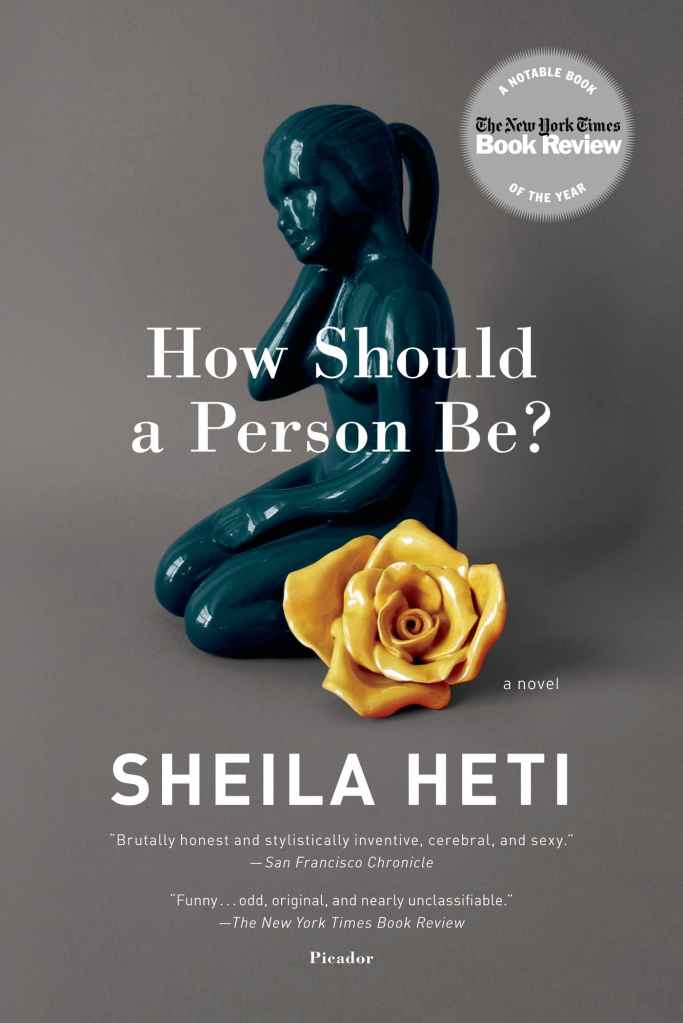
4. Next to Michael Mann’s cop thriller “Heat 2,” a brilliant, blistering, book-form sequel to his 1995 crime movie masterpiece “Heat,” with Robert De Niro and Al Pacino among other badasses, the best book I read this summer was Sheila Heti’s “How Should a Person Be?” — sticky auto-fiction that giddily pinballs through its meandering idiosyncrasies. This jagged, brainy book functions with the itchy buzz of life. It’s hilarious. Awkward. Wincing. Wonderful. Yeah, life.

Narrated by a 30-ish Heti, it’s aptly described as “part literary novel, part self-help manual, and part vivid exploration of the artistic and sexual impulse.” It happily recalls the sui generis first-person fictions of Rachel Cusk, Jenny Offill and Elif Batuman, currently my favorite writers. They kind of drop you mid-thought into their lives, then roll on from there with chatty, funny, unembarrassed realism. The works revel in their mundanity, which becomes a kind of magnificence.

Heti’s 2012 novel was named one of 15 “remarkable books by women that are shaping the way we read and write in the 21st century” by The New York Times. A bold but clear choice I wholly endorse. Heti has a new novel, “Pure Colour,” that I wasn’t bonkers about, but you might find worth a peek. For now, “How Should a Person Be?” is what I’m bellowing about from the mountaintop. (Me. Megaphone. A towering crag.)  

5. If you want to know something about me, read this tart and telling passage from Elizabeth McCracken’s new novel “The Hero of This Book”:

“Myself, I loathe having my picture taken. I have for as long as I can remember, even in the old days when you could go weeks without somebody trying. In all group shots I am not pictured. It’s beyond vanity and in the realm of superstition. I don’t like people looking at me. I don’t like being the center of attention except under very specific conditions. … I will not stop for a photo. I will not look at myself in a mirror for you. I will not watch myself pass in a plane-glass window.”

There. Now you know a bit more about me. Also, I’m not big on dragons. 

My current cultural playlist

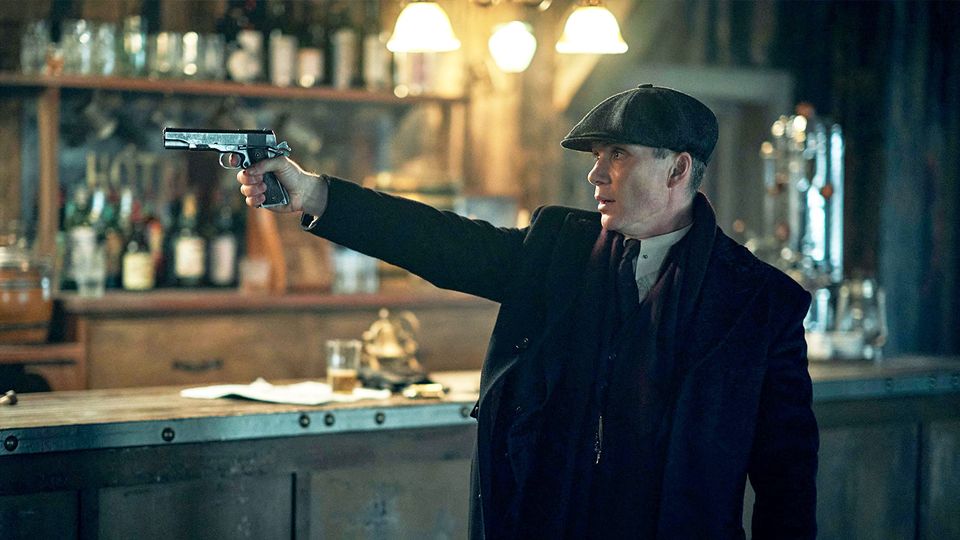
1. Way behind on the cult British crime saga, I’m discovering the gritty and gruesome pleasures of “Peaky Blinders,” an uncompromising gangster epic bristling with politics, razor blades, gamblers, guns, and unvarnished thuggery. 

Set in Birmingham, England, just after World War I, the Netflix series is a fearsomely atmospheric blood opera starring a rogue’s gallery of dapper gangsters with deep family roots and a hunger to stay in power. It openly, inevitably recalls “The Godfather,” “The Sopranos” and, on a knife and knuckle street level, “Gangs of New York,” with perhaps more thematic tentacles.

The show is fronted by Cillian Murphy as crime boss Thomas Shelby, whose smoldering menace can burn a hole like a bullet. One website has voted him the Greatest TV Character of All Time, a testament to Murphy’s pit bull commitment and conviction. He unnerves every time he’s onscreen, makes you shift in your seat. Pepper the grimy period setting with tunes by Nick Cave, PJ Harvey and White Stripes and you get more than anachronistic friction; you get gang-banging with a boogie beat. 

2. Listening to Nirvana’s short, punchy songs, it struck me again why the band is so good and lasting: Almost lick for lick, Nirvana is as infectiously hooky as the Beatles.

And on the Beatles — my favorite band, and I’m not a hundred years old — I liked this line from “The Idiot,” Elif Batuman’s riotous novel of the head and heart: “The Beatles turned out to be one of the things you couldn’t avoid, like alcohol, or death.”

3. You also can’t avoid Marvel and its muddleheaded mayhem in the current cinema, a soul-battering bummer. But there do exist little oases floating past the aesthetic carnage, attractive indie films like the raunchy, uproarious “Zola” and my latest favorite, “The Worst Person in the World.” 

The grabby title is slyly misleading in this dark rom-com drama about a young woman who skitters between jobs and lovers while surfing life’s foibles. Joachim Trier’s prickly Norwegian charmer, ablaze with insinuating characters and sexy anecdote, is told in 12 fluid chapters, led by endearing star Renate Reinsve, who won best actress at Cannes for her intricate portrayal of a woman in flux. Hardly the worst person in the world, she’s a millennial supernova.

4. Ottessa Moshfegh’s new novel “Lapvona” is grossing out reviewers with its blithe violence and panoramic depravity. (Is Moshfegh the worst person in the world?) The medieval fable, set in a village rife with plague and other misfortunes, is earning wildly mixed reviews, many of them lashing in their displeasure, even from fans of Moshfegh’s previous dark fictions (“Eileen,” “Homesick for Another World”). 

I’m a fan as well, and I’m steeling for a rough ride. I’m only on page nine, and here’s a verbal taste: “disemboweled” “heads of the dead,” “a bone sticking out through the flesh,” “animal excrement.” (Page nine.) The book, in all its gloppy mucus and viscera, came out this week — which makes it the perfect summer beach read. You heard it here first.

Culture in the time of Covid

My Covid’s gone and I feel strong as an ox, even though I barely know what an ox is. A big cow? Paul Bunyan’s interspecies BFF? Actually, I just looked it up. An ox is a “castrated bull used as a draft animal.” So let’s scratch the whole ox analogy entirely. 

Point is, I’m back — non-contagious, symptom-free, fit as a fiddle. (I don’t know what that means either. Skip it.) It took about five days to vanquish the virus, and it wasn’t as bad as I imagined. It was like a mild cold, but without mucus violently erupting from my lungs. This was a dry cough, little hacks, as if an infant was smoking a cigarillo.

As hoped, I got a lot of reading done during my convalescence. I wrapped up “The Sportswriter,” Richard Ford’s extraordinary, bittersweet novel about life, love and letdowns, and started three more books, all highly acclaimed and released in the past few weeks.

Alas, two of them tanked. Those would be Ali Smith’s “Companion Piece” and Mieko Kawakami’s “All the Lovers in the Night.” 

I’m not sure what critics are going on about with Smith. They go bananas for her Seasonal Quartet novels — I failed miserably to warm up to two of them — and seem to regard the new book as the prosaic sublime. I read 175 pages of “Companion Piece” and surrendered with a mere 50 left. She’s a slog, oblique, flirting willfully with incoherence. I wasn’t having fun. I was having a migraine.

I enjoyed Japanese super-author Kawakami’s earlier novels, the shrewd and touching “Heaven” and “Breasts and Eggs,” which sounds like a particularly provocative breakfast dish. But her latest, though not totally displeasing, never takes off. It’s slow going … going nowhere.

But I hit pay dirt with “Either/Or,” Elif Batuman’s sequel to “The Idiot,” tracing the turbulent interior life of a female college student who’s trying to figure it all out. It’s at once wildly funny and erudite, catchy and sparkling, and that’s about all I can ask for in a book. Bonus: the author’s name is Elif.

For someone isolating with time to burn, I watched very little in the way of shows and movies. I did stay abreast of the series “Hacks” (hilarious), “Top Chef” (harrowing) and “Barry” (hilarious and harrowing). And I’m looking forward to sinking my teeth into “Irma Vep,” the great Olivier Assayas’ dramedy about a vamp, vampires and the insanity of making movies.

Meanwhile, everybody and their easily-scared tweens are bingeing Netflix’s gimmicky genre mash “Stranger Things.” I preferred the show when it was called “Scooby-Doo.”

I also got to anticipate my July journey to Buenos Aires as I was spread out, aching and sniffling with dramatic moans of self-pity. It’s something to look forward to, and, from a piece I read recently, that’s not only a good thing, it’s a healthy thing: “Having something to look forward to boosts your mood and lowers your stress. It can increase motivation, optimism and patience and decrease irritability.” Huh.

Not quite a Covid cure, but it can’t hurt. So much so that I started looking forward to my annual October trip, leap-frogging the July trip I haven’t even taken yet.

I’m thinking Budapest, a European joint I have yet to visit. Or perhaps a return to Krakow. Or Berlin. I’ll have to see what Covid is up to in those places. I might be cured, but the tenacious bug, mean and mercurial, still has the world in its gooey grip. 

Books, bookings, and Bourdain

A few things banging around my head this week …  

David Sedaris has a new book out. Whoop-dee-do.

Expectedly, knee-jerkingly, reviewers have stumbled over themselves to praise the foppish funnyman’s latest collection of personal tales (often tall), diary entries, cultural observations and social sniping. 

Snicker-worthy at his very best, Sedaris, a humor essayist for The New Yorker, has made a cottage industry out of wan, admittedly embellished autobiography, droll stories about his family, his husband and his privileged moves to the French and English countrysides. 

Turning life into literature, he is frank, irreverent, sassy, yet sensitive, as any good writer should be. And he is a good writer, even if his language is baldly prosaic, stylistically flat-footed, determinedly unadorned, dare I say drab. (I said it.)

Overrated, with thousands flocking to theater-sized readings to hear his nasally, high-pitched deadpan — I’ve been there — he’s not exceptionally funny or insightful, though he taps a reservoir of honest empathy. He’s a queer, urban Erma Bombeck, flattering a particular strain of hipster and sophisticate with teeny tee-hees. 

***

I’m pumped about Portugal. Barely back from Paris and already I’m poring over books and sites about Lisbon and Porto, legwork for a weeklong stay in mid-January, when I’ll probably get soaked by merciless rain (while temps hover at a balmy 58 degrees). Paris must feel like a betrayed mistress.

The flight, which cost less than a good winter coat thanks to an airline credit, is booked. Hotels, at seductive off-season prices, are booked. Two walking tours, including a Porto food tour, are booked. 

I got back from Paris exactly one week ago. I am shameless, a monster. 

Unlike Paris, London or Spain, Portugal isn’t front-loaded with blindingly spectacular sights and museums. It instead thrums with an old-world vibe, cobbly neighborhoods spread over San Francisco-y hills, views and plazas and churches and food, including unparalleled bounties from the sea, and of course the people. (My people. As mentioned before, I’m of Portuguese descent, though my ties to the country are tenuous at best. I’m a terrible ambassador.)

It’s a walking world, Portugal. I plan to amble, stomp and stagger through the country’s two biggest cities, with the very occasional — and very cheap — taxi for longer hauls. A picture says so much, and makes the heart do a jig:

Porto

***

Smarter, funnier, better looking and a brilliantly better writer — not mention an infinitely superior cook, natch — Anthony Bourdain and I still had a lot in common. 

We’re both wanderers, seekers, a little profane and rough around the edges, smart-alecks, atheists, ironists and guiltless sensualists. We’re angry, fiery and melancholic. We’re easily bothered and bored, and don’t always know what to do about it, except, in many cases, hit the road.  

And like him, for all my searching, I’m still not sure what I’m looking for. And I’m pretty sure I will never find out. Bourdain, a suicide in 2018, probably never did either.

This hits me watching “Roadrunner: A Film About Anthony Bourdain,” a moving, multilayered documentary about the celebrity chef, author and influential television host by gifted filmmaker Morgan Neville (the Oscar-winning “Twenty Feet from Stardom,” another masterpiece). 

Sure we had things in common, but Bourdain, in his books, shows and this remarkable movie, cuts a troubled figure, the classic brooding, almost romantic enigma who toggles manically between wonder and woe.

With his streamers of verbiage, buoyantly prickly charm, zeppelin-sized attitude (and ego), lanky strut, tats and designer shades, Bourdain was hipster as tour guide, a foodie philosopher, man of the world who was always just a little itchy in the role. He was the reluctant rock star — cynical, self-effacing — who still craved the glory, glamor, privilege and, alas, the drugs, including heroin, that came with it.

At his best Bourdain was an influencer before the term gained the narcissistic kiddie cachet it flaunts today. Before any trip, be it Toronto or Tokyo, I watch a rerun of “No Reservations” or “The Layover” to get a voluptuary’s feel for a city and nail down must-do destinations of plate and place. I’ll be rewatching his “Parts Unknown” episode about the food and culture of Porto soon enough. I trust him to steer me to the coolest and most coveted spots. He hasn’t failed me yet.

The programs, of course, are as much about the man as the places he visits. They’re about getting an earful, and a mouthful, from a dark, dazzling host who found so much joy between grumbles. He made the dangerous seem divine, just how I like it.

***

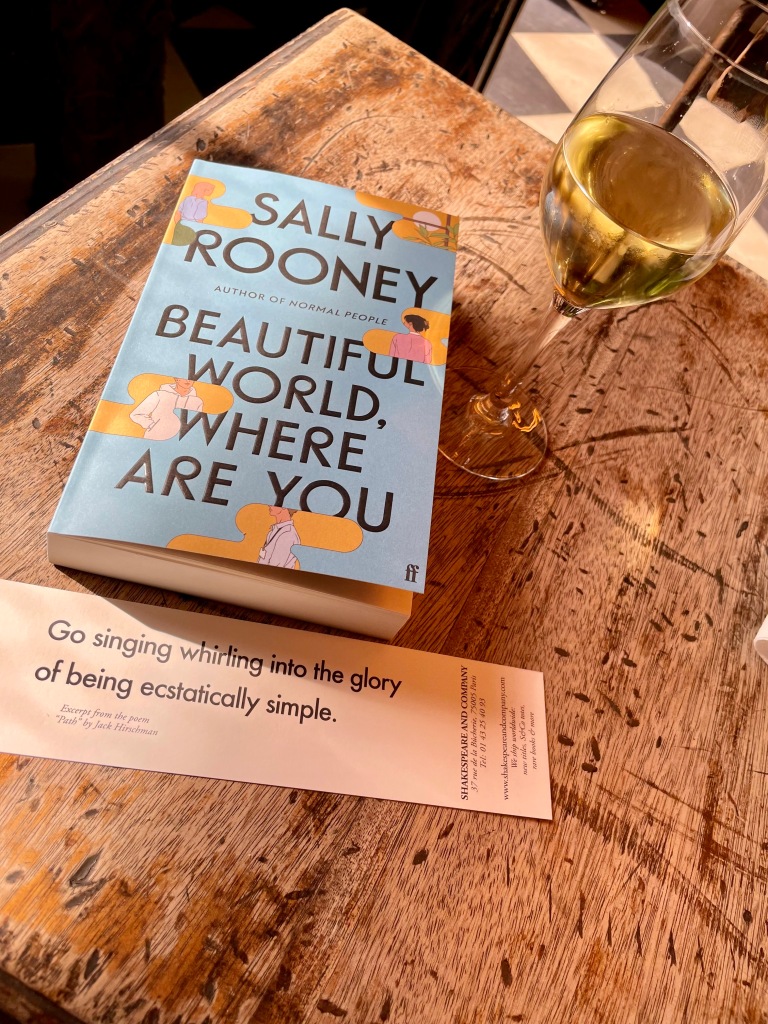
When in Paris, I always duck into the fabled Shakespeare & Company bookstore, smack on the Seine on the historically literary Left Bank, where Joyce, Hemingway, Fitzgerald, Stein and Sartre tippled and typed, spinning the blank page into eternal art. 

Cramped and crowded with tome-seeking tourists, the creaky-floored shop, honeycombed with nooks, alcoves and twisty aisles, specializes in French and English language literature — no junk, just the good stuff. It’s not snobby. It’s just smart. And the English-speaking staff are unfailingly cheerful and helpful, stamping your book with the store’s inky insignia. It’s a pulp paradise, the kind that makes a bibliophile go a little mad with delight and desire.

I went firmly middlebrow on my recent pilgrimage, grabbing a paperback (it’s only available in hardback in the States) of Sally Rooney’s new novel, the wincingly titled “Beautiful World, Where Are You.” I cracked it immediately, reading in bars and cafes with a Chardonnay or latte on hand. 

The Irish Rooney (“Normal People”) is a reliably breezy read, plainspoken, occasionally lyrical, but mostly succinct and pinched. Her control is impressive and her sturdy, confident voice makes you want to follow her wherever she’s going, which often includes naked people. 

I just finished the book on my return from Paris and enjoyed it. It covers Rooney’s preferred topics — love, sex and friendship, yearning and ambition among anguished millennials — with detour discussions about Marxism and life’s unfathomable purpose. (Rooney, a wunderkind at 30, is a professed Marxist.) 

Coming from the famous bookshop, it’s not only a winning read, it’s a fitting souvenir from that most bookish of cities.

Dogs with blogs

This actually happened. From 2012 to 2015, the Disney Channel aired a sitcom called “Dog with a Blog,” which was about the loopy shenanigans of a cookie-cutter suburban family whose dog just so happens to talk. 

And type. And write. So good is the dog, Stan, at writing that when everyone’s in bed, he slinks off to the glow of the family computer and authors a blog entry, reflecting on the day’s events, affairs and lessons. He does it in a wry voiceover mash of Steven Wright and Woody Allen (furnished by comedian Stephen Full). 

In the TV-spotless house of five, only the kids know Stan can talk. Of course the parents, big dopey grownups, have no clue the mutt can mutter. A show description: “The children learn of Stan’s talking ability and agree to keep it a secret from their parents, fearing if the world finds out that Stan can talk, he will be taken away for experimentation.”

(Experimentation?)

I watched “Dog with a Blog” with my pre-tween nephews, and it was one of the few kid’s shows I survived (the essential, wackadoodle “Adventure Time” is another). It’s actually very funny; not excessively clever, but wreathed with Stan’s dry, sardonic quips, which have a soft adult edge. 

Now, my dog, Cubby the Incandescent, also happens to blog. He’s followed my lead and decided he needed a forum for his daily observations and deep contemplations, things the world should know. Blogs: the great dumping grounds.

I’ve got Gnashing and, Cubby, as a canine, aptly has Gnawing. He’s quite adept at navigating the laptop keyboard, even if he occasionally hits the wrong key. As Stan says on the show, “Delete. Well, that couldn’t be clearer. Or more hurtful.” (Dear doggies, man isn’t your best friend; Command Z is.)

Though the kids know Stan talks, no one on the sitcom is aware Stan blogs. I sort of wish no one knew I blogged, and in fact, most of my closest friends are oblivious. If they find this place, great. I just don’t feel like advertising it. 

Why? Plain shyness. Writing is partly a private act, I think, though obviously I want to get some of it out there. It’s complicated. (Notice I post no recent photos of myself or my last name on this site. I’m the stealth blogger.) 

Cubby is more of a hambone. (Stan, I don’t know. It’s never clear who his readership is, if anyone.) Cubby will carry on about chasing the cats away from his bone, like a big hero. He’ll crow about yelping maniacally at the FedEx guy, as if the FedEx guy gives one goddam. He’ll lament the trauma of getting groomed (even though he takes sedatives before his haircuts). And somehow he wrings material from napping 16 hours a day. I’m pretty sure that’s where he cooked up the entry about hunting dik-diks on the Serengeti.

Me, I go for the absurd, offbeat, anecdotal and reminiscent, with some straight-up travel dispatches and lots of made up phooey. Unless you’re hawking a service — all those preening fashion, workout and health sites — the point of a blog, I think, is to entertain, elicit a laugh, enlighten with fun facts and regale with good photography. It’s to get personal, reveal who you are, and sometimes wrap it all in old-fashioned folderol. 

Like this whole post. Purely asinine. Though it goes to show the variety of blogs and bloggers out there doing hard work for their respective audience. We’re a motley crew. 

Stan’s a dog with a blog. 

Cubby’s a dog with a blog. 

And me? I’m a dawg with a blog.

Cubby gazing perplexedly at his own photo on the computer. He’s working on his next blog entry. More navel-gazing.

Photo phobe

Look at that, I think, watching citizens on the street interviewed on the nightly news. So composed, so poised, so extemporaneously eloquent, fluid and alive, all with a thrusting camera and flood lights in their makeup-free faces, knowing this is a one-shot performance for the big TV show, posterity even. How do they do it?

Me, no. Cameras are my kryptonite. I am so camera shy, from still photos to shaky video, that even in these starved, socially distanced times, I will not do FaceTime or Zoom with even my coolest pals. They know this, so they don’t try much. No. They never try.

I’m ruthless: The last time my own mother tried to FaceTime me — on my birthday — I declined her three times. After that, we had a brittle phone chat. It was a short call.

Cameras are performative devices; they make you assume an artificial skin. I personally find this embarrassing and uncomfortable, and it’s not just because I dislike seeing my own image, although I certainly do. Hammy poses, coerced smiles and theatrical displays of affection — it’s all so plastic and painful. Every time my picture is taken, I feel like I’ve sold my soul to Lucifer. And he wants a refund. 

I used to be quite photogenic, if I may say so. I do not believe this anymore. And so, amid group shots in particular, I try to hide as much as possible. My resulting image is invariably spectral — that of a Native American spirit hovering with ritual solemnity in the background, very displeased with my historical lot. 

I’m a wuss. Not only do I shun pictures, I dread public speaking, including toasts, and prefer to interview others instead of being interrogated. 

Of many offers to be interviewed on television and radio for my last job, I made only two exceptions. I was so fumbly and fidgety when I appeared on TV that I can hardly even remember the incident, except that I hated it. Seeking a segment for “This American Life,” NPR guru Ira Glass interviewed me from New York. Naturally, I choked with nerves. 

Traveling alone, I used to snap selfies for the visual record. I have a lot of those and they’re not bad. Even my distorted self-image can’t ruin all of them. But I don’t do that so much now, yet I have, in these Covid climes, surrendered to FaceTime for the occasional doctor appointment and such. I don’t like what I see. Not one bit.

So how do those regular folks on the news get so natural and comfortable and chatty, besieged by lights and cameras on live TV? I’d dash if a camera crew approached me.

If they indeed snared me, I’d gleam with flop sweat and stammer like a fourth-grader giving a book report. I’d botch the take and wind up on the cutting room floor. Then I’d shamble off, relieved, yet again, that the camera didn’t get me.