Hounding the dogs of Istanbul

She ambled into the cafe smiling, her rump gently shaking this way and that, tail shyly wagging. The cafe owner, a radiant globe-trotter named Nazan who’s lived in Istanbul for years, joyfully greeted the large brown mutt, patting her head and cooing her name. The dog then plopped onto the wood floor and rolled on her back, legs skyward. She remained in this posture for a good half hour. She looked ridiculous. And adorable.

1.jpg

The pup, whose name is Garip, is one in a gaggle of dogs and cats Nazan feeds and takes care of. Garip is a stray, part of thousands that live in the by turns picturesque and grungy streets of Istanbul, a massive, hilly metropolis bulging with 16 million people — the world’s fourth largest city and the biggest city in Europe. 

That means a lot of stray dogs, whose numbers rival the city’s seething stray cat population (lovingly profiled in the documentary “Kedi,” which I wrote about HERE). It’s a zoo out there, an amicable, well-behaved cosmos of bewhiskered street urchins that are mostly pampered by locals or, at worst, casually ignored. 

Animus towards the animals isn’t evident. I was in Istanbul for nine days this month and kept a close eye on the roving dogs and cats. The critters are almost universally plump and well-fed by caring, compassionate locals attuned to the spiritual sustenance of communing with intelligent four-legged creatures that reciprocate the love. 

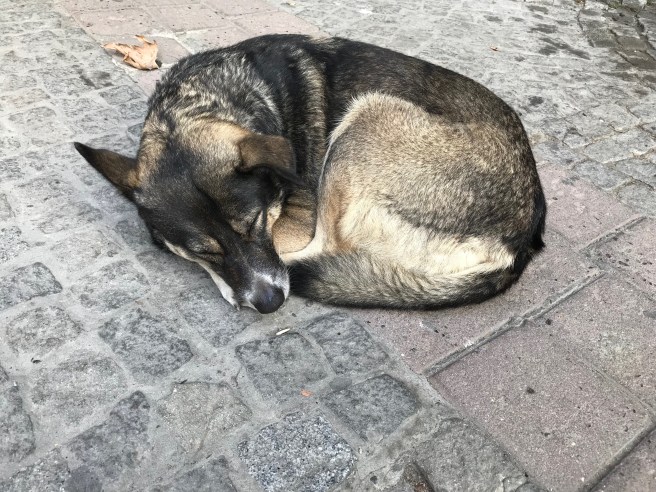
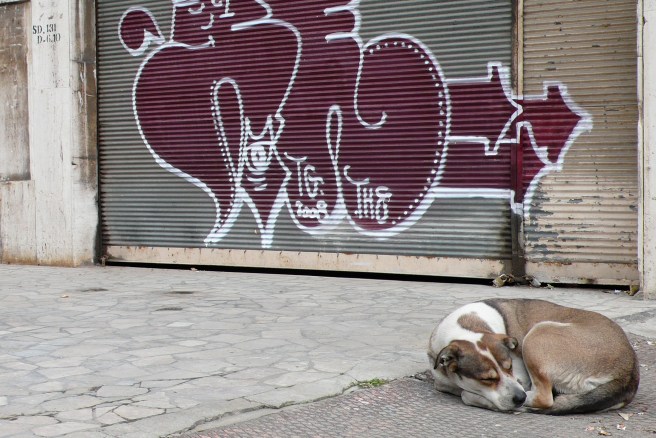
There they are, zonked out, on their sides or curled in balls, in the middle of plazas amid the bustle and noise of swarming tour groups that step over them. They loiter outside of restaurants, reliable fonts of food, and snarf up the dog kibble people put out for them on schedule. Nimbly dodging cars, some move in small packs but most ramble their neighborhoods as lone wolves, occasionally pausing to sniff one of their hairy cohorts’ rear-ends before tramping off down cobblestone paths.

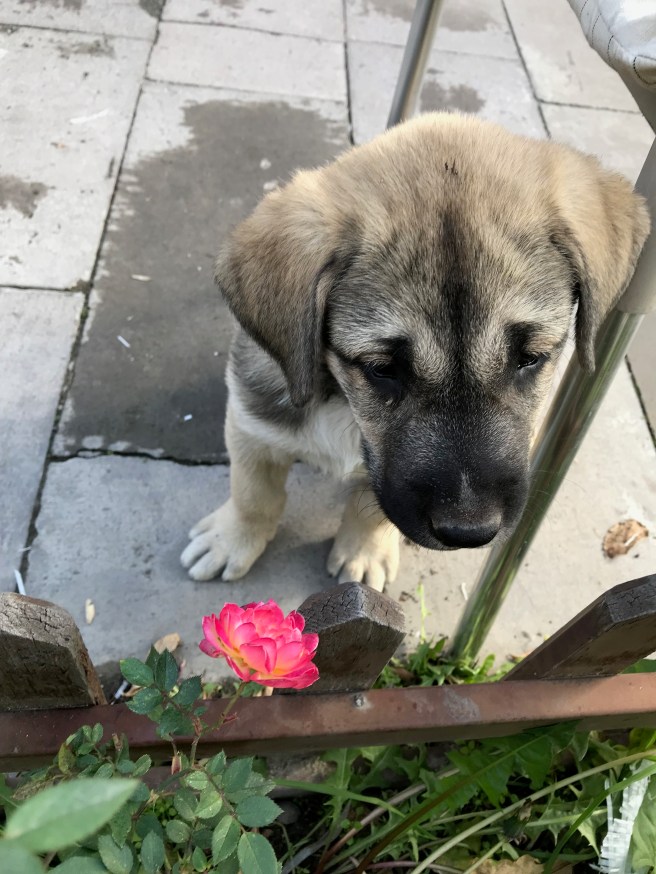
The dogs calmly stroll around for snacks and strokes, but are rarely beggy. They don’t cadge, they don’t hector. They scarcely bark. Rather they befriend and endear. If you approach them, they nuzzle up to you, tail fanning, like any dog worth its canine credentials, yet leave you alone when you pull away (unless you call them to follow you, as I often did). Their independence is admirable, even noble.  

As the homeless can attest, street life’s a bitch. Hunger remains an imperative and untended wounds agonizingly fester. I met a dog with a ghastly slash around its throat and another with an oozing cut on its back leg that left a bright streak of blood down its fluffy cream tail, looking like a giant paint brush dipped in red paint. Many stray dogs are registered by the city, signaled by a tag on their ear that means they’ve been fixed and vaccinated. I think that’s swell.

At the cafe, the marvelous Mitara Cafe & Gallery, Nazan visibly adores her furry charges, her courteous quadruped pals. She speaks to them, strokes them, invites them in for a bite and respite from the heat or cold. When I handed her a tip for my lunch, Nazan assured me it would go to food and medical care for the animals. That was all right by me.

A motley gallery of some new Istanbul friends:

2

3.jpg

4.jpg

5.jpg

P1030568_1.jpg

6.jpg

7.jpg

P1030243_1.jpg

8.jpg

When a suitcase becomes a basket case

I own an old piece of luggage that is, at long last, the worse for wear.

It’s lost that luggin’ feeling. 

For some 18 years it’s been my sturdy companion around the globe, from Israel and India to Morocco and Madrid; Egypt and China to Turkey and Poland; Thailand and Lebanon to Japan — and beyond. It carried worlds of stuff, from my underwear to a Turkish hooka; from Syrian soaps to ham from Spain and pirated DVDs from Vietnam.  

All the rugged mileage this road warrior has incurred has aged it like a pugilist pummeled into premature dotage. Not helping are airport baggage handlers who hurl one’s precious parcels like sides of beef.

I’ve seen it. I actually watched through the ovoid plastic jet window a handler on the tarmac chuck my exact suitcase — mine — into the cargo hold like it was a sack of stinky refuse. It was almost heartbreaking.

My luggage — a 22-inch two-wheel roller made of thick nylon by the superb Pathfinder — is still functional. It’s just outmoded, beaten and battered, like shoes that are broken-in to just-right comfort but are scabby and gangrenous. It isn’t dead. But it is officially on Social Security.  

IMG_1170
Suitcase or basket case?

Scarred and scuffed, it’s a homely old comrade, chain-smoking, hard-drinking, occasionally finding itself in a barroom brawl. It has rolled around and seen the world, seen good times and bad, and, well, I’m out of clichés. 

Strips of plastic peeled off the two beleaguered wheels a year ago and the zipper ripped off one of the front compartments that accommodates books, magazines and documents.

Without a quartet of spinning wheels, the bag is unwieldy, especially on streets and sidewalks. It can be frustratingly graceless, at once ratty and bratty. 

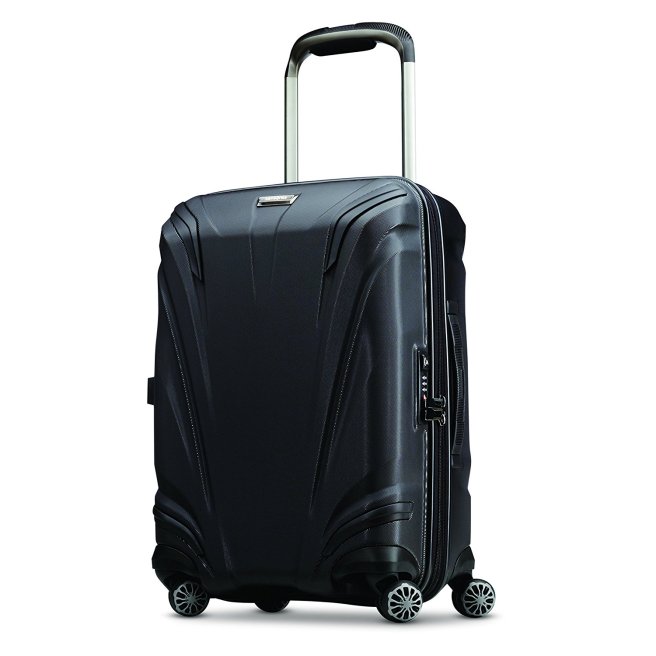
All of this, of course, is just noisy throat-clearing to announce I have replaced the grizzled (yet forever faithful) Pathfinder with a newer model, the, huh-hum, Samsonite Silhouette Xv Hardside Spinner. Behold:

91LpuiyYmhL._SL1500_.jpgI haven’t used my new bag yet — I will next week when I return to Turkey — but I’ve taken my brother’s slightly older version on a few journeys. So the model has been test-driven, with flying colors. It’s a dynamo.

Recall my old bag is 22 inches long. The new one is 21 inches — total carry-on action if I choose. Samsonite offers a chart that says the 21-incher is the perfect size for a two-day trip, which means they’re bonkers.

As I did with the 22-incher, I stuff all I need into these bags with zero space issues, no problems. I don’t know what their product-testers are packing, but I can pack a good 10-day trip into bags this size. (Of course, I only pack a loincloth, foldable toothbrush and shower cap.) 

Whatever. I’ve got the packing thing down. Cram, condense, fold clothes into origami. Give me 20 minutes and I’m ready to roll.

And nowadays that means rolling on four well-greased spinners. 

A1kcDI9526L._SL1500_

The daunting and taunting of the bulging bookshelf

Nothing in a home excites me more than bookshelves crammed and jammed with actual books, as opposed to knickknacks, tchotchkes and corny picture frames. Filled right, they are towering works of art, swirls of graphics and oceans of colors.

I love engorged, groaning bookshelves, whose heaving pulp cargo functions as stylish and classy decor, the jostling spines stringing rainbow rows of erudition, edification and entertainment. So gorgeous and seductive is a grand, brimming bookshelf, it’s almost erotic.

8536d681f28f66caa54226bbccc05e6b--bookstores-libraries.jpg

At minimum, it takes hundreds of volumes to stock an amply, aptly impressive bookshelf. It takes a collector’s fervor, an obsessive appetite for those bound squares of facts, fiction and, so often, beauty.  

But there’s this: Do we actually read all the books in these sprawling collections? Or do they act largely as pretentious decor, literary plumage that flatters the owner?

That depends, but I know I rigorously try to read every title on my shelves, as nearly impossible and as crazily aspirational that proposition is. Still, I don’t see them as frills and frippery. I simply think walls of books look amazing. (Bookshops and libraries: Platonic ideals of aesthetic glory.)

I confess I don’t read all the books I acquire. One, the quantity is too great, especially when new books keep crashing my bulging bookosphere. Two, not every book is worth reading — too many just aren’t good enough. 

So, as I’ve mused here before, I frequently dispense with books that aren’t thrilling me. The rate that I put books down at the 50-, 80- or 100-page mark is deplorable. It’s also necessary. I show no quarter.

“I own far more books than I could possibly read over the course of my remaining life, yet every month I add a few dozen more to my shelves,” writes Kevin Mims in this essay in the New York Times.

That is a sickness I know well. But mostly I’ve stopped this hoardish habit. I realize now that not every well-reviewed book or immortal classic is worth picking up.   

I used to work in a corporate bookstore — the biggest bookstore in San Francisco at the time — and, like that ravenous kid in the candy store, the one with chocolate smeared all over his mouth, I couldn’t help but accrue a gigantic book collection. It fast became overwhelming, so I kept a list on a lined yellow notepad of all the books I hadn’t yet read, planning to cross titles off as I went. Sheer folly, that.

I have since evolved and have become the prince of the partially read book. Though my shelves boast more tomes that I have actually completed, the rejects are copious. 

And then there are the books I haven’t even cracked yet, and may never get to. In his essay, Mims locates a term for this: “tsundoku, a Japanese word for a stack of books that you have purchased but not yet read. My personal library is about one-tenth books I have read and nine-tenths tsundoku.”

That doesn’t mean your fabulous bookshelves are mere pretty repositories, ceiling-scraping storage bins. They are libraries and all that that word implies: knowledge, art, stories, journeys, lives, cracking your head open with the world.  

Says Mims:

A person’s library is often a symbolic representation of his or her mind. A man who has quit expanding his personal library may have reached the point where he thinks he knows all he needs to and that what he doesn’t know can’t hurt him. He has no desire to keep growing intellectually. The man with an ever-expanding library understands the importance of remaining curious, open to new ideas and voices.”

bb42752b8ffbeacfca9b8d5d6918ecdd.jpg

* Late postscript: I stumbled upon this nifty quote in my readings later today. It’s from “The Bookish Life,” an article by Joseph Epstein:

So many books are there in the world that no one can get round to even all the best among them, and hence no one can claim to be truly well-read. Some people are merely better-read than others. Nobody has read, or can read, everything, and by everything I include only the good, the beautiful, the important books.”

How to annoy a Good Samaritan

For the first time in my life, and hopefully the last, I called 911. It happened today, though it almost didn’t happen. The injured party of two, which did not include me or anyone I know, degenerated into a noisy confusion of bickering and dithering about if I should actually make the call. 

Call it! 

No, don’t call, I’m fine! Jesus!

Annoyed, I rolled my eyes and dialed. 

I was outside the library when I heard a crash then piercing screams and old-man groans — drama and panic before a fine civic institution. A splendid fall day.  

What happened was this: A woman is pushing an elderly man in one of those mini-wheelchairs, officially called transport chairs, when the conveyance hits a large uneven crack in the concrete, spins around and flips over.

The man, who’s attached to an oxygen tank, falls backward in the chair, landing on his back and bonking his head on the ground. There he is, stuck on his back, knees airborne, moaning. His elbows appear to have gotten the worst of it, and they are scraped and bloody. 

blog art.jpg
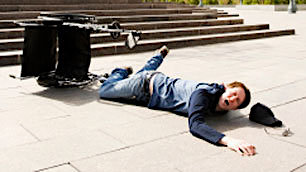
A highly inaccurate reenactment

Screaming and swearing, the woman, doughy and Weeble-shaped, tries to help him up, loses her balance, and falls on top of him, squishing the poor guy. 

Get off me!

Goddmmit! Oh! Ack! Help!

The woman, brassy and braying, tries to get up and falls on her ass on the concrete. She is screaming and cussing. I try to help her up but she’s having none of it.

Oh! My knee! Aaaah!

Yadda yadda yadda. 

She’s fine, a marvelous drama queen.

By now she’s really getting on my nerves, cussing and yelling at her supine companion whose head almost cracked open like a melon.

He, on the other hand, is calm and good-natured, with a crinkly sense of humor, even though he’s on his back on the concrete, knees in the air, tubes up his nostrils. He sort of looks like Hyman Roth in “The Godfather II” or Grandpa from “The Munsters,” except with a constellation of age spots across his olden face. 

He asks me to place my foot under his head as a cushion and I do. It’s a ridiculous scene. She repeatedly swears she will sue the city. She takes a picture of the guy on his back. Don’t take a picture! he yells. 

So I call 911 and the dispatcher keeps me on the line, asking a zillion questions about what’s happening, if the old man is on blood thinners (he is) and other questions I have no answers to. I can barely hear because the woman is screaming and swearing the whole time. 

Can you call 911 for human obnoxiousness?

The aggrieved twosome looks — and acts — like a married couple, though she seems to be in her late 50s and he in his late 70s, early 80s. Daughter and father is more likely. Either way: a nightmare.

The EMS arrives apace, sirens wailing, lights twirling. Taking a final gander at the squabbling duo and circling medics, I saunter off, irritated, into the library. The guy is still on his back. She’s still squawking.

I check out “Apocalypse Now.”

Idle thoughts about our human duality

Eric Idle, one of the great Monty Pythonians, spoke in yesterday’s newspaper to say this: “I think I am an optimist by day and a pessimist by nighttime.” 

I take this to mean that life’s workaday gunk, from headaches to the headlines, and the daily news cycle, that cataract of informational sewage, from Trump to pathologically unfit Supreme Court nominees, poisons him in a most unpleasant manner. 

That he undergoes a sort of icky Dr. Jekyll/Mr. Hyde binary: By day he’s merry old Eric Idle (Jekyll), getting along hunky-dory, and by night, fangs sprout, thick hair unfurls on his hands and face, and his disposition waxes decidedly splenetic (Hyde).

Fredric-March-and-Mr.-Hyde
Mr. Hyde, left, and Dr. Jekyll — same fella, different moods

For all that, Idle is evidently not a morning person. He says: “I can’t stand talking to people before lunch. I don’t think anybody civilized does.” (Hear, hear!)

I relate, to an extent. I am not a morning person. It takes a couple of hours, and at least one caffeinated elixir, for the early-hour crust to peel away, the nocturnal fog to burn off, my voice to clear from hoarsey to honeyed, my mood to shift from monosyllabic zombie to socially functional, with a possible grin if you’re really nice.  

It’s like the transformation of the Wolf Man back to a regular bloke, while we’re trading in Universal Horror metaphors.

But Idle and I differ in that I am a pessimist by day and an optimist by night — polar opposites. I arise and experience the day as Hyde — hairy, harried — and then I cool off, wind down and digest the day’s doldrums and distress during the dark. I relax, anxiety dissipates, I operate in a less pressurized space, though I must say I miss Hyde’s chimpanzee orthodontics and senatorial eyebrows. 

I rise in a murky mood. And, though it improves quite quickly, pessimism hovers over me during the daytime, an existential pall, a storm cloud poised to spit angsty, acid raindrops. I’m a little tense and the day’s news buffets me and only mixes me up more, stirs the pessimistic pot, which is really more like a cauldron, black and bubbly.

And then! The sun ducks, darkness falls like a stage curtain on the woozy light, and I slowly unwind. I once asked a therapist why this was — why my mood and my whole being gets, well, better at night. He had an answer that I cannot recall. It was some time ago. Bummer. I think it’s something about letting things go. Work is over. The night is yours. A splash of vino is poured. Fists unball.

I googled this phenomenon with imperfect results. All sorts of reportage about morning people vs. night owls popped up, but none of it addressed mood and state of mind, optimism vis-à-vis pessimism, focussing more on sleep habits, insomnia, and other folderol. There’s much about how some at night get droopy and others get galvanized, staying up later than the snoring household.

That’s not what I’m on about. It is noontime as I type this, warm, partly cloudy, just like me — warm and partly cloudy. Darkish thoughts percolate, I’m a little clenched, my forehead is a map of (mostly innocuous) worry. I am Mr. Hyde to Eric Idle’s enviable Dr. Jekyll.

But our roles will switch as the day progresses. Idle is slowly being filleted by life’s slings and arrows, so that by nighttime he will curdle with negativity. I’m already a wreck, lucky me. I’m Dracula (another Universal Horror allusion, you’re welcome), miserable in the sunlight, a goddam barrel of monkeys by night. We do what we can.

Istanbul’s citywide kitty corner

Goddamm cats. 

All over Istanbul, they ramble and climb, pounce and shinny. These homeless street beasts tackle each other in play; hiss and strike in combat; scrounge and scavenge for the next meal. They barge into shops and curl up in chairs and beg for food at sidewalk cafes with various degrees of rough-hewn etiquette (claws, paws and purrs).

000e4198-800.jpg
From the film “Kedi”

Most importantly, they insinuate themselves into the homes and hearts of many of this huge city’s denizens, soft souls who often regard the felines with an almost spiritual gravity, spurring the occasional display of soggy sagacity: 

“Dogs think people are God, but cats don’t,” a cat-lover says in “Kedi,” a documentary about the thousands of stray cats of Istanbul. “Cats know that people act as middlemen to God’s will.” 

I’m pretty sure I have no idea what that means.

“Kedi” (cat in Turkish, though it sounds a lot like kitty) is a well-received film from last year that lavishes the love — there’s not one hater in the whole picture, no one shooing away a cat with a broom — on Istanbul’s famed felines. It feels like a short film stretched taffy-like into a 79-minute feature that’s at once indulgent and superficial, while pleasant and lightly informative in an ingratiating PBS sort of way.   

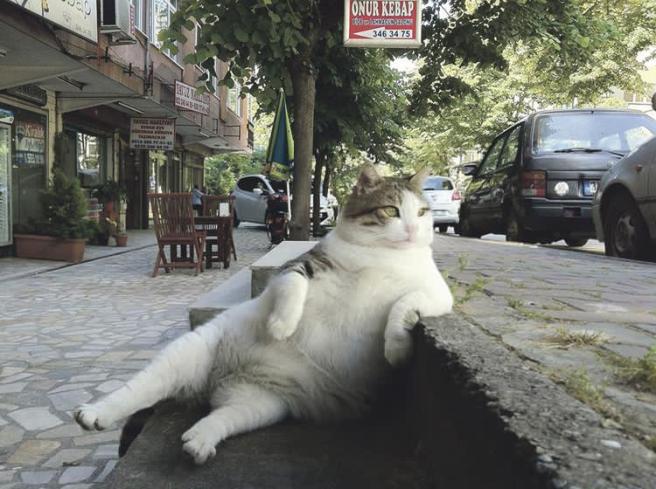
Someone in the movie declares the homeless kitties are the city’s soul, but on my few visits to Istanbul I saw far more stray dogs than cats. Like this winsome fella, who became my pal for nearly a month:

P1020788.jpg
Istanbul, 2008

Still, I certainly saw many cats, such as this leery pair of scrappy, well-fed survivors:

P1030495_1.jpg
Istanbul, 2008

In “Kedi” cats inhabit rooftops, cardboard boxes, markets, cemeteries, trees and awnings, and the film paints artful visions of the kitty stars, from Bergmanesque close-ups to whisker-level Steadicam action of running, jumping and chasing (mice beware).

The cats comprise a motley array, and I expect to see the kitty cavalcade when I return to Istanbul next month — toms, calicos, tortoiseshells, mamas nursing their babes, cats with patterns like a painter’s palette, or, one of the stars of “Kedi,” a female hellion dubbed “the neighborhood psychopath.”

fat cat.jpg
From the film “Kedi”

Inevitably, kitty characters and personalities emerge, inescapably anthropomorphized. “It’s so fascinating,” says a simpatico fishmonger of the cats who not so mysteriously follow him around. “They’re just like people.”

We have two cats. They’re just like people: indifferent, solitary, narcissistic, wise, wily, incessantly hungry, jerks.

Yet in “Kedi” the humans are like grandparents who spoil their charges. A shopkeeper compares a kitty comrade to one of his children as he brushes her fur while she looks off into heavenly ecstasy. Another man compares the company of cats to the soul-soothing power of prayer beads.

Our cats provide the soul-soothing power of pooping, crotch-licking gremlins.

Taking care of these furry street urchins is, they say, their duty. They are cat custodians, and for many of them the animals supply a divine connection that is healing, curative and therapeutic.

How is this possible? one may ask. Cats purr and meow, but are otherwise as mute and inscrutable as the Sphinx. They scamper off a lot for no damn reason.

“I imagine having a relationship with cats must be a lot like being friends with aliens,” muses a dreadlocked woman in the film. “You make contact with a very different life form, open a line of communication with one another, and start a dialogue.”

As someone who talks to the animals, from cats to rats, I love that.

(“Kedi” stuff, including trailers, can be seen here.)

Ode to a wondrous hair explosion

It was like a solar event radiating from her head, explosive yellow curlicues twirling and boinging into the stratosphere. Flaring, flaming, the bleached helixes formed a magnificent afro that any ethnicity could pull of with high-fashion finesse. It was positively Kaepernickian.

This vision appeared today in a cafe and I oddly did not see the woman’s face, just the back and side of her head. It was plainly a woman, but I have no idea if she was white, black, brown or what. I stared at the flaxen shrubbery from behind. Its corona of frizz entangles you, startles, transfixes. 

edfef30baa823b90dcbebb4aee0c907b--blonde-selfies-girls-selfies.jpg
A lot like this.

It’s so loud, so brash, it’s like a bulletin, a manifesto, a mission statement. Hair, like clothes, is like that: It’s an articulate communicator, revealing much about a person, like the choice of your car or your dog does. It says This is me, and quite a bit more. 

What this gigantic yellow afro says is: YES DAMMIT!

If you want a piece of that, you can buy the big ‘do for $19 from Amazon:

Unknown.jpeg

But that tilts toward offensive, never mind the repugnant artificiality of it. 

I like what I saw, the real deal, the brazen authenticity and screw-you audacity. I like the sheer follicular electricity, all zap and fire.

Drinking outside the box

Summer’s steamy curtain call is almost here (woo-hoo!), but we’re still in a light wine state of mind. Rosé is our go-to beverage in the seasonal swelter — with citrus-laden gin and tonics right behind — almost like sody-pop for the kids: refreshing, quenching, yet still retaining that sneaky bite adults crave (and sometimes require).  

These days we’re getting our rosé from a faintly unorthodox source: We’re drinking from a box. They call it bag in box wine, or simply boxed wine. Either way, you extract a plastic nozzle or spigot from a cardboard box and wine spritzes from it, or more specifically, from a shiny bag inside the box.

It’s resplendently dorky.

And yet …

w5254575tf_1.jpg

After a period of snooty ignominy, boxed wine is back in vogue, shorn of shame and stigma amongst those who know a good deal and, yes, a good wine. Excellent boxed wines abound, including the crack rosé we’re drinking in almost blushing abundance: Lab Rosé, from Casa Santos Lima winery outside of Lisbon, Portugal. (Rosé, incidentally, is defined as “a light pink wine, colored by only brief contact with red grape skins.” It’s exceptionally fruity, just a tad dry, ideal for the hot months.) 

Three reasons boxed wine rules:

— It’s way cheaper. A standard 3-liter box holds as much wine as four regular wine bottles. Our local outlet sells a Lab Rosé box for $17. Do the math and get misty-eyed. Then guzzle. What you lose in sleek glass aesthetics you make up for in sheer value.

— It’s environmentally sound. Say several sources: The production of boxed wine generates about half the emissions per standard bottle of wine.

 It lasts forever (almost). “Thanks to its handy-dandy vacuum-sealed spigot, boxed wine has a longer shelf life after opening than its bottled counterparts,” writes one pro. “And I mean a lot longer. Up to six whole weeks, in fact.”

IMG_1161And that brings me back to Lab Rosé, which is that much more of a bargain because of its prodigious quality. It is, for example, far more luscious and drinkable than its more expensive Provence Rosé counterpart, whose gloppy malty finish is ruinous. And though Bota Box Dry Rosé is quite fine, it too is several dollars more than trusty Lab.

Lab indeed earns consistently strong reviews from wine experts and sundeck sippers alike. Wine Enthusiast bestows Lab Rosé a respectable 86 points, noting, “This is a pale colored, attractively perfumed wine. With red berry fruit flavors, bright acidity and a lively orange zest texture, it is fruity and ready to drink.”

Ready to drink, for sure. Right out of the dorky, yet somehow radically cool, box.

My best fiend: remembering a childhood pal

My best friend between ages 5 and 10 was a freckled scamp named Gene, who even at that age seemed to conduct life on the razor’s edge, courting trouble with a highly evolved sense of mischief and the occasional snap of malice.

Always cooking something up for us to perpetrate, be it leaving dog poop on someone’s porch then doorbell ditching or setting small fires with gun powder in his bedroom, Gene earned the nickname “Gene the Machine” from my dad, who didn’t know the half of it.

Small and short — he sat on a tall step stool at the dinner table — Gene provided my unsentimental education. He taught me every cuss word I know. When he blurted “Go to hell!” at a girl in our fourth-grade class, I was too overcome with snickers to be shocked. He introduced me to nudie magazines, some of which he buried in plastic bags in his backyard. He sold me on the rock band Kiss and the dubious pleasures of pyromania. 

Boy holding burning matchstick

Matches and firecrackers were always on hand. We scorched many things, including, by accident, ourselves. At our mildest we would torment plastic army men, igniting them and watching them melt, black, acrid smoke curling up. Eventually Gene, with another pal, burned down a large field. (That misbegotten episode attracted the authorities.)

Something of a holy terror when he was in form — like the time he tortured to death two frogs he found under a rock — Gene also exposed me to twin thrills: the breathtaking delights of high-impact rollercoasters and the gnarly waves at our Southern California beaches. To this day, a mean, uncompromising rollercoaster is a peerless high.  

And then he’d do something reckless, like toss shotgun shells into a bonfire or pour rubbing alcohol on the garage floor in a circle, light it and stand in the middle of it as if performing some kind of pipsqueak pagan ritual.

We were young and he made me laugh harder than anyone. Yet this incorrigible gremlin exposed me to dangers and things wrong and taboo, even illegal. (Where were our parents amid the devilry?) Once he convinced me to throw rocks off a cliff into dense traffic. A man, enraged, saw us and we ran like hell.

Even Gene’s jokes were warped, naturally. He told me that he was going to stick a firecracker in the neighbor poodle’s butt and light it. Seeing my horror, he admitted he was kidding. Thing was, I didn’t put it past him. (Then again, he was a bleeding heart animal lover, lavishing cooing affection on his dog and pet rat.)

After I moved, at 10, from Santa Barbara to the San Francisco Bay Area, Gene and I kept in touch, seeing each other twice a year to hit the next rollercoaster, smoke cigarettes on the railroad tracks and listen to heavy metal as our teenage years blossomed.

Gene picked up the guitar and played metal like a madman — he was good at whatever he tried, from surfing to skiing — and I continued playing the drums I started as a kid. We jammed, copying riffs we heard on vinyl by the likes of Ozzy Osbourne, Metal Church and Metallica.

And then Gene’s heedless path took him down bum detours, drug addiction being the worst of it. We saw less and less of each other as we hit our 20s — college, jobs. He struggled mightily with his demons, and lost. At 26 he was dead from an overdose. I was a pallbearer at his funeral with a few other guys I’d never met before.

I still have dreams of Gene — impish, funny, alive. He made an enormous imprint on me, shaping and influencing me in ways to live (loud, with a scrap of healthy risk) and not to live (like a kamikaze). Age has tempered, filtered and refined all that. I’m (arguably) well-adjusted, considering the Gene factor.

In the end, Gene was just a neat kid, scrappy and irrepressible, taking a bite out of life with enviable gusto if too little restraint and a sometimes shaky moral code. I facetiously call him that devil child. But, thing is, I don’t think he’s anywhere near hell.

The cafe’s human carnival

It is on Saturdays in the teeming cafe that the grasping hodgepodge of humanity is on circusy show, performing a bustling if familiar boogie starring tip-tapping lap-toppers, laughing friends, wailing toddlers, softly groping couples and expert baristas, frenzied, always frenzied, deploying tentacles behind the long curving counter, confecting elaborate beverages for the restive masses. 

It’s not quite as crazed as it sounds — well, it kind of is — yet characters abound, vivid regulars I see several times a week. Like:

The frowzy old codger, pants up to here, who shuffles through the cafe, pacing to and fro, issuing random quack-quacks like a grizzled duck. Or The Wayward Whistler, who sort of bops in, sunglasses on, whistling blithely, lost in his own groovy cosmos, loud and vexing. He’s like the guy strutting with a boom-box on his shoulder, self-awareness at zero, tweetling away through lips like a Cherrio.

laptop-1103330_640.jpg

And let’s get her out of the way: one of the most unfortunate stars of the show, a barista I’ll call C. (as in Crazy). She is the worst kind of “funny,” the aggressive kind. She inflicts her humor on you, weaponizes it. She uses her post behind the counter as both launchpad and stage.

C. is loud — screeching jetliner loud. And she weirdly believes that feistily abusing customers and colleagues is a hoot. “Every single last one of you, even my coworkers, gets on my nerves!” she booms in a strangled bray directly at a customer whose icy, confused half-smile makes you want to shrivel up and die. Hilarious!

Another time, C., a squat, stout woman, waddles up to the register and thunders: “DO I HAVE TO RING THEM UP? THEY DRIVE ME CRAZY!” She is pointing at two customers. She is smirking, this distaff Don Rickles. They don’t know what to do. Hysterics!

One day C., a dumpling of ear-shattering zingers, actually starts barking like a dog. “You all right?” a coworker quietly asks, eyebrow cocked, embarrassment flooding the room.

The cafe, much like C., is a frequent shambles, with boxes scattered across the floor, unkempt bathrooms, backed-up orders. That said, many of the baristas are pros: efficient, conscientious, polite and often doting.

Yet it’s the people-ly parade that’s most engaging, the variety of voices, the panoply of personalities that eddy through what is, at its best, an aromatic oasis from the familiarities of home.

It’s the nebbishy white guy with the foot-tall afro of such fluffy resplendence it could be a follicular monument. It’s the pretty, modish woman with the irresistible bangs and regrettable tattoos who consorts with a dubious bearded fellow in too-short skinny jeans.

It’s the gabby, globular ex-cop who wears black and yellow Steelers regalia — cap, jacket, shirt — everyday and clearly doesn’t know what an “inside voice” is. His guffaws are small earthquakes registered as far away as Idaho.

It’s the just-retired mailman who looks roughly 90 and has the ashen, cadaverous facade of a slain vampire, yet is endlessly friendly, despite the fangs. It’s the knots of teenage girls who come in giggling and gabbing, texting the entire time, mad multitaskers who have this smartphone shit down.

Amid all this, the chatty din, the roiling throngs, I read and write. Inconspicuous as I am, head buried in the computer, I’m not quite invisible. A few baristas know my name, including cackling C., who has unleashed her corrosive humor on me to no effect, except my urge to barf.

Yet I lay low, tucked in, watching the human carousel, that merry microcosm, by turns fascinating, alarming and heartening, spin on.