Back in black

After an unintentional hiatus of chronic brain farts, here are a few bite-size entries:

Tripping over trips

I bought a flight to Chile. And scrapped it. I bought a flight to Toronto. And scrapped it. Fickle? Right. Even after planning and paying I decided neither destination would slake my thirst for culture, art, food, action. So I scotched them in favor of the capital of the European Union’s most populous nation, that mad beehive of historical and cultural abundance, Berlin. Chile would have happened this month, Toronto last month, and Berlin, well, it’s a ways off — October. Yet as with any trip, I’m already committing vigorous reportage, booking tours and meals, boning up on the history and italicizing gotta-see sights, from the fabled Reichstag and remnants of the Wall (now vibrant murals) to Hitler’s bunker (that fetid suicide pit) and the enticing Museum Island — five museums colonizing a mid-city isle on the lovely Spree river. Sounds great, I think. Equally terrific: I got full refunds for the Chile and Toronto trips. Did I mention my brother is coming along? Fine company, he’s also a crack navigator, which is perfect for me who gets hopelessly lost the second I step out of the hotel. I’m the guy holding a huge, creased paper map upside down, battling fluttering winds.

Doggy style

I don’t laugh out loud very often while reading, but I did, a lot, soaking in Miranda July’s new novel “All Fours,” a warm, warped, touching, unashamedly naughty and riotous love story that goes places you’re never quite prepared for. It’s a joy. The story follows the romantic zigzags of a 45-year-old artist who’s a married mother but stumbles upon unlikely love with a much younger man who likes to dance. Sex, perimenopausal panic and motel redecorating ensue. It’s conventional until it’s not, both bawdy and bizarre, with just the right touch of July’s signature kookiness. Never has the writer — who’s also an actress and filmmaker — been more in control of her habitual twee impulses. And never has she been so seamlessly funny.

Doggy style part II

Cubby the magical mutt is, I’m afraid, getting old. The guesstimate age for this chipper rescue pup is seven to eight, solid middle-age in human years — paunches and ear hair, janky joints and jowls, gray and grumbles. Yet while he can be a bit creaky scrambling up the stairs and some tiny warts have mushroomed on his compact body, Cubs still plays chase with his stuffed Yoda and barks with shattering verve at the random car horn and rumbling UPS truck, more than ever in fact. But he’s also more neurotic than he was in his slavering, carefree youth. Sometimes if landscapers are extra noisy or the wind rustles the trees in violent whooshes the dog will quiver and hide under my legs or behind a chair. Also, his outside duties (doodies?) seem harder to coax out of him. Otherwise Cubby’s a hale old boy, snapping up treats and begging for belly rubs. He sleeps well, too, though his snoring can register 7.5 on the Richter scale. Those little earthquakes are a thing of most assured comfort.

His head looks enormous.

Recent tomes I’ve tapped

I’m never not reading a book or two. These are a few new titles I got my grubby paws on: 

Mike Nichols’ 1966 film of Edward Albee’s corrosive play “Who’s Afraid of Virginia Woolf?” remains a dish-rattling, drink-spilling, daggers-in-your-ears delight, all marital earthquakes and social Molotov cocktails. (Cocktails. Of course.) Booze is big in that cracked portrait of a long-wed couple on the rocks. (On the rocks. Of course.) And you get a contact high reading the riveting “Cocktails with George and Martha: Movies, Marriage, and the Making of ‘Who’s Afraid of Virginia Woolf?’” by Philip Gefter, who capably captures the play’s serrated edges, dubious morality and verbal drive-bys, as well as the behind-the-scenes hoopla of making a controversial movie with a controversial couple, no less than Richard Burton and Elizabeth Taylor — Hollywood nitroglycerin. It’s a bracing blast of theater and cinema history.  

“Headshot” is by a woman named Rita Bullwinkel. Let’s get that out of the way. (There, done.) This slim, tightly coiled novel is also a muscular debut, damp with the blood and sweat of a passel of female teenage boxers, zesty characters realized with pointillist panache. Time-leaping and fragmentary, the girls’ stories are told in intense vignettes for a scrappy scrapbook of pugilistic profiles that pounds with humanity and life. If not quite a K.O. — more tonal and rhythmic variety would shake things up — the book is a fleet-footed contender. 

With irksomely precocious flair — at 35, he’s a wizardly wunderkind — poet Kaveh Akbar conjures worlds of art and ideas in his radiant fiction debut “Martyr!” Reeking agreeably of auto-fiction, this dense but delectably readable novel is about an Iranian-American poet scouring past and present, life, death and love with the insight of an artist and the squishy heart of the wounded. Gorgeous language propels you through its lush, gently philosophical thickets. And despite some muddled mysticism near the end — I’m allergic to spiritual allegory — “Martyr!” had me pleasantly reeling. 

Lorrie Moore’s a personal favorite and her latest fiction is the knottily named “I Am Homeless If This is Not My Home.Like all her books, tangy prose festoons the pages (a bite-size sample: “Fluorescent light rinsed the room.”). Yet the novel, with its arch surreal touches, rubbed me wrong. The narrative, centered on a man and his dying brother, is gawky, with sharp elbows and knobby knees. Plus, there’s heaps about chemo, cancer and croaking, and I’m not in a hospice mood. The novel just won the National Book Critics Circle award for fiction, so call me bonkers. In this rare instance, Moore is less.

Not for the feint of heart but perhaps for suckers for sentiment, the bleak memoir “Molly” — breathlessly written by Molly’s husband, Blake Butler, a noted novelist of thrillers — starts with her gunshot suicide and continues with another bang, the crack of bared emotion and tell-all candor. This is the story of Butler and Molly Brodak’s three-year marriage, a melding of art and nature and words and, in her case, bouts of inconsolable darkness. Brodak, a published poet and author who said “I simply wasn’t good enough,” killed herself three weeks before her 40th birthday, in 2020. “Molly” is so much about her and her devastating secrets, yet equally about Butler’s clawing to the other side of grief through deep (and verbose) psychic excavation. He includes Molly’s suicide note (“I don’t love people. I don’t want to be a person”), along with the frantic blow-by-blow action of finding her body in a favorite field of theirs. These passages are tough-going, not only for the forensic particulars, but for Butler’s writerly histrionics as well; he pants on the page. A cult sensation, tugging readers to and fro like emotional taffy and kicking critics into superlative overdrive, “Molly” is a divisive read, by turns lovely, wincing and overheated. It is the first book I’ve read that opens with the phone number for the national suicide hotline. 

Food porn, Sicilian style

It’s 33 degrees outside and a cold winter sun glares from unblemished skies, the deep snow melts and the tweedly doodles and musical Morse code of birdsong fills the chilly air. Even inside, my hands are numb and puckered, and I should really put on gloves. But I can’t type with gloves. The blogger’s quandary.

Here’s another quandary: I just got back from my maiden voyage to Sicily — namely, the capital city Palermo — and, writerly speaking, I am constipated, all blocked up. Ex-Lax for writers — is that a thing? Gloves or no gloves, my typing is stymied. 

Let’s try this. Let’s look at a picture of one of my many fabulous meals on the fabulous trip, like this heartbreaking pizza:

Or this exquisite specimen of pistachio gelato:

And why not this prosciutto panini with a popular Italian beer:

Or the best cannoli I’ve ever had, made before my eyes in an actual nun’s convent:

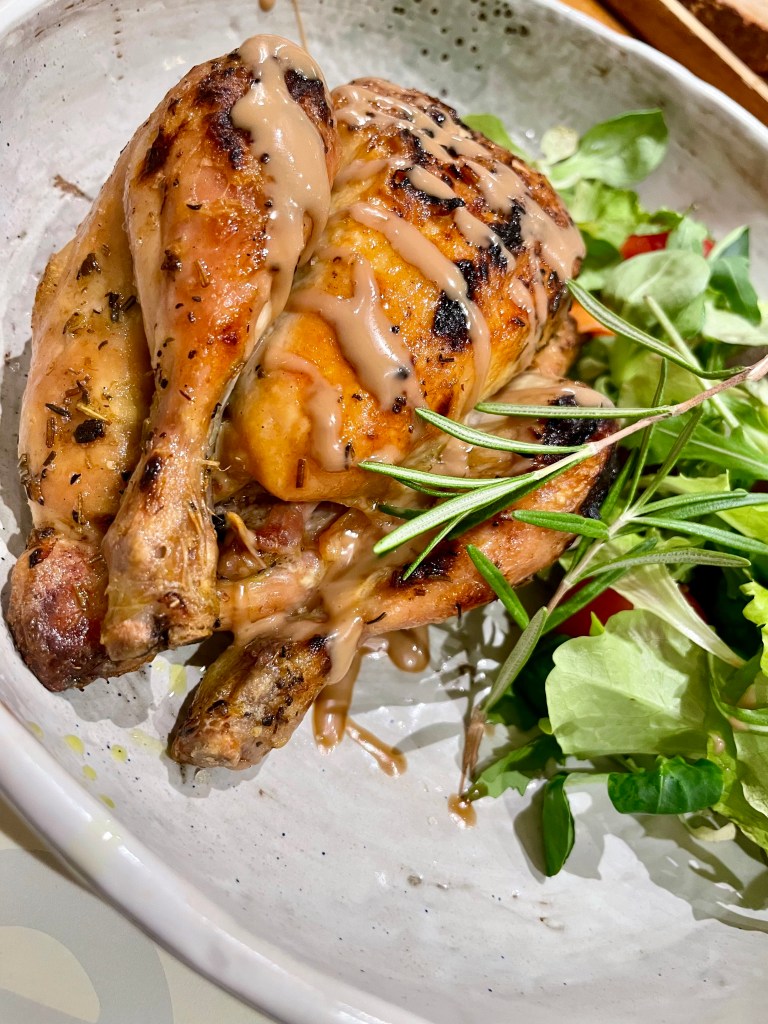
See, with most of my journeys, food takes up considerable real estate on my itineraries, at least 50 percent of why I go and what I do. Art, cathedrals, quirky museums — like the marionette and Inquisition museums in Palermo, the gruesome catacombs, plus the Mafia tour I took — are mandatory and rewarding. But nothing quite so viscerally gets the gut like, say, this succulent, perfectly seasoned chicken I feasted on:

Sicily — infamous for its Mafioso, which is actively being stamped out — is the biggest island in the Mediterranean, set just below mainland Italy. It boasts a regional flavor, dialect and attitude all its own, and its denizens are a proud people. They are also unfailingly kind, helpful, funny — and self-admittedly gesticulative and loud.

All of my Ubers were sleek black Mercedes and, as it was low season last week, non-local tourists were scarce. Booking a tour or a table was a cinch, and the weather hovered in the very comfortable mid-60s. (No gloves needed!)

Palermo, a coastal city of about 700,000, is exciting the way gritty Naples is. It pulses. It’s richly historical and traffic-choked with throngs of motor scooters; graffiti-strewn and colorfully multicultural. Pet dogs are plentiful — sidewalks are mushy minefields of poop — and street food rules. Like the Sicilian Arancini, fried rice balls, nearly the size of a tennis ball, filled with melty cheese and meat. Phenomenal.  

As I’m still a bit writer’s-blocky, I exit with these non-foodie shots of the rightfully famous Palermo Cathedral, a dazzling architectural melange of Islamic, Norman and Christian influences. I’ll share more about picturesque Palermo when my brain freeze thaws. Ciao.

‘X’ marks the spot

I recently wrapped Catherine Lacey’s transfixing novel “Biography of X,” and it still haunts me. Published last year, the book is pungent and persistent, banging around my brain, impressions springing up at random moments, all of it fragrant and strangely alluring.

“X” is a big book of ideas and feelings. It has a collage-like texture. It’s about art and the ravenous impulses of the artist; romantic love and its hazards; the fluidity of identity; the slipperiness of selfhood; and the rigors of creation. 

And it’s about the relationship between X, who has died, and her widow CM, the so-called writer of this fictional biography, which of course was written by Lacey in a neat feat of authorial ventriloquism.

X — who went by a swarm of pseudonyms, depending on her setting — was a shape-shifting Zelig, insinuating her self into the realms of art, music and literature, finding creative success and romantic excess, much of it to CM’s dismay and heartbreak as she researches her ex-wife’s half-cloaked life. 

In elegant, unfussy prose, Lacey conjures an alternative world in which X wrote the iconic David Bowie song “Heroes”; Jackson Pollock, Alexander Calder and other major artists are killed in a terrorist bombing; and Bernie Sanders is the President of the United States. Cameos by Patti Smith, Christopher Walken, Susan Sontag and other luminaries arrive with cheeky nonchalance.

Lacey’s command of her literary experiment and the constellation of personalities she so blithely courts sometimes makes you think you’re reading an actual biography of an actual person. It’s a good trick, deft and ambitious, and a delight to plunge into.

At 38, Lacey is a bona fide wunderkind, and her performance in “Biography of X” has me trusting her to lead me farther into her cerebral yet accessible oeuvre. 

This week I got her slim gothic fable “Pew,” from 2020. It’s about an anonymous orphan who’s lacking crucial identifying components — age, name, sex, history — rattling and confounding a small, deeply religious community in the American South. 

I’m half-through this mysterious novel, whose humanity almost blinds. I’m with it all the way, totally sold. Lacey’s virtuosity sings, loud and clear as a bell. I’ll just say it: She is one of the most interesting authors of her generation.

Facing evil

Let’s not get all down about it, but I’m reading “Survival in Auschwitz,” the slim and indelible account of life in the most notorious Nazi concentration camp by Primo Levi, an “Italian citizen of Jewish race.” Published in 1947, the pages bulge with terrible and inconceivable realities, much of it learned about in any decent schooling, yet far more personal and unsparingly granular. The horrors are shattering.

So I will spare you. I’m reading the book, an autobiographical classic, because of my upcoming visit to Auschwitz, just outside of Kraków, Poland. My trip, as I’ve oft-noted, takes me to Budapest, then Kraków, where I went years ago, including the day trip to the concentration camp, which is now a haunting al fresco museum that staggers with its bleak, blunt truths. Even the gift shop (yes, gift shop) is stained with gloom.

Why do we go to such places? I know someone who said he would skip Auschwitz if he went to Kraków, a fact I find astonishing. Few places throb with such recent history and so many fresh ghosts and has shaped so much of the modern era to now. It’s living history, inescapable. To duck it, inexcusable. 

That’s just me. Genocide is vital and we should be exposed to it as a reality check and cautionary device. Visiting Auschwitz (or Duchau, which I toured in Germany) is mind-expanding. It’s not a place for morbid curiosity or ogling. It’s a place for reflection and wonder. Like any potent museum, it works intellectual muscles and, more so, wrenches emotional ones. It’s as powerful as any Holocaust memorial or, similarly, the 9/11 Memorial and Museum. Its utter humanity rumbles, and humbles.

I have a strong stomach for dark and doom. I seek out shrines to deformity and mortality, like the Mütter Museum in Philadelphia, the Museum of Forensic Medicine in Bangkok, freak shows and books about human oddities. I always make a solemn visit to Holocaust museums, be it in Amsterdam or Israel. Or, of course, Auschwitz-Birkenau. 

It’s not about luxuriating in morbidity or getting a “thrill” from death, like some sophomoric Goth, who gleans reality from graphic novels and zombie movies. It’s the opposite, being repelled by it while pondering the strength, the sheer fortitude, of the victims and acknowledging that it can’t happen again. The triteness of that statement is a reflection of its truth.

In “Survival in Auschwitz,” Primo Levi writes eloquently of struggle and endurance in the face of naked evil inside the death camp. His spirit is wounded but unbowed. Survival is paramount, and he carries on because it’s all he can do. 

He says: “Sooner or later in life, everyone discovers that perfect happiness is unrealizable, but there are few who pause to consider the antithesis: that perfect unhappiness is equally unobtainable … Our ever-sufficient knowledge of the future opposes it, and this is called, in the one instance: hope.” 

Is Austin overrated? and other stray thoughts

1. Even through my teens, my two grandmas, bless their long-dead hearts, called me Chrissy, and I didn’t mind a bit (unless it was in front of my friends, then I turned a scorching shade of fuck me). Today, one of my best friends, an unassailable lady in Texas, occasionally calls me Chrissy or even Chrissy Poo in endearing texts. Born Christopher, I’ve always gone by Chris, but that’s a unisex name, and for those of you with monikers like Jamie, Terry, Jessie, Charlie, etc., you know it can get sticky. Sometimes at my newspaper gigs, I’d get hate mail addressed “Dear Sir or Madam.” But that was rare. Readers could pretty much tell I was a guy, because my reviews often had an acid tang, a little banner that said: dick. Two of my favorite names for girls are Samantha and Alexis, which of course become Sam and Alex. I almost named a pet rat Samantha. When my sister-in-law calls the dog my way, she’ll chirp, “Go see Chrissy!” I don’t blush. I kind of like it. If it’s good enough for old Cubby, it’s good enough for me.

2.If I got a bunch of dogs, these are some of the names I would give them: Bongo, Mamet, Alvy, Corn Pop, Gatsby, Heddy, Akira, Brando, Phoebe, Takeshi, Willa, Uncle Johnny, J.D. and, my favorite, Kaboom. I don’t think a single one of the dogs would be pleased with me. Too bad. That’s just for starters. (Growing up we had a little black poodle named Itai, which is Japanese for “ouch.” Just think how he felt.)

Corn Pop and Bongo going at it.

3.I just retired my 2-year-old Apple AirPods — the first generation earbuds that pop out of your head when you sneeze — and replaced them with snuggier AirPods Pro: 2nd Generation, and I made a vital sonic discovery. It’s one that many of you probably already know (this Luddite lags in the world of aural ecstasy). And that’s that the pods furnish remarkably better sound quality when used for movies and videos than plain Apple Music tunes. I do my listening on a MacBook Air, be it music, podcasts, YouTube or films. I’ve watched three movies with the new pods (including the enthralling if baffling “Arrival,” a film that pushes me even closer to hating sci-fi) and the audio excellence — sumptuous, immersive, surround-soundy — has me giddy. Even a 1950s Billy Wilder flick cranked out sound like I was in a fine, classic movie theater that actually gave a spit about its presentation. Power to the pods.

4.I once worked with a masterly, natural-born writer named Michael Corcoran, who was the newsroom’s resident curmudgeon, bristling maverick and trenchant culture critic. Now retired, the award-winning scribe, who’s also a friend, maintains a beguiling blog whose lead entry is as incisive as it is infamous, a biting takedown of his hometown Austin, TX, titled “Welcome to Mediocre, Texas.”

“Only the mediocre are always at their best, someone said, which could be why Austin is so damn proud of itself,” Corcoran begins, and continues:

“There are two cities in the U.S. that truly matter: New York and L.A. Everywhere else is bullshit. Austin is cool and fun and artistic and — most importantly, easy — but that doesn’t make it a great city. The things that make a town a city — rapid transit, a great art museum, Chinatown, pro sports — Austin is without. We’ve got L.A.’s traffic, but no one who can greenlight a project bigger than a Chili’s commercial.”

Read the full rant HERE, especially if you’re reflexively enamored with Central Texas’ ego-tropolis, which a visitor I know once compared to Sacramento and Stockton.

But it sure is purty