One magnificent mollusk

Coiled near its rocky den, the octopus slowly unfurls a tentacle like a flower blooming in a time-lapse photo to the human hand before her. It glances the hand then suddenly sucks it, gently pulling it toward her. The moment carries the pitter-patter of courtship, of holding hands for the first time. Could this be love?

“That’s when you know there’s full trust,” says the owner of the suction-cupped hand, free diver and filmmaker Craig Foster, in his remarkable documentary “My Octopus Teacher.” A viral smash, the Netflix film has been shortlisted for the best documentary Academy Award. Really, it deserves a special accolade, say, Best Buddy Picture Between Man and Mollusk. The movie is something else: devastating octo-poetry. 

A simple story about a grown man befriending a gorgeously slithery cephalopod in the swaying kelp forests of South Africa, the film depicts the burly, soft-spoken Foster as a dedicated student of the ocean who is truly moved by the relationship he forges over a year with the sea animal that remains unnamed. (I suggest Octavia.)

Part of his lesson is noticing the striking similarities between us and these “alien” creatures, the way connection, interspecies or not, is essential and a well of bracing contentment. “It does give you this strange level of octopus joy,” notes Foster, saying words that have likely never been uttered before.

As a pupil, Foster is a keen observer, learning by watching his silent friend do what she does: hunt, hide, jet, crawl, swim and, sometimes, walk on two legs on the ocean floor. That trippy spectacle, both funny and boggling, is one of many scene-stealers.

She’s a gelatinous chameleon, enacting stunning physical transformations with her bulbous head, serpentine legs and polka-dot suckers to blend seamlessly into the Day-Glo surroundings. Her effortless shape-shifting is part of the movie’s multi-pronged magic.

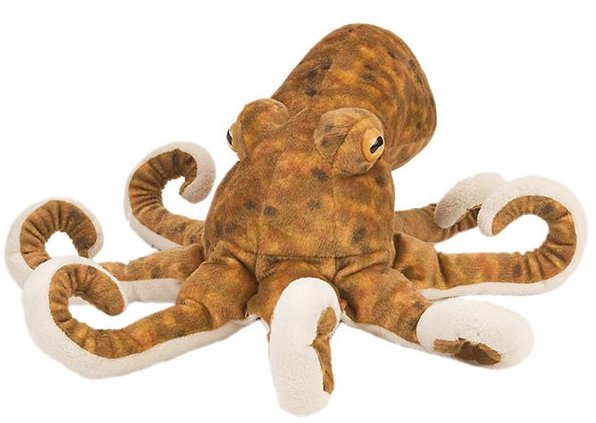
“My Octopus Teacher” reminds me of many oceany things, like the charmingly odd adopt an octopus campaign at the World Wildlife Fund, where for a $55 donation you get a plush stuffed octopus, a photo, an adoption certificate and other tentacular goodies. It never occurred to me that octopuses were endangered, but WWF says they’re “vulnerable to toxins and pollution,” yet doesn’t that cover just about everything? (Please send me $55. I am endangered. My plush doll is amazing.) 

As much as I love watching the delightful octopus in the movie, I love even more putting octopus in my mouth. Almost unavoidable on midscale restaurant menus — perhaps another reason they’re endangered — grilled octopus is hot stuff, up there with bone marrow and short ribs. Both chewy and silky, the meat has a mild sea-foody flavor complemented by a good fiery sear. Here’s a spectacular piece I scarfed in Barcelona:

I don’t want to eat the movie’s affable octopus. She’s a darling — adorably clever, wily and pretty, much like the picture itself, which is also fairly wrenching (brace for some drama). 

It’s an elemental tale rife with homey pleasures: the hand holding, the snuggling, the mutual respect. The bond is inexplicable but palpable, right there on screen, like when Foster’s new BFF seems to be tailing him through the sea.

“That’s one of the most incredible feelings,” he beams, “to be followed by an octopus.”

It’s fantastic, and it almost breaks your heart.

An EKG? WTF?!

So I tell my doctor that I think my heart is fluttering, murmuring, skipping a beat or doing something wiggy that makes me worry I’m about to have a heart attack. I like my heart to beat to a steady 4/4 tempo — your basic rock beat — and not do paradiddles and drum solos. I want Ringo Starr keeping time, not Keith Moon. 

The doctor raises an eyebrow but is distinctly untroubled and prescribes me an EKG, or electrocardiogram, which goes like this: “An EKG measures the electrical activity of the heart. It tracks these beats and electrical impulses and tells how the heart is functioning.”

An EKG? I frown. But what did I expect? I whine about my impending cardiac arrest and suddenly I’m hooked up to an octopus of cables. Did I think the doctor would just check my blood pressure and stethoscope things away? (Yeah, a little.)

Like any sane person, I loathe medical procedures. They’re intrusive, worrisome, expensive, and they smell funny. But I quickly learn that an EKG is rudimentary health stuff, like a blood test, or a digital rectal exam (sorry). Of course I do it. 

This is what the whole thing looks like (that isn’t me, and that certainly isn’t my nurse):

The procedure is so fast and easy — 10 minutes tops — that I’d barely call it a procedure. More like a way to have some chest hair ripped out. 

Just doing it makes me feel healthier. I’m unaccountably certain the results will be peachy and I can go on living a questionable lifestyle. 

Later, the doc summons me. Things are suddenly not so glowing. Irregularities appeared on the EKG. She wants me to get an echocardiogram, which is: “a test that uses ultrasound to make pictures of your heart.” It’s what they do on a pregnant woman’s belly to see the fetus, but on your ticker.   

Terrific. Now I’m not just stressed, I’m nearly beside myself. 

And for good reason. The echocardiogram I eventually get bears unsettling news. Apparently my heart is in distress: I have a dilated aorta and a “bundle branch block” on the left side. The doctor tells me to see a cardiologist and gives me the name of one. 

I sigh, hard. What’s wrong? the doctor asks. Well, I say, you just gave me a pile of shitty news. She tries to soften the blow: At most, he’ll examine you and tell you to come back in a year, she says. I sigh again. I’m a big sigher. 

Convinced I’ll soon be getting a triple bypass, or a baboon heart, I nervously see the cardiologist, a man bald of pate and kind of soul. Why are you here? he asks right off the bat. Well, I was told I was about to die, I say, if not in those exact words.

Not even close, he says. The abnormalities that appeared are actually totally normal, nothing to worry about, now get the hell out of here and live your life. 

Amazing! I’m free! I’m healthy! My chest will not explode in the next six months! This is a huge turnaround. A new lease on life. I almost kick up my heels like a leprechaun.

And then a dark curtain drops and it occurs to me that good health is fleeting. We are all decaying, breaking down, each breath the beginning of the end. The cardiologist’s warm, mellifluous words become so much empty prattle. Sigh.

But I am undeterred. I will seize the good news and slap the heavens with a high-five. I will take it day by day, adopt a zen perspective, stay calm, reside in the moment. The proverbial bus may smoosh me, or I’ll die a shriveled twig under hospice care, age 101. Really, I don’t know what’s next, how this life thing will play out.

I know only one thing: I kinda don’t want my heart to stop. Hit it, Ringo …

Royal pain

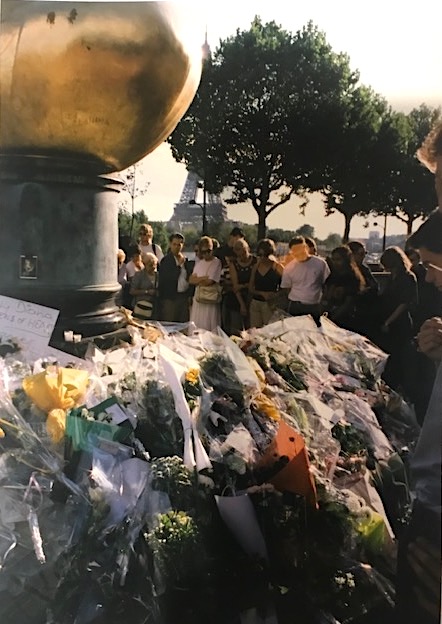
Exactly one week after Princess Diana was killed in a car crash in Paris, in 1997, I stumbled upon a sprawling ad hoc memorial for her just above the Pont de l’Alma tunnel, where the catastrophe occurred. My arrival was strictly serendipitous; I don’t even remember why I was in that part of Paris at that particular time. I was just a gawking tourist ambling along, probably whistling like an idiot. 

Yet there it was, an ocean of bouquets, effusive notes and photographs placed by milling mourners paying their respects. It was September 6, the very day of Diana’s funeral, which was held at Westminster Abbey in London and finished at her resting place in Althorp Park, the Spencer family home. 

Diana’s makeshift shrine in Paris, September 6, 1997

My reaction to the spectacle was a rush of surprise tinged with ambiguous sorrow. Not for a moment had I ever thought about Princess Diana — or any of the Royals — before this chance encounter. I found their soap opera travails — marriages, divorces, deaths, births and betrayals — perversely overplayed and monumentally tedious. (Only the recent season of “The Crown,” featuring a star-crossed Diana, came close to holding my attention to royal hooey, and raptly at that.) Yet I was dimly moved, despite myself.

The Royals live their own fractured fairy tale, without the court jester (or is that Philip?). Drama, oodles of drama. The latest swirls around Prince Harry and Meghan Markle’s self-exile to shiny California and if I cared a whit I’d rewind to juicy bits about Fergie, Philip, Charles, even poor Diana, who was groomed for sainthood by an adoring public.

Why the undying interest in the Royal Family? Who are these people? They’re obscenely rich, for one, leading charmed if crushingly idle lives in monstrous palaces fit for, well, a king. Yet they’re only human, pitifully so. Their crises are legendary, fed to the public in a manner fitting congenital spotlight whores. Their reign serves no discernible purpose, rendering them privileged waxworks, oxidized totems of antiquity that just sort of sit there, performing the robotic “royal wave” to the glazed masses when not shooting skeet.

It’s a twisted phenomenon, the whole royal-watching rigamarole. And it’s hardly trifling. Google “royal watching” and you’ll get some 613,000,000 results. Compare that to a search of “Barack Obama,” who I’d argue is far more interesting and consequential, and you get a paltry 132,000,000 results. Then again, the British monarchy has been around since the 10th century. But still.

The American analogue is JFK and Jackie’s self-styled Camelot, that dreamy, idealized, media-genic Arcadia that spawned a (rather jinxed) political dynasty. Kennedy’s 1,000-day presidency in no way compares to the Royals’ 1,000-year run, at least in duration, but both are subject to fawning scrutiny by lovers and haters alike. The glamor and intrigue, triumphs and tribulations! It’s a tea-time telenovela, with two cubes of schadenfreude.  

I guess that’s what gets us: human frailty played out on the public stage. It’s Shakespearean, irresistible, satisfying yet not so much. They’re our heroes and our villains; we spit-shine them with a loogie. Such empty-calorie ogling has been a pop-culture sport through the ages, whispered in gossip, screamed in tabloids. And it doesn’t require a king’s (or princess’) ransom. Talk, after all, is cheap — and royally seductive.

***

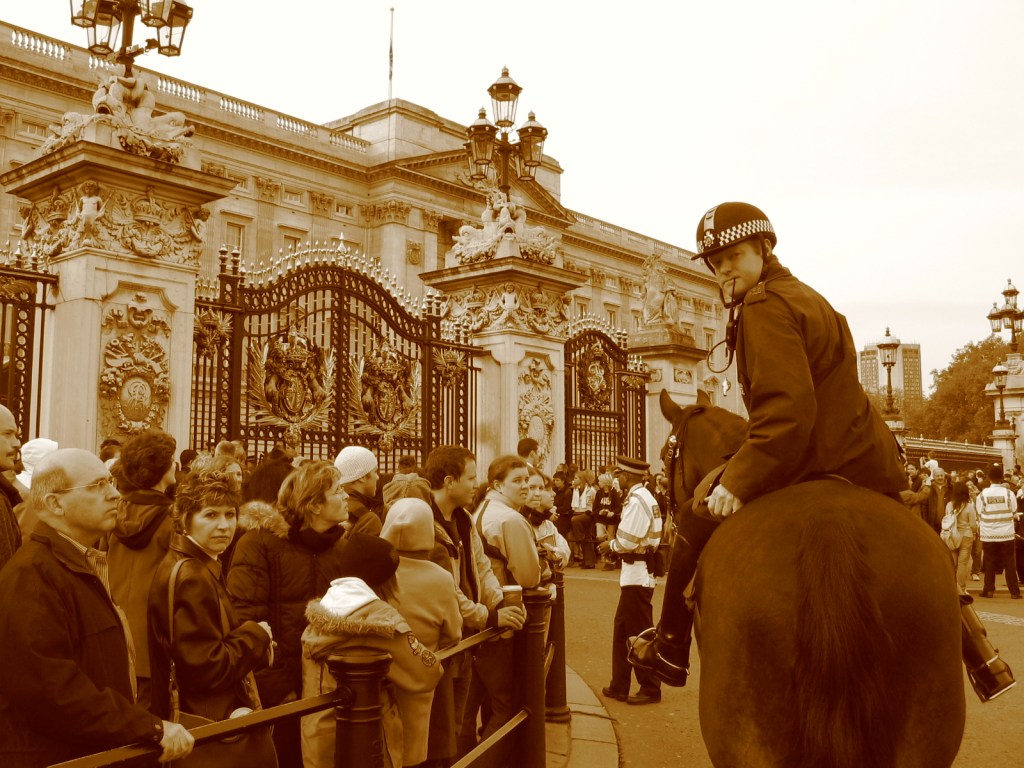
Speaking of stumbling on monarchy malarkey: In 2004 I chanced upon the Changing of the Guard at Buckingham Palace in London, an irony-free shuffle of hollow pomp and frivolous circumstance. Since I just sort of materialized without a plan, I wound up unmoored on the street instead of obediently queued on the sidewalk. As you can see, the glaring horseback bobby was having none of it. Maybe he sensed my royal revulsion.

Buckingham Palace, 2004

College, the great mind-blower

In my first semester of college, Marlon Brando blew open my bitty blinkered brain.  

I was 18 and watching the actor at a small on-campus screening of “A Streetcar Named Desire,” Elia Kazan’s 1951 film of Tennessee Williams’ torrid fever dream of a play. I was mesmerized, disturbed, rattled. 

Who is this guy? I wondered. What is this guy?

I had seen Brando in “The Godfather” and “Apocalypse Now” on VHS, but this was different. This was the young, bristling Method actor, a radical of modern performance, searing the screen with unseen naturalism — a combustible churn of physical and psychological muscle, animal charisma, brute sexuality and roiling menace. 

He was a new kind of screen male. He hollered and knocked things over. He was sensitive, a raw nerve. He was scary, feral. He was gorgeous. He was hideous. He was fantastic.

This, I thought, is what college is about: revelation, learning, getting gobsmacked by the greats. All at once, in that Brando bombshell, was a liberating feast of ideas and culture. The very next day, I borrowed a Brando biography from the library. I craved more.

A curious kid at a university in a wildly diverse, culturally rich city, I gulped it all, from Hong Kong action flicks to Zippy the Pinhead comics. In a city of famed seismic activity — yes, San Francisco — Brando was one of the first icons to rock my late-teen world.   

Brando, smoldering

He wasn’t alone. Other cultural forces who uncorked my brain included, in no order: Beethoven; Sartre; the Marx Brothers; Shakespeare; Freud; Stanley Kubrick; the Beatles (I’d always known their music; I just didn’t know their music); Orson Welles; Buddha; Nietzsche; John Waters; Dalí; Bogart; Buñuel; Kafka; the Ramones; Fellini; Charlie Chaplin; New Yorker film critic Pauline Kael.

(Woke alert: I realize there is only one woman and, save for Buddha, exclusively white people on the list. This is just before I fell for Toni Morrison, García Márquez, Miles Davis and all the rest. As it’s the past, there’s very little I can do to remedy the situation.)

I adored my school. It was an institution that showed scant regard for sports and frats. (I sort of felt sorry for our neglected little football team, but not really.) It was the kind of liberal arts college where August Coppola — brother of Francis Ford Coppola and father of Nicolas Cage — was Dean of Creative Arts and the city newspaper’s erudite pop critic taught my History of Rock ’n’ Roll course. 

Protests were big — pro-Palestine, anti-apartheid. The Red Hot Chili Peppers played the stamp-sized Student Union for five bucks a head. Director Sydney Pollack gave a seminar on filmmaking. Free movie screenings abounded. You barely needed class when almost everything around you was an education.

Take the campus library: nerdy, for sure, but a free, all-you-can-eat buffet of intellectual stimulation. There I’d watch esoteric documentaries, listen to concertos and symphonies and pore over rare books. It was all part of this teen’s great game of cultural catch-up.

And isn’t that what college is, a way to get young minds up to speed on the world, culture, history, life? It’s about my freshman geography professor dismissing the Bible as a book of fairy tales and the above rock history teacher expounding on the lush productions of Phil Spector, Fleetwood Mac’s “Rumours” and Springsteen’s “Born in the USA.”

It’s about watching bad improv groups perform in the dorms and serving as Opinion Editor on the fiery campus newspaper. It’s about eating falafel for the first time and meeting Allen Ginsberg at a reading of “Howl” at City Lights bookstore.

College as entrée to life’s rich pageant, untrammeled exposure — that’s how I took it. There were city museums and concert halls — at 19, I got a student subscription to the San Francisco Symphony — the Haight-Ashbury, its own mad cultural-historical corridor; movie theaters like the Castro, Red Vic and Roxie; plays at ACT and the Magic Theatre. Not to mention the cultural cornucopia awaiting just over the bridge in Berkeley.

I got my first good camera as a freshman, styling myself a shutterbug about town, a wee, wannabe Weegee. I got deeper into my drums, soaking up sophisticated masters like Steve Gadd and Terry Bozzio, learning to kick things up while toning them down. 

It was all about finesse, those early college days, about forging newly freed passions into a prismatic worldview that made sense to me. And it began with a revelatory sensation that was balled-up in the raw, sweaty brio of Marlon Brando.

Not for a moment has that novel feeling stopped. Once launched on the journey of discovery, you’re pretty much stuck. College lit a fuse; the explosions keep on popping.

Tales of a teenage screw-up

I got busted a lot as a teenager, twice by the law, but mostly by my parents, who were, in hindsight, exceedingly levelheaded but had their limits when it came to teen tomfoolery. Especially the smart-ass kind. 

Lessons learned: Don’t lie. Don’t smoke pot in the house. Don’t back-talk like Judd Nelson in “The Breakfast Club.” And don’t sneak out at night and sleep in some kid’s tree fort with your girlfriend. Just don’t.

That last one burned bad, because the punishment fit the crime. Not only was I grounded for two weekends, but any chance to see Ozzy Osbourne in nearby San Francisco was promptly jettisoned. 

I didn’t know my parents had discovered my tree fort escapade when I excitedly showed them the newspaper ad for the show. Seethed Mom: “You have the balls to ask us if you can go to a concert?” I crawled to my room, chastened, shut down. Did she really say “balls”? I thought.

Of course, months later, I sneaked out again to meet a girlfriend late at night — at a golf course of all places — so you can call me a recidivist, or, more accurately, a bonehead. This time I wasn’t caught. And this time I didn’t sleep over near the ninth hole. I pedaled my Mongoose BMX back home and was tucked into my twin waterbed (which was way outdated even then) before dawn. My antics were par for the course.

And then the fuzz found me. Senior year of high school. Four guys in a beaten brown Pinto parked on a hilltop in a suburban housing development. Drinking beer, puffing pot. Red and blue lights. Two of us cited for weed, me and my friend Mike, by one Officer Burt, whose notoriety for chasing down teen scofflaws was legendary and feared.

The upshot: I spent a weekend on a modern-day chain gang, minus the chain, digging up shrubs on street islands in the blazing sun, wearing a reflective vest. (I can’t believe I’m telling you this part: At lunch, three of us peeled off and lit up. Seriously: bonehead.) 

Not only was I cited for marijuana possession that night, I was also hit with underage alcohol possession — a little boo-boo I soon repeated. (Bone. Head.) I was doing 42 in a 30 zone when I was pulled over. Unfortunately, on the backseat I had a cooler containing a six-pack. “What’s in there?” asked the unflappable officer. I was more saddened that he confiscated my beer than getting a speeding ticket and a yet another citation. 

But I shouldn’t have been, because that second offense landed me in what’s casually called alcohol school, which is really a series of weekly night classes for young drug and booze offenders. I had to go for a month.

Busted. Again.

The “teacher” was one of those self-consciously hardened scared-straight types, scowling and threatening like he wanted to beat holy hell out of each of us loser drug-addict criminal hooligans. Too bad for him he was about 5’5” and 110 pounds. Still, it was a sobering lesson in naked unpleasantry. 

As vigilant as Mom and Dad were, they were curiously unruffled by my run-ins with the law. I don’t even think I got grounded for either citation (no, wait, I’m sure I did). They certainly weren’t shocked or affronted. I vividly recall presenting my pot possession ticket — a folded-up yellow carbon copy — to them that night and confessing my sins in full. And I recall utter calm. And I recall getting high after they went to bed. 

The teen mind boggles. Restless and wild, it pushes, tests and risks in a haze of addled morality. Often, it knows not what it does. It’s stubbornly stupid that way, and the learning curve is steep. Maturity comes at a price. See you on your next tour, Ozzy.

I found ways of getting grounded with almost self-flagellating consistency. Because Mom was around more and shared my fiery temper, most of my domestic devilry featured face-offs with her. It was never pretty and nothing to be proud of, particularly since I almost always lost. I once overheard my Dad telling my Mom that I was a “problem child,” which happens to be the name of a pretty good AC/DC song.

So I was a poor pupil in the School of Not Getting Busted. But I straightened out. Mostly. I was something of a voluptuary in my 20s and 30s, a confirmed singleton with a penchant for potent potables and an imperishable wanderlust that still whirls me around the globe. Encounters with cops dropped to nil and a safe and sane credo was duly adopted. 

I’m still a bit bonkers — where’s the fun in going totally straight? — but I’m no longer foolishly unruly. That’s kid’s stuff. And despite some good memories, I don’t miss it at all.

OK. That’s pretty much a lie. So ground me.

Loving animals, doggedly

As I was scratching the dog’s belly today, he squeaked out a tiny fart that I excused him for since, as far as I know, he can’t speak English and isn’t versed in basic human etiquette. I kept scratching and he emitted customary groans that I tend to interpret as vague doggie ecstasy. Sounds coming from both ends, très stereophonic.

Cubby the Wonder Mutt likes to lie on his back, supine, head tossed back, eyes squinched, rear legs spread-eagle, his pee-pee out in all its centerfold glory. He’s a good dog, as they say — always “good,” never “great” or “fabulous,” why is that? — even if he resembles one of those diabolical pygmy hellions, an Ewok. Compare, contrast: 

OK, not exactly, but sometimes I glance at him and scream in fleeting horror.

Animals, like ol’ Cubs, are always on my mind. For some reason, I’ve been watching more YouTube junk than normal and it seems like half the videos are prefaced with ads for heart-curdling, soul-gutting animal causes. 

They’re the kind that show emaciated puppies and starving bony horses and shivering dogs with so much eye goop they can barely see. It screws everything up. I don’t even feel like watching the video I was set to watch after those damn commercials. 

They get me every time. So there I go, helplessly dropping cash into the coffers of PETA, the Humane Society and other groups, like the crazy one for abused donkeys in India and the World Wildlife Fund’s stupendous adopt an octopus program. 

And I recently joined the ASPCA’s modest monthly membership, which amounts to an obscenely affordable 63 cents a day. I told them to save resources and keep the free t-shirt, which would only wind up as a dust rag. Pretty soon, thanks to all my donations, I’m going to own about 14 complimentary animal calendars that I really do not want.

I think I’m so nuts about animals and their welfare because I was raised with a rotating menagerie of pets: dogs, cats, rats, turtles, fish, rabbits, hens, salamanders. And I was scarred by “family” films like “Old Yeller” and “Where the Red Fern Grows” that only make you love animals more and hate sadistic filmmakers. Even “Charlotte’s Web” planted a screwdriver into my heart, and she was just a crummy spider. (Even now I don’t kill spiders. I scoop them up and plop them outside.)

I hate to rate my animals, but since Cubby is in the other room probably flashing the neighbors on his back, I present the best dog my family ever had, a black Lab dubiously named Spooker. That’s her below, the one flicking her tongue. (I’m the one with the righteous tiger slippers; my brother Craig sports the scandalous red onesie.)  

Usually when I profess my love of animals I essentially mean dogs. I care a lot about monkeys, mice and manatees, but I can’t say I love them. Even as tykes, you can see how much we love our big black Lab, our companion, our third parent, protector and pal. Dogs are furry clichés: loyal, cheerful, eager, bursting with unconditional love, even if that means the occasional, totally misguided leg hump. That’s a pretty good package. 

Cubby fits the bill. He sort of represents all animals for me — penguins, porpoises, platypuses, the random narwhal — and so by caring for him I’m embracing the whole animal kingdom. 

That sounds super corny, and re-reading that sentence makes me shudder. But it’s true. Cubby contains multitudes. He’s small in body, big in heart. He lavishes affection on us and only asks in return walks, food, and heartfelt belly rubs, the kind that make him groan and wheeze like a 79-year-old with emphysema. Sometimes if you press just right, he produces the tortured warbling of bagpipes. Then he slowly passes out.

A good dog indeed. No. A great dog. How about a fabulous dog.

Starry-eyed snapshots

In my time as a film critic, I often brought along my own pocket camera to interviews with celebrities, either because I wanted to or the newsroom was simply understaffed that day. I was recently sifting through some of the resulting photos — glorified snapshots, really — and plucked a few that don’t totally suck. You might recognize some of these distinguished folks.

Tom Skerritt (“Alien,” “Top Gun”)
Chloë Grace Moretz (“Kick-Ass,” “Hugo”) at age 12
Lemmy of Motörhead
Sam Rockwell (“Moon,” “Three Billboards Outside Ebbing, Missouri”)
Janeane Garofalo, comedian, actress (“Reality Bites,” “Ratatouille”)
Zombie czar George A. Romero (“Night of the Living Dead,” etc.)
Chloë Sevigny (“Kids,” “Boys Don’t Cry,” “Big Love”)
James Cromwell (“Babe,” “L.A. Confidential,” “Six Feet Under”)
Danny Trejo (“Machete,” “Heat,” “Breaking Bad”)
Bonus shot: James Hetfield and Cliff Burton of Metallica in a tiny nightclub in Berkeley, California, promoting their debut album “Kill ‘Em All” when I was 14

The piano man: a musical meditation

It is dusk and the piano man slides onto his bench and begins playing in the vast hotel lobby, which is arranged with socially distanced dining tables and bar seats for a pop-up piano lounge vibe. 

A sad smattering of customers eat and drink and, shhh, the piano man is tinkling his heart out, swaying ever so gently to his own one-man band. He presides over the shiny black baby grand with quiet authority, as much groovy gravitas as one can muster in a chain hotel that’s trying really hard. 

What am I doing here, listening to the piano man on a frigid Tuesday evening? That’s a short, spectacularly uninteresting story, reader, so we move onto the lonely man tickling plaintive keys, which are surely moist with his falling tears.

The piano man performs sans face mask but with a natty blue scarf round his neck,  evoking a Lake Tahoe lodge feel (the fireplace crackles). He should be wearing a face mask because he is not a singing piano man. He performs instrumentals of dubiously hip pop standards — “As Time Goes By,” “Moondance” — frilling the tunes with jazzy tinsel and rococo flourishes, the filigreed doodles of the creatively restive.

Without singing, this piano man (lower case) is unlike Billy Joel’s iconic Piano Man (upper case), who is implored to: Sing us a song you’re the piano man/Sing us a song tonight/Well we’re all in the mood for a melody/And you’ve got us feelin’ alright.

That’s not quite the scene in the hotel lobby bar this night. No one is making requests. No one is tossing five-spots at the resident artiste. (Where, oh piano man, is your tip jar tonight?) No one is “in the mood for a melody.” Alas, no one is listening.

He’s playing “Tiny Dancer.” He ponders his life as he does.

I am transfixed. The piano man is good. The euphony, the dexterity! Those gliding hands are mad-nuts, and he doesn’t even glance at them. He scans the near-empty room, eyes half-mast, perhaps in a self-induced fugue state. What is the piano man thinking?

I took piano lessons as a wee one. I learned exactly one song. It was 12 seconds long and had these lyrics: “Here we go, up a road, to a birthday party.” Fact: It’s the easiest piano tune ever, making “Chopsticks” seem like Chopin. I mangled it every time.

I figure if I have one more cocktail I’ll sidle up to the piano and join our hero in a duet of “MacArthur Park,” he on the keys, me out of key.

The piano man is an island, no tipsy admirers warbling along with the tunes, patrons shuffling past without so much as a knowing smile or polite nod. He is a rock of existential solitude, abandoned by rotten weather, Covid, the Tuesday night blues. He’s a street busker in a ghost town. The misunderstood genius, honored only after his tragic, Mozartian death. 

The piano man as metaphor. I think we’ve heard that song before, played to the tune of “I’m So Lonesome I Could Cry.”

The piano man’s shiny black berth, the day after his show.

Rating life, and everything else

Once a former colleague and I were talking about how overrated most movies are. We were actually astonished and pretty disheartened. (“Avatar”? Christ.)

Then I took a big leap and mused that life is overrated, and I wasn’t really kidding. My pal nodded, even softly repeating my words. We traded wry grins that belied a deep sadness. We went back to work.

Funny thing is, even that sadness was overrated. Because it wasn’t quite sadness so much as bluish resignation, a minuscule sigh. Life, overrated as it may be, goes on.

Isn’t everything sorta, kinda overrated? All right, not everything. There’s family, romantic love, learning, travel, dogs, bourbon, art, Billy Wilder, anything concerning Doritos.

Still, the very question is unnerving. It’s not the most joyous thing to realize I can think of a kajillion things that are overrated, yet I’m sure you can, too. Let’s go for it. I’m totally just spitballing here:

  • empanadas
  • “The Wire”
  • Johnny Depp
  • most rap
  • “The Queen’s Gambit”
  • Sofia Coppola
  • dinner parties
  • all things Harry Potter
  • “Twin Peaks”
  • sports
  • music festivals
  • celebrity/celebrities
  • chicken breast
  • fake breasts
  • almost every Netflix comedy special
  • Twitter
  • zombies
  • Quentin Tarantino
  • road trips
  • “The Office”
  • late Red Hot Chili Peppers, including “Californication” (but not “My Friends”)
  • giant Ferris wheels in major cities
  • “Fargo” (the 1996 movie)
  • Brazilian waxing
  • Dave Eggers
  • Prague
  • politicians
  • “Vertigo”
  • year-round warm weather
  • Colson Whitehead’s novel “The Nickel Boys”
  • David Sedaris 
  • convertibles
  • “Borat Subsequent Moviefilm”
  • video installations

Excuse the haphazard tally; I was just getting started. I could have tossed in podcasts and pork rinds. Hell, I think I’m overrated. Put me in the top slot.

The thing with overrating stuff is how impossibly subjective it is. I can say life — or, for that matter, “Titanic” — is overestimated and there’s a 90-plus percentage you’ll disagree. Surely one of you thinks David Bowie is overrated, but I’d argue he is not, to my grave.  

But subjectivity is part of the pleasure. Sports fans (grossly overrated) forever gauge teams and players in heated arguments of gladiatorially subjective rating games. 

And it is a game. In Woody Allen’s “Manhattan,” Diane Keaton and Michael Murphy rattle off members of their own “Academy of the Overrated,” including Vincent van Gogh, F. Scott Fitzgerald, Lenny Bruce and Ingmar Bergman, formidable figures that seem name-checked just to piss off a breed of urban intellectual. (Woody himself goes apoplectic listening to them.)

As a game, cataloging one’s personal overrated (movie, food, person, book) is a cathartic kick. The characters in “Manhattan” are having a giggling ball airing their pointedly curated Academy. Tossing together my list above was fun and purgative, despite its sloppy incompleteness. (Though I did self-edit as I went. I felt some inclusions would offend sensitive readers. Like God, and jellybeans.) 

Is life really overrated? Sometimes, especially when you consider sickness, loss, debt, all those Tyler Perry movies. But it’s underrated, too — getting lost in a European city, succulent bone marrow in a good restaurant, fond memories, Al Pacino roaring his way through “Heat.”

Maybe it’s an even split. Maybe life and all its facets, good and not-so good, are what make things interesting. Maybe Coldplay (overrated) and cold weather (underrated) can coexist. And maybe, really, overrating things is itself overrated.

Retreat of the Jedi

When I was 9, “Stars Wars” was the shit. That movie and “Jaws,” two years earlier, jounced my cinematic world off its axis and into, well, outer space. (This of course happened to 95.9 percent of every kid of a certain age, so I’m sort of stating the obvious.)

I devoured “Star Wars” action figures, posters, a cool TIE fighter model, even bed sheets that were blue like the cosmos. “Jaws” — same. I was shark-crazed for about five years. I owned a real shark jaw from Tijuana, a “Jaws” t-shirt (see my About page), many shark books, and a dorky “Jaws” game, where you tried to fish junk out of a plastic shark’s mouth without his toothy smile chomping down on your pole. I sucked at it.

My grade-school teachers grew concerned about my constant drawings of sharks munching the limbs off hapless swimmers in blood-filled waters. Thing is, I’m still a bit batty about the misunderstood ocean predators, which are perfectly evolved, hyper-efficient killing machines, much like the creature in “Alien.”

But my starry-eyed view of “Star Wars” dimmed at a dramatic clip — almost light speed, let’s say. I only half-heartedly went to see 1980’s “The Empire Strikes Back,” a movie that inspired no more expenditures on franchise merch. (By then it was a cultural arm wrestle between “Star Wars” and KISS — George Lucas vs. Gene Simmons. The latter spit blood. He won.) 

Jedi jaded as I quickly became — the Force was now farce — I never did get around to 1983’s “Return of the Jedi.” I wasn’t interested. I didn’t care. Hard rock and girls had hijacked any alliance to “Star Wars,” and, besides, I was obsessing over more interesting movies like “An American Werewolf in London,” “The Elephant Man,” “Alien,” “The Dead Zone,” “The Fly” and, dare I say it, Woody Allen’s entire oeuvre. 

But a third “Star Wars” installment, no matter how disappointing its description, was still news — if not a cultural earthquake, then a rippling aftershock. Crowds flocked and you couldn’t help being exposed to trailers, photos and fan regurgitations of the episode in which Darth Vader famously croaks.  

Furry bundle of unrelenting embarrassment

And what I saw was repellent: frenzied Muppet creatures; the unforgivable Ewoks (tiny, fuzzy Jar Jar Binkses); the grinning ghosts of Yoda, Obi-Wan and Anakin Skywalker (together at last!); and the coda’s mortifying Ewok celebration, featuring gibberish music and creature dancing (Chewbacca boogies!). And I vowed I would never watch “Jedi.” Ever. 

Until I did.

This is where I admit that I watched “Return of the Jedi,” a full 27 years after it was released. It was an impulse rental, done under a cynical cloud of camp: “This is going to be so gorgeously godawful,” I thought, “that it will furnish a galaxy of perverse pleasures. I will howl with laughter at the Razzie-worthy writing and titter at the labored excesses of puppet pandemonium, including the hopelessly lame Jabba the Hutt, who reminds me of a big burp.”

My plan, alas, backfired. 

The movie completely surpassed its build up of rank horrendousness. But the experience wasn’t fun or funny. In fact, the sheer naked badness of “Jedi” served as a bludgeon that beat me into one of my darkest post-movie depressions ever. I actually felt physically ill watching it, and by that satanic climax of dancing Ewoks and high-fiving heroes I had died a few deaths. To this day, I consider “Return of the Jedi” one of the worst movies I’ve ever seen. (Yes, worse than “Jaws 4: The Revenge.”)

At least critic Chuck Klosterman puts a humorous spin on it: “‘Return of the Jedi’ is quite possibly the least-watchable major film of the last 25 years. I knew a girl who claimed to have a recurring dream about a polar bear that mauled Ewoks; it made me love her.” 

And yet at the ever-vexing Rotten Tomatoes, the movie boasts an astonishing 82% approval rating. Opines the Denver Post: “It’s everything it ought to be — glorious, exhilarating, exciting, absorbing, technically wondrous.”

No, no, no, no and no. The movie is absolutely none of those things. Just watch this scene and try not to vomit. 

Jabba the Hutt, looking like an unspeakable bodily excretion.

It’s true that I’ve way outgrown the whole “Star Wars” dweeb-o-sphere, much as the Marvel universe is to me so much sophomoric hubbub. I’m not watching the latest “Star Wars” spinoff, “The Mandalorian,” and I have a terrible urge to squish baby Yoda’s head. 

That pretty much disqualifies me from the Way-Out World George Lucas Built, and that’s fine. Who needs Ewoks and Wookiees, Jabbas and Jedis, CGI and C-3PO, third-rate mysticism and fourth-grade mythology?

And yet “Jaws,” my other grade-school movie crush, remains one of my favorite pictures ever. Its arresting grainy realism is still fully convincing. Its adult’s-eye view of human frailty and interpersonal politics makes no concessions to the popcorn crowd. So finely orchestrated are its grisly thrills, you can allow yourself to be terrorized by a 25-foot plastic mechanical shark that’s as supple as a redwood.

It helps that Spielberg is 5,000 times the filmmaker Lucas is (OK, “American Graffiti” is pretty great). But it also helps that “Jaws” is Muppet-free and doesn’t traffic in cockamamie mythos. It helps that its only creature is sincerely menacing with very high stakes, and that all of “Jedi’s” itty Ewoks would make so much tasty shark chum.