Melting ice cream dreams

I feel bad for the old ice cream truck fella, an icon of hearty Americana who once, back in “Leave it to Beaver” times, was known as the Good Humor Man, and who now is definitely not in a good humor.

Yet here he is, making the rounds at 3:30 each afternoon without fail, rumbling through the neighborhood, tinny tunes jangling from a rusted rooftop megaphone, the Pied Piper of Popsicles. Are those tear stains on his cheeks?  

These are mournful times and, unsurprisingly, the traveling ice cream business is way down, what with parks closed, or only slowly reopening, and the pandemic pandemonium roiling unabated. I hear the music and look out to see two or three tykes clamoring at the truck window instead of the bevy that used to get all Wonka-Bar crazy for the latest frozen thingamajig. 

It’s almost painful watching the face-masked driver handing out melty treats to the wan crowd. What once took a frantic 15 minutes or more is now a few-moments pause, a hiccup with the motor running. (Melting? Maybe my heart.)

Better days for the ice cream man.

What I also notice is how the truck’s musical tootling has changed over the summer. Going from upbeat circusy music, this might be the only ice cream truck whose jingle is by Beethoven, namely “Für Elise,” a strangely moody tune to play from a Day-Glo magnet for giddy children.

I suspect our fraught racial climes have affected the ice cream man’s tune. He used to play the hokey folk song “Turkey in the Straw,” which goes like this. Some argue that the song, which confectionary vehicles nationwide blare as a Pavlovian call to calories, is actually a 100-year-old minstrel ditty that’s grossly racist. Revisionists refute that. 

Not Wu-Tang’s badass RZA, who’s updating “Turkey in the Straw” with a hip-hop twist. CNN reports: “RZA came up with a new ice cream truck jingle because the old one was used in minstrel shows.” Last month, Good Humor even ordered all ice cream truck drivers to stop playing the outmoded number because of its sullied history. 

As if the nameless driver doesn’t have enough woes without the cursed and forever corny “Turkey in the Straw.” The children disperse wearing ice cream lipstick, scampering back to homebound quarantines or kicking balls in the street. I picture our quiet hero despondent, driving off with his forehead resting on the steering wheel, enduring the same few bars of Beethoven’s old melody played over and over on something between a strangled street organ and a broken music box, with that creepy carnivalesque tang.

The music echoes down the block and through the trees, an earworm for the dwindling masses, calling out: eat me

Fall reading officially begins … now

A Big New Book is being released tomorrow: Elena Ferrante’s “The Lying Life of Adults, the follow-up to her celebrated four-book Neapolitan Novels (“My Brilliant Friend,” etc.) that’s been awaited with clammy palms and mild hyperventilation around the world. They call it Ferrante Fever, the passion with which readers embrace her Naples-set, fiercely feminist fiction. In fact, so beloved and famous are her novels, of which I’ve only read two (heresy!), I will go into no more detail about their glittering renown. 

As reclusive and elusive as Sasquatch, Ferrante writes under a pseudonym and an impenetrable cloud of anonymity, so thick even her tireless English translator has never met her (him? they?) in person. The tenacity with which she preserves a faceless non-identity, shrouded in maddening mystery, makes Ferrante a sort of Banksy of literature. She’s been touted for the Nobel Prize, and we wonder how that would work — a fashionable no-show à la Bob Dylan? Does it matter?

41fHc-hEosL._SX342_BO1,204,203,200_

The publication of “The Lying Life of Adults” (which charts the thorny coming of age of a teenage girl) has been called the “literary event of the year” by those New York magazine types, and lots of slobber has soaked its impending release. 

I haven’t read the novel yet — I have a copy on hold, he panted — so I can’t say much more about it without paraphrasing the publicity notes and that will put all of us to sleep. When I finally crack it, I’ll share. 

Meanwhile, about the excellent book I just finished today … 

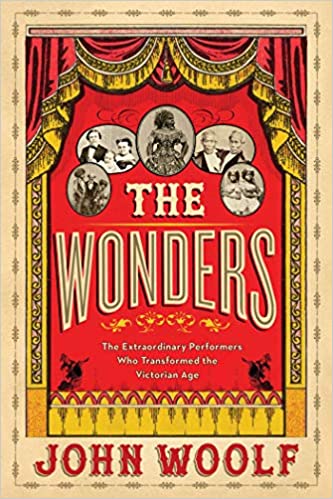
I have great faith in the tastes of London-based blogger Jessica, a native Ohioan who writes the funny and fascinating — and on the rare, lucky occasion, riotously scatological — Diverting Journeys. So when she recently reviewed the freak show history “The Wonders: The Extraordinary Performers Who Transformed the Victorian Age, I promptly grabbed a copy. A fellow enthusiast of the creepy and freaky — from baroque cemeteries to carnival sideshows and babies-in-jars museums — Jessica writes, “I genuinely loved this book. It was so fun to read, and was the perfect combination of cultural and medical history.” 

51Nh9MINwEL._SX331_BO1,204,203,200_Agreed. Author John Woolf weds sharp scholarship and anecdotal color about some of the most popular human oddities of the 17th to 20th centuries with accessible and mesmerizing verve. Some of the abnormalities are digestible — dude, you’re like the size of a Cabbage Patch Kid! — while others rattle: the rampant racial exploitation marring the sideshow circuit truly sickens. 

A “Wonders” sampling: the woman with a blimp-sized derriere and an XL labia; the original Siamese Twins (slaveholders, they), who both married and had like fifty children; an array of dwarfs who thrived as playthings in Europe’s royal courts; and two of my all-time favorites, Julia Pastrana, billed as the Ugliest Woman in the World, and Joseph Merrick, the eternally doomed Elephant Man. (Actually, Pastrana was also doomed. You cannot believe how she winds up.)

These are stories of amazement — you keep wondering how? and why? — and, too often, searing heartbreak. This book somehow manages not to shatter you, not by shirking facts, but by maintaining a tempered, dignified humanity that cleaves to historical reality. Shudder if you must. 

julia-pastrana-2
Julia Pastrana

Life’s an itch

This is not a pleasant post, far from mouthwatering, streaked as it is with pus, scabs and blood. If you’re looking for pixie dust and gummy bears, you’re way off, and I suggest you head to, oh, cutecatvideos.net or marthastewart.com. Giddiness awaits.

You know what eczema is? It’s not heavenly and I’ve got it hellishly. Not rampantly, but not mere diaper-rash dapples either. Mine’s mid-grade, enough for me to finally visit a dermatologist and to repeatedly try to saw my legs off with a cheese knife. The vile rashes are largely confined to my legs, with the random breakout on my arms and hands. Scaly fingers — the best!

Unsightly if not quite repulsive, the fleshly malady — “in which patches of skin become rough and inflamed, with blisters that cause itching and bleeding” (thank you, Webster, for that subtle description) — resembles a mild poison ivy rash. And it itches with fury and hellfire.

The condition is nothing new to me; I’m just electing to whine about it now, here, for your delectation. I’ve endured eczema eruptions sporadically since my wee years, when my parents slipped socks over my hands at bedtime so I wouldn’t rip open my flesh and bleed all over my “Star Wars” sheets while sleeping. 

I only bring it up because this bout is strange and strangely intense. Without dwelling on the oozy, crusty details, I’ll just say it’s a spectacular nuisance, keeping me up nights with feline scratching frenzies and poorly lit attempts to slather lotion over the seething inflammations, like putting out a blaze. Additionally, I’m ruining pairs of summer shorts, some of which have become polka-dotted with rude little blood stains. (Spray ’n Wash has some splaining to do.) 

I never dreamed I’d seek professional treatment for simple eczema. For months I’ve stubbornly tried to master the misery with over-the-counter remedies whose healing powers have proven distinctly underwhelming. There’s the Gold Bond Eczema Relief lotion and some wimpy 1% hydrocortisone creams — both mighty letdowns. The proof is in the ragged tissue under my fingernails.  

Nearly everyone, on the web and in person (including my new dermatologist), recommended I take an antihistamine for the itching, namely Benadryl. So I did. A lot. The other night, over the course of several hours, I popped eight Benadryls, a feat that might get me into the Guinness Book of World Records, or at least a spot on “Jackass.” Benadryl is a well known sedative, too, and most people I know plunge into a coma if they take more than one. But I am, alas, immune to the soporific powers of this allergy curative. A stiff Scotch will have to do.

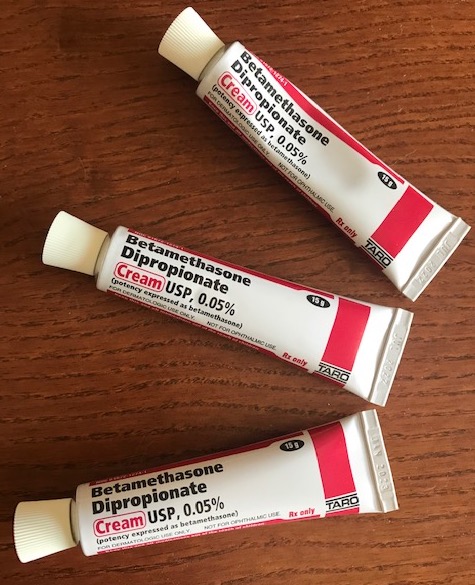
Sometimes the big guns must be marshaled. The dermatologist meeting was quick and to the point. Besides urging me to take antihistamines, the doctor prescribed Betamethasone Dipropionate cream, described as a “strong corticosteroid,” which means, I hope, that it contains healing superpowers of uncommon righteousness. Corticosteroids come with myriad side effect warnings, from acne to glaucoma, but I’m going for it. Besides, I don’t think I’ll get acne or glaucoma on my legs.

Occasionally caused by allergic irritations, eczema mostly attacks for no good reason. As a little kid, chocolate triggered my eczema, so I had to eat that entirely lame chocolate substitute, carob. (By around 9, though, I was all about M&Ms and Reese’s. Hence a new affliction: cavities.) 

Here’s something. Last night was my first go with the powerhouse corticosteroid. I applied it as directed and went to bed. Around 4 a.m. I awoke with both hands clawing the treated regions. Itchy as ever, I took some Benadryl (for a total of seven that night), hoping it would blunt the pain and knock me out. Mission: failed. I was up all night, writhing. 

Still, I will keep at it, slathering white cream on red rashes, seeking a miracle. This is a process, it will take time, and I’m just scratching the surface.

Shop till you flop

Oh, the quarantine is wonderful. I read, I write, I drum, I shop, I gaze at the floor. There’s my epitaph.  

The shopping’s the perilous part, even though most of what I buy online are essentials I’d get at the store anyway: vitamins, shampoo, mountains of books — exhilarating. My purchases run in the $10-$20 range, except for the drum kit I mentioned in a prior post, which cost twice as much as my October ticket to Paris (that trip: never gonna happen). 

Recently I went for another big-ticket item, if not super big-ticket. I bought some fashionable duds: expensive jeans, classy pants that, per historical weather patterns, I won’t be able to wear with a hint of comfort until late September. (For now I wear shorts. I do not like shorts. I look absurd in shorts.) 

So I’ve sported the new jeans around the house, duly admiring them — the slim fit of the raw Japanese denim, the pleasing inky-blue hue, the so-called 4-way stretch, which means a dash of boingy material is stitched into the crunchy denim for optimum comfort, making unnecessary the small ordeal of “breaking in” fresh denim, which often requires rocks, whips and a blowtorch. 

Buying stuff is a two-pronged sensation. It’s electrifying, scouring products, comparison shopping, finding gems, clicking “Place Order,” waiting for the arrival. Yet it’s all so fleeting. When it’s over, item delivered and in my hands, I die a little death, deflated, which is exactly when I should light up a post-coital cigarette.

But the more expensive items — the drums, the jeans, the cursed Paris flight (which was purchased in April) — resonate much more than, say, a three-pack of Colgate. Not because they’re pricier but because they are on a patently superior echelon, more novel, more enduring, more exciting. I love the drum set, I love the jeans, I love Paris. 

None of it will save me. I shop, therefore I am — shrug. That’s claptrap, plain melodrama. At best I’m a half-hearted shopper in normal times, avoiding the antiseptic zombie shuffle of Muzak-y malls and largely being dragged numbly through shops and boutiques even in hip consumer hives like New York’s SoHo, an area I do like.

But stuff must be bought, from boxer briefs to Benadryl. And — why not — the occasional pair of rocking blue jeans. Yet the lockdown shouldn’t make us spendthrifts, but indeed the opposite: penny-pinchers. Dire times, etc. I’m working on that. Meanwhile, that sound you hear is me clicking my way down a rabbit hole of unbridled acquisition.

Random stuff, summer edition

I’m always jazzed when I discover a great new writer — or at least new to me — and that’s the case with American pop culture critic Chuck Klosterman. I’m not sure why, but I’ve avoided his work for a full decade (jealousy?). Then I recently read a description of one his anthologies that snared my interest. (It was surely the fact that KISS and Metallica were two of his topics.) Growing up a metalhead in the Midwest in the ‘80s, Klosterman was weaned on the likes of Guns N’ Roses, Cinderella, Mötley Crüe, and KISS (still his favorite band, which I find outstanding). He declares KISS “the second-most influential rock band of all time,” after the Beatles. Chew on that. 

Today he writes with breathtaking omnivorousness about culture at large, from TV to Chicken McNuggets. (He also writes a lot about sports. I skip all that.) He pens novels, memoirs and big thinky pieces. He’s breezy, never ponderous or pretentious — he’s pretty much anti-pretentious — penetrating, smart as hell and equally as funny. This summer I’ve read his collections “IV” and “X.” I’m now on the memoir of his early hair-metal fandom, “Fargo Rock City.” The book is about much more than his little life worshipping bands like Poison. It’s expansive, ecstatic, packed with big ideas and witty perceptions. With Klosterman, it always is. 

I slipped in a sweaty drum session last night, pounded away for about 30 minutes to an array of vintage rock, most of which would make you blush. I performed pretty well, but not A-plus. I was thinking too much. When I think about what I’m playing, about what move I’m going to make next, I throw myself off and lose the beat. Same goes when I think about life things while I play — it derails the groove and mistakes are made, sticks are dropped. As a metal madman once screeched, “C’mon feel the noise!” Meaning, don’t think it.

It’s been years since I watched the 1996 cult comedy “Waiting for Guffman,” the Christopher Guest mockumentary that, with sardonic sweetness, lampoons community theater culture and the talentless goofs who inhabit it. On a whim, I rewatched it. I cringed at what I once adored. Gags are broad, the jokes are fizzless, the parody punchless. It feels facile and off-key. That said, my love for Guest, Eugene Levy and Catherine O’Hara remains undying. (Forget “Schitt’s Creek.” I’ll take classic “SCTV” any day.)

I got my first haircut in more than four months the other day. (A new national holiday should be declared.) It was a new place, a new barber, a guy I quickly cottoned to. We gabbed almost entirely about world travel — Turkey, Morocco, Japan, India and, natch, Paris, since that’s where I’m booked to go in October. I expressed my concern that even in the fall the world won’t be ready for regular tourist travel. He demurred. His prediction, stated with blithe confidence: All this pandemic mess will be done with in — get this — six weeks. September, he averred, and things will be back to normal, and I will easily get to fly to an all-open Paris. Maybe he was just making me feel better. Maybe he doesn’t read the papers. Maybe he’s been huffing the Aqua Net.   

I’ve rediscovered the kaleidoscopically inspired Cartoon Network show “Adventure Time,” whose title doesn’t begin to convey what’s in store for the kiddies (and rabid adults) who tune in. I can’t either. Squirting diarrhea, rainbow unicorns, a talking piñata, a verbal, shape-shifting dog and so much stuff that qualifies as unapologetically batshit that I can’t possibly smoosh it into this space. Now airing on HBO Max, each 11-minute episode — any longer and your eyes might bleed — is a heady, unhinged phantasmagoria of the surreal, psychedelic and wildly non sequitur. It’s also positive, uproarious, sad, thoughtful and weirdly timely. And it’s a damn cartoon.

Adventure_time.rpg_-696x522.jpg

A step backward for Sophia

Hagia Sophia is one of my favorite structures in the world. A chunky, imposing cathedral-turned-mosque-turned-public-museum, flanked with four rocket-like minarets, a bulky beacon doused in faded hues of pink and salmon, the famous building shares the same lush Istanbul peninsula as the nearly-as-glorious Blue Mosque. Almost amazingly, the edifices sit directly across a palm-lined park from each other, a spiritual and architectural bonanza. 

So it’s with slack-jawed dismay that I read this about the treasure in today’s newspaper:

“President Recep Tayyip Erdogan issued a decree ordering Hagia Sophia to be opened for Muslim prayers, an action likely to provoke international furor around a World Heritage Site cherished by Christians and Muslims alike for its religious significance, stunning structure and as a symbol of conquest.

“The presidential decree came minutes after a Turkish court announced that it had revoked Hagia Sophia’s status as a museum, which for the last 80 years had made it a monument of relative harmony and a symbol of the secularism that was part of the foundation of the modern Turkish state.”

Erdogan, on an Islamist tear, is, like another aspiring authoritarian, a crackpot. And today’s move on Hagia Sophia is culturally criminal. 

More from the article:

“Built in the sixth century as a cathedral, Hagia Sophia stands as the greatest example of Byzantine Christian architecture in the world. But it has been a source of Christian-Muslim rivalry, having stood at the center of Christendom for nearly a millennium and then, after being conquered, of the Muslim Ottoman Empire, when it was last used as a mosque.”

Below are some of my photographic memories of the holy site, aka Ayasofya, where you can see the exotic marriage of Islam and Christianity, including walls of crumbled majesty, their layers peeled back to reveal vibrant Christian frescoes and mosaics from 537 AD, as well as gigantic round panels emblazoned with Arabic script perched from atop the basilica. For years, it was the world’s largest interior space. It is spellbinding. 

We’ll always have Paris?

With a dash of relief, I’ve learned my cheap ticket to Paris for October remains valid, that United hasn’t deemed it necessary to cancel the trip — yet. Booked in early April, when the pandemic was mustering its full fury, the flight still does seem doomed, even four months away. The virus isn’t letting us off that easy.  

Hitches abound. Like the new edict by the European Union barring American visitors to the Continent. That’s a nifty start. Perhaps that will change by fall, if a particularly reckless, infantile and hysterically pathological world leader decides to do his job and quit frothing at the mouth. 

But what will Paris be like in four months? The city is gingerly reopening, taking wise baby steps. Cultural crown jewel the Louvre opens Monday with Covid guidelines and protocols. Only 70 percent of the museum will be accessible — most of the popular stuff — and masks will be mandatory for visitors aged 11 and up.

Cleaning up the Louvre for its July 6 reopening.

I’ve done the Mona Lisa to death, but for those who must, it will go like this, says a Louvre director: “Until now, people would crowd around the Mona Lisa. Now, visitors will stand in one of two lines for about 10 to 15 minutes. Then each person is guaranteed a chance to stand in front of the Mona Lisa and look at her from a distance of about 10 feet.”

I’ll politely pass.

The magnificent Musée d’Orsay opens July 23. Musée Picasso, a personal essential, opened June 22, as did Musée de l’Orangerie and citywide cinemas (I always see three or four classic movies when in Paris). Centre Pompidou opened three days ago, and the ghoulish Catacombs have been open since mid-June. Showing through January 2021 at Musée Jacquemart-André is “Turner: Paintings and Watercolours from the Tate” — nirvana.

That’s a tantalizing start. Or is it foolhardy, madness?

Parks and gardens are open, as are many shops, restaurants, cafes and bars. But that also signals a behavioral slalom course of masks, social distancing, crowd control, etc. Right now, I wouldn’t hazard it, even in my favorite city. Now isn’t the time to be there. Four months, fingers crossed.

This incorrigible planner has had a fully refundable hotel reservation since spring — Hôtel Jeanne d’Arc Le Marais, which has reopened — and slavering beads on at least three restaurants, including the peerless Frenchie and Michelin-star Le Chateaubriand. 

At six days and six nights, this is a short jaunt to Paris for me. If it happens. I have no doubt the pandemic could dash my plans, and that’s OK, because I’ve resigned myself to things not working out. In these epochal times, far more important things jut into high relief, the pandemic to the November election.    

We’ll always have Paris, sure. It’s just a matter of when.

Whenever. Whatever. 

In the grip of one-click commerce

It’s hardly an original phenomenon, that of the quarantined individual occupying some of his time — right, much of his time — transfixed by the latest goodie or gadget at an online store. Screen shopping (analogous to window shopping) or actual shopping (analogous to pulling out the plastic) are, at least for this laptop-leashed homebody, becoming a thing, and I’m sort of going broke. 

I’m “just looking,” gawping, craving, yearning and, oops, placing the cursor on the final button in the series that begins with “Items in Cart” and running through “Billing Information” and so on. These days, I’m all about the Place Order click. The little quiver it fires through my synapses triggers a delicious squirt of endorphins. 

That tiny physical gesture, which can amount to a giant fiscal gesture, is the point of no return. The order is in. The store has your digits, which will show on your card only when the product ships. (That is egregiously untrue. The moment I click, my card is invariably, simultaneously charged.)

Actually, it’s not the point of no return, because return policies are mostly generous and convenient. Indeed, I am the Cancellation King, the agitated avatar of buyer’s remorse. So often I will order something at night and the next morning, in a stomach-clenching panic, hastily cancel the order. I do this with ridiculous regularity. The folks at Amazon probably don’t even process my orders anymore until a good 48 hours have passed. 

I’m not just treating myself to stuff during this flirtation with errant shopaholism. Besides tons of books, the only “fun” purchase was a rather pricey electronic drum set, which is only frivolous if you think a lifelong hobby and creative discipline is frivolous, and I don’t. It’s fun, but it’s also enriching and therapeutic, even cathartic.

This week’s acquisitions from online retailers include: an iPhone stand for the drum kit (longish story), a comfy cushion for my rock-hard drum stool, a pair of my favorite drum sticks, and two boxes of V8 juice, eight big bottles in all. 

(I labor under the wholly unreasonable conceit that this vegetable juice is the secret elixir for humanity’s immortality. Which is nuts, because I don’t even want to live forever. Yet I do want to combat agonizing disease and retain glowing skin. And so: V8, voluminously.)

Some other recent orders: at least 20 books (separately); toothbrushes (which were so bad I got an instant refund); hair goop; bar soap; exfoliant; a pair of green shorts; three caps (emblazoned with logos: The New York Times, Metallica and, dear reader, Gnashing); and film t-shirts (Scorsese, “The Elephant Man,” Columbia Pictures, RKO Pictures, A24 Films).

A few things I cancelled: socks, batteries, floss, reading glasses, stacks more books. 

Most of my purchases are, to my mind, essentials. These aren’t reckless sprees; they’re well-considered Covid consumerism — even if I did finally cave and sign up for Amazon Prime, a dark and foreboding development that can only lead to incalculable folly.

Buying stuff is invigorating for about 20 minutes, like a drug, and then you come down and feel fried and deflated. But then the buzz returns: delivery day!

Or, if you’re me, you place an order, marinate some, then dash and click cancel, like it never even happened. Negation — sometimes that’s the best shopping experience of all.    

Doldrums on the drums

Playing hard rock drums in my longhaired youth was such an impassioned pursuit that I envisaged fans, flash bombs, spotlights, triumphant noise and righteous fury as a way of life. The kinetic absurdity of that dream isn’t lost on me, no. Today I think of it all as the Misbegotten Musings of a Muddled Metalhead. Rock.

Playing music has a way of getting into your marrow, and drumming up a drippy sweat is still a fervid pastime. But, first, rewind. I put down my sticks almost exactly 10 years ago, for good. Until, seemingly out of nowhere, the beat bit me again early this month. Faster than a John Bonham bass patter, I was online shopping for a new drum set to call my own and to pound holy hell out of. 

It couldn’t be a drooled-over acoustic — neighbors, sigh — so I pinned down a hot electronic deal made by superior e-brand Roland. The five-piece kit has a mesh snare and three mesh tom-toms, a bass pad, hi-hat, ride and crash cymbals. Bonuses: a Pearl bass pedal, a Pearl drum stool (that’s, alas, cement-hard), fine headphones and three pairs of sticks. I’ve already bought an extra crash cymbal: One crash makes an impoverished sound, and the physicality of playing with two is exponential. At least the way I play.

rol-td1dmkde_1.jpg

The set is explosively on the money, better than expected, sturdy, loud, textured, complex — a fine wine. I’ve compiled a list of 62 songs to play with — tunes with thump and phwump — which is where the headphones come in. It’s like a greatest hits from my teens and twenties. Meaning: mortifying. 

Now for the downbeat. While the drums are exemplary, my actual performance is something else. Mildly, I am very rusty. My playing isn’t tearjerking, but distinctly arrested. It’s been a while. I’ve always been acutely, painfully, soaringly aware that I am not a great musician. I can keep a propulsive 4/4 beat and embroider it with a well-placed fill or frill, but I should be astounding by now, even considering how little I’ve played since high school.

I’m crisp, but sloppy. Swinging, but stilted. On-beat, but off-key. Sometimes I impress myself and nail a song; other times I’m pure Spinal Tap. (Who I’d like to be is the tentacular wunderkind in the exhilarating drum drama “Whiplash.”)

When I’m really stinking up the joint, the drumming is depressing instead of fun and therapeutic. The purchase then seems catastrophic, a harebrained waste. My long-ago drum teacher, the unfailingly affable Jeff Campitelli (who was teaching Metallica drummer Lars Ulrich at the same time as me), told me that, yeah, we all have bad days, and that my bad days are probably worse than his bad days. That’s self-evident — Jeff is a monster musician — but it sounded sage and philosophic at the time, and I still think about it. 

Bad days bite, but the beat goes on. I no longer dream of screaming fans and flammable stagecraft. I just want to play well. That’s good enough. It’s also harder than hell. There will be blood. But also, I’m pretty sure, joy. A couple years ago I wrote, “Musicianship, I am certain, is an exquisite madness.” I’m sticking by that.