Picturing people, peripatetically

IMG_2773.JPG
Harajuku girl, Tokyo, Japan.

When I travel abroad, once or twice a year, I keep my digital point-and-shoot camera in my outer coat pocket or untangled in my messenger bag, always at the ready, grabbable, right there for the right shot.

P1010393
Beggar girl, Old Dehli, India.

I’m something of a shutterbug, a total amateur driven by the blameless enthusiasm of a self-taught neophyte, toting a picture-taking toy. But I learn fast, and one of the early lessons in my journeys was how dull so many of my photos were. They were dry, clichéd, postcardy, filled with stolid buildings and objects and places you’re supposed to photograph just because you’re there and you want indelible proof that you did indeed behold the Mount of Olives, Ghiberti’s bronze doors or the Hanoi Hilton.

They weren’t awful, but they were lifeless, generic. What they missed were people and faces — humanity. I almost always travel solo, and, anyway, I’m not a big fan of pictures of friends and family standing robotically in front of oceanfronts and monuments.

So I started seeking locals for my shots. The approach not only improved my photographs but also improved my travels. Suddenly I was paying more attention to the daily activities of people, their work, play, drudgery and joys. Observing residents in action literally put a face on a place and deepened the cultural experience.

P1010792
Religious man, Jaipur, India.

Sometimes I “sneak” photos of people engaged in everyday life — men bathing in the Ganges in Varanasi, India; a man selling prayer beads to a customer in Istanbul; a student bicycling in Beijing — yet as a general rule I approach subjects who have a striking face or are wearing an arresting outfit or are doing something vaguely exotic and ask permission to take their picture.

This requires a spot of nerve, especially for an introvert like me. But I’ve found that in many places, if you’re courteous, low-key and smiling, people are receptive, even eager.

P1020932.JPG
Girl, Istanbul, Turkey.

I’ve had great success in Asian nations, where residents display a friendly excitement and curiosity toward the dopey American who wants their photo. Children in developing countries are especially agreeable to having their picture taken, mugging, posing, snatching at the camera to see their image. (Though, with both young and old, you should be prepared to drop a couple of coins into outstretched hands when you’re through.)

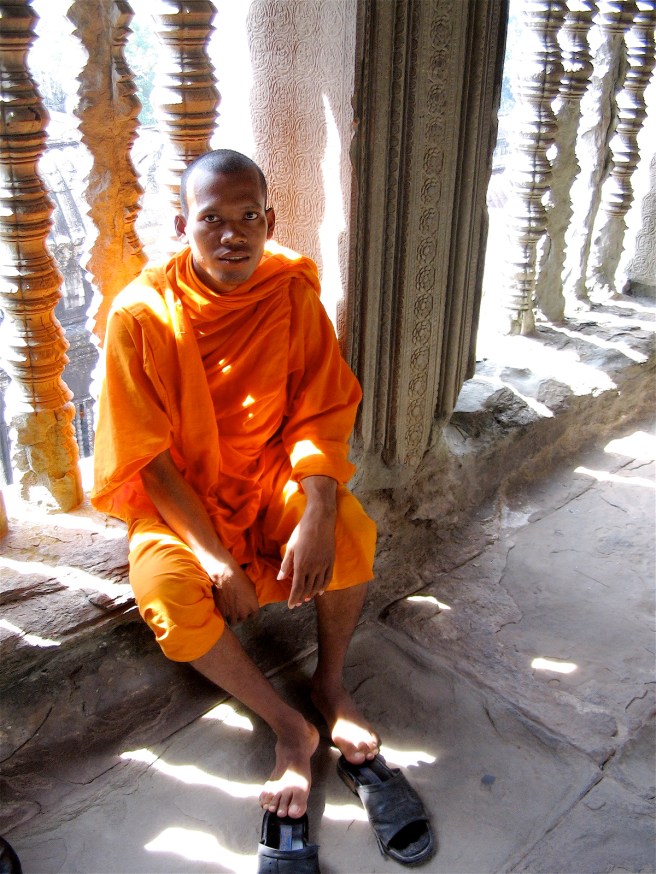
IMG_2124.JPG
Buddhist monk, Angkor Wat, Cambodia.

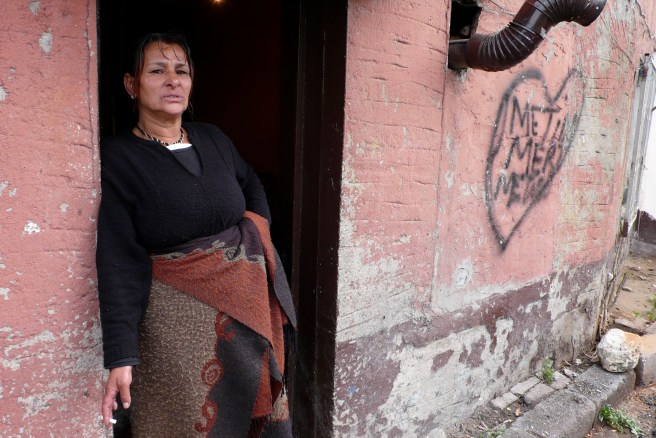
This is a selection of portraits I’ve taken around the world. They are the simplest of snapshots done with basic consumer digital cameras, not phones. They are carefully framed, yet quickly shot. I take only one picture of my subjects as a matter of speed and courtesy. There are no re-dos.

P1010372.JPG
Old Delhi, India.
P1010325.jpg
New Delhi, India.
IMG_2373.JPG
Hanoi, Vietnam.
IMG_2153.JPG
Siem Reap, Cambodia.
P1020909.JPG
Boys, Istanbul.
P1010689.JPG
Kids and cow, New Delhi.
P1030271_1.JPG
Smoking woman, Istanbul.
P1010760.JPG
Udaipur, India.
P1030285_1.JPG
Praying man, Beirut, Lebanon.
P1010782.JPG
Udaipur, India.
P1020572.JPG
Istanbul.

Drinking and striving

A Cucumber Rickey? That’s a thing?

It is a thing, evidently, an alcoholic thing, a thing that tastes like a wonderful thing.

I recently discovered the Cucumber Rickey (yes, I now know the drink’s been around since Tutankhamun) at the Montreal bar La Distillerie, a packed, ultra-trendy but relievedly casual spot that specializes in inspired, palate-thrilling cocktails without the pretense and rigamarole of highfalutin mixology, and does so at gulpingly cheap prices. My Cucumber Rickey — Bombay Sapphire gin, a truckload of fresh cucumbers, lime juice, simple syrup, and orange and mandarin bitters — was $7.50 in U.S dollars. Another, please.

IMG_0704
Gin, cukes, paradise.

A poor specimen of  a cocktail connoisseur — a kicky gin and tonic does me fine — I’m still keenly curious about and eager to try new alcoholic concoctions. I regret I didn’t have time to sample more from La Distellirie’s festive menu, which boasts 27 specialty drinks, though I did try the toothsome Mohawk — Bombay Sapphire gin, peach purée, lemon juice, elderflower cordial, homemade jasmine tea syrup, soda water — a fragrant sweet and sour pleasure. (What in the hell is elderflower cordial?)

That menu is something else, a disarming, user-friendly catalog tailored to individual thirsts. For instance, if you’re in the mood for a “Herbal, Fresh, Refreshing” drink you can choose from four cocktails, including the ubiquitous Mojito, as well as my dear Cucumber Rickey and Mohawk.

o
the Mohawk — sweet, sour, sublime

If you require a “Robust-Intense Powerful Concentrated” drink, select from the Mad Man, Rollercoaster and three others. A quartet of neon-tinged beverages with long French names are located in the “Accessible, Delicate, Light-Soft” category. And so on. There are six categories total.

La Distellirie has three locations in Montreal. I was at the smallest and most popular spot — got there early, beat the crush — in the city’s Latin Quarter (make that Quartier-Latin) on Rue Ontario East. Two doors down from La Distillerie is Pub Quartier-Latin, a ridiculously friendly, semi-dive bar, with a cheery staff, cheap drinks, heaping greasy food and reliable WiFi. I hung out there a lot, writing on my laptop and sipping passable gin and tonics.

My drinking preferences have evolved over time. Fifteen years ago I’d keep a 12-pack of Rolling Rock in my fridge and stock no distilled spirits. A few years later I always had cheap Yellowtail merlot on hand, but still no hard booze, which I drank almost entirely at bars (mostly, blush, vodka cranberries). My beer and wine period seems to have lasted forever, and my liquor sophistication remained downright uncivilized.

IMG_0738.JPG
Where zesty cocktails are found in Montreal’s Latin Quarter.

Until, at last, my brother introduced me to the nuanced grandeur of Scotch — the peat, smoke, vanilla, grass, fruit, even hay — all those swirling notes that begin in the nostrils and finish in a slightly seared gullet. He enlightened me by pouring The Glenlivet, Laphroaig and Talisker, single malts reserved for special occasions. (Our everyday Scotch is the smooth, blended, wholly unpretentious Dewar’s White Label.)

We sample gins for the best G&T’s, as we call them, and have graduated from Schweppes to Fever-Tree premium tonic. Our favorite gin to date: The Botanist. Least favorite: New Amsterdam. (Only later did we learn it was distilled in Modesto, Calif., explaining scads.) We quickly realized that Gordon’s London Dry beats out Bombay Sapphire in taste and price.

We make easy Scotch and sodas, the occasional Cape Cod, and try out new ryes and bourbons, Woodford Reserve being a standout.

negroni
My brother’s dreaded Negroni.

As I said before, I’m a cocktail dilettante. My brother’s the aspiring mixologist, who, like a driven chef, derives myriad satisfactions from confecting a complex libation, step by step, following a strict recipe. He’s especially partial to Old Fashioneds and the bitter, face-scrunching Negroni, which offers a delightful finish of ear wax.

When done creating, he always clinks glasses and often smacks his lips after the first sip of success.

He’s particular about his brands and demands his ice cubes just so. This self-anointed beverage snob, a real liquid dandy, won’t drink at any bar that sprays its tonic from a push-button nozzle, or soda gun. That’s commitment.

I don’t care if they fire my tonic out of a gun. Yet I do crave quality, like the tasty bracers at La Distellerie, which take skill and a little heart. I make modest drinks as best I can — my G&Ts, when I slice up some fresh fruit, are really not bad — and I like to think I could pull off my own Mohawk or Cucumber Rickey. All that, even if I do pour my wine from a cardboard box.


Six books I didn’t put down this summer

I’m an impatient reader. I get excited about reading a particular title, I crack it, read it, and allow it 50 pages to regale me. If I’m not enthralled or at least engaged by page 50, that book is going down. I can’t say how many books I’ve stopped reading at the mid-century mark. The humanity.

This summer has proven good for reading — fruitful, satisfying, nourishing. I think I’ve only put down two books, always apologetically. (As in all my breakups, it’s me, not them.)

One I did not cast aside was Elizabeth Strout’s mellow novel “Anything Is Possible,” a chiseled gem that’s really a collection of nine interconnected stories, deeply soulful snapshots of life, love, loss and more, whose subtlety has an easy-listening vibe.51mPEE0qUtL._SX336_BO1,204,203,200_

I journal a lot. And in May I wrote that Strout’s book is “freeze-dried minimalism, pared and spare, miniaturist portraits so easy to read and follow but practically toothless. They don’t leave imprints, marks. Delicate as bird bones, the prose lacks the prickle and sparkle I’m drawn to — listless, not lifting — yet it still holds me.”

That sounds harsh, but I enjoyed “Anything Is Possible” — I gladly finished it — even though I hardly remember a thing about it, and I almost forgot I’d read it altogether. I guess anything is possible.

Rather more memorable books I’ve read this season abound. Here are five great ones:

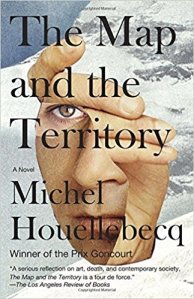
Michel Houellebecq’s award-winning novel “The Map and the Territory” is all brawny brain, yet brisk and entertaining, pretty brilliant and laced with slashing erudition. France’s literary bête noire, Houellebecq’s reputation as an Islamophobe, misogynist and racist precedes him, so I braced for acrid ugliness. But this is a relatively mild story about the meteoric rise of a young artist and all the traps and trappings of an obscenely priced art market, and, for an extra twist, the murder of a writer named Houellebecq, whose portrait he had painted.
513g-KhvYPL._SX321_BO1,204,203,200_

Art, love, money and death are shrewdly explored and a sparkling literary flair survives the book’s English translation. It’s pungent with sharp, funny insights like this:

“It’s impossible to write a novel … for the same reason it’s impossible to live: due to accumulated inertia. And all the theories of freedom, from Gide to Sartre, are just immoralisms thought up by irresponsible bachelors.” 

And, on a more harrowing note: “As you approach the truth, your solitude will increase.”

From one despair to another: Matthew Klam’s mordantly funny “Who is Rich?” hurls its title character Rich Fischer, a washed-up cartoonist, into paroxysms of lust, existential turmoil and the maw of marital decay. Here’s Klam on the latter topic:

“It was just the usual struggle to stay in love, keep it hot, keep it real, the boredom and revulsion, the afterthought of copulation, the fight for her attention, treating me like a roommate, or maybe like a vision of some shuddering gelatinous organ she’d forgotten still worked inside her.”
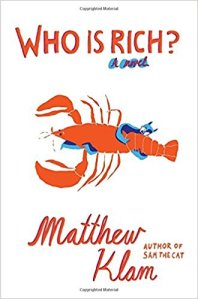
41OvV2OwvWL._SX328_BO1,204,203,200_A tart entertainment, this wincingly lifelike novel starts out breezily but deepens by the chapter with sometimes devastating insights, keen, unsparing observations on family life, marriage, infidelity and children, who he regards as wondrous, but also soul-killing and disappointingly mundane.

Bitter and despairing over his shambolic life, Rich spirals into a hell of his own mind. By the last 30 pages, he’s quaking on the edge. Love kills. Yearning destroys. But light does beam in:

“How do you do it? How do you span the nothingness? Through love, through music, through art, through the sharing of food, fucking and experiences.” 

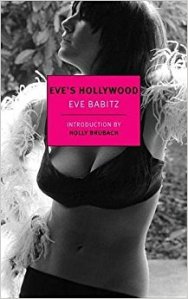
Billed as a novel, Eve Babitz’s crackling “Eve’s Hollywood” reads like a rollicking, site-specific memoir, pulling readers on a picaresque through Los Angeles and the author’s precocious and prickly teenage mind.

In this unsung classic, first published in 1974, Babitz is our beautiful, privileged tour guide, leading us to druggy parties, the Watts Towers, a favorite taco joint, encounters with rock stars, bums and bohemians.
41LfGk35RaL._SY344_BO1,204,203,200_

Babitz’s prose is casual poetry, jazzy here, plainspoken there, always direct and evocative with smells, colors and emotions. She’s like a kid scrawling in a scrappy journal, her memories of parties and privilege unfurling with a blasé panache. She possesses the eye of an adolescent anthropologist, at once callow and cutting, seeing through it all.

Renata Adler’s “Speedboat” also blurs the border between novel and memoir, but more radically than Babitz’s book. Almost structureless, the story’s protagonist, journalist Jen Fain, hopscotches urban America, bumping into life and experiences in jagged, kaleidoscopic impressions. The fragmentary scraps, fragrant and alive, aren’t woven into a narrative tapestry, more a crazy-quilt, and that’s made the 1976 novel an influential cult item among writers like David Foster Wallace.

51x-mF3wvCL._SX356_BO1,204,203,200_

Partway through “Speedboat,” I noted in my journal: “Not sure what it’s about, or if it is, as it seems, slices and episodes of a journalist’s peripatetic life.”

I was right, but journalist Guy Trebay, writing in the book’s afterward, nails it: “By turns journalistic, diaristic, aphoristic, always episodic and mordant, ‘Speedboat’ is a novel made up of a series of sharply observed miniatures rendered aslant.”

That’s my kind of book.

Sherwood Anderson’s “Winesburg, Ohio” is one of those canonical masterpieces that no one has heard of. Published in 1919 but distinctly modern in tone and themes, this fine fiction is a cycle of 22 interlinked short stories limning more than a dozen characters’ lives in confining small-town America.

51ivP9BjP5L._SX331_BO1,204,203,200_In patient, pellucid prose, Anderson plumbs work, religion, morality and the loneliness and isolation of life in fictional Winesburg. I found the quaintness of time and place relaxing and gently engrossing. The stories possess a simple sublimity, and taking my time through its pleasures was a joy. It’s a fast, clean read that isn’t without dramatic and emotional punch. A hushed knockout.


‘The Elephant Man’ is David Lynch’s best film

“When I first heard the title an explosion went off in my brain, and I said, ‘That’s it.’ It was a true blessing to get that movie.” — David Lynch on “The Elephant Man” in a 2007 interview with yours truly

David-Lynch-for-Cover
David Lynch

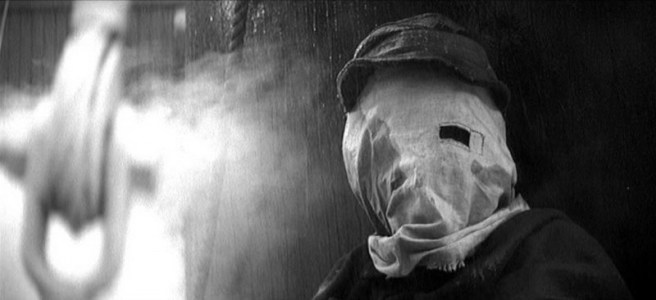
In “The Elephant Man,” David Lynch’s disturbing-heartbreaking biopic from 1980, John Hurt plays the title character, born Joseph Merrick, a young man so monstrously deformed that people scream at the sight of him, forcing him to wear a burlap sack over his mountainous head and a shroud around his body, covering every inch of his warped, tumor-encrusted flesh, save for a normal, miraculously unblemished left hand.

main.jpg

Embalmed in layers of latex and makeup, Hurt is entirely unrecognizable as Merrick. He’s like a knobby, gnarled, twisted tree trunk with sad, tiny eyes and a high, saliva-slurred voice. It’s an amazingly sensitive performance, that of an actor vanishing into and fully embodying a character. (Hurt, who died in January, was nominated for a Best Actor Oscar for the role. He lost to Robert De Niro in “Raging Bull.”)

hqdefault   05042018_3234

(The real Joseph Merrick, left; John Hurt as Merrick in the film.) 

Co-starring a pointillistic Anthony Hopkins in perhaps his finest role, “The Elephant Man” is a showcase of virtuosity, from Lynch’s eccentric vision to Freddie Francis’ sumptuous black and white photography and John Morris’ chilling carnivalesque score. A study of two men — Hurt’s freak show celebrity and Hopkins’ conflicted physician caretaker — the 19th-century-set drama is also a tender inquiry into human dignity and compassion. In look, texture and emotional rewards, it’s a model of cinematic specialness, ravishingly artistic and uncontainably sad. It is, in short, Lynch’s masterpiece.

TENNanthonyhopkinsFACES
Anthony Hopkins in maybe his best performance

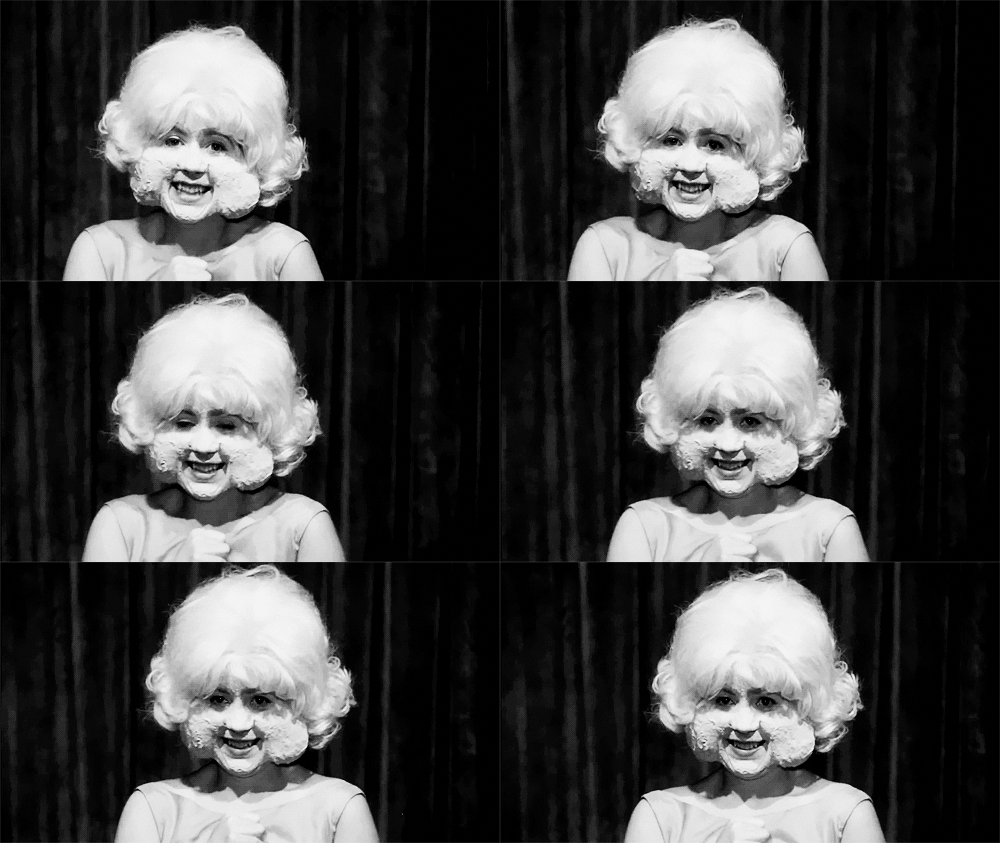
It was none other than funnyman Mel Brooks who tapped Lynch to direct “The Elephant Man” as part of Brooks’ foray into producing serious films. He was struck by Lynch’s 1977 feature debut “Eraserhead,” a hallucinatory head-trip that’s become the epitome of the cult midnight movie. “Eraserhead” is the surrealist progeny of Dali and Buñuel’s “L’Age d’Or” (1930), shuddering with unsettling images, notably a reptilian squawking monster-baby and a small dancing girl inside a radiator, whose cauliflower growths on her face mirror the tumored deformities of Merrick. In our 2007 interview, Lynch called “Eraserhead” “My most spiritual film.”

If “The Elephant Man” is his most emotional film, it also doesn’t shirk the avant-garde flourishes beloved by Lynch, the master of modern surreal cinema. With their unnerving atmospherics, several scenes could be lifted from “Eraserhead”: the opening attack of Merrick’s mother by rumbling, trumpeting elephants; Merrick’s vertiginous nightmare; the elegiac denouement. The scenes are decidedly phantasmagorical, filled with dancing clouds of smoke; clanking and throbbing with ambient industrial noise; and damp with symbolic water and steam. Executives at Paramount wanted the sequences removed from the film, but Lynch prevailed.

0359.jpg

Lynch, cameraman Francis and production designer Stuart Craig evoke an eerie Victorian London in haunting black and white, the shades of dreams and nightmares. From the city’s backstreet slums to the boisterous freak shows, it’s a sooty, Dickensian world, paved in rain-soaked cobblestone and punctuated by hissing blasts of steam billowing from primitive machines. It sets a mood that puts you on edge for the entire picture, and it is somehow beautiful.

For all that, “The Elephant Man” remains the director’s most accessible movie — after, of course, the almost comically anomalous “The Straight Story,” a delightful G-rated family film released by Walt Disney in 1999.

Six years after “The Elephant Man” Lynch wrote and directed the gleefully perverse “Blue Velvet,” which landed him his second Best Director Oscar nod. (He’d earn a third for “Mulholland Drive.”) As violent and otherworldly as it is, “Blue Velvet” feels largely grounded and relatably human.

His next pictures — including the anarchic blaze of “Wild at Heart,” the tedious and drastically overestimated “Mulholland Drive,” the experimental mishmash of “Inland Empire” and television’s wearying “Twin Peaks” — not so much.

(Mercifully, I’ll skip Lynch’s ill-fated adaptation of “Dune,” his follow-up to “The Elephant Man.” When I asked him about it in our interview, he simply replied, “Heartache.”)

I have a hard time taking Lynch’s later work seriously. I’ve always thought the “strangeness” in these films was indulgent and sophomoric and not very well thought out. He suggested as much during our interview. He told me he made up the story for the three-hour ordeal that is “Inland Empire” as he was shooting it. Yup, that’s exactly what it feels like.
And that’s why the almost button-down linearity of “The Elephant Man” is rather a relief. It’s also why, possibly, die-hard Lynch fans, practically cultists, don’t talk a lot about his first studio film, going directly to “Blue Velvet” as a starting point. Despite its weird ornaments, “The Elephant Man” might be too mainstream, too Oscar-nominated for purists. The film earned eight nominations, including Best Picture and Best Director.

What’s different about “The Elephant Man” from the other movies is that it doesn’t traffic in abstractions and actually contains feeling, heart and soul. Though it’s never exploitative — it’s hardly emotional porn — it can be a wee manipulative. (There are least four crying scenes.) It’s Lynch’s most human, most humane, work of art.

It is his only film of unfettered beauty.

elephant-man-5.jpg

An easy, breezy interview with the late Sam Shepard

Sam-Shepard-QA-010.jpg

Sam Shepard, who died last week of Lou Gehrig’s disease at age 73, was a consummate actor, all crinkled deep-West cool, and a groundbreaking, Pulitzer-winning playwright. He was also hell of a good sport during my interview with him in Austin, Texas, in 2006. He laughed off my blind spots, stuck with me, and seemed to have a good time. But who knows? Shepard was also something of a mystery man, solo, soulful, if often smiling.

In a small tribute to the artist, here is our interview:

Sam Shepard laughs more than you’d think he would, considering the actor-playwright’s sun-crisped cowboy persona, which dons the dusty, romantic despair of a desert loner.

Namely, Shepard laughs at me. He has a great dry chuckle that heh-heh-hehs whenever I demonstrate my sweeping ignorance of things cow, horse, rope and ranch. This happens often.

Best remembered as Chuck Yeager in “The Right Stuff,” Shepard was in Austin to screen his film “Don’t Come Knocking” during South by Southwest. He was disappointed that the movie wasn’t playing at the grand Paramount Theatre.

“That’s one of the reasons I wanted to do it,” he says in a soft drawl. “That beautiful big theater.

“Instead,” he laughs, “it’s in some stockyard theater.” (It screened at the Alamo South.)

Shepard co-wrote “Don’t Come Knocking” with director Wim Wenders, their second collaboration since “Paris, Texas” in 1984. Shepard stars in the film with longtime partner Jessica Lange.

Tall, lean, with striking blue eyes, Shepard, 62, cuts a suave figure in a black leather blazer, blue jeans and fancy cowboy boots. He sits down in the Four Seasons hotel bar and orders iced tea. He has written dozens of plays, including “Fool for Love” and “True West,” and acted in more than 40 films.

One of those films is Terrence Malick’s “Days of Heaven.” Shepard was having dinner with Malick and Wenders that night. I ask if I can come. He just laughs.

Q: Yesterday I interviewed John C. Reilly. He says hi. Do you have any words about him?

SS: He’s here? I didn’t see him. He’s a remarkable actor. We had a lot of good fun doing “True West” together (in 2000 on Broadway, with Philip Seymour Hoffman). It was unique in that he and Philip would switch roles every two nights. The transformations were amazing. Philip just won the Academy Award, bless his heart.

Q: How does “Don’t Come Knocking” fit into your body of work? It’s set in a familiar world of yours with a familiar character, but it’s steeped in valediction and redemption much like Clint Eastwood’s “Unforgiven.”

SS: I really don’t think about any of my work like that. I don’t know how to categorize it. I just go instinctively with certain ideas and allow those ideas to play themselves out. Because I’m the same person, obviously there’s going to be similarities with what’s done before. But if anything, Wim and I were trying to avoid similarities to “Paris, Texas.”

Q: Yet there are thematic similarities between the two films.

SS: Of course there are. The main characters share the same sort of alienation and strandedness and remoteness.

Q: Is that where the wide-open settings come into play, as metaphors for the characters’ predicament?

SS: Yes. It’s interesting to set characters like that against an overwhelming landscape, almost like he’s lost in the ocean.

Q: What kind of boots are those?

SS: Leddy.

Q: Leddy? Is that a famous brand?

SS: Yeah, man! Where you from? (Laughs) These are made in Fort Worth. They’re belly ostrich.

Q: That’s ostrich? I notice your belt buckle’s kind of elaborate, too.

SS: I have cutting horses. I won this.

Q: You won that? It’s like a trophy?

SS: Yeah. WHERE are you from?

Q: Can you tell me what cutting is?

SS: It’s an activity with quarter horses where you go in and separate cattle and keep the calf from getting back into the herd. It’s an old art form.

Q: You do that?

SS: Yes.

Q: The buckle says you won it in 2003. Is it gold, some valuable item?

SS: It’s Montana silver.

Q: What’s next for you?

SS: I’m in the middle of a play right now.

Q: One of yours that’s currently being staged or a new one you’re writing?

SS: I’m writing a play. I’m a playwright.
Q: I know. (He laughs.) Your (Pulitzer-winning) play “Buried Child” is being staged right now.

SS: It’s a workshop production that I didn’t even know about. And someone’s doing “The Late Henry Moss.” And I’m acting in a new film in Shreveport. You follow horse racing at all? Probably not. There was a famous filly called Ruffian in the ’70s, an extraordinary horse. Every time she ran she broke a track record. She died in a match race against a colt, snapped her leg. I’m playing her trainer.

Q: Sounds perfect for you. Who’s directing?

SS: A guy from Quebec. I don’t really know his name. (Laughs) A French guy.

Gross anatomy: the marvelously macabre Mütter Museum

Pathologies are my thing. Twisted limbs. Fleshy protrusions. Faces swathed in nappy hair, Chewbacca-like. Conjoined twins. Horns curling from foreheads. Extra heads — those are always fun.

I don’t revel in the maladies of others; I revel in the Other. People are fascinating. People are more fascinating with three legs.

This foible of mine, this adorable morbidity, came early on, delighting my parents, who stood back, weighed adoption strategies and ever so gingerly catered to my wiggier curiosities. For my eighth birthday I requested and received the illustrated book “Very Special People: The Struggles, Loves and Triumphs of Human Oddities.” Since then, many have believed I belong in this book.

These outré fascinations have grown to include death and the dead, and have led me to abnormal forays in my frequent travels. There I was at the Royal London Hospital, sleuthing with the grace and aptitude of Inspector Clouseau for the skeleton of Joseph Merrick, aka the Elephant Man. (Mission: failed.) At the Golders Green Crematorium in London I witnessed roaring ovens and jars of fresh ashes, some heartbreakingly labeled “baby.”

There was the blech-fest of the Meguro Parasitological Museum in Tokyo, where all squirm and squiggle of microbe-y monster were displayed in clear, fluid-filled cases, sometimes feasting on animal innards.

At the Museum of Forensic Medicine in Bangkok, medical students dissecting cadavers giggled when they saw me spying in the doorway, pointing my camera. I repaired upstairs to the musty exhibit of bottled fetuses, crumbling bones and full-length cadavers floating in dishwater liquid like humongous pickles.

My two noble efforts to see the freak show at Coney Island were thwarted by poor timing. Yanking on the bearded lady’s follicular abundance will have to wait.

Yet, for a constant traveler of my tastes and temperament, the Taj Mahal of the morbid has long been the famed Mütter Museum, a repository of anatomical horrors and shrine to primitive, rusty-tooled medicine in the College of Physicians of Philadelphia. It is where, at last, after years gazing at its web site, I recently visited. Disappointment was not in the cards.

Part edifying scientific journey, part powerful appetite suppressant, the Mütter is smack in Philly’s city center, a brisk walk from the Philadelphia Museum of Art. Inside, once through the deceptively donnish foyer, the museum is cool and musty, packed with old wood and glass cases revealing the historically pertinent — Florence Nightingale’s sewing kit — and the surgically slimy — a mammary tumor afloat in liquid, resembling a buttery dessert.

muttermuseum.jpg

Human skulls — some intact, some cracked or bullet-pocked — checker an entire wall, each tagged with the cause of death, be it hanging, suicide or disease. The brownish heads came to the Mütter from Central and Eastern Europe in 1874, a major acquisition for the medical institute, which boasts 62,000 visitors a year, many of them children on school field trips. (I want to go to their school.)

Founded in 1849 and named 10 years later for surgery professor Thomas Dent Mütter, the museum throws open in graphic, naturalistic detail the ranging possibilities of the human body, and the havoc that can befall it from within and without. Diseases, injuries, birth defects — it’s an elaborate temple to the slings and arrows of outrageous fortune.

Much of it is not pretty. This is a given. It can be ghastly, grisly, unimaginable. (The “wet specimens” section is home to a jar labeled “Moist Gangrene of the Hand.” In it sits a human hand rotted black, the skin tattered like a torn leather glove, bones poking from the wrist.)

But to merely recoil at the exhibits is to shut out a world of contemplation, and to allow an emotional reflex to override a rare opportunity for understanding.

Not that emotions wither in the objective, secular hothouse of science and medicine. We are human, after all. And the museum unpeels the tangible layers of our humanness, down to the bones in many cases.

Strolling the more than 3,500 square feet of tidy halls and floors, I experienced kaleidoscopic feelings, be it excitement or queasiness or, in the presence of deformed human fetuses, such as the child with “46 twists in the umbilical cord,” great sadness at life so cruelly muffled before it even whimpered.

The upward of 1,700 sticky specimens — a sliver of John Wilkes Booth’s thorax; a full skeleton encrusted in its owner’s ossified sinew and organs — and 20,000 objects — an archaic penile syringe, leech jar and bleeding bowl — demand gawkers to question our flesh-and-blood frailty and peer across the accepted borders of what constitutes normalcy.

Some guests will ponder God’s inscrutable will and the crap-shoot of birth; others might mull our fleshly finiteness, staring at them at every turn, and thank their lucky stars.

“The museum challenges visitors in a way that few American museums do,” says Dick Levinson, Mütter spokesman. “It’s impossible to visit here without confronting issues of sickness, mortality and human sexuality. We’re the museum young people love because we don’t preach, we don’t sugarcoat and we have no agenda except for allowing the voice of science to speak.”

That voice speaks loudly, but with fitting respect and as much dignity as a naked cadaver can possess. There’s humor in the macabre, as horror movies show, so a giggle of shock or a throwaway quip (“Hey, Tom, that skull has your cheekbones”) won’t ruffle the contemplative oxygen of the galleries. It eases the mood. Remember, school kids come here. By now, them bones and body parts understand the various responses of the living to the so forthrightly dead.

chang_eng.jpg

Some of us get giddier than others at such places. I was most thrilled that the autopsy of the original Siamese twins, Chang and Eng Bunker, was performed at the Mütter in the 1870s, and that the museum kept some nifty souvenirs for display. I examined the plaster cast of the twins’ bound torsos and, below it, their connected liver, a chalky, scabby island bobbing in a pan of fluid.

That’s an island this world traveler and seeker of the strange calls one thing: paradise.

What’s so strange about ‘Stranger Things’? Not much.

When people ask what I think of the sci-fi Netflix series “Stranger Things”the hot streaming show last summer — my guard goes up, I tense a bit and, mealy-mouthed, I say it’s OK, not bad, pretty good.

In truth, I want to say it’s not that great, it’s overpraised, it’s kinda, well, meh. But I don’t. It’s exhausting being that guy, the crossed-arms critic who can’t “let go” and “enjoy.” (Brother.)

(I bring up the series because the trailer for “Stranger Things 2” is now out here. Season 2 arrives on Netflix, four days before Halloween.)

I didn’t not enjoy the show, he said defensively. It’s entertaining, vivid, sporadically funny. And yet — and this is vital — it’s almost never scary. As much as I stuck with it and went along for the ride, I wanted it to be less of a wholesome family show and more of a spooky supernatural thriller, which is what its premise — a boy is abducted by unknown forces and the fraught search for him is aided by a mysterious girl with psychokinetic powers — promised.

stranger-things-netflix-196205.jpg

With its largely youngster cast, “Stranger Things” reminds me of a glorified version of ‘90s kiddie show “Goosebumps,” a would-be creepy anthology series that supplied as many chills as a camp-fire spook. Not much is chilling in the Netflix show either, at least nothing you haven’t seen in superior movies from which the Duffer Brothers, the show’s twin-sibling creators, poach and pilfer. The result, as many have noted, is a studied pastiche of ‘80s supernatural thrillers, horror, sci-fi and scrappy kid adventures like “E.T.,” “Poltergeist,” “The Goonies,” “A Nightmare on Elm Street” and “Stand By Me.”

Set in 1983, the show looks good, persuasive in its (at times ham-fisted) period detail, murky cinematography and all. But the Duffers don’t seem to know where to go with their fetishized homages, from obvious period pop tunes and a tinkly synthesizer score worthy of John Carpenter, to apt fashions and hairdos. They coast on the easy fumes of nostalgia that GenXers and retro-mad millennials are so eager to huff.

What plays like a rote missing-persons drama, with bonus scenes of sinister figures in hazmat suits and a slimy monster-thingy, finally feels empty, clunky and too familiar. The show never brushes the sophisticated originality or creep-outs of, say, “The Twilight Zone.”

The Duffers also over-emphasize how cute the boys are with their dweeby tween banter and precocious smarts of incurable nerds. That said, all of the young actors, even the mysterious girl who’s mostly a saucer-eyed cipher (Millie Brown), are quite good.

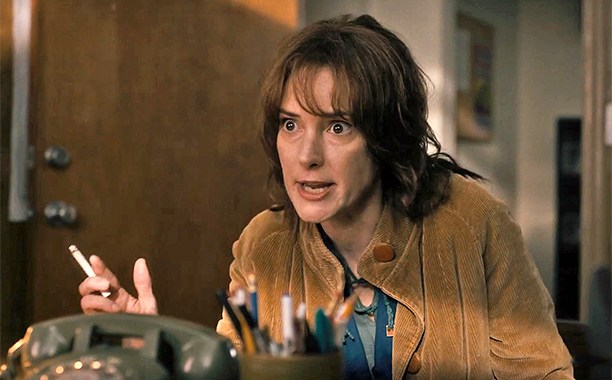
What actually is scary in “Stranger Things” is ‘80s screen queen Winona Ryder as the missing boy’s shaken mother. Locked in hyperventilating hysterics, she’s strained and haggard, like she might be hurting herself. Shrieking and puffing a cigarette with a quaking hand, it’s a repetitive performance and, if it wasn’t so irritating, a risible one.

717a85f6-7273-4631-9870-29abd906435a.jpg
Winona Ryder … berserk.

Never mind all that for a moment. “Stranger Things” is critics’ catnip. It’s racked-up several Emmy nods and enjoys a 76 out of 100 score at Metacritic and a 95% rating at Rotten Tomatoes. I stand baffled, if not bowed.

Again I feel like the ornery outlier, the curmudgeon who won’t play along, lean back, pull out the popcorn. But as a teenager tells his younger brother in the show, “You shouldn’t like things just because people tell you you’re supposed to.”

Like most of the series, it’s not an original idea, but it’s one I’ll stick by.

Metallic memories

I was 14 the first time I saw Metallica in concert. It was 1983 in a tiny nightclub called the Keystone Berkeley, in Berkeley, California, in the San Francisco Bay Area, where Metallica was formed and where its members still reside. The club, a bona fide hole, was famous for showcasing the Grateful Dead in its heyday. I won’t mention that again.

Metallica was plumping its debut album, the indie-label thrash classic “Kill ‘Em All,” and was sandwiched on a bill between locals Exodus and headliner Raven, a so-so British metal act with a singer that shrieked like a banshee, screeching songs like “Hell Patrol” on an album called (sigh) “Rock Until You Drop.” (After Metallica’s epic, local-heroes set, Raven finally hit the stage at 1 a.m., well past my bedtime. We split.)

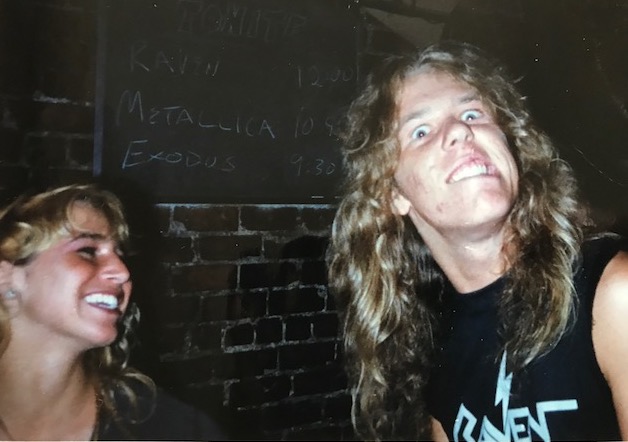
Before they went on, the four members of Metallica hung out in the clammy, smoke-swirled venue, drinking beer and flirting with female fans. I snapped a few pictures of the band, using a now-obsolete Vivitar pocket camera with a 110 film cartridge and a mighty flash. I’m sure they were thrilled.

Here’s singer-guitarist James Hetfield and drummer Lars Ulrich:

IMG_0768.JPG
James Hetfield and friend.


LARS.JPG
Drummer Lars Ulrich, making silly to the kid with the camera.

What’s nuts is how young they were, how young we all were. Hetfield and Ulrich are five years older than me, making them 19 or 20 at this show. Hetfield still had zits. Ulrich, at 5-feet-6-inches, looked like a little kid. And yet, though we didn’t know it then, despite the universal excitement over their first record (and we’re talking vinyl record), these guys were about to break big, over the decades becoming one of the most significant arena rock bands of its time. (Hetfield’s reported net worth today: $300 million. Back then: $21.50 and a scuffed skateboard.)

I have more of a visual than aural memory of the concert, but it’s safe to say Metallica mostly played songs from the 10-track “Kill ‘Em All” — “The Four Horsemen,” “Seek & Destroy,” “Whiplash” — plus their usual encore of Diamond Head’s catchy “Am I Evil?,” which was a huge influence on Ulrich.

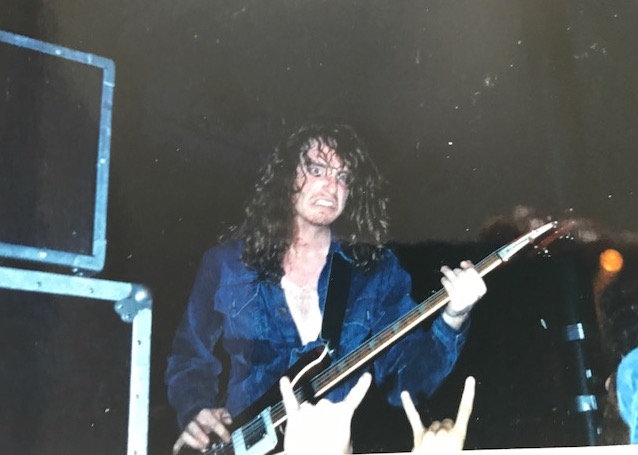
It was, of course, a sweaty, head-banging affair, the lip of the micro stage a crush of raging, testosteronic catharsis. The band matched the fury, hair-lash for hair-lash, so much so that teeth-gnashing bassist Cliff Burton was taken off stage for a lengthy breather. The rumor was that he almost passed out. It was that kind of show.

IMG_0764.JPG
Cliff Burton in one of his better moods.


IMG_0766.JPG
A mid-set break backstage. Hetfield gives me the peace sign up his nostril and Burton relaxes as best he can. Burton was killed three years later in a tour-bus accident.

In a six degrees of Metallica trip, I eventually learned that Ulrich and I shared the same drum teacher, an affable, infinitely tolerant 25-year-old named Jeff Campitelli, who also happens to be a spectacular musician. (In 2008, Rolling Stone named him one of the 50 best drummers.) To Jeff’s dismay, neither Ulrich or I knew the drum rudiments, which, says one pro, “are the building blocks for every drum beat, fill, or pattern that you could ever play.” We were not highly evolved drummers.

At the time, Jeff was in a Bay Area pop trio called The Squares, whose guitarist was none other than Joe Satriani, who has, of course, gone on to guitar-hero megastardom. Among other big-time gigs, Campitelli still plays with Satriani, whose former guitar pupils include Charlie Hunter, Steve Vai and a fellow named Kirk Hammett. 

Hammett, you may know, plays the axe for a little band called … Metallica.


Eric Wareheim and Nina Arianda are the funniest people on ‘Master of None’

Perhaps it’s sacrilege to say, but the funniest, most outstanding performances on Aziz Ansari’s great Netflix series “Master of None” are by Eric Wareheim and Nina Arianda. (Yes, by two white people on a brown person’s show. Deal.) I’m talking funny factor and acting wattage. Ansari is himself a crack comic actor — a laser-witted, rubber-faced, helium-voiced mensch, remarkably sensitive, graced with an unassuming authenticity. Wareheim and Arianda are better. They’re eccentric, wild, take more comedic chances. They’re sort of bonkers.

While Wareheim appears in most of the 20 episodes in the show’s two seasons, Arianda was a one-shot guest star in a single episode during season one titled “Hot Ticket,” a masterwork of comic ingenuity, including Ansari and a fine cast spritzed by the deadpan Lena Waithe and the wry and dry H. Jon Benjamin (who also, btw, provides the voice of Archer).

One episode! And she’s practically the best thing that’s ever happened on the show. Arianda makes her blowzy mark during roughly six minutes of screen time. She’s like Alec Baldwin in “Glengarry Glen Ross” or Gene Hackman in “Young Frankenstein,” stealing the show with a fizzy vigor that throws the whole affair off its axis.

Let’s be clear. “Master of None” is consistently good and frequently superb. Following the professional vagaries, friendships and turbulent love life of 30-ish Dev (Ansari) in New York, the show throbs with feeling, a millennial “Seinfeld” but with pathos, whose observational insights are both funny and socially and racially attuned. Excellent episodes abound — season two grazes Woody Allen heights of romantic complication — but I find myself returning to “Hot Ticket,” which gets funnier on each viewing.

xMPGnwf
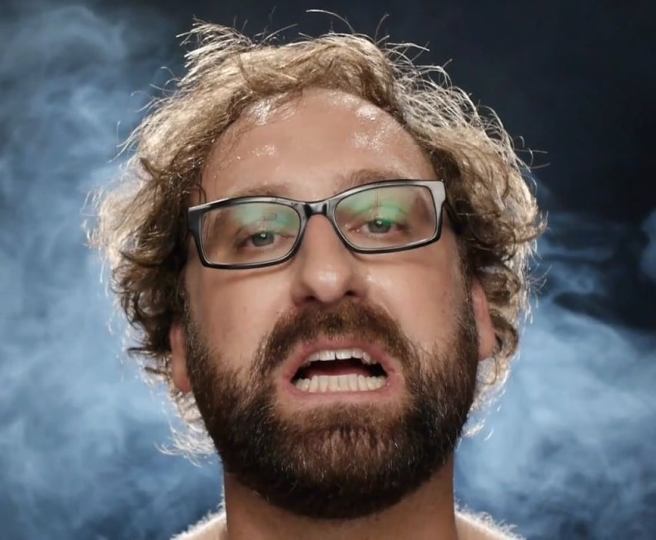
Eric Wareheim. Don’t ask.

Wareheim — half of the gloriously deranged “Tim & Eric Awesome Show, Great Job!” — plays Arnold, Dev’s best friend, a 6-foot-7-inch bearded man-baby. Rather thick in the head, Arnold provides uproarious seasoning to Dev’s occasional blandness. With his adenoidal voice and pursed lips, he often traffics in dry, surreal laughs. (Note in “Hot Ticket” his query to his pals: “What if someone sent you a picture of a turtle climbing out of a briefcase?” Believe me, it’s a gut-buster.) When Dev, Arnold and pals gather to watch the BBC’s “Sherlock,” Arnold has to hush them up. “Dudes, can we please not talk during the show? Respect my Cumberbatch!”

Wareheim’s Arnold is reliably present on “Master of None,” yet always a treat. Arianda, who plays a waitress named Alice in “Hot Ticket,” is a novelty to be savored. Her big scene comes when Dev invites her to a VIP concert. He barely knows her, but that changes fast as she performs loud impersonations of Cartman from “South Park,” demands Dev take obnoxious Vines of her, dares herself to give a stranger a blowjob in public and tops things off by stealing a girl’s jacket, then proposes they do some coke and play laser tag. She a gorgeous nightmare, and all Dev can do is watch horrified before running for his life.

Arianda is so good as Alice, she shakes all of us up. A Tony-nominated Broadway performer (“Venus in Fur”), with roles in films like Woody Allen’s “Midnight in Paris,” the actress has a scratchy voice and elastic facial features. She’s pretty and protean, and her Alice might be one of her most off the hook turns. Season three of “Master of None” is a done deal. We can only hope she didn’t scare off Dev too much.

MV5BMTQ4MTQ4NTg1Ml5BMl5BanBnXkFtZTgwNjIzNTkzNzE@._V1_SY1000_SX1500_AL_
Nina Arianda and Aziz Ansari, just as she starts getting … whack. Notice his wax-museum smile. 

Filming life in fascinating fragments

Too many worthy films flitter aimlessly in the ether, small and micro titles that never reach the local whatever-plex and go straight to DVD or get lost in streaming’s infinitely accommodating democracy (see, for one, Joe Swanberg’s hidden comic gem “Win It All” on Netflix). Sometimes the films get lucky, becoming cult revelations (“Wet Hot American Summer,” anyone?). Yet so often they go poof, vanishing into cinematic oblivion.

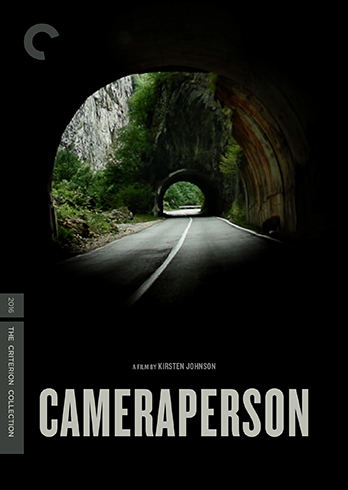
One of those small movies is “Cameraperson,” Kirsten Johnson’s transfixing, deeply personal free-form documentary, which is doing quite well, thank you. The 2016 film, peculiar and pretty wonderful, played minimally, and then, oh-so sneakily, debuted on DVD.

853_DVD_box_348x490_original.jpg

I don’t even remember how I heard about “Cameraperson.” It’s that kind of discovery, unique and hushed, like a hot, under-the-radar new restaurant, or a monkey’s paw. Remarkably, I located the movie at the library, just sitting there patiently, new, unsullied, waiting to be taken home like a shelter dog.

But “Cameraperson” is no mistreated mongrel. In fact, it’s laureled with widespread acclaim, earning a 99% rating at Rotten Tomatoes and shiny critical bouquets like “brilliant“ and “masterpiece.“ And none other than The Criterion Collection (which takes such good care of its superbly tasteful catalog that I bought a t-shirt) issued the DVD and Blu-Ray of the film. That’s prestige.

But what is “Cameraperson”? It’s a curio of whole-cloth originality, a globe-hopping cinematic scrapbook assembled from Johnson’s 25 years as a non-fiction cinematographer for other directors. She shot, among many docs, Michael Moore’s “Fahrenheit 9/11” and Laura Poitras’ “Citizenfour,” both of which won Oscars for best documentary.

But this is her movie, so personal that she calls it “my memoir.” It could also be called a vivid, living career diary, a collage of unvarnished outtakes from numerous docs that she handpicked and wove together with a crazy-quilt method that’s not always obvious.

Zigzagging and hopscotching from subjects and locations, a visual essay emerges. Artful connections and startling juxtapositions happen. Panoramically, with spare narration — her debt to Frederick Wiseman is palpable — Johnson captures multitudes: from a mossy-toothed shepherd strolling with his wooly charges, to bristling backstage drama at a Brooklyn boxing bout; from a fraught Nigerian maternity ward complete with yawping, slime-coated newborns, to shots of lightning in rural Missouri, punctuated by Johnson’s own camera-shaking sneezes. “These are the images that have marked me and leave me wondering still,” she says in the film’s opening note.

There is so much more.

Jumpy Liberian street scenes. Interviews with former rebel warriors who give testimonies of combat horrors. A panning shot of a Yemen prison for Al-qaeda fighters. A rickety, joyful Ferris wheel ride in Kabul. Grim visuals of Guantanamo Bay, Wounded Knee and Tahrir Square, places far removed from peace. A Christian-themed ballet performed by little girls in Colorado Springs. Far-flung centers of protest and massacre, mass rape and public executions. A visit with Johnson’s mother, who suffers from Alzheimer’s. Chirpy frolics with Johnson’s adorable twin toddlers, who are enthralled by a dead bird.

Though beauty abounds — there’s even splendor in a Bosnian martyrs’ cemetery — not all of Johnson’s shots are the master compositions you’d expect from a seasoned camera artist, and that might be the point. Many of the visuals are haphazard, shaky and seemingly random, like she’s busy setting up a shot or gathering all-important “coverage.”

You might also say the pictures are achingly authentic, quivering in the raw, glinting moment; that they are human, all too human.

cameraperson.jpg
Kirsten Johnson and friends