The drudgery, and joy, of writing

Last month or so, I was reading a terrific book about the making of the classic movie “Chinatown” titled “The Big Goodbye: ‘Chinatown’ and the Last Years of Hollywood,” by Sam Wasson, and I had to grin at this quote from legendary screenwriter Robert Towne: “So much of writing is trying to avoid facing it.”

That’s hardly the most original thing uttered about the writer’s penchant for procrastination and craven dread of the blank page — Hemingway summed it up: “There is nothing to writing. All you do is sit down at a typewriter and bleed.” — but it was a reassuring reminder that cooking up stuff for a readership, a nervously performative act, isn’t always a joyride, or particularly easy. It can be a grind. It can be depressing. It can sap the soul. 

But it can also be exhilarating and, when things are flowing, a blast. Well, let’s not get carried away. How about … satisfying? Said great journalist Russell Baker: “I’ve always found that when writing is fun, it’s not very good. If you haven’t sweated over it, it’s probably not worth it.”

I don’t know how you reconcile that dichotomy, the yin and yang of good and rotten, delight and drudgery, but they seem to jibe. There’s a fruitful friction. Good days, bad days, middling days. (That last line? Lazy writing. Bad writing. I left it there as a specimen of what can go wrong.) 

I always want to write, but once I sit down and face the empty page that sneers, “Go ahead, try and fill me,” I tend to constrict, choke, unless I’m especially inspired and know how I’ll begin and where I’m (generally) going. Those days are the exception. Right now, I’m winging it. I had that Robert Towne quote in my head and started riffing. (Help!) 

There’s no map. There’s only this: Get it down. The prose may be raw and bloody — embarrassing, eye-sizzling — but the ideas matter and the words, those painstakingly chosen few, will be chiseled out of the viscous blob of verbiage. Editors are helpful at this stage, and I’ve worked with many who have saved my prolix ass. But here on this free-floating blog I’m on my own. I am judge, jury, executioner. And I probably should have executed that sentence. 

Point is, writing, like any creative endeavor, is a messy enterprise, hard to do but at times truly rewarding (I have ten journalism awards that bear that out, he crowed). You have to dive in head first, and toil to make a splash. Taking pride in your work is mandatory — read tons, write multiple drafts, and use spell check for chrissakes — the only way you’ll do anything worth a damn.

First you must conquer that blank page, which requires actually facing the music, not dodging it, as Towne noted. I’m working on a writing project that I approach tentatively, with baby steps, not because I’m indolent but because I am, frankly, a little scared. 

There’s a cure for that. It’s simple yet courageous: Sit down, stare at the page, and bleed.

You must win the staring contest with the blank page. Despair is likely. So is reward.

The Tao of Nick Cave

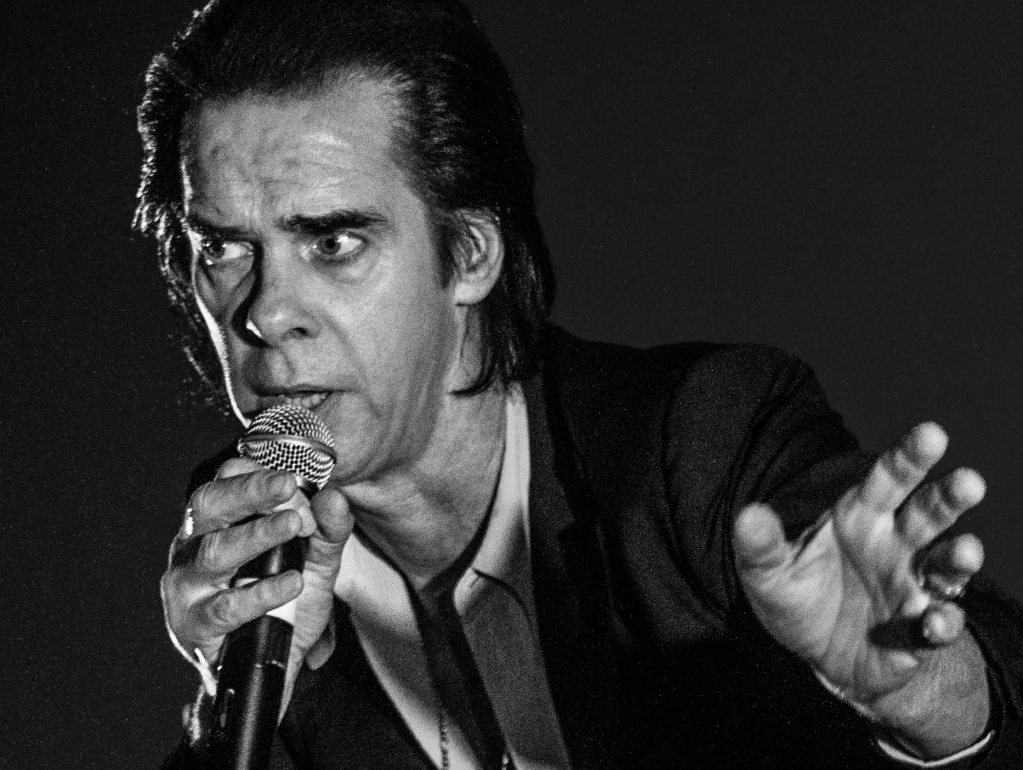
Nick Cave — Australian musician, composer, filmmaker, writer, artist, actor, all-around Renaissance man, with slick black hair and natty suits hanging off a long, pencil-thin frame — runs a sage, funny and heartbreakingly sincere advice column on his website The Red Hand Files. His counsel is so sharp and impassioned, you wonder: What can’t the guy do? I bet he can fly.

Recently, a precocious 13-year-old boy wrote in, asking this: “How do I live life to its absolute fullest, and not waste my potential? Especially as a creative. Also, what is a great way to spiritually enrich myself, in general, and in my creative work?”

I relished Cave’s response so much, I am excerpting a chunk of it here.

These are, to me, words to live by:

“Read. Read as much as possible. Read the big stuff, the challenging stuff, the confronting stuff, and read the fun stuff too. Visit galleries and look at paintings, watch movies, listen to music, go to concerts — be a little vampire running around the place sucking up all the art and ideas you can. Fill yourself with the beautiful stuff of the world. Have fun. Get amazed. Get astonished. Get awed on a regular basis, so that getting awed is habitual and becomes a state of being.”

Nick Cave — bard, baritone, Bad Seed, badass.

Cutting to the core of creativity

I’m reading two books right now: “Kudos,” the mesmerizing new novel by Rachel Cusk, and the non-fiction treatise “The Creative Habit” by celebrated dancer-choreographer Twyla Tharp.

418cPmaavEL

The former is a whole-cloth original, narrative-defying, discursive and brainy, like the two previous books in Cusk’s Outline Trilogy, “Outline” and “Transit,” of which “Kudos” is the ravishing finale. Challenging and unorthodox, the seemingly autobiographical novels crack open your mind in a furiously fresh manner. They evoke Karl Ove Knausgaard’s rambling “My Struggle” series but are more rigorous, compressed, and chewier.

Catching my breath, I’m really here to dwell on Tharp’s self-described “practical guide,” whose full title is “The Creative Habit: Learn It and Use It for Life.” I’m a sucker for eloquent lessons on creativity and the artist’s way, including, yes, “The Artist’s Way” by Julia Cameron, “The Sound on the Page” by Ben Yagoda, “Bird by Bird: Some Instructions on Writing and Life” by Anne Lamott and “The War of Art” by Steven Pressfield. These books possess transformative powers, tweaking your creative habits just so, massaging your brain to look at the blank page or canvas with a kind of nervous optimism instead of paralyzing dread or clogging trepidation. They are weighted with wisdom.

twyla-tharp-the-creative-habit.jpg

Tharp, a paragon of her art form, knows of what she speaks, and she speaks it plainly and persuasively, with little decorative dressing but plenty of panache. She’s a beneficent, caring lecturer, and the book, breezy and empathetic, bulges with sticky, pragmatic advice. Quick: “In order to be creative you have to know how to prepare to be creative.” Or: “There are no ‘natural’ geniuses.” That’s in the first nine pages, and somehow I find these statements awfully encouraging. 

She digs much deeper, with infectious enthusiasm. Using hard-earned lessons from her own work methods and creative processes in ballet and presenting instructive anecdotes about artistic challenge and triumph among such underachievers as Mozart, Beethoven Richard Avedon, Balanchine and Maurice Sendak, Tharp casts a wide net showing how happy accidents, preparation and luck (those are Siamese twins), ritual, archiving and mineable memory are critical components of productive creativity. (She also includes some loopy exercises that I didn’t have much use for. One required a bunch of eggs.)

Flipping through this clean, handsome, none-too-big book I plucked a few quotables:

“The first steps of a creative act are like groping in the dark: random and chaotic, feverish and fearful, a lot of busy-ness with no apparent or definable end in sight. There is nothing yet to research. For me, these moments are not pretty, I look like a desperate woman, tortured by the simple thumping away in my head: ‘You need an idea.'”

“Another trap is the belief that everything has to be perfect before you can take the next step. You won’t move on to that second chapter until the first is written, rewritten, honed, tweaked, examined under a microscope, and buffed to a bright mahogany sheen. You won’t dip a brush in the paint until you’ve assembled all the colors you can possibly imagine using in the course of the project. I know it’s important to be prepared, but at the start of the process this type of perfectionism is more like procrastination. You’ve got to get in there and do.”

“The best writers are well-read people. They have the richest appreciation of words, the biggest vocabularies, the keenest ear for language. They also know their grammar. Words and language are their tools, and they have learned how to use them.”

“There is no one ideal condition for creativity. The only criterion is this: Make it easy on yourself. Find a working environment where the prospect of wrestling with your muse doesn’t scare you, doesn’t shut you down. It should make you want to be there, and once you find it, stick with it. To get the creative habit, you need a working environment that’s habit-forming.”

“Jerome Robbins liked to say that you do your best work after your biggest disasters. For one thing, it’s so painful it almost guarantees that you won’t make those mistakes again. A fiasco compels you to change dramatically. The golfer Buddy Jones said, ‘I never learned anything from a match I won.’ He respected defeat and he profited from it.”

“These mistakes — relying too much on others, waiting for the perfect setup, overthinking structure, feeling obligated to finish what you’ve started, and working with the wrong materials — are deadly. Any one of them will undermine your best efforts.”

“Whom the gods wish to destroy, they give unlimited resources … Limits are a secret blessing, and bounty can be a curse. I’ve been on enough big-budget film sets to appreciate the malignant influence of abundance and bloat.”

“You might not struggle for spine. You might be content to receive any random thought floating through the ether that happens to settle on you that day. You might think you don’t need a supporting mechanism for the art you’re constructing, a controlling image, a collateral idea to guide you. You might think getting lost is a big part of the adventure. You may think that, but you’d be wrong.”