Berlin boogie

So there we were, rambling the hip Berlin sidewalks, hopscotching crumpled cigarette packs whose contents the locals so blithely puff, and glancing at the endless walls of colorful graffiti that looks like so much bubble-lettered gobbledygook, when we stumbled on a little shop that sells porcelain pups. Yes: glazed Great Danes and shiny Schnauzers. My brother and I peered in the windows, pointing, laughing, pining. Too bad the damn place was closed. We moved on, slightly crushed. Onward.

Berlin is a beaut. It may not be the prettiest or most charismatic city I’ve been to — you win, Paris, Istanbul and Tokyo — but it is relentlessly amicable, stylish, pulsing. The city, from which I just returned, has a big determined heart, still pulling itself out of the twin muck of Nazism and Communism, that makes it both a little staid and also, wildly, weirdly, the techno-rave dance capital of the world, a pent-up human energy explosion.

It’s an offbeat charmer, animated by a vibrant polyglot and a diverse people, be it leather-clad Eurotrash, Arab falafel slingers, or well-heeled bougies and their primly groomed doggies. It presents an alluring jumble of history and humanity, culture and cuisine, with a dash of decadence and the pesky ghosts of a bleak past that’s shudderingly recent.

We spent six full days stamping the streets, alleyways, museums and squares of this relatively young metropolis, whose US-backed west and USSR-backed east didn’t reconcile till the Wall came tumbling down in the great thaw of 1989. Much of the architecture looks shiny-new, replacements for the rubble left by ferocious Allied bombings during WWII.

Berlin was also rocked by rock ’n’ roll. We took a tour of  the city’s grungy, arty, DIY underbelly in a vintage 1972 Ford Econoline van driven by the shaggy founder of the Ramones Museum Berlin, which is really just a funky bar strewn with punk artifacts. It’s cool. The tour was happily heavy on David Bowie and Iggy Pop’s ‘70s stint in Berlin, which forged a collective creative milestone in rock, including Bowie’s wondrous “Heroes.” We can be heroes, just for one day. Or, in our case, six days.

A side note: For all its diversity — the Turkish and Arab worlds exert strong stakes — Berlin has blind spots. I saw fewer than three Black people in six days, and that’s troubling and hard to fathom for a US visitor. I googled this and read that most of the Black population lives in the so-called African Quarter, an area I’m pretty sure we didn’t hit and whose existence rather unsettles. Ignorance may place me out of my depth here; facts are elusive. And yet.

And now, a smattering of visuals — alas none of those porcelain pups that so capture the whimsy, artistry and dog-love of the bounty that’s Berlin … 

Berlin Cathedral with the famed, kitschy TV tower of East Berlin

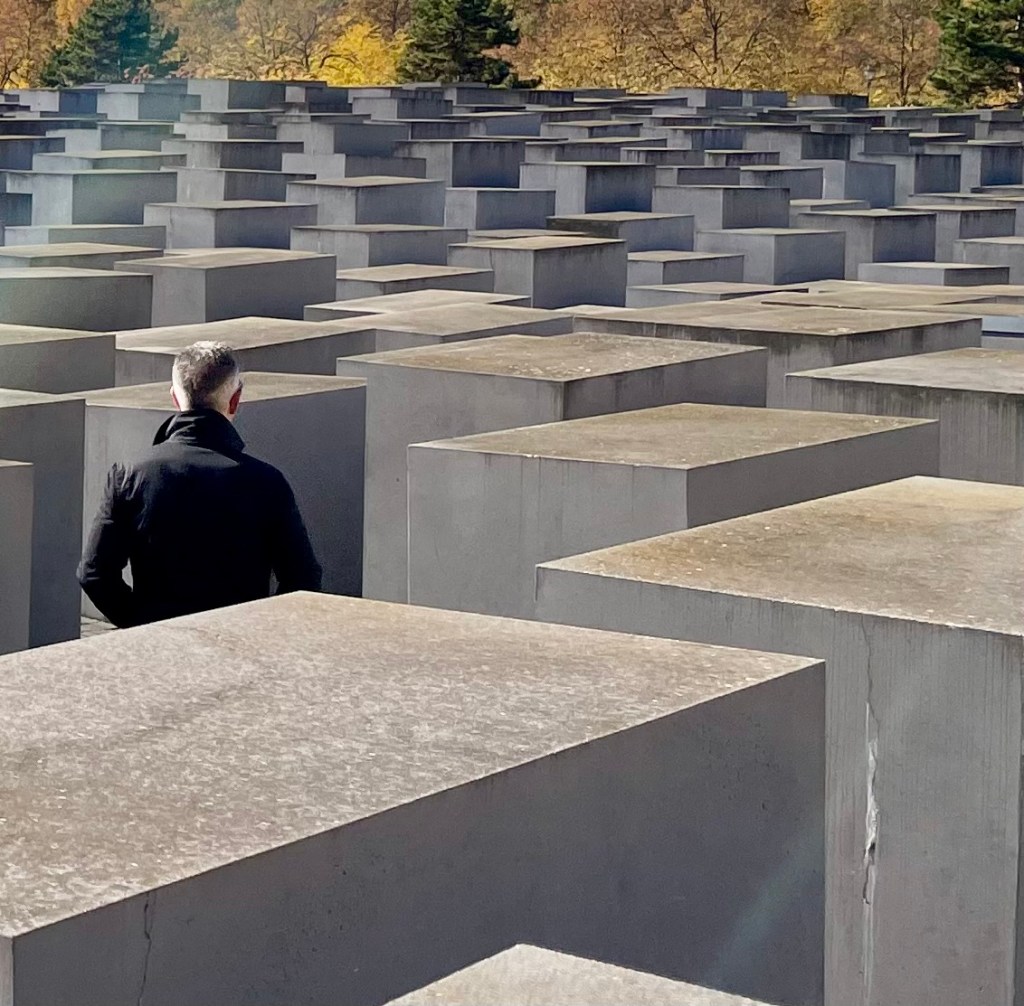
Memorial to the Murdered Jews of Europe — stark, contemplative, abstract

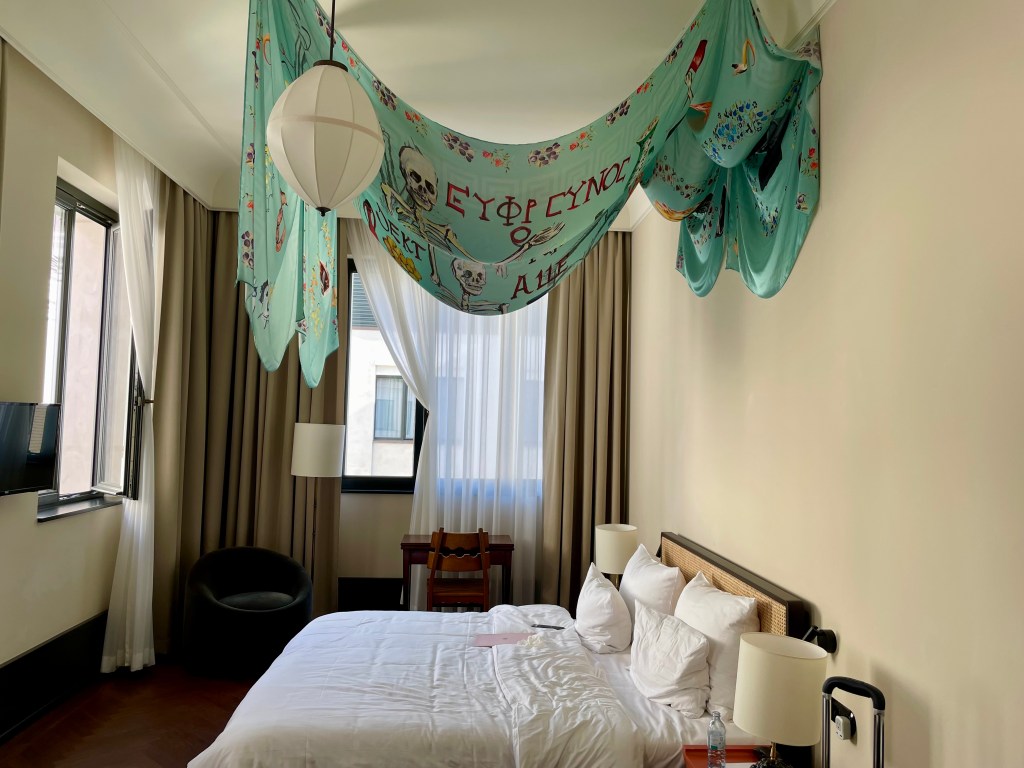
My bed at the lovely Chateau Royal Hotel, with mystifying skeleton-emblazoned canopy

The Tiergarten park, a 520-acre urban oasis in West Berlin, where I sipped a stein of lager in a leafy biergarten

Tiergarten

A bar I wish was open when I passed

Cafe Frieda, my favorite restaurant in Berlin, swathed in that glorious graffiti

Some of the bar staff at our arty hotel, a fantastically hospitable crew, slinging mean, creative drinks
Guinea fowl dinner at my second favorite Berlin restaurant, Eins44 Cantine

The iconic Brandenburg Gate, doing its thing, just sitting there, from the 1700s

One of my new Berlin buds

Facing evil

Let’s not get all down about it, but I’m reading “Survival in Auschwitz,” the slim and indelible account of life in the most notorious Nazi concentration camp by Primo Levi, an “Italian citizen of Jewish race.” Published in 1947, the pages bulge with terrible and inconceivable realities, much of it learned about in any decent schooling, yet far more personal and unsparingly granular. The horrors are shattering.

So I will spare you. I’m reading the book, an autobiographical classic, because of my upcoming visit to Auschwitz, just outside of Kraków, Poland. My trip, as I’ve oft-noted, takes me to Budapest, then Kraków, where I went years ago, including the day trip to the concentration camp, which is now a haunting al fresco museum that staggers with its bleak, blunt truths. Even the gift shop (yes, gift shop) is stained with gloom.

Why do we go to such places? I know someone who said he would skip Auschwitz if he went to Kraków, a fact I find astonishing. Few places throb with such recent history and so many fresh ghosts and has shaped so much of the modern era to now. It’s living history, inescapable. To duck it, inexcusable. 

That’s just me. Genocide is vital and we should be exposed to it as a reality check and cautionary device. Visiting Auschwitz (or Duchau, which I toured in Germany) is mind-expanding. It’s not a place for morbid curiosity or ogling. It’s a place for reflection and wonder. Like any potent museum, it works intellectual muscles and, more so, wrenches emotional ones. It’s as powerful as any Holocaust memorial or, similarly, the 9/11 Memorial and Museum. Its utter humanity rumbles, and humbles.

I have a strong stomach for dark and doom. I seek out shrines to deformity and mortality, like the Mütter Museum in Philadelphia, the Museum of Forensic Medicine in Bangkok, freak shows and books about human oddities. I always make a solemn visit to Holocaust museums, be it in Amsterdam or Israel. Or, of course, Auschwitz-Birkenau. 

It’s not about luxuriating in morbidity or getting a “thrill” from death, like some sophomoric Goth, who gleans reality from graphic novels and zombie movies. It’s the opposite, being repelled by it while pondering the strength, the sheer fortitude, of the victims and acknowledging that it can’t happen again. The triteness of that statement is a reflection of its truth.

In “Survival in Auschwitz,” Primo Levi writes eloquently of struggle and endurance in the face of naked evil inside the death camp. His spirit is wounded but unbowed. Survival is paramount, and he carries on because it’s all he can do. 

He says: “Sooner or later in life, everyone discovers that perfect happiness is unrealizable, but there are few who pause to consider the antithesis: that perfect unhappiness is equally unobtainable … Our ever-sufficient knowledge of the future opposes it, and this is called, in the one instance: hope.”