Block party, year 48

It’s 6:45 p.m. and they’re still slinging burgers and hot dogs during what is officially the neighborhood’s 48th annual block party on a cool pre-fall eve. 

Forty-eighth — how is that even possible? There’s no one alive who’s that old. That means the block parties started in, like, 6 B.C. 

My math is fuzzy. What do I know. I just know the food spread bestowed by the locals is stupendous: Asian noodles, chicken empanadas, homemade guac, spicy pulled pork, eggplant parmesan and, inevitably, simple bags of neon-colored Doritos (party size!), and so much more. (Wait, no deviled eggs?) It’s a smorgasbord and you’ll never see me type that word again.

I don’t know one person at this asphalt shindig. I’m barely — barely — acquainted with my next-door neighbors and the people across the street. And the next-door neighbors didn’t even show at the block bash.

I met one of the guys across the street at the keg, which was lamentably undernourished, and we shook hands, made introductions and proceeded to flaccid small talk before I split. He’s lived across the way for at least four years. We’ve never exchanged a wave. Now we’re chatting over Budweiser in red Solo cups. 

And now I’m gone. Pulled pork beckons.

These block parties are never huge; only three blocks are invited. But they gather a decent melange of folks, a hundred or more. It’s a good blend — florid artsy types to troglodyte Trumpsters — that could use a healthy dose of diversity. Alas, this isn’t Berkeley.

Children. Why does everyone have two or three clinging, clamoring rug rats, pesky tweens or teens, boisterous broods of brats? It’s a nightmare. While the tots whine and cry, the tweens peacock on electric scooters, slaloming perilously around standing diners with an aren’t-I-cute smirk, hair billowing. I need a large hockey stick.

Dogs. Dogs are good. And there are at least six or seven, all leashless, roaming about, panting, grubbing for cheeseburgers and wieners. Cubby the magic mutt joins the canine convention, but his indifference towards other dogs is like Marvel fans to real movies. He does a quick sniff then mutters, “Get me the hell out of here of here. I’m bored. I smell Doritos.”

By now I’m pickled in boredom, too. I hit the keg for a second time and of course it’s dry. A guy is pumping it like mad, desperate for a last drop. His reward is a fizzle of foam. We look at each other and loudly commiserate.

I may have just made a friend.

Whistle while you irk

Here he comes. Yes, he is coming. I don’t see him. I hear him. From afar. He’s whistling, oh-so carefree, head swaying, body grooving. And he’s doing it loudly and without a whit of shame or self-consciousness. Notes swirling from his pursed lips for all to hear.

This middle-aged guy, this oblivious songbird, comes to the cafe almost every time I’m there, which is a lot. He sports sunglasses, a down vest, chinos. And he strolls around whistling, sometimes to a song of his choosing, often to whatever is playing on the cafe stereo. Tweetle-lee-dee …

Whistling.jpg

Why am I so vexed by a man who whistles merrily about a coffee shop? Whistling, it’s said, is a symptom of happiness. One site muses: “Are whistlers so insanely happy that they have some overly elevated level of joy? So much so that it bubbles up and spills out in the form of air molecules passing over the tongue and through their lips?”

If so, am I just madly envious of this fellow’s happy mien? His ability for unfettered glee to pour out and tweetle in everyone’s eardrums unbidden? He’s not a bad whistler. He’s actually fairly adroit, a mini jazz-flute maestro vamping on his facial wind instrument.

No, I am not envious. I have no idea if he’s inflated with uncontainable ecstasy, though he appears pretty content and confident with his hands-in-pocket swagger. It’s that his music is like a yappy-dog bark, nails on a chalkboard. Then again, I can’t whistle enough to call a dog.

Yet I give him license. Whistling Willie, I’m convinced, is simply indulging a bad habit. His tuneful penchant is pure reflex, like the drummer who instinctually taps the table with his fingers. We all have tics, mannerisms and foibles, even if they’re not as piercing and public as full-throated whistling. The dude’s just doing his thing.

pluggingears-614x307

The lip-doodling is pretty damn distracting (otherwise I wouldn’t be grousing) when I’m trying to read and write. “If you’re an anti-whistler type, short of duct tape, how can you keep your focus when Tweety Bird starts up?” asks the above web site, Screenflex (a portable room divider company!).

There are no answers. There is only discipline. Tune out the tunesmith. But it’s not just the “music” that kills me. It’s the brazen indifference to his fellow folks, inflicting, without a flinch, his own song list on strangers, like the lunk who hoists a blaring boom-box strutting down the street for all to hear, no matter individual taste and basic social decorum. It’s the principle.

Unknown.jpeg

My whistler, my personal Bobby McFerrin, who’s probably a swell human being, despite the cloud of patchouli cologne he resides in, just needs a touch of self-awareness to wake him up — perhaps an actual whistleblower to call him out, bawl him out, and slip a cork into that irksome “O” on his face.

Busload of memory

In grade school, my friends and I would take one of those long yellow school buses that picked us up at the bottom of our street. The interior of the bus was lined with green leather benches — they fit three kids, to hell with seatbelts — and it smelled funny. A little sweet but musty, like diesel and kid funk.

The bus driver was an amiable but firm 50-ish woman named Mrs. Pelton. She had short dark hair and wore a yellow polo shirt everyday like a school-district uniform. 

I don’t know what her pants were like because she was always sitting down in that lone, boxed-in driver’s seat, the one with the huge steering wheel and hissing, hydraulic lever that operated the folding door we kids clambered through.

I don’t recall Mrs. Pelton ever hollering at me to settle down and be quiet or anything like that, but once she alarmed me in a way I can’t forget. She was driving down a sloped street and something happened — what, I’m not sure. She didn’t crash or swerve or brake hard. 

But she was shaken, and she said, “I’d rather hit a dog than a child.” A cannonball hit my belly. I couldn’t believe it. Rather hit a DOG than a child? I was stricken, my callow little head not appreciating the value of human life. Like now, I was partial to animals, loved and worried about them unabashedly. 

“Rather hit a dog than a child.” I suppose I thought she should run down some snot-nosed kid instead of a poor, innocent pup. What a guy. That moment has followed me all these years. It’s the biggest thing I remember about Mrs. Pelton, who has surely passed on by now, unless she’s like 250. 

Memories, good and bad, are strange like that — random, sticky. I have a storehouse of them, and many seem to pop up daily. Like when Tom Rainbolt peed all over my back in the boy’s bathroom in third grade, or when I learned to ski, or when I kicked a hole in our hallway wall (so busted), or when my best grade-school friend, reckless Gene, hurled live shotgun shells into a bonfire, or working at the exotic dance club or landing my first newspaper job, or …

Often, when whacked with insomnia, a dusty reel of life memories unspools in a long, disjointed movie of the irrepressible past. Some of it’s joyful, a lot of it’s painful. The things done right and the endless bruising regrets. It’s the id unleashed. (Of course everybody does this.)

I have a strong memory muscle — I recall much of my childhood in blinding Technicolor — marred by minor spells of amnesia. It’s not like I forget who I am — though that would be tremendous (temporarily) — but more like I’m not as mindful, drifting off. This is bad. Memories are magic, if I can be any cornier, a pass key to the past, illuminating the present (lessons learned, etc.). Attention must be paid. OK, the homily is over.

Beyond the life-molding experiences — playing in bands, fizzled romances, getting peed on — it’s the people from the past who stand out: Mom, Dad, first-grade teacher Ms. Brose, Brandon, Janice, Roxanne, high school English teacher Mrs. Condon, Guen, Sativa, Nettie, Shannon, Laura, Nicky the dwarf — and, of course, ole Mrs. Pelton, who’d rather hit a dog than a kid, bless her sweet, sensible heart. With those few words, she locked a place in my long, crowded bus of memory.

Jotting down life

I’ve been journaling since 1994, and the unrelieved banality of my journals not only disappoints me, it lances me, makes me realize how crushingly uneventful, how downright nondescript, my life has mostly been. 

Or has it?

Of course there are highs and lows recorded in the reams of pages I clutch and possess with paternal jealousy, some on paper, such as Moleskin notebooks, but most in digital files stored on my well-backed-up laptop. 

That much verbiage can’t be all bad, and some of it, I humbly admit, is pretty all right. I’ve lived loudly. I’ve loved amply. I’ve travelled widely. I’ve won awards. I engage my myriad interests. And my friends and family are tops.

Rereading some old entries has triggered surprise and delight at a deft phrase, a funny observation, a jolting memory, or a nostalgic or sentimental rush. And none of it is performative; it’s for me and me only.

I have perused past journals raptly, and felt a strange exhaustion afterward, as if the words exhilarated me, hauling me through a woozy time-warp. Like: getting violently ill twice in Thailand in ’95; the great break-up of ’01; being shortlisted for a Pulitzer in ’06; Mom’s death in ’19; Dad’s passing the following year; and so much more.

I’ve done a decent job filling life’s canvas and, with equal fervor, filling pages about it all. This is starting to sound like a valediction, like I’m in hospice or something. That’s hardly the case. I’m merely musing, and that’s what journaling is about — navel-gazing, woolgathering, reflection and introspection. It’s capturing the milestones and the millstones, the highlights and the lowlights.

Almost always it’s simple recording, dull, everyday stenography. Like this I typed yesterday: “I lie in bed, trying to wrest another hour or so of sleep from the morning, and all it amounts to is tossing and turning and amplified anxiety, ugly thoughts and visions. It is torture.”

It can be dark, indulgent, meaningless, like the above. Even so, getting it down is the heart of the process. Journaling is purging, an irrigation of the brain and pipes of the soul. If lucky, it provides fuel for future scribblings. 

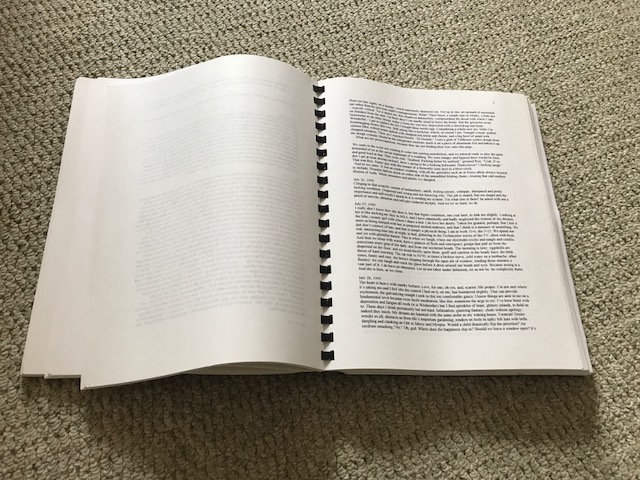
Some of my journals, printed and bound

A famous writer says to “mine your journals” for essay and blog material, something I’ve taken to heart. Dreary daily bulletins can be spun into content, stories, little narratives. Sometimes they are inspired, like gold; other times (too often), they’re gruel. 

So now when I return to this post’s opening graph, I think it’s all wrong. My journals aren’t reserves of the uneventful and the nondescript — the banality of drivel — but contain just enough substance of a full life. 

I’m no journaling master. And I obviously haven’t mastered this life thing. Last week in the airport, on the way to Scotland, I did some journaling. I’ve plucked a snippet from that entry, a sentiment that holds true for that trip, for writing, and for life as a whole:

“I still don’t know what in the hell I’m doing. I really don’t.”

The acrid bite of literary realism, in brief

Realism rules. Consider the first 10 words in Richard Yates’ novel “The Easter Parade”:

“Neither of the Grimes sisters would have a happy life”

Sting, sizzle. 

This opener is massively effective. Knifelike, it plunges into the story, ducking preliminaries or decorous setups cluttered with background frills and bunting. Before we’ve even met the protagonists we are told in the chilliest terms how things will unspool for them tonally, if not dramatically. It’s a great entrance, pungent, punchy.

51N-fpgePTL._SX331_BO1,204,203,200_

I broach this because I’m half-way through “The Easter Parade” and its satisfactions are abundant, much like those in Yates’ corrosive classic of marital dissolution “Revolutionary Road.” That masterpiece of American realism is fiction with fangs, casting an unsparing eye on mainstream domestic rituals.

And it’s part of a 20th-century literary tradition, stories and novels, mostly by male writers, that scrutinize the age of anxiety, explicit sex, cynicism, malaise, regret, envy, jobs, kids, homes, husbands, wives, lovers, losers, drunks, the city and the mirage of the white suburban dream.

Highlights in this unofficial canon of realism include: Yates’ “Revolutionary Road”; Philip Roth’s “American Pastoral”; John Cheever, Ann Beattie, Raymond Carver and Tobias Wolff’s unflinching stories; James Salter’s “Light Years”; John Updike’s “Rabbit” tetralogy; Richard Ford’s “Bascombe” trilogy; and so many more.

51dfJ7pwjDL._SX331_BO1,204,203,200_

Disillusionment, loss, heartbreak and disappointment are fragrant themes of these authors. But strangely the stories don’t feel forlorn. They almost feel consoling, perversely empathic — even when the human condition is laid bare and loneliness, our worst fear, takes hold.

”If my work has a theme,” Yates said, “I suspect it is a simple one: that most human beings are inescapably alone, and therein lies their tragedy.”

These realists serve up banality without bathos, unnerving wisdom in unfussy, largely conventional language. They are bleak and blunt, sometimes cruel in their honesty.

A (bitter) tasting:

“The hell with this aching, suffering, callow, half-assed delusion that he was in ‘love’ with her. The hell with ‘love’ anyway, and with every other phony, time-wasting, half-assed emotion in the world.”  — Richard Yates, “Revolutionary Road”

“He had learned the worst lesson that life can teach — that it makes no sense. And when that happens the happiness is never spontaneous again. It is artificial and, even then, bought at the price of an obstinate estrangement from oneself and one’s history.” — Philip Roth, “American Pastoral”

“She perceived vaguely the pitiful corruption of the adult world; how cruel and frail it was, like a worn piece of burlap, patched with stupidities and mistakes, useless and ugly, and yet they never saw its worthlessness.” — John Cheever, “Stories of John Cheever”

“There is no complete life. There are only fragments. We are born to have nothing, to have it pour through our hands.” — James Salter, “Light Years”

“Any time spent with your child is partly a damn sad time, the sadness of life a-going, bright, vivid, each time a last. A loss. A glimpse into what could’ve been.” — Richard Ford, “Independence Day”

51aBkOQUbQLThese are acid words. They are tough and unsentimental. I gravitate to them, and I can’t recommend them enough. They are beautiful. In them I locate unembellished truth. I’ve lived a little (Christ, I’m starting to sound like a grizzled cowboy) and none of these sentiments rings false or fabricated. They sound snipped from life in all its tarnished glories and burnished failures, and it is intoxicating.

Unsparing truth, from Philip Roth, 1933-2018

“No one gets through unmarked by brooding, grief, confusion, and loss. Even those who had it all as kids sooner or later get the average share of misery, if not sometimes more. There had to have been consciousness and there had to have been blight.”

— Philip Roth, “American Pastoral”

roth.png


Bitching about the birthday

The birthday blues are too obvious, an emotional cliche as lamentably predictable as Christmas cheer and Valentine’s self-pity.

Too bad. I’ve got those jangly, moaning blues, just a little bit, for tomorrow I smash head-on into one of those big, hairy birthdays, the kind with horns and tusks that makes you spin yet makes friends and family giggle. 

I’m getting older when I specifically asked the calendar to cease and desist from advancing. It’s disgusting. But I can do this. 

th.jpeg

Plans for the Big Day? Hilarious. A good friend scheduled his wedding for tomorrow, so I’ll be spending a chunk of my time celebrating someone else’s milestone. That should keep my mind off things. Pass the Champagne.

(Truth be told, I haven’t actually “celebrated” — party, gathering, friends — my birthday since I turned 13. The attention mortifies me.)

Spiffy (or is it scratchy and twitchy?) in suit and tie from the nuptials, I will then be taken to a suave dinner at Tom Colicchio’s swanky Temple Court in the Beekman Hotel in Lower Manhattan, courtesy of my swell brother, who is also attending the marital event. (Kudos, Jeff and Debbie!)

Do birthdays really change anything? Will I wake up tomorrow with a jungly, gray Moses beard? Will my insistent lower-back ache go into sudden overdrive? Will the pain in my left hand morph into full-blown grandpa arthritis? Will my ambivalent outlook on life, a fraught shade of charcoal-gray, turn black, black, black?

On all counts, I think not. Tomorrow, April 7, will be an overcast Saturday, breezy and easy, featuring a soiree that I don’t even have to throw — I’ll pretend it’s my birthday party — a day in New York, and a dinner sure to stagger. 

The calendar pages flip. It happened one year ago, no big deal. It happened the year before that, ditto. A dear friend said not to worry, I have scores more years to go. I’m not sure that’s the best news — I’m really not digging visions of me in my nineties.

I fear aging, not dying. One will beat the other; it’s a race to the finish. My birthday is just another lap.

Quote of the day, via Philip Roth

“He had learned the worst lesson that life can teach — that it makes no sense. And when that happens the happiness is never spontaneous again. It is artificial and, even then, bought at the price of an obstinate estrangement from oneself and one’s history.”  

— Philip Roth, “American Pastoral”

d4b60-philip2broth.jpg