Scoping out the right reading specs

I am going blind. 

Not quite, but sometimes it feels like it. 

Like when I’ve been reading and writing all day and, by dusk, the words start blurring on the page in an inky soup and I have to hold the book or laptop back till my arms are fully outstretched before me and the writing is a ways from my eyes, as if I’m appraising a rare gem or sacred artifact.

I feel like Old Man Grumpus, wondering in a grizzled, quavering voice: What’s this say here, Ma? I can’t see the gobbledygook dancing before my eyes. What does “yipdoodle jippy jo” mean?
Blurry-Vision.jpeg

It’s a tragedy. I’m used to having 20/15 vision. (That, incidentally, is very good, beating 20/20.) I don’t know what I have now, but I still don’t require everyday prescription glasses. I can read signs from miles away. Yet my up-close reading vision is slowly slipping, degrading, clouding up — and costing me money.

I acquired my first piteous little reading glasses (+1.25 power lenses) at a drug store in 2008. They were cheap and hideous gold-wire doohickies and within months they fit lopsided on my face. I looked like Jerry Lewis after a pratfall. I still wore them, rocking the homeless look.

Then my reading vision got fuzzier, mossy, and I graduated (er, devolved) to +1.50 power lenses a few years ago. These specs still work fine, until, that is, my eyes, after hours of reading, strain and blur. I like the glasses, stylish black and white, made by a respected readers brand, with a commensurate price. But it’s time to move on and up. My eyeballs are working too hard just to type this. 

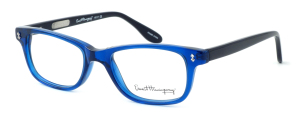
So I have ordered, with a fleck of rue and despair, +1.75 power reading glasses. Lens power goes as high as +7, so I remain pretty low on the spectrum. The transaction isn’t without some distress, knowing that the precious orbs are steadily deteriorating. The only consolation is that these new specs flaunt a sleek stylishness and subtle audacity. They are a glossy blue and black — living on the edge.
hemingway-4617-black-blue__87137-1510853853.jpgFriends and family either cluck or cackle whenever I’m without my glasses and I need to read something, from a menu to a price tag. I’ve actually flagged down employees in grocery stores to read food labels for me because I am absolutely adrift in an optic fog. Some people joke that I should get a granny chain for my glasses to dangle around my neck. That’s not a funny joke because it might be a reality rather soon. Amid all the mirth and mockery, all I can think is: old man!

But this old man is about to be the proud owner of some hot specs (blue!), a minor if critical development in the history of my readers that you might just call … visionary.
More highly finicky reading

I’m the worst. I’m impatient. I’m mean. I’m discerning. I have taste. When it comes to books, I am ruthless. I’m even worse with movies. Most don’t stand a chance.

I have put down four books, closed them for good well before the 100-page mark, in the past two and a half weeks. Suffused with sorta-guilt — ah, not really — I swan to the next book, hoping for gems and genius. I am an optimist garbed as a very dark pessimist.

Mining this small stack I located gold — the books are by literary heavyweights, after all, and they do often gleam — but I also found fool’s gold, which I will not abide.

41wp7sr5mbl-_sx321_bo1204203200_.jpg

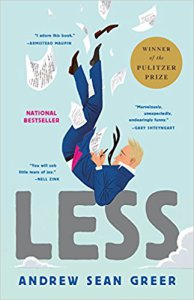
The yeasty comic novel “Less” was the chintziest of the four. It won the Pulitzer Prize this year for fiction. What are you gonna do? I read, I shrugged, I shut. 

With wan humor tangled in wry, hackneyed observations about gays and straights and executed in lite-beer fizzy prose — “a quick, easy summer read,” said one critic, as if that’s a compliment — “Less,” by Andrew Sean Greer, reminded me of a gay-themed comedy series on HBO, one of those middling shows no one watches. The novel, says Greer, is “a love story, a satire of the American abroad, a rumination on time and the human heart.” Thanks, Mr. Greer, for defining “generic.”

I read some 75 pages of “Less” and I must agree with this writer who actually finished the book: It’s “chock-full of gay clichés that feel outdated, and the tone is generally one of superficial, unearned cynicism that sometimes drifts into cattiness.”

Yup. Even The New York Times, in an upbeat review, called it “too sappy by half.”

Zadie Smith writes with a magic wand; her language and storytelling gifts are things celestial (and she makes me gush floridly). I’m an ardent fan of her fiction — “White Teeth” glitters — but her 2012 novel “NW,” a typically vibrant latticework of people and place, didn’t grab me by the lapels, no matter that I don’t have lapels. As exceptional as the writing is, the story has a matte finish when I yearned for glossy. 

Unknown.jpeg

Wade into Rivka Galchen’s hailed stories “American Innovations” and it’s clear why she is one of America’s hottest young fiction writers. She’s crisp, funny and fanciful, with a biting originality and a smidge of the surreal. But as much as I appreciated the collection, I put it down. I almost fell for it, then fashioned a one-word review: meh.

While there’s no shame in not finishing a book — I can’t believe people who feel they have to get to the last page even if it’s a slog — I can’t help but gulp and blush at this failure: Edith Wharton’s 1920 Pulitzer-winning classic “The Age of Innocence.”

I did not get far in the rather slim novel. I found the prose cluttered and perfumey, chokingly Austenian (though without the giggling), and fustily 19th-century for my contemporary palate. (Oddly, I loved Wharton’s 1911 “Ethan Frome.”) Wharton weaves long, highly populated sentences of lace and crushed velvet, many of them woozy and lovely.

Problem: I kept picturing doilies. 

Antidotes to these literary losers are a trio of new fiction by some of the most acclaimed women authors around: “Kudos” by Rachel Cusk, “How Should a Person Be” by Sheila Heti and “Homesick for Another World” by Ottessa Moshfegh. 

51zp1zkt38l-_sx328_bo1204203200_.jpg

I’m knee-deep in that last title, a 2017 collection of stories by the precocious Moshfegh, whose novel “Eileen,” a darkly off-kilter character study, impressed and troubled me — just how I like it.    

Moshfegh’s stories are spare and wicked, laced with a perfect pinch of transgression, enough to fill an eye-dropper. They are comic and you laugh, but there’s dried blood in them. 

Some excerpts:

“He thought that the drugs we bought in the bus-depot restroom were intended to expand his mind, as though some door could be unlocked up there and he would greet his own genius — some glowing alien in glasses and sneakers, spinning planet Earth on its finger. Clark was an idiot.” 

“Our repartee would be rich with subtlety and sarcasm, as smart and funny as mid-career Woody Allen. Our fucking, like Werner Herzog, serious and perplexing.” 

“I hated my boyfriend but I liked the neighborhood.”

To me, that is dreamy writing, all at once blithely sardonic, intelligently aloof and drolly perceptive, attached to the stinger of a scorpion.

On readers: quote of the day

I know a handful of adult humans who, without a whiff of shame or embarrassment, blithely admit they don’t read. This is not only startling to me, it’s seismically appalling.

They (our president included) don’t get the appeal, they have no use for words or language or a particular type of storytelling that is expressly non-passive, that’s indeed near-immersive. I’m trying hard not to sound snobbish about this. It’s like the sports fan whose passion eludes the non-sports fan or the punker who has no interest in Bach or Bartok. We are who we are.

This bibliophile will never understand, and trying to understand the bookless simply exhausts me.

What I am — and here I quote one of the most apt descriptions I’ve seen — is “a person who considers reading an emotionally instructive and intellectually legitimate form of lived experience.”

That’s Alice Gregory reviewing Lisa Halliday’s new fiction “Asymmetry,” which I plan to grab once I finish Evan S. Connell’s smashing 1959 novel “Mrs. Bridge.” Gregory’s account of the serious reader made me even gladder to be one and sadder for those who are not.

What they are missing is incalculable.

shutterstock_112499642.jpg

It’s OK, you don’t have to read that

Idea of the week: “Some real talk: most writing isn’t worth consuming.”

This both striking and self-evident statement was plucked from a purposely (and pleasingly) provocative essay titled “The Case Against Reading Everything,” by Jason Guriel at The Walrus. It’s a good line, because it’s irrefutably true, and because it comes from a site called … The Walrus.

books4.jpg
No way.

Guriel is impugning the moldy axiom that all honest writers must “read widely” — that is, indiscriminately, catholically, voraciously, hoovering the latest hardbacks, pounding down poetry, gobbling it all, from Bellow and obituaries to Cervantes and cereal boxes. It’s the old “balanced diet” theory. He’s not having it.

Neither am I. It’s an unrealistic ideal, reading it all, though I freely admit to reading obits and cereal boxes. In my twenties, I tried strenuously to read wide and far, from the gilded canon to contemporary classics, and I about hurt myself. The volume of verbiage is simply too monstrous, overwhelming and intimidating. I now embrace my blindspots (“Infinite Jest,” sci-fi, “Ulysses,” anything by J.K. Rowling) and guiltlessly shun writers I don’t feel a quick kinship with.

In college, a tough-minded journalism professor chuckled when I told him about the stacks of books taunting me and my ironclad will to conquer them. “You must be selective,” he said, and I deemed him very wise.

To this day, with impunity, I put down books that don’t regale me 110-percent, even if I’m half-way through them. Long ago, I literally dropped in the garbage John Grisham’s “The Firm” with only 50 pages out of 544 pages left. (A bratty gesture, I know, yet one unencumbered with regrets.)

It’s the quality, the intensity, not the breadth of one’s reading that counts. It’s about focus and concentration — concentrating on the works and writers that nail your sweet spot and eschewing inconsequential distractions. Says Guriel:

“The call to ‘read widely’ is a failure to make judgments. It disperses our attention across an ever-increasing black hole of mostly undeserving books. Whatever else you do, you should not be reading the many, many new releases of middling poetry and fiction that will be vying for your attention over the next year or so out of some obligation to submit your ear to a variety of voices. … Instead, shutter your ear against mediocrity. To fall in love with language, don’t fan out. Fall down a rabbit hole. Cynthia Ozick wanted to be Henry James. Nicholson Baker has a whole book about his obsession with John Updike.”

I’ve fallen down many rabbit holes, becoming a near completist of Philip Roth and, yes, Nicholson Baker. I was religious in my ardor for former San Francisco Chronicle humor columnist Jon Carroll, and marveled at New Yorker film critic Anthony Lane’s linguistic paradiddles (until, that is, he became wearisome, cutesy and gassy, a fallen hero).

Rabbit holes are thrilling. I most recently tumbled into that of L.A.-centric novelist Eve Babitz, snarfing up five of her groovily stylish books in a matter of weeks. I did what Guriel suggests, fell in love with the language, shuttered my ear against mediocrity. It was to me what reading is all about. It was like a spell — a love affair without the doom.