Flicks and the physician

Small talk with your various professionals, be it a masseuse or barista, is standard social glue. I gab with my barber extensively about world travel, for instance, swapping tales of our latest journeys to pass the otherwise awkward time. It’s chop and chat. (Most guys at the barbershop jaw about sports. Tedium crystallized.)

Things are different with your doctor, unless it’s with your therapist, where talk isn’t cheap but it is profuse. With medical doctors small talk is spotty, because the climate is so clenched, so clinical. For one, they always seem to be in a tizzy, a nerve-wracking rush. Two, it’s hard to shoot the breeze when they’re asking you to turn your head and cough. 

I had the biannual appointment with my primary care physician the other day, and I came away thinking how cool he is. After prattle about my prostate, gab about my gall bladder, and talk of a tetanus booster, he eyed my t-shirt and said, “That’s a great studio.” I had to look down to remember I was wearing my A24 shirt that looks like this:
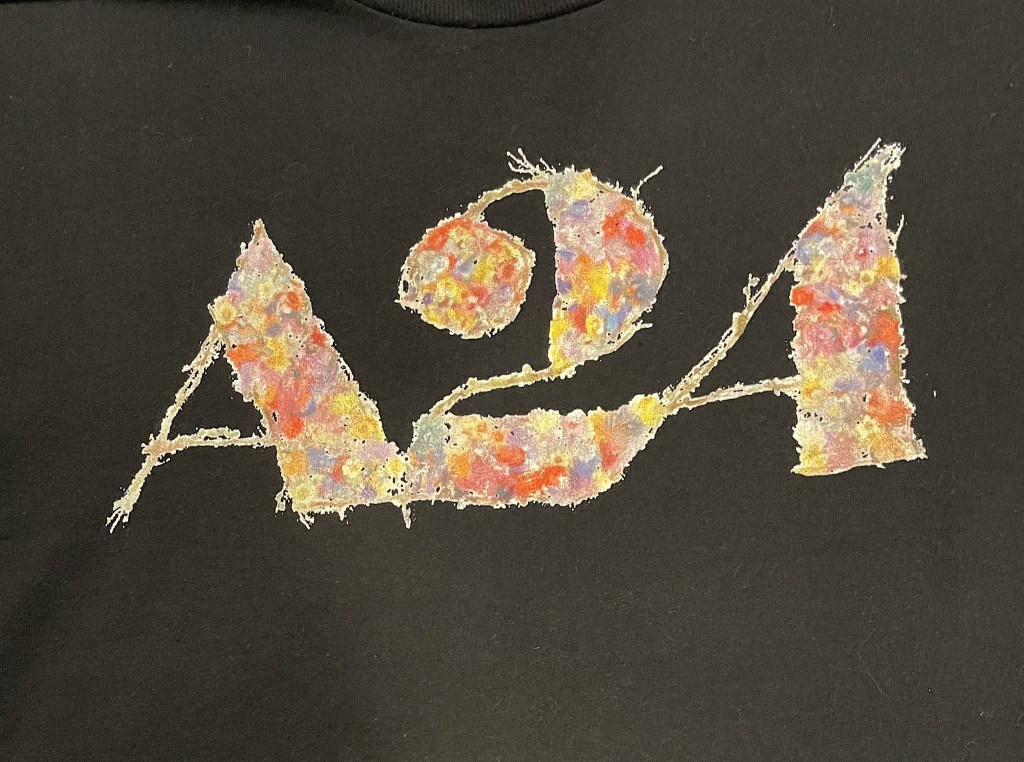
A24, if you’re wondering, is the hot indie film distributor right now. The boutique shop — which (shockingly) scored a Best Picture Oscar this year with “Everything Everywhere All At Once” — is a mighty machine, celebrating 11 years in the biz with brazen and peculiar taste. Ambitiously art-oriented, A24 pushes cult films that garner lavish critical kudos and discerning viewing audiences. 

Movies like: “Ex Machina,” “Midsommar,” “Hereditary,” “Uncut Gems,” “The Tragedy of Macbeth,” “Aftersun,” “The Florida Project,” “Talk to Me” and more

And TV shows like: “Euphoria,” “Beef,” “The Idol,” “Ramy,” “Irma Vep,” “Ziwe” and more.

The good doc and I fell into a spontaneous groove, both of us animated by the splendor that is A24. We agreed that the ending of “The Witch” was spectacular and the ending of “Midsommar” sputtered. 

His favorite A24 movie is “The Lighthouse,” with Robert Pattinson and Willem Dafoe, and he loves “The Whale,” which snagged Brendan Fraser a Best Actor Oscar. I told him I like “The Witch” more than the mind-boink of “The Lighthouse,” both films directed by visionary wunderkind Robert Eggers. He was okay with that. He just nodded, knowingly.

So, yeah, A24 is badass. Dr. So and So digs it. I dig it. But I guess the point is me and my professional — a guy who actually used a stethoscope on me — forged a small connection. Everyone likes movies, and most everyone can chat them up. This, however, was specific, downright micro. It was like talking about a tiny kebab kiosk in the slimmest side streets of Istanbul that only the savviest tourist would know about. 

And then reality barged in. Suddenly, the nurse entered and jabbed me with a tetanus shot, and my fellow A24 fan was gone, vanished in the weird smelling ether of the doctor’s office.

Fade to black. Roll credits. We’ll always have “The Witch.”

Fur, feathers, and folderol

On the About page of this blog, I caution that my writings here are “forever random and rambling.” Rarely has that been so true than right now … 

*  *  *

The Tao of Cubby 

Cubby, the über-mensch of mutts, scurries across the wood floor, his nails recalling the tip-tap of a typewriter. (If only he could actually type. That would save me tremendous carpal tunnel distress.) 

He is fleet, balletic. Though he resembles a gray Oscar the Grouch — bodily bedhead, articulate brows — the dog is chipper and civil, venting frenzied yaps only when evolutionarily expected (read: Amazon). 

Cubby is also mindful and meditative. He follows the flow of the universe and the whiff of tacos. Part Chinese sage, part Scooby-Doo, he adheres to the Taoist tenets of simplicity, patience, compassion, and the canine tenet of raw sirloin. 

Spiritual but godless, Cubby finds solace in Sartre’s “Being and Nothingness” — self-deception! free will! — but not in Scripture. He likes to quote Socrates: “I am the wisest dog alive, for I know one thing, and that is that I know nothing.”

For Cubby, things just are. Why this, why now? As Cubs might say, Because. Just because.

*  *  *

In anticipation of Easter, a short tale featuring baby chicks

When I was five, we had a pair of baby chickens, a female (yellow) and a male (black). They scuttled around our backyard and slept in a wood and wire coop, also in the backyard. The birds were strictly decorative. We had no intention of consuming their flesh.

One night a possum tried to get the chicks. Hearing the ruckus, my Dad went outside and our black Lab followed, charging and half-killing the hissing marsupial. Distressed by the injured animal — drama in suburbia — Dad tried to put it out of its misery using a broomstick (why not a spatula, or a straw?). 

He failed, unsurprisingly. The possum was either unconscious or playing dead. Because the next morning the creature was still moving in the garbage can in which it was placed. A man sans a plan, Dad left it there to die on its own, to the collective horror of his family. 

Soon after, we gave the chicks to a cousin who cared for them on his sprawling farm. I’m sure they were delicious. 

*  *  *

Speaking of chickens …

Braided with wisdom, wit and woe, Jackie Polzin’s “Brood” is a deceptively slight novel about a woman caring for a small brood of chickens as she copes with the personal tragedy of a miscarriage. 

Not sold? Be, because Polzin’s debut is sublime. It’s steely, and gentle as a breeze.

The chickens are both main characters and peripheral walk-ons in this compact book, so don’t fear a poultry-centric story. In fact, there’s not much of a story at all. Deeply contemplative and minutely observed — à la Jenny Offill (“Weather”) and Marilynne Robinson (“Gilead”) — Polzin limns her nameless narrator’s life with by turns clinical realism and dazzling impressionism. There is much to learn about chickens, and life.

The precision of the prose, so nipped, tucked yet vital, is a marvel. Even the chicken passages, with their homely brown eggs, scratch feed and scaly feet, are poetic reveries. A human- and chicken-scale miniature, “Brood” loses none of its emotional texture next to its lo-fi humor. It’s one of the most lulling and pleasant books I’ve read in a spell. 

*  *  *

The larger worth of small talk

Strolling down the sidewalk, you run into an acquaintance — someone you know only faintly, yet well enough for a stop and chat; say, your mechanic or a few-houses-down neighbor — and you find yourself beaming hello, how are you, and before you know it things have devolved into vapid chitchat, the dreaded small talk.

Small talk eats the soul — the empty jawing about weather, work, kids, traffic, assorted gossip and platitudinous pleasantries. Defined as “polite conversation about unimportant or uncontroversial matters,” small talk reeks of the banal, the trivial, the sort of airy transactions saved for your Uber driver, that guy you went to high school with and haven’t seen in years, or the faux-cheery barista you encounter each morning. 

Still, while it can be painful, what with the groaning predictability of the exchanges, small talk serves a purpose: it fills the dead space we all fear. It’s a buffer, prosaic padding, a time-killer of minor moments that would otherwise be awkward, excruciating, or both.

Words. They will save us. No matter how crudely utilitarian.