Cubby the dog got a haircut the other day. Told to shave him short, the groomers had a field day. Short. Sure!
Three days ago Cubby was a walking haystack, a fluffy-cheeked Ewok, one of those stray dogs that takes gardening shears and chainsaws to clean up. The goofy part-Schnauzer mutt, a bounding gray Germanic furball, was ready for a summer trim.
And there you go.
Cubby came trotting out from the grooming, mildly disoriented, half-damp, and … ha! What do we have here, little rat-dog creature? Oh, yes. Short. Short. His curls are gone and swaths of his torso are pink, so shorn is the fur. He’s a baby chick, a Peeps.
And how we’re having fun with it. (Sorry, Cubs.)
A friend was visibly shocked by Cubby’s new haircut. “Cubby! You shrunk! You’re bald!,” she gasped. I told her that he caught on fire. She almost cried.
Someone long-distance asked what the little guy looked like. My brother aptly put it, “Imagine a sausage, a scrotum, a seal and an otter mixed together.”
At least for me, haircuts are traumatic events, so I feel for the fella. To his credit, Cubby hardly seems to notice. Occasionally he’ll scratch or furiously lick those pink areas, but otherwise he seems to think he’s quite the catch, thin and svelte and groovy.
And when I give him a fair assessment, I have to nod and say, “Yep.”
So I was walking around the hood recently and I spotted a squirrel in the road squished like a jelly donut. It was gruesome and sad and got me thinking about mortality, careless drivers, blameless rodents and, yes, Italian food.
I envisioned the shockingly good meals I ate last year in Rome and Naples: pizza margherita, caprese salad, pasta carbonara, ravioli, gelato, etc. And that led to thoughts about the kinds of food I might eat on my upcoming journey to Scotland.
This was tricky, because I don’t really know what native Scottish fare is, except for the shuddering national dish haggis, dubiously defined as “a pudding composed of the liver, heart and lungs of a sheep, mixed with beef or mutton kidneys and oatmeal and seasoned with spices, which is packed into a sheep’s stomach and boiled.”
Suddenly, I see that pulverized squirrel.
This is a job for some A.I., I mused, too lazy to grab my Scotland guide books. So I asked ChatGPT to spit up some famous Scottish dishes and it gave me haggis (#1), smoked salmon, porridge (!), black pudding (sausage made with pig’s blood) and other grub that doesn’t sound wildly appetizing on paper, but rather Dickensian.
That said, I’ve made reservations at seven restaurants in Edinburgh and Glasgow that seem delicious, and almost all of them boast Scottish cuisine (the exception is an Indian joint that looks otherworldly). I’m particularly amped about Makars Gourmet Mash Bar in Edinburgh, which merrily touts affordable farm-to-table dishes featuring lots of mashed potatoes and scads of fresh meats and veggies. Bangers and mash? Um, yeah.
I was watching “Top Chef” the other night and the show’s deceptively sweet host Padma Lakshmi — she of the cutting parting words, “Please, pack your knives and go” — reminded me how food is of paramount consideration when choosing where to travel. I go partly for the local cuisine, be it sushi and takoyaki (octopus balls) in Japan or jamón ibérico and patatas bravas in Spain (or, gulp, haggis in Scotland).
This trip is different. Despite my A.I. research, nothing but the cursed haggis stands out, and yet the menus at my reserved restaurants are thoroughly enticing. A quasi-foodie — sort of a Foodie, Jr. — I’m all about adventuresome eating, be it silkworm cocoons in China or that whole cobra in Vietnam I’ve mentioned here a thousand times. Will I try haggis? Maybe. Yet I don’t want to order an offal-filled sheep’s stomach only to gag on the first bite and then where will I be? Embarrassed and out 20 bucks.
I rarely strike out in my gastronomical exploits — OK, the silkworm cocoons were disgusting — so anxiety is low. I bet I can do haggis. Right? After all, it really isn’t like it’s roadkill or something.
Today was a two-errand day. I was picking up a modern classic potboiler at the library — the one about a ginormous great white shark that terrorizes the bejesus out of a New England beach town — and I was getting my periodic pedicure at the salon. I dubbed the day “ ‘Jaws’ and claws” to amuse myself. (Mission accomplished.)
The book I got really is “Jaws,” Peter Benchley’s 1974 blockbuster that spawned Spielberg’s famous film and a million petrified beachgoers around the world. As a kid, I lived in beachy Santa Barbara when both were released, and I fantasized about flesh-shredding teeth and ominous dorsal fins to unhealthy degrees. It terrified me, and I loved it.
First I worshipped the movie, which I saw at age 7, then I snatched my parents’ mass market paperback of Benchley’s novel and gobbled it up at age 8. I savored those pages, slashing with vivid, violent writing that helped turn me onto reading for a lifetime.
I still own that cracked, yellowed paperback, but it’s packed away with other mementos. So, on a whim, I hit the library up for its copy. I quickly located some of my favorite passages, ones that haunted — and excited — me as a young reader.
Just like my own copy
Can you handle it? This horrifying scene is from the opening of the book, when a young woman — recall her from the movie — takes a skinny-dip in the moon-dappled ocean.
“The fish smelled her now, and the vibrations — erratic and sharp — signaled distress. The fish began to circle close to the surface. Its dorsal fin broke water, and its tail, thrashing back and forth, cut the glassy surface with a hiss. …
“At first, the woman thought she had snagged her leg on a rock or a piece of floating wood. There was no initial pain, only one violent tug on her right leg. She reached down to touch her foot, treading water with her left leg to keep her head up, feeling in the blackness with her left hand.
“She could not find her foot. She reached higher on her leg. Her groping fingers found a nub of bone and tattered flesh. She knew that the warm, pulsing flow over her fingers in the chill water was her own blood. Pain and panic struck together. The woman threw her head back and screamed a guttural cry of terror.
“This time the fish attacked from below. It hurtled up under the woman, jaws agape. The great conical head struck her like a locomotive, knocking her up out of the water. The jaws snapped shut around her torso, crushing bones and flesh and organs into a jelly.”
Now, as a young boy, this was about as stupendously visceral as prose could get. (And I omitted the rest of the violence for reasons of taste and space.) “A nub of bone and tattered flesh” — I reread that line over and over, shocked, thrilled, gobsmacked.
Even today, these opening pages stun. Getting the book at the library, I was hoping Benchley’s eloquence would strike me again, and it did. That’s why I shared some here.
Call him a hack or a mercenary, but you’d be wrong. Benchley’s a savvy craftsman, expert at tension and thrills, not to mention a vibrant stylist with a painterly (think Francis Bacon) flair. His humans, from Quint to Brody, pop off the page even if the world he confects for them occasionally brushes pulp.
I’m not going to reread the entire novel, which is remarkably short at 278 pages, but it was fun revisiting a book that so influenced my cultural life.
Why “Jaws,” why now? Well, I’m reading an excellent new book about the history of Hollywood and the Academy Awards called “Oscar Wars,” and I’m deep in the chapter focusing on the making of “Jaws” (as well as “Barry Lyndon,” “Dog Day Afternoon,” “One Flew Over the Cuckoo’s Nest” and “Nashville” — 1975 was a hell of a year in American film.)
The lore is notorious: Making the movie “Jaws” was a prolonged ordeal and near-disaster for all involved, including a 26-year-old Steven Spielberg, who was sure his nascent career was finished. We know how that turned out.
If the movie “Jaws” remains one of my all-time favorites — in a crowded field that includes “Heat,” “All About Eve,” “Sweet Smell of Success,” “Manhattan,” “City Lights,” “Seven Samurai,” “Duck Soup” and on and on — the novel “Jaws” is more of a sentimental gem. It’s dear to my heart for reasons that go beyond art. On a nostalgic level, it has — yes, I’ll say it — sunk its teeth in me. And it won’t let go.
“I don’t want to be buried in a pet sematary/I don’t want to live my life again!”
— “Pet Sematary,” the Ramones
I once had a pet rat named Becky. After two and a half years of feisty play and impish scampering, tug of wars and belly tickles, she got terminal cancer and I had to put her down. I placed her remains in a decorated wooden box, dug a hole in the hard Texas dirt, and buried her in my backyard.
I repeated this ritual with three other pet rats — Phoebe, Tammy, LaShonda — and it shattered me every time. My yard became a veritable pet cemetery, a rodent resting place, and each grave should have cautioned me: Never again. I didn’t learn.
I also buried a blue betta fish named Alvy in the ad hoc graveyard. He thrived for four swishing years in a big sparkling bowl. I nestled the old man in a matchbox and set him in the ground, saluting him for his gratifying longevity. I miss the fish.
If you care one lick, laying your pet to rest is undiluted trauma. The platitude holds: pets are family, loving and adored, like hairy children who only live to their teens, if that. So integral are they to our lives, you swear they speak English and read minds. (I’m convinced Cubby the dog is really a tiny man in a dog suit. I keep looking for a zipper.)
And so we honor them in death as in life, with a sentimental flourish and teary respect. Or at least we do in the modern age. There was a time when “people disposed of their dead pets in the river, or might have sold their bodies for meat and skin,” notes a CNN essayist. I know of modern folks subjecting their late Spots and Trixies to taxidermy, which is not only creepy, it’s selfish and disrespectful and twisted.
Burial and cremation are popular send-offs. Barcelona, Spain, is set to open its first pet cemetery next year, with plans to carry out 7,000 animal cremations a year. Why? “Constant public demand,” they say. Barcelona is home to 180,000 dogs alone. Surely there’s just as many cats. (Rats? I bet.)
In 1983, Stephen King published the popular horror novel “Pet Sematary” about some macabre happenings surrounding a buried cat that is resurrected, or some such nonsense. The book spawned a 1989 movie (with “cemetery” also intentionally misspelled for plot purposes), which featured a cat-chy theme song by the Ramones.
The book and film helped spread the idea of the pet cemetery. And yet pet cemeteries are not some freaky esoteric brainchild of ghoul-meister King. There’s one in London’s Hyde Park, founded in 1881. New York’s legendary Hartsdale pet cemetery was founded in 1896, followed by Paris’ Cimetière des Chiens in 1899.
About a hundred years later, I founded my own pet cemetery, at age 6, in my family’s pretty and serene Japanese-style garden in Santa Barbara. (This preceded the rat resting place by decades.) Surrounded by bamboo, moss and a statuary fountain, the graveyard contained goldfish, salamanders and other mostly water-bound critters. I’ve been at this a while.
On film, celebrated director Errol Morris made his debut with the acclaimed 1978 documentary “Gates of Heaven,” about the pet cemetery business and the souls who rely on it. It’s alive with vivid characters who are wrenchingly emotional about their dearly departed four-leggers.
Critic Roger Ebert, who named the film one of his 10 all-time favorites, wrote about “the woman who speaks of her dead pet and says, ‘There’s your dog, and your dog’s dead. But there has to be something that made it move. Isn’t there?’
“In those words,” Ebert writes, “is the central question of every religion.”
The cat wails plaintively, pathetically, for no known reason. It is high-pitched and high-decibel. It’s a distress signal, a siren from the depths of hell that is feline.
Cats are OK. I like them well enough, about as much as I like, I dunno, pet pigs. I don’t like them as much as I love pet rats, that is certain. Pet rats and I go way back. It’s an intricate relationship.
In my life, I’ve had a half dozen rats: Phoebe, Becky, LaShonda, Tammy, etc. They are like mini dogs — affectionate, social, clean and wickedly intelligent. They play. They come when called. They like their bellies rubbed. Theydrink beer. Dogs are tops, but rats are little badasses.
Cats, well.
I’ve had about five cats, including this wailer who indiscriminately cries, whines and yowls. It’s like living with a sickly crone, or a werewolf.
The cat, a rescue named Spicy by his prior owner, resides with his sister, Tiger-Lily. She rarely makes a peep, only the occasional textbook meow, the sound you hear when you look up “meow” in the dictionary.
Tiger is sweet, gentle, svelte, independent. Spicy is pushy, needy, burly, noisy. Plus his eyes weep goop like the Exxon Valdez.
But Spicy is cherished. He’s an animal, after all, and animals tend to deserve unconditional love, spoiled as they are because they are cute and cuddly, fun and furry, smart and, in Spicy’s case, smart-alecky.
Is he smarter than us? He slinks with an underplayed intelligence and studied detachment. His yellow eyes burn through you, laser beams of simmering condescension. When they’re not softening at half-mast during cuddle mode, those eyes are saying, “Screw you.”
He nips with sharp teeth to prod you to stroke him, to demonstrably adore him. He climbs in your lap when there’s already a laptop there, plop. He claws at the carpet with violent resolve, sounding like someone’s hair is being ripped out. And, of course, he whines and caterwauls like an opera diva in grandiose agony. He thinks all of this is charming, and it is to a point. But he’s giving cats a bad rep.
Of course Spicy does not represent all cats. He isn’t even emblematic of truly bad felines, like those cringey manimals from “Cats.” No, he’s in-between, part cuddle kitty, part son of a bitch. Don’t get me wrong. I love him like a pet. Just not my pet.
Tiger-Lily and Cubby the dog own more of my heart. Cubby may bark like a madman and scratch the paint off the door on occasion, but he’s all angel, whereas Spicy has a satanic streak. Sometimes you’ll try to pet him and he’ll arch his back and bristle his fur. Devil cat!
And those yowls he emits evoke “The Exorcist” more than “Puss in Boots.” As I said, though, I like him alright, even if he’s trouble. Meow? More like meh.
If that sounds like relief, bliss, accommodation, you’re mistaken. I like snow, but I also dread it in myriad ways. I think you know what I mean. Snow is pretty, all those crystalline scenes and twinkling tableaus. It facilitates novel outdoor activities — skiing, sledding, snowball fights, snow angels, murderous avalanches.
But it’s also drudgery: shoveling and scraping, slush and brown blech. I once, as a full-grown adult, slipped on my ass into a giant snow bluff. I was carrying groceries. And I’m still so goddam mad about it, I could punch a snowman.
It’s the last day of February and the planet chooses now to fart out four piddling inches of icy powder in our East Coast parts. It arrives all coy and cutesy after a stubbornly snow-free winter that I will blame on dystopian climate change. Better theories? Fire away.
You gotta walk in this crap. And drive in it. Both are treacherous outings. Somehow I lost my crummy winter boots — Frankenstein would’ve loved them — so taking the limping dog out for a walk in my sneakers felt like a high-wire act. I kept thinking: If I fall on my ass again, I’m cashing it all in. I’m just going to lie there and melt away with the snow.
But Cubby was digging it. He made so much yellow snow, it looked like neon graffiti sprayed across the endless white canvass. I think he wrote his name. (Another snowy pastime. Those were the days!)
The snow fell overnight. You go to sleep with black streets, gray sidewalks, bare trees, visible cars. And you wake up stuffed inside a marshmallow. Branches bowed with white, cars buried, streets streaked by road-ripping plows. It’s a winter wonderland. For about half a day.
Then, unless more layers fall, it’s ice and mush and puddles and mud. So we got lucky, spared the drippy drama of multiple winter snows. Right now the stuff is melting fast. Tinkles of water from rooftops drop like rain. The sidewalks are clearing for safe strolling.
People walk their dogs, wearing hats and muffs and gloves, sartorially overcompensating. It’s not that cold. But let them believe. Who knows when, or if, we’ll get blanketed in the white stuff again. Next month. Next year. Never.
It always wrecks me to see an injured or afflicted animal, be it a stray dog scratching helplessly at mounds of scabby boils in Shanghai, a moped-stricken hound in Hanoi, or a baby hippo fatally gored by fighting adult hippos on the Serengeti. (I saw that one on TV in Florence last week. Thanks, Nat Geo.)
Now Cubby the magical, mystical mutt may be ailing, and it’s distressing. The ridiculous animal is suddenly walking like Willy Wonka in the 1971 movie as the chocolatier emerges from his factory to greet the Golden Ticket holders, with a pronounced limp, one leg stiff and useless as a board.
Cubby’s back left leg is palsied and raised off the floor, bent. He’s walking around like one of those fashionable three-legged dogs that pop up in hip shows and movies. (See: Pamela Adlon’s “Better Things” or Wes Anderson’s “The Life Aquatic.”)
I’m no vet, but I’ve gently pressed, pulled and squeezed Cubby’s leg and paw and there seems to be no pain. He’s emitted nary a whine and he looks at me like I’m some sort of touchy-feely perv-o.
He still scampers up and down stairs, leaps onto sofas. Maybe he’s pulling a Wonka. (If you recall, Wonka was faking it, just so he could perform this tremendous somersault and show up everyone as credulous dupes. He was the best.)
I hope he’s faking it, the curly little wisenheimer (actually he’s part Schnauzer). See him in video action just last week HERE. It’s worth it.
As you can see, Cubby’s no old man — the rescue pup is roughly seven — but he’s no Gen Z whippersnapper, either. (Though he does adore making spritely little dances on TikTok.) He’s middle-aged, with tufts of distinguished gray and the breath of a chain-smoker.
But I fret. To watch a creature suffer causes me unshakable anguish. The sick and maimed street animals I’ve seen around the world haunt me many years later. I was even nervous when Cubby, still at the shelter, was neutered and had to wear one of those big cones on his head. He did it with tail-wagging courage and panting dignity.
And now this, the hobbling hound. We’re stumped. The dog will go to the vet if the mystery malady continues. Sometimes animals just want attention, and they can be quite wily at doing it. In the end, we just hope scruffy Cubs has been pulling our leg.
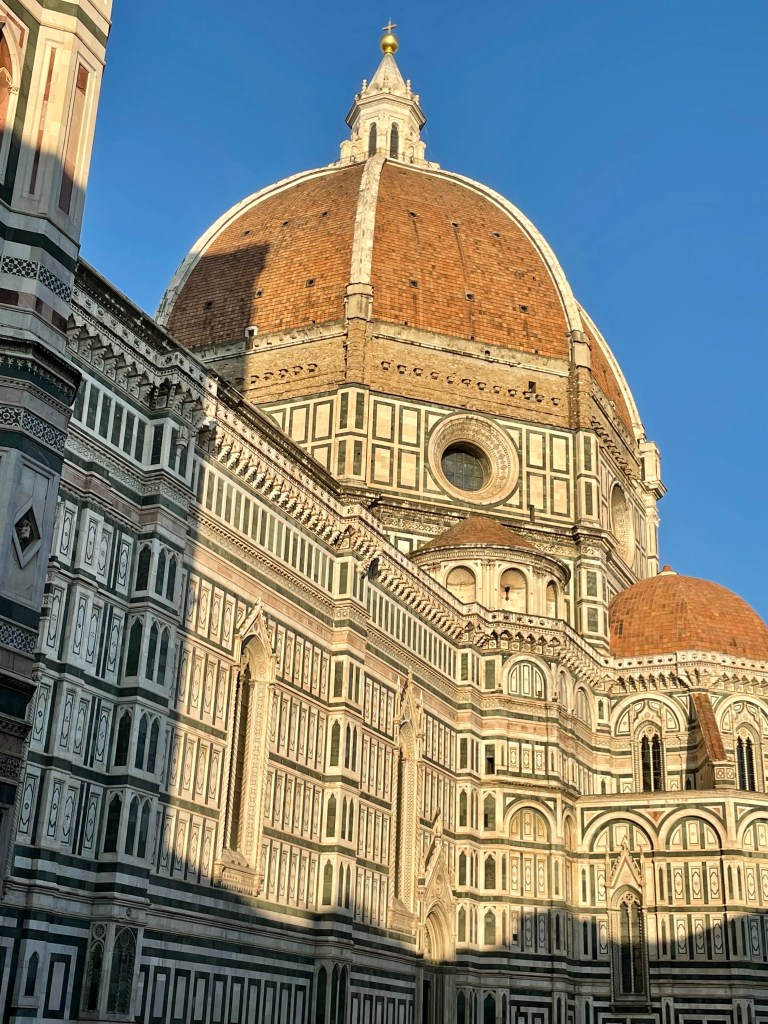
The humongous duomo (cathedral) that is the centerpiece of Florence slams you with its blunt-force beauty. Instead of describing it, which would reduce its flamboyance to a clinical chill, here’s a couple of shots that hint at its Renaissance marble glory:
Elaborate, bold, proud. And yet the cathedral’s interior is almost naked, largely stripped of art and artifice, the gaudy trimmings of Catholicism. Except for some stained glass, it is cold and gray, stubbornly spartan.
But then you look up at Brunelleschi’s mind-boggling, logic-defying dome and soak in Vasari’s “Last Judgement,” one of the world’s largest paintings, a spectacular sprawl of doomsday religious commotion. I craned my neck and arched my back for a proper peek, stretching body parts that I’ve never used before. The painting, which gives the interior a dazzling kick, is outright sublime.
As is Florence, which at times seems to be one enormous fashion show cum gelato shop. That’s not a complaint.
Last night, I ate my first sit-down dinner here at a highly acclaimed restaurant (ristorante!), whose groovy chef/owner wears so many arm bangles he practically looks bionic, or like a distant cousin of C-3PO. He’s one of those characters who hangs photos of himself with celebrities like John Travolta all over the joint.
Today, to see more of Tuscany, I beat it about 40 minutes outside the city to Chianti, land of fine red wine. I was with a tour group of mostly swell people for a wine tasting and damn it started early. We had to meet at 8:45 a.m. and the drinking began at 10 a.m. sharp and lasted till 1 p.m. We were all baffled. But it turned out well and I was back at my hotel by 2:30 p.m.
The guides basically left the group tipsy then thundered off in the big bus. Everyone I talked to said they were going to go take a nap, which I shamefully admit I did (for all of 20 minutes).
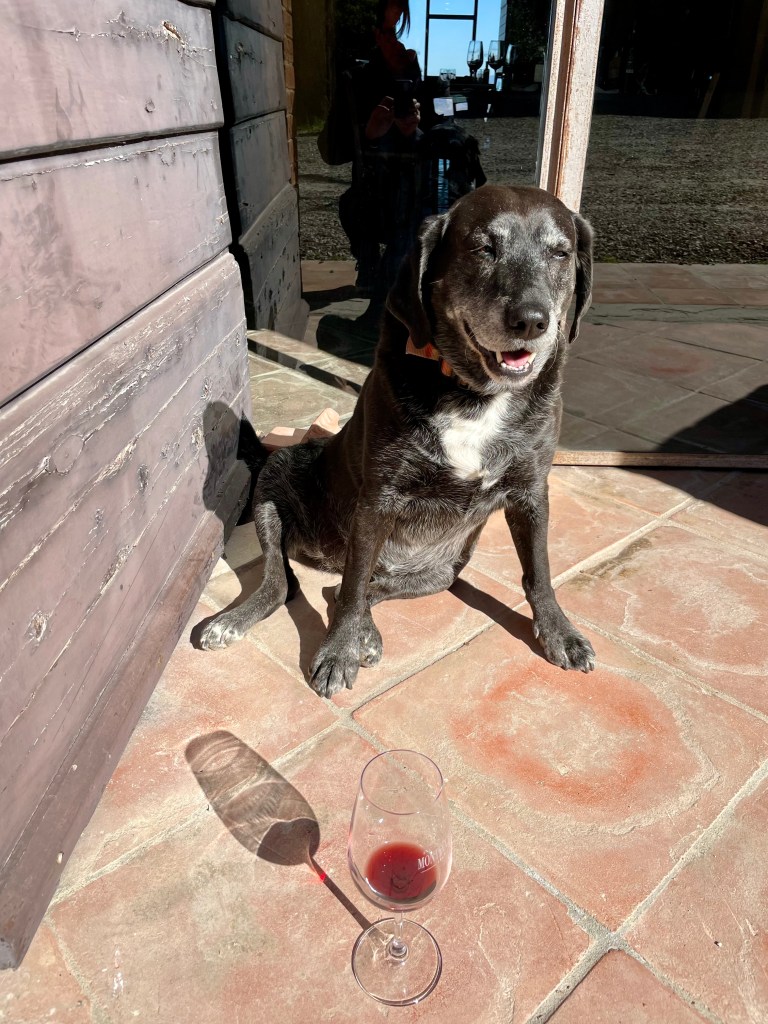
At one of the wineries, three Labrador Retrievers roamed the idyllic grounds when they weren’t begging for belly rubs and general adorable attention. I liked the dogs immensely, even more than some of the wine poured so generously — and frequently. This place is vino mad, and I like it.
Am I getting sick, dammit? Is this portentous throb in my brain the on-ramp to a massive cold? Is that familiar scratch in my throat a tease to a burning ribbit? Do those worrisome pangs in my limbs augur aches across my entire body?
Am I pissed about all this?
Yes, I am!
For one, I hate being sick — and that, reader, is the winner of the most unoriginal statement in the history of the world.
Two, I have a date. With Philadelphia to be exact. This week. A three-day assignation with some fine art, that’s what it is. And excellent food. And an unapologetic dive bar named Dirty Frank’s. That is correct: Dirty Frank’s.
Philly is only two hours away. And there happens to be two art shows worth some time there: “Matisse in the 1930s” at the Philadelphia Museum of Art (the place with the mountainous steps that Sylvester Stallone scales in “Rocky” — and why did I feel I had to mention that?), and “Modigliani Up Close” at the peerless Barnes Foundation, one of my very favorite venues for aesthetic astonishments.
And food. I will indulge in delicious vittles (and drink) at Village Whiskey (burgers, the eponymous hooch, and oodles of class) and The Dandelion, a “sophisticated homage to the British pub.” Last time I was there, I ate right next to a crackling fireplace.
We can’t overlook Dirty Frank’s, that famous cash-only, no-nonsense skank bar just around the corner from my hotel. It’s a neat, neon-splashed, Bud-in-the-bottle joint, replete with a hard-rocking jukebox, darts, pinball and miles of tats. Vice magazine calls it “a gleaming oasis of weird in a town beset by 21st-century slickening that’s always made people its primary business, no matter who those people are.” Word-for-word, my cold seems to fade at that description.
But is it actually fading? My head still thumps, my throat slightly sizzles. It’s time for three more Advils. I got a flu shot in September, so it can’t be the flu, can it? And I’ve had Covid and I don’t have any respiratory symptoms. And yet …
Take it easy, I tell myself. As I gulp down the pills, I toast good riddance to any sick and hello to Matisse, Modigliani — and Frank. Now, as further deterrence, I plop down for a nap. And I dream of Philadelphia.
A few years ago at Dirty Frank’s. The pooch and his pilsner.
Whenever the dog senses someone is at the front door he explodes in an ear-shattering commotion of vocal violence and door-clawing destruction. Deafness commences and paint is scraped off in neat vertical lines by furious, and improbably artistic, paws.
At these times, the pup is something of a monster, a fleecy, compact gremlin with the screeching pipes of an F-16 taking off. The transformation from hound to hellion is startling, obnoxious, and comprehensively annoying.
Paint peeled off with house-guarding gusto
Cubby is a good dog. Cubby is a bad dog. He is both — say, 94.2% good, 3% bad, and the rest is murky amorality. But, Jesus, he is loud.
His lightning-jag meltdowns — crack! — upend your equilibrium with the sharp jolt of a car crash. They scare the holy crap out of you. And that just pisses you off more.
It’s not unlike a child throwing a tantrum, but those horrible scenes are strictly selfish displays — look at me, gimme me what I want! — whereas what we have here are exhibitions of the dog’s innate sense of protecting his home and humans.
Maybe he gets something out of it — a shudder of heroism, a surge of purpose — though I doubt it’s a conscious ego grab. And for that I reserve steadfast respect. He has integrity.
Still, the outbursts are grating and hair-raising. Imagine a swarm of bees loosed in your living room at 150 decibels, and instead of buzzing, it’s bark-yapping. (Bark-rapping — now that would be something else entirely.) Voices are never raised at Cubby, until he goes batshit for the poor, unwitting FedEx guy.
In a semi-controlled roar we chastise the dog: Cubby! No! Stop! Shush! And my stand-by: Shut the HELL up! (Throw in another expletive for spice, and accuracy.)
He understands none of it. The dog yelps away, scratching the door, bounding from chair to couch, having a rousing old time. Or maybe he’s scared, or chasing attention. I visited a couple of dog-expert sites and they were oddly lame and unhelpful. (Although they did say that yelling at the dog is counterproductive. Whoops.)
Thing is, Cubby has no intention of attacking whoever is visiting, be it the Jehovah’s Witnesses or a friendly guest. When the door opens, he stops barking, tail wagging wildly, muzzle madly sniffing. It seems he just wants to mark his territory with the sonic boom of a trusty guard dog. Considering his size, this is both sweet and sad.
Of course Cubby most of the time is chill, adoring and delightfully docile. Belly rubs are his drug of choice. His joyous, jumpy greetings lift you up. You should see the old boy sleeping, nostrils fluttering, legs kicking. It kinda cracks your heart. Silence.