Clearing out the museum of Mom

Florence was a gas. I got back a few days ago and I’m still huffing the trip’s fragrant fumes and, I admit, getting a little high. It was an idyllic sojourn: the friendliest, prettiest people; piquant pizzas and pleasing piazzas; huge marble slabs of history; staggering art; so much gelato you could vomit. And dogs — a festival of dogs.

I’m leaving on a jet plane yet again in a week, but this one isn’t for vacation; it’s for vacating. My brother and I are going to the San Francisco Bay Area to clear out my late ole Mom’s condo and put it on the market. We are vacating the abode of its current renter and as much furniture and stuff as we can in a short stretch of time, about six days. It could be a herculean errand, or it might snap into place like Legos.

Mom passed in late 2019, so this isn’t really a mournful visit, though it is naturally tinged with blue-hued rue. Ghosts, memories, love and misses. We have to riffle through reams of photos — that’ll be fun and painful and snoringly tedious — and decide what things we want and what can hit the curb. My brother can’t wait to get his grubby hands on this damn metallic rabbit Mom placed next to the toilet. It’s probably spattered in urine.

Save for that weird rabbit, there’s nothing original about any of this. It’s just another life stage, a serial speed bump that most of us have to go through. My turn. Yawn. 

Yet we’re going to make the most of it, dammit, back in the Bay Area bosom we grew up in. From the San Francisco airport, we’re beelining it to our favorite restaurant in Chinatown, House of Nanking, a bustling joint we used to line-up for before they expanded a bit. I like their zesty food so much — especially the Nanking Sesame Chicken — and the surly, snappish owner, that I still wear one of their neon-bright t-shirts. 

Then it’s down to business. For a while. 

We’ve planned other sidelights to sustain our spirits and energy. Like a special dinner at chef /author Alice Waters’ legendary Chez Panisse in Berkeley. This is quintessential farm-to-table California cuisine, which Waters practically invented. I’ve eaten there before. It’s spectacular, an institution. My brother, the foodie who’s been to them all, says it’s his favorite restaurant. We’re spoiling ourselves. We’ve also slated a day and dinner in Napa. Boo-hoo for us. 

Still, getting real, the trip won’t be fun; a few good meals can’t blot out the grim reality of the situation. Fortunately, Mom left a fastidiously tidy home, decorated with utmost taste and artistic flair. (We will be plundering her artwork and art books for sure.) She had class, and we want to honor that by doing this dirty work with a soupçon of respect.

We’re dismantling a life, in a way, dislodging and dispersing things that defined a real person. And we’re a part of it. My travel photographs adorn a wall. A painting my brother made of David Bowie adorns another wall. And so on. 

I think of the place as a museum of Mom — meticulous, magnificent —  carefully curated, painstakingly, and with inexpressible love. We have our work cut out for us. 

Dying for our sins, and for Italian food

Like many Catholic countries, Italy is crawling with crucifixes, and Florence, where I’ve been for four days so far, is inescapably swept up in the cross craze. The objects, often beautiful pieces of art, are bloody, baroque, humdrum and horrific — a whole cross-section. 

Jesus died on the cross and we know that wasn’t pleasant. Naked, nailed, speared, bleeding, suffocating … you get the picture.

I do too. But what I don’t get is the exuberant, even perverse glorification of Christ’s grisly death. I sort of understand the symbolic power of it all — God willed it — yet wonder why people wear one of history’s worst torture devices around their necks. (And I wonder why so many heavy metal bands are morbidly obsessed with them. Dude!)

Speaking of bodily torment, today I stumbled on the rabidly popular sandwich stand All’Antico Vinaio — the kind of place with lines out the door — where I had been hoping to go but had no idea where it was. Pure kismet. This was after I took in a sprawling and mind-altering M.C. Escher (he sounds like a Dutch rapper) exhibit at the Museum of the Innocents, whose name has guilt written all over it. I didn’t know Pink Floyd was so into Escher, but it makes almost comical sense.

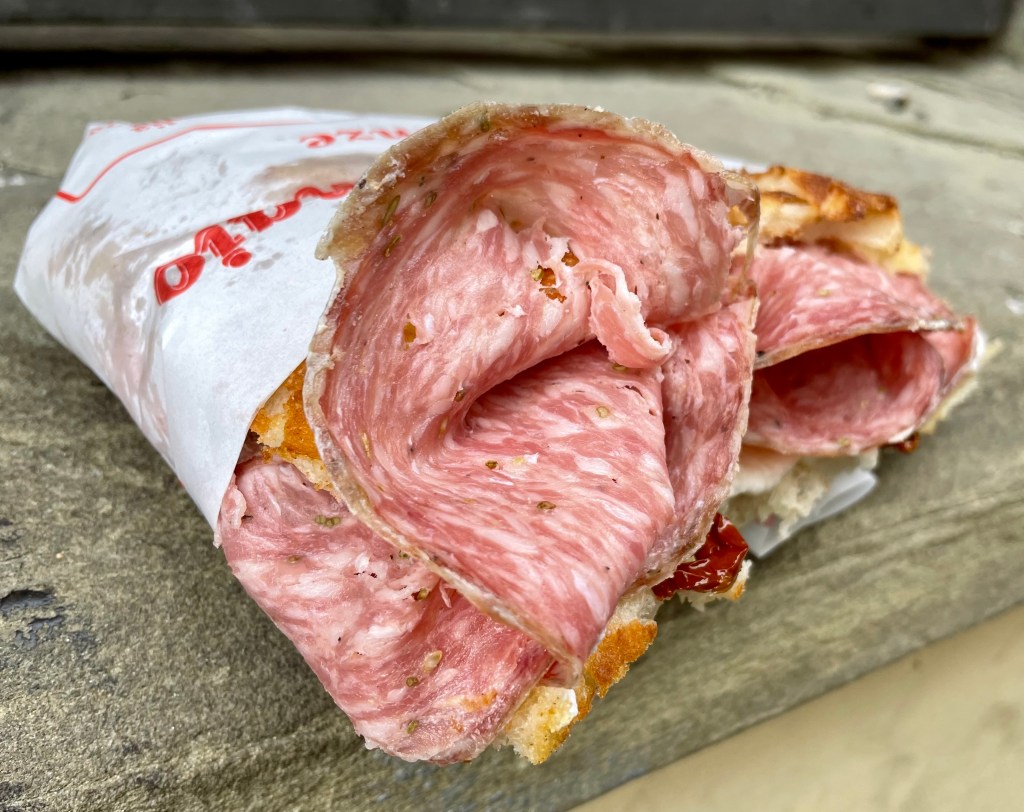
I couldn’t read the big menu board at the sandwich place — Italian and all — but I finally settled on the Firenze for seven euros, or just over seven bucks. The baseball mitt-sized meal consists of six heart attacks worth of salami, creamed parmesan and sun-dried tomatoes, stuffed between thinly sliced focaccia. It was fantastic, popping with flavor, and totally unfinishable. The pigeons had a frenzied feast.

The night’s meal is typically the highlight of the day and must be meticulously researched. For dinner I went to an old-school trattoria — defined as an “Italian restaurant serving simple food” — that ratings aggregates go gaga for. Even Michelin backs this joint. It was fine, but mostly wound up being overrated by dint of its noble, been-there-forever history. The giant glass of house wine was a plus at a meager four euros. I maybe eat one or two steaks a year and I ordered a sirloin (Florence is famous for superior steaks) and a seven-euro salad that was actually a few floppy, naked leaves worth about 15 cents. 

The steak was solid, but it dawned on me: As yummy as they are, steaks are like pancakes — they get boring about half-way through. I was glad I didn’t get a true “Florentine” steak that so many diners got and chewed on for like an hour. Those meats are the size of the cut from the opening credits of “The Flintstones,” a slab so big it tips over Fred Flintstone’s car.

As far as Florentine greatest hits, the other day I visited the awesome 17-foot-tall marble nudist David, by Michelangelo. I didn’t mention it before, but here’s a peek (it’s almost obligatory, isn’t it?):

Getting there is half the battle, but so worth it

It’s a blinding blue 60-degree Monday in Florence, Italy, and I just about broke my neck slipping on a yellow glob of melting gelato on the sidewalk. Except for the fact that I almost became a paraplegic, I will not complain. 

See, this happened a block from my hotel, which — both boon and bane — is plumb in the fluttering heart of the ancient Renaissance city center: the Duomo, Medici Museum, Academia, Uffizi, and I’ll stop before this embarrassment of riches makes me flush. I say bane because it’s teeming with bodies — though, from what I gather, most are locals; they’re speaking Italian and looking stunningly chic. Locals are good, even local tourists. They almost always make a journey better. Fellow American tourists? Meh.

Yet I’ve only been here an hour, so what do I know? Maybe I’ll get mugged, or pummeled for persistently mispronouncing grazie. Big plans await this week in Tuscany, a region peppered with medieval towns and fecund vineyards and a particular tower with dismal posture. I will tour cathedrals and museums, take day trips to crumbly towns, and sip vino, nectar of the gods (next to bourbon and gin).

An angle of the Duomo, Florence

Getting abroad is always fun for me, ha. I can’t sleep on the seven- to 10-hour red-eyes, and this time I had a delightful layover in Munich, where the short flight to Florence was delayed and my fortitude, eyes and shoulders were drooping gruesomely, Quasimodo-ly. 

Finally we were herded into a standing-room-only shuttle bus and dumped at the bottom of steep stairs leading to a tiny jet. Ascending, I felt like Joe Biden, like I should turn and wave to the press scrum and his half dozen fans.

I had a bad feeling about this winged, rickety rust bucket. When it finally got off the ground, creaking and rattling, I was reminded of a bi-plane, or worse, one of those tiny-tot airplanes you put a quarter in and rock about on the curbside in front of Safeway or Target. 

But we made it, despite the bloody fingernails and crippling jet lag. More on how the hell it’s all going down later. For now, a much-needed cocktail at swooningly classy bar/restaurant/book and flower shop La Ménagère, a stone’s throw from the Duomo:

I’m going, no matter what

Am I getting sick, dammit? Is this portentous throb in my brain the on-ramp to a massive cold? Is that familiar scratch in my throat a tease to a burning ribbit? Do those worrisome pangs in my limbs augur aches across my entire body?

Am I pissed about all this?

Yes, I am!

For one, I hate being sick — and that, reader, is the winner of the most unoriginal statement in the history of the world. 

Two, I have a date. With Philadelphia to be exact. This week. A three-day assignation with some fine art, that’s what it is. And excellent food. And an unapologetic dive bar named Dirty Frank’s. That is correct: Dirty Frank’s

Philly is only two hours away. And there happens to be two art shows worth some time there: “Matisse in the 1930s” at the Philadelphia Museum of Art (the place with the mountainous steps that Sylvester Stallone scales in “Rocky” — and why did I feel I had to mention that?), and “Modigliani Up Close” at the peerless Barnes Foundation, one of my very favorite venues for aesthetic astonishments.

And food. I will indulge in delicious vittles (and drink) at Village Whiskey (burgers, the eponymous hooch, and oodles of class) and The Dandelion, a “sophisticated homage to the British pub.” Last time I was there, I ate right next to a crackling fireplace.

We can’t overlook Dirty Frank’s, that famous cash-only, no-nonsense skank bar just around the corner from my hotel. It’s a neat, neon-splashed, Bud-in-the-bottle joint, replete with a hard-rocking jukebox, darts, pinball and miles of tats. Vice magazine calls it “a gleaming oasis of weird in a town beset by 21st-century slickening that’s always made people its primary business, no matter who those people are.” Word-for-word, my cold seems to fade at that description.

But is it actually fading? My head still thumps, my throat slightly sizzles. It’s time for three more Advils. I got a flu shot in September, so it can’t be the flu, can it? And I’ve had Covid and I don’t have any respiratory symptoms. And yet …

Take it easy, I tell myself. As I gulp down the pills, I toast good riddance to any sick and hello to Matisse, Modigliani — and Frank. Now, as further deterrence, I plop down for a nap. And I dream of Philadelphia.

A few years ago at Dirty Frank’s. The pooch and his pilsner.

The wow of Bilbao

In a fight, Madrid beats Barcelona. That’s my take. I’ve been to both Spanish cities twice now — I returned this week from the capital, Madrid — and conclude that Madrid is the real charmer, the metropolis of less sprawl, less dazzle, less tourists. If it has perhaps fewer bucket-list attractions — despite the marvelous Prado and its trove of Goyas and El Grecos, and Picasso’s overwhelming “Guernica” at the Reina Sofía — it compensates in sheer street-level charisma.   

Madrid is about its distinct, vibrant, supremely walkable barrios, humming with old-world quirks and character. Tapas, flamenco, doggies, blue-chip ham that’s cured for years, wonderful locals, seductive atmosphere. There’s something more intimate, more personal, more special about Madrid compared to big chest-thumping Barcelona. Both are world-class — I do love my Gaudí — but I could live in Madrid.

On another high note, one of my trip’s tippy-top joys was a two-day jaunt to Bilbao, far north in hilly Basque Country. If you know Bilbao, a bustling bayside city of 350,000, it’s probably because of the famous Guggenheim art museum, which is celebrating 25 years as a ridiculously successful tourist magnet.

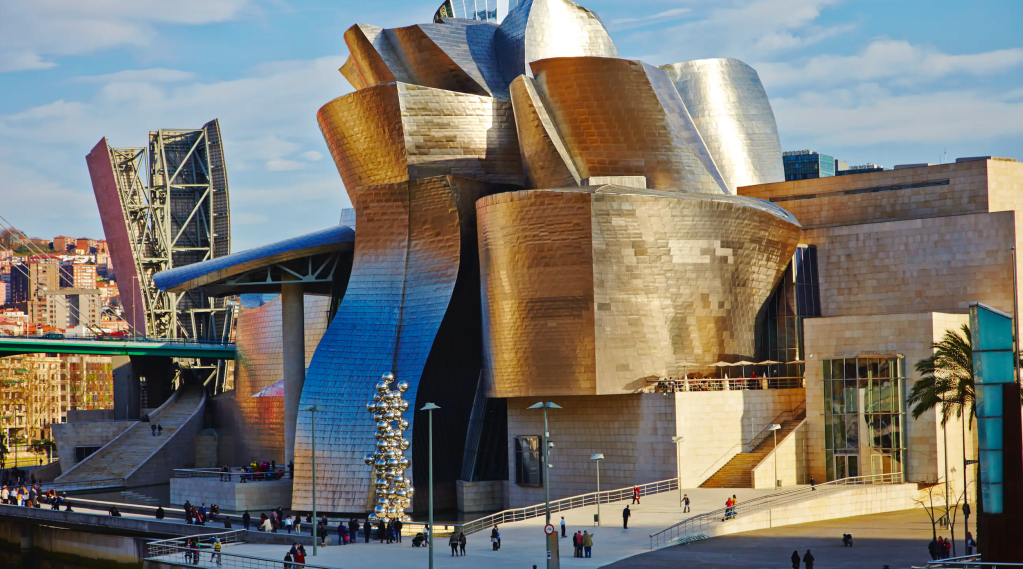
The Guggenheim, designed with playful splendor by architect Frank Gehry, is a shimmering shrine for modern art, from Serra and Rothko to Warhol and Bourgeois. It’s a succinctly curated spread of visual greatest hits, a tantalizing survey that’s intelligently to the point. You leave filled, not fatigued. 

Naturally the Guggenheim’s star is Gehry’s woozy vessel for the art — all shiny, warped grandeur — which is not only gorgeous, but mind-boggling. How does he conjure such elaborate beauty? (Er, genius.) And how in the world was it actually built — by elves and sorcerers? It’s all so breathtaking, a fun, lavish, almost Escherian modern marvel that vaults gawkers into fits of selfie euphoria. 

Here’s a few more angles:

Louise Bourgeois’ giant spider teetering on the museum waterfront.
Inside the museum, Richard Serra’s extraordinary space-bending steel sculptures.

And some shots of Bilbao and Madrid:

Madrid flamenco. So much boot-stomping, hand-clapping, sweat-flying drama. Operatically physical.
Madrid
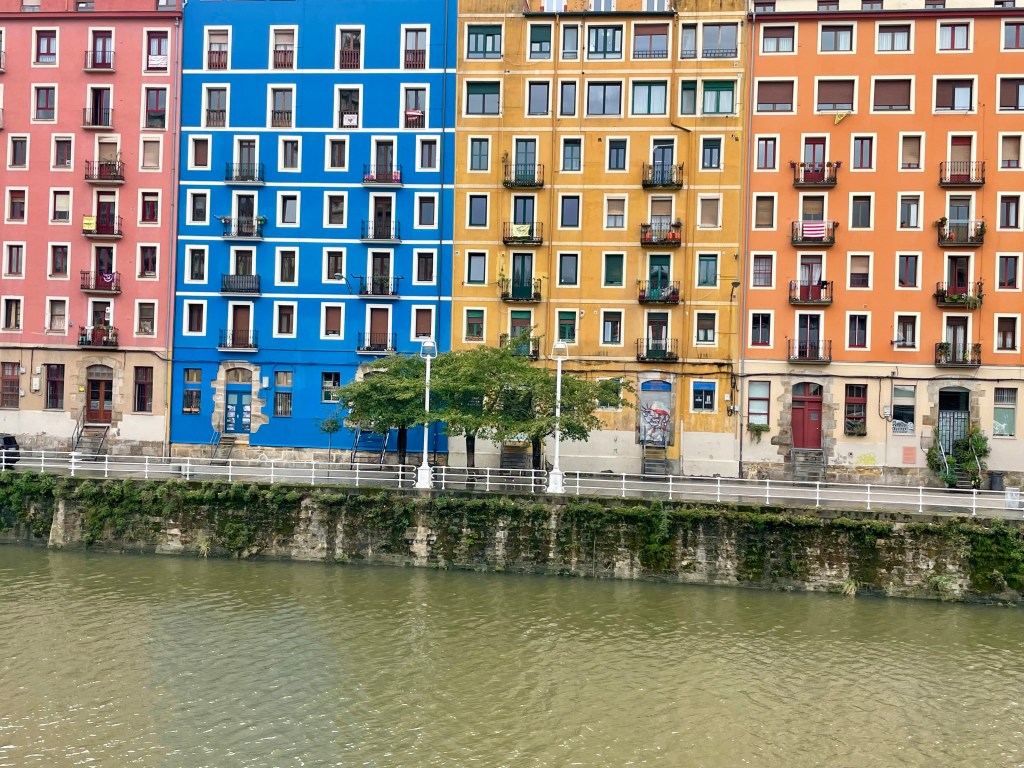
Bilbao
Old Bilbao
Old Bilbao
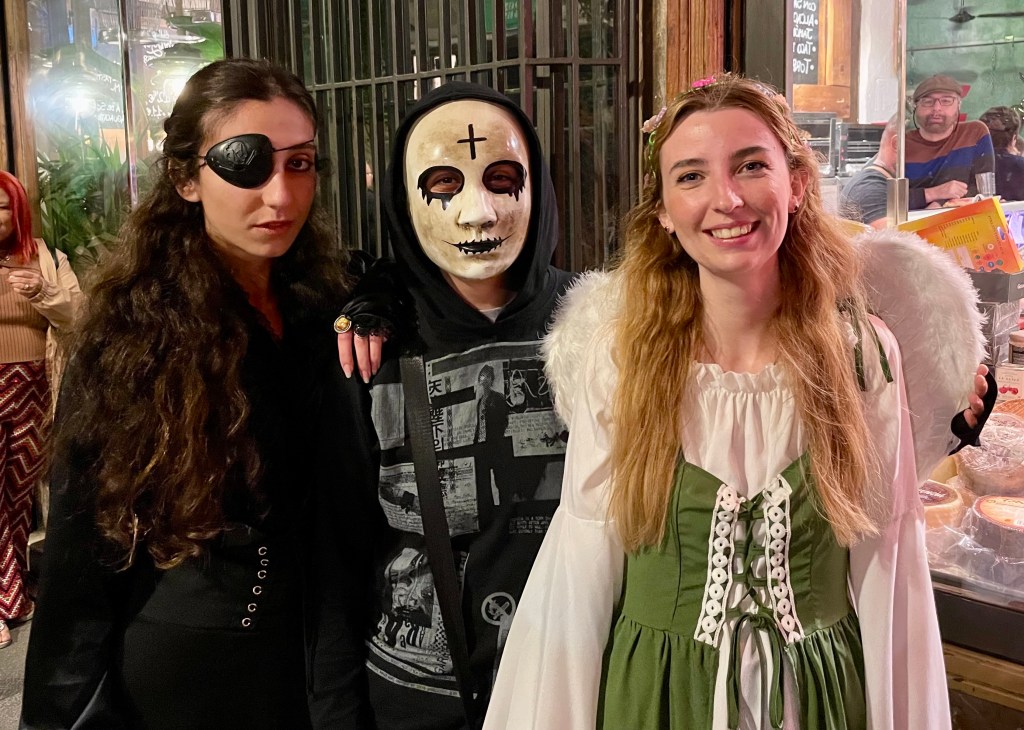
Halloweeners in Madrid (a rare sight)
Street-art dog, Madrid
Real dog, Madrid

Rewards of the return visit

Friends, those kooks, occasionally wonder why I often return to places I’ve already traveled to instead of going somewhere new and horizon-expanding. The answers are simple and numerous. One, obviously, is that I’ve fallen for a city or country and the days I visited were but a tantalizing taste. I want more. To really get under the skin of a place. So I go back.

(It should be said that last week I was enjoying my first journey to Buenos Aires — my first time in South America — so I still seek the exotic and uncharted.)

To return to a destination is also to refresh the original experiences that made it special and to caulk the holes of crumbling memory. Right now I’m considering a revisit to Madrid, Spain, where I went like 20 years ago. That trip is a fond haze.

Besides Picasso’s gobsmacking “Guernica” and the gems of the Prado Museum — I’m specially partial to the wackadoodle Bosch triptych — I remember only a convivial Irish pub where I met some fun locals and a whiplashing green rollercoaster on the city outskirts. It didn’t even seem to be part of an amusement park, just this stand-alone adrenaline machine amid the trees. Anyway, it was a blast. 
So I’m mulling Madrid for my fall trip, with a three-day excursion north to Bilbao, which is famous mainly for its warped and woozy Frank Gehry-designed Guggenheim art museum but has, since the museum’s opening in 1997, blossomed with attractions and an arty, edgy personality all its own.

Guggenheim Bilbao

I’ve yearned to go to Bilbao for at least 15 years, but you don’t just go directly to the city, you typically go through a hub like Barcelona or Madrid then trek north by train to Spain’s autonomous and beautiful Basque Country.

Thus I’m piggybacking a new place with a place I’ve been before, but both should be rejuvenating and illuminating, since, as I said, my memories of Madrid are a scintillating smudge. 

This happens. I went to Rome in March and even though I had been there twice before, it was changed as much as I’d changed in the intervening years. Same with my January visit to Lisbon. I recognized much of the city, but it was also strikingly novel, a whole new world. It’s about layers: each visit peels back exciting ones, those you didn’t see or didn’t have time for the first go around. Discovery is fathomless.

And this is from someone who journals copiously and snaps photos like a paparazzo. But those mementos are static, mere documents, like a map or a postcard. Throbbing, breathing life is the aim, so, yeah, it’s time to go back.

Getting to the meat of Buenos Aires

I think I got swindled in the land of steaks. Here I am in Buenos Aires, which bulges with unrepentant carnivores who adore their burgers, steaks and sausages, and I thought I’d try the quintessential meat experience at legendary parrilla, or grill, Don Julio. No meat maven, I’ve only been to a steakhouse maybe twice in my life (that’s including the Sizzler). Perhaps I fell victim to culinary naïveté. 

The place and service were impeccable, if a bit frenzied, and I loved where they sat me and how I was treated in the classy, rustic setting. I ordered the basic ribeye, a side of mashed potatoes and one glass of Malbec wine. I swallowed it down. 

What I choked on was the check, which came to $155 US — for three items, pre-tip. It was my second night in Argentina and I hadn’t figured out the exchange rate and the check came in pesos, so I really couldn’t tell what I was paying until I examined my debit card statement back at the hotel. Was that a $125 steak, I keep wondering. Or a $50 glass of wine? Or, erg, $75 mashed potatoes? (Dummy that I am, I didn’t keep my receipt. I rarely do.)

Despite being slightly miffed — the meal wasn’t that great — I’m over it, and the mishap is but a faint bruise on a smashing trip. 

A metropolis of unvarnished beauty and unfailing hospitality, slathered in eye-popping street art and graffiti, teeming with leashed dogs that provide stereophonic barking and plagues of poop, Buenos Aires is a great cobblestoned colonial melange of Spanish, French and Italian — a splash of old New Orleans — that’s exhilarating in its swirling Euro-diversity. (For all that, I have to say how perplexing, and distressing, it is that in six days here I have literally seen only two Black people.)

There’s time left on the journey, but for now these are some snapshots, beginning with the offending but delicious $teak:

A trip that’s up in the air

This is the book I just ordered:

Big and bold it announces “Buenos Aires,” and you can gather from it that Argentina’s capital is in my sights for my next destination. The nerve, the gall, you might huff, considering I got back from Italy a mere four days ago. But see, I’m a greedy globe-trekker, scheming my next move on the plane back from my latest journey like a cheating lover. 

Buenos Aires wasn’t on my bucket list. Though I almost went years ago, I’ve never been to South America. As I was decompressing after my flight home from Rome, I was chatting with a woman, a friend of a friend, whose entire life is an unbroken blur of world travel. She asked where I was off to next and I had no answer. I really didn’t know. I just knew it would happen in the fall, my prime travel season.

I told her I never travel in the summer because of the heat and the crowds, and she, a veteran of Argentina, suggested Buenos Aires. Below the equator, our summer is their winter, of course. I could go in July and luxuriate in 59-degree temps in a jacket and jeans. And it’s the off-season, so crowds are thinner and prices cheaper. I was on my computer researching the city within minutes. 

I was taken. Infused with Spanish, Italian and French colonial influences that lend it a lusty European sheen, yet still boldly Latin, the city of 13 million people is famed for a dizzying eclecticism that runs from its architecture to cuisine, including ubiquitous beef steaks and flowing Malbec. Street art animates facades, baroque cemeteries lure the living, and, if you’re into it, clubs smolder with tango. (I’ll watch the dance, but not partake, lest I cause an international incident.)

It’s all enticing until you shop for flights, which run a stroke-inducing $1,200 to $1,300 in July. Argentina also requires you to buy travel insurance to cover any hypothetical Covid treatments. That’s in addition to a negative Covid test, proof of vaccination and some other minor paperwork. 

That’s the downside. The upside is stylish and affordable boutique hotels (I already have one picked out), 15-minute taxi rides costing $2.50 USD, dinner with a full bottle of wine for $10, free museums, jumping cafe and bar cultures and, by most accounts, loopy, lively people. I’ll tell you more when my book arrives. 

Buenos Aires is Spanish for “fair winds” or “good air,” and isn’t that nice. It’s not certain that I’m going there; I’m thick in homework and investigation. I’m vetting this city that seems magnificent on paper, and might be even more so in the flesh. I’ll see where those fair winds carry me.

P.S. If you don’t think I’m already pondering my fall voyage, you are grossly ill-informed. Scotland? Iceland? Poland? Peru?

Italy finito, beautifully

As I write this, 35,000 feet in the sky on a jet back to the States from nine fine days in Italy, I’m swollen with that cruddy reverse homesickness in which you miss the place you visited instead of your actual home. Rome and Naples were wonderful and I wasn’t ready to leave and I wanna go back. I’ve got the home-bound blues.

Still, my last rueful day in Rome was brilliant, quite literally — balmy mid-60s, cloudless, cerulean skies, sunglass weather. The kind of conditions that make people dress way too skimpily for the actual temperature. I was perfect in jeans, a light jacket and t-shirt. The guy in the short-shorts and tank top, not so much. 

Especially if he wanted to get into the Pantheon, the almost 2,000-year-old Roman temple turned Catholic church, where modest dress is a must. Leaders, popes and artists, including Raphael, are buried in the cylindrical building, which is famous for its oculus (or big hole) at the tip of its dome, shooting down a thick beam of sunlight like a celestial Bat-Signal.

Our lovely tour guide in Naples told us he gets chills whenever he enters the shrine. I did not get chills, but I was aptly awed by the ambient beauty and unimaginable feats of engineering. So often in Italy, if you regard your surroundings for just a moment, astonishment floods in and you wonder what hit you. It’s called the sublime.

I didn’t care if I found it or not, but fate planted an unmistakable sign in front of me — a literal street sign — so I ambled over to the vacantly majestic Trevi Fountain, where mugging selfie dolts and preening sun-worshippers congregate on days like this, as if Nicola Salvi’s pompous 1735 fountain is a swimming pool or the beach and not just a glorious repository for Bernini-style sculpture. I do respect this extravagant splash machine, but it’s a brief pitstop, not a gawk spot, despite its iconic role in Fellini’s “La Dolce Vita,” a personal favorite. 

A local beer, a prosciutto and mozzarella sandwich, and a cappuccino later, I headed to the Vatican for a guided tour of the Vatican Museum, a riot of artistic riches. Our tour guide barely made it on time, and my mood was starting to curdle. But she materialized at last, a petite Italian who used a plush Woodstock doll dangling from a stick in lieu of the boring old tourist-group flag for us to follow amid the crushing, claustrophobic crowds (many of them terrible teenagers, lolling, laughing and leering). 

She gave each of us little radios with ear buds so we could hear her literate narration of highlights in the museum. But the contraptions were on the fritz, all buzz, fizz and crackle — sonic flatulence that drowned out her spiels about each grand piece of art, from writhing statues of men and lions and Raphael’s “The School of Athens,” to the visual commotion of Michelangelo’s peerless Sistine Chapel ceiling. The works spoke for themselves.

As we finished, I asked the guide for the nearest taxi line, and she warned me to be careful with them, that they quote outlandish prices and don’t use the meter. And so it was. I approached a driver and told him my address and he promptly said it would cost 40 euros because of, you know, that zany Tuesday traffic. I scoffed and said, “You’re crazy,” and he responded, “You’re crazy.” Genius.

I hailed a passing cab, got in, and paid 14 euros back to my hotel, where I wound down, went out and ate pasta, sipped wine, and, reflecting on the past nine days, sighed: perfetto. Which in English translates simply as: damn

Roamin’ Rome

Monday, shaking off a sleepless redeye flight and some wretched jet lag — both cruel and not recommended — I strolled around my hotel neighborhood in Rome, which sits in the shadow of the Colosseum, that 2,000-year-old stadium of sport and slaughter. (I’d tell you about the tour of it I was signed up for, but I was turned away because I wasn’t carrying my Covid vaccination card — since I was expressly told I wouldn’t need it — and that’s a lesson learned. I think I handled it well. I stormed off in a hissy.)

I hit a wine shop and picked out an eight euro bottle of red, then walked some more and stumbled upon two crumbling basilicas of God and grandeur. Naturally they’re festooned with stunning artwork, from grim statuary to crackling frescoes that make the shrines vibrant museums in their own right. Cool and dark, they emanate that dank churchy smell that’s as singular as old books. I wish I could bottle that funky perfume. 

My brother came a day later, Tuesday, and we’ve been strategizing for weeks about what to eat in Rome and Naples. The cities are lousy with pasta and we’ve vowed not to settle for only that and the ubiquitous pizza. Our sights, and bellies, are set on fresh seafood, veggies (eggplant parmigiana, thank you), charcuterie, risotto, roasts and more from the Italian smorgasbord. I plan on gaining 75 pounds. Tonight is the cutting-edge Osteria Fernanda — creatively plated, self-consciously contemporary Italian food — and I expect nothing less than the orgasmic …  

Several hours and a nine-course tasting menu later, we are sated. And euphoric. It’s the kind of feast where your eyes roll back and superlatives involuntarily pour out at each course, like the “eel with marinated Campari vegetable, acid rice sauce, soia and umeboshi” or the “venison cannelloni with black cardamom and forest wine.” It sounds fussy — I can barely pronounce some of the ingredients — and it is. But sometimes you have to go for it. We did and the rewards were golden.

I’m leaving a lot out — the churches, the museums, the astonishing new Ai Weiwei sculpture, suspiciously inexpensive sushi and a fall-apart sandwich seemingly made half of mayonnaise — but I have a question to ask: Where are all the bars in Rome? 

Try as we might — our efforts are bold and valiant — we cannot locate a single bar bar for a simple nightcap. Wine bars are plenty and some touristy eateries offer trendy cocktails, but where do you get a neat Scotch in this burgh? It’s a conundrum we plan to unravel. It’s getting serious. 

We finally asked a taxi driver about this and he said, “Rome is a museum. It’s not Milan.” And we laughed knowingly. When we got to our hotel we went to the itty-bitty “bar” there and each ordered a neat Scotch. We still have sleuthing in our plans. We go to Naples on Thursday, then back to Rome, which has some ‘splainin’ to do.