In defense of death

A new book is out and contains a passage that provides a frisson of happy recognition: 

“The human cannot abide the thought of death … Most people aren’t wrestling with dread so much as trying to ignore a chronic background anxiety.”

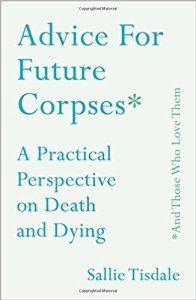
This comes from Sallie Tisdale’s windily, and wittily, titled “Advice for Future Corpses (And Those Who Love Them): A Practical Perspective on Death and Dying.” It’s a slimmish, scintillating book, pimpled with wisdom and knowledge from the stance of a professional thinker, steadfast Buddhist and registered nurse — a trusty troika.

41Td+RX8QDL._SX324_BO1,204,203,200_

But why does that quote sing? As I’ve touched on in prior posts (like this one), we are the whopping deniers, gymnastic dodgers, when it comes to confronting or even thinking about death. We know it’s there, lurking in the gloom of the collective id. Most people, as Tisdale says, are “trying to ignore a chronic background anxiety.”

I find this absurd and annoying, because I wonder: How, on a daily basis, does one not consider their inevitable, totally inescapable and at once entirely unpredictable (how and when will you die?) and completely predictable (you’re gonna die!) mortality?

“Advice for Future Corpses” examines that idea with a graceful, empathetic touch and it adds to a mini-mountain of mainstream literature about dying that includes Atul Gawande’s mega-hit “Being Mortal: Medicine and What Matters in the End” and Cory Taylor’s “Dying: A Memoir,” to name just two.

Why this death-book boomlet? Because lots of us are understandably freaked about the fearsome finality. (At least those who even consider it.) For one, people are living longer than ever and we find ourselves taking care of aging, often incapacitated parents and relatives. Death is in our face. And still, so many look away.

IMG_0599
Brompton Cemetery, London, 2017

Call me sick. Tisdale quotes William James on two personality types: the “healthy-minded … with its strange power of living in the moment and ignoring and forgetting,” and the rest, the “sick souls” who cannot blot out the naked prospect of mortality. Yes, a sick soul am I, but also enlightened, awakened and aware that our flimsy, fleshly bodies will someday fail us and atomize to dust.

I’m a nervous type so the fact that I look death in the eye doesn’t mean it’s a steely gaze. I lose that staring contest every time. Death scares me, even if, as I believe, it’s one big great nothingness — no heaven, no hell, no paradisiacal virgins — and we shouldn’t be scared of nothing. Yet the unknown is killing us, so to speak. Its foreverness terrifies.

Tisdale writes: “The psychiatrist Irvin Yalom describes the ego facing extinction as being ‘staggered by the enormity of eternity, of being dead forever and ever and ever and ever.’”

Totally.

“At some point,” Tisdale says, “most of us shift from realizing that sooner or later some future self will die to realizing that this very self, me, precious and irreplaceable me, will die. It’s a terrible thing to grasp, and though this insight may last a mere second, it changes your life.”

Her breadth on the topic dazzles. She addresses both sides of death-phobia (terror vs. liberation), our response to death (unalloyed grief), the certainty that we will die, the notion of the “good death,” personal anecdotes such as her dying friend shopping for biodegradable coffins and shrouds, and Zen-worthy declarations like “cremation can have a kind of stark beauty.”

She naturally can’t get to the bottom of it — death’s mystery is all-engulfing, impenetrable, the Big One — but her Buddhist-nurse compassion touches every page and she sheds copious slats of light into our shared abyss. My favorite citation comes from a dying Rabelais, whose last words were: “I am going in search of a great perhaps.”

The beauty in that is bottomless.

img_0601.jpg
Brompton Cemetery, London, 2017

The euphoria of traveling alone

This was a mistake: I once told a female friend to go ahead and meet me in Tokyo when I went some time ago. She was excited. Then I wrote in a blog that she shouldn’t be too excited because I need my space, that I, huh-hum, walk the Earth alone. This did not go over well. This was unmannerly. And dumb. Whatever. It was true.

2015
Louvre, Paris, 2015

Decidedly, defiantly, I am an incorrigible solo traveler. Occasionally I’ve traveled to Europe or somewhere in the States with a gal pal, but 99-percent of the time I’m a one-man production. Two weeks in Japan. Three weeks in India. Two weeks in Turkey. Ten days in Paris. Do I get lonely? Rarely. Embracing solitude and deflecting loneliness is an art form, and, done right, it’s invigorating.

Last fall, I wrote here about loneliness vs. solitude: “My own skin doesn’t fit well. Which means comfort among others doesn’t come easy. Traveling, I love to read in cafes, scribble in journals in bars, roam streets, cathedrals and cemeteries alone, without the nattering of companions. I move to my own beat …”

41glx2w8k7l-_sx329_bo1204203200_

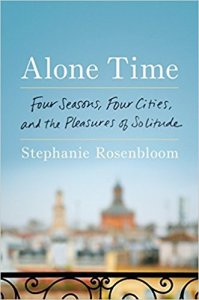
So I am gladdened by the new book “Alone Time: Four Seasons, Four Cities, and the Pleasures of Solitude” by journalist Stephanie Rosenbloom. Not only are the four cities she explores — Paris, Istanbul, Florence, New York — some of my absolute favorites, but her experiment in solitary travel is of course immensely attractive.

Despite spending undue verbiage defending solitude — feebly citing scientists, psychologists and philosophers who rail against the social stigma of aloneness, as if it’s some zany pathology — Rosenbloom says that solo travel is surging, and, a fine reporter, she provides the stats.

In a time when everything is socially entwined and extravagantly networked, the hunger for alone time is greater than ever, be it a solo trip to a movie or a solo trip to Morocco. I habitually go the movies alone, just as I unfailingly globe-trot untethered. As Rosenbloom learns, such excursions are steeped in rare splendors, from the placidity of eating alone and truly savoring a meal to the transformative power of focusing on the present moment.

“Alone, there’s no need for an itinerary,” she writes. “Walk, and the day arranges itself.” One can be “curious, improvisational, open to serendipity.”

BLUE 2008.jpg
Blue Mosque, Istanbul, 2008

As when I spontaneously tooled through the fairy-tale hills of Cappadocia, Turkey, on a rented Vespa, or stumbled upon the ritual slaughter of sacred rams in a mosque abattoir in Istanbul, or visited an orphanage for critically ill children in Siem Reap, Cambodia, or, most harrowing, got myself detained by Hezbollah goons in South Beirut. And of course there are countless cordial encounters and forged friendships among fellow travelers and locals that organically blossom, and often last.

Rosenbloom had a plan: visit Paris in springtime, Istanbul in summer, Florence in autumn and New York, her hometown, in winter. Except for New York, she was only in each city for up to one week. Her aim was to peel back the delights of traveling alone in exemplary locations, ones awash in food, architecture and art, revealing how fine it can be to be unhurried, “accountable to no one,” exhilaratingly free.

The upshot is part vivid travelogue and vague memoir, filigreed reportage and free-floating opinion. “Alone Time” doesn’t provide the stunning personal epiphanies and life-altering experiences of Elizabeth Gilbert’s classic “Eat, Pray, Love” (nor the luxurious prose). It’s more a practical guide, a how-to on solo travel, including an epilogue, “Tips and Tools for Going It Alone.” (Though I had to roll my eyes at a few sections, like this one: “How to Be Alone in a Museum” — really?) She offers some gauzy instructions, like how “to be open to wonder,” which, actually, is much easier than you think.

Rosenbloom, diehard journalist, is wed to her sources, so that her rigorous apologia for eating alone comes with too many testimonials from psychologists and the like, bogging down what modest narrative thrust there is. I wanted to blurt out: “Eating aloneJust do it! It’s entirely fine and easy and acceptable. You don’t need a sheaf of Ph.D studies to validate this primal pleasure.”

For this introvert, whose two favorite cities happen to be Paris and Istanbul, “Alone Time” is a mild affirmation that my travel habits might have universal appeal, something I kind of already believed. Solitude -— not loneliness, which must be fended off —  is a source of power and creativity, great assets while on the road.

2010.jpg
East River, New York City, 2010

As I wrote last fall: “In solitude one reaps energy from oneself. You create your own space on your own terms, with your own powers, cultivating your mind, with the option of joining the wide world at anytime. Great freedom defines solitude. It’s the incubator of creativity and art. It’s the locus of self-communion.”

Rosenbloom, who began her physical journey and spiritual awakening in the City of Lights, sums up with characteristic pragmatism and admirable ambition: “My aim wasn’t to master Paris. It was to master myself: to learn how a little alone time can change your life — in any city.” And there she nails it.

The acrid bite of literary realism, in brief

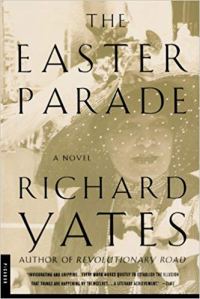
Realism rules. Consider the first 10 words in Richard Yates’ novel “The Easter Parade”:

“Neither of the Grimes sisters would have a happy life”

Sting, sizzle. 

This opener is massively effective. Knifelike, it plunges into the story, ducking preliminaries or decorous setups cluttered with background frills and bunting. Before we’ve even met the protagonists we are told in the chilliest terms how things will unspool for them tonally, if not dramatically. It’s a great entrance, pungent, punchy.

51N-fpgePTL._SX331_BO1,204,203,200_

I broach this because I’m half-way through “The Easter Parade” and its satisfactions are abundant, much like those in Yates’ corrosive classic of marital dissolution “Revolutionary Road.” That masterpiece of American realism is fiction with fangs, casting an unsparing eye on mainstream domestic rituals.

And it’s part of a 20th-century literary tradition, stories and novels, mostly by male writers, that scrutinize the age of anxiety, explicit sex, cynicism, malaise, regret, envy, jobs, kids, homes, husbands, wives, lovers, losers, drunks, the city and the mirage of the white suburban dream.

Highlights in this unofficial canon of realism include: Yates’ “Revolutionary Road”; Philip Roth’s “American Pastoral”; John Cheever, Ann Beattie, Raymond Carver and Tobias Wolff’s unflinching stories; James Salter’s “Light Years”; John Updike’s “Rabbit” tetralogy; Richard Ford’s “Bascombe” trilogy; and so many more.

51dfJ7pwjDL._SX331_BO1,204,203,200_

Disillusionment, loss, heartbreak and disappointment are fragrant themes of these authors. But strangely the stories don’t feel forlorn. They almost feel consoling, perversely empathic — even when the human condition is laid bare and loneliness, our worst fear, takes hold.

”If my work has a theme,” Yates said, “I suspect it is a simple one: that most human beings are inescapably alone, and therein lies their tragedy.”

These realists serve up banality without bathos, unnerving wisdom in unfussy, largely conventional language. They are bleak and blunt, sometimes cruel in their honesty.

A (bitter) tasting:

“The hell with this aching, suffering, callow, half-assed delusion that he was in ‘love’ with her. The hell with ‘love’ anyway, and with every other phony, time-wasting, half-assed emotion in the world.”  — Richard Yates, “Revolutionary Road”

“He had learned the worst lesson that life can teach — that it makes no sense. And when that happens the happiness is never spontaneous again. It is artificial and, even then, bought at the price of an obstinate estrangement from oneself and one’s history.” — Philip Roth, “American Pastoral”

“She perceived vaguely the pitiful corruption of the adult world; how cruel and frail it was, like a worn piece of burlap, patched with stupidities and mistakes, useless and ugly, and yet they never saw its worthlessness.” — John Cheever, “Stories of John Cheever”

“There is no complete life. There are only fragments. We are born to have nothing, to have it pour through our hands.” — James Salter, “Light Years”

“Any time spent with your child is partly a damn sad time, the sadness of life a-going, bright, vivid, each time a last. A loss. A glimpse into what could’ve been.” — Richard Ford, “Independence Day”

51aBkOQUbQLThese are acid words. They are tough and unsentimental. I gravitate to them, and I can’t recommend them enough. They are beautiful. In them I locate unembellished truth. I’ve lived a little (Christ, I’m starting to sound like a grizzled cowboy) and none of these sentiments rings false or fabricated. They sound snipped from life in all its tarnished glories and burnished failures, and it is intoxicating.
Having a ‘Good Time’? Me too.

Finished Tommy Orange’s debut novel “There There” — terrific, explosive — and I’m now onto Amie Barrodale’s arch short stories “You Are Having a Good Time.” After just a few of these fun-size fictions, I am firmly in the book’s thrall. The title alone thrills me a little.

41glx2w8k7l-_sx329_bo1204203200_

I am glad I’m reading “You Are Having a Good Time,” because I am indeed having a good time. But frankly the stories are a lucky place holder for a book I’m waiting to arrive, “Alone Time: Four Seasons, Four Cities, and the Pleasures of Solitude,” by travel journalist Stephanie Rosenbloom.

The book is about her year traveling solo in Paris, Istanbul, Florence and New York — four of my favorite cities, especially the first two — and all that she loved, loathed and learned basking in that life-expanding mode of emancipated alone-hood. I’m an inveterate solo trekker enamored with the places she visits, so Rosenbloom and I might have a lot in common.

10MANCUSI-superJumbo
Amie Barrodale

For now, Barrodale’s “You Are Having a Good Time” is a gratifying off-kilter kick, a spasm of spare, elusive, funny tales that are touched by mystery, an alluring unknowability. With cavalier irreverence, she throws a strobe-light on aberrant facets of the human condition.

Barrodale conjures “stories that don’t behave as you expect stories to behave,” notes the book flap. “Beautiful or Grotesque?” asks the headline on a review of the 2016 collection.

Or there’s this review headline: “Stories Exploring the Misguided, the Unrequited and the Mortified.” That review concludes: “None of these stories explain themselves willingly.”

That is true. Take “The Imp,” in which a possible ghost upends the relationship of a man and his pregnant wife. A tarot reader is involved. Or the bleakly comic “Night Report,” which follows a troubled woman to a New Age mountain retreat where she breaks down and declares, “I wish that I were dead. I’m heartbroken, and if I had a gun I would use it. … I’d shoot Eve. Thank you. I’d shoot Eve in the chest.”

Then there is “Frank Advice for Fat Women,” which opens with a dry, quizzical flourish: “A woman who was lonely and depressed should begin by getting on some medication. She should clean her house and throw away clutter. After that, Dr. Sheppard told his patients to lose weight and wear dresses.”

Her eye for detail is keen: “The restaurant was empty except for a guy at the bar. He was a little chubby. I could tell he was single because he was wearing white tube socks with black dress shoes. His jeans were too tight on him. I don’t mean that he had on skinny jeans. I mean that he had on jeans that were two sizes too small, and he was uncomfortable. He kept squirming, fooling with his phone. …  Outside, through the window, I saw an old guy stop under a tree, pull down a branch, and smell a flower.”

On love: “Being torn apart is what a relationship is. So don’t be afraid. Play the game.”

The stories groove to mercurial rhythms, and sometimes seem to bear a torch, in search of a point. They withhold facile answers and spurn tidy bows. They’re fun like that, and funny. They are dark, but giddy.

51XyTyEIp7L._SX331_BO1,204,203,200_

Barrodale’s stories — this is her only book — are a cousin to the blithely jagged fiction of Ottessa Moshfegh, who’s an avowed fan. “It’s one of my favorite books,” she recently said. “Like (Michael) Ondaatje, Barrodale makes me hold my head and ask, ‘How?’”

Moshfegh shouldn’t be too envious. She’s the better writer, more probing, bolder, weirder. But Barrodale is a force, an alchemist of the odd, fabricating devilish modern tales that totter your balance and leave your mouth dry.


A quote on confidence

I‘m reading “There There,” the smashing debut by Tommy Orange, and it’s a novel of ambient beauty as well as a penetrating portal into urban Native American culture. It’s a world at once broken, squalid and, by the skin of its teeth, empowered. The writing swings, crackling with observational fire. This aside about a young woman’s curdled confidence oddly hit home, like a lightning jag. It throbs with truth and woe.

“Something she always notices is how much confidence and lack of self-doubt people have. Take Harvey here. Telling this terrible story like it’s captivating. There are so many people she comes across who seem born with confidence and self-esteem. She can’t remember a day going by when at some point she hadn’t wished she could burn her life down.”

9780525520375

Cutting to the core of creativity

I’m reading two books right now: “Kudos,” the mesmerizing new novel by Rachel Cusk, and the non-fiction treatise “The Creative Habit” by celebrated dancer-choreographer Twyla Tharp.

418cPmaavEL

The former is a whole-cloth original, narrative-defying, discursive and brainy, like the two previous books in Cusk’s Outline Trilogy, “Outline” and “Transit,” of which “Kudos” is the ravishing finale. Challenging and unorthodox, the seemingly autobiographical novels crack open your mind in a furiously fresh manner. They evoke Karl Ove Knausgaard’s rambling “My Struggle” series but are more rigorous, compressed, and chewier.

Catching my breath, I’m really here to dwell on Tharp’s self-described “practical guide,” whose full title is “The Creative Habit: Learn It and Use It for Life.” I’m a sucker for eloquent lessons on creativity and the artist’s way, including, yes, “The Artist’s Way” by Julia Cameron, “The Sound on the Page” by Ben Yagoda, “Bird by Bird: Some Instructions on Writing and Life” by Anne Lamott and “The War of Art” by Steven Pressfield. These books possess transformative powers, tweaking your creative habits just so, massaging your brain to look at the blank page or canvas with a kind of nervous optimism instead of paralyzing dread or clogging trepidation. They are weighted with wisdom.

twyla-tharp-the-creative-habit.jpg

Tharp, a paragon of her art form, knows of what she speaks, and she speaks it plainly and persuasively, with little decorative dressing but plenty of panache. She’s a beneficent, caring lecturer, and the book, breezy and empathetic, bulges with sticky, pragmatic advice. Quick: “In order to be creative you have to know how to prepare to be creative.” Or: “There are no ‘natural’ geniuses.” That’s in the first nine pages, and somehow I find these statements awfully encouraging. 

She digs much deeper, with infectious enthusiasm. Using hard-earned lessons from her own work methods and creative processes in ballet and presenting instructive anecdotes about artistic challenge and triumph among such underachievers as Mozart, Beethoven Richard Avedon, Balanchine and Maurice Sendak, Tharp casts a wide net showing how happy accidents, preparation and luck (those are Siamese twins), ritual, archiving and mineable memory are critical components of productive creativity. (She also includes some loopy exercises that I didn’t have much use for. One required a bunch of eggs.)

Flipping through this clean, handsome, none-too-big book I plucked a few quotables:

“The first steps of a creative act are like groping in the dark: random and chaotic, feverish and fearful, a lot of busy-ness with no apparent or definable end in sight. There is nothing yet to research. For me, these moments are not pretty, I look like a desperate woman, tortured by the simple thumping away in my head: ‘You need an idea.'”

“Another trap is the belief that everything has to be perfect before you can take the next step. You won’t move on to that second chapter until the first is written, rewritten, honed, tweaked, examined under a microscope, and buffed to a bright mahogany sheen. You won’t dip a brush in the paint until you’ve assembled all the colors you can possibly imagine using in the course of the project. I know it’s important to be prepared, but at the start of the process this type of perfectionism is more like procrastination. You’ve got to get in there and do.”

“The best writers are well-read people. They have the richest appreciation of words, the biggest vocabularies, the keenest ear for language. They also know their grammar. Words and language are their tools, and they have learned how to use them.”

“There is no one ideal condition for creativity. The only criterion is this: Make it easy on yourself. Find a working environment where the prospect of wrestling with your muse doesn’t scare you, doesn’t shut you down. It should make you want to be there, and once you find it, stick with it. To get the creative habit, you need a working environment that’s habit-forming.”

“Jerome Robbins liked to say that you do your best work after your biggest disasters. For one thing, it’s so painful it almost guarantees that you won’t make those mistakes again. A fiasco compels you to change dramatically. The golfer Buddy Jones said, ‘I never learned anything from a match I won.’ He respected defeat and he profited from it.”

“These mistakes — relying too much on others, waiting for the perfect setup, overthinking structure, feeling obligated to finish what you’ve started, and working with the wrong materials — are deadly. Any one of them will undermine your best efforts.”

“Whom the gods wish to destroy, they give unlimited resources … Limits are a secret blessing, and bounty can be a curse. I’ve been on enough big-budget film sets to appreciate the malignant influence of abundance and bloat.”

“You might not struggle for spine. You might be content to receive any random thought floating through the ether that happens to settle on you that day. You might think you don’t need a supporting mechanism for the art you’re constructing, a controlling image, a collateral idea to guide you. You might think getting lost is a big part of the adventure. You may think that, but you’d be wrong.”

More highly finicky reading

I’m the worst. I’m impatient. I’m mean. I’m discerning. I have taste. When it comes to books, I am ruthless. I’m even worse with movies. Most don’t stand a chance.

I have put down four books, closed them for good well before the 100-page mark, in the past two and a half weeks. Suffused with sorta-guilt — ah, not really — I swan to the next book, hoping for gems and genius. I am an optimist garbed as a very dark pessimist.

Mining this small stack I located gold — the books are by literary heavyweights, after all, and they do often gleam — but I also found fool’s gold, which I will not abide.

41wp7sr5mbl-_sx321_bo1204203200_.jpg

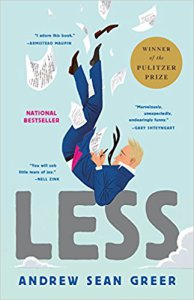
The yeasty comic novel “Less” was the chintziest of the four. It won the Pulitzer Prize this year for fiction. What are you gonna do? I read, I shrugged, I shut. 

With wan humor tangled in wry, hackneyed observations about gays and straights and executed in lite-beer fizzy prose — “a quick, easy summer read,” said one critic, as if that’s a compliment — “Less,” by Andrew Sean Greer, reminded me of a gay-themed comedy series on HBO, one of those middling shows no one watches. The novel, says Greer, is “a love story, a satire of the American abroad, a rumination on time and the human heart.” Thanks, Mr. Greer, for defining “generic.”

I read some 75 pages of “Less” and I must agree with this writer who actually finished the book: It’s “chock-full of gay clichés that feel outdated, and the tone is generally one of superficial, unearned cynicism that sometimes drifts into cattiness.”

Yup. Even The New York Times, in an upbeat review, called it “too sappy by half.”

Zadie Smith writes with a magic wand; her language and storytelling gifts are things celestial (and she makes me gush floridly). I’m an ardent fan of her fiction — “White Teeth” glitters — but her 2012 novel “NW,” a typically vibrant latticework of people and place, didn’t grab me by the lapels, no matter that I don’t have lapels. As exceptional as the writing is, the story has a matte finish when I yearned for glossy. 

Unknown.jpeg

Wade into Rivka Galchen’s hailed stories “American Innovations” and it’s clear why she is one of America’s hottest young fiction writers. She’s crisp, funny and fanciful, with a biting originality and a smidge of the surreal. But as much as I appreciated the collection, I put it down. I almost fell for it, then fashioned a one-word review: meh.

While there’s no shame in not finishing a book — I can’t believe people who feel they have to get to the last page even if it’s a slog — I can’t help but gulp and blush at this failure: Edith Wharton’s 1920 Pulitzer-winning classic “The Age of Innocence.”

I did not get far in the rather slim novel. I found the prose cluttered and perfumey, chokingly Austenian (though without the giggling), and fustily 19th-century for my contemporary palate. (Oddly, I loved Wharton’s 1911 “Ethan Frome.”) Wharton weaves long, highly populated sentences of lace and crushed velvet, many of them woozy and lovely.

Problem: I kept picturing doilies. 

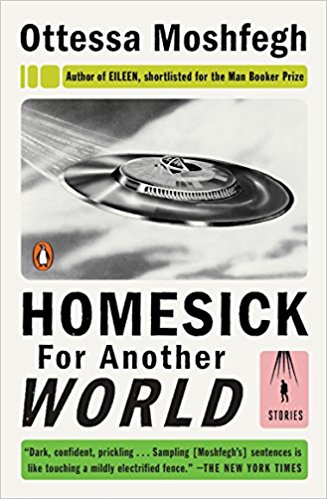
Antidotes to these literary losers are a trio of new fiction by some of the most acclaimed women authors around: “Kudos” by Rachel Cusk, “How Should a Person Be” by Sheila Heti and “Homesick for Another World” by Ottessa Moshfegh. 

51zp1zkt38l-_sx328_bo1204203200_.jpg

I’m knee-deep in that last title, a 2017 collection of stories by the precocious Moshfegh, whose novel “Eileen,” a darkly off-kilter character study, impressed and troubled me — just how I like it.    

Moshfegh’s stories are spare and wicked, laced with a perfect pinch of transgression, enough to fill an eye-dropper. They are comic and you laugh, but there’s dried blood in them. 

Some excerpts:

“He thought that the drugs we bought in the bus-depot restroom were intended to expand his mind, as though some door could be unlocked up there and he would greet his own genius — some glowing alien in glasses and sneakers, spinning planet Earth on its finger. Clark was an idiot.” 

“Our repartee would be rich with subtlety and sarcasm, as smart and funny as mid-career Woody Allen. Our fucking, like Werner Herzog, serious and perplexing.” 

“I hated my boyfriend but I liked the neighborhood.”

To me, that is dreamy writing, all at once blithely sardonic, intelligently aloof and drolly perceptive, attached to the stinger of a scorpion.

Death becomes us

“To live fully is to live with an awareness of the rumble of terror that underlies everything.” 

Ernest Becker, “The Denial of Death”

For some of us, the above “rumble of terror” is a buckling, earth-cracking tremor felt many times each day, a sort of clockwork bell that tolls every hour, on the hour. It is, of course, death, our unavoidable mortality, crooking a finger, baring its teeth and uttering a horror-movie cackle.

Drama aside, what Becker says is that without a sharp recognition of the reality of your own death you paper over a critical dimension of existence. Without death, paradoxically, a major chunk of life is muted. You reside in the dark.

5154120492_e2269336f61.jpg

The existential denial Becker speaks of amounts to an ignorance as willful as it is mystifying. To mention dying has become taboo. How can the most important stage in life, the great closure, the monumental punctuation mark, be off limits? I don’t want to think about it,” goes a common refrain. “It’s just too horrible.” 

But is it? By being aware of your mortality, knowing you will die, that it is an unstoppable event, you can cultivate a richer, more philosophical, existentially awakened life. The aim of this consciousness, as I’ve written before, is to “put you in touch with an untapped aspect of your spirituality, to jolt you out of complacency and into perhaps uncomfortable soulfulness.”

Instead, people distract themselves from the big questions and tough realities. Texting, Facebook and binge TV shows are potent diversions. We think we have control over our lives by doing the right things — exercising, eating healthfully, thinking positive, traveling, communing with art and nature, procreating.

Rubbish.

“Modern man is drinking and drugging himself out of awareness, or he spends his time shopping, which is the same thing,” Becker says.

Death isn’t on my lips — I rarely broach the subject — but it weighs on my mind like an anvil. I’m not talking about the gruesome, corporeal details of death — the corpse, the medical examiner, the venal funeral industry, the land waste of burial — but the chilly philosophical fact of mortality, of dying. Not how we die, but that we die.

Hans Larwin's amazingly evocative 'Soldat und Tod' ('Soldier and Death') from 1917

It’s confounding that people dodder through life without considering death, as though it’s some vague, distant inconvenience that won’t afflict them — not even when they’re crossing a busy street or speeding down the highway or eating a marbled slab of steak or hauling around 100 pounds of extra body weight. The musty cliché “ignorance is bliss” could not be more fitting.

Accepting our fate now, in the present, dulls the fear factor. The idea of dying — Becker’s “rumble of terror” — is inarguably frightening, and that’s certainly why so many of us keep it at bay. But awareness makes you smarter, more prepared. It eases the angst. “The fear of death follows from the fear of life,” Mark Twain said. “A man who lives fully is prepared to die at any time.”

To live fully, says Becker, means to live mindfully, to be cognizant of that lyrical rumble of terror, to embrace one’s fate, or to at least be on cordial terms with it. It is, in fact, consciousness in full bloom.

The dog’s search for meaning

It’s hot outside and the dog gallops up the stairs to the very warm attic, panting with a slashing smile, tongue flapping, teeth bared, eyes wide and wild, tail wagging. He looks “on,” like he’s just hit the stage to burst into a blazing showtune, or just won the lottery. He’s so very jazzed to be here. 

Realizing he’s just exerted that much energy only to run into me at the top, me, ordinary me, who has no food for him, just pets and pats for the good doggie, he quickly calms and collapses on the floor, seals his salivating maw, exhales one huffy breath through his nostrils and resigns himself to the humdruminess of life. Rip-off, he’s certainly thinking.

The dog is not alone in his deflation. The heat rises to the cozy attic and no fan, no matter its wattage, can disperse the vapors. But it’s an existential heat, too, one we all know at some point, here and there. The dog is in the throes of it, stretched out in languid dismay.

IMG_0829
The dog, gazing at me, pondering his existential predicament.

And so am I, to an extent, though I am not physically sprawled out, that would be ridiculous. Still, the dog and I are in moody concert, encased in ennui, a kind of life weariness, if just for this time. Trying to write, I turned to reading my book, “NW” by Zadie Smith, when the dog jogged up to say hello and discovered the groin-punch of nothingness.

Right now, his glass — or his water bowl — is half-empty, to borrow the old metaphorical measure of the optimist vs. the pessimist. He is slowly realizing that life isn’t a continuous (tennis) ball, that letdowns lurk, that existence precedes essence, that not all chew toys are created equal. These are things I learned years ago, that we make our own happiness, shape our own lives, that free will, not divine intervention, reigns, and that disappointments and satisfactions are divvied up about 65/35. The dog doesn’t know all this yet. He is a troubled soul.

In anthropomorphic terms, he’s displaying a glint of neuroses. Somewhere Freud and Jean-Paul Sartre are high-fiving over the notion that psychological and existential angst can be traced in a furry quadruped.

The dog seeks the meaning of life, this is plain from his searching brown eyes, furrowed brows and the alarming way he drags his butt across the carpet. Freud’s pleasure principle manifests itself in his frequent calls for belly rubs. Sartre’s theory, which states that our individual responsibility in defining our own lives is almost debilitating in its enormity, has the dog a little down. Knowledge of his own mortality is something of a buzz kill.

At times like this, a good, jaunty walk won’t cut it. Scooby snacks — nope. A ride in the car? He snickers. But the dog is resilient, and getting his tail wagging is not a demanding task. As with me, these moods of brooding despair and overthinking are intermittent. He’d rather eat a good meal or harass the cats than dwell on the insane, undeniable meaninglessness of his puny little life.

And the next time he does, I plan to start reading to him from Sartre’s daunting opus “Being and Nothingness” or Freud’s “The Future of an Illusion.” And when I myself plummet to pondering the philosophical conundrums, the dog can read to me from — this is an actual book — “Chicken Soup for the Soul: What I Learned from the Dog.”

Life’s too short for sulking. I know this. However, the dog, whose years are on the seven-year scale, meaning he’s about 21 to 28 in human years, resides on a shorter leash. But this canine savant is swiftly learning one of the essentials, no matter how fur-raising:

Self-realization — it’s a bitch.

Writers die. The art doesn’t.

The great authors Tom Wolfe and Philip Roth died eight days apart this month. I heard nothing about the startling proximity of the loss of two of America’s towering writers. And nothing about the theoretical third death of someone else famous when two celebrities die back-to-back. Nothing about that ghoulish trifecta.

th.jpeg
Philip Roth, died May 22.

If that make-believe third fatality does indeed occur soon, and he or she happens to be another English-language writer, which giant will fall? Toni Morrison? Stephen King? Alice Walker? John Irving? Ian McEwan? Cormac McCarthy? None of these literary lions are spring chickens, excuse the mixed animal metaphors.

Such morbid business is the stuff of cocktail party parlor games, slightly sick, if innocuous: King? No way. McCarthy is next, just watch. He’s 84! Or some such scintillating blather.

th-1.jpeg
Tom Wolfe, died May 14.

When a popular artist dies it makes a loud rip and a mighty hole in the cultural fabric. A sometimes-fan of Wolfe — I couldn’t get through much of his work, but “The Right Stuff” and “Bonfire of the Vanities” thrilled with reportorial breadth and linguistic virtuosity — I am a confirmed Roth acolyte. His death briefly shook me and cast me in a blue mood. Celebrity passings rarely have this effect on me. I took it personally.

Yet the sting faded, and I was gladdened to see book shops and libraries erecting proud shrines to the author of “American Pastoral,” “Sabbath’s Theater” and “The Human Stain,” small mountains of hardbacks and paperbacks as monuments to genius.

640_P2010011

I’ll get back around to the books, but for now I’m revisiting the PBS documentary “Philip Roth Unmasked,” an incisive portrait for the budding Rothian, a reminder of what made the novelist a colossus and worthy of the Nobel Prize that so shamefully eluded him.

I should say I was also hit harder than usual by the deaths last year of novelist Denis Johnson and playwright-author-actor Sam Shepard. Johnson was a marvel, his seminal short stories “Jesus’ Son,” the hypnotically chiseled “Train Dreams” and the haunting Vietnam epic “Tree of Smoke” funny, hallucinogenic and wildly transporting.

sam.shepard.true.west.vhs.s.2.JPG

Shepard, who I met and interviewed (see here), was always a personal favorite. An artist disguised as a road-weary bohemian cowboy, his acting was consistently spot-on (he was ace in the 1983 movie adaptation of Wolfe’s “The Right Stuff”) and I’m deeply partial to his 1980 play of fraternal fury “True West,” a raging comic masterstroke about bad blood, beer suds and the prickly craft of screenwriting. 

Watch it on YouTube, starring John Malkovich and Gary Sinise as riotously bickering brothers. It will, like Philip Roth at his best, knock you out. When you come to, the whole world will be a little bit different.