“I love to travel. I just hate the travel part.” — old axiom
Why is boarding a plane so unpleasant? It’s unnecessarily stressful, for me at least, riddled with confusing queuing rules, mumbly loudspeaker instructions that sound like the adults in Charlie Brown specials, brazen line-cutters, and the overall sense of sweaty barnyard herding.
My biggest stress point is the overhead bins and making sure I find a space for my small carry-on roller that’s not in row 57 when I’m in row 22. So now, on United, I pay a $24 fee for “priority boarding” largely to avoid overhead bin combat. (Though passenger jostling is an amazing spectacle.) Even then it can be a hassle to locate an empty bin that some moron hasn’t stuffed with jackets and backpacks that belong under the seat.
I’ve never tussled with a fellow passenger for bin space, but once while struggling I murmured “shit” under my breath and a flight attendant heard me (what is he, a cocker spaniel?) and said aloud, “Oh, we’ve got a live one here,” which of course only pissed me off more.
Paying for priority boarding is worth it. It places you in line 2, just behind the first-class bigwigs, meaning you board in the second group instead of the saps in 3 through 5, who shed bitter tears as they futilely seek space in the already packed overhead bins while you coolly, regally read your book, your carry-on stowed directly above you, snug and smug.
But that, of course, is only the beginning of the journey. The rest is its own kind of nightmarish diabolical shitty hell. The cramped, crowded quarters. Seat backs that bonk you on the forehead. Mealy meals — chicken or pasta, always. Drenched, toilet paper-strewn lavatories (their term, not mine). Butts constantly bumping you in the aisle seat as people scrunch by. Chiclet-size pillows made of gauze. And so forth in the untold litany of awful air travel platitudes.
The tradeoff for this misery is why you do it. Flights will wreck you with stress and redeye fatigue. They are, frankly, a pain in the ass. My post-flight recovery time is cosmic. But then I rebound, ready for days of stuff in a new city, until it’s time for the dreaded return flight. I steel myself for this phenomenon.
The going-back blues are knee-buckling, a gut punch of leaving a place at which you seemingly just arrived. Oh, the banality of home! The only remedy is to begin mapping your next trip, including — and this is critical, really, listen — strategizing how to snag the perfect overhead bin, a forward-thinking start to any vacation.
Before I visit a country for the first time, I like to bathe in the local culture, mainly through books and movies. (I save the food part until I get there and do it right, with bite.) As mentioned in my last post, I head to Seoul, South Korea, in a few weeks, so I’ve been hungrily reading novels and watching films by Korean artists. Christ, they’re grim. How I love it.
Take “Memories of Murder,” by Bong Joon-ho, who made the stinging class-warfare satire and Oscar-winner “Parasite,” itself fairly bleak. This excellent serial-killer detective saga throbs with death and dark humor, winding down to a gut-punch ending that will leave your jaw somewhere around your big toes. Kim Jee-woon’s “I Saw the Devil” is another serial-killer drama, a fiendishly clever spin on the revenge thriller splattered with brutally sadistic punishments that I cannot speak of here, lest the authorities bust in.
Something lighter? Try the smash Netflix series “Squid Game,” in which financially strapped citizens try to win millions playing grueling games with the simple rule: you lose, you die. I haven’t seen so many blood geysers since “The Wild Bunch.”
Twisted, yes. But then you don’t know Park Chan-wook’s 2003 masterpiece “Oldboy.” Yet another revenge rampage, Park peppers his gorgeously gory film with creative curlicues not easily forgotten — like the antihero devouring a whole, live, squirming octopus in one take and, later, fending off dozens of assassins armed with only a hammer, a tour de force of cinematic choreography.
It’s not much sunnier on the book side. I just finished the slim novel about suicide “I Have the Right to Destroy Myself” by Young-Ha Kim. It’s gloomy, but also not great. It’s infatuated with its own misery.
More famous is “The Vegetarian” by Nobel Prize-winner Han Kang. The heroine of this celebrated novel renounces meat, triggering a plague of psychological and bodily repercussions. (Put. Down. The. Cheeseburger.) And I’ve just started “Lemon” by Kwon Yeo-sun, about the unsolved murder of a high school student. More death — party time!
Is Korea so cracked? Apparently I’ve tapped into a thick cultural vein of crime, vengeance, class disparity, the sordid and surreal, the darkly existential and the exceptionally, even giddily, violent. That vein is a bloody gusher.
Speaking of unchecked violence, the other day I bayonetted my cheek with a thumbtack. I was lancing a pimple, not too giant, but big enough to evoke the Elephant Man. A hard, stubborn whitehead that was impervious to onslaughts by furious fingernails. So I said F-it, I’m getting a tack and uprooting this beast. First, I sterilized the tack’s point in the dancing blaze of a Bic lighter. Then I rinsed it in hot water. Then I took the business end of said tack and dug out the pimple’s white core from my cheek. Blood happened, but I extracted the thing in 30 seconds flat. My threshold for pain and gore is impressively high. The tattered flesh around the deceased pimple healed in a few days. I am an absolute master. Dermatologists, take note. And fellow zitheads: Shelve the Stridex. You might find more relief at Staples than CVS.
Like its kaleidoscopic neighbor Japan, South Korea is a Day-Glo bouncy house of the whack, weird and wonderful. While there, I will have ample offbeat options: Should I visit the Toilet Park and Museum, aka Mr. Toilet House, a festival of fecality? Or the Penis Park and Museum, studded with upright totems of erotic arousal (stop it!)? Or the Meerkat Friends Cafe, where twelve meerkats — so smooshily cute, like living anime creatures — a random raccoon and a floofy white Arctic fox scamper and play with you as you sip, and conceivably spill, coffee? I’ll be at all of them, of course. Oh, I almost forgot the popular Poop Cafe, whose theme is all things playfully bowel-adjacent (think chocolate soft serve, etc.). Consider it checked.
I’m supposed to be in Nashville right now. But I’m not, and I’m glad.
A trip down South was planned as a post-France jaunt, 3.5 days, fast, domestic, easy and fun. I’d do it in early March while the weather’s still mild, my final trip till the annual fall journey in October or November, wherever that may be.
I booked a Nashville hotel, some tours and great restaurants, and of course a flight. But very late in the game it struck me that the math wasn’t computing. The damn thing, for hardly four days in a city of modest attractions, was costing just shy what a longer trip abroad would cost. I blanched, then I panicked. What was I doing, numbskull?
This was two weeks ago, this brilliant epiphany I should have seen months ago. Text my brother, I thought and I did. He began firing off trip ideas — Granada and Valencia, Spain, for starters — then, boom, he sent me a swanky hotel bargain in … Seoul, South Korea. My immediate text response: “Oooooo.” A fire was lit.
Despite having in the past mulled Seoul as a destination, it never quite captured my imagination, even though it looks like the sister city — high rises, high tech, sleek and seductive, old and new — of Tokyo, one of my favorite places.
Quick like, I was on the web, from Chat GPT and Lonely Planet, to TripAdvisor and YouTube, researching and rummaging. And, hell, if Seoul wasn’t completely captivating. Pagodas meet K-Pop, kimchi mingles with Korean BBQ, and temples to godlike emperors and gaudy consumerism abound. I checked mid-April weather (cool to warmish) and saw that it’s also peak cherry blossom season. What!
I’m a capricious creature, incurably impulsive, too often following my gut before my head (see: Nashville). But while this reversal — I booked the Seoul hotel and swapped my Nashville flight credits for Korea credits — is dramatic and sudden, it is not rash.
Rash implies foolish and reckless. This time I’ve thought it out, lured to a place I’ve never been, based on hours of homework. Frankly, my heart was never fully in Nashville. It was whimsical, poorly reasoned. They may serve soul food there, but they don’t serve Seoul food. Tours are booked — I might be most excited about the “Anthony Bourdain Ultimate Korean BBQ Experience,” and why not? — hotel secured, etc. The flights are a time-sucking monstrosity — 20-some hours — but you gotta roll with it if you’re committed.
The email contained bad news. My guide, whose ratings are off the charts, was bailing on our tour of Aix-en-Provence in Southern France. Cold comfort: He was enlisting a substitute guide in his place, someone named Ivanna, about whom I knew nothing. I pictured a comely Ukrainian woman, perhaps bespectacled, tall, sweet and ironic.
A few days later Ivanna introduced herself via text: “I’ll be the little Asian lady with bluish hair, so I’ll be hard to miss!”
Oh. Grand.
Trips are rife with hiccups, snags. This wasn’t one of them. Ivanna turned out to be a joy, a brainy fount of local knowledge, witty, thoughtful, considerate, with hair tinted a winning shade of cobalt. She’s young, Malaysian, went to Loyola University in Maryland and speaks three languages. She lives in Aix with her husband and children. In two brisk, stuffed hours, she led me down skinny cobblestone lanes and yawning boulevards, telling me scads about the city’s history, from kings to cathedrals, and where to get the best ice cream and ogle good art.
This is the best of travel — the brain- and eye-popping excursions that crack open new vistas you could only wonder about. Topped with two scoops of lip-smacking ice cream.
I was staying in Marseille for six days last week and Aix was an obvious day trip, as was Arles (Roman ruins! Van Gogh!), but more on that lovely town another time. Marseille and Aix are 39 minutes apart by train, yet worlds apart in complexion.
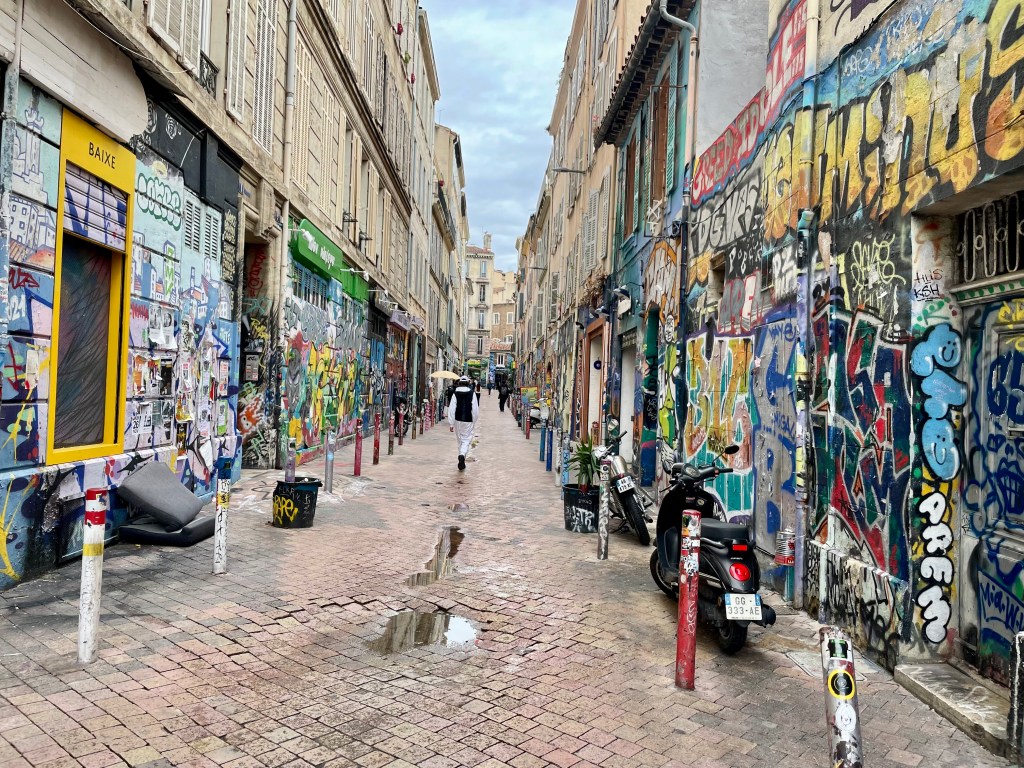
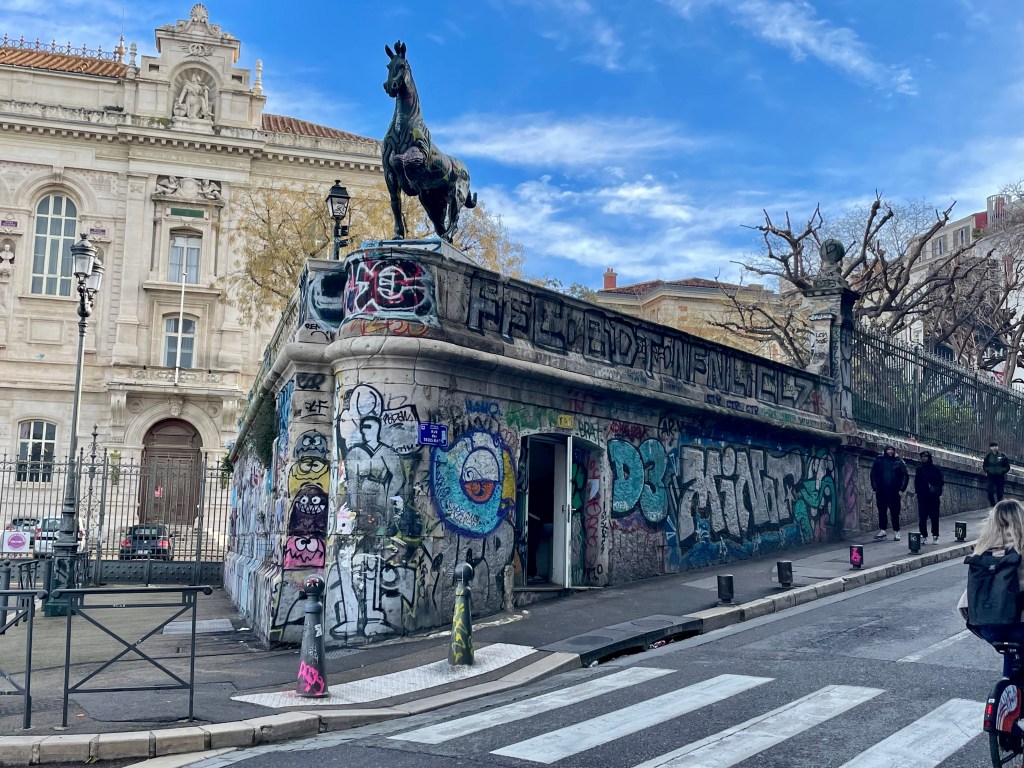
Marseille: gritty and huge (France’s second largest city); slathered in graffiti and street art; assertively multicultural; set on a picturesque port; growling with speeding scooters and motorbikes; part Paris, part chaos.
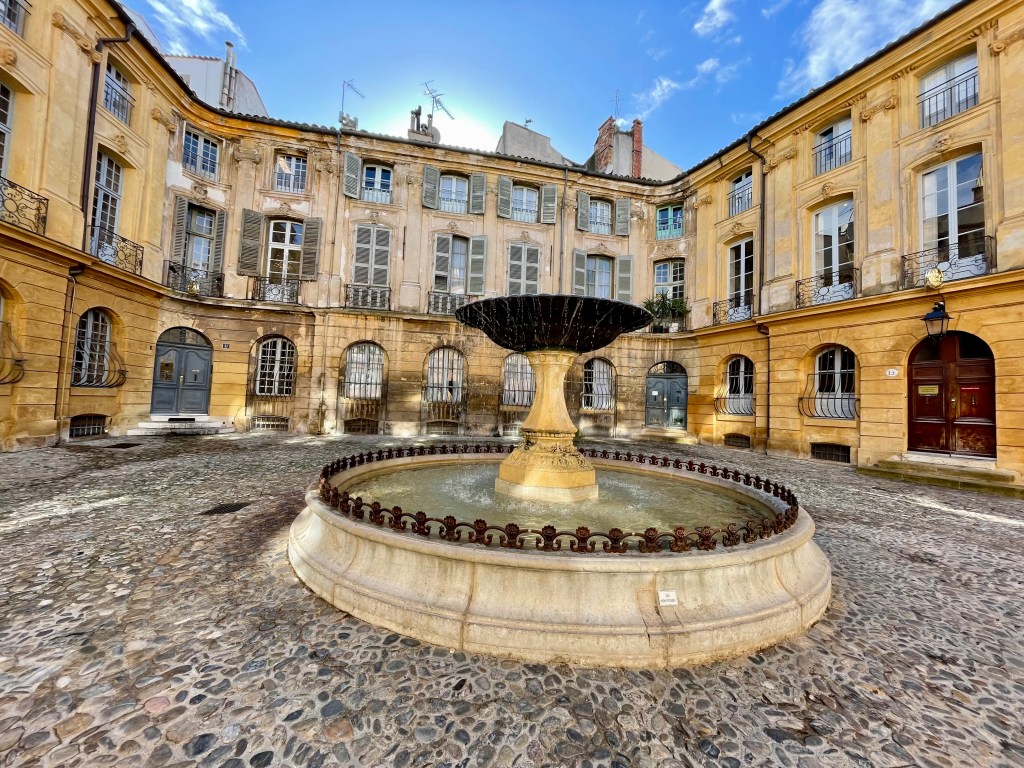
Aix: exuberant, medieval charm constructed of yellow and ocher stone; clock towers, boulevards and basilicas; fountains juiced by thermal springs; home of Cézanne (though, tragically, the city owns none of his paintings); boutiques and tranquil beauty.
The dichotomy is dizzying. One thumps with rap and rock, while the other strolls, hands in pockets, whistling. Both are ancient — at 2,600 years old, Marseille is the oldest city in France — and exude that quaint, sometimes ghastly, always intoxicating historical spirit that Europe seems to have a monopoly on.
One of many famed fountains in Aix-en-Provence
Why Marseille, you say? Partly because it’s enjoying a moment right now, with hosannas in The New York Times to Condé Nast Traveler and beyond. A trend follower I am not. I did a day trip to Marseille in 2007 that spurred my urge to return to this bustling, bracingly diverse city. And so I did. And I’m glad. There you have it.
Marseille’s reputation for crime and grime is passé at best, slanderous at worst. Locals laughed with me when this was brought up, like, What are they talking about? Think New York, Chicago, San Francisco — they have their blights and trouble spots, but there are simple ways around that. And what’s a big city without some dirt under its nails? (My Fodor’s travel guide said my hotel was in an “iffy” neighborhood. I call bullshit. The crib and the hood are très cool.)
Marseille’s fabled Cours Julien district. It’s never met a can of spray paint it didn’t love.
Vaunted as a foodie’s paradise, Marseille let me down many times gastronomically. I tucked into good but never great dishes originating from France, Italy, Argentina, Tunisia and the Ivory Coast. Alas, with heaving disappointment, my maiden acquaintance with Marseille’s world-famous fish stew, bouillabaisse, was a bust. The fish was dry and flavorless, the broth bland and tepid, and this was at legendary bouillabaisse megastar Chez Fonfon. The soup and one glass of wine took me for a hundred US dollars. The web review I wrote back at the hotel is a seething tirade about getting rooked.
Where the food flopped, the people shined. My minor allergy to others is cured when I travel. Connections with locals are almost always tonic and nourishing, pulling me out of my fortress of solitude to swap world views and pleasantries. We laugh as we wrestle with our linguistic limitations — my French is pretty much non-existent, basically sign language — and commiserate when politics are broached, which gladly is not often.
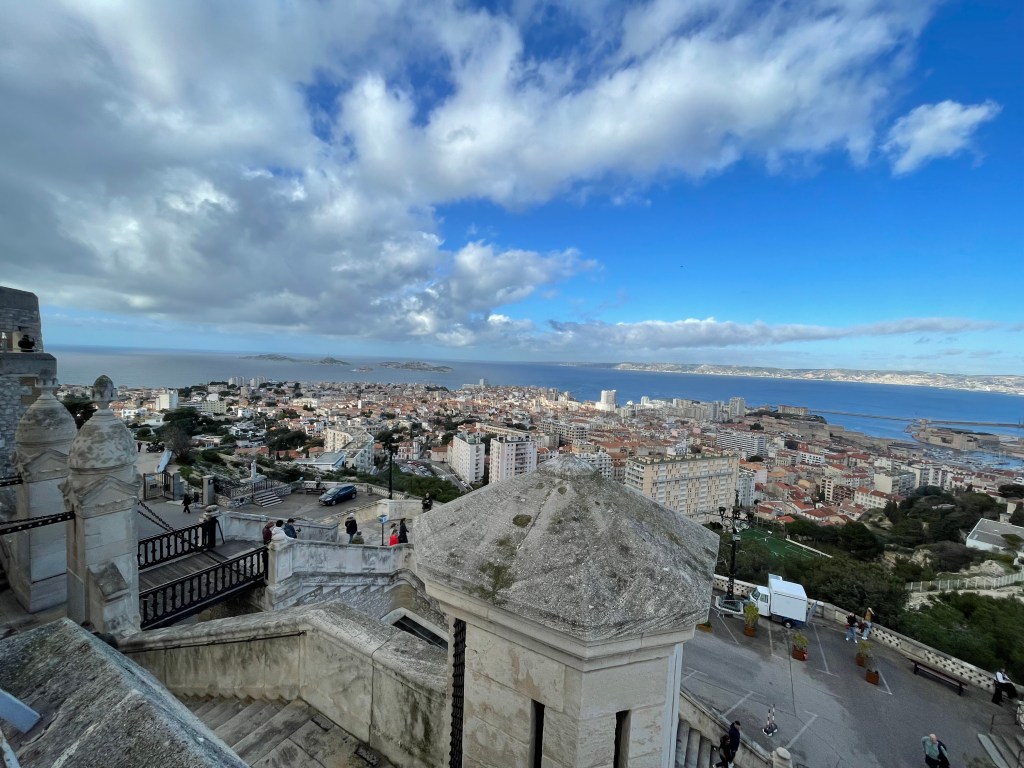
Marseille from the hilltop Notre-Dame de la Garde basilica
My past as a film critic is my social super power. It uncorks an uncanny passion in people that’s rooted in the universal language of cinema. I had a half dozen lively conversations with local Marseillaise about their favorite films and filmmakers, from Tarantino to Tarkovsky and every indie and classic in between. France’s renowned love affair with the movies burns bright. (I stumped them all when I mentioned “Annie Hall,” however.)
Meanwhile, over at my hotel, the hipster joint with the hipster name, Mama Shelter Marseille, the music played loud on weekends, pure DJ slop stuck on the same crowbar-to-the-cranium beat. The throb carried straight to my fourth-floor room well past 1 a.m. and I found myself in grandpa grumpus mode, calling reception to complain. To my surprise, the next day they upgraded my room to a larger one away from the bar, and even gifted me two fat gourmet cookies and a bottle of apricot juice. I felt like a little boy. I thought it was the nicest thing in the world. I’ve never said mercibeaucoup so many times.
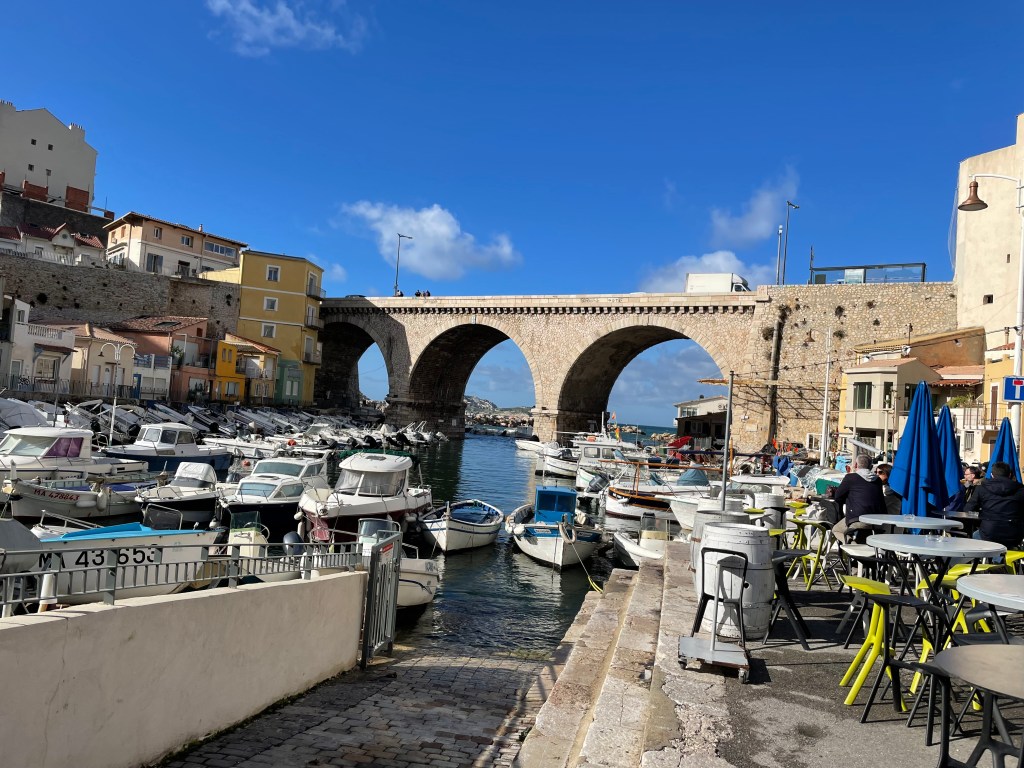
A small Marseille port, lined with restaurants, including the notorious Chez Fonfon. A soup with a view.
About fifteen feet from the hotel is a tiny pizzeria, really rather a dump that’s mostly for take-out, where I got my final meal in Marseille. No more overpriced, underwhelming haute cuisine on this trip, I sniffed.
Again, the people. The pizzeria is run by a stout, olive-skinned woman in perhaps her mid-forties with a handkerchief on her head and flour on her hands. I bought three plain slices and while they heated up we chatted in stilted English (she apologized for hers) about where I was from and she seemed happy for this foreigner’s patronage.
She told me her son had just visited Miami and loved it. She asked if I had been and I had to say I wasn’t a big fan of South Beach — the place reeks of douchebaggery, though I left that out — but that young men adore it and, for that, America is doomed. I left that out, too. She chuckled. I took my slices back to the hotel and bellowed a hearty Merci! Au revoir!
Later, after watching “Forgetting Sarah Marshall” in French with no subtitles, I went to bed. I heard nothing but the occasional motorbike screaming down the narrow streets.
The city in its graffitied glory. Me, I love the street art. It has character, panache.
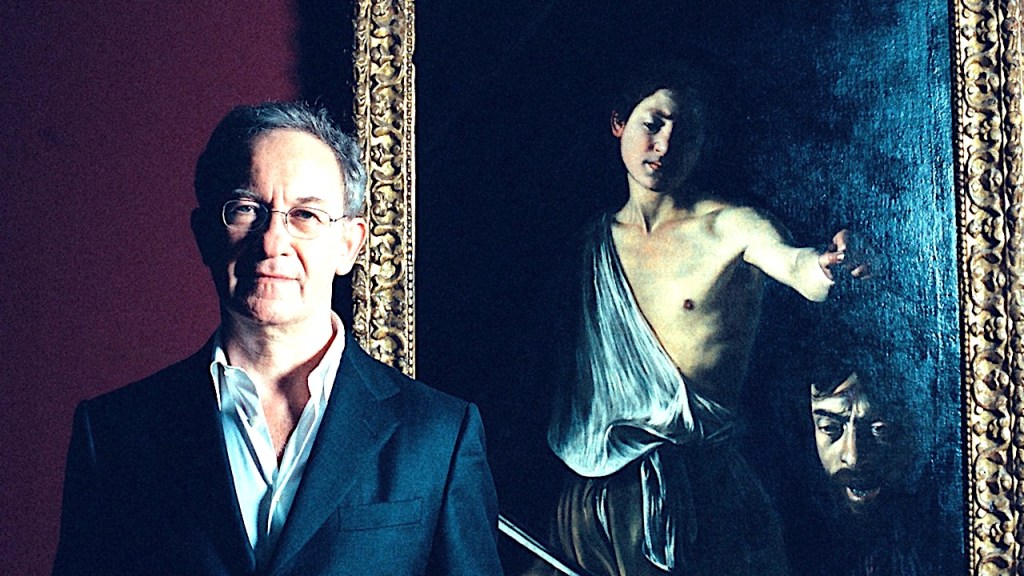
Been enthralled rewatching the eight-part docuseries “Simon Schama’s Power of Art,” keeping winter’s brrr at bay with deep insights and gobsmacking grandeur. The 2006 BBC show, now streaming, profiles an octet of artistic titans hosted by the smartest guy in the room, scholar and scamp Simon Schama, known for a heap of cultured feats, including “Citizens,” the landmark history of the French Revolution.
With theatrical kick and piercing opinions, Schama surveys these pigment-stained characters in one-hour slices: Caravaggio (blood, beauty and butchery); Bernini (boggling, blissed-out sculpture); Rembrandt (peerless Dutch portraits — “Mr. Clever Clogs,” Schama cracks); David (the divisive “Death of Marat”); Turner (violent squalls of blinding light); Van Gogh (dazzling swirl-scapes, with an ear to the ground); Picasso (Cubism: Braque ’n’ roll); and Rothko (pulsing rectangles of preternatural color).
Tweedy but cool, shirt buttoned low, Schama is a delight. He deploys effortless erudition with an impish glint in his eye, a calibrated smirk and a gift for eloquent, giggle-making irony — he’s brainy and funny. But he’s also dead serious, reverent, about his heroes and their eternal masterworks. Art, he seems to say, is no joke. Except when it is.
As one observer says, “Schama is not neutral; he argues, provokes, and interprets boldly,” adding that the series “helped shift popular art docs away from polite scholarship toward emotion, conflict, and stakes.”
It’s how he peels back the works’ essence and the artists’ humanism that stands out. For example, he not only declares but demonstrates how Van Gogh “created modern art” amid a maelstrom of mortal mental distress. (That chapter is understandably the most heartbreaking.)
If you like transcendent art — “Slave Ship”! “Starry Night”! “Guernica”! — cinematic reenactments with fine actors in real locations, and the sly, conspiratorial air of a charismatic host, the series is a feast. More than edifying, it’s electrifying.
Just listen to this guy: “Great art has dreadful manners,” says Schama, who writes every episode. “The greatest paintings grab you in a headlock, rough up your composure, and then proceed in short order to rearrange your reality.”
Right about there, my knees buckle.
Schama presenting Caravaggio’s gleefully grisly “David with the Head of Goliath”
I’ve been blabbing here about going to Marseille in early February. A picturesque coastal city, the second largest in France, it’s famed for a gritty, hip, multicultural vibe, a fabulous port and craggy shorelines kissed by Listerine-blue Mediterranean waters.
Marseille is also famous for its motley cuisine, from French and Moroccan to pizza and West African. But above all it’s known for the iconic, somewhat extravagant seafood stew, bouillabaisse — rich, aromatic and typically made with various Mediterranean fish.
The recipe generally goes like this, and here I’m cribbing:
A traditional bouillabaisse has two parts:
The broth – saffron-gold, flavored with fennel, garlic, tomato, orange zest, olive oil, and Provençal herbs.
The fish – several firm, rock-dwelling fish from the Mediterranean, added in stages so each cooks properly.
Now, many hot-shot chefs mess with the recipe, adding shrimp, lobster, mussels and other mollusks, god forbid. This bouillabaisse virgin — never had it! — is allergic to shrimp and lobster (an adult-onset allergy; I love shrimp), so I fretted about where I would get a purely traditional fish stew in Marseille.
All the guidebooks and websites point to one restaurant, Chez Fonfon, which has been serving bouillabaisse for 74 years using scorpion fish, red mullet, eel and other fishies in its recipe. “We offer to prepare the fish in front of you or already prepared for immediate enjoyment,” says the Fonfon site. I’ll take the show, please.
Then, as is my wont, I over-thunk the meal. What if they also add shrimp or lobster? I’d just have to see. Or not. Yesterday I emailed Chez Fonfon and asked the question. A few hours later they responded.
“Our bouillabaisse is prepared in the traditional way, using only rock fish and vegetables. It does not contain any crustaceans such as shrimp or lobster.”
Jackpot. Now I can sleep at night and dream of rock fish swimming in my bowl, sans crustaceans stinking up the joint, toxic creatures that would make my throat swell, my breathing sputter, likely ending in my death, face-down in my very first, and last, bouillabaisse. Merde!
During the post-holiday malaise, things poke and peck at my addled brain, fretting about the good, the bad, the grotesque …
Starting with the latter — the elaborate idiocy, the vomit-inducing venality of the so-called Donroe Doctrine, whose cutesy moniker makes me wonder: Who is he kidding with this crap? The perverted man-child is not kidding with, in his words, “my own morality,” which includes everything from ICE to Iran, a rogue’s gallery of revulsion. I pray that crippling tragedy looms in his wretched future. His crew of groveling lapdogs? Same.
On the good side, I’ve cracked a newish book that’s been called by critics “a magnificent vision,” “transcendent,” “spectacular” and “not so much a novel as a marvel.” That would be Kiran Desai’s “The Loneliness of Sonia and Sunny,” which is relatively slim for its daunting 700 pages. Yet what it lacks in girth it makes up in thudding weight. I could curl it and achieve Himalayan biceps.
I’m only on page 50 in this (let the publisher describe it) “story of two young people whose fates intersect and diverge across continents and years — an epic of love and family, India and America, tradition and modernity,” and I’m hooked.
It’s one of those chunky novels with character/family trees for a prologue, like “War and Peace” or “One Hundred Years of Solitude,” which can trigger the scram instinct in me. I don’t relish flipping back every twenty pages to recount who’s who.
But so far, very good. Desai conjures scenes and characters with creamy eloquence and imagery as supple as a Degas. The prose is wise and true, and funny, too. I only have 650 pages to go (sound of me lifting a cinder block).
Planning for two imminent journeys — Southern France in February and, implausibly, Nashville in March — continues unabated. It’s kind of a chore, but, like cooking or Lego building, it becomes a stimulating hobby, a minor challenge with low stakes.
I’m doing well so far in this First World folly, but the fine tuning feels endless. A Nashville restaurant I booked just emailed to say, sorry, your reservation is canceled because we are now “permanently closed.” The same happened with the Patsy Cline Museum (maybe these closings qualify for the “bad” in my opening paragraph), which a dear friend hinted is better than the popular Johnny Cash Museum. Call me “Crazy,” but I’m more interested in Cline than Cash. Bummer.
I voluntarily bailed on a street-art tour in Marseille, France, as I came to my senses that $194 is obscenely too much for a two and half-hour stroll amidst what’s essentially glorified graffiti. I don’t even know how I got myself tangled in that scam.
But I do that a lot. I plan trips with wide eyes and a growling stomach at first, and then, as the dates approach, I reel myself in and get sensible. Like, do I really want to do that whiskey distillery tour and tasting in Nashville? Well, yes. Yes, I do.
Denis Johnson’s “Train Dreams,” an exquisite novella I’ve read twice, once some years ago, once this winter, has been adapted for the small screen (Netflix) with mostly luminous results. Directed and co-scripted by Clint Bentley, the movie tells the story of a lumberjack razing towering forests in the Pacific Northwest to make way for the nation’s railroads. He marries. He has a child. Life intrudes.
Honoring the book’s ethereal touch, the movie aches to be a Terrence Malick epic: languid voice-overs, long traveling shots, fetishized natural beauty, breezes blowing through rustling trees, time-jumping episodes in place of linear plot.
It’s commanded by sylvan abundance and the honed, minimalistic performance by Joel Edgerton, whose eerie quietude is near-tragic if well-earned. Though cast in shadow, there is joy here — family, friends, sharp epiphanies. I was moved by the story’s rich poignancy and tender humanity. It’s as delicate as a dandelion.
Right about now I have a squirming urge to bolt, to unshackle from the boring and banal, to hop a jet and vacate this place somewhere faraway, to get the hell out of here, to go go go. Sure, Mexico City was only six weeks ago, a distant, wondrous dream doused in humanity and habanero, but plans must be made when that itch called wanderlust screams for scratching.
And so I plan. And I move fast. And I’ve picked where to go next. And, greedily, I’ve chosen two discrete destinations for early 2026. And they’re probably not what you would think.
Because they’re not what I would think, either. Marseille, Aix-en-Provence and Arles in Southern France happen the first week of February. Then, in a whiplash turnaround, I hit Nashville, during the first week of March.
Nashville? you ask in italics. Me, too.
In an abbreviated checklist, what the country musical capital has going for it: a slew of top-tier southern food restaurants, like the legendary Prince’s Hot Chicken (extra spicy fried fowl); the Country Music Hall of Fame Museum; the National Museum of African American Music; pour-happy whiskey distilleries; vibrant ‘hoods, including the hip, boho East Nashville, where I’m staying; and of course neon-bedazzled Broadway, where practically every bar — miles of them — is a honky-tonk or a venue hosting crunchy Americana in lieu of touristic cowboy hats.
The Strip slash Honky-Tonk Highway, as it’s alternately dubbed, is also where I will urgently avoid the famed flotillas of inebriated bachelorette bashes that turn the avenue into a twerking, tongue-flashing parade of sorority swillers. In pink cowboy boots, to boot. They should rename it Hell’s Highway.
Nashville’s blinding Broadway
Now, to France. Despite the grungy reputation of Marseille — France’s second largest city, animated by African and Italian immigrants, graffiti, a picturesque port and world-class cuisine — the character-rich, seaside region has found its footing in recent years as a must-do destination.
It’s “the underrated city in the South of France that should be on your bucket list,” toots Condé Nast Traveller, calling it an “untamed labyrinth, the dusty-rouge Mediterranean Port City” that delivers everything from grand cathedrals to transcendent bouillabaisse, Marseille’s iconic seafood stew.
And it’s affordable. For instance, my hotel, the whimsical Mama Shelter Marseille, is less than $100 a night, and it’s no dump. It has personality, pizzaz and a penchant for partying. (Grandpop here is bringing earplugs just in case.)
From Marseille I’ll catch under-an-hour train rides to Aix and Arles. These quaint, leafy, cobblestoned villages in Provence are where Roman ruins — ogle the gaping 2,000-year-old Arles Amphitheater, home to bullfights today — dot the stomping grounds of great painter Cézanne and great paint-eater Van Gogh. Both towns exude Old World charisma, naked charm and uninterrupted beauty. I’ll spend a day in each, then rail back to the grit, graffiti and gormandizing of Marseille.
And then, sigh, my journeys will be complete for the first part of 2026, and I won’t embark on another one (or two!) till fall, when the weather cools and, critically, my wallet recovers. Wanderlust is an incurable disease and I’m inflamed and afflicted. I do what I can about it. Which invariably comes down to go.
Twenty-two tacos. That’s all I could devour over seven days in Mexico City before I hit taco fatigue, a malady that beats Montezuma’s revenge by a long shot. (I was gratefully spared that gastrointestinal massacre.) Too many tacos — poor me. But it happened: I burned out on the tortilla-wrapped meats and spices, even though they were otherworldly delicious. Al pastor remains a gastronomic god.
I knew I peaked during an exhaustive nighttime taco tour, which included a pitstop for a heady mezcal tasting. I could only devour seven of the tacos served — including a rather average one at the only taco stand in the world to earn a coveted Michelin star — and had to pass, bloatedly, on the final two. (That would have been nine tacos in three hours, if you’re counting.) I simply couldn’t finish, unless my tour mates wanted to see the feeble American provide a gut splash on the sidewalk.
During my week in Mexico City, I wasn’t on a journey to eat as many tacos as possible. There was no quota. From the start, I wanted to leave room for an array of local delicacies, street food to fine dining, enchiladas to empanadas. Mission accomplished. Pizza even slipped into the plan. Thanks to its strong European tang, the city is famed for its prodigious pies. It was amazing.
The city surprises like that. CDMX, as they call it, is a sizzling melange of cultural influences, a vibrant swirl of art, cuisine, architecture (note the heavy Euro inspiration), lovely people, dogs, parks, museums (only second in the world for the sheer number of them, after London), sports, and, crap, a serious and grueling traffic problem. Don’t get me started. No, do. Some Uber rides took an hour, stop-starting, for just a few miles. The Ubers were nearly all dusty, dented beaters, but they muscled through and delivered. The streets — as clean as Tokyo. And there are no public trash cans. Pride reigns.
Located in the center of Mexico, the megalopolis sits 7,350 feet above sea level, which makes it higher than Denver, with thin air and temperate climes. It teems with life — 22 million people live there. That’s a lot of humanity, not to mention the multitude of pleased and pampered pups I saw all over the city.
I usually take wads of pictures of camera-happy hounds on my travels, but I only snapped a few this time. Here’s one, among a smattering of shots, a taco-y taste of CDMX.
In line at the Frida Kahlo Museum. I forgot her name.
Frida Kahlo looking pensive, near the museum. The city bursts with street art.
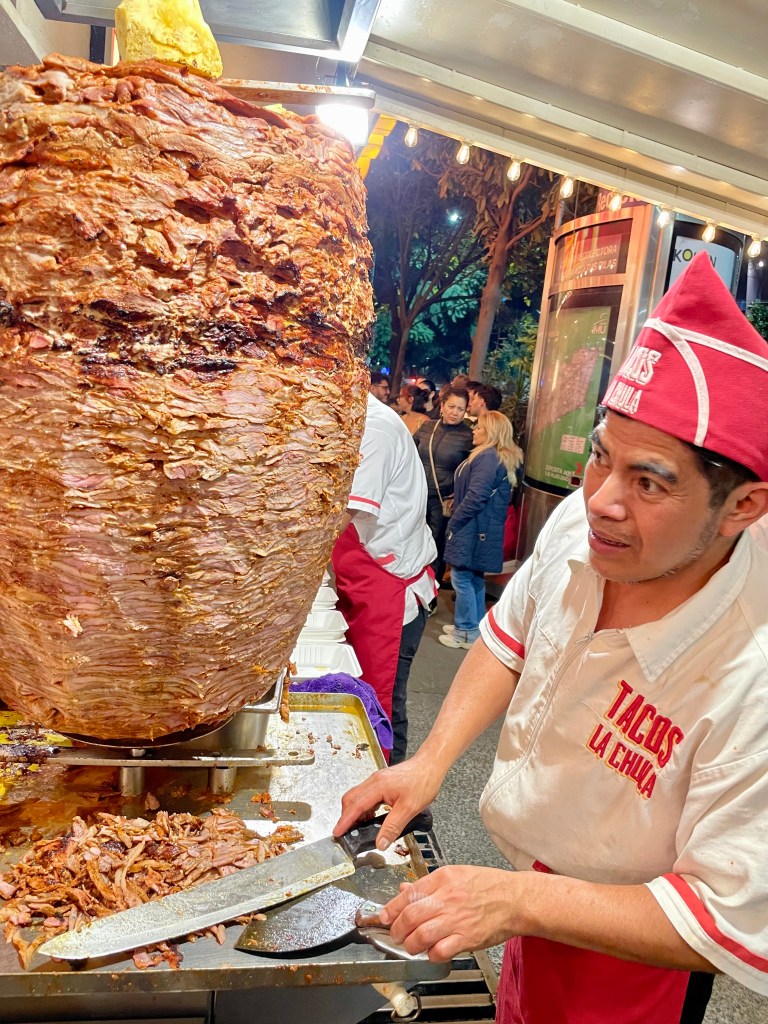
Cooking up one of my favorites, pork tacos al pastor.
Al pastor up close. That’s marinade, not blood.
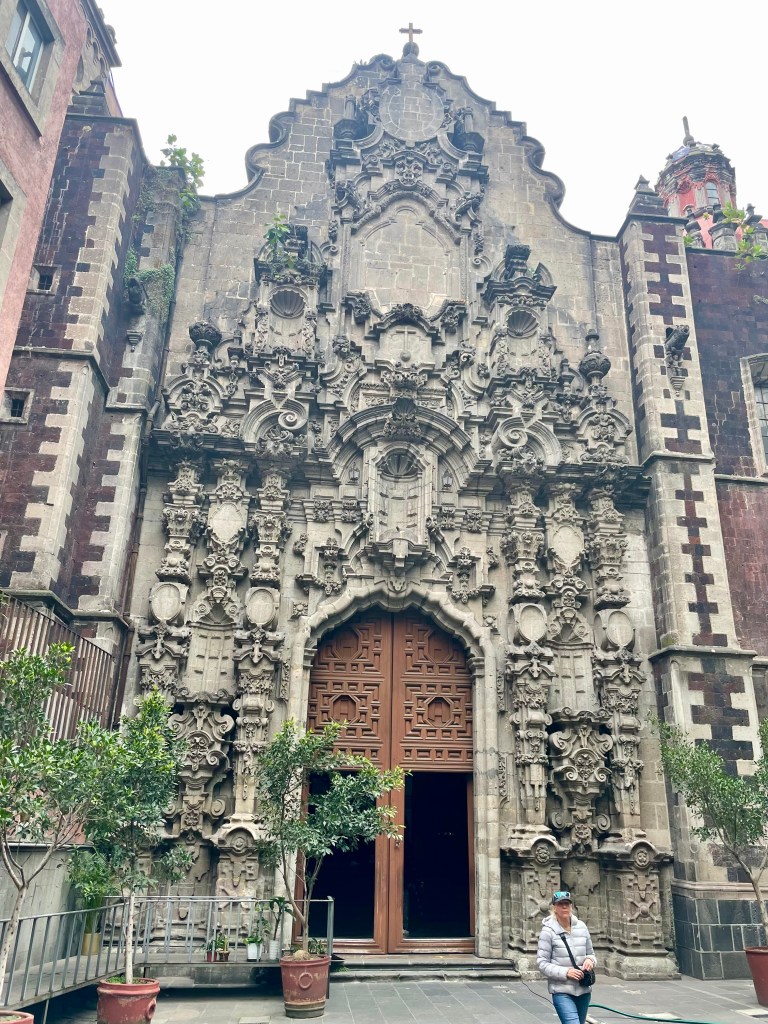
A cathedral in the City Centro.
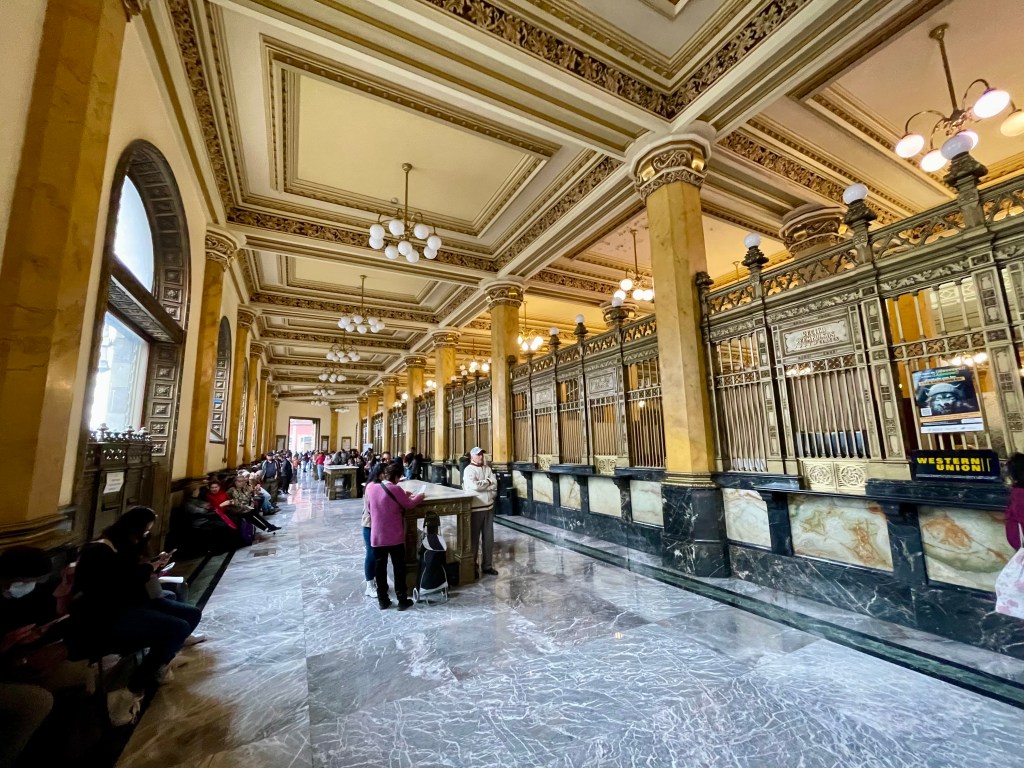
The famous interior decor of the main post office.
The ludicrous circus-like spectacle of lucha libre: wrestling theater. The crowd of 7,000 goes wild at the backflipping, body-stomping, mask-wearing rivalries. It kind of gave me a headache, in a good way.
One of the better pizzas I’ve ever had, even in Italy. Perfection.
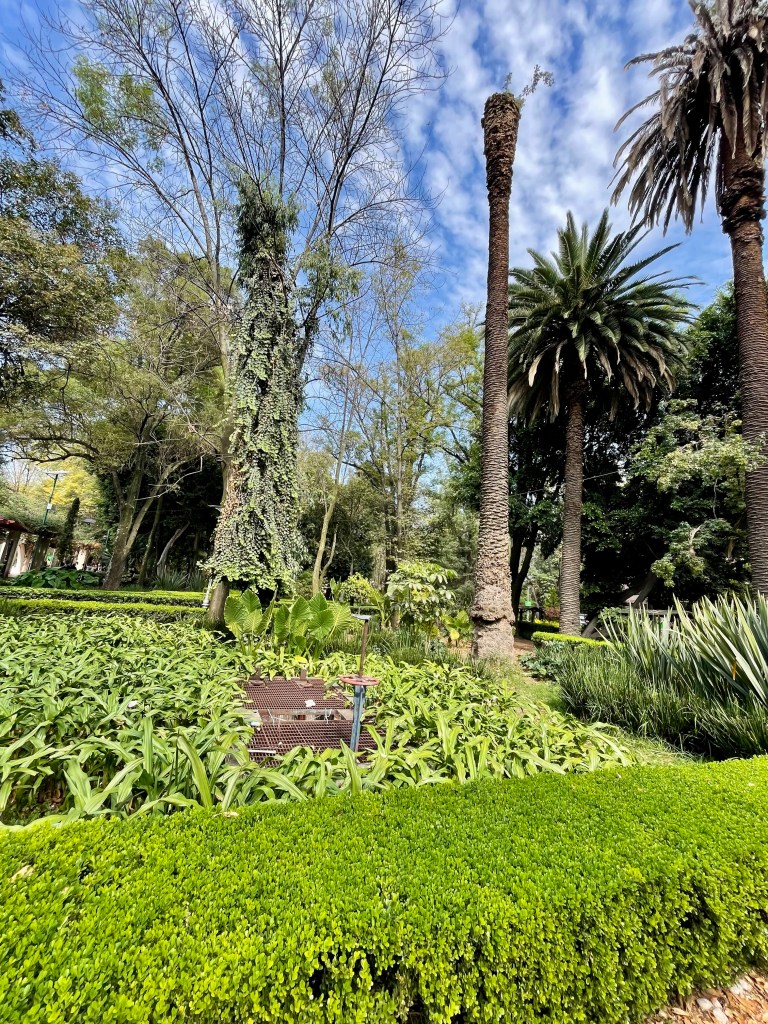
A typical park smack in the city. Joggers, yoga, musicians, dogs, salsa dancers.
Palace of Fine Arts (Palacio de Bellas Artes)
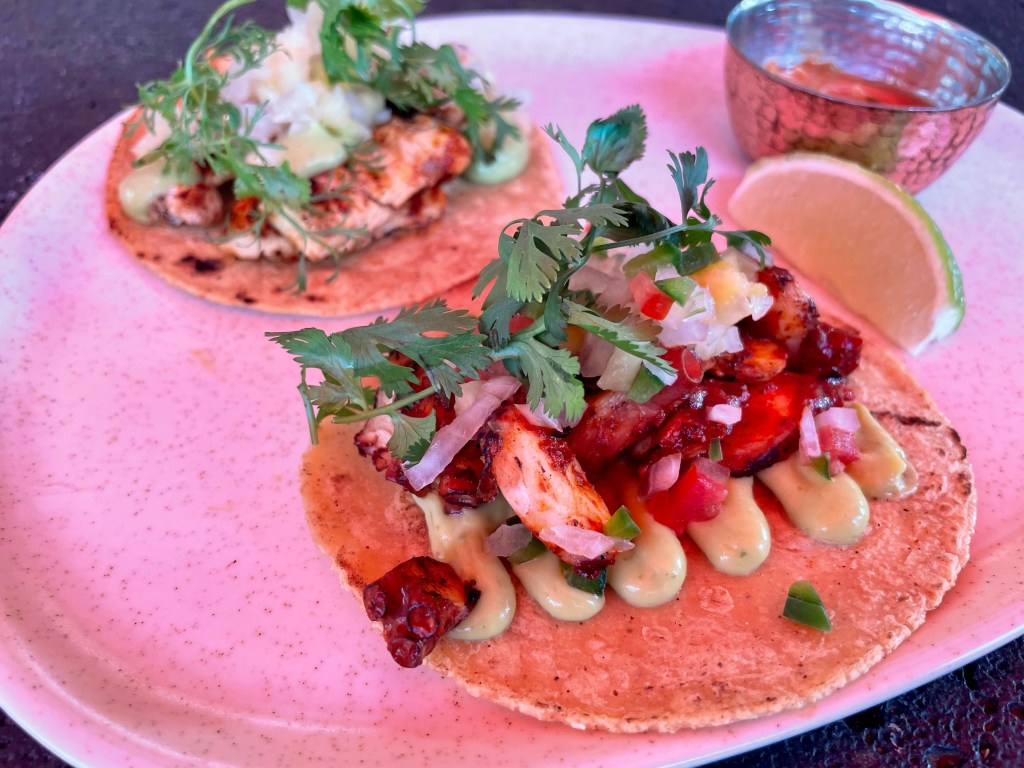
Rear is chicken taco al pastor. Front is octopus al pastor. Awesome.
Breakfast before a three-hour tour of the astounding Museum of Anthropology.
A random facade in City Centro.
Large tortilla chip with guacamole. On top: grasshoppers. Yes, delicious.
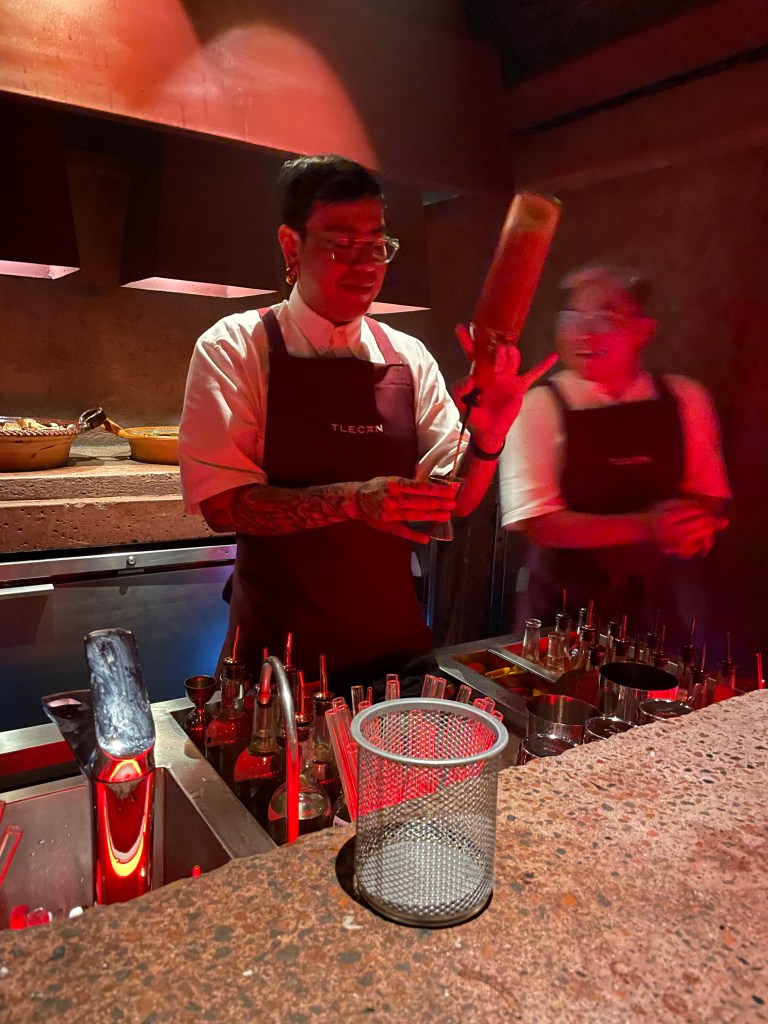
Making me a killer cocktail at Tlecānmezcal bar. It’s ranked #23 in the World’s 50 Best Bars 2025 and #3 in North America’s 50 Best Bars 2025. It, like Mexico City, lives up to the hype. Ultra-modern with a hearty, heartfelt nod to history.
It’s positively pouring rain, cats, dogs, giraffes, and it is blustery, leaf-dislodging, noisy on multiple levels — water, wind, things blown over, gutters gushing — and it’s kind of great, though going outside seems like unnecessary peril. Thus: homebound.
The day before Halloween — can you imagine the poor kids and parents braving this mayhem? — yet things look up for the big bloody day. The forecast is sunshine and 60 degrees. Boo-yah! as a ghost might cheer.
Nowadays the most I do for Halloween is steal fun-size Reese’s from the brimming bowl meant for trick-or-treaters and the parents who steal Reese’s from their children. My Halloween dress-up heyday was when I was Paul Stanley from KISS one year and Gene Simmons from KISS the next. This was during the Reagan Administration, so slack must be cut. Like Marley’s Ghost, I wore metal chains as Simmons. Totally rock.
Damn, it’s like a monsoon out there now. The skeletons on the lawn probably have hypothermia.
On my last blog post, I hinted that Cubby the dog would go well with some guac and salsa. Well, he’s since got a bath — no longer is his scent eau de tortilla chips — and a haircut. He now looks like Moe from the Three Stooges. He’s spiffy and perfumey and the groomer tied a natty bandanna round his freshly coiffed neck. It’s too late for a photo of the transformation; he’s growing out, the bandanna is gone, and already he’s starting to smell like a Taco Bell Crunchwrap Supreme.
Mexico City beckons. I leave in a week for seven days. As always before a trip, I’m angsty-excited, a nervous muddle of dread and joy. Like, what if I catch Montezuma’s revenge, or get mugged at the ATM? Flip side, what if the food (tacos tacos tacos tacos) spirits me to rapture and the locals’ hospitality restores my faith in humanity? I’ll report later on this uncharted adventure. Bet you can’t wait.
It’s been 20-plus years since I read two ecstatically received literary novels — Annie Proulx’s “The Shipping News,” which won the Pulitzer Prize and the National Book Award, and Ian McEwan’s massive seller “Atonement,” considered the prolific British writer’s crown achievement. (I’ve read seven of his novels. He’s spectacular.)
Now. My response to both books, back then, was: meh. What a child I was. I just finished “The Shipping News,” and its deep-grained, lyrical, downright poetic and funny prose carried me along its often exotic world-scapes and among its colorful characters. It’s a trip, and one worth taking. There are a lot of fish.
With “Atonement,” a high-toned, very English story, I have only begun rereading it and already I’m snared by writing that seems crafted with a laser beam, so specific, rich and dazzling, you want to kill yourself, if you care about these things.
The dog smells like a bowl of stale Doritos. The nor’easter is splatting rain and blowing tree-tossing gusts. Our sociopathic “president” continues to appall on a daily basis (no, you’re not getting the Nobel, so shut up). And I have a zit on my forehead that’s festering like Mt. Vesuvius in 79 A.D.
Otherwise things are just super, grand and dandy, unless you consider that Diane Keaton, one of the most charming and beautiful creatures ever to grace the big screen, has died. Crushing. Long live Annie Hall.
I go to Mexico City in precisely one month, though just days before that I have a dental appointment I’d rather not keep but will, because two of my teeth appear to be turning gray (this mad world!). I’m afraid I am becoming wizened.
If you squint really hard you can squeeze out some of the bad news and unfettered horrors — Gaza, Ukraine, the new Spike Lee movie — unfurling across the world. But it’s not easy, and almost certainly not possible.
But back to the one kernel of okay news, my vacation in Mexico City, a full week in November. I’ve been booking tours and making reservations with tentacular zeal. And I’ve also been uprooting prior plans. In an earlier post I mentioned that I registered for a tacos al pastor cooking class, a splurge and a mash note to my favorite taco.
Well, I nixed the class (sorry, Anne R.!) for two expeditions: one a three-hour guided tour of the National Museum of Anthropology (sounds deadly, but I’m assured it’s essential) and the other a festive, three and a half-hour Tacos and Mezcal Tour, whose price tag I blush to share with you. Guess which tour I’m looking more forward to.
Other good news lurks. Fall has fallen, and despite the nor’easter, which is really quite mild in these parts, the weather is totally dreamy. Usually I’m abroad for Halloween — Europeans try very hard to get it down, though it’s still strictly amateur hour there — but I’ll be around this time and that’s a plus.
I dig a good monster mash. I also like all the costumes that I can’t tell what the hell they’re supposed to be. Is that a ballerina werewolf? I hope some savvy kids deck out as Annie Hall: men’s tie, vest and khakis, and that wide-brimmed hat. Sartorial genius. They can flummox all their friends who still dress in Pokémon.
On a side note, what ever happened to the smashed pumpkins in the street? In my day, that was as mandatory as begging for goodies. Kids today. So thoughtful. Or clueless.
I guess in the end that’s also good news. Smashing Pumpkins is a great band — pay special attention to the superhuman drummer — but smashing pumpkins is just boneheaded vandalism. Thus I hesitantly cheer its extinction.
Good news and bad news will always share a table, so we’re kind of stuck. Israeli hostages are freed (yay). Diane Keaton dies (boo). Leaves are falling with the temperature (yay). Jeff Tweedy releases a solo triple album (boo). Paul Thomas Anderson’s new movie, “One Battle After Another,” is an apparent masterpiece (yay). Oh, and the dog. Yes, the dog. He really needs a bath (self-explanatory).
















 GNASHING.