The Portugal slideshow continued from the previous post …


WONDERING. WANDERING. WHATEVERING.

The Portugal slideshow continued from the previous post …
I about had a stroke scaling the steep medieval alleyways of my ‘hood in Porto, Portugal, last week, fuming at yet another of life’s inconveniences — precipitous hills! The humanity! — while clutching my chest and wiping my brow.
It was the same in Lisbon’s Alfama area, the capital city’s coolest, oldest, most mazy residential neighborhood, cut through with endless perpendicular hills and narrow passages. I am either desperately out of shape or the Portuguese are sadomasochists. (The former, decidedly.)
These are not complaints. These — crippling strokes, premature heart attacks — are symptoms of the kind of euphoria travel so uniquely delivers, and what I experienced during a week split between Portugal’s two largest cities, Porto and Lisbon. Considering strokes and such, you could say the trip was to die for. I was smitten the entire time.
I’ve been to much of the continent and Portugal reverberates with a different European tang that’s refreshingly, truly Old World. The people are amazing. And, except among many hacking, shriveled taxi drivers, English magically appears whenever you need it. It’s a country of nuance and contrast, urbanity and tradition. And with crazy luck, gorgeous January weather of cobalt skies and 60-degree days, everyday.
Both cities exude singular flavors. Sight-wise, there’s much to see but not an excess. That’s why walking tours are outstanding, taking you deep to reveal the nooks, the crannies, the crooks, the grannies (seriously: old women pop their heads out of two-story windows and chirp, “Bon dia!”). These are pleasant places, vibrant and laidback, and, with their fabled trams/trolleys, rolling hills and postcard waterfronts, redolent of classic San Francisco, my old stomping ground.
My brother asked if I missed a museum-centric city, à la Paris, but I did not. I do weary of so many museums in other cities that can, occasionally, feel like obligations. These cities are all street, with street art, graffiti, cathedrals, tavern after tavern (wifi — what’s that?), earthy food, multitudinous alcohol (Port, wine, Ginjinha!), ankle-twisting cobblestone, claustrophobic side streets, vertiginous hills and slopes, all of it intoxicating.
The streets are brilliantly bad for driving — lots of cobblestone in rattletrap cars with Model T shock absorbers. Sometimes I thought we’d been in an accident, but it was just a thump in the road. Rides are a steal: Uber lifts ran me $3 on average, with taxis still a bargain at twice the price.
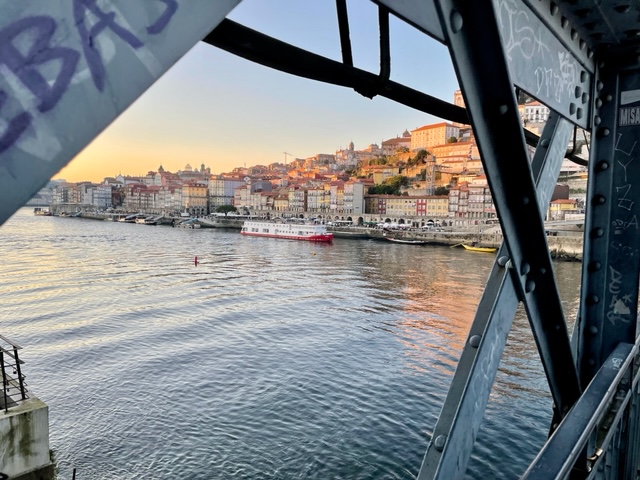
Four days in Lisbon, then a three-hour train north to Porto, which resides languidly in pastel colors on the picturesque Douro River. My boutique hotel, a little alleyway charmer, was smack near the water, where it’s clotted with touristy action, even in January, but not too much. Like the guy with the explosive man bun juggling for tips. I got, but did not finish, a fish bowl of sangria, on the water, in the sun and breeze, while a hippie juggled in the distance.
In both cities the women are dark and lovely and the old men are raisin-faced, unshaven, bent over, sweater-clad, with baggy pants and newsboy caps — exactly how I hope to turn out. One day I had two female servers who possessed hairier arms than mine. As a man of Portuguese heritage, I almost cried with respect and admiration. They put my Aunt Silvia to shame, never mind my Uncle Johnny.
The Portuguese language is enchanting, musical, soft around the edges, like cookie dough. It has notes of Spanish, Italian and Russian, dappled with flower petals. It’s fragrant, easy on the ears and I know all of four words of it.
I found these twin cities fresh, novel, relaxed, uncrowded, winsome. Really, from the fine hotels to the affable people, authentic atmosphere to gushing hospitality, legendary history to rapturous food, Portugal is in my travel pantheon. It’s real Old World material. Humble but proud, and never pushy or arrogant. And always something beautiful.
Onto the slideshow, continued in the next blog post …



For all my previously stated apprehensions about the upcoming trip to Portugal — I leave in four days, with unease about how wonderful it will be — I’ve found some solace reading journals from my last Portugal journey, more than 15 years ago. Poring over the pages, it comes back to me: the rolling, vibrant cityscapes, the bonhomous people, the embracing Old World charm, the generously poured Port. What am I worrying about?
Here I am on my arrival in Lisbon those many years ago:
“Beautiful, entrancing, even at night. Quickly lost in the dense street maze searching for food. I’m in the Bairro Alto warren of eats and bars — bony alleyways, pastel walls, quintessential old country. Chanced upon a small, dark, red-lit Parisian-style bar filled with young, mellow boho types. Incense burning, jazz playing, modern art, movie lobby cards. Very hip but stripped of pretense. The basso hum of lively conversation. I am jet-lagged, spaced, zonked, enraptured. I am deranged with travel. It is sublime.”
Fueled by jogged memories — just in time — my enthusiasm for this trip gladly spirals. The journal, scribbled in blue ink and dappled with doodles, proves an encouraging record of a good trip, leavening heavy thoughts of the future voyage with hope and anticipation.

I adored Portugal, though I must admit I wasn’t totally taken with its high-altitude fairy-tale town Sintra, with its cupcake castles and princely palaces and perilously steep hills that about sent me into cardiac arrest. My visit, I wrote, felt “mechanical,” the buildings “precious,” the whole joint a tourist trap of ersatz charms. The sylvan setting was nice, however, so green and lush and tall.
We must be reasonable. Travel inevitably presents the occasional hiccup, and you can do far worse than pretty Sintra. It’s all part of the adventure. Like this meal in Lisbon I noted:
“Dinner was ‘Typical Portuguese Sausage.’ But only a third of it was the kind I know and love; the rest was wretched: red, and mushy like squash, and black with bubbles of tough fat. Didn’t eat the pasty ones and tucked the others in a paper napkin so the lovely owner lady — ‘Is it good?’ she asks; ‘Delicious,’ I lie — wouldn’t know. I threw them outside. I hope a dog found them.”
Note to self: try the blood sausage again. You might like it. Older, wiser, and all.
And that’s how I’m taking this whole trip, equipped with wider eyes and hard-earned wisdom. The last Portugal visit also included a few cities in Spain and Morocco. This time it’s two places in Portugal — Lisbon and Porto — and that’s it. Seven days of focused voyaging, all of it, I think, I hope, divine.

“They’re nice to have. A dog.” — F. Scott Fitzgerald
Splayed on his back like an overturned tortoise, the dog snores in staccato grunts and fluttering wheezes that are violent enough to startle. Sounds of strangled kazoos, squashed whoopie cushions, warbling carnival organs. He’s a racket, a veritable Concerto for Broken Squeeze Toys, but who would interrupt these guttural snorts of puppy pleasure?
I, for one, enjoy the cacophony. Let sleeping dogs lie, they say. And groan and grrr and croak and rasp. In a way, it’s like the gurgling of an infant, adorable, musical, slightly alarming. It shows the critter’s vim and vigor. And his ability to emit really strange sounds while passed out and dreaming untold tales of fleeing postmen and the earthy fragrance of his fellow hounds’ sphincters.
Cubby the dog stirs. He stretches, this bushel of gray curlicues, letting go one big shuddering whine, as if the stretch pumps out a kind of yawning release. A gusty nostril exhalation and he is awake, eyes ajar, head up, tongue licking the air.
And there, he sees it. His toy, his fresh bone from a Christmas lode of new chews, this one his favorite: a bully bone, which is, literally, a dried bull penis. It looks like a thick rod of beef jerky. It looks, happily, nothing like bovine genitals.
The brown stick is upright between the dog’s front paws, like a cocktail straw in Cabo, and he gnaws it with slobbery gusto. Cubby is a jealous owner. If one of the cats gets within six feet of an idle bully bone, the small dog pounces and chases off the feline, who has no idea what Cubs is on about. The cat’s thought bubble is clear: Good Christ.
Soon, a human bleats the word “out” at Cubby, a word as magical as “open-sesame” or “Beetlejuice” for its causal powers. It means, of course: Let’s go for a walk. Once you say it, there’s no going back. The dog is leaping, yelping, scraping your legs, doing the famed doggie dance that only the coal-hearted can resist.
The walk. An exasperating stop-start excursion, all sniffs and pees and poop, with little in the way of aerobic exercise for the human, making it that much more maddening and futile. But this is for the dog. It’s all for the dog. This doggie bag is not for restaurant leftovers. It’s for dookie, see. For the dog.
Fortunately, dogs snooze with comatose abandon. They’re shameless about it. Insomnia is not a thing with dogs. Cubby does not require my melatonin; he is naturally anesthetized. A soft surface will do. Give him two minutes and he’s out, limbs jerking, squiggly noises emitting from a twitching snout.
He is rather musical in this state. If you press his belly just so, you’ll get a fine bagpipe rendition of “Free Bird” for your troubles.
And it’s always worth the trouble, dogs that is. Barking, scratching, on that rare occasion peeing on the carpet — I can’t think of many canine crimes. Cubby’s got it pretty much down, the dog thang. He might sleep like a rumbling volcano, but he also shows a quiet nobility — an aplomb befitting his rich, regal beard (really, it’s the beard of a meth-head, or Manson) — that makes you look on in adoring awe, and indisputable respect.

2020 bit, hard. Somehow 2021 was just as rotten. 2022 looms — turn the page and all that. Don’t hold your breath. It’s going to be another shit show.
What’s been on the menu of wonderfulness? In short: family deaths, illness, Covid and its spawn-of-Satan variants, political/racial/social outrages, chronic insomnia, that gnarly pimple on my forehead last summer — the usual maelstrom.
Complaining about, even inventorying, these things is by now beyond trite. So we saunter ahead and seek purpose and palliatives, things that distract and dull the pain.
Like … hell, I don’t know. A stiff drink? (Yep.) Christmas carols? (Bah!) How about just a mindset adjustment, a way of looking at the world in a soft-focus haze rather than the cold, klieg-light glare we’re currently deploying?
Things are pretty bad, but for most of us, most of the time, they’re not catastrophically bad, are they? Maybe they are. I’ve had my share of catastrophes in these gloomy times — some bad, some badder — and yet I’ve still found resilience, wisps of hope.
It’s a matter of focus and self-possession. If at all possible, we need to mellow. Take a deep breath wrapped in a sigh. We’re starting to hit the I’m-over-this-shit button, yet we’re in for more bone-cracking cold. Hang tight. But not too tight.
Maybe this is a call for self-improvement. For our quirks and foibles — our hideous flaws — to get tweaked and kneaded into something softer and more accepting. And more helpful.
Me, for instance. I own a roiling anger that springs from fighting life, resisting and pushing, sparking off it, flint-like. I strain and recoil, writhe and seethe. It isn’t helping. I need to cork it. Clonazepam does only so much.
I don’t do New Year’s resolutions — hardly a novel stance — but if I did one it would be to ride the next wave with the mettle and determination of that young surfer who got her arm bit off by a shark but keeps on shredding half-pipes like nothing ever happened. Limbs are missing. Still, we carry on.
At long last I need prescription eyeglasses. I figured it, the doctor confirmed it. I am the most olden and wizened man on Earth.
And yet I am not devastated. I am hardly ruffled, didn’t even blink. I’ve been wearing reading specs for some time now, used namely for books, food labels and computer stuff, and without which I couldn’t type these words and how that would break your heart.
I can see people, cars, trees, raccoons and the general environment with spectacular clarity. No one appears fuzzy like a gelatinous apparition or a melting snowman. In fact, I’d reckon my vision is at least 80 percent normal and healthy.
Yet, as I have just learned, I am clinically far-sighted: objects at a distance are clear but those up close, like book pages, laptop screens and microwave buttons, are distressing smudges. They look like amoebas, or roadkill.
So this week I elected to get a fancy, full-blown eye exam, my first in about 15 years (and my second ever). I pictured, blurrily, a speedy, comfortable procedure featuring paper eye charts and other quaint peepers paraphernalia.
Instead, for almost an hour, I was subjected to a harrowing battery of high-tech tests featuring Kubrickian contraptions, yellow-dye eyedrops, blinding photos of my wide-open eyeballs, all while being ushered in and out of apparatus-cluttered rooms by two assistants and a doctor who maintained a scary, chirpy detachment. The lab coat, an unsettling touch.
Eventually, I was done. I blinked about 585 times, wiped the gooey yellow dye from my lashes, examined, with the trio, disconcerting snapshots of my bulging, bloodshot orbs, and listened to the dilated diagnosis. I am going blind.
No, but a prescription was prescribed: progressives. These are glasses, or specifically lenses, or, as I snatched off the web: “a type of prescription eyeglasses that let you see your whole field of vision without switching between multiple pairs of glasses.” That’s a bit reductive, but it makes the point.
The upshot: I need real glasses.

At least I sort of know what having glasses is like, what with my onerous readers and all. Those I have to fetch and fumble for, be it at home or in the tahini aisle at Whole Foods, or at the ATM, etc. (and that’s a very long etcetera).
The new glasses I ordered will be glued to my face with utmost convenience and questionable aesthetics. I wanted dark blue, even cobalt, frames, and I selected a blue-blackish pair from the sterile racks and rows of spiffy eyewear. The frames run pricey, the lenses even more. Discounts are involved, so the damage isn’t blinding. Still, the money might be spent more festively on my approaching voyage to Portugal, on, say, museums, or octopus platters.
Color me excited. Blurs be gone. The whole world crystalline. Granny glasses, the cursed readers, in the dustbin. I foresee all of this, and I haven’t even tried on the new glasses. I envision a brighter future. I call this far-sightedness.
I never liked horses. I have my reasons: The massive height and rippling musculature. The crazed eight-ball eyes, rubbery mouths and domino choppers. The lurching giraffe necks and screeching neighs. The rearing, kangaroo-punching hooves and kicking hind legs. The bratty obstinacy. The abundant, free-falling poop.
Frankly, horses scare me. I’ve rode horses. It’s like riding a displeased minotaur.
For all that, I don’t hate horses. But I know someone who does. That’s the person behind the website I Hate Horses, which is now, sadly, just a lowly Facebook page. The writer launches with “I hate horses. They are stupid, fat, nasty, brainless wasted space in this world.” It doesn’t get much more erudite than that, I’m afraid, though some of the rants are funny despite the inescapable barnyard humor.
What spurs this little blog post is a line by journalist extraordinaire Susan Orlean in her new essay collection “On Animals.” She writes that as a child she experienced “that golden moment when I, like millions of young girls throughout human history, fell into an adolescent swoon over horses.”
Why is this? It’s a fact that many young girls become smitten with those glossy, galloping pasture pets. Growing up I knew girls who collected pricey model horsies that stood in regal poses and, if lucky (or rich), actually owned one or two of the animals. I, who was busy burning model airplanes and catching snakes and listening to KISS records, never grasped the fascination with the big snorting beasts. Dogs, yes; horses, nay.
And yet horses exude an undeniable majesty, a strange, ravishing nobility that can only be summed up in the fancy word equine. They are shiny, demonstrably wise (watch them buck dimwit riders), tough, fast, strong, with billowing manes and dancing tails, despite an overwhelming perfume of hay and horsiness.
I’ve ridden these gorgeous monsters, these mythological creatures that might have sprung from Homer or Ovid. It was not pleasant. In Egypt I rode a dumb, galumphing camel that gave me more delight. I found the horses disobedient and nearly uncontrollable. I cursed them and dug my sneakers into their ribs. I am surprised they didn’t hurl me off onto the dusty plain and stomp me to death.
I’m no cowboy, and farms are as foreign to me as, say, the opera stage, or a Lamaze class. Horses may not be my thing — there are horsey people and sane people — but I appreciate them for their might and mystery. They are wondrous but weird, and they definitely have a demonic streak, but I kind of like them for that, too. Giddyup.

On a frigid fall weekday, I strolled to the library, determined to slow down my crazed buying of books by borrowing some instead, and I suddenly tripped and fell, all but face-planting on the cracked concrete. The wind swirled. Snowflakes fluttered, constellations of falling stars. I clutched my knee and whined like a baby infant. God wept.
Everything okay, I rose, did the ritual dust-off, and walked on, wearing a pinched wince on my unscathed puss. I casually looked around, praying no one saw.
At the library, I had work to do, books to seize. Recently, I had the throbbing urge to re-read “Beloved,” the Toni Morrison classic enshrined as one of the greatest works of literature of the 20th century. Slavery, infanticide and malevolent ghosts — fine holiday reading. Found it, grabbed it.
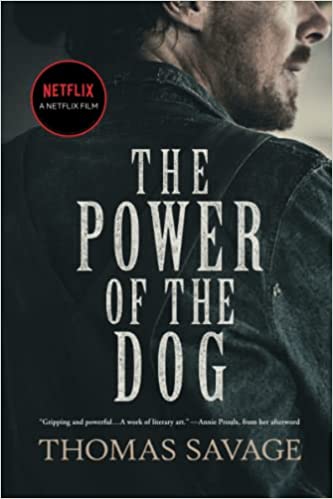
Oscar chatter circles Jane Campion’s new film, the spare, unsparing western “The Power of the Dog,” starring Benedict Cumberbatch. For that, the 1967 book it’s based on, by the unsung Thomas Savage, is receiving renewed attention. So I also got it. (And I read it. It’s terrific — all searing psychological grit with a blindsiding twist that will snuff your dreams of ever becoming a cowboy.)
I’m hot and tepid with novelist Lauren Groff — I quite liked her novel about a utopian commune “Arcadia,” but found the acclaimed marital dissection “Fates and Furies” ordinary and wildly overrated. Still, I’m going to give her latest super-hyped novel, “Matrix,” a shot. So I got that, too. It’s a character study about a young woman who discovers love and feminist agency in an impoverished abbey in 12th century England. Sounds … intriguing?
Heading to Portugal soon, I picked up Portuguese literary eminence and Nobel Prizer José Saramago’s “The Gospel According to Jesus Christ.” This isn’t Saramago’s most famous novel — that would be “Blindness” — but it’s kind of better. It’s a mash-up of the four Gospels with Saramago slyly, ironically and contempletively (and controversially) filling in the mysterious, nettling voids of those holy books. He presumes and vamps on what Jesus did in his childhood and adolescence, up to his grisly demise on the cross with a skeptic’s impish wit. I loved the book. I loved the shivery last line: “But what Jesus did not see, on the ground, was the black bowl into which his blood was dripping.” Human, all too human.
Elizabeth Strout knows humans. Author of such intimate, character-driven novels as “Olive Kitteridge” and “My Name is Lucy Barton,” her prose is lean, literary and deeply felt, homing in on individuals, real people, with an empathic laser beam. She banishes cynicism for a rare authenticity that invites organic joy and pain. Her latest is “Oh William!” (oh, that title!), a continued riff on characters from “Lucy Barton.” Lucy and her ex-husband William reunite platonically for what’s inescapably called a journey of discovery, one with neat, homey zigzags that ring hard and true. Its humanity is unassailable, its humor wry, its imprint lasting. That’s another book I got.
I scored that day among the teeming stacks, under the florescent mists. Five books essentially for free is nothing to smirk at, and my luck seemed boundless, until it wasn’t. I couldn’t find Franzen’s latest family blockbuster “Crossroads” or John Gardner’s cult classic “Grendel” — an ironic tale told from the point of view of the aggrieved monster in “Beowulf” — or Elizabeth Samet’s “Looking for the Good War: American Amnesia and the Violent Pursuit of Happiness” and, gee, doesn’t that sound like festive holiday reading, not unlike “Beloved”?
In my book, oh yes, it certainly does.
I have a cold, all the pumpkin pie is gone, and my pants are dirty. Still, Thanksgiving was fine, just grand, as we did all the gathering, eating and digesting (Macy’s has the floats, we have the bloat) called for on this most misunderstood and head-smacking of holidays, in which hysterical myth supersedes historical fact.
Massacres, disease, the galling absence of quality cranberry sauce — I won’t get into the lowlights of the so-called First Thanksgiving. Think rather turkey, stuffing and pie obtained in an annual pilgrimage to Whole Foods, pun most sincerely intended.
It’s a whitewashed affair, with thoughts totally not on the brutal realities of 1621 and more on unabashed gluttony, soggy family movies and, for the yahoos, grunts from the gridiron. Put the guy carving the turkey in suspenders and a bow tie and you’ve got a Norman Rockwell painting.
Sounds unbearably wholesome. More like ho-hum-some. Which is how I like it. Give me low-key and low-pressure — you know, Covid-sized shindigs — over the flustered festivities of my childhood. That’s when long-lost relatives converged in fragrant farm towns for queasy parties featuring a veritable rogue’s gallery of relations, from fawning, darling grandparents to scofflaw second cousins. (I’m looking at you, Billy, the toothless terror.)
Those were the days, until they weren’t, and I am glad. Though I’m not pleased about the pesky cold I somehow caught out of thin, albeit chilly, air. I’m all snot and snorts, hacks and honks. It’s hardly incapacitating — if someone said let’s hit the slopes or jet to Spain, I’d pack in five minutes flat — but it is annoying. Waking each morning I feel mummified, rising from a death slumber, swaddled in phlegm.
Thanksgiving has always been entrée to the big kahuna of holidays, Christmas, much as, say, Harry Potter’s been a gateway drug to genre realms for an entire generation (and for many stunted adults), be it to fantasy, sci-fi, Marvel or manga.
But I digress. Thanksgiving kicks open the wreathy door for the even more brazen fantasies of Christmas, which has also lost its historical meaning, drowned in an ocean of twinkly, tinseled fabulism animated by sardonic elves and sexless singing snowmen. Look closely, waaay in the background, and you might spot a slight bearded fellow whose birthday this supposedly is. He’s the one waving meekly.
The power of myth prevails on some of our biggest holidays. (Easter. Sigh.) But that’s what we’re there for — entertainment, merriment, community, ritual (not the deep, religious kind, but the fun, Chardonnay kind), and the weird random fairy tale that will keep the kiddies hyperactively interested.
But here’s the truth: there is no Santa Claus, there is no Easter Bunny, there is no Great Pumpkin and there is no utopian First Thanksgiving sit-down. We all know this. Nobody cares.
What we do care about isn’t trivial, it’s familial. It’s a little indulgent and, well, a lot ignorant. Yet it’s merry and nourishing. And, no matter a cold and some carping, it counts.
As I’ve mentioned about 32 times, I’m going to Portugal in January, another far-flung journey, a big bite of exoticism and edification, of soul nourishment and reckless indulgence in the name of peripatetic pleasure. I’m absolutely thrilled about it. It’s going to be terrible.
I’m riding the old seesaw of doubt and delight I always teeter on once I’ve bought my ticket and committed to swanning to someplace faraway, a jaunt that could be brilliant or a bust. I’m giddy. I’m aghast.
After a two-week flurry of excited planning for Portugal — I booked neat boutique hotels, cheap tours, acclaimed restaurants and compiled a list of things to do and see — here’s what I wrote in my journal the other day:
“I don’t think Portugal is going to be that great. The giant swell of energy I had for the trip has fizzled. And yet I’m still all about it and I kind of can’t wait.”
Three sentences oscillating with exquisite ambivalence.
The initial bloom of enthusiasm wilts into a kind of premature burnout. I’m two months away from the actual trip and already I’ve invested too much time, energy and money on a mirage. Waiting, I stew.
It’s not about this particular destination. It’s about all destinations, be it Japan, New Orleans or my recent trip to Paris. I get loopy, worried that all my anticipatory energies are for naught. What if it’s disappointing? What if I get in an accident? What if, god forbid, it rains? What am I doing? Refund!
This worry-wart-ism, this privileged angst mixed with delirium, has me up at all hours researching and reserving and sometimes, in fits of bleary-eyed buyer’s remorse, canceling flights only to rebook them the next morning when I’m a mite more sane.
Portugal ain’t Paris, and its comparatively modest offerings — a smattering of churches, a few museums, breath-stealing views, spicy sausage and smoky sardines — distress me. I’m going to the two largest cities, Lisbon and Porto, and both seem a little sleepy, more scenic than interactive, more walk-y than do-y.
Still, I look forward to a long tour of labyrinthine Alfama, Lisbon’s oldest, most atmospheric neighborhood, and hopping classic Tram 28, rattling up city slopes the color of Easter candies (see below).
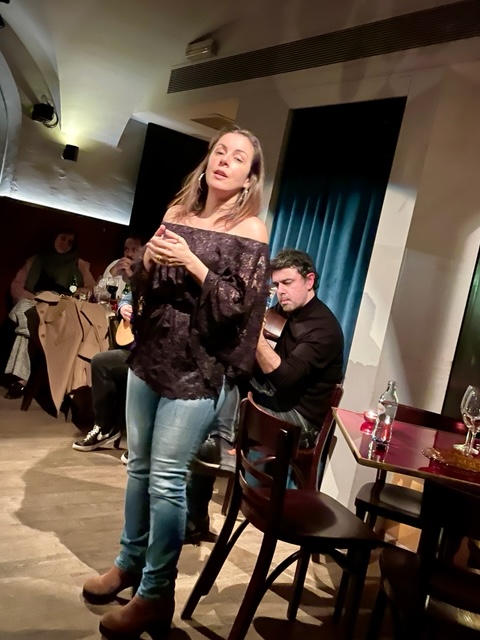
In Porto I’m doing a fancy port tasting and taking a celebrated food tour. I’ll hear fado in a cavern-esque club. (How much fado singing I can take is a whole other matter.) And Portugal’s famed chocolate chain Chocolataria Equador — I’m there. (I’ll have the Dark Chocolate with Gin, por favor.)
Then there’s the people, always the people. I’m sure I’ll be saying obrigado (thank you) profusely.
The juices flow again just typing those words. I’ll always feel a churn of emotions about each journey — I’m a stubborn realist — so it’s about harnessing the positive and running with it. I have a good feeling about this. I think.
No matter. It’s happening. I’ve done my homework and charted the trip in almost granular detail. Everything’s in place. (I think.)
Now I stand back, sit down, and wait patiently, with or without a hearty supply of Xanax.

 GNASHING.