Summer’s roar and pour

The sounds of summer: little girls shrieking in the park; the ice cream truck’s old-timey jingle-jangle; the living room fan’s sighing thrum; the glassy clank of the ice dispenser; the dog’s whistling nostrils as he naps to cool off.

Meanwhile, the sky is about to explode. 

Cool Whip clouds froth and darken, snuffing the sun with enveloping shadow. Then: thunder snaps and growls like splitting wood, and plump raindrops slap hard surfaces. 

It’s 90 degrees and, like that, it’s pouring and roaring. The sounds of summer. 

Only an hour ago I was walking in woolly humidity — the kind of goop that makes the small of your back immediately pool with sweat — under partly cloudy skies, typical summer climes on the East Coast. Which means, wear smart shoes and pack an umbrella.

No one cares that it kissed 100 degrees yesterday. Cloudbursts and thunderstorms are coming — have arrived — and while climate change is partly to blame, this is rather normal atmospheric behavior here and now.

I am so happy. Rain douses the heat, and temperatures can drop 20 degrees in less than an hour. Summer, foiled again! Lightning, so dazzling a sight, rakes bleak skies, and thunder makes Wagnerian drama.  

But they’re fickle, these wet, boisterous storms, with fitful, stop-start rhythms. Fooled into thinking one has passed, I jump at the chance to walk the dog.  

It’s hot as hell. The sun blazes — until it doesn’t. Shade suddenly blankets everything. Rumbles and cracks, those sounds of summer, augur trouble.

We get soaked. 

All dolled up

When I was 8, I picked out a stuffed seal from the gift shop at SeaWorld in San Diego. He was gray, firm and fuzzy, and I promptly named him Salty using all the imagination my tiny head could muster. (Seals live in the ocean. The ocean is salty. Voilà!) 

I owned a sprawling menagerie of stuffed animals, including Bugs Bunny, Snoopy and this cruddy sawdust snake I won at a carnival, but Salty immediately became my favorite. When I accidentally spilt milk on him, I erupted in tears. I liked him that much.

A handsome fella with a minimalist design — nubby flippers, dark glass eyes, a few canine whiskers — Salty beat out Bugs and a hand-me-down teddy bear as my preferred plush, realigning the delicate balance of the toy hierarchy. Indeed, during my last move, I donated all of my stuffed animals except Salty, who even now sits out, visible to all. He radiates pinniped pride.

Salty on the left (stern as always); Bugs; and the ancient, loved teddy bear I was given

Salty had it easy. His job was to be an object of cuddle-osity and little more. I never drafted him for elaborate games or humiliating role-playing frolics. He has an almost comically serious face, and I could tell he would brook no foolishness. 

I left that to my, huh-hum, KISS dolls, creatures that were all about foolishness. Infected with the KISS bug before I turned 10, I greedily got my hands on the original dolls of Gene, Ace, Paul and Peter and was thrilled. I built them a big stage trimmed with Christmas lights. I never used it.

Because what does a non-collector — the dolls’ valuable packaging went straight into the garbage — do with plastic figures of rock stars, who also happen to be comic book heroes? Well, you play dolls, naturally.

The original KISS dolls

This is where I look sillier than usual. My next-door neighbor Joanie, a year older than me, owned the requisite Barbie and Ken dolls. I brought over the KISS guys and we dreamt up a scenario of Ken secretly being Gene Simmons without make-up, and then, when his superhero powers were conjured, I’d pull out the Gene doll. 

And there you have the presto-chango transformation from a blonde beefcake Republican to a hairy, tongue-wagging Neanderthal who belches blood and exhales fire. 

Lest you think I only played with a stoic seal and kabuki-faced clowns, my brother and I also wrung creative mileage from a caped Evel Knievel action figure (including a small motorcycle); a doll of sensible chimp Cornelius from “The Planet of the Apes”; and, of course, a kung-fu grip G.I. Joe, whose buzzcut fell out when we put him in the bathtub. 

I also liked the thick rubber dude called Stretch Armstrong — he was very stretchy, pull, and that was it — who met a grisly demise when, out of pure boredom, I sliced him open and synthetic pink jelly oozed out. (I think my plastic Army men found a gnarlier fate: I lit them on fire and watched them melt into gooey puddles.)

Only Salty survives. His plush playmates are somewhere in the Salvation Army ether, hopefully finding good homes, many, like that pitiful carnival snake, probably sacrificed to the incinerator. The KISS dolls are somewhere, packed away. I think. I don’t really know. And I kind of don’t care. I don’t exactly have any friends who’d want to play dolls with me anymore.

Perched in the open like a noble sphinx, Salty is none the worse for wear (the milk didn’t stain him; my tears might have). His whiskers are slightly bent out of joint, and he could maybe use a dusting. 

Otherwise, that stuffed stalwart hasn’t aged a bit. In so many ways, neither have I.

‘Girls Gone Wild,’ stripped to its essence

Back when I was a roving cultural reporter and movie critic for a Texas newspaper, I was assigned the dubious task of covering the arrival in town of the “Girls Gone Wild” crew at a local dance club. Pointing a throng of cameras at a small stage, the “GGW” crew cajoled local women to partake in a strip contest with cash and travel awards. No matter your morals — it’s complicated — I viewed this as a curious sociological excursion.

This is how the night went down, and how I put it into words …   

Lauren is not getting naked. 

Somehow, the bleached blonde with a toffee tan thinks that a girl can get wild without really getting wild. That in this day and age a girl can attain most righteous wildness by spurning the fundamental step of giving the public a peek. 

What gumdrop world is she living in? 

When the video cameras from “Girls Gone Wild” come to your town — and they came to Austin the other night — there are certain expectations, and every single one of them has to do with bare skin. The “GGW” cameras do odd things to young women. Naughty things. Namely, they inspire women to lift their tops and expose themselves, often while their tongues hang out sloppily. This is called wild. 

Not, says Lauren. 

“I will not be showing (anything). Absolutely not. No way. It’s called ‘Girls Gone Wild,’ not ‘Girls Gone Naked,’ ” says Lauren, who, like many in this story, withheld her last name. The 21-year-old with a leonine mane of yellow hair and jeans low enough to reveal lots of red silk thong works at a bar and is studying to get her real estate certification. 

“I don’t look down on any girls who are wild enough to do that. To each her own,” she says. “But that’s just not my style. You’ve got to leave room for the imagination, you know.” 

Thirty minutes later, Lauren was taking it off. 

There she was, on stage at country-dance warehouse Midnight Rodeo in South Austin, gleefully lifting her Girls Gone Wild mini-tank top for about 700 howling, whooping, screaming, yelling, barking, caterwauling young men, who were apparently seeing their first bare breasts. 

Writhing with professional panache and shooting a carnal glare at the boys, Lauren’s soft-spoken modesty melted, then hardened into Elizabeth Berkley in “Showgirls.” 

Woooo-yeeahh-owww! went the men. 

Ha! went the dozen women on stage. 

The women, ages 18 to 23, were competing in a “Girls Gone Wild” talent contest (is lap dancing a talent?), the winner of which will appear on a “GGW” pay-per-view event. 

The direct-order video company’s Austin stop was part of a 31-city tour that’s brought camera crews to San Diego, Philadelphia, Dallas and Lubbock. First prize this night was $100 cash and an all-expenses paid trip to Panama City, Fla., where the winner will take part in another “GGW” contest. 

It’s a common perception that in party, aka college towns, Mardi Gras has become a kind of open-air flash ’n’ flesh bazaar. Grunting young men proffer tacky plastic beads to greedy women, who gladly, if drunkenly, haul their tops over their chests and under their chins for impromptu peekaboos. The boys go wild. 

Joe Francis, the young multimillionaire who created “Girls Gone Wild,” decided several years ago to bring video cameras to these and similar spring breaky gatherings. Give the girls beads, make them go wild, tape it and sell it. 

“GGW” boasted more than $90 million in direct-response orders last year and the brand has become shorthand for “drunken-girl antics.” “GGW” trades in “normal people” and avoids pros and strippers, Francis says. 

Any young woman will lift her top for the low price of guaranteed male attention, he says. “You’d be surprised, man,” says Francis by phone from his L.A. office. “Every time I go out, I see a girl who I thought would never do it.” 

Joe, meet Lauren. 

“I know, I know,” says Lauren, holding her forehead like a kid who’s been caught breaking a promise. She’s backstage, being escorted by the “GGW” crew to the winner’s circle. Lauren won the contest. 

“It was the heat of the moment,” she explains. 

Sociology of a shirt lift 

“I’m not drunk enough,” says Crystal W., a bespectacled blonde in a white tank top. 

Tonight, she’s leaving the stripping to her peers. “I encourage them. If you have a beautiful body, why can’t you share it with everyone else?” 

Crystal’s friends have been wheedling her to do it all night. “Why do I have to go on stage to do it? I can do it for you myself. I don’t need that extra push. I do it for my friends all the time.” 

Crystal is a good friend. 

On the other side of the rambling, neon-splashed dance hall — where bar servers sling Day-Glo shots in test tubes and a guy named Robert is coaxing his girlfriend Stephanie to get on stage — giggle Amanda Brown and Melissa Dotson, 19-year-old University of Texas students. 

The brunettes are dressed in tight, slight outfits that would pass for loincloths in some cultures. They rushed to Midnight Rodeo when they heard about the event on the radio. 

“We’re lookin’ to be famous,” Melissa says. 

“We get off on it,” Amanda says. 

“We’re not doing it against our will in any way. Not everybody has to like it,” says Melissa. “We’re not porn stars. We’re 19, we’re experimenting, we’re having fun. We’re out there.” 

On stage, Amanda and Melissa gyrate, kiss each other and lift up each other’s shirts. (They eventually take second and third place.) 

The boys hoot with stadium-rock abandon. They slaver and yell obscenities. Their eyes bulge like bloodshot moons. The overall expression on their faces is something like this: !!!!!!!! 

Wes Parnell, a slightly slurring 22-year-old UT student, assumes the role of resident sociologist and human behaviorist. He speaks waveringly, but with confidence. He spies two young women registering for the contest. 

“Oh, they’re going to take it off,” Wes assures us. “They don’t have a choice. When they get up on stage and start drinking alcohol, they start doing things that they don’t know they’re doing. They love it, they absolutely love it. Girls start seeing what the guys think and the guys trick them into doing more.” 

There’s a study of what makes girls go wild waiting to be vetted for psychological illumination. We can listen to Wes, or we can drag in an expert in feminist media studies. 

That would be Mary Kearney, assistant professor of radio-television-film at UT, who explains, “There’s some recognition when you’re a woman in your late teens and early 20s that sexuality is a form of power for you. And for a lot of younger women, it’s the only form of power they have. They are told on a daily basis that their primary goal in life is to get male attention. So if they’re getting it by lifting up their top, so be it.” 

Especially for middle-class white women, Kearney says, “This might be a chance for them to feel sexy in the moment, for girls to be wild. It’s sluttish behavior, and girls might be pushing the boundaries for themselves, to be like, ‘Ooo, I’m wild and crazy!’ Of course, they don’t really understand that it’s a pretty conventional climate for girls and women to be rebellious.” 

We return to the wisdom of Wes. “Girls have such low self-esteem, they need guys to cheer ’em on,” he insists. 

“I don’t have low self-esteem. I just don’t feel like being a slut.” That’s a brunette named Chanbra, who’s been encircled by several boys begging her to join the contest. One of them thrusts a cocktail into her hand. 

“It’s just for fun, just for fun,” says a guy. 

“I know . . .” Chanbra sounds breathless and confused. 

“Just do it. Please,” says another guy. 

“This is the third time I’ve been told to do it, and I’m not doing it. Sorry, y’all,” Chanbra says, and leaves. 

“Well, lost cause.” 

The call of the ‘Wild’ 

A petite young woman named Joanna bolts off the crowded stage mid-show and beats a hasty retreat backstage. She pulls off her cowboy hat and sighs with what sounds like relief. She was fleeing. 

“I couldn’t do that to myself,” Joanna says. “I’m not like that. I think it’s trashy. Looking at the crowd, I decided I’m not putting myself out there as a piece of meat. I’m shaking I’m so nervous.” 

Why was she up there then? 

She was egged on by friends, despite her protests. “I thought it was fun being part of the scene, and then it just got too far.” 

Away from male taunts and chants of “Show your . . .,” Crystal W. looks exhilarated. She wound up on stage flashing the crowd after all.

“I was naked! I don’t know why,” she gasps. “I can’t believe I did that because I come here a lot and I know everyone. Oh, my God.” 

Woodworth was persuaded by her friends, including Kimberly Hyde, who joined her on stage. 

“I’m just crazy like that,” Kimberly says. “It was a blast.”

It’s nothing new for her. She flashes her guy friends upon request. 

“Wanna see?” she asks.

Philip Roth, ranked

Good, bad, worshipful, scandalous — writer Philip Roth is making boldfaced headlines again, four years after his death. His largely acclaimed new biography and its author Blake Bailey are under fire, while publications like The New York Times are issuing fresh appraisals of his almost 30 novels and memoirs, like this and this.

This longtime Roth fan joins the chorus. I haven’t tackled all of his books but I have read his most celebrated titles, from “Goodbye, Columbus” (1959) to “Nemesis” (2010) and many in between. What follows are my five favorite Roth novels, with an obligatory postscript about a glaring omission.

 1. “American Pastoral” (1997) — Roth’s Pulitzer Prize-winner may be the best novel I’ve ever read. It’s deep, thorny, complex, timely and so rich with perception and wisdom — communicated in ferocious, passionate prose — that you’re stuffed after each sitting. But it’s not difficult. Tracing the life of one Swede Levov and his daughter’s radical political terrorism in 1968, “Pastoral” gradually becomes an epic tragedy about recent American history and our hero’s inevitable descent. A biting, indelible masterpiece.  

2. “Sabbath’s Theater” (1995) — Raunchy, stylized, rip-snortingly funny and  aggressively profane, this cathartic gush of undiluted id is Roth at his sweatiest and most swinging, a big bite of eros that “shows off his linguistic verve and his unparalleled ability to stare unblinkingly into the psyche of a depraved scoundrel,” raves one critic. Winner of the National Book Award, this feverish, in-your-face opus isn’t easy, and it shouldn’t be. What it is: crudely sublime. 

 3. “The Human Stain” (2000) — A dean of a college faculty is ousted after he makes a loaded, if ultimately benign, remark interpreted as racist. He holds a shocking life-long secret close to his vest in this, “one of Roth’s most complex moral conundrums,” which came out during similar dramas unfolding in academia and beyond. The book bristles with Roth’s fanged moralism; the writing is poignant, alive, uncompromising. 

4. “Operation Shylock” (1993) — What could have flopped as an elaborate literary stunt winds up one of Roth’s richest masterworks. “His best use of autobiography and his most incisive use of meta-techniques,” a critic writes, “the novel pits Philip Roth against an imposter, a man going around using Roth’s name and identity to proselytize about the necessity for Jews to return to Europe.” Crazy, but that’s its brilliance. Roth’s facility with form proves, again, formidable, his wit and playful intelligence on dazzling display.

 5. “Everyman” (2006)— A meditation on “one man’s lifelong skirmish with mortality,” this slim book, part of a quartet of late shortish novels, marks Roth’s return to the profoundly personal following the speculative politics of “The Plot Against America.” Haunted by death, the protagonist looks back on his life, from childhood, marriage and divorce, to old age and sickness, all the while reflecting on the inevitable — his own impending demise. Bracingly elegiac.

P.S. About that other famous book everyone so adores, the one in which the hero masturbates with a piece of liver: Don’t overestimate the frenzied gimmickry of “Portnoy’s Complaint,a worthy early volume (1969) whose onanistic perversities, both smug and farcical, fuel the novel’s shrill pitch. I like this ribald coming-of-age comedy well enough, but it’s more exhausting than exhilarating, minor Roth at its most breathlessly attention-hailing. It made him a literary star. 

Flipping out for a photo

As I mentioned in a recent photo-centric post, I love taking pictures of kids I meet in my world travels. That’s because, I wrote, “They’re eager, giddy and attention-hungry, all the while laughing and bursting with curiosity, asking questions (‘Where you from?’) and grabbing at the camera with often sticky hands.”

I’ve taken plenty of pictures of Istanbul’s children, a panoply of poses, pouts and play.

Sometimes they’re happy, eager subjects:

Sometimes they’re playful:

Sometimes they’re artfully posed:

And sometimes they’re fledgling rebels, with a wee message for the dope with a camera:

This rapscallion is my kind of kid. There I am, popping my head out of my second-floor hotel room, presumptuously pointing the camera, and getting what I deserve — a little birdie telling me to go fly away, to take a flying f***. Brilliant.

Cryonics — a miracle, or just another coffin?

You’re alive. You die. Your body is then submerged in an icy bath of liquid nitrogen, clouds of frosty fog billowing down the sides of the tank in which you now float in suspended animation. 

The lid is sealed. And there it is: instead of being buried or cremated, you are being cryonically preserved, your body — or, in some cases, just your severed head — enshrined for eternity.  

If you’re lucky — say, the procedure actually works, or the planet doesn’t blow itself up while you’re in deep freeze — you will stir to life again, a muddle-headed Rip Van Winkle, yawning and stretching, wiping decades of goo from your eyes, and, oh, do hurry, brushing intractable halitosis from your maw with cases of Colgate. 

You can hear a delirious Dr. Victor Frankenstein baying, “It’s alive! It’s alive!” The excitement is electric. You’ve been dead — no, you’ve been a “patient,” say the scientists, who spurn the term “dead” — for 25 years. But now, in a miracle out of the most outlandish science fiction, you are, yes, alive. Indeed, re-animated. Forget the cancer. Forget the car wreck. You’re back in business.

Never happen. This is science fiction of the most cynical kind, a laughable, despicable scam convincing the gullible that there is life after death, as long as you freeze your body first. And as long as you cough up (cough, hack) $250,000 for your whole body or $80,000 for just your head. Costs only mount.

These sums come from the Alcor Life Extension Foundation, a major cryonics company in Arizona “built on the spectacular wager that it can rescue its patients from natural post-mortem deterioration until a distant time when cellular regeneration, nanotechnology, cloning or some other science can restart their lives,” writes the Times

Alcor insists it can stop the dying process with cryonics, which it calls — and I kind of love this — “an ambulance to the future.” The company promises “future restoration of good health and reintegration into society for all patients.” 

Alcor has 182 frozen patients and 1,353 members, or living people who give Alcor cash as a sort of pre-freeze down payment. I hear a cuckoo clock in the distance.

This — death — is right up my morbid alley. I think about dying with unhealthy frequency, and, as I get older, the bleak thoughts strike with increasing ferocity. But I am not a life freak. I don’t pine to extend this predicament. I understand it’s all miserably finite. Plainly: I do not want to live forever. Freeze me if you like, but only if I’m placed in the TV dinner aisle. 

And so cryonics seems like so much quackery — misguided, wasteful and patently impossible. It reminds me of “Re-Animator,” Stuart Gordon’s 1985 horror classic in which a crackpot scientist is obsessed with resurrecting dead bodies, with splattery results. The movie was smart, playing the premise for gory laughs. 

I don’t think anyone is laughing — except to the bank — at Alcor and other cryonics outfits. They seem to really believe this twaddle. They believe a disembodied head can bob in freezing fluid and later be reattached to a torso and come to life. This happens in dazzling fashion in “Re-Animator,” but I’ll bet my life (ha) this will not happen to any real person. Ever.  

What if it did? What then? “I don’t want to do it because it might work and I don’t want to come back as a carnival act,” cracked actor Walter Matthau. I’m with the guy who coached the Bad News Bears. What kind of zombie-ish life can a thawed corpse lead after decades levitating in faux amniotic fluids? Are they immortal, or can they die again? Now I’m thinking of another horror movie: “Dawn of the Dead.” 

Yet freezing a corpse and jumper-cabling it back to life will never occur, and never has. Cryonics boasts no success stories. There is no Lazarus in its impoverished narrative. Peddling unabashed pseudoscience, cryonics advocates, and especially those who sell it, are no better than psychics, mediums and tarot card hucksters, ethical, religious and legal issues be damned.   

And who knows what nefarious schemes cryonic patients have cooked up before they died. As with anything, there are surely some bad people swimming in those tanks. Like disgraced, sex-trafficking financier Jeffrey Epstein, who wanted to have his head and penis frozen after death so that he could “seed the human race with his DNA.” 

Ick. 

When I think what I would do if my life was extended cryonically, I first see a long, leisurely trip to France, one of the most gorgeously alive places I know. If friends, family and doggies were still living — remember, I could be floating in a tank for decades before scientists figure this thing out — I would reunite with them with big, stiff-limbed hugs (I also see extensive and excruciating physical therapy after years of immobility).

Everything would have changed. My nephews might be old men — older than me when I died — making for some acute interpersonal awkwardness. The whole thing sounds messy, difficult and expensive. And, fortunately, utterly hopeless.

And yet proponents have faith. Says Alcor company honcho Tanya Jones, “If we can prove this works, everybody will know about us.”

Sorry, Ms. Jones: brace for obscurity. 

Baseball legend Ted Williams’ head cryonically preserved … ew, no.

The naked truth about a job I had

Slash was bored. The iconic shredder from Guns N’ Roses, famed as much for his seething guitar licks as his Niagara of dark curls, surly sneer and non-ironic top hat, paced the film projection booth at the Mitchell Brothers O’Farrell Theatre as he waited for the strip club’s notoriously hard-partying co-owner Artie Mitchell. 

A magnet for lustful and plain curious celebrities, including on this night the freshly famous bandmates of Guns N’ Roses, the upscale flesh emporium in San Francisco, home to some 100 dancers, was anointed the “Carnegie Hall of sex in America” by none other than gonzo journalist and Mitchell Brothers confidant Hunter S. Thompson. 

Famous and infamous, classy but trashy, a spotless venue filled with dirty deeds, the O’Farrell was where I worked for three months when I was 19. It was novel. It was exciting. It was a droning bore.

So there was Slash in my workplace, a quintessential rocker I didn’t recognize. Guns N’ Roses was relatively new, despite having just sold two million albums, and was in town shooting a scene for Clint Eastwood’s latest Dirty Harry movie, “The Dead Pool.” The group’s hit “Welcome to the Jungle” revs the film’s soundtrack.

A fellow longhair, I shot the breeze with Slash, who explained that, no, he was not a member of Bay Area metal band Exodus (my bad), and that his actual group, GNR, wears its influences on its sleeve, from the Stones to Aerosmith. I still didn’t know who the hell they were. 

Enter Artie. “You look tired. Let’s chop one,” he tells Slash.

Here’s what I wrote in my journal later that night:

“Slash’s eyes glow and a malicious grin cuts across his sagging mug. We’re in the projection room and they go to the counter and Artie begins to nonchalantly cut a fine white powder and shape lines. And he slurs, ‘Let’s make the first rock ’n’ roll porn film!’ They howl with laughter.”

The job was surreal that way. 

A callow journalism student at San Francisco State, I was lured to this unusual gig at “one of the most infamous and oldest erotic dance clubs in the country” by rumors that Hunter S. Thompson, an ink-stained hero, was working at the club as night manager to write a book. (He did work there for a bit in 1985. The book never materialized.)

When the place closed last fall due to Covid-19, right after its 51st anniversary — it opened on July 4, 1969 — many appraisals appeared about the O’Farrell Theatre’s checkered history. 

For instance: the Mitchell Brothers, Artie and Jim, were the defendants in over 200 court cases involving obscenity or related charges. (They were never convicted.) In 1991, Jim fatally shot Artie and was sentenced to six years in prison for voluntary manslaughter. (Jim died in 2007 of a heart attack.) In 2000, their story was dramatized in the movie “Rated X” starring real-life brothers Charlie Sheen and Emilio Estevez as Artie and Jim.

The postmortems are expectedly zesty. Yet I haven’t read a better physical snapshot of the den of debauchery than this one from SFGate.com:

“Like most strip clubs, the Mitchell Brothers O’Farrell Theatre is a plush, disorienting palace. Upon entry, the walls are smattered with headshots of dancers and pornographic memorabilia. The walls are mirrored; the curtains are velvet. For decades, beneath the scintillating glow of disco balls and red rotating lights, the carpeted kingdom has provided anything from nude lap dances to ‘flashlight shows’ for San Francisco’s ‘weirdo’ strip club clientele.”

The writer does neglect to mention the hallways lined with gurgling aquariums, the Green Door Room (three women and a working shower), the glass case stocked with pink sex toys, and that those flashlight shows were far more gynecological than titillating. (The writer also wouldn’t know what my manager told me on my first day: “Don’t touch the girls. It’s like fucking the boss’ wife.”)

To some, my job sounds breathlessly, unimaginably sexy, each shift an hours-long orgasm of totally unclothed ladies with frisky stage names — Bambi, Trixie, Roxie — doing things with and to each other many people couldn’t (or wouldn’t) conceive.

But a job it was — fun, alive, yet often grinding. I not only ran the old-school film projectors, I also DJ’d live shows, did floor “security” and made beer runs for the brothers and their guests. (Because the women were all-nude, no alcohol was sold in the club, and the brothers confined their partying to the upstairs offices and, in Artie’s case, the projection booth. I eventually split a DosXX with Slash there.) 

Besides the random celebrity client — GNR, Aerosmith, Billy Idol, in my day; Trevor Noah and Justin Bieber more recently — the famous folks who dropped in were usually working girls. These would be “golden age” strippers and porn stars, from Marilyn Chambers and Nina Hartley, to Hyapatia Lee (who generously lactated on the audience) and a geriatric Tempest Storm (who, dubbed “The Queen of Exotic Dancers,” died in April at age 93).

Backstage with two of my coworkers (photo not by me)

Call it an education. Chatting with male patrons, I learned what made them tick and why they kept coming back week after week or more. Chatting with female coworkers, I learned what leads one to strip and, in many cases, perform XXX acts in public. 

Rarely I got hit on by a dancer (“Anytime you want some excitement, let me know,” offered Sasha), or even a male customer (“Are you sure you wouldn’t take a tip to be touched somewhere?”). I learned how mundane the human body really is (and isn’t) and the contortionist lengths we’ll go to be turned on by it.

My stint at the O’Farrell was meant to be a life experience and, truly, fodder for my own writing. That implies I was enchanted and starry-eyed the whole time. I wasn’t. After my very first shift, I was effectively inured to the supposedly sexy spectacles. A fantasy for some, there’s little fantastic about it. It’s nude ladies. It’s horny men with rolls of cash. It’s a dubious lap-dancy, pelvic-thrusty, semen-stained subculture. It’s a job. 

Says one of the theater’s longtime (jaded?) DJs: “Being a male-bodied man in your 20s and being around naked women, it’s the shit, but after a while you’re desensitized, and they’re your sisters.”

Exactly. And that’s not so bad, is it?

The O’Farrell’s famous backside mural

Dead heads

When I die, give me head.

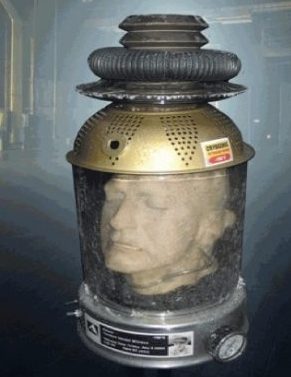
Scratch that. What I mean is: put me in a head. Specifically as ashes, poured into a ceramic simulacrum of my noggin, mug and all, including hair and rockin’ Don Johnson stubble.

This active seeker of novel burial techniques has found a new one, the ultimate head trip. It’s an urn by the company Cremation Solutions and it’s as ambitious as it is ghoulish: 

“Customers send in a photo of their face, and the company scans it, creates a 3-D model and then 3-D-prints an 11-inch polymer head (with an optional wig) and mounts it on a hollowed-out marble base. Cost: from $600 to $2,600.”

In a grody Hannibal-esque touch, you pop off the crown of the fake head, rather like a cookie jar, and deposit the ashes inside the plaster brain pan, which is naturally empty, much like the brain pans of some people I know.  

“Death masks are so eighteenth century,” quips one reviewer of the disembodied domes, adding that they can “stand looking less lobotomized.”

Yes, that glassy, dead-eyed gaze begs improvement — sunglasses perhaps? — as does the wax-museum luster of the fake flesh. While these 3-D computer models may console mourners, they ick me out more than comfort me.  

I wonder how many times someone yelps and clutches his heart when he catches a glimpse of one of those mannequin-meets-Marie Antoinette heads in his home office. I could see myself, in a frightened start, backhanding a loved one’s waxy head, sending it flying in shards and puffs of ash, because it’s so unrelentingly eerie. (The facial expressions are all about serene neutrality. I see a glazed embalming job instead.) 

In vintage corporate-speak, Cremation Solutions pitches this bizarre selling point: “You will never again have to worry that you might forget what your loved one looked like when you invest in one of these custom made, very lifelike cremation urns.” 

Curious, considering that forgetting what your loved one looked like hasn’t been an issue since the invention of the photograph 200 years ago.

Who really wants to see a macabre doll head staring at the wall every time they enter the room — a startling bust that could be mistaken for a fancy penny bank, or a decapitated midget? According to Cremation Solutions owner Jeff Staab, demand is low. 

“They look so real that they actually creep people out,” Staab tells Newsweek, with impressive candor. “Most people write what a stupid idea they are. But we do sell ’em. There are some weird people out there who want Grandma’s head on the mantel, looking at them all the time.”  

Or Obama’s head. Puzzlingly (suspiciously?), the company uses a fake head of the 44th President as a sample urn, pissing off some and pleasing others.

Staab says the Obama noggin was a “practical joke … I get shit all the time, people saying how dare you have an urn made out of the president’s head,” he says. “But it wasn’t even my idea. I’d rather have a George Clooney head.” 

The Obama head a “practical joke”? Couldn’t you say the whole enterprise is exactly that?

Stuff this

The taxidermist was having none of it. 

On assignment for a midsize city newspaper, I was interviewing the local taxidermist, a Mr. Martinez, stuffer of critters, asking him about his life’s calling: 

How did you arrive at upholstering bobcats and mounting them in hissing, menacing postures? 

What’s the taxidermy process? Do you only use the animal’s skin?

Is it bloody? Does it stink? 

That kind of crap.

Growing bored by Martinez’s predictable answers and feeling stifled in his stuffy workshop — a matchbox cluttered with mounts, models, skins and dead, static animals in dubious attitudes — my mind drifted.

Though I knew the answer, I asked Martinez if he could taxidermy my long-passed pet rat Phoebe. Sure, he said without a blink, though with a wink, as if a common eight-inch rodent would present any challenge.

Then, scanning the room’s carpentry, tanning and painting gear, I waxed inspired. Could you, I asked, stuff my best friend Ian and mount him in a fearsome pose, like an agitated grizzly? Martinez smirked, but he hadn’t heard my full pitch.

My friend is still alive, I told him. Is that a deal-breaker? Martinez snorted, shook his head and pondered how his lab’s chemical fumes had affected me. Surely he thought I was delirious. Or just dumb as a mounted wildebeest head.

But I really did wonder if he could taxidermy my dear pal Ian, a generous fellow with good skin and, hairy as a chimp, would look splendid posed in a loincloth, hunting a saber-toothed tiger in the Neolithic period. I picture this scene amid a Serengeti landscape in a diorama in a musty natural history museum. That, I think, is where Ian belongs. You’re welcome, bud. 

No and no, said Martinez, squashing the dreams of this faithful friend. Adds award-winning taxidermist Katie Innamorato: “It’s illegal to taxidermy or mount a human being in the U.S. While I’m sure it’s possible, the end result doesn’t seem worth the trouble. Human skin discolors greatly after the preservation process and stretches a lot more than animal skin.”

Gross.

You want gross? Ogle this:

That’s from the site Bad Taxidermy, a cheeky celebration of botched stuff-and-mount jobs, from the whimsically warped (a kitty fastened with giant angel wings, dangling from the ceiling, its face a mask of open-mouth terror) to the near-blasphemous (a quacking duck head popping out of the butt of a surprised baby lamb).

As Bad Taxidermy and its competing site Crappy Taxidermy illustrate, it’s simple. 

There’s good taxidermy:

And there’s grotty taxidermy:

From macho hunter displays to Victorian curiosity cabinets, taxidermy rarely goes out of fashion. Two books — “Crap Taxidermy” and “Taxidermy Gone Wrong: The Funniest, Freakiest (and Outright Creepiest) Beastly Vignettes” — are taxonomies of the mutilated and misbegotten, the bungles and blunders. Horrible hilarity ensues.

What is taxidermy, exactly? Real fur, jagged antlers, feral poses, glassy doll eyes and wholesale creepiness come to mind. (Also: reprehensible game hunters and their appetite for machismo-fueled slaughter.)

Essentially, says an expert, “taxidermy is a mix of many disciplines — sculpting, woodworking, sewing, painting, carpentry and tanning, to name a few.”

It’s a grisly craft. “The animal is first skinned in a process similar to removing the skin from a chicken prior to cooking. Depending on the type of skin, preserving chemicals are applied or the skin is tanned. It is then either mounted on a mannequin made from wood, wool and wire, or a polyurethane form.”

I’m of two minds: I absolutely hate the idea of killing creatures for egomaniacal trophies. The other part of my brain revels in the freakish Frankenstein concoctions sprung from twisted artistic souls, Gothy individualists in black, with scads of tats and a penchant for playing Bauhaus while making taxidermy scenes of iguana tea parties.

My pal Mr. Martinez is a more traditional practitioner of the taxidermy arts. As his workshop attests, he goes for big cats, woodland animals, spindly deer, exotic game and other heartbreaking visions. 

So he won’t stuff my friend, got it. Maybe if I modify my specifications so Ian could still be prepped and mounted without breaking any laws. Maybe if Martinez does something less human and more on the hybrid side — a hint of Dr. Moreau, say.

Maybe, just maybe, we can settle on this:

Books, movies, threads — a summer medley

Some things I’m reading, watching and wearing as the hot months satanically descend …

Mieko Kawakami is big in Japan. And her fame is spreading globally with verve and velocity. Called a “feminist sensation,” the writer is best known for her big novel “Breasts and Eggs,” and she’s gleaning renewed praise for her just-released fiction “Heaven.” 

She’s good, really good, and I’m drinking her work up in chugs and gulps. I read the slim “Heaven,” a taut drama about middle-school bullying laced with philosophical echoes (think Nietzsche), in two days. And I’ve made it half-way through the 400-page “Breasts and Eggs” in the same amount of time. (And, yes, the title makes total sense.)

Kawakami is a deceptively simple read, limning pressing social issues in prose of polished glass. The crisp writing rattles with ideas about female body image (ever thought of bleaching your nipples?), donor pregnancies, family secrets and teen torments. It’s frank, funny and squirmily real.

Japan’s preeminent novelist Haruki Murakami experienced “pure astonishment” reading “Breasts and Eggs,” a best-seller in Japan that’s become a controversial feminist talking point, flagged (flogged?) for its graphic discussions of bodily ownership among two women and a teenager. The grumblers? Mostly men.

In the new book, “Heaven,” a boy with a lazy eye is tyrannized at school — he’s forced to eat chalk once he sticks it up his nose, for starters — and befriends a girl outcast, making a dweeby, beleaguered duo that’s not going to take it anymore. “Heaven” ends hellishly. It’s unsettling, it’s shocking. And it’s near-perfect.

The trailer for the new Netflix movie “The White Tiger” is frenetic, hyper-stylish, abundant and ambitious. It presents a messy, modern India of epic proportions, with glitz, guns and girls. 

Which is confounding considering the film’s writer-director is the great Ramin Bahrani, who’s earned arthouse cred for wondrous micro-budget dramas like “Man Push Cart,” “Goodbye Solo” and “Chop Shop,” a gritty miracle that Roger Ebert named the sixth-best film of the 2000s, while hailing Bahrani as “the director of the decade.” I agree.

Based on the rollicking Booker-winning novel by Aravind Adiga, “White Tiger” is conspicuously Bahrani’s biggest film to date, inviting comparisons to staunch minimalist Chloé Zhao, who’s making a Marvel blowout after this year’s hushed Oscar-winner “Nomadland.”  

I haven’t seen it yet, but Bahrani’s zesty crime drama looks to have the heft, the dazzle, of something new and career-altering. I’m aching to see what this indie miniaturist and unswerving humanist does with the novel’s byzantine riches.

When shopping for clothes, I wait till August, when, as they say, the fall collections land: blacks and beige, layers and long sleeves, boots and beanies.

It’s not even summer and already I’ve plucked attire with a defiantly wintry flair, including a thick New York Times sweatshirt — black with a brash Gothic “T” across the chest — that complements the tasteful Times ball cap I bought last year (no, I will never wear both together; there’s only so much the world can take).

Call me a walking billboard, a corporate hussy. Actually, I’m just an ink-stained fiend for crack reporting, crackling prose and kicky Gothic fonts. I love newspapers in general (see my newspaper coffee mug collection, Chicago Tribune to the Austin American-Statesman, Gothic type both). The Times is tops. I wear its merch with pride.

That’s right, it’s barely summer and I’m buying cold coverings. Like the knitted crochet slippers from Russia I bagged at Etsy (see this post). They’re made to look like classic black and white Nike running shoes. They’re goofy. They’re funky. They’re walking punchlines. The photos alone bust me up. That won’t be the case when my feet freeze off.

I’ve acquired lighter weight clothing, too, including two movie-themed t-shirts: one of cerebral creep-out “The Witch,” featuring an eerie prancing goat on the print; and a simple black T elegantly screened with “A John Woo Film” in English and Chinese.

This film wonk also snatched a pair of A24 socks, A24 being the thriving boutique outlet releasing cult hits like “The Witch,” “Midsommar,” “The Florida Project,” “Moonlight,” “Eighth Grade,” and a raft of other extraordinary indies. The socks are grey and too long, and the company logo looks stitched by elves. But I like them.

A24 socks. It’s come to this.

I love this book title: “Everyone Knows Your Mother is a Witch.” Sold! 

So I grabbed this buzzy novel by Rivka Galchen, released this week, lured by the chatty euphony of the title and Galchen’s rep as a literary wunderkind. I’m still on “Breasts and Eggs,” so I’ll get to this soon, tackling what’s billed as a harrowing and humorous tale of witches and hysterical fear in 1618 Germany. (“The comedy that runs through the book is a magical brew of absurdity and brutality,” says the Washington Post.)

Also on my hypothetical IKEA nightstand, all cheap and rickety, is David Diop’s slim war drama “At Night All Blood is Black, winner last week of the 2021 International Booker Prize. The Franco-Senegalese author specializes in 18th-century French and Francophone African literature, and the novel was shortlisted for 10 French literary awards. 

A wrenching description that makes you want to ball up and hide:

“Peppered with bullets and black magic, this remarkable novel fills in a forgotten chapter in the history of World War I. Blending oral storytelling traditions with the gritty, day-to-day, journalistic horror of life in the trenches, Diop’s novel is a dazzling tale of a man’s descent into madness.”

A perfect beach read, no?