For introverts, self-quarantine isn’t so bad

Introverts tend to enjoy more time to themselves, are very aware of their internal thoughts and recharge more in solitude. Extroverts are just the opposite. Extroverts are more outspoken, outgoing and absolutely love being around other people. They’re talkative and like being the center of attention.”                                                   — Chelsea Connors, therapist

Extroverts chafe me. This certified introvert has spent most of his life avoiding them: the whooping jocks, chest-thumping frat boys, screechy sorority girls, cocky corporate management types, knee-slapping laughers, actors, garrulous social hambones who have to keep everyone rapt with hypnotic anecdotes and stories, the very loud and touchy.

These are the people who are having a hard time with “social distancing” during COVID-19. They’re on FaceTime and Zoom, keeping the party going electronically, lest life in self-quarantine shrivels them up into lonely nobodies. The outgoing who live to go out, hug and high-five and fist pump and kissy-kissy on both cheeks. And strangely cracking up, constantly.

friends_having_fun-1200x628-facebook.jpgIntroverts, on the other hand, are naturally adapting to the situation, even relishing it. This, pundits declare, is the year of the introvert, what with mandated social distancing during the pandemic, which demands people stay apart, social scenes closed or restricted, and families huddled in their homes. No sports events? Oh, darn it.

“Finally,” a tweeter rejoices, “something I’m good at: staying at home and avoiding people!”

Isn’t it great? 

In case I’m branded some sort of antisocial Hamlet or “The Boy in the Plastic Bubble,” I emphatically aver that I do (did) like to get out for a great dinner, good movie or a play, and some drinks. And my inveterate world travel is taking a heartrending hit. 

But it’s worth noting this shift in the social landscape: the meek shall inherit the earth, for a while. From the Twitter-sphere come these words of comfort for the eternally uncomfortable:

— “Any other socially awkward introverts out there feel oddly aroused anytime anyone mutters the phrase ‘social distancing?’ Asking for myself. Obviously.”

— “As single and an introvert, we’ve been social distancing since before it was popular.” 

— “Introverts have been doing this for years! Look who’s suddenly the cool kids at the party now!” 

— “Finally introverts experience a world that is suited to us. All events cancelled, we don’t even have to go thru the trouble of flaking. No one is making random small talk or physical contact. Everybody minding their own business.”

— “So ‘social distancing’ is gonna save us all from #CoronaVirusSeattle.YAY. INTROVERTS WILL SURVIVE AND RULE THE WORLD. Quietly, of course. But still.”

common-words-introverts-extroverts.jpg

Reckless randomness in scary times

Like many of you, we are grumblingly housebound during the seismic spread of the coronavirus, aka the Trump Pandemic, a little scared, a lot curious, shuffling clenched and downcast in a novel world of social paralyzation and dystopian edicts, woozy with the surreal and unthinkable. Enter: takeout, Amazon, streaming movies, books we should have read eons ago, board games, bottomless web surfing, asphyxiating boredom, idle nose picking, staring contests, etc.

The end is nigh. 

Or not. 

Yes, bars, restaurants and even Starbucks are shuttering, and it’s a cataclysmic cluster-boink. I can’t even get a haircut now, so by July I’m going to look like Weird Al Yankovic.

But if you have the gall, guts and lunacy, there are ways out. Like zooming to far-off lands that may well be (yes, they will be) infected. Peek yearningly at PlanMoreTrips, a new site that promises, with a pinch of perversity, to “Find the Best Corona Virus Flight Deals,” like: a $137 roundtrip from New York to Lima, Peru; a $43 roundtrip from Dallas to Las Vegas; or a $231 roundtrip from New York to Barcelona.

960x0-1.jpg
Lima, Peru

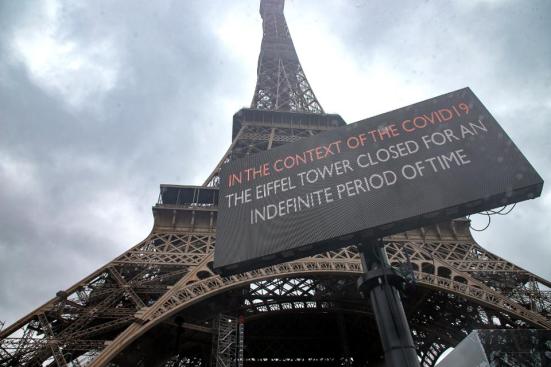
All of that makes me want to travel badly; I strain at my leash. But it’s a global crap-storm out there. I don’t want to go to Paris when the D’Orsay and the Louvre and Frenchie restaurant and my three favorite cinemas in the Latin Quarter are closed. (Though I still kinda really do.) And of course I don’t want to get ill or make anyone else sick. So we sit. We stew. We play Scrabble. Shit.

Now for some random, corona-free stuff (just what you were waiting for) … 

—  Cubby the hirsute hound finally got a haircut. In puppy parlance, he was groomed. While his body is shorn and tiny now, almost tubular, like a Pringles can, the Baron Munchausen beard and mustache remain, rather regally. And all that hair removal revealed something we always suspected was there, but never saw: a bright pink butthole. Sorry, but it’s true. And it’s strangely alarming, yet delightful too. He’s got one! He’s even less freakish than we thought! Good boy.  

  Spring dispirits for many reasons. Besides sunshine and heat and bugs and pollen, and everybody chirping about such delirious wonderfulness (they’re all wack), there are insane allergies some of us contend with. Actually, I combat them daily, through all climes, so I can’t blame the new season, as much as I detest it. (Did I mention swimming pools, barbecues and shorts?) Thing is, my allergy meds barely work, if at all. Runny nose, watery eyes are my main symptoms, and they could not vex me more. I’ve tried an array of meds. This week I’m moving on to Flonase. Can anyone vouch for this pricey nasal spray? (Gross, right?) 

  Timely thought: “Either God can do nothing to stop catastrophes like this, or he doesn’t care to, or he doesn’t exist. God is either impotent, evil, or imaginary. Take your pick, and choose wisely.” — Sam Harris, author of “The End of Faith”

—  Serious film fans know Werner Herzog — prolific auteur of mind-tweaking features (“Fitzcarraldo,” “Aguirre, the Wrath of God”) and consciousness-rattling documentaries (“Grizzly Man,” “Cave of Forgotten Dreams”) — as a brilliant iconoclast, Germanic chaser of “ecstatic truth,” and venerated pop culture polymath (he’s voiced himself on “The Simpsons” and plays a villain in the “Star Wars” series “The Mandalorian”). This week, he’s interviewed in a New York Times Magazine Q&A under the unsurprisingly prickly headline “Werner Herzog has never thought a dog was cute.”It’s typically profound and brain-expanding. “How do we give meaning to our lives?” Herzog says. “That question has been lingering over my work and life. That’s what I’ve been pursuing for a very long time.” And from there, he’s off.29mag-talk-jumbo

—  The other day, Yahoo!, the oddly antiquated web server, rapped my knuckles with a stern warning to be a nice boy. An admonitory email landed in my rarely used Yahoo! mailbox, part of which reads: 

“It has come to our attention that you may have violated the terms of service on Yahoo! Please reread the terms and cease any use of your account that may violate them. If your use of your account is brought to our attention again, we may terminate it without further notice.” 

I’m shaking in my sneakers, big bad Yahoo! (Thank you for providing the exclamation point I otherwise would have furnished in that sentence.) My crime: replying to a couple of comments on a Trumpian news story on the site, which unaccountably attracts a large, semi-literate, far-right readership. The comments, dumb as dirt, borderline racist, the usual vile cant, set off my volcanically anti-Trump triggers and, helplessly, I typed some half-baked responses, teeth grit, smoke poofing from orifices.

Perhaps stooping to the commenters’ level, I called them ignorant hillbillies who should skitter back down the holes they crawled out of — or some such balderdash of which I am not proud. I used no curse words (wait, isn’t “hillbilly” an expletive?) and hardly drew outside the lines. Yahoo! is having none of it. I broke the rules. I upset some Neanderthals and a corporate legal department. To the corner I go. Such a bunch of … yahoos.

maxresdefault.jpg

Superman is dead.

For five good days, Superman was my pal. 

Tall and lanky, with raven-black hair and a swoopy cowlick, and of course that totemic red and blue spandex suit, flaming cape billowing aft, Superman hung out, drank and watched movies with me and my soul-buddy Shannon during the South by Southwest Film Festival in 2007. Superman was our Super-friend. 

Alas, kryptonite conquers. I just learned that Superman, née Christopher Dennis, died last November, a piteous death that HuffPost reports here:

“Christopher Dennis, the ‘Hollywood Superman’ who posed for thousands of photos with tourists outside the famed Chinese Theatre in Los Angeles, has died. He was 52.

“Dennis, who was homeless, was found in a used clothing donation bin in Van Nuys, a neighborhood about 10 miles from the tourist district where he earned a living. Police said he was likely looking for something to wear and that no foul play was suspected.”

81nM64QV+BL._SX300_.jpg

Dennis was at the film festival promoting — alongside The Hulk, Batman and Wonder Woman — the ridiculously entertaining documentary “Confessions of a Superhero,” which profiles the costumed characters of the Hollywood Walk of Fame with heart and, yes, heroics. (See the trailer here.) He appeared numerous times on “Jimmy Kimmel Live.”

Dennis, a goofy guy with a crooked smile and sweet as a golden retriever, said he was inspired to put on the cape and tights because of his uncanny resemblance to Christopher Reeve, cinema’s most famous Superman. Some days he could make a bundle posing for photos; others, not so much. It was a rough life. HuffPost says that Dennis was once beaten with a golf club and robbed of his money and his Superman garb. He resorted to panhandling and drugs. Super drag.

Thirteen years after palling around with Superman, I frankly don’t remember fine details, just that we had a blast. Below is Dennis at the film festival, posing with Shannon and actor Paul Rudd, who’s now himself a screen superhero as Ant-Man. (Why is Shannon gasping? Rudd decided to grab her butt at exactly the right second. Superman looks on, wondering if he should save her. Nah.) 

Shannon___Paul_R._P1060628.jpeg

Nicolas is cagey about why he bought himself a giant tomb

One day Nicolas Cage is going to die. It will be sad, maybe shocking. Hopefully, in rightful madman form, he will spontaneously implode, eyes bugging, equine teeth gnashing, receding hairline beading with sweat, perhaps a cackle or two.

If we’re not prepared to lose this most erratic of thespians and eccentric masterminds, he apparently is. As you may know, he already has his own tomb erected in New Orleans’ oldest cemetery, St. Louis Cemetery No. 1, which was founded in 1789. He bought the tomb in 2010 for a reported $3.2 million. He has big plans. Dying is one of them.

IMG_1883.JPG

Amid mossy, decaying, crumbling graves from the 18th and 19th centuries stands, with majestic incongruity, Cage’s 9-foot-tall pyramid, resplendent in polished white marble and engraved with the Latin maxim “Omnia Ab Uno,” meaning “Everything from One” — fittingly enigmatic. (The cemetery is also home to late New Orleans voodoo queen Marie Laveau, one reason it’s said Cage picked this lot, though he’s never publicly explained why he settled on New Orleans’ most revered cemetery with a 9-foot-tall pyramid.)

I just got back from touring the cemetery and of course Cage’s ostentatious, rather comical spectacle is a big draw. Women plant lipstick kisses on the marble surface (giggling facetiously we hope), and selfies are mandatory. Locals detest this empty pyramid of death, as it befits the environs with the stylistic subtlety of a Popeye’s Chicken on the Champs-Élysées.     

IMG_1882.JPG

The actor incidentally just visited the mausoleum a couple weeks ago during Mardi Gras with a gossiped-over “mystery girlfriend.” They wore matching black leather pants for the occasion, dig.

Cage is not a native New Orleanian, but he’s owned homes in the city, including a place so haunted it caused him ghastly tax problems (it’s called evasion), cratered a soaring movie career and kinda made him crack up. 

You don’t say. 

ladies-and-gentlemen--nicolas-cage-amp-039-s-future-tomb_o_2987955.jpg

Tale (tail?) of a hirsute hound

Cubby the wonder dog has gone a very long time without a good, healthy grooming. His face is downright Ewokian, that wet button nose struggling to peek out from the furry foliage. His brows are thick, heavy, senatorial. His body would make Bigfoot blush. Such inordinate overgrowth is witnessed in only the most luxuriant jungle weaves and tangles, invoking machetes, flamethrowers and scythes fit for Death himself. 

Cubby, we submit, needs a haircut.

He knows it, we know it. Supercuts knows it. As does the kid down the block who mows the neighbor’s lawn for five bucks.

Seriously, clippers and razors should be at the ready. Cubby fears and loathes the grooming ordeal — sedatives required — and we sympathize. And so we let him go, and grow. But it’s in his best interest to be shorn, for comfort, hygiene, and to not look like David Letterman. 

Right now, three months after the photo below was taken, Cubby’s corkscrewy fur looks like swirling oceans of gray Reddi-wip, curling waves lurking with mythical sea monsters. If you think he looks lush here, you should see him now. To namecheck another “Star Wars” critter, he’s wildly Chewbaccian. I live with a barking, carpet-staining Wookiee. 

BAS_12_08_2019_8_2

Then again, here’s what he looks like after a spanking professional shearing. Such grooming makes him appear bald and sprightly, thinner, a bit rat-like, though retaining that preposterous Spaghetti-O tail (which I adore). Gone are the Austro-Hungarian mustache and frowzy Haight-Ashbury beard. (Gone too is that panting smile, curiously.)

img_0829.jpg

All of which is to say: 1. A barbershop chair awaits Cubby’s fuzzy tush. 2. Call it a springtime trim, ripe for warmer days. 3. Wanted: Dog groomer who can handle a hirsute hound that’s neurotic, nervous and Xanax-popping, and may require a John Deere to cut mighty scrubland. We exaggerate, a little.

Occupational hazards of the novelist

Anyone who has ever tried to write a novel knows what an arduous task it is, undoubtedly one of the worst ways of occupying oneself. You have to remain within yourself all the time, in solitary confinement. It’s a controlled psychosis, an obsessive paranoia manacled to work completely lacking in the feather pens and bustles and Venetian masks we would ordinarily associate with it, clothed instead in a butcher’s apron and rubber boots, eviscerating knife in hand.”

— Olga Tokarczuk, from her Booker-winning novel “Flights,” a luminous series of human and existential journeys revealed in shards and fragments. A supernova of imagination and intellect.

z24027629V,Olga-Tokarczuk-i-jej--Flights---czyli--Bieguni--po.jpg
The Polish author won the 2018 Nobel Prize in Literature.


One of those grab-bag blogs filled with mad miscellany

— In New Orleans next month, I’m forgoing the vaunted National WWII Museum for the more mischievously skeevy Museum of Death, a labyrinth of the gross and ghoulish and other alliterative G’s (ghastly, grisly … ). Body bags, coffins, car accident photos, Manson family ephemera, cannibalism — and, well, I’m making a poor case for my mental stability. Why not do both museums? Because I’m booked for a cemetery tour (I know, I know), a paddleboat cruise on the Mississippi, a French Quarter tour and a hop through the Dixie Brewery, which is $5 compared to the war museum’s nearly $30 entry, which is twice as much as Museum of Death tickets. And, really, aren’t both museums monuments to mortality in their ways? (Plus, I’ve seen “Saving Private Ryan.” It didn’t go well.)

mod-hdr3.jpg

— People slap flashy stickers and decals all over their laptops, without realizing the machines are not skateboards and are anything but billboards of hip. A Dell? Fine. A Mac? Plain vandalism.

1hFFNNJHOVyul0OLXpKgpcKM2MOF6S_large— Best movie from the ‘70s I recently re-watched: rattling rock melodrama “The Rose,” starring an atomic Bette Midler, shrill and crazy, on a Criterion DVD. Directed by Mark Rydell, the tipsy tragedy, loosely based on Janis Joplin’s hasty flame-out, was shot by storied cinematographer Vilmos Zsigmond, with assistance on the feral concert scenes from lens legends Conrad Hall, László Kovács and Haskell Wexler. Toni Basil choreographed Midler’s bestial gyrations. The movie, a buckling downer, holds up rapturously. (Watch it with “A Star is Born.” Discuss.) 

— I saw the trailer for the new Wes Anderson movie, “The French Dispatch.” My eyes bled. My mind sizzled in its teeny brain-pan. Once upon a time, Anderson was one of our most exciting young filmmakers (“Bottle Rocket,” “Rushmore.”) He’s now one of our most exasperating. And cloying. And irritating. And incurably cutesy.

the-french-dispatch-wes-anderson-breakdown

“All gunfighters are lonely. They live in fear. They die without a dime or a woman or a friend.” — Burt Lancaster, philosophizing in 1957’s otherwise poky “Gunfight at the O.K. Corral.” Sometimes I wonder: Am I a gunfighter?

Unknown.jpeg

— I liked but didn’t love Oscar history-maker “Parasite,” Bong Joon-ho’s catchy Korean comedy-thriller-horror flick. It swept the Academy Awards, becoming the first foreign-language movie to win Best Picture, which I’m all for. But the movie doesn’t explode. It’s not “Crash” or “Green Book” bad, somehow and embarrassingly snatching top honors — not even close. It is, simply, the most overrated movie of 2019. I placed it #8 on my top 10 list. It is very good. And I am so happy it shut-out “Once Upon a Time … in Hollywood,” patently one of the year’s worst films. For those who haven’t seen “Parasite” but have followed its triumphs, I’m afraid some shade of disappointment is possible. 

Peter Schjeldahl of The New Yorker is one of the sharpest art critics I’ve read, and one of the lushest, most literate prose stylists around. Gifted as he is, he still says things like, “I’ve toiled all my life, in vain, to like myself.” He adds, “Writing is hard, or everyone would do it.” It is humbling.

—  This is the most poignant line I’ve read in a book in some time: “There is a species of moth in Madagascar that drinks the tears of sleeping birds.” It’s from Jenny Offill’s deep and droll new novel “Weather.” I also liked this: “I’m too tired for any of it. The compromise is that we all eat ice cream and watch videos of goats screaming like women.”

51f1y5-4yqL._SX298_BO1,204,203,200_

— Winter is fast receding. Son of a bitch.

— I noted above that “Saving Private Ryan” and I had a dubious relationship upon its 1998 release. As a full-time movie critic, I gave the summer blockbuster two stars out of four. I recently located my love letter to the film, part of which reads:

“The World War II epic ‘Saving Private Ryan’ begins with a screen-size image of the American flag. The banner ripples in the breeze with patriotic solemnity, as John Williams’ score puffs its chest and gives a stern salute to our tear ducts.

“Dissolve to a scene of soft-focus Americana plucked from Norman Rockwell, featuring a family borrowed from a life insurance commercial. As this ideal of scrubbed, middle-class solicitude walks quietly toward a white cross in a military cemetery, the screen fairly creaks with labored pathos. You start to wonder if you’re watching a parody of a Steven Spielberg movie.

“Actually, it’s an inadvertent self-parody, for this is a Spielberg movie, his latest and most contrived attempt at serious adult filmmaking. Despite its unflinching (almost desperate) depiction of battlefield carnage, ‘Saving Private Ryan’ is marred by mawkish indulgence and counterfeit drama, Spielberg’s twin weaknesses. The man can’t help it: He lards the film with freeze-dried sentiment, tingle-inducing declarations and cello cues. The considerable gore is largely separate from the main story; it’s a bombastic stage setter.”

BattleFilm-Ryan_960x640.jpg
Save me, Private Ryan.

It’s cold. Let’s read.

Books and movies. I do a lot of both during the hibernating winter months. I’ve plowed through some good books so far this season, with more to come …

Stripped-down realism is so refreshing. That’s what Elizabeth Strout’s cold-water splash “Olive, Again” delivers in the return of the author’s forever-stubborn, wryly splenetic septuagenarian Olive Kitteredge, reluctant heroine of the eponymous, Pulitzer-winning novel from 2008 (“Olive Kitteredge”). The matte finish of ordinary life somehow glistens in these prosaic pages, as Olive and her kin and the locals of small Crosby, Maine, get on with life with all the grace they can muster. Amid the deceptive, lulling ordinariness emerges Olive, who gives just about everyone a pain in the ass. 

51fu2JUE-1L._SX327_BO1,204,203,200_

“God, Olive, you’re a difficult woman,” says a suitor. “You are such a goddamn difficult woman, and fuck all, I love you. So if you don’t mind, Olive, maybe you could be a little less Olive with me, even if it means being a little more Olive with others. Because I love you, and we don’t have much time.” The truth as prod — perfect.

Unfailingly elegant, with literary punch and panache, Christopher Isherwood’s classic 1964 “A Single Man” follows George, a gay, British, middle-aged English professor in suburban Southern California, as he manages life after the death of his partner. Solitude reigns, though George experiences symphonic emotions, from fury to attraction, all in finely wrought descriptives. Called a “lyric meditation on life as an outsider,” the novel is at once explosively alive and exquisitely melancholy. 

31RtOm2Tf1L._SX322_BO1,204,203,200_

In Kevin Wilson’s quirky, arguably gimmicky, new novel “Nothing to See Here,” the main attractions are 10-year-old twins who self-combust when stressed or agitated. Right: they go up in flames. Yet the young author doesn’t belabor the peculiarity, mingling a heavy heart with a breezy tone that depicts events in buoyant deadpan. And while the conflagrations are certainly a metaphor for something, I’m not sure what that is. (Wilson’s fires are more light than enlightening.) 

When the twins’ caretaker Lillian first witnesses one of their freak shows, she shakes off the shock and mildly observes, “Then, like a crack of lightning, she burst fully into flames, her body, a kind of firework, the fire white and blue and red all at once. It was beautiful, no lie, to watch a person burn.” 

Unknown.jpeg

The book is clearly some fun, though it’s braided with furrowed, moving passages about taking care of people, avoiding pain and erasing past hurts. “How did anyone keep this world from ruining them?” Lillian wonders. “I wanted to know. I wanted to know so bad.”

Garth Greenwell’s fawned-over “Cleanness” is more than its homoerotic parts, excuse the imagery, though it certainly is that, too. This novel (or is it a story collection?) sketches a psychosexual character study of an American teaching in Bulgaria, sifting through his cluttered past of intimacies. We see (smell, feel) it all in a journey of desire, love and loss.

This follow-up to Greenwell’s adored “What Belongs to You” falters a bit in a cluster of sex scenes dominating the final stories. It becomes repetitive, fetishistic, rather dull. And yet you don’t give up, because the writer knows exactly how to lull you, with a masterly, agreeable control that’s never pushy.

41mU4Aq2z0L._SX324_BO1,204,203,200_

On the nightstand now: The brand-new “The Big Goodbye: ‘Chinatown’ and the Last Years of Hollywood” by crack showbiz historian Sam Wasson. Propulsive prose, staggering detail and wise reflection turn this history into a 3D pop-up book of period L.A., pinballing from the Manson murders and its impact on hot auteur Roman Polanski (who would, of course, helm “Chinatown”), to the creative relationship between Jack Nicholson and screenwriting eminence Robert Towne and the very seeds of SoCal noir. And that’s just up to page 70. 

Concerned largely with the making of a quintessential masterwork of ‘70s film, the book promises to be “the defining story of the most colorful characters in the most colorful period of Hollywood history” and is being compared to classic, unflinching making-of studies “The Devil’s Candy”and “Easy Riders, Raging Bulls.” 

Already, I’m gripped.41O2b3Fog0L._SX327_BO1,204,203,200_

Kirk Douglas: His 9 best

2181.jpgOne of my favorite Golden Age Hollywood actors, Kirk Douglas, died last week at age 103. The cause: overwhelming magnificence. Here debonair, there explosive, Douglas, he of the arresting crater chin, fetching floppy hair and feline growl, made a raft of movies, acting in, producing, or both. He could chomp a scene or recede with quiet, smirking menace. No matter what he did, the ecstatically watchable performer made every movie moment better. I’ve picked nine of his best starring roles, all worth a rewatch:

1. “Paths of Glory” — Playing against type in Stanley Kubrick’s gut-wrenching 1957 antiwar masterpiece, Douglas is a moral paragon among obscene military corruption, with scenes so emotionally powerful, they sear. (See this.) 

p0777b0p.jpg

2. “Ace in the Hole” — A scathing portrait of Douglas’ unscrupulous newspaper writer, who will ditch a man’s life to nail a career-making scoop, in Billy Wilder’s haunting and prophetic 1951 thriller. Deemed so cynical, one critic dissed it as “ruthless.” Consider that a compliment.

acecover.0.jpg

3. “Out of the Past” — Quintessential 1947 noir, directed by mood-meister Jacques Tourneur (“Cat People”), streaked with guns, fedoras, dames, snappy dialogue and mushroom clouds of cigarette smoke. Douglas, as an oily, vengeful gangster, hires Robert Mitchum’s private dick to find his mistress (Jane Greer, a classic fatale). Mitchum falls for his quarry and things get very, very complicated. This is Mitchum’s film — he’s in almost every shot — but Douglas slithers his way in, like a cobra.

whit-and-jeff-edit.jpg

4. “Detective Story” — Or: “The Angriest Cop in the World.” Douglas cleaves the screen in William Wyler’s 1951 chamber noir set over a single day in a police precinct station. He plays a draconian detective with a Vesuvian temper, always the bad cop in the face of criminal slime — “a one-man army against crime.” He has other, personal troubles brewing, too, making him even more mercurial, a violent, teeth-gnashing fury. He’s a spectacle, and he’s marvelous. 

1886-3.jpg5. “Lust for Life” — The actor’s beautiful depiction, both physically and psychically, of the tormented, misunderstood-in-his-life painter Van Gogh, brings to the fore Douglas’ primal strength: inextinguishable passion.

Kirk-Douglas-in-Lust-for--001.jpg

6. “Lonely Are the Brave” — In screenwriter Dalton Trumbo’s melancholy masterstroke from 1962, Douglas is a cowboy Quixote, living in modern times like they’re the Old West, happy to cling to a carefree existence on the back of his faithful horse. The drama, writes one critic, is a “hymn to rugged individualism and freedom slowly being strangled to death by voracious urban development.” Douglas is alternately euphoric and conflicted by the rule-bound world he must face. It’s heartbreaking. 

lonely.jpg

7. “Spartacus” — Douglas and director Stanley Kubrick wrangled making this consummate 1960 swords and sandals epic, a friction that perhaps kindled the actor’s fiercely multifaceted performance. Through romance, slave revolts and mano-a-mano combat, he gives it his clenched-jaw all.

2230.jpg

8. “The Bad and the Beautiful” — With frigid duplicity, Douglas plays an amoral movie producer in Vincente Minnelli’s exemplary Hollywood takedown that’s sometimes spoken in the same breath as “Sunset Boulevard.” If not as wickedly gothic as the latter, this entertaining soundstage drama hits its Tinseltown targets with giddy marksmanship. With Lana Turner, Dick Powell and an Oscar-winning Gloria Grahame. 

the_bad_and_the_beautiful_kirk_douglas.jpg

9. “Champion” — Few original dramatic strokes here, but Douglas, as boxer Michael “Midge” Kelly, rages operatically, elevating a gritty sports melodrama to near noirish heights. It’s about sacrifice, family, commitment and finally integrity, something Douglas proved the epitome of — on screen and off. The 1949 role earned him an Oscar nomination, his first of three. (Three? Shame on you, Academy.) 

Champion.jpgRunners-up“A Letter to Three Wives” (directed by Joseph L. Mankiewicz, 1949);  “20,000 Leagues Under the Sea” (Richard Fleischer, 1954); “Gunfight at the O.K. Corral” (John Sturges, 1957); “Seven Days in May” (John Frankenheimer, 1964); “The Fury” (Brian De Palma, 1978).


Sin City vs. Sin City

Let me say, between America’s two premier party towns, New Orleans kicks Las Vegas’ gilded, ersatz ass, that Emerald City conjured from desert pixie dust into a flashing mirage of gambling, chintz and sloshing oceans of open containers. 

Scripturally do I believe this: New Orleans, jewel of the Deep South, stomps Vegas, that spendthrift voluptuary of the West. I’ve been to both cities and can vouch for the Big Easy’s superior party bona fides, its inebriating beauty, gnarled history and lavish multiculturalism. On all counts, Vegas is bereft, a kind of gimcrack DisneyWorld to NOLA’s organic abundance, its French-kissed joie de vivre and bon viveurs, its patina of worldly class.

It’s mossy swamps vs. desert scrub. Beads, boobs and Bourbon Street vs. chips, glitz and the Strip. Indelible musical heritage (blues, jazz, zydeco) and culinary complexity vs. karaoke and Guy Fieri. It’s the rich mythology of Mardi Gras and voodoo vs. the dancing Fountains of Bellagio and hokum-pocus of Criss Angel.

big-drinks.jpg

Neither’s perfect. Both burghs are powerful magnets for slavering douche-baggery, cruising sidewalks nursing two-foot-tall girly drinks. (The rank cluelessness of these swaggering alpha males is adorable.) Both often display the collective mentality of a pimply 17-year-old boy (repeat: boobs) or a tequila-tottering bachelorette queen. Liquor rules. And there are no rules.

Having just returned from Vegas — where I won a whopping 50 cents at an airport slot machine and walked away with a spring in my step (I beat ‘em, by gosh!) — I can attest to the town’s vacant neon soul. It’s plastic, garish and grubby. It’s all facade, robbed of emotion — unless Christopher Cross, recently serenading the Strip with cloying power ballads, warms the cockles of your heart.   

And yet, like millions before and after me, I liked it. Truly, if not excessively. The booze, the vulgar resorts, the cacophonous casinos, a solid comedy show, my slick yet cheap hotel, some world-class meals that rival New Orleans’, fine weather and endless people-watching by turns transfixing and obnoxious. 

It was my second time in Vegas, and on this trip I learned how to enjoy myself by doing a little research and a lot of relaxing. Not poolside relaxing, but a mental, non-judgmental kicking-off of the shoes. I let Vegas do its Vegas thing.

Which is quite different than the similarly storied New Orleans thing. I’ve been there twice, on my 21st birthday and a hasty two-night stay during a Southern road trip about 15 years ago. I typically prefer a different kind of city — Chicago, Kyoto, Istanbul, Florence — but NOLA exudes a neat Big Little City vibe, like Charleston, South Carolina, or Austin, Texas. 

It’s southern to the core, twangy, tangy, congenitally ecstatic, weird and wonderful and proud of it. It’s one of those towns that always wants to get it on. (Though I’m not fond of strolling, badgering brass bands that strain to suck you into their high-stepping, hand-clapping, nightmarish street parties.) 

photo-1568693059993-a239b9cd4957.jpeg

Here’s where I say I’m heading to New Orleans for a few days next month, a week after the big, beady, booby bash that is Mardi Gras. (There’s more to it than that, of course, but it looks like a psychedelic bad trip from here, never mind all the deep-dish tradition. Explains journalist Chris Rose: “Mardi Gras is the love of life. It is the harmonic convergence of our food, our music, our creativity, our eccentricity, our neighborhoods, and our joy of living. All at once.”)

I have plans, none of them fantastically original. While I’m strenuously avoiding Pat O’Brien’s and its barfy Hurricane cocktail (been there, done that) and skipping the gorgeous green gatory goo of the swamps (done that, too), I will get lost in the pastel, fern-festooned, bar-clogged French Quarter, cruise the murky Mississippi on a Twain-ish paddlewheel steamboat and stroll famed cemeteries, those crumbly cities of the dead. 

shutterstock_426101227_copy.1528821762.jpg

My bad, but I’m eschewing the heralded art and World War II museums for the morbidly unhinged Museum of Death, and I will duck the city’s voodoo jive, most of which is about authentic as the eye-rolling “ghost tours” haunting the area with the spookiness of a ghoul out of  “Scooby-Doo.” 

the-scrumptious-louisiana.jpg

One of the nation’s finest food capitals, crackling with heritage, race, culture and love, New Orleans is synonymous with smorgasbord, from beignets to Po’ Boys, crawfish to jambalaya. Here’s where I’m going, to name a few: Peche (seafood inspired by the Gulf, Spain and South America), Cochon (Cajun and Southern cooking), Gris-Gris (Southern eats) and NOLA (a fusion of Creole, Acadian and Southern cuisine with global influences by local legend Emeril Lagasse).

For music and drink there’s the obvious, like world-famous Tipitina’s. I’ll skip it for the hip Bacchanal Wine, a laidback music-food-vino joint in the Ninth Ward that some regard the best bar in the city, if not the world. I also plan to hit popular jazz club The Spotted Cat, a cramped, sweaty spot where those damn brass bands, blaring with cheeks ballooned, may get to me yet. 

13220634_10154148345724820_3503016145107323727_o.jpg

“America has only three cities: New York, San Francisco, and New Orleans. Everywhere else is Cleveland.”

 Tennessee Williams