What we’re really looking for when we travel

“I travel not to go anywhere, but to go. I travel for travel’s sake. The great affair is to move.” — Robert Louis Stevenson

“I read; I travel; I become.” — Derek Walcott

Someone recently suggested to me that my many travels aren’t journeys to see the world and immerse myself in the new, novel and astonishing but to escape from life, to bolt from my existential predicament with its quotidian contours and smothering banality. 

Well, duh.

P1010466.jpg

Rather than take umbrage at this reductive hypothesis, I embraced its glaring self-evidence. But it is only half-right. Escape from routine and workaday doldrums is part of the algebra of travel for most of us, but the other part about immersion in the new, novel and astonishing is undeniably, irrefutably the most important piece of the equation. That unquenchable thirst for fresh, unpredictable experience, from culture to cuisine, people to history, is absolutely paramount. To say otherwise is preposterous.

IMG_2773

After all, you can’t actually escape yourself or your life just because you’re standing woozily before the Taj Mahal or whizzing happily on a moto-bike through the maniacal streets of Saigon. “Wherever you go, you take yourself with you,” author Neil Gaiman said. You can’t not pack you. You view the world through the lens — smudged, rosy, cracked — of your own inescapable mind.

Yet there’s another way to look at the urge to trot the globe, and it goes like this: “We travel not to escape life, but for life not to escape us.” That dimly cryptic maxim has no author, just the copout “anonymous,” but it’s deep nonetheless. It’s saying travel is life itself, that to travel is to truly live. I know I’m at my most alive, most stimulated traveling, when unfamiliar vistas and uncharted ways of seeing and surviving crack open like great gifts. I look, I learn, I marvel. Smitten here, flummoxed there, I gulp it all down.

IMG_2908

Contrarily there’s journalist Janet Malcolm, who finds travel a lesser version of daily living, “a low-key emotional experience, a pallid affair in comparison with ordinary life. (Our homes) are where the action is; they are where the riches of experience are distributed.” (A celebrity in her profession, Malcolm has an incredible job, and she presumably enjoys a highly satisfactory family and social life in very nice accommodations. I’m just saying.)  

Real life will inevitably beetle its way into our journeys. We are not immune from the humdrummeries of being human just because we’re sipping sangria in Sevilla or snorkeling in Thailand. More often than not, we are pulled back into normal existence while trekking and must deal with the minutiae and mundanities of getting by. Currency hassles, airport irritants, sore feet, crappy service, taxi ripoffs, unvarnished boredom — life is a greedy intruder. 

Some germane questions: Does travel satisfy the urge to fill something, or to shed something? Ponder.

P1010792

I finish with this besotted soundbite from illustrious world-traveler Pico Iyer, who defines wanderlust far better than I can: 

“We travel, initially, to lose ourselves; and we travel next to find ourselves. We travel to open our hearts and eyes and learn more about the world than our newspapers will accommodate. And we travel, in essence, to become young fools again — to slow time down and get taken in, and fall in love once more.” 

Travel as enchantment. There you have it.

(Photos by Chris at Gnashing.)

Tough and tearjerking, ‘The Rider’ might be the best movie of the year

If you want to have your heart gently removed from your chest and dropped softly into a Cuisinart that’s switched to purée, go see the quietly devastating rodeo western “The Rider,” now in select theaters, mainly arthouses, which are so often repositories for rich, challenging, downcast dramas reeking of raw humanity so true it sears.  

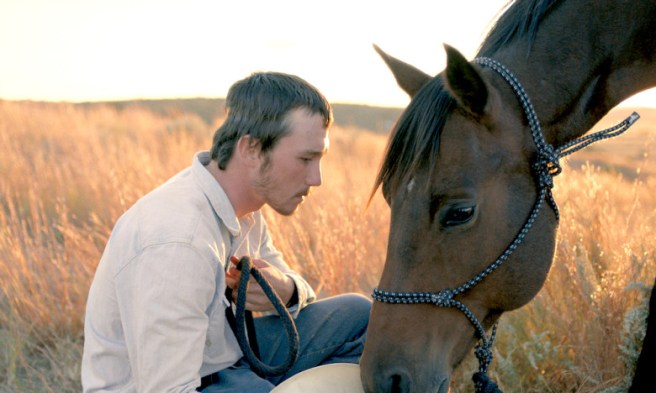
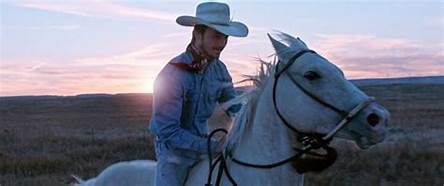
Chloé Zhao’s lo-fi drama — the Dakota prairie lushly shot by cinematographer Joshua James Richards — moves at a painstaking pace, the clip of everyday life in action. But little is everyday here: Twenty-something Brady is a local rock star of rodeo bronc riding whose skull, we see in the opening shots, is stapled shut and oozing blood. A terrible accident in the ring has left him slightly brain damaged. He’s forced to give up the rodeo, the only life he knows, outside of breaking colts, which he does with a calm, tough-love Jedi mastery. His skill and sensitivity with the beasts are sublime to behold.

The-Rider-Movie.jpg
Brady Jandreau and pal Apollo in “The Rider.”

Brady (played by crisp, affectless non-actor Brady Jandreau) lives with his drinking and gambling father (gruff Tim Jandreau) and mentally challenged little sister Lilly (an extraordinary Lilly Jandreau, who is actually disabled) in a ramshackle trailer. It’s a hardscrabble existence with scant room for creativity or reinvention.

“The Rider” is a fine-grained portrait of the pains of getting back on your feet after life-altering disappointment, about rebuilding your spirit after it’s been body-slammed and shattered. This is Brady’s task, and he goes at it with gimlet-eyed resolve and a proudly perched ten-gallon hat.

th.jpegWe see Brady drinking beer with his cowboy bros, working valiantly in a drug store and, most exquisitely, visiting his best friend Lane (Lane Scott), another former rodeo luminary, who, now severely paralyzed from a car accident, lives at a rehab center. Scott, who is really paralyzed and non-verbal, is spectacular in a turn of heartbreaking clarity. He’s hard to watch, but you can’t take your eyes off him.

Elegiac and painful, wreathed in dusty, grassy beauty, the film wears a gritty, documentary patina. It’s been called “American regional-realist,” which sounds about right.

“The Rider” is easily one of the best movies of the year — it has a 97% Fresh rating at Rotten Tomatoes — partly because it doesn’t rub your nose in sadness; the emotion just organically, effortlessly surfaces. It’s driven by an ensemble of untrained actors behaving like actual people — people so achingly authentic, it sort of tears you up.

Writers die. The art doesn’t.

The great authors Tom Wolfe and Philip Roth died eight days apart this month. I heard nothing about the startling proximity of the loss of two of America’s towering writers. And nothing about the theoretical third death of someone else famous when two celebrities die back-to-back. Nothing about that ghoulish trifecta.

th.jpeg
Philip Roth, died May 22.

If that make-believe third fatality does indeed occur soon, and he or she happens to be another English-language writer, which giant will fall? Toni Morrison? Stephen King? Alice Walker? John Irving? Ian McEwan? Cormac McCarthy? None of these literary lions are spring chickens, excuse the mixed animal metaphors.

Such morbid business is the stuff of cocktail party parlor games, slightly sick, if innocuous: King? No way. McCarthy is next, just watch. He’s 84! Or some such scintillating blather.

th-1.jpeg
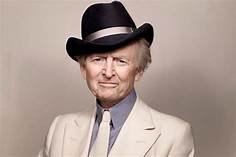
Tom Wolfe, died May 14.

When a popular artist dies it makes a loud rip and a mighty hole in the cultural fabric. A sometimes-fan of Wolfe — I couldn’t get through much of his work, but “The Right Stuff” and “Bonfire of the Vanities” thrilled with reportorial breadth and linguistic virtuosity — I am a confirmed Roth acolyte. His death briefly shook me and cast me in a blue mood. Celebrity passings rarely have this effect on me. I took it personally.

Yet the sting faded, and I was gladdened to see book shops and libraries erecting proud shrines to the author of “American Pastoral,” “Sabbath’s Theater” and “The Human Stain,” small mountains of hardbacks and paperbacks as monuments to genius.

640_P2010011

I’ll get back around to the books, but for now I’m revisiting the PBS documentary “Philip Roth Unmasked,” an incisive portrait for the budding Rothian, a reminder of what made the novelist a colossus and worthy of the Nobel Prize that so shamefully eluded him.

I should say I was also hit harder than usual by the deaths last year of novelist Denis Johnson and playwright-author-actor Sam Shepard. Johnson was a marvel, his seminal short stories “Jesus’ Son,” the hypnotically chiseled “Train Dreams” and the haunting Vietnam epic “Tree of Smoke” funny, hallucinogenic and wildly transporting.

sam.shepard.true.west.vhs.s.2.JPG

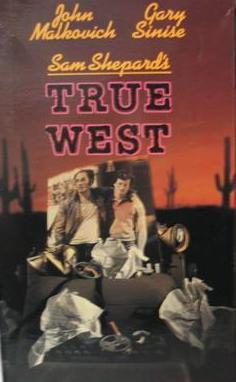
Shepard, who I met and interviewed (see here), was always a personal favorite. An artist disguised as a road-weary bohemian cowboy, his acting was consistently spot-on (he was ace in the 1983 movie adaptation of Wolfe’s “The Right Stuff”) and I’m deeply partial to his 1980 play of fraternal fury “True West,” a raging comic masterstroke about bad blood, beer suds and the prickly craft of screenwriting. 

Watch it on YouTube, starring John Malkovich and Gary Sinise as riotously bickering brothers. It will, like Philip Roth at his best, knock you out. When you come to, the whole world will be a little bit different.

A catty catalog of cultural irritants

So many affronts, so little space. Ergo I will call out only six middle-brow cultural irritants that make me ponder the arc of civilization. Expect a sequel. For now, this:

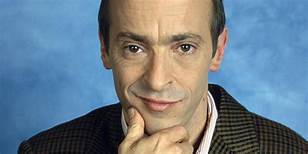
th-2.jpegDavid Sedaris — Snicker-worthy at his very best, Sedaris, an author and humor essayist for The New Yorker, has made a cottage industry out of wan, admittedly embellished autobiography, droll pieces about his family, his lover and his privileged moves to the French and English countrysides. Turning life into literature, he is frank, irreverent, sassy, yet sensitive, as any good writer should be. And he is a good writer, even if his language is surprisingly prosaic, stylistically flat-footed. Overrated, with thousands flocking to theater-sized readings to hear his nasally, high-pitched deadpan, he’s not exceptionally funny or insightful, though he taps a reservoir of honest empathy. He’s a queer, urban Erma Bombeck, flattering a particular strain of hipster and sophisticate with teeny tee-hees.

U2-2014U2 — Because Coldplay is too obvious and Wilco too irrelevant, I’m picking on the most deserving of all bloated, self-important, grandstanding white-people bands. As much as I appreciate the group off-stage — humble, bleeding-heart humanitarians, endlessly concerned with leftie causes and global injustice — as a rock band they represent bombastic blandness. Recycled guitar riffs, repetitive drum beats (if Larry Mullen isn’t rock’s most boring drummer, I don’t know who is), Bono’s predictable pleas for world wonderfulness, and stadium shows of gargantuan gaudiness that exemplify the elephantine excess U2 so vocally rails against. They are an enigma, and forever annoying.

th-1.jpegWes Anderson — Once upon a time the promising filmmaker was so good — inventive, with witty stylistic flourishes and a big, boyish heart: “Bottle Rocket,” “Rushmore,” “Fantastic Mr. Fox.” But amid and after those gems, the dandy-as-director became the worst: a manic, preening showoff. Fussy, hyper-designed, mannered, cloying and overwritten — I’m looking at you, “Grand Budapest Hotel” — his movies are like stuffing fistfuls of pure cane sugar into a mouth filled with painful cavities. Cinematic sadism.

th.jpeg

Jimmy Fallon — Television’s embodiment of cutesy, mugging, please-love-me sycophancy. Dancing, playing charades, lip-syncing, giggling like a tipsy toddler, pitching guests marshmallow questions while fawning over them with googly eyes and panting tongue — “You’re so awesome!” — he’s the only TV personality I know of who looks like he’s going to piss his pants at any moment.

th.jpeg

Outdoor Music FestivalsMy nightmare epitomized. I’ve survived many of these, from Pearl Jam at San Francisco’s Polo Field to numerous Lollapaloozas and Days on the Green, to al fresco jazz festivals. Terrible, all of them. Acoustics meant to reach 100,000 people are stretched to gauzy echoes — bands have never sounded worse. Bare, sweaty, whooping flesh is crammed together in slick seas, unbudging, except for girls wiggling on their boyfriends’ shoulders blocking the view of miniature musicians on stage (thank god for JumboTron). Crushing summer heat. Rip-off food and drink booths. Hemp and beeswax candle vendors. Misting tents. Fragrant porta-potties with show-missing lines. Two more words: tie-dye.

bendahlhausofficial-neat-formal-man-bun-e1491414734529.jpgMan buns — This is simply inexcusable. Enough has been made about how embarrassingly stupid these pseudo-samurai top-knots are and yet men, mostly young, insist on sporting them (invariably with metrosexual beards, no less). Begging, wheedling, outright shaming, nothing can stop them. It’s a mass delusion — they honestly think they look cool and that these baleful hairballs are not the ultimate caricature of hipsterism run amok. I’ve actually seen seemingly sensible women with their arms around man-bunners. Yes! True! I have! Shoot me now.

Big hopes from a tiny guitar-like thingy

My niece wants a ukulele for her 13th birthday. When I first heard this I started, did a double-take, and glanced to the heavens. Then I thought: Wait, awesome. A ukulele. And I proceeded to volunteer to be the acquisitor of said micro-guitar, which is actually in the lute, not guitar, family, I now know.

Ukuleles are, of course, ridiculous musical instruments, hollow, fretted, fearlessly tiny objects with four nylon strings. One helplessly conjures Tiny Tim plinking a ukulele while bleating “Tiptoe Through the Tulips” in a fluttering falsetto in the late 1960s. Once heard, the song is hard to delete. Therein lies the tragedy. 

th.jpeg
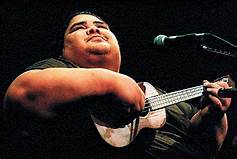
Israel Kamakawiwoʻole

Inordinately better, we cleave to what is regarded the most popular song on the ukulele, “Somewhere Over the Rainbow,” as performed by late Hawaiian musician Israel Kamakawiwoʻole. He was a massive man, with a massive heart and a massive talent. Though his doughy arms swallowed the instrument, his touch on the strings was caressing, the lilt in his high, quavering voice heartrending. Listen to his take on the “Wizard of Oz” classic here. It will destroy you.

Back to yuk-uleles — er, ukuleles. These lute-like things are a Hawaiian adaptation of an instrument from the Portuguese Azores called a machete, which gained wide popularity in the U.S. and spread internationally.

And then spread to my niece, a precocious green-haired gamine. This could be wonderful (Hawaii!), or calamitous (instant boredom, or worse, Tiny Tim). My niece and I share a heritage that goes back to the Portuguese Azores, so there is hope for her aptitude. She is a dexterous creature. She might be a born ukulelean. And the tiny guitar (lute!) that I’m getting her comes with a tuner and beginner’s songbook, plus a case. Extra promising: many of her friends play the Lilliputian lyre (lute!).  

th
Tiny Tim. Help us all.

Yet I can’t help shake the instrument as somehow clownish, witnessed in circuses, bad stand-up and “Gilligan’s Island.” Perhaps I’m wrong. Just a few celebs who played or at least dabbled with the ukulele: Elvis, Marlon Brando, Adam Sandler, Willie Nelson, Paul McCartney, John Lennon, Greta Garbo, Steve Martin, Taylor Swift, Elvis Costello, Pink, Barack Obama, and on it goes.

So there’s hope. And dignity. Even if the instrument is a mere 21 inches long with only four strings, like a guitar left in the dryer too long. I expect mighty sounds from my niece. One of her favorite bands is Twenty One Pilots, which at times deploys this mini-lute. I’m not a fan of the band, but I’m a fan of her, and that gives me confidence that this ukulele experiment, this dip into plinky-dinky ditties, will sing.

In art museums, when are selfies ever cool?

An article I just read triggered a deep-seated pet peeve of mine. It’s not about how super it is that summer’s almost here, which really gets my goat, because I loathe summer. And it’s not about the astonishing nincompoopery going on in Washington right now. 

It’s more important than all that. It’s about patrons taking selfies in the world’s greatest museums, standing like glassy-eyed dolts before masterpieces by Van Gogh, Da Vinci, Rembrandt and Caravaggio, all the while blocking the paintings for others as they stage strenuous fake smiles at their cell phones without actually studying the monumental artworks hanging mere feet away. Pose, smile, snap, leave.

Recently at the Rijksmuseum in Amsterdam I was looking forward to truly absorbing Rembrandt’s grand, justly famous “Night Watch.” It had been years since I’d seen it in the flesh, and this time I read up on it, prepared for a more immersive, enlightened viewing. 

IMG_1062.jpg
Mobs of viewers before Rembrandt’s “The Night Watch” this month in Amsterdam.

Not a chance. The painting is quite gigantic and still, when I got to it, a crush of phone-wielding zombies were cluttering up the view. I jostled and elbowed, to no avail. Details I wanted to drink in, such as the fuzzy little self-portrait of Rembrandt peeking out from between two watchmen, had to be quickly glanced before some dunderhead, camera in fist, bumped me away. 

Cell phones and those mortifying selfie sticks abounded, with people actually pointing cameras at themselves, plastering on gargoyle grins and snapping themselves in front of a masterwork they couldn’t care less about except for how it will look on Instagram. Can you imagine how those shots turned out? The mind reels. The stomach turns. 

A few sublime Vermeers prominently adorn the Rijksmuseum, but if you want to see them, really see them, wait until the Selfie Squadron gets its fix. Watch as it rushes up to gentle tableaus of sun-splashed domestic life, framing and snapping pictures, then summarily rushing to the next painting, like it’s a contest, some kind of desperate relay.

The selfie epidemic is even uglier at the Louvre with Da Vinci’s magnetic “Mona Lisa.” 

The way many patrons “interact with the 500-year-old painting exemplifies how differently the digital generation experiences art,” says The New York Times article I read. “Most of the roughly 150 people crowded around the painting were taking photographs of the piece, or of themselves in front of it. In the presence of the ‘Mona Lisa,’ digital photography, more than looking at the actual artwork, has become the primary experience.”

merlin_137029152_aa4f1816-a22b-477d-8ee4-ebeb6c390ce4-superJumbo.jpg
The “Mona Lisa” at the Louvre in Paris. (Photo by Pedro Fiuza.)

This disgusts me, and it probably shouldn’t. No, actually it should. And this is why:

“Imprisoned by its reputation as the most famous painting in the world, the ‘Mona Lisa’ has, to all meaningful intents and purposes, ceased to exist as an original work of art. It has become an idea — and a photo opportunity.”

Hasn’t everything been reduced to this, a crass photo opportunity? Even at Starbucks, I see people satisfying the urge to take selfies of themselves with their massive milkshakes that pass as coffee drinks, tongues hanging out or lips pursed, fingers making a peace sign. Who but the takers wants to look at these images?

It’s too easy to blame unchecked narcissism, yet that’s surely a contributing toxin. As someone who’s almost pathologically camera shy, I can’t fathom this slavering need to record oneself every 15 minutes until dizzying repetition nullifies any semblance of originality. The pictures all look the same; only the “zany” faces vary. People love to look at themselves. As the center of the universe, their self-adoration knows no bounds. It is, I think, a sickness. The camera-clicking hordes in museums reveal a kind of twisted vanity.

Think about it. Your mugging face, beaming, and in the far background, lost in the clamor, is “The Night Watch” or the “Mona Lisa.” What then? The shame.

Unsparing truth, from Philip Roth, 1933-2018

“No one gets through unmarked by brooding, grief, confusion, and loss. Even those who had it all as kids sooner or later get the average share of misery, if not sometimes more. There had to have been consciousness and there had to have been blight.”

— Philip Roth, “American Pastoral”

roth.png


I’ll read this next. Or maybe this. No wait. What about that?

A few posts ago I crowed about the next five books I plan on reading.

Scratch that. 

Things change. Switcheroos occur. Some books work, some don’t. I close and tuck away the latter and embrace and finish the former. There’s been some tucking away going on. 

I announced on the blog that after completing the superb Siamese twins biography “Inseparable” I would take on my Amsterdam holiday Kurt Vonnegut’s darkly comic wartime novel “Mother Night.” All of that happened. 

Except: I didn’t cotton to the Vonnegut book as I was certain I would. Quite early on I found it uninviting, atonal and dry. I shut it. And became desperate. I was still in the States and my sole vacation book was failing me. 

51Ix-oAS0zL._SX319_BO1,204,203,200_

Discouraged yet determined, I marched to an airport bookshop, poked and peeked at a dozen acclaimed books, until I hit the staff picks display, which spotlighted Ann Patchett’s heavily praised novel “Commonwealth.” I’m not used to paying full price for paperbacks, but I popped the almost $20, grimacing and banking on the best — even while recalling that I couldn’t get into Patchett’s previous blockbuster “Bel Canto” the two times I tried.

“Commonwealth” is strong. On the whole trip, though, I read only 47 pages of it — my laptop is a serious distraction. I enjoyed the book’s humor, descriptive muscle and palpable humanity, and I planned on gladly finishing it back home.

41kvpzruegl-_sx329_bo1204203200_85.jpg

Then this happened: Waiting for me at home was Rachel Kushner’s new, ecstatically reviewed “The Mars Room,” which was on my list of five books to read next. It was, of all things, a library book, with a two-week checkout limit. I pounced. “Commonwealth” would have to wait.  

I just wrapped “The Mars Room,” a very good if never truly great page-turner set largely in a sordid women’s prison, much like “Orange Is the New Black,” with grim and funny detours streaking the story, including a few to the San Francisco strip club of the title. Kushner is good with grit, limning harrowing and humorous situations with a kind of streamlined tough-gal strut. And the final pages seize you hard. 

Before the Amsterdam trip, I borrowed two other titles on my list of five, Zadie Smith’s “NW” and Ottessa Moshfegh’s “Homesick for Another World,” neither of which I got around to thanks to the pleasingly time-consuming “Inseparable.” They remain fast on my reading list. 

61txVZFq-EL._SX331_BO1,204,203,200_

And yet: Dropping off “The Mars Room,” instead of getting the Smith or Moshfegh books, I got distracted and picked up two more books on my extended wishlist, Curtis Sittenfeld’s comic coming-of-age novel “Prep” and Jesmyn Ward’s National Book Award-winner “Salvage the Bones.” 

I get sidetracked in a snap when I’m around piles of books, my head on a pivot, eyes flashing, hands flipping pages, picking up and putting down volumes. So much to read, so many diversions, so many anxious postponements.

Of the two books I grabbed, I chose first to plunge into the poverty-stricken, pre-Katrina, Mississippi-set “Salvage the Bones.” So far, it is rapturously evocative, the prose raw and earthy and exquisite, the narrative quivering and propulsive.

Here is Ward’s description of a pit bull giving birth to puppies:

“Skeetah grabs the puppy’s rear, and his hand covers the entire torso. He pulls. (The mother) growls, and the puppy slides clear. He is pink. When Skeetah lays him on the mat and wipes him off, he is white with tiny black spots like watermelon seeds spit across his fur. His tongue protrudes through the tiny slit that is his mouth, and he looks like a flat cartoon dog. He is dead.”

If “Bones” eventually chokes — that’s far-fetched — I’ll do what I am wont to do: put it down and move on to the next title. But what will that be? “Prep” or

51at-ah4UzL._SX309_BO1,204,203,200_

Even with two books before me, I said screw it and ordered Karl Ove Knausgaard’s “Spring,” a slim new memoir arriving in the States bubble-wrapped in effusive plaudits. The book is “poignant and beautiful,” a critic says. “Even if you think you won’t like Knausgaard, try this one and you’ll get why some of us have gone crazy for him.” (I’ve read five of his books and have gone crazy for him.)

“Prep” or “Spring” — I’m betting on the latter. Or will yet another title crash my consciousness and hijack the show? Likely.

Book fiends I know are afflicted with this disease of ravenousness, of greedy insatiability, of jonesing for the next fix. Books as lifeblood. Beats baking. Beats sports.

The saga continues, so much pulped wood before me, no end in sight. It’s an embarrassment of riches — words, language, poetry, morality, mortality, love and loss. And, as that, it’s a crazy blessing.

Just a typical day out in Austin, Texas

A long time ago in the hip and happening capital of Texas …

AUSTIN — Motorcycles have their place: soaring over rows of parked trucks; buzzing maniacally inside the Globe of Death; revving on stage at Judas Priest concerts. But they really stank up the city over the weekend, when nearly a billion rumbled in with their owners and the chicks who ride on the back for the annual hog-athon.

The bikes were gorgeous, exotic creatures: fetishistically sculpted chrome and steel, sparkling in the sun, low-slung and high-maintenance. Many appeared like they just vrooomed out of TV’s “American Chopper.” And they were everywhere downtown, rolling in parade formations and shredding the muggy air with hot chainsaw screams and crackling flatulence.

8-12-13-386.jpg

In other words, they were noisy and they took every single parking space. (One bike per meter? Please. You can stuff four of those things between the painted lines.) Still, I’m glad these hairy, leather-laden compatriots, who seem to believe a well-tied head scarf serves the same protective function as a helmet, enjoyed the weekend fellowship and Austin’s renowned ethos of tolerance. It gives the city that rowdy edge.

Levitch1
Timothy “Speed” Levitch

I didn’t even mind that the bikes’ symphonic violence (thousands of tubas played in a rain of napalm) sporadically drowned out my conversation with Speed Levitch at Casino El Camino. Through the bar’s ambient chatter, through the jukebox punk and metal, the choppers chopped.

Speed’s the star of the garrulous documentaries “The Cruise” and “Live From Shiva’s Dance Floor.” The movies reveal a young eccentric whorling through funny, far-out reveries, spinning streamers of soliloquy around the neon rave of his own mind. He’s a performance artist, a living one-man show, radiating an internal spotlight. He’s pretty charismatic, if kind of freaky.

Part poet, part gypsy-hippy, Speed has lots of friends in town and performs here often. He came from New York to do his show over the weekend. Saturday night he was merely hanging at one of his favorite local bars to get one of his favorite local dishes, Casino’s eggplant sandwich.

As we wove through flotillas of idling two-wheelers, Speed told how he’s reinvented his famed New York tour-guide shtick into ambulatory sidewalk theater. (Watch the above movies and you’ll understand.) He was inspired by a friend who coached the late Spalding Gray, Speed said. “He told me, ‘Do what you feel and keep a clear communication with your soul, amplify it, and then call it theater.’ ”

Then Speed sped off.

Later, at the city’s premiere arts venue: Some two hundred people attended Andrei Tarkovsky’s 1972 sci-fi fugue “Solaris” at the Paramount Theatre.

The turnout surprised me. “Solaris” isn’t action-packed summer adventure. It has more in common with Ingmar Bergman, fog and glaciers than George Lucas, androids and lasers. It’s a challenging, deeply spiritual and very long trip. It’s been called the Soviet answer to “2001: A Space Odyssey.” But Kubrick’s film is “Spaceballs” compared to the abstruse, though fascinating, eye-squinchingly wise “Solaris.”

967bf6f366bd28712a7f041b5c36e7f8

Nearly everyone endured all three hours, despite an intermission — an invitation to flee. As the red velvet curtains closed over an elegant “The End” tag, the audience sat in dumbfounded silence. Eventually, murmurs were heard. Blood returned to vital organs.

I’m picturing some of these brave souls walking to their cars in a stun-gun stupor. They drive silently through the dark, the radio off. At home, they strip, lie on their bed in the dark, and softly weep.

Far in the distance, a chopper revs and groans.

Passing on to a new passport

So my passport is about to expire — August 18, to be exact — and I’ve spent the last 40 minutes or so applying for a spanking new one, filled with precisely 28 crisp blank pages watermarked with stirring visions of Americana, from the Statue of Liberty to orbiting spacecraft; from an Alaskan grizzly eating a fresh, flopping salmon (true!) to the noble, jut-jawed mugs of Mt. Rushmore. It’s like a little picture book to remind you of home while you’re happily clomping around and spending money in someone else’s fine nation. 

To get this desperately necessary booklet (I travel, therefore I am), I have to send thoroughly filled out PDF forms, a check for $110, a new mug shot (I’m camera shy, so that’s delightful) and my old passport to whatever U.S. department of whatever. Then, in several weeks, I’ll have a crease-free dark blue book that will allow me to get the hell out of here to somewhere new, exotic and magnificently dangerous. Or maybe just to Paris. 

IMG_1137.jpg

I will miss my current passport. For one, my photo isn’t ghoulish. I look young, boyish, and remarkably tan. And I’m proud of the stamps from other countries I’ve collected in the course of its 10-year life: Lebanon, Syria, Russia, the Netherlands, France, Turkey, Spain, Canada (well, Canada), England, and more. I will stick a Post-It note on this passport with the earnest message: Please return this! When I did that last time, they returned it, but punched a bunch of holes in it to invalidate it. Fair enough. Old passports make fond keepsakes.

It’s crazy and not a little depressing that it’s already time to renew my passport. Ten years is a stretch. But I’ve given this pocket pal a good workout, gripping it to far-flung places, some of which I never imagined I’d ever go. I don’t look the same, but only once has a customs agent done a double-take when checking my photo. “That was a long time ago,” I assured her. She smiled. I sighed.

The last time I renewed a passport and got the one I have now, the one about to expire, I did it a couple years before its expiration. That’s because I was traveling to Lebanon and Syria (before the current war) and my passport contained a stamp from Israel, where I had been years earlier. Both Lebanon and Syria bar entry if your book has an Israel stamp for obvious, if arguable, political reasons. So I had to get a whole new passport. What with paying for a Syrian visa to boot, those pre-trip costs were onerous.

IMG_1140
She’s still in good shape.

This time I’m cutting it close. In some countries your passport must be valid for more than three months before the expiration date. When I went to Amsterdam a few weeks ago the airline attendant looked at my passport date, did some quick math in her head, and paused before letting me check-in.

I’ll have none of that. Time is of the essence if I want to travel anytime soon, though I have no plans. I’m off to get a new passport photo, which for me is like getting a colonoscopy, an uncomfortable, possibly traumatizing event. If the recent picture on my Russian visa is any indication, the new photo will be monstrous, even gargoylian.

I have no idea where I’m going next with the new passport. I don’t travel in summer -— too hot, too crowded, too pricey — so I can relax and blithely research the next adventure. Then, by fall, I’ll be off, ready to deflower the new booklet with its first kiss, the loud, mechanical thomp of the customs agent’s stamper.