In defense of proudly prosaic poetry

Who likes poetry? I mean, who sincerely enjoys and delights in the art’s nose-crinkling inaccessibility, willful allusiveness and opaque flights of fancy? Who, really, likes to be flummoxed?

I do. Not much. But a little.

With a philistinian gulp, I admit that I prefer my poetry streamlined, simple, more aerodynamic than pyrotechnic. “Prose poetry” — the wondrous fictions of Nabokov, Marquez, Marilynne Robinson, Cormac McCarthy, to name a few — is what I really savor, alongside the vaulting, tongue-tangling verse of Shakespeare’s plays. (I haven’t worked hard enough to appreciate the Bard’s beloved Sonnets. I know, I know. Poetry, see, so often requires toil. I tire easily.)

Recently reviewing the great Ben Lerner’s book-length essay “The Hatred of Poetry,” The New York Times remarked: “A lot of people seem to hate poetry, which is arguably neck-and-neck with mime as the most animus-attracting of art forms. Loathing rains down on poetry, from people who have never read a page of it as well as from people who have devoted their lives to reading and writing it.”

I‘m loving the Times.

Now, here’s what feels like a blushing confession, a bald admission that I am, at long last, a quasi-poetryphobe. And that is: My favorite poet is Billy Collins. Elfin in aspect, with a humble mien and dazzling intelligence, Collins might be the most popular poet in America. His publishing deals are staggering. He enjoyed two stints as U.S. Poet Laureate. His readings are thronged. He’s like the Tom Hanks of poetry.

He also might be one of America’s most loathed poets, caught in that love-hate swirl of backlash — or simple lash. He’s deplored by many readers, critics and fellow poets, dismissed as easy, anodyne and frivolous, appealing to the lowest-common denominator, the beach-read slugs.
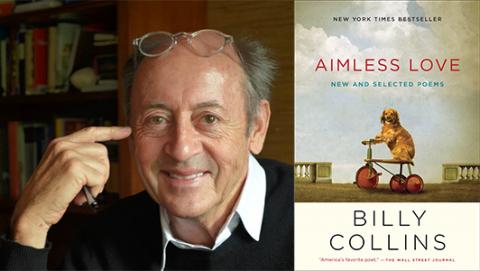
Billy Collins Photo and Book 07212014.jpg

As The Buffalo News said: “To his critics, Collins is a ‘major minor’ poet at best whose work is formulaic, if not predictable, and whose relentless efforts to charm the reader assume that the only way a poem can work is on the demotic level, which is to say, as colloquial speech.”

An online wag cracked: “Billy Collins is to good poetry what Kenny G is to Charlie Parker; what sunset paintings at the mall are to Jackson Pollock.”

Or, jeez, perhaps Collins is the Thomas Kinkade of poets.

Then again, no.

Collins’ gently cascading language is deceptively dismissible. It doesn’t boogie; it waltzes and sways. The poems are indeed colloquial, plain-spoken, but the artist braids his mini-narratives just so, to surprising and droll effect. Explosions are rare. He ferrets out little truths in life’s nooks, casting a soft, never-blinding light on them, hoisting them as shiny epiphanies that make you nod in gratitude.

Almost consistently funny, his poems are also often dark, shot through with self-deprecation and doubt about the whole racket of writing. It’s charmingly self-referential, even a bit neurotic.

Collins is the master of  “witty poems that welcome readers with humor but often slip into quirky, tender or profound observation on the everyday,” That’s the Poetry Foundation, which also cites no less than John Updike (speaking of an exemplary prose poet), who praised Collins’ “lovely poems” as “limpid, gently and consistently startling, more serious than they seem, they describe all the worlds that are and were and some others besides.”

Read for yourself here.

One of Collins’ poems, “The Country,” which opens the fine collection “Nine Horses,” hooked me early on, made me follow him all the way:

I wondered about you

when you told me never to leave

a box of wooden, strike-anywhere matches

lying around the house because the mice

might get into them and start a fire.

But your face was absolutely straight

when you twisted the lid down on the round tin

where the matches, you said, are always stowed.

Who could sleep that night?

Who could whisk away the thought

of the one unlikely mouse

padding along a cold water pipe

behind the floral wallpaper

gripping a single wooden match

between the needles of his teeth?

Who could not see him rounding a corner,

the blue tip scratching against a rough-hewn beam,

the sudden flare, and the creature

for one bright, shining moment

suddenly thrust ahead of his time —

now a fire-starter, now a torchbearer

in a forgotten ritual, little brown druid

illuminating some ancient night.

Who could fail to notice,

lit up in the blazing insulation,

the tiny looks of wonderment on the faces

of his fellow mice, onetime inhabitants

of what once was your house in the country?

That poem cracks me up every time. It’s funny yet concerned, a little nerdy. (You can watch an animated video of the poem here.)

Thing is, Collins wants poetry to be easy and lucid and fun and moving. He’s curated two volumes of such work, “Poetry 180: A Turning Back to Poetry,”  featuring poems by, among others, Catherine Bowman, Philip Levine, William Matthews, Paul Muldoon, Mary Jo Salter and Pulitzer Prize-winner Stephen Dunn, my second favorite poet, who also traffics in prosey stylings that illuminate life with wry melancholy. (Check him out, especially, I think, “A Postmortem Guide,” which I’d like read at my own ashes scattering. Classic stanza: I learned to live without hope/as well as I could, almost happily,/in the despoiled and radiant now.)

It doesn’t matter that Collins is no Larkin, Wordsworth, Heaney, Dickinson or Keats. Hell, maybe he is. I don’t know. But like the best art, his quirky poems are nourishing. They stimulate and tickle. They please me. I think that’s enough.

Curiosity killed the Catholic

I’m always on the lookout for a little religious illumination, be it the rattling Scientology documentary “Going Clear” to actually inviting a pair of Mormon elders to my home for an eye-crossing lesson in radical historical revisionism. (They were very nice young men, for the record, natty in ties and pressed white shirts. A wee deluded.)

Right now I’m returning to some tried-and-true texts: the four Gospels and Acts in the New Testament, along with “The Historical Figure of Jesus” by E.P. Sanders.

This hidebound agnostic isn’t going reborn, hasn’t “found” anything and anyway isn’t searching for religious enlightenment, a Damascus moment. I’m a minor history buff (literally: it was my college minor) and armchair theologian, which means I sit in an armchair and read about religion with skepticism and a giant cigar.

The cigar’s a jape, but I’m fascinated by ideas of mass worship, divinity, mysticism and the spread of religion through the ages. Seeking “truth” isn’t the object — I don’t believe it resides in a religious text — but merely intellectual stimulation.

(And I have gotten out of the armchair: I was raised Catholic — baptized, Sunday school, weekly Mass, teenage apostasy, the works. In 2000 I made a solo trip to Israel to, among other things, get immersed in monotheism firsthand. It altered none of my thinking on the matter, except to solidify preconceptions about faith and fanaticism.)

Curiosity killed the Catholic. The more religion I ingest, the warier I become. I thirst for facts, historical actualities, not myths or homilies or inspired conjecture. I want the relative power of knowledge, not the affirmation of faith.

What strikes me is how, outside of the academy, intellectual ballast is so often at odds with religion. Example: A good friend in college prided herself on her devout Christianity, chided me for everyday blasphemies, went to church weekly and praised Christ. But she never read the Bible and everything she knew about the religion was received wisdom, blind faith from the church and her parents. Once, when I described to her what Jesus probably looked like, she said, and I quote, “Didn’t he have those beautiful blue eyes?” Yes, and a brushed swoop of sandy-blond hair.

face-of-Jesus
Would the real Jesus please stand up?

Maybe Jesus did look like Barry Manilow. But I care more about a historically accurate account of what he said and did. I especially want to know how he turned water into wine, a miracle that could save me bundles at Liquor Locker. No one seems to have a complete grasp on the actual Jesus. Even the Catholic Bible I’m reading is strewn with footnotes that cast troubling shadows over the “gospel truth.” Despite my reading, I’m still a grappling student. I’ll get back to you when the heavens crack open.

It’s my journal. If only it were more.

“Journal entries, those vessels of discontent, are notoriously fickle, subject to the torque of mutable feelings; without caution, speculation falls into usurpation.” Cynthia Ozick

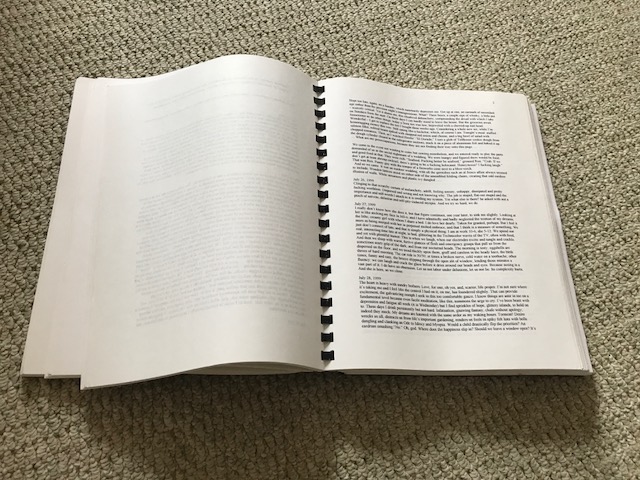
I’ve kept a journal for more than 22 years. It’s mostly electronic, tip-tapped on my computer, though I’ve printed out hundreds of pages from the first decade or so and bound them in a plastic spiral binder, as if I wrote a book. It’s quite fat.

IMG_0760.JPG
A big hunk of my journals, bound.

(This word barrage, incidentally, doesn’t include the stacks of Moleskin notebooks deliriously filled during my extensive world travels.)

What I write in the journal is hardly revolutionary. I report, remember, ruminate, philosophize, complain, yearn, whine and woolgather — all that human stuff. Most likely it is ravenously narcissistic, disgustingly self-obsessed, irretrievably solipsistic. (And how.)

Some of it’s pretty juicy, even naughty, but I’m careful not to get too personal about others. For one, I’m not comfortable anatomizing friends and family; second, I wouldn’t want to injure feelings of someone who pried where they weren’t supposed to. (Once, someone did pry where they weren’t supposed to. A romance that was in its death throes was instantly snuffed.)

It wants badly to be literary, more narrative than journalistic, even occasionally novelistic, lyrical, with cartwheels and curlicues. This means a lot of it is dreadful. Perhaps what I’m aiming for is the memoir-y fictions of writers like Ben Lerner (the astounding, erudite “10:04”), Karl Ove Knausgård (the granular, un-put-downable “My Struggle” series), Teju Cole (“Open City,” a minor masterpiece), and Eve Babitz (“Eve’s Hollywood,” a delicious, decadent Didion), paragons of the form, of living, breathing autobiographical novels.

And then there’s one of the Platonic ideals, Dostoyevsky’s “Notes from Underground,” the first half of which is the faux-memoir of a blustering, philosophical nihilist, spittle flying with frothing apoplexy. It’s nuts, pure sulfurous id.

And, three attempts in, I still can’t surrender to this undisputed (until now) classic novel. Despite its machine-gun stream-of-consciousness, “Notes” is a grinding slog. The book rushes headily but incoherently, a corrosive rant by its nameless protagonist that loops-the-loops, caroms, careers and pinballs. Zesty, it’s also strangely insipid. I don’t know what the character is on about most of the time, but there’s a zing and energy propelling his transgressive thoughts.

About putting it down, yet again, I am conflicted, though I am mostly just bored, and that — boredom by a work of art — is unforgivable. I persevere for my friend Sativa’s sake. “Muscle through,” she, a fan of the book, tells me. But I can’t.

Still, I wish my journals were as combustible, as gnarly and smart. Sylvia Plath’s published journals, so frank and vivid, have inspired me, told me how to limn a banal day, galvanize a simple gesture. Lerner, infusing the quotidian with ballistic intelligence — he’s something else. (I’ve twice read “10:04.”)  I return to my bloated journal, its thirsty computer pages, recording the day, feelings, longings, and do what I can, all the while hoping for something approaching, or just faintly grazing, art. Ha.

Remembering Nicky

Lately I’ve been wondering where Nicky the dwarf wound up. Kids at my grade school used to taunt Nicky because he had an oversized head, was 2-and-a-half feet tall and rode around the playground on his tricycle. He had a heck of time walking with any haste, and he wore his hair in a fluffy manner fashionable during the late ’70s. The whole situation was pretty tragic, a bully’s delight.

I was more of an acquaintance than a friend of Nicky’s, and never a bully. This was in third and fourth grades. Nicky was a little younger than me and always wore this tiny jumpsuit that was gray with red pinstripes running up the abbreviated legs. He always wore sandals with white socks, too. I have no idea why I remember these details, but I’m pretty good that way. Ask my amnesiac brother, whose childhood memories begin at age 30.

Once when I went up the street to visit a kid named Billy, who was closer to my brother’s age, I was startled to find Nicky there. Were they related? Billy had elfin features, so maybe he was secretly an elf, and he and Nicky made toys. Maybe the two of them are very rich men today.

What stuck out most about Nicky was his voice. It was high and piping, yet it also bore the moaning, otherworldly timbres of the humpback whale’s song. Adult supervisors called yard duties walked about the playground with whistles around their necks — bored, lumbering sentinels scouring for youthful mischief. Too often it came in the dependable razzing of poor Nicky, and that’s when he would let out this pitiful cry in the voice of an old woman with laryngitis: “Yaaaa-rrrrd duuuu-tyy!” What broke your heart was that his voice had no muscle, so it didn’t carry beyond the circle of tormentors. It was like steam from a broken train whistle. It’s a sound, so many years later, I still hear precisely. (I actually do a pretty good imitation of it, if you just ask. Bring cookies.)

Humpback_Whale_underwater_shot

Now, I hope this hasn’t gathered into one of those “insensitive” articles that elicit exercised emails. I don’t really care, because I don’t think it should, and I won’t read them. I suggest you don’t put “dwarf” in the subject line.

Truthfully, Nicky comes up only because he’s a vivid memory, and I spend an uncommon amount of time sifting through my past, which thrives in my head, brilliantly and fondly. His random invocation has nothing to do with a book or a movie. Those close to me know I think about that kind of stuff all the time. I can still, if you’d like, expound on Grace McDaniels, the Mule-Faced Woman, nearly 30 years after first seeing her in the book “Very Special People.” (Even Tom Waits has sung about homely Grace.)

My memories are active things. Here are a couple that just popped up: In 1976, at SeaWorld in San Diego, my mom got drenched by a walrus that sprayed a mouthful of water at her. On my ninth birthday, two friends and I threw dirt clods at the house next door and I busted one of its windows. We had to clean up the mess the next morning. At age 13, some friends and I dumped a bag of dog doo on someone’s doorstep. I got blood poisoning from a nasty BMX wreck at about the same time.

Nicky’s there, too, wheeling about on his tricycle, not knowing where he’s going, and unaware that some of us, so many years later, would think about the answer to just that.

My, oh, ‘Maudie’

maudie_02

Today’s movie was between Sofia Coppola’s “The Beguiled” and the no-one-knows-what-the-hell-it-is indie “Maudie,” starring the serendipitously hawkish Sally Hawkins and Ethan Hawke. For various reasons (read: two reasons, neither scintillating) I chose “Maudie,” showing at the cozy, weirdly configured arthouse cinema.

It’s a Tuesday matinée and tickets are a chest-clutchingly cheap $7. The darkened theater is, per usual, populated with nattering, dithering geriatrics, clogging the entrance and doddering up the aisle as I stand impatiently, sighingly, behind them. “Jesus,” I finally mutter as I squeeze past a stolid body. Then I think: “Christ, this movie better match its unanimously rapturous reviews.” I lean back, put a foot up.

The movie is a splendor, something immoderately special. Inchworm slow and ear-cuppingly quiet, it’s a doozie about an eccentric couple, a painter and a fishmonger, that somehow, against bounteous, brittle odds, stays together and loves one another. My eyes moistened. Hawkins, all aquiver, like an injured sparrow — devastating. Two unwell people, frail and difficult, made me conscious of death and illness and curdled personalities, misanthropy, shyness, pain. It was scary. A fine work of art, if not altogether pleasant. I will see it again. I like my movies rather agonizing.

Also pretty agonizing are other peoples’ movie lists, bests and worsts. I take them personally; I get gastric distress when I read them, always. The New York Times recently proclaimed its 25 Best Films of the 21st Century, and it’s a muscular litany of durable art: “Boyhood,” “Eternal Sunshine of the Spotless Mind,” “Moonlight,” “There Will Be Blood,” “Yi Yi” and so forth. (Although it also lauds the quizzically overestimated “Inside Llewyn Davis.” I’ve seen it twice. It’s still as vapid as drywall.)

The list tips its hat to the Dardennes brothers’ 2006 neo-realist ordeal “L’Enfant,” which I, in my professional film critic days, named one of the best films of the aughts. This in mind, I rewatched it the other day. It was about half as good as I remember it.

Loose-limbed and one-note, with a pleading social conscience worn on its tattered sleeve, “L’Enfant” is a chiseled moral tale about a poor teen couple that’s just had a baby. She loves the child while he, a tragically inept thief, turns around and sells it on the black market. He is a dim young man.

The film’s verite grit is bulldozed on and you feel dirty and battered hanging out in its fearsomely authentic demimonde. I adored it on first viewing, and many people still do. I wonder if they’ve watched it recently. You can tell the movie’s final shot is supposed to tear you apart, and I’m sure it did when I saw it 11 years ago. Not now. It’s a little pushy and mawkish and more than a mite manipulative. You can see right off that it’s going to dwell for an eternity on the couple crying together then go black — not fade, but a hard cut to black, then credits. And that’s what happens. I wasn’t buying it.

That confessed, I still like the film; I’m just seeing it through a heightened critical prism. That happens. You can be hard on a work of art but still enjoy and appreciate it. Take “The Big Sick,” the praise-spangled rom-com starring the charming and funny Kumail Nanjiani and the always swell Zoe Kazan, whose quirky luminosity lights a fire under the low-temperature affair.

It’s wry, cute, droll, vaguely touching, but it never gets there. I liked it — I’d give it a B — but not as much as I felt I was supposed to. It’s mild and soft when it should bite, cutesy when it should be real. It’s also, at close to two hours, about 30 minutes too long.

Amid the crush of hosannas for “The Big Sick” I feel like a party-pooper, the sole hater swirling alone in outer space, far from its admirers. Be thankful: In space no one can hear you grouse.

The-Big-Sick-poster-1-e1493749505435.jpg
‘The Big Sick’