Buzz kill

I try to prioritize my murderous impulses. I don’t kill much, and what I do snuff out tends to possess multiple legs, pincers and stingers, and the potential to bite me and make me very unhappy. Rashes, swelling, itching — don’t fuck with me. 

So this is wonderful: Numerous yellowjackets have found their way into the house. There’s a nest outside and the belligerent arthropods are zipping through a vent straight indoors, flying and buzzing and trying to find their way back out, which of course they can’t. 

The pests are a type of wasp, not a bee, and can sting repeatedly without dying, unlike the dumb, suicidal bumble bee whose guts pour out when it unleashes its stinger. Yellowjackets are also more aggressive and tenacious when in attack mode. They have nothing to lose. They’re winged terrorists, mini drones aimed directly at you. And they get pissed off easily. 

And so, when I spotted one banging against the window above the kitchen sink, I: 1) freaked, 2) swore, and 3) sprung into action. I slipped off a sneaker, zeroed in on my jittery, buzzy target, and smooshed it with heroic gusto. Twhack, plop

And yet. While the vibrating, yellow-striped beast quivered in its death throes, it sort of broke my heart. I adhere to no religion, including Jainism, which is dedicated to the non-injury of any living creature. A Jainist wouldn’t hurt a fly, literally. I would. I do. Flies are a pesky pestilence.

Despite the yellowjacket drama — a crime scene, really— killing bugs is not my thing. When I stumble upon a beetle, spider, cricket or other creepy crawler that belongs outside and not, say, in my bedroom, 99-percent of the time I’ll get a tissue and gingerly carry it first class to the front lawn where it hopefully gains its bearings and flies or waddles back into the verdant, perilous wild. (If it gets cute with me, it’s swirling down the toilet.)

I’m like the Saint Francis of Assisi of bugs, except I’m not from Italy, I’m not Christian and I don’t wear a brown habit with a rope tied around my waist, though that might make a fine fall fashion statement. Francis, among many things, is the patron saint of animals. Even now, World Animal Day, when all manner of creature and critter is blessed in churches on Frank’s behalf, is held on October 4. (I’d take Cubby the dog, but he doesn’t believe in that hocus-pocus either, even if they give him a cookie.)

I’m no fan of bugs, but I empathize and believe they deserve a shot in this big doomed world, which is as much theirs as ours. That’s why I feel bad about the yellowjacket I turned to gruel. It wasn’t his fault he winged his way inside, and he was plainly trying to get out. But he couldn’t, and he was too dangerous and elusive to snatch in a tissue and deposit outside. It’d be like trying to save an injured Great White in the ocean. Just don’t.  

A sacred place. Even for heathens.

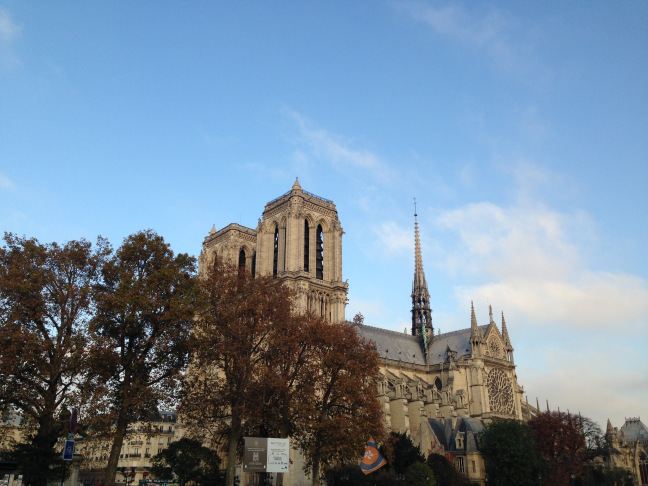
I last visited Notre-Dame just over three years ago, in fall 2015. When in Paris, I invariably duck into the grand Gothic cathedral several times, because it’s there, because it’s beautiful, because its draw is irresistible. It is Paris splendor epitomized.

I’ve been to Paris on five occasions, which means I’ve been to Notre-Dame at least 15 times. It never gets old. Rather, each visit rewards with something new and startling. Sometimes I just hang out on the plaza in front of Our Lady — the sprawling Place Jean-Paul II Square — sipping coffee, people-watching, marveling at the twin bell-tower facade and those maniacal, sniggering gargoyles perched way up high. 

A Catholic apostate and mid-level opponent of organized religion, I don’t worship in Notre-Dame, which went up in flames yesterday, mostly surviving the catastrophic blaze that had the world aghast. (Maybe there is a God.)

merlin_153563949_4a583841-241c-47fd-acff-a7c8dff47f89-superJumbo.jpg
Notre-Dame Cathedral in flames Monday in Paris

I don’t go for the holy experience, but the wholly experience — a soothing spiritual state of serenity and rumination, reflection and introspection, inspired by the vaulting, dimly lit sanctuary’s artwork, architecture, luminescent stained-glass and twinkling constellations of prayer candles. And that’s just the interior. 

Agnostic natives are with me, according to a piece in today’s NY Times: “France is one of the least religious countries in Europe. Urbane, intellectual Parisians often dismiss religion as archaic and unenlightened.”

IMG_0736.jpeg
Notre-Dame facade, fall 2015

But like other transporting religious structures around the world — from the Jama Masjid mosque in Delhi to the Wat Arun Buddhist temple in Bangkok — Notre-Dame is staggering to even this peevish secular humanist, with its gilded grandeur and gravity-defying architecture that toils so magnificently to transcend crude corporeality and reach for the heavens. In all her glory, Our Lady, I think, tickles the firmament.

(This goes for scores of religious sanctums I’ve traveled long and far to be dazzled by: the Blue Mosque in Istanbul, St. Peter’s in Rome, Angkor Wat in Siem Reap, La Sagrada Familia in Barcelona, and on and on. All instill dizzy awe, even if I’m not always buying what they’re peddling.) 

Even without the slightest religious propensity, I bewail the damage to Notre-Dame. Like most, I was sickened watching flames devour the cathedral, my old friend, on the news. More is there than a quaint, history-encrusted, 850-year-old church. It is the ineffable, the mystical, the irrefutably sacred.

img_0690.jpeg
Standing tall, fall 2015.

The cathedral, with a wingspan from Joan of Arc to Victor Hugo to Disney, “is universal, Western, religious, literary and cultural, and that’s what makes it different from any other object,” says a French analyst in the Times. “It’s the whole spectrum from the trivial to the transcendent, the sacred to the profane.”

In other words, it is stubbornly irreplaceable. Its survival, by a hairbreadth, an act of God, divine intervention, is something I am loath to believe in: a naked miracle.

Whatever saved it, I think it was more the skill, action plans and water hoses of the Parisian fire fighters than, say, the conquest of virtue vs. evil. But it doesn’t matter. Notre-Dame didn’t collapse or burn to cinders. It is, they declare, structurally sound. No lives were lost. And for that, all of us should sigh a collective amen.

But do note, those devilish gargoyles survived the flames, and they are still sneering.

gargoylesnotredame.jpg

Frustration to ‘The Firebird’ — the sublimity of St. Petersburg

In St. Petersburg, Russia, catching an Uber the hell out of the Alexander Nevsky Monastery was nigh impossible and immaculately exasperating — client and drivers just could not connect and a flurry of cancelled rides ensued — so I found myself trekking down bustling Nevsky Prospect, the main thoroughfare in this wonderfully massive city, pocked with shops and banks and restaurants, groceries and souvenir kiosks. I strolled contentedly (ignore the steam poofing from my ears) till I could stroll no more, and located a spot at a landmark from which to finally hail an Uber ride. (Did I mention the average Uber fare ran me about $1.50 US? A dollar-fifty. Yes, at this point I’m grinning.)

What I was doing at the famed, winsome Alexander Nevsky Monastery, at the tippity-top of Nevsky Prospect, was looking at graves, mostly those in the famous Tikhvin Cemetery, where Dostoyevsky, Tchaikovsky, Mussorgsky, Rimsky-Korsakov and other brand-name bodies lie.

img_0846.jpg

For about $7 US, one is invited to amble the leafy paths of the 19th-century burial grounds and, with map in hand, á la those furnished at the unsurpassed cemeteries of Paris, seek out the eternal mattresses of the famous and infamous. The weather was cool, distinctly autumnal, the leaves turned and fallen. It was bliss.

Dostoyevsky lurched at me:

IMG_0848.jpg

As did this distressed woman, who perhaps witnessed my Uber travails:

IMG_0853.jpg

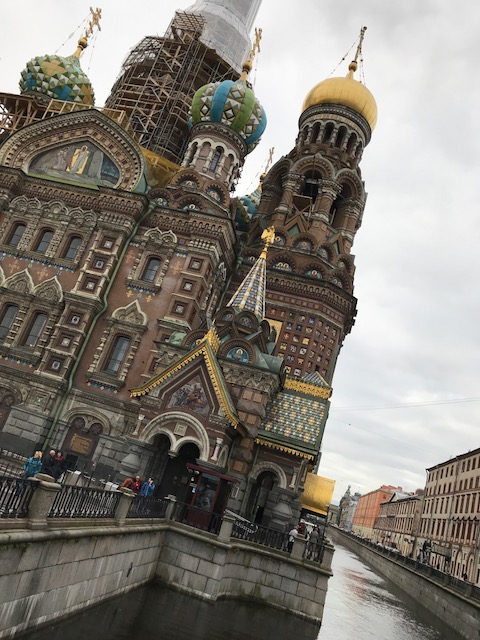
For this visitor, St. Petersburg was glorious that way, in its vibrant, tumultuous history, which is epic and bracingly complex, riddled with shake-ups, triumphs, reversals, oustings, wars, creeps (that’s you, Rasputin), revolutionaries (that’s you, Lenin), and cataracts of blood. Where else would there be this, the knockout, perversely titled Church of the Savior on Spilled Blood, the spot where Alexander II was assassinated by a terrorist bomb:

BLOOD 1.JPG

INSIDE CHURCH.jpg

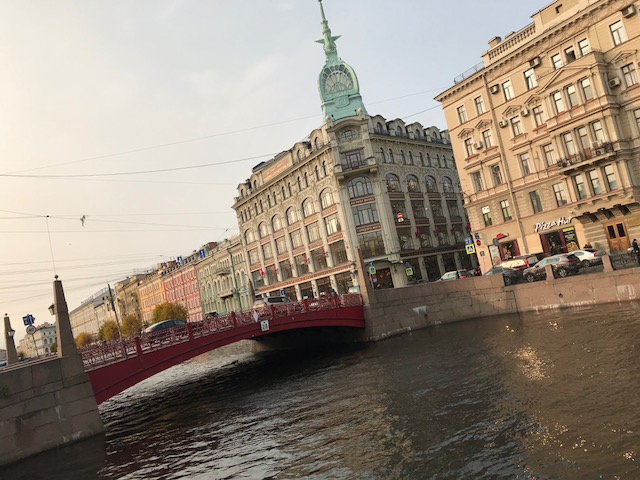
Endless canals stream through St. Petersburg, requiring scores and scores of small bridges, reminiscent of Amsterdam and its canals, or Paris and the regal Seine.

IMG_0888.jpg

IMG_0889.jpg

And, as I boasted in an earlier entry, I located unfettered beauty at the ballet in the legendary Mariinsky Theatre. I watched, and reveled in, Stravinsky’s landmark fairytale “The Firebird,” perched in a fine dress circle seat. It was lush and extravagant. My view:

THEATER.jpg

Bonus shots: The Winter Palace, once the official home of the czars in the 1700s, in the sprawling Palace Square. This is the main building of the boggling Hermitage Museum.

HERMT.jpg

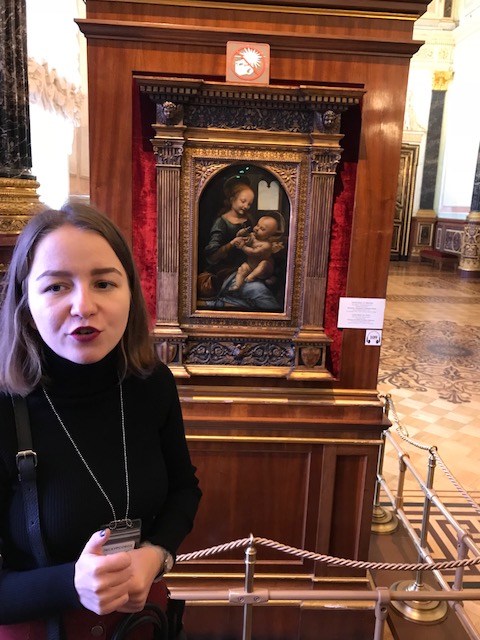
Below, a Hermitage guide describes Leonardo da Vinci’s exquisite “Madonna and Child” from 1478:

IMG_0809.jpg

And that’s all from Russia. I’ll spare you the food porn.