Sin City vs. Sin City

Let me say, between America’s two premier party towns, New Orleans kicks Las Vegas’ gilded, ersatz ass, that Emerald City conjured from desert pixie dust into a flashing mirage of gambling, chintz and sloshing oceans of open containers. 

Scripturally do I believe this: New Orleans, jewel of the Deep South, stomps Vegas, that spendthrift voluptuary of the West. I’ve been to both cities and can vouch for the Big Easy’s superior party bona fides, its inebriating beauty, gnarled history and lavish multiculturalism. On all counts, Vegas is bereft, a kind of gimcrack DisneyWorld to NOLA’s organic abundance, its French-kissed joie de vivre and bon viveurs, its patina of worldly class.

It’s mossy swamps vs. desert scrub. Beads, boobs and Bourbon Street vs. chips, glitz and the Strip. Indelible musical heritage (blues, jazz, zydeco) and culinary complexity vs. karaoke and Guy Fieri. It’s the rich mythology of Mardi Gras and voodoo vs. the dancing Fountains of Bellagio and hokum-pocus of Criss Angel.

big-drinks.jpg

Neither’s perfect. Both burghs are powerful magnets for slavering douche-baggery, cruising sidewalks nursing two-foot-tall girly drinks. (The rank cluelessness of these swaggering alpha males is adorable.) Both often display the collective mentality of a pimply 17-year-old boy (repeat: boobs) or a tequila-tottering bachelorette queen. Liquor rules. And there are no rules.

Having just returned from Vegas — where I won a whopping 50 cents at an airport slot machine and walked away with a spring in my step (I beat ‘em, by gosh!) — I can attest to the town’s vacant neon soul. It’s plastic, garish and grubby. It’s all facade, robbed of emotion — unless Christopher Cross, recently serenading the Strip with cloying power ballads, warms the cockles of your heart.   

And yet, like millions before and after me, I liked it. Truly, if not excessively. The booze, the vulgar resorts, the cacophonous casinos, a solid comedy show, my slick yet cheap hotel, some world-class meals that rival New Orleans’, fine weather and endless people-watching by turns transfixing and obnoxious. 

It was my second time in Vegas, and on this trip I learned how to enjoy myself by doing a little research and a lot of relaxing. Not poolside relaxing, but a mental, non-judgmental kicking-off of the shoes. I let Vegas do its Vegas thing.

Which is quite different than the similarly storied New Orleans thing. I’ve been there twice, on my 21st birthday and a hasty two-night stay during a Southern road trip about 15 years ago. I typically prefer a different kind of city — Chicago, Kyoto, Istanbul, Florence — but NOLA exudes a neat Big Little City vibe, like Charleston, South Carolina, or Austin, Texas. 

It’s southern to the core, twangy, tangy, congenitally ecstatic, weird and wonderful and proud of it. It’s one of those towns that always wants to get it on. (Though I’m not fond of strolling, badgering brass bands that strain to suck you into their high-stepping, hand-clapping, nightmarish street parties.) 

photo-1568693059993-a239b9cd4957.jpeg

Here’s where I say I’m heading to New Orleans for a few days next month, a week after the big, beady, booby bash that is Mardi Gras. (There’s more to it than that, of course, but it looks like a psychedelic bad trip from here, never mind all the deep-dish tradition. Explains journalist Chris Rose: “Mardi Gras is the love of life. It is the harmonic convergence of our food, our music, our creativity, our eccentricity, our neighborhoods, and our joy of living. All at once.”)

I have plans, none of them fantastically original. While I’m strenuously avoiding Pat O’Brien’s and its barfy Hurricane cocktail (been there, done that) and skipping the gorgeous green gatory goo of the swamps (done that, too), I will get lost in the pastel, fern-festooned, bar-clogged French Quarter, cruise the murky Mississippi on a Twain-ish paddlewheel steamboat and stroll famed cemeteries, those crumbly cities of the dead. 

shutterstock_426101227_copy.1528821762.jpg

My bad, but I’m eschewing the heralded art and World War II museums for the morbidly unhinged Museum of Death, and I will duck the city’s voodoo jive, most of which is about authentic as the eye-rolling “ghost tours” haunting the area with the spookiness of a ghoul out of  “Scooby-Doo.” 

the-scrumptious-louisiana.jpg

One of the nation’s finest food capitals, crackling with heritage, race, culture and love, New Orleans is synonymous with smorgasbord, from beignets to Po’ Boys, crawfish to jambalaya. Here’s where I’m going, to name a few: Peche (seafood inspired by the Gulf, Spain and South America), Cochon (Cajun and Southern cooking), Gris-Gris (Southern eats) and NOLA (a fusion of Creole, Acadian and Southern cuisine with global influences by local legend Emeril Lagasse).

For music and drink there’s the obvious, like world-famous Tipitina’s. I’ll skip it for the hip Bacchanal Wine, a laidback music-food-vino joint in the Ninth Ward that some regard the best bar in the city, if not the world. I also plan to hit popular jazz club The Spotted Cat, a cramped, sweaty spot where those damn brass bands, blaring with cheeks ballooned, may get to me yet. 

13220634_10154148345724820_3503016145107323727_o.jpg

“America has only three cities: New York, San Francisco, and New Orleans. Everywhere else is Cleveland.”

 Tennessee Williams

Reading, a loner’s sport

I read in bars. It’s spectacularly geeky behavior, but as I often haunt bars alone, white pages peppered with black typography make excellent company. If it’s early and bar seating is available, I’ll even brazenly crack my laptop at a corner stool and read and write. I haven’t spilled a drink on the laptop yet, knock on formica.  

tl-horizontal_main

I don’t know many loners (why is everyone so umbilically peoplely?), so my bar-book habit isn’t totally understood. Once, while I was relaxed and swimming in words, a colleague razzed me for reading The New Yorker in a neon-drenched corner of a Texas dive bar. I told him to buzz off and returned to an exceptionally chucklesome Shouts & Murmurs. Not exactly high drama, but the point is: Some just don’t get it. 

And I get that. If I wasn’t such an insatiable reader — I bring reading material everywhere (I even read a book on line at Disneyland) — I’d regard someone with a book and a beer in a bar as exotic, or sad, possibly pretentious. “Reading a book seems to say: ‘I’m going to be here all evening, drinking this one light beer, so please rescue me from a lifetime of loneliness before I go home to the cats who will someday eat my corpse,’” quips The Daily News.

Funny. But what that misses is what a bold gesture reading alone in public is, and not a piteous one. Bar readers know they appear out of place, irretrievably nerdy, kind of lame. But they also know what they’re doing: enjoying two of their favorite things — words and wine; Tom Wolfe and Tom Collins — in a refuge away from home, where, despite the hermetic aspect of the reading experience, one is still surrounded by the healthy buzz of other beings. The book (or magazine or newspaper), after all, can easily be put down — unlike phones with most people, who are truly and perversely debilitated by their devices. 

“The person at the bar reading a leather-bound copy of ‘Great Expectations’ isn’t pathetic,” Thrillist avers, helpfully. “They’re mysterious and brooding and potentially full of more intricate webs of life-challenging secrets than a YA section at Barnes & Noble. All this is diminished if you are reading from an iPad. Or anything by Dan Brown.” (Those last two lines are funny because they’re true.)

And yet another critic of sipping a White Russian while nipping some Dostoyevsky on a barstool calls reading in bars a “standoffish, even hostile gesture. It signifies that you have little interest in celebrating or commiserating with your fellow patrons.”

So what and boo-hoo. And anyway, that writer’s observational faculties are comical at best, foolhardy at worst. A “hostile gesture” — reading? Maybe if you’re poring over “Mein Kampf,” “Dianetics,” or “Fifty Shades of Grey.” But a book can be an invitation, a conversation starter (especially if you’re reading any of the above titles). And it beats people-watching or glazing over the Times Square spread of LCD TVs. 

Unless it’s you and your child cuddled in bed, or an author appearance at a bookshop event, reading’s a solitary experience. A book, a beer and I. That’s why I’ve never understood the allure of book clubs (note the smooth segue to our next topic), those small-talk nightmares all about chit-chat and socializing and rarely about the book selected by an unreliable committee.

I already have a long list of books I really want to read without being assigned something I might kind-of sort-of want to read in a circumscribed period of time. In other words: homework.  

“Nearly everyone who’s been in a book club has a bone to pick with them,” writes SFGate. “Big personalities dominate the discussion. You’re expected to read a thousand-page brick in a single month. The books you pick are too literary, or not literary enough. Janice didn’t pitch in for wine and cheese.”

So there is this: As part of a verifiable “introvert revolution” springs the Silent Book Club, an actual book club often called “Introvert Happy Hour.” It started in San Francisco eight years ago with two gal pals reading together in a bar. It now boasts 180 chapters worldwide. 

SilentBookClub_CodyPickens.jpg

“The concept is simple yet revolutionary: Members meet up at a bar, a library, a bookstore or any venue that will host them. Once the bell rings, silent reading time commences. After an hour, the bell rings again,” NPR writes. 

“Other than that, there are no rules. Liberated from the orthodoxy of traditional book clubs, participants can bring whatever they’d like to read and chat about anything, before and after the designated reading time.”

Yes, but, it’s still a club, and I’m not partial to organized bodies, be it team sports or religion. So this one, despite its fresh, sensible rules, will have to be a pass. I simply don’t understand why strangers feel the need to congregate and read together. 

People are needy things, squeezed by social pressures and expectations, FOMO (fear of missing out) syndrome, and other insecurities. For me, loneliness isn’t the goal; solitude is. I extract myself from others for a while, book in one hand, beer in the other. Call it eccentric. Call it snooty. I call it peace. I call it bliss. 

A writer’s journey from journalism to fiction to television

One of the best books I read last year was the pungent novel “Fleishman is in Trouble” by Taffy Brodesser-Akner. Studded with surgical social perceptions, mordant laughs and vibrating relevance, it’s dubbed a “timely exploration of marriage, divorce, and the bewildering dynamics of ambition.” If you’re married, or divorced, beware: It has teeth.

d8kg-square-1536

I attended a recent discussion and Q&A with Brodesser-Akner, led by one of her editors at The New York Times Magazine and complemented by a full house of admiring readers. The discursive confab was funny, at times boisterous, always sharp.  

The author is well-known for her smart and sassy celebrity profiles in the NYT Magazine. Among her most famous, and infamous, subjects are Bradley Cooper, Tom Hanks and Gwyneth Paltrow. Some interviewees have not been taken by her resulting articles, but, as a one-time celebrity profiler, I had to applaud when she said that she couldn’t care less what her subjects think of what she’s written about them; she cares only what her editors and her readers think. Truth first, feelings second. Or even sixth. 

Brodesser-Akner’s novel — a smash bestseller, award-winner and named a best book of 2019 by numerous publications — is being turned into a TV series for FX that she is writing with utmost fidelity to the source, she says.

With a showy, dimply smile, big laugh and swift, expansive wit, Brodesser-Akner regaled some 100 fans, chatting about her book’s characters and motivations, responses to the novel, the jump from journalism to fiction, family, parenthood, marriage and TV writing.

Some snippets:

 — “I always just wanted to be a writer. I always wanted to make my money writing. I went to film school because I wanted to be a writer and that program had no math or science requirements, which fit my educational criteria. I fell into journalism when I found out after college that they didn’t just hire you to write screenplays. I looked in The New York Times, which used to have a robust jobs section, and there was a job there for a magazine called Soaps In Depth. And I got a job there. A year later, because of my tremendous productivity and my rapport with my subjects [she laughs], I was approached by a larger soap opera magazine.” [From there, she contracted with GQ and the Times.]

About writing personality and celebrity profiles: “You come in with the stakes being pretty low. Profiles have been so done to death that all you have to do is make sure they’re true, and then you can experiment with them. It’s like what they say about chefs and roast chicken: When chefs all get together they make for each other roast chicken, because that’s the thing you’re supposed to show from this place of plainness what you can do with it. And that’s how I think of profiles: the roast chicken of journalism.” 

go0r7Qfp.png

On midlife, a looming theme in the novel: “Midlife is pretty shocking. I did not know how confusing it would be at this particular age. It’s like a second adolescence. But at least when I was an adolescent I thought I knew what I was doing. Now I know enough to know that I don’t. And there’s the constant strains of contentment and being distraught being in line with each other. It’s the way I feel about the suburbs. I can walk down the block and think, ‘This is beautiful. Wait, what kind of person finds this beautiful?’ That’s middle-age for me.” 

About turning “Fleishman is in Trouble” into a nine-episode TV series: “I am writing it now, and it is very hard to write television. They want it very faithful to the book, at least for the first season. They talk about a second season because that’s all they can do. That’s all TV executives do. They’re sharks; they can only swim forward. They want it to mimic the book as much as possible, which sounds easy and it is not. What’s hard about it is if you think about what my specific skills are — when there is no story, I can still write a story. I came to prominence on a story about Nicki Minaj in which I went to interview her and she remained asleep for the duration. I wrote 6,000 words about it. It was a rollercoaster.”

On going from magazine to fiction writing: “Magazine to fiction writing was amazing. Because the book was like a profile — that’s how I kept it in my head, it’s just a long profile that I’m making up. The hardest part of it was, whereas I think I’m a decent observer of people, to make people up and then have to observe them is to kind of deny what is so amazing about people, which is that they always contradict themselves and they’re unpredictable. Whereas creating something is to make up a series of predictable things.” 

“When I decided to write (the novel), I had this gut feeling of: ‘Oh, this is the one.’”

Brilliant bite-size books

I might be a tad late on this, but I’ve just discovered the marvels that are the mighty, mini hardbacks of the Picador Modern Classics series. I’ll be brief, out of breathless excitement and, well, what can I possibly add to the unadorned fact that these books exist and that, from what I can tell, there are only 12 titles available in this novel (pun, intended) format?

So, like the books themselves, I will be compact. 

But I repeat, with a shill’s enthusiasm, I am enamored of these brilliantly itty-bitty books, which are about the same dimensions of an iPhone 11 — if thicker, more paper-y, less glassy (and, alas, devoid of Siri’s seductive, dulcet tones). 

At less than six inches tall, the books are made for pockets, but they are still chunky, quality hardbacks, running about $16 list. They’re so adorable and beautifully designed, they’re practically edible, or at least highly collectible.

I just finished Christopher Isherwood’s devastating novel “A Single Man” in the Lilliputian edition. (My review: radiant.) Now I’m re-reading Marilynne Robinson’s lyrical 1980 masterwork “Housekeeping.Rarely do I get the urge to make a phone call on it, as mostly I’m wholly aware it is a book.

Other titles in the Picador collection include Denis Johnson’s masterly, evergreen stories “Jesus’ Son”; Joan Didion’s indelible essays “Slouching Toward Bethlehem”; Jeffrey Eugenides’ breakout novel “The Virgin Suicides”; Michael Cunningham’s shrewd reinvention of “Mrs. Dalloway,” “The Hours”; and Susan Sontag’s landmark study “Regarding the Pain of Others.

That means there are five more worthy titles to check out in the series. Do so HERE.

CpRkIYZUAAAeyc7.jpg

Approaching Vegas, warily

New_York_New_York_Hotel_and_Casino_sm_i245v0.jpgThe Las Vegas trip I wrote about many weeks ago is fast approaching, and I have so many qualms about it — still — that I often refer to it as “madly misbegotten” or “crazy-stupid” or “a dangerously prolonged snap of full-fledged insanity.”

I wonder: What am I doing? Here’s what I’m doing: I’m trying Vegas on for size after a lame visit 20 years ago, when I was as green as a gecko, this time for two days and three nights, tiptoeing out of my comfort zone of Big City Cosmopolitanism (Barcelona, Tokyo, etc.) and making the plunge into trash, cash and neon splash. 

I’m going to the atomic-bomb-blasted Mojave Desert for some improbably fine dining, appalled and mouth-agape strolls through Disneyesque fake-scapes that perversely mimic Manhattan, Venice, Paris and Egypt, and possibly plopping coins into some one-arm bandits (I even know the lingo!), if they still exist. I hear coin slots are nearly obsolete in favor of tawdry video slots. But what do I know?

Not much. I picture myself getting up latish, say 9 a.m., and wondering what in the hell one does in Las Vegas at that hour, besides shake off the previous night’s debauchery. Breakfast/brunch buffets and gambling are what I’ve gathered. I don’t do either. Most of those bargain buffets are gruesome, Greco-Roman barf-fests and serious gambling’s for dolts and the delusional, so then what? I’m lost.

But not quite. To while away an hour or two there’s the curious National Atomic Testing Museum, which sounds about as festive as the Paris sewer tour I once took, without the fetid funk. I expect the grim and the grimy, hairy history and some shock (America did what?) and awe (kablooey!). HazMat suits preferably required.

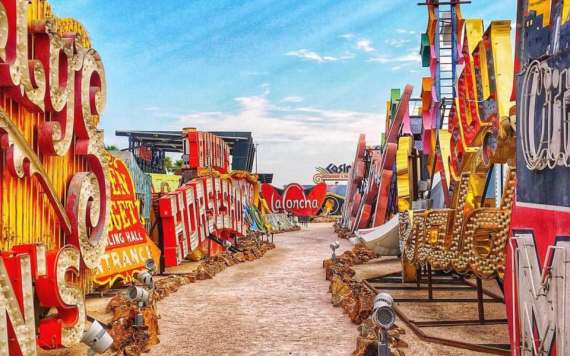
More radioactive, hence something I surely won’t be doing, is the overrated-seeming Neon Museum, which currently is semi-colonized by electric signage designed by movie director, artist and Tiny Tim wannabe Tim Burton, whose films — “Edward Scissorhands” to “Charlie and the Chocolate Factory”; “Sleepy Hollow” to “Dumbo” — give me spontaneous cavities and slashing migraines. 

neon-museum-las-vegas-lights.jpg
The Neon Museum

Entry is normally $22 to walk about the corpses of old Vegas signage, but because there are emblems from Burton films the price is $30 and I’m not paying one extra dollar to see anything by Burton, kiddie clown and gothic goblin of make-believe, eyeliner ghouls and big-eyed bugaboos. (OK, I kinda liked “Beetlejuice.”) 

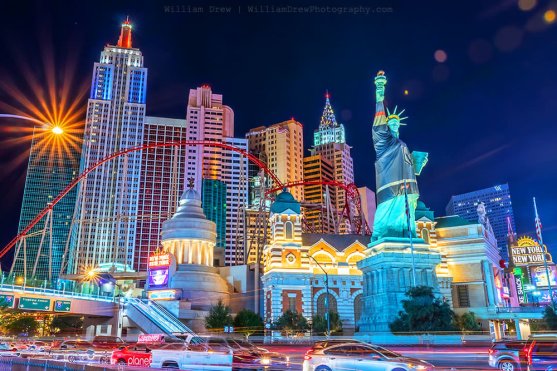
For true titillation, I’m eyeballing at least two thrill rides, something Vegas, knowing its lack of sticky attractions, has stuffed itself with. The Big Apple Coaster at the ridiculous New York-New York Hotel barrels around a towering simulacrum of Manhattan, Statue of Liberty and all, with hair-blowing, cheek-fluttering views of the Strip and a pygmy Empire State Building.

Atop the landmark Stratosphere tower is the delectably named Insanity, described as a “ride that dangles you 866 feet in the air and spins you around, all while forcing you to stare at the ground. A massive mechanical arm extends 64 feet from the edge of the Stratosphere, and spins you at speeds of up to 65 mph.” As near to heaven as one can get. 

insanity.jpg
Insanity ride

Night falls. Instead of Vegas’ dazzling yet pocket-wringing Cirque de Soleil extravaganzas — I’ve seen a few in my day, all blaze and wonder — I’m opting for the famed Comedy Cellar which, I’m certain, will be a jamboree of mediocrity. (Discount tickets help.) There’s a lot of bad comedy out there. As the adage goes, dying is easy; comedy is hard. I have a feeling I’ll witness mostly the easy part. But that’s some of the fun of live comedy, he said wistfully. 

Onto food. Here’s what I’ve lined up, dinner-wise:

Bouchon — Sitting at the bar at Thomas Keller’s renown French bistro at The Venetian, I’m mulling the French onion soup (Soupe à l’Oignon) and Gnocchi à la Parisienne. (Or maybe the Poulet Rôti, or roasted chicken.)

Lotus of Siam — Regarded by some as the best Thai food in America, this cozy hotspot is also a bucket list destination. (I don’t have a bucket list, but I’m adding this to it.) Recommended are moo dad deaw (Thai-style pork jerky), a deep-fried marinated spicy pork appetizer, and khao soi, crispy duck on a bed of egg noodles in curry, with lime and pickled vegetables. I’m getting both.

Jaleo — At celeb chef José Andrés’ renown Spanish joint, jamón ibérico de bellota is dubbed “the most luxurious cured meat in the world.” I’ll take that and perhaps the José Experience tasting menu. Thank you.

That sounds like a lot of fun, actually. But face it, Vegas is really one elaborate rip-off, a con job, a losing proposition, a fool’s game, especially if you gamble. Even those thrill rides I mentioned: they’re $15 and $29 a spin. I just looked that up and I’m currently making new plans. I hope there’s a merry-go-round nearby.

Sin City clichés are only reinforced as I re-watch movies like “Casino,” “Leaving Las Vegas,” Albert Brooks’ comedy classic “Lost in America” and Elvis Presley’s camp classic “Viva Las Vegas,” in which he warbles:

Viva Las Vegas/With your neon flashing/And your one-armed bandits/Crashing all your hopes down the drain 

“Crashing all your hopes down the drain”? Coming from the King, I don’t know if I should laugh or cry. What I do know is care must be taken. I believe the slogan: What happens in Vegas, stays in Vegas.

Which I take to mean, my money is filched in Vegas.

And my money stays in Vegas. 

Damn.