Occupational hazards of the novelist

Anyone who has ever tried to write a novel knows what an arduous task it is, undoubtedly one of the worst ways of occupying oneself. You have to remain within yourself all the time, in solitary confinement. It’s a controlled psychosis, an obsessive paranoia manacled to work completely lacking in the feather pens and bustles and Venetian masks we would ordinarily associate with it, clothed instead in a butcher’s apron and rubber boots, eviscerating knife in hand.”

— Olga Tokarczuk, from her Booker-winning novel “Flights,” a luminous series of human and existential journeys revealed in shards and fragments. A supernova of imagination and intellect.

z24027629V,Olga-Tokarczuk-i-jej--Flights---czyli--Bieguni--po.jpg
The Polish author won the 2018 Nobel Prize in Literature.


One of those grab-bag blogs filled with mad miscellany

— In New Orleans next month, I’m forgoing the vaunted National WWII Museum for the more mischievously skeevy Museum of Death, a labyrinth of the gross and ghoulish and other alliterative G’s (ghastly, grisly … ). Body bags, coffins, car accident photos, Manson family ephemera, cannibalism — and, well, I’m making a poor case for my mental stability. Why not do both museums? Because I’m booked for a cemetery tour (I know, I know), a paddleboat cruise on the Mississippi, a French Quarter tour and a hop through the Dixie Brewery, which is $5 compared to the war museum’s nearly $30 entry, which is twice as much as Museum of Death tickets. And, really, aren’t both museums monuments to mortality in their ways? (Plus, I’ve seen “Saving Private Ryan.” It didn’t go well.)

mod-hdr3.jpg

— People slap flashy stickers and decals all over their laptops, without realizing the machines are not skateboards and are anything but billboards of hip. A Dell? Fine. A Mac? Plain vandalism.

1hFFNNJHOVyul0OLXpKgpcKM2MOF6S_large— Best movie from the ‘70s I recently re-watched: rattling rock melodrama “The Rose,” starring an atomic Bette Midler, shrill and crazy, on a Criterion DVD. Directed by Mark Rydell, the tipsy tragedy, loosely based on Janis Joplin’s hasty flame-out, was shot by storied cinematographer Vilmos Zsigmond, with assistance on the feral concert scenes from lens legends Conrad Hall, László Kovács and Haskell Wexler. Toni Basil choreographed Midler’s bestial gyrations. The movie, a buckling downer, holds up rapturously. (Watch it with “A Star is Born.” Discuss.) 

— I saw the trailer for the new Wes Anderson movie, “The French Dispatch.” My eyes bled. My mind sizzled in its teeny brain-pan. Once upon a time, Anderson was one of our most exciting young filmmakers (“Bottle Rocket,” “Rushmore.”) He’s now one of our most exasperating. And cloying. And irritating. And incurably cutesy.

the-french-dispatch-wes-anderson-breakdown

“All gunfighters are lonely. They live in fear. They die without a dime or a woman or a friend.” — Burt Lancaster, philosophizing in 1957’s otherwise poky “Gunfight at the O.K. Corral.” Sometimes I wonder: Am I a gunfighter?

Unknown.jpeg

— I liked but didn’t love Oscar history-maker “Parasite,” Bong Joon-ho’s catchy Korean comedy-thriller-horror flick. It swept the Academy Awards, becoming the first foreign-language movie to win Best Picture, which I’m all for. But the movie doesn’t explode. It’s not “Crash” or “Green Book” bad, somehow and embarrassingly snatching top honors — not even close. It is, simply, the most overrated movie of 2019. I placed it #8 on my top 10 list. It is very good. And I am so happy it shut-out “Once Upon a Time … in Hollywood,” patently one of the year’s worst films. For those who haven’t seen “Parasite” but have followed its triumphs, I’m afraid some shade of disappointment is possible. 

Peter Schjeldahl of The New Yorker is one of the sharpest art critics I’ve read, and one of the lushest, most literate prose stylists around. Gifted as he is, he still says things like, “I’ve toiled all my life, in vain, to like myself.” He adds, “Writing is hard, or everyone would do it.” It is humbling.

—  This is the most poignant line I’ve read in a book in some time: “There is a species of moth in Madagascar that drinks the tears of sleeping birds.” It’s from Jenny Offill’s deep and droll new novel “Weather.” I also liked this: “I’m too tired for any of it. The compromise is that we all eat ice cream and watch videos of goats screaming like women.”

51f1y5-4yqL._SX298_BO1,204,203,200_

— Winter is fast receding. Son of a bitch.

— I noted above that “Saving Private Ryan” and I had a dubious relationship upon its 1998 release. As a full-time movie critic, I gave the summer blockbuster two stars out of four. I recently located my love letter to the film, part of which reads:

“The World War II epic ‘Saving Private Ryan’ begins with a screen-size image of the American flag. The banner ripples in the breeze with patriotic solemnity, as John Williams’ score puffs its chest and gives a stern salute to our tear ducts.

“Dissolve to a scene of soft-focus Americana plucked from Norman Rockwell, featuring a family borrowed from a life insurance commercial. As this ideal of scrubbed, middle-class solicitude walks quietly toward a white cross in a military cemetery, the screen fairly creaks with labored pathos. You start to wonder if you’re watching a parody of a Steven Spielberg movie.

“Actually, it’s an inadvertent self-parody, for this is a Spielberg movie, his latest and most contrived attempt at serious adult filmmaking. Despite its unflinching (almost desperate) depiction of battlefield carnage, ‘Saving Private Ryan’ is marred by mawkish indulgence and counterfeit drama, Spielberg’s twin weaknesses. The man can’t help it: He lards the film with freeze-dried sentiment, tingle-inducing declarations and cello cues. The considerable gore is largely separate from the main story; it’s a bombastic stage setter.”

BattleFilm-Ryan_960x640.jpg
Save me, Private Ryan.

It’s cold. Let’s read.

Books and movies. I do a lot of both during the hibernating winter months. I’ve plowed through some good books so far this season, with more to come …

Stripped-down realism is so refreshing. That’s what Elizabeth Strout’s cold-water splash “Olive, Again” delivers in the return of the author’s forever-stubborn, wryly splenetic septuagenarian Olive Kitteredge, reluctant heroine of the eponymous, Pulitzer-winning novel from 2008 (“Olive Kitteredge”). The matte finish of ordinary life somehow glistens in these prosaic pages, as Olive and her kin and the locals of small Crosby, Maine, get on with life with all the grace they can muster. Amid the deceptive, lulling ordinariness emerges Olive, who gives just about everyone a pain in the ass. 

51fu2JUE-1L._SX327_BO1,204,203,200_

“God, Olive, you’re a difficult woman,” says a suitor. “You are such a goddamn difficult woman, and fuck all, I love you. So if you don’t mind, Olive, maybe you could be a little less Olive with me, even if it means being a little more Olive with others. Because I love you, and we don’t have much time.” The truth as prod — perfect.

Unfailingly elegant, with literary punch and panache, Christopher Isherwood’s classic 1964 “A Single Man” follows George, a gay, British, middle-aged English professor in suburban Southern California, as he manages life after the death of his partner. Solitude reigns, though George experiences symphonic emotions, from fury to attraction, all in finely wrought descriptives. Called a “lyric meditation on life as an outsider,” the novel is at once explosively alive and exquisitely melancholy. 

31RtOm2Tf1L._SX322_BO1,204,203,200_

In Kevin Wilson’s quirky, arguably gimmicky, new novel “Nothing to See Here,” the main attractions are 10-year-old twins who self-combust when stressed or agitated. Right: they go up in flames. Yet the young author doesn’t belabor the peculiarity, mingling a heavy heart with a breezy tone that depicts events in buoyant deadpan. And while the conflagrations are certainly a metaphor for something, I’m not sure what that is. (Wilson’s fires are more light than enlightening.) 

When the twins’ caretaker Lillian first witnesses one of their freak shows, she shakes off the shock and mildly observes, “Then, like a crack of lightning, she burst fully into flames, her body, a kind of firework, the fire white and blue and red all at once. It was beautiful, no lie, to watch a person burn.” 

Unknown.jpeg

The book is clearly some fun, though it’s braided with furrowed, moving passages about taking care of people, avoiding pain and erasing past hurts. “How did anyone keep this world from ruining them?” Lillian wonders. “I wanted to know. I wanted to know so bad.”

Garth Greenwell’s fawned-over “Cleanness” is more than its homoerotic parts, excuse the imagery, though it certainly is that, too. This novel (or is it a story collection?) sketches a psychosexual character study of an American teaching in Bulgaria, sifting through his cluttered past of intimacies. We see (smell, feel) it all in a journey of desire, love and loss.

This follow-up to Greenwell’s adored “What Belongs to You” falters a bit in a cluster of sex scenes dominating the final stories. It becomes repetitive, fetishistic, rather dull. And yet you don’t give up, because the writer knows exactly how to lull you, with a masterly, agreeable control that’s never pushy.

41mU4Aq2z0L._SX324_BO1,204,203,200_

On the nightstand now: The brand-new “The Big Goodbye: ‘Chinatown’ and the Last Years of Hollywood” by crack showbiz historian Sam Wasson. Propulsive prose, staggering detail and wise reflection turn this history into a 3D pop-up book of period L.A., pinballing from the Manson murders and its impact on hot auteur Roman Polanski (who would, of course, helm “Chinatown”), to the creative relationship between Jack Nicholson and screenwriting eminence Robert Towne and the very seeds of SoCal noir. And that’s just up to page 70. 

Concerned largely with the making of a quintessential masterwork of ‘70s film, the book promises to be “the defining story of the most colorful characters in the most colorful period of Hollywood history” and is being compared to classic, unflinching making-of studies “The Devil’s Candy”and “Easy Riders, Raging Bulls.” 

Already, I’m gripped.41O2b3Fog0L._SX327_BO1,204,203,200_

Kirk Douglas: His 9 best

2181.jpgOne of my favorite Golden Age Hollywood actors, Kirk Douglas, died last week at age 103. The cause: overwhelming magnificence. Here debonair, there explosive, Douglas, he of the arresting crater chin, fetching floppy hair and feline growl, made a raft of movies, acting in, producing, or both. He could chomp a scene or recede with quiet, smirking menace. No matter what he did, the ecstatically watchable performer made every movie moment better. I’ve picked nine of his best starring roles, all worth a rewatch:

1. “Paths of Glory” — Playing against type in Stanley Kubrick’s gut-wrenching 1957 antiwar masterpiece, Douglas is a moral paragon among obscene military corruption, with scenes so emotionally powerful, they sear. (See this.) 

p0777b0p.jpg

2. “Ace in the Hole” — A scathing portrait of Douglas’ unscrupulous newspaper writer, who will ditch a man’s life to nail a career-making scoop, in Billy Wilder’s haunting and prophetic 1951 thriller. Deemed so cynical, one critic dissed it as “ruthless.” Consider that a compliment.
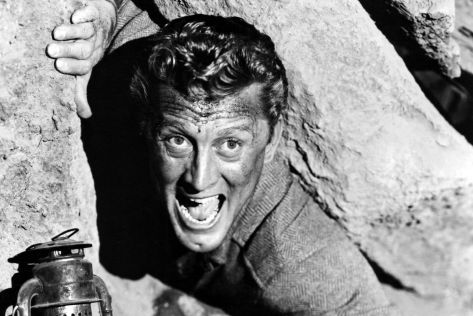
acecover.0.jpg

3. “Out of the Past” — Quintessential 1947 noir, directed by mood-meister Jacques Tourneur (“Cat People”), streaked with guns, fedoras, dames, snappy dialogue and mushroom clouds of cigarette smoke. Douglas, as an oily, vengeful gangster, hires Robert Mitchum’s private dick to find his mistress (Jane Greer, a classic fatale). Mitchum falls for his quarry and things get very, very complicated. This is Mitchum’s film — he’s in almost every shot — but Douglas slithers his way in, like a cobra.
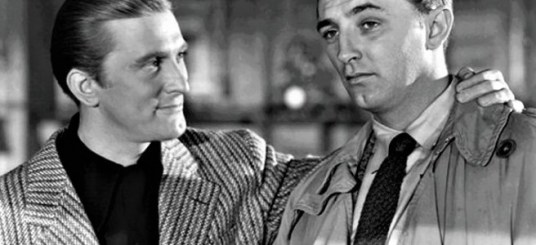
whit-and-jeff-edit.jpg

4. “Detective Story” — Or: “The Angriest Cop in the World.” Douglas cleaves the screen in William Wyler’s 1951 chamber noir set over a single day in a police precinct station. He plays a draconian detective with a Vesuvian temper, always the bad cop in the face of criminal slime — “a one-man army against crime.” He has other, personal troubles brewing, too, making him even more mercurial, a violent, teeth-gnashing fury. He’s a spectacle, and he’s marvelous. 

1886-3.jpg5. “Lust for Life” — The actor’s beautiful depiction, both physically and psychically, of the tormented, misunderstood-in-his-life painter Van Gogh, brings to the fore Douglas’ primal strength: inextinguishable passion.
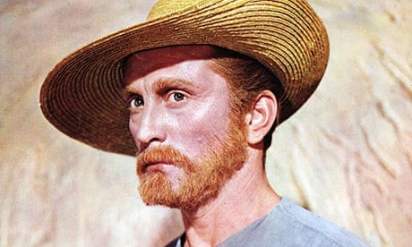
Kirk-Douglas-in-Lust-for--001.jpg

6. “Lonely Are the Brave” — In screenwriter Dalton Trumbo’s melancholy masterstroke from 1962, Douglas is a cowboy Quixote, living in modern times like they’re the Old West, happy to cling to a carefree existence on the back of his faithful horse. The drama, writes one critic, is a “hymn to rugged individualism and freedom slowly being strangled to death by voracious urban development.” Douglas is alternately euphoric and conflicted by the rule-bound world he must face. It’s heartbreaking. 

lonely.jpg

7. “Spartacus” — Douglas and director Stanley Kubrick wrangled making this consummate 1960 swords and sandals epic, a friction that perhaps kindled the actor’s fiercely multifaceted performance. Through romance, slave revolts and mano-a-mano combat, he gives it his clenched-jaw all.

2230.jpg

8. “The Bad and the Beautiful” — With frigid duplicity, Douglas plays an amoral movie producer in Vincente Minnelli’s exemplary Hollywood takedown that’s sometimes spoken in the same breath as “Sunset Boulevard.” If not as wickedly gothic as the latter, this entertaining soundstage drama hits its Tinseltown targets with giddy marksmanship. With Lana Turner, Dick Powell and an Oscar-winning Gloria Grahame. 

the_bad_and_the_beautiful_kirk_douglas.jpg

9. “Champion” — Few original dramatic strokes here, but Douglas, as boxer Michael “Midge” Kelly, rages operatically, elevating a gritty sports melodrama to near noirish heights. It’s about sacrifice, family, commitment and finally integrity, something Douglas proved the epitome of — on screen and off. The 1949 role earned him an Oscar nomination, his first of three. (Three? Shame on you, Academy.) 
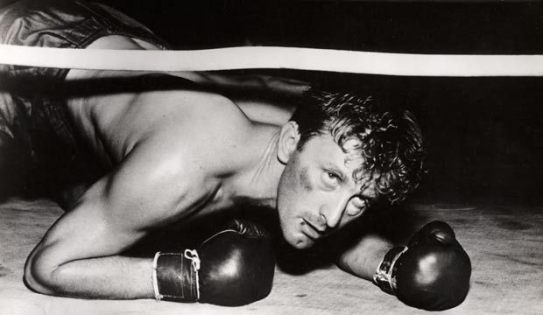
Champion.jpgRunners-up“A Letter to Three Wives” (directed by Joseph L. Mankiewicz, 1949);  “20,000 Leagues Under the Sea” (Richard Fleischer, 1954); “Gunfight at the O.K. Corral” (John Sturges, 1957); “Seven Days in May” (John Frankenheimer, 1964); “The Fury” (Brian De Palma, 1978).