Health scares have a sly way of wrecking your day, your week, even your month.
Say you’re awaiting test results, as I was this past week. Each day you wait to hear from the doctor is a kind of water torture, drip drip drip, as you check your phone and email every hour, every minute, to see what the verdict is: Am I sick, or in the clear? It’s aggravating. It’s terrifying.
For six days I’ve been lightheaded, my heart’s been racing, my stomach’s a mess, and I’ve been socked with depression and free-floating angst. I’ve been great fun to be around. Even the dog’s avoiding me.
Last Wednesday, I underwent a pretty invasive procedure to test for a pretty pernicious malady, and it took the doctor till today, Tuesday, to get back to me with results. I’ve been walking around like an anxiety-racked zombie for almost a week.
At 1 p.m. local time, the goddam doctor called with the report: “Good news,” he said, in a semi-chipper tone. Let’s just keep an eye on it for now, he went on, come to my office for a quick chat, then go ahead with your May trip to Scotland. (Actually, he has no idea about Scotland. I just added that for cheery effect.)
Jesus Christ. I exhaled the breath I’d been holding for 144 hours and made him repeat the words “good news.” I see him Thursday. I may hug him, or bring him an ice cream cone.
The body bites. Its chances of betraying you — indeed, attacking you — are about 98.9 percent. We’re not all doomed, unless you consider dying doomed. But not all of us will be struck with dementia, MS, cancer, heart disease, diabetes, Parkinson’s, you name it. Some will croak in their sleep; some will get smooshed by a speeding autopilot Tesla.
We live on borrowed time, and I apologize for the gloom (and the cliché). For now, though, it’s good, or at least steady, news for many of us. Rejoice. I am — well, as best as this born pessimist can. I get encouraging news, cheer, then fall back into the abyss of: What does it all mean?
Nick Cave — Australian musician, composer, filmmaker, writer, artist, actor, all-around Renaissance man, with slick black hair and natty suits hanging off a long, pencil-thin frame — runs a sage, funny and heartbreakingly sincere advice column on his website The Red Hand Files. His counsel is so sharp and impassioned, you wonder: What can’t the guy do? I bet he can fly.
Recently, a precocious 13-year-old boy wrote in, asking this: “How do I live life to its absolute fullest, and not waste my potential? Especially as a creative. Also, what is a great way to spiritually enrich myself, in general, and in my creative work?”
I relished Cave’s response so much, I am excerpting a chunk of it here.
These are, to me, words to live by:
“Read. Read as much as possible. Read the big stuff, the challenging stuff, the confronting stuff, and read the fun stuff too. Visit galleries and look at paintings, watch movies, listen to music, go to concerts — be a little vampire running around the place sucking up all the art and ideas you can. Fill yourself with the beautiful stuff of the world. Have fun. Get amazed. Get astonished. Get awed on a regular basis, so that getting awed is habitual and becomes a state of being.”
Last weekend, we hit a panel discussion at the Philip Roth festival in the late novelist’s hometown of Newark, New Jersey. We left it walking on intellectual air. Not smugly, but smilingly. It was heady and engrossing. Fun, funny and fascinating.
Called Philip Roth Unbound, the festival was a three-day celebration of all things Roth, from bus tours around his old Newark haunts to numerous panels parsing the formidable genius that gifted us “Portnoy’s Complaint,” “American Pastoral” and “Sabbath’s Theater,” to name some obvious masterpieces. (Need more? How about “The Human Stain” and “Everyman.”)
“[A] panel on the cathartic power of discomfort. With each new novel, Roth predictably delighted and shocked readers with his frank depictions of human frailty and immorality. No aspect of behavior was spared his withering critical eye — sex, gender, race and religion were all fair game.”
I love it.
The panelists, all novelists, were a youngish quartet of publishing stars, award winners and best-sellers: Ayad Akhtar,Susan Choi, Gary Shteyngartand my personal favorite, Ottessa Moshfegh. They comprised a supergroup of sizzling hot writers, gathered to chat up Roth, his transgressive themes, techniques, cultural impact, and personal influence on each writer.
I won’t recap the 90-minute discussion, but I will say that Choi was supremely poised and verbally chiseled; Akhtar, as moderator, navigated the discussion with shrewd erudition; Shteyngart labored to entertain with cussing and comic schtick, including some mugging (he was often very funny); and Moshfegh, coming across as a cerebral introvert and a smidge neurotic, was refreshing in her sometimes spacey reflections.
To be surrounded by diehard Roth fans was heartening. Too often I feel that Roth is marginalized. He’s either too dirty, too angry, too offensive or too smart. His books aren’t easy; they are verbally dense, lashed in skeins of urgent ideas about life, marriage, love, sex, Jewishness, morality, death, politics, art. They are mean, unsparing, philosophically violent, crude, passionate and hilarious.
Few writers — Saul Bellow is one — could graze such dazzling complexity, that Rothian exuberance, that volcanic, (sometimes literally) orgasmic prose. “American Pastoral” (1997) is one of my top two favorite novels. It sucked my breath away with its relentless moral and artistic propulsion. It should be banned by sheer dint of how good it is.
“Sabbath’s Theater” — described by one critic as “Roth’s coarsest, frankest, and most exhilarating novel, showing off Roth’s linguistic verve, and his unparalleled ability to stare unblinkingly into the psyche of a depraved scoundrel” — is mandatory reading, a master text of style, for anyone pursuing the art of fiction. (I’m about to read it again.)
Roth died at 85, in 2018, without winning the Nobel Prize (though he received many awards, including the Pulitzer). In later years, he was regularly shortlisted, but was likely too incendiary for the milquetoast committee. Every October I would check the paper to see if it was his turn, then throw it down, crushed, livid. Bellow won it in 1976. Faulkner in 1948. Toni Morrison in 1993. Roth would fit right in that company of trailblazing masters.
Maybe he was just too much much. Roth fans are zealous and jealous, and to see the capacity crowds at the festival, chatty and excited, reminded me the great one lives on. Or at least his challenging ideas and coruscating wit live on. We at least have that.
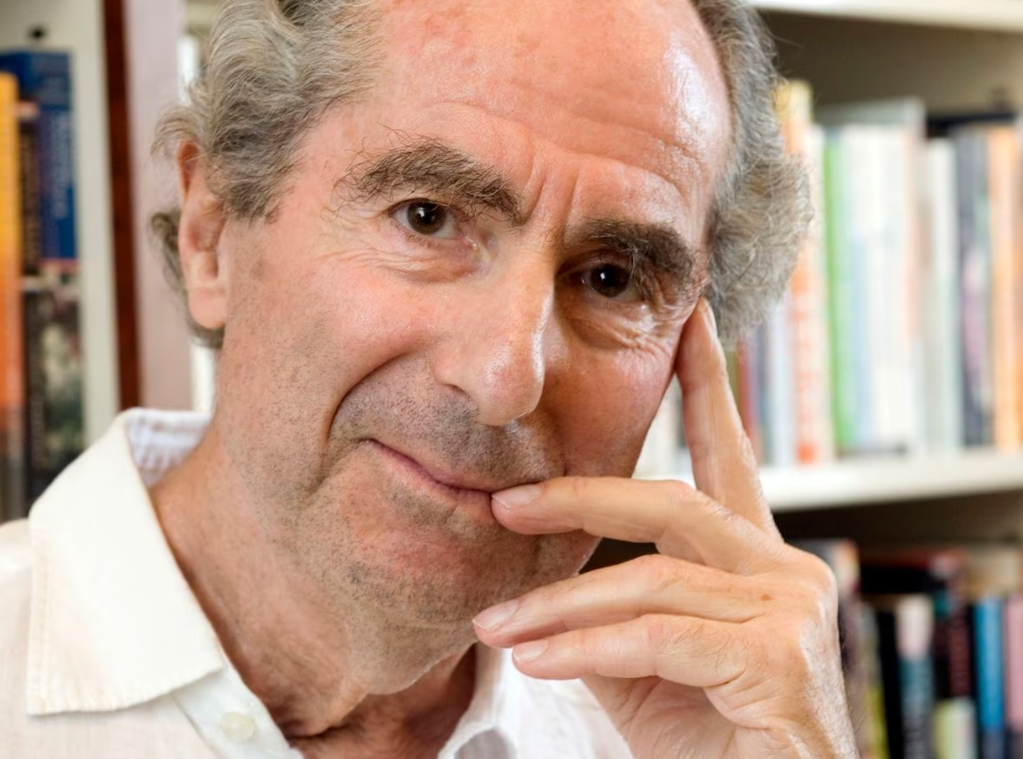
Philip Roth. Such a dirty, furious, brilliant mind.
Recently, while sifting through thousands of old photos left behind at my late mother’s home, I came across a shot of me on Halloween, age 11. At that time, I was a fanatical follower of rockers KISS — lustily, irretrievably, hoarding trading cards, t-shirts, records, temporary tattoos, magazines, posters, all of it.
For shits and giggles, I present to you my tween attempt to be KISS frontman/demon Gene Simmons:
I’m trying to get super excited about Scotland, much as I tried a year ago to get jazzed about Ireland.
We know how that turned out: I bought a flight to Dublin only to exchange it a week later for a flight to Paris. It was after I studied the destination with a flea comb, burrowed into my research, only to arrive at the great existential query: What am I thinking? (I ask this frequently in my life.)
I’m sure Ireland is splendid, despite the fact that pubs, pubs and pubs are invariably named the top experience in everything I read. A friend just returned from Dublin and said it’s terrific — for two or three days. Then you run out of things to do. At that point, of course, you rent a car for the verdant countryside and … yawn, you lost me.
I’m an urban traveler. I seek culture, cuisine, cobblestone. Art, edifices, bustling humanity and idiosyncratic neighborhoods. I also seek cool climates — I’m done sweltering in the tropics — for summer travel. Last July I went to Buenos Aires to, among many reasons, escape our heat. I slipped on my jacket each day with a big grin.
And so, Scotland. I’m eyeing a May trip to the capital Edinburgh and Glasgow, the largest city in the country, both of which brim with museums, castles, street art, music (here is where I make peace with bagpipes), hearty food (do I dare try haggis?) and, a-ha, whisky. May weather hovers in the mid-50s and below and I’m already happily shivering.
Like Ireland, Scotland is comprised of highlands, lowlands, islands, cliffs, crags, rolling pastures and billowing grass. It’s lousy with forts and castles. It doesn’t look like I’ll get into all that, though I might be whisked away on a day trip. I probably should.
Maybe I’ll spot Nessie, the wondrous Loch Ness Monster, and hitch a ride on her mythical scaly back through the chill waters. (As a kid, I used to love Nessie, that bashful and elusive lake dinosaur. I thought she and Bigfoot should get married.)
I am a wee nervous about the language, specifically the knotty Scottish brogue, which contorts familiar English into musical pretzels and thick-tongued tootles that leave some of us wincing with incomprehension. I once worked with a native Scot named Alan Black and I couldn’t understand a damn word he said. We got along swimmingly, but I’m sure I missed 60 percent of what he was telling me.
This worries me, the rogue brogue. I’ll be made the fool by cheery locals who will snicker at me between sips of lager and Glenfiddich, doing spit takes. I’ll be the dumb American carrying around an ear funnel, going, “What’s that, mate?”
I can do this. The more I excavate, the more Scotland attracts. I’m thinking seven days between the two cities, yet there’s more to explore. The trip could get longer, epic, out of control. It could go from a jaunt to a journey. I like that. (Cue: “Loch Lomond.”)
The cat wails plaintively, pathetically, for no known reason. It is high-pitched and high-decibel. It’s a distress signal, a siren from the depths of hell that is feline.
Cats are OK. I like them well enough, about as much as I like, I dunno, pet pigs. I don’t like them as much as I love pet rats, that is certain. Pet rats and I go way back. It’s an intricate relationship.
In my life, I’ve had a half dozen rats: Phoebe, Becky, LaShonda, Tammy, etc. They are like mini dogs — affectionate, social, clean and wickedly intelligent. They play. They come when called. They like their bellies rubbed. Theydrink beer. Dogs are tops, but rats are little badasses.
Cats, well.
I’ve had about five cats, including this wailer who indiscriminately cries, whines and yowls. It’s like living with a sickly crone, or a werewolf.
The cat, a rescue named Spicy by his prior owner, resides with his sister, Tiger-Lily. She rarely makes a peep, only the occasional textbook meow, the sound you hear when you look up “meow” in the dictionary.
Tiger is sweet, gentle, svelte, independent. Spicy is pushy, needy, burly, noisy. Plus his eyes weep goop like the Exxon Valdez.
But Spicy is cherished. He’s an animal, after all, and animals tend to deserve unconditional love, spoiled as they are because they are cute and cuddly, fun and furry, smart and, in Spicy’s case, smart-alecky.
Is he smarter than us? He slinks with an underplayed intelligence and studied detachment. His yellow eyes burn through you, laser beams of simmering condescension. When they’re not softening at half-mast during cuddle mode, those eyes are saying, “Screw you.”
He nips with sharp teeth to prod you to stroke him, to demonstrably adore him. He climbs in your lap when there’s already a laptop there, plop. He claws at the carpet with violent resolve, sounding like someone’s hair is being ripped out. And, of course, he whines and caterwauls like an opera diva in grandiose agony. He thinks all of this is charming, and it is to a point. But he’s giving cats a bad rep.
Of course Spicy does not represent all cats. He isn’t even emblematic of truly bad felines, like those cringey manimals from “Cats.” No, he’s in-between, part cuddle kitty, part son of a bitch. Don’t get me wrong. I love him like a pet. Just not my pet.
Tiger-Lily and Cubby the dog own more of my heart. Cubby may bark like a madman and scratch the paint off the door on occasion, but he’s all angel, whereas Spicy has a satanic streak. Sometimes you’ll try to pet him and he’ll arch his back and bristle his fur. Devil cat!
And those yowls he emits evoke “The Exorcist” more than “Puss in Boots.” As I said, though, I like him alright, even if he’s trouble. Meow? More like meh.
Last year in Lisbon, Portugal, I was served a 12-course meal that stuffed me so brutally, I was this close to dashing to the restaurant bathroom and purging myself. I felt like an engorged zeppelin, about to burst with the sloshing goulash bloating my belly. I was in theatrical distress.
And the food, which was amazing, kept coming. And coming. I finally had to hold up a hand when the server brought the final course, which was a square of baklava the size of a matchbox. That hand said, “Cease. Go back wherefrom you came. Take that morsel of food with you. Be gone before disaster strikes.”
Still, he insisted on boxing up the dessert. I conceded. All the while an argument raged between my mind and my stomach. The mind won. By the grace of god, I did not vomit.
I was reminded of this fine-dining discomfort the other night at an eatery that’s the opposite of the gourmet Portuguese blowout: La Tapatia, a homey, festively painted Mexican restaurant/cantina in Concord, Ca., some 30 minutes east of San Francisco.
(My brother and I are in the East Bay clearing out my late Mom’s townhouse and putting it on the market. Wading through Everests of old photos is by turns amusing, exhausting, and wildly depressing.)
We adore La Tapatia and anticipated its decadent cuisine before we left the East Coast. It’s a destination spot dishing up fiercely old-school Mexican food: chips and salsa, margaritas, rice and refried beans, tacos, burritos, the whole enchilada.
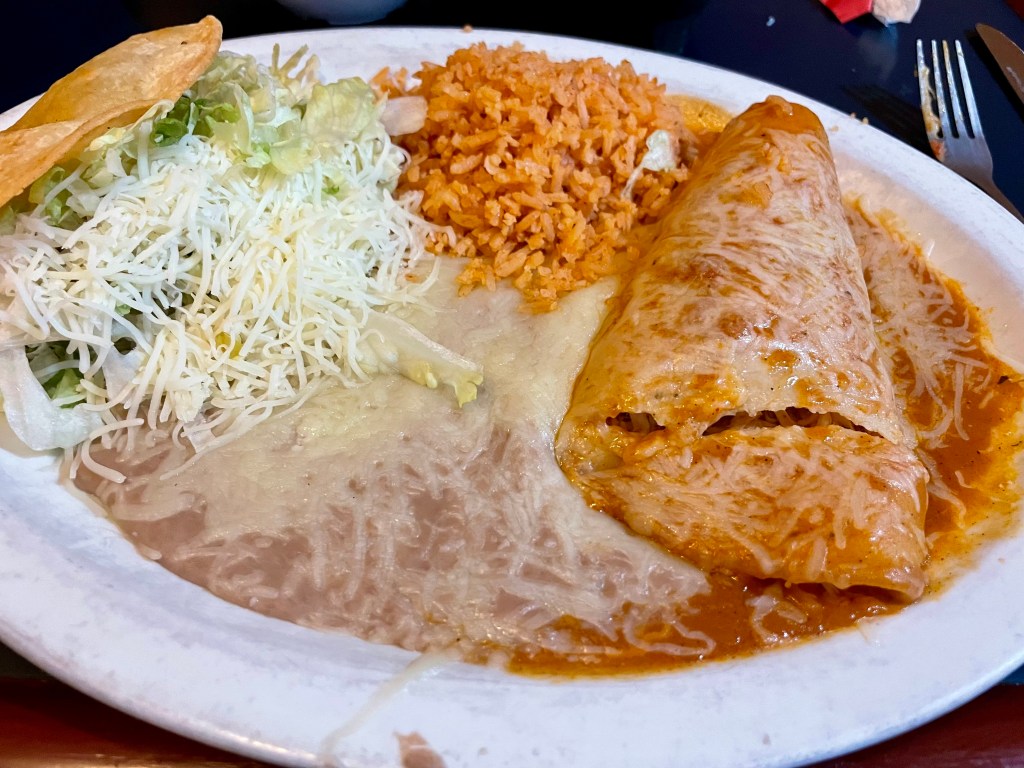
With a tangy margarita, I had a chicken taco and chicken enchilada. The plate was massive, flooded in a sea of beans and rice:
It was deliriously good. But here’s the thing: I got so gorged on chips and dinner, I spontaneously puked when I got back home. It was quick and painless, and I topped it with a gin and tonic. I’m disgusting. (A girlfriend once told me I have the “constitution of a bird.” I cannot argue with this.)
To offset the stress and gloom of this seven-day trip, we’ve turned it into a foodie foray, hitting many good places — we’re eating out twice a day, every day — as well as favorite restaurants we’ve long loved in the area.
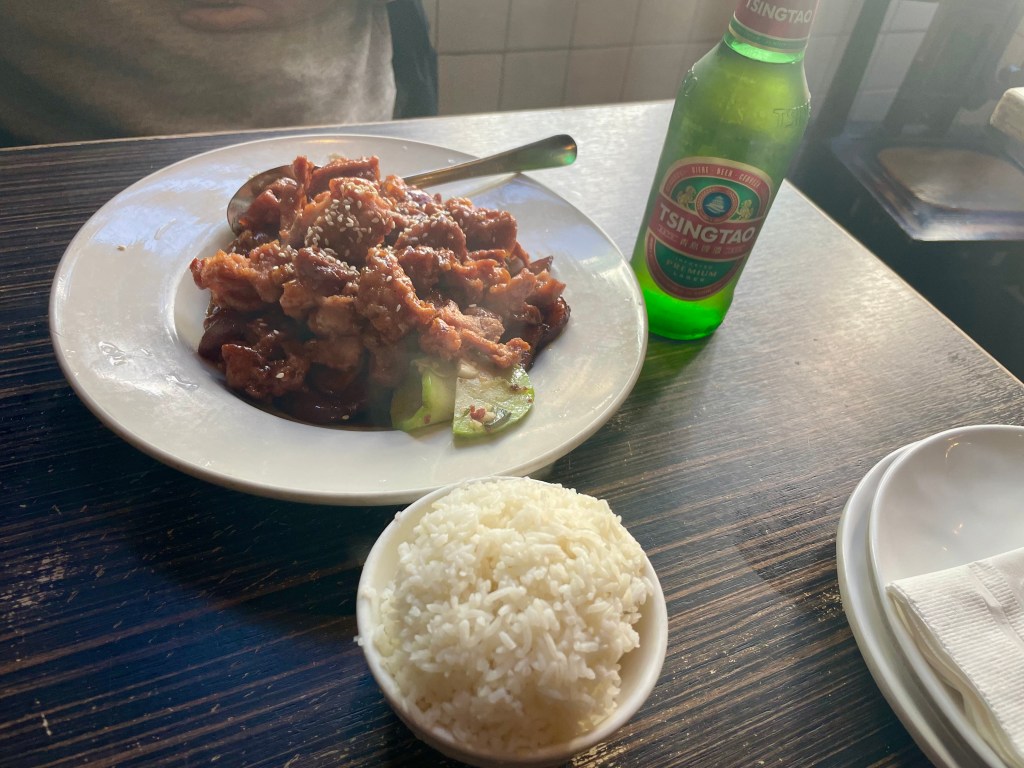
Like the scrappy, frantic joint in San Francisco’s Chinatown. From the SF airport, we went straight to our reliable haunt House of Nanking, where I had the celebrated Nanking Sesame Chicken, a dish of cosmic savoriness:
I’ve mentioned before that I own a House of Nanking t-shirt. It’s that good. I learned that scenes from “The Matrix Resurrections” were filmed there. Photos of Keanu Reeves with the beaming owner paper the windows. For some reason, I’m proud.
Yesterday we met our old friend Tony for lunch at the classy, very bougie Acre Kitchen & Bar on College Avenue in Berkeley. Though the sardines, arriving with three tiny bottles of Tabasco, were wonderful, Tony was the highlight. He’s about the nicest guy you could know, a real mensch, radiating a gentle joy that inspires faith in the world. He ate a French dip and took a selfie of us.
Sardines and Tabasco. Tony didn’t have any.
In Berkeley, where my brother went to Cal, we kicked around used book and record stores, working up an appetite for an early dinner at Alice Waters’ legendary restaurant Chez Panisse. Considering this could be our final trip to the Bay Area, we splurged on the crazy-expensive four-course dinner menu, which changes daily, and it went like this:
California white sea bass tartare with Meyer lemon, ginger, and fried capers
Wild mushroom ravioli in brodo with Parmesan
Corvus Farm guinea hen roasted in the hearth; with potato-rutabaga purée, spring onions, and spinach
Hazelnut sherbet and chocolate ice cream meringata
Guinea hen roasted in the hearth.
Pretentious? Nuh-uh. Chez Panisse keeps it real with a humble farm-to-table ethos that’s exquisitely prepped and presented. Service is impeccable, always with a smiling expansiveness, never fussy, and often with a quip or two. The food: spectacular without being show-offy. It’s special but to the point.
I don’t think I’m overselling the experience, because we went back two nights later (after scrambling for a coveted reservation) for the more modest à la carte menu, no less delicious and memorable. My appetizer was “sprouting broccoli roasted in the wood oven with preserved lemon and mint yogurt”; my main course was “grilled lamb leg with shoestring potatoes, glazed carrots, and red wine butter” — all of it superb, as expected.






 GNASHING.