Ballet in Russia, a quintessential splurge

Even though my Russian visa still hasn’t been officially issued — it’s in the tortured, Kafkaesque pipeline, though they have said (brusquely) that it should ship in two days — I went ahead and bought a ticket for the ballet at the famous, chandelier-encrusted Mariinsky Theatre in St. Petersburg.

mar3.jpg
Mariinsky Theatre, St. Petersburg

I’ve been to the ballet once in my life — Nijinsky and Stravinsky’s clashing “Rite of Spring” in San Francisco, eons ago. Granularly, I know next to nothing about the art form, though my appreciation for it is lavish. I think Misty Copeland is recklessly awesome. (I think the Natalie Portman movie “Black Swan” is curdlingly rotten.)

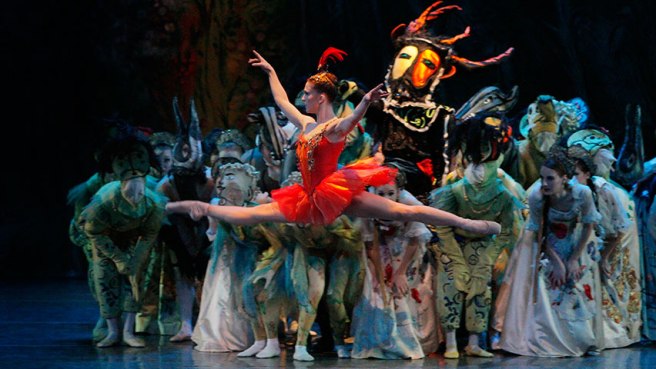
Misty Copeland in the title role, American Ballet Theatre
Misty Copeland in the title role of “The Firebird,” American Ballet Theatre

The mid-October matinee is for Stravinsky’s 1910 “The Firebird,” a Technicolor Russian fairytale told in two “scenes,” which runs a zippy 50 minutes. The ballet, with choreography by Michel Fokine, was Stravinsky’s breakthrough as a composer, followed famously by “Petrushka” and the “Rite of Spring.” My ticket in the Dress Circle was a doable $48.

I’ve been reading up on the performance, and came across choreographer Fokine’s fascinating notes:

“When staging the dances I used three principles that are utterly different in terms of character and technique in this ballet.

“I created the evil kingdom using grotesque, angular and sometimes freakish and sometimes amusing movements. The monsters moved on all fours, jumped like frogs, did different ‘tricks’ with their legs, sitting and lying on the stage, their hands like fish fins, at times under the elbows, at times under the ears, the arms were entwined, they moved from one side to the other, squatting and so on, in a word they did everything that twenty years later began to be known as modern dance and what at the time seemed to me to be the most suitable means of expressing a nightmare, horror and ugliness. Virtuoso leaps and frivolity were also used.”

This sounds splendidly transporting. Which is precisely why I travel. Expect a vivid report next month. And if anyone has opinions or comments about this ballet or St. Petersburg or what have you, please share. Thanks.

firebird2.jpg

Firebird3-BouderSlideShowGallery.jpg


Life, death, brevity — quote of the day

“The world’s small, breathing denizens, its quaking congregations and its stargazers, were fools to sacrifice the flaring briefness of their lives in hopes of paradise or fears of hell. No one transcends. There is no future and no past. There is no remedy for death — or birth — except to hug the spaces in between. Live loud. Live wide. Live tall.’’

Jim Crace, “Being Dead”

41RCP79053L._SX316_BO1,204,203,200_.jpg

A grave interest in cemeteries

Considering my voluptuous fascination with death and dying, I’ve become quite the habitué of graveyards and cemeteries, be they local, regional or far-flung amid my world journeys. I dig graves. And I go out of my way to find them, stroll them, contemplate and photograph them, from Boston to Brooklyn to my personal cemetery capital of the world Paris.

My favorite cemetery is, no surprise, Père Lachaise in Paris, a dense, lush, almost medieval necropolis of winding paths and boulevards, overgrown ivy and shady groves — a crepuscular cosmos unto itself whose edifices just happen to be ornate, angel-crested crypts and poetry-carved tombstones. Famous artists, actors, writers, politicians — Jim Morrison to Oscar Wilde, Proust to Edith Piaf — slumber here. Locating their graves is part of the game at the labyrinthine, 110-acre Père Lachaise, which contains over a million graves. (Cimetiere du Montparnasse is another must-see, star-studded burial spread in Paris.)

tchaikovsky
Tchaikovsky’s grave

Researching my nearing trip to St. Petersburg, Russia, I was thrilled to find a whole page about local cemeteries. The most popular and famous is the Tikhvin Cemetery at the Alexander Nevsky Monastery, where Dostoyevsky, Tchaikovsky, Mussorgsky, Rimsky-Korsakov and other luminaries rest. Expect travelogue-y descriptions of my visits to the Russia repositories.

Meanwhile, this is a catalog of recent cemetery jaunts — and more. All the images have to do with death, dying, the great beyond.

Brompton Cemetery.jpg
Brompton Cemetery, London.
IMG_0593.JPG
Westminster Abbey, London. (How I face the world each morning.)
P1030498_1.JPG
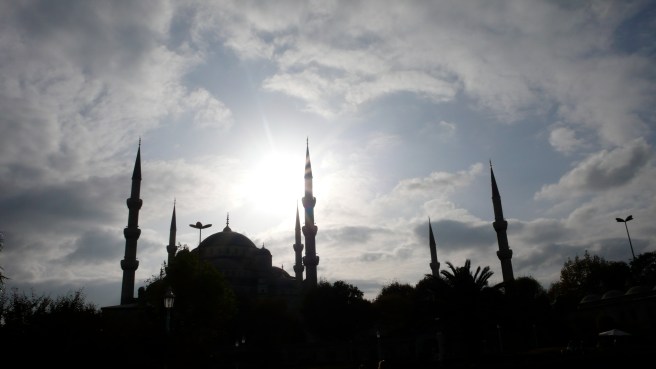
Istanbul Islamic cemetery.  
FA16FA9E-06A8-40F1-9C54-3E22B87389C1-1.JPG
Serge Gainsbourg, Cimetiere du Montparnasse, Paris.
IMG_0625.JPG.jpeg
Karl Marx, Highgate Cemetery, London.
IMG_0621.JPG.jpeg
Highgate Cemetery, London.
ABEFB758-EE5D-43B2-A61C-4D50BB0EC1D5-1.JPG
Cimetiere du Montparnasse, Paris.
P1000772.JPG
Paris Catacombs. (Alas, poor Yorick!)
DC6723B0-A939-4842-89D0-D0A700999977-1.JPG
Cimetiere du Montparnasse, Paris.
IMG_0581.JPG
Cast of Joseph Merrick skeleton, aka The Elephant Man, Royal London Hospital.
EBEC8464-28D8-4F9B-9E68-D7EA7DD3AA53-1.JPG
Pere Lachaise Cemetery, Paris.
IMG_0614.JPG.jpeg
Highgate Cemetery, London.
80725826-6856-4B2E-827F-64482FB2D639-1.JPG
Cimetiere du Montparnasse, Paris.
P1010633.JPG
Funeral pyre of old woman, Kathmandu, Nepal.
IMG_0601.JPG.jpeg
London.

Tongue-tied in Russia? Nyet! (Maybe da.)

quote-russian-is-a-very-deceptive-language-because-it-looks-easy-at-first-it-s-like-setting-out-for-a-armand-hammer-317087.jpg

This is going to end in tears. I plan to go to Russia soon. I know only a single word in Russian, nyet, which of course means “no,” my favorite word in the English language. Actually, I also know vodka and borscht. I know what the first is. The second is a little hazy. Is it a type of sports car?

I’m always a bit insecure visiting foreign countries never knowing the host language. Because I never know it. Even in Spain, France and Germany, I go equipped with maybe four words and phrases — yes, no, please, thank you, do you speak English? — and that’s it. I’m terrible that way, afraid to fumble and bumble the sacred words of another place. I do my best, and thankfully English is such a dependable lingua franca. Even Turkey was a breeze, and I did miraculously all right in Japan and China. Vietnam teemed with English, so that was swell.

1_123125_123050_2111751_2120150_050609_cb_arabic_tn.jpg.CROP.original-original.jpg

But Russia, oy. (Yiddish, that.) Those words are long, even the short ones are long. And they’re in Cyrillic, not Latin. I searched “most difficult languages to learn” and Russian ties with Ukrainian as, get this, “Simply Arduous.” They come in third place. At number one is Polish, named “Extremely Hard.” Number two is “Very Hard,” with Finnish, Hungarian and Estonian tying. (English, incidentally, is number eight at “Basic to hard.”)

“Simply Arduous” is right. I scroll the travel guide’s little baby glossary in the back of the book and my stomach knots. I’m going to have to carry around a small slip of paper as a cheat sheet just for “hello,” “yes,” “thank you” and “please.” See this for greetings:

Screen-Shot-2015-10-09-at-18.54.45.png

How do you memorize all this? I’m sticking with Preevyet — “Hi!” — over the tongue-tangling Zdrastvooyte for “Hello.” There’s just no way. I’ll probably only wave, pretend I’m mute. “Yes” is a thank-god simple da. I can do that. And “thank you” is spa-see-ba — that looks manageable. “Goodbye” is Da sveedaneeya — not going to happen. Instead I will smile, shake hands and say, Paka, which is “Bye-bye.”

_66032538_144342017.jpgCall me a language wuss. I’m over it. I bone up, some, and I always do fine. I’m obviously not a big talker abroad, unless my interlocutor speaks English, then we have a fine old time. Russia just seems different. I’ve read repeatedly that you’ll have the best luck with English-speakers among millennials, students and the like, which makes sense. That’s how it was in Japan and China. Young people are learning the language and they absolutely love to practice with native speakers. I’ll be avoiding all locals with wrinkles, paunches and tweed berets.

learn-russian-cyrillic-alphabet

When the language barrier is too great to bridge, I have on my trips resorted to producing my Moleskin journal and, I swear, taken turns drawing pictures with my new friend. I recall a woman in Lyon, France, trying to explain to me that gas, or petrol, was very expensive. She drew a car and a gas station pump and added exclamation points around the tableau. I got it. Other times, as in Tokyo, we’d write down words in the most elemental English, from movie titles we should see to places we should go. I tried to explain Woody Allen to someone, so I drew his iconic, bespectacled head. It worked. It’s a blast, these exercises in primal communication.

Russia, I hope, is no different. I look ahead to the awkward pauses of miscommunication, the stammers and even the throwing up of hands and parting ways amicably. I hope there are more da‘s than nyet’s, but even so I’ll have my notebook at the ready for my own version of Pictionary.


Bound for St. Petersburg, Russia. Any tips?

image13.jpg

After some squinched-eyed consideration, I’ve elected St. Petersburg, Russia, for my annual fall journey.

Wise? A gaffe? Anyone?

It will be short — six days — but, from what I’ve gathered through meticulous research, that seems about right. The Hermitage Museum, the State Russian Museum, St. Isaac’s Cathedral, canal boat tours, the Peter and Paul Fortress and, naturally, the Russian Vodka Museum, to name a few must-dos. Plus the farm-to-table Cococo (anointed by Bourdain) and obligatory Mishka bar, among other hot spots for noshing and tippling.

My target dates are in mid-October, when the temps vary between the high-40s and low-50s F, my kind of climes (so long summer!). Eyeballing the way-off forecast, rain and snow aren’t slated to dampen things.

Has anybody been to St. Petersburg? Tips? Cautions? (Please tell me no more about obtaining an entry visa. So far it has been a nervous, expensive, off-putting ordeal.) Know any good cemeteries? Where to get a fine vodka tonic? Drop a line if you will, thanks! (Go to “Contact” at the top of page.)

Unknown-3.jpeg    images.jpeg  Unknown.jpeg
Unknown-2.jpeg

Dying is easy, writing is hard.

enhanced-buzz-orig-5873-1383088140-8.jpg

The quote about writing from “Death in Venice” novelist Mann has for decades been my favorite assessment of the craft, even, if you will, my mantra. I present it because just days ago in The New York Times an op-ed writer echoed it crisply: “If you find writing easy, you’re doing it wrong.” This is something I have staunchly believed, and still do. Writing’s a bitch.

I’ve written so long and hard that my head hurt, that I’ve become physically wobbly, a wet noodle. And compounding the physical complaints was the inexorably depressing notion that what I just spent hours extracting, exhuming, molding and crafting was irrefutable crap.

“There is nothing to writing. All you do is sit down at a typewriter and bleed.” — Ernest Hemingway

A journalist colleague once called me a bleeder, because I am so slow and painstaking a writer. I’ve spent six hours on a 700-word article, I’m ashamed to admit. That isn’t the norm, but it also isn’t uncommon. Every word — no: every syllable — counts.

My best friend as a writer is so rudimentary I shouldn’t even have to mention it, and that’s reading. Yet I know many writers who don’t get this. What reliably dumbfounds me is how little so many of them actually, actively read. Television has usurped reading as a cultural pastime, confused as literature as it is. I guarantee watching TV is not going to improve one’s prose skills (teleplay-writing skills, maybe). Too many would-be writers are aspiring illiterates. A fact.

As the greats have harrumphed :

“The greatest part of a writer’s time is spent in reading, in order to write; a man will turn over half a library to make one book.” — Samuel Johnson
“Write. Rewrite. When not writing or rewriting, read. I know of no shortcuts.” — Larry L. King
If you don’t have time to read, you don’t have the time (or the tools) to write. Simple as that.” —  Stephen King

26stephens-web-blog4277Done correctly, writing is work, grueling toil. It’s fun (when it’s going well), but not that much fun. Still, creating and thinking are so gratifying that it’s worth it. It takes time, hours and hours. Listen to Louis Menand of The New Yorker:

“Writing, for 99-percent of people who do it, is the opposite of spontaneous. Chattiness, slanginess, in-your-face-ness, and any other features of writing that are conventionally characterized as ‘like speech’ are usually the results of laborious experimentation, revision, calibration, walks around the block, and recalibration. … Writers are not mere copyists of language; they are polishers, embellishers, perfecters. They spend hours getting the timing right so that what they write sounds completely unrehearsed.”

That’s as hard as it sounds, and, without the most gimlet-eyed editor, failure is inevitable. But we try. We do the work. We grind, grope for the felicitous simile and metaphor, strive for the perfect punctuation, the poetic stroke, the tickling aside. We do, yes, bleed. Sympathy is unfitting for such a self-involved venture. The only reward is to be read.

There’s no pride in my Jane Austen prejudice

9780141804453

I can’t do Jane Austen’s “Pride and Prejudice.” I’ve tried to read it three times, and each time, at around page 20, I crinkle my nose, toss my head back, issue a fluttering sigh, then slap the book shut. Slap.

Pinched and prissy, the prose is like flossy streamers of chirp and chatter, candied and precious and irritating. I can’t comment much further since I haven’t cut a very long swath through the novel, which turned 204 this year. That’s endurance: Readers still love this book, along with other unimpeachable Austen classics, from “Persuasion” to “Emma.” She retains the mantle of literary goddess, and to cross her is blasphemy.

pride-and-prejudice_wedding

I’m not buying it. Neither are a lot of other readers, individuals far more distinguished than me. Charlotte Brontë, Emerson, Woolf, Mark Twain, Stephen King and Lee Child are but a few with allergies to those charming Austen tropes of money-lust, snobby class divisions, giggling and gossip, society fetes, courting and coupling, husband-hunting and, of course, life’s gilded apotheosis, heavenly nuptials.

“The one problem in the mind of (Austen),” wrote Emerson, “is marriageableness. All that interests any character introduced is: Has he or she the money to marry with, and conditions, conforming? … Never was life so narrow … Suicide is more respectable.”

I know more than I let on about Austen’s work, via literature, criticism and film. What grates is a little of the “Downton Abbey”-syndrome inflicting her work and her world, the unctuous materialism, the superficial scope of humanity, the tea-sipping, pursed-lip superciliousness. Henry James dubbed Austen’s heroines “she-Philistines,” which will be called misogynistic, namely for an author whose work is so exhaustively feminist. (I’m torn on that one. Send comments with the subject line “Jerk.”)

I must be fair. My affection for 19th-century English literature is finite. This will reveal scandalous volumes about my taste for it: I cannot get through Dickens, despite valiant essays. I’ve cracked “A Tale of Two Cities” three times — fail. Both “Great Expectations” and “David Copperfield” parried my great expectations. His books are cluttered, fancy and fussy. Everything reads like a hyper, heightened children’s tale, which is why as a third-grader I so adored “A Christmas Carol.” (Donna Tartt’s cloying “The Goldfinch,” supposedly an adult novel, was so redolent of Dickens I had to put it down halfway through. My teeth hurt.)

anna_karenina9780143035008b

When it comes to 19th-century novels, I pledge fealty to Tolstoy’s “Anna Karenina,” Flaubert’s “Madame Bovary” and “Sentimental Education,” Dostoyevsky’s “Crime and Punishment,” Wilde’s “The Picture of Dorian Gray” and Twain’s “Adventures of Huckleberry Finn.” There are others, but not many. (Apologies “Moby Dick,” of which I’ve read two-thirds. Fail!)

Speaking of Twain, I allow him, king of the caustic and our satirical sire, to encapsulate my feelings about Austen and her most celebrated novel:

“I often want to criticize Jane Austen, but her books madden me so that I can’t conceal my frenzy from the reader; and therefore I have to stop every time I begin. Every time I read ‘Pride and Prejudice’ I want to dig her up and beat her over the skull with her own shin bone!”

Oof.

But what is Twain saying? “Every time” he read “Pride and Prejudice”? He read it more than once, or did he just dip into it occasionally, glossing passages to confirm its unreadability, as I do whenever I pass it on the bookshop shelf?

I’m a humble hater. I am certain “Pride and Prejudice” spills forth with aesthetic virtues: bounding wit, robust guffaws, social acuity, perspicacious wisdom. I do believe that. But I am blind to it — blinded in those first excruciating pages by the twee, twittery and bogusly confected. Austen trafficked in realism. What an insufferable reality.

Feral photos: Travel encounters of the animal kind

A monkey yelled at me in Jaipur. Another snatched a banana from my hand in Cambodia. A gang of them exploded in all directions, thumping on cars, flying onto rooftops, screeching and scaring the holy bejesus out of me in Delhi. Monkeys: the devil’s minions.

I adore animals and I’ve met many on my journeys, mostly skinny street dogs, but also water buffalos, cows, painted elephants, a mammoth tattooed pig, Egyptian camels, those accursed simians and more skinny street dogs. Because I haven’t been to sub-Saharan Africa or deep into tropical jungles, I haven’t encountered anything wildly exotic, say, a panther or platypus. (I did meet a king cobra in Hanoi. And then I ate it. Eleven courses, including its beating heart in rice wine. I am still recovering.)

Never, ever do I visit zoos on my travels. The mere idea is a great depressant. The sad, ramshackle Shinagawa Aquarium in Tokyo helped snuff my appetite for captive-animal displays.

P1020814
Cappadocia, Turkey.

Of course I meet milling mutts wherever I go. Dogs are the best, even if they can break your heart. In Kathmandu a young punk randomly kicked a stray dog in the ribs. It let out a terrible yowl. I grabbed the kid and chewed him out and promptly befriended the dog, which seemed alright. We still email.

In Tokyo I hung out with a guy and his shambling black Lab. In Paris I played with a pooch wearing one of those medical cone-collars. I took his picture, but didn’t include it here. For now, I offer these creature features:

P1010316.JPG
The Three Muske-steers: a trio of bovines in New Delhi, India, just chilling.
P1020916.JPG
My best pal in Istanbul, a homeless hound I hung out with during two visits to Turkey. I fed her well. We talked politics.


P1010822.JPG
Monkey with child going ape-shit in India. Something I said?
P1020522.JPG
Kitten with pierced ear (evil-eye earring) at carpet shop, Istanbul.
P1020964.JPG
Sheep to the slaughter, awaiting the knife at a mosque in Istanbul.
P1010376.JPG
Stray mama nursing pups in Old Delhi, India.
P1010518
Water buffaloes cooling off in the filthy Ganges, Varanasi, India.
P1010324.JPG
Kids and their kid, New Delhi.
P1030243_1.JPG
Stray snoozing, Istanbul.
P1010530.JPG
Kinder, gentler monkey, Varanasi. 
IMG_2318.JPG
A little too late to befriend this guy in Vietnam.
P1010901.JPG
Festive bovine, Mumbai.
P1020008.JPG
Sad, sickly stray in Mumbai. I shattered.
P1010474.JPG
That dog, above, belongs here, Agra, India.
P1030531_1.JPG
A clown and his kitty, Istanbul. I need a large polo mallet.
7. 11-course cobra lunch.JPG
Bonus shot: Remains of 11-course cobra feast, Vietnam.

When traveling, putting reality on vacation

I’m starting this with a longish quote from journalist Janet Malcolm. Don’t let its length deter you. It’s quick and breezy and devilishly smart — and, for seasoned travelers, likely very apropos.

“Without knowing exactly why, I have always found travel writing a little boring, and now the reason seemed clear: travel itself is a low-key emotional experience, a pallid affair in comparison with ordinary life. … (Our homes) are where the action is; they are where the riches of experience are distributed. On our travels, we stand before paintings and look at scenery, and sometimes we are moved, but rarely are we as engaged with life as we are in the course of any ordinary day in our usual surroundings. Only when faced with one of the inevitable hardships of travel do we break out of the trance of tourism and once again feel the sharp savor of the real.”

Despite the faint bite of the discontent, Malcolm doesn’t sound like a traveling grump to me. She crystallizes, I think, the realities of moving about, strenuously seeking the kind of transcendence concomitant with the very best travel.

IMG_2756
Meeting people is easy. (Tokyo)

But it’s only part of the picture, which is, of course, far richer than the one she paints. She’s right: travel is largely a “pallid affair” compared with actual daily living, which thrums with family, friends, work, pets, a house — all that fluid, unpredictable, tangible, huggable life stuff. And true, staring at paintings and cathedrals can sometimes be a static, numbing, “low-key emotional experience.”

Yet for this hardened solo traveler, it can be a challenge to keep the noise of real life on mute. Alone, I have to seek human contact, that great distraction from oneself, though mostly on my journeys I will go hours, even a day, without speaking so much as two or three words. I live largely in the bustling mental metropolis of my mind, Pop. 1. It is very noisy. Reality isn’t easily shaken.

Naturally, I see all the sights, monuments, museums, theater, ruins, vistas, cemeteries, etc. of a place. The beaten path does have detours: I’ll observe the riverside cremations of human bodies in India and Nepal or witness the ritual slaughter of sheep at a mosque in Istanbul. These extracurricular excursions pry open the head to strange wonderments and infuse a journey with reality-excusing exoticism.

P1020800
My cave hotel, Cappadocia, Turkey.

Yet it’s never so perfect. Life’s banalities and hassles don’t just vaporize once you’re negotiating the lunatic streets of Tokyo or chilling in your stunning cave hotel in Cappadocia. Workaday concerns, from money and transportation, to waiting in lines and surmounting language barriers (that’s always entertaining, even fun, I find) barge in, upending the illusion of Being Far Away.

I hate to admit to boredom while traveling, and I combat it fiercely. I get restless and disappointed when I linger for more than 20 minutes in a cafe reading the paper or simply decompressing. I like to move, sustain a momentum. But then you risk rushing and, the upshot of that, running out of things to see and do. You max out the city, at least for a time. Even when this happens I invariably rally, recharge, suck in a second wind and begin to discover all over again.

P1030469_1
Cool guys I met in the Grand Bazaar in Aleppo, Syria, before the war.

I’ve blogged that taking photos of locals profoundly enriches the cultural experience. You meet people that way. Or vice-versa. I have met dozens of terrific humans around the world by pure serendipity — at a bar or bazaar, in a museum or on a train. Meeting people is easy.

But some effort is required. In India, during Diwali, the Festival of Lights, I bought a wad of fireworks for a gaggle of kids who were gathered in front of a convenience store. They lit them off and had a ball. So did I.

P1010704
Kids, fireworks, India.

It was one of those transporting, non-static moments of travel that happens when you crawl out of your head, search, stretch and explore, and, as Malcolm says, “break out of the trance of tourism and once again feel the sharp savor of the real.”

But in this case the real is peerlessly human and rapturous, the very definition of surpassing lackluster reality for something almost impossible to attain in everyday life — the transcendent.