A catty catalog of cultural irritants

So many affronts, so little space. Ergo I will call out only six middle-brow cultural irritants that make me ponder the arc of civilization. Expect a sequel. For now, this:

th-2.jpegDavid Sedaris — Snicker-worthy at his very best, Sedaris, an author and humor essayist for The New Yorker, has made a cottage industry out of wan, admittedly embellished autobiography, droll pieces about his family, his lover and his privileged moves to the French and English countrysides. Turning life into literature, he is frank, irreverent, sassy, yet sensitive, as any good writer should be. And he is a good writer, even if his language is surprisingly prosaic, stylistically flat-footed. Overrated, with thousands flocking to theater-sized readings to hear his nasally, high-pitched deadpan, he’s not exceptionally funny or insightful, though he taps a reservoir of honest empathy. He’s a queer, urban Erma Bombeck, flattering a particular strain of hipster and sophisticate with teeny tee-hees.

U2-2014U2 — Because Coldplay is too obvious and Wilco too irrelevant, I’m picking on the most deserving of all bloated, self-important, grandstanding white-people bands. As much as I appreciate the group off-stage — humble, bleeding-heart humanitarians, endlessly concerned with leftie causes and global injustice — as a rock band they represent bombastic blandness. Recycled guitar riffs, repetitive drum beats (if Larry Mullen isn’t rock’s most boring drummer, I don’t know who is), Bono’s predictable pleas for world wonderfulness, and stadium shows of gargantuan gaudiness that exemplify the elephantine excess U2 so vocally rails against. They are an enigma, and forever annoying.

th-1.jpegWes Anderson — Once upon a time the promising filmmaker was so good — inventive, with witty stylistic flourishes and a big, boyish heart: “Bottle Rocket,” “Rushmore,” “Fantastic Mr. Fox.” But amid and after those gems, the dandy-as-director became the worst: a manic, preening showoff. Fussy, hyper-designed, mannered, cloying and overwritten — I’m looking at you, “Grand Budapest Hotel” — his movies are like stuffing fistfuls of pure cane sugar into a mouth filled with painful cavities. Cinematic sadism.

th.jpeg

Jimmy Fallon — Television’s embodiment of cutesy, mugging, please-love-me sycophancy. Dancing, playing charades, lip-syncing, giggling like a tipsy toddler, pitching guests marshmallow questions while fawning over them with googly eyes and panting tongue — “You’re so awesome!” — he’s the only TV personality I know of who looks like he’s going to piss his pants at any moment.

th.jpeg

Outdoor Music FestivalsMy nightmare epitomized. I’ve survived many of these, from Pearl Jam at San Francisco’s Polo Field to numerous Lollapaloozas and Days on the Green, to al fresco jazz festivals. Terrible, all of them. Acoustics meant to reach 100,000 people are stretched to gauzy echoes — bands have never sounded worse. Bare, sweaty, whooping flesh is crammed together in slick seas, unbudging, except for girls wiggling on their boyfriends’ shoulders blocking the view of miniature musicians on stage (thank god for JumboTron). Crushing summer heat. Rip-off food and drink booths. Hemp and beeswax candle vendors. Misting tents. Fragrant porta-potties with show-missing lines. Two more words: tie-dye.

bendahlhausofficial-neat-formal-man-bun-e1491414734529.jpgMan buns — This is simply inexcusable. Enough has been made about how embarrassingly stupid these pseudo-samurai top-knots are and yet men, mostly young, insist on sporting them (invariably with metrosexual beards, no less). Begging, wheedling, outright shaming, nothing can stop them. It’s a mass delusion — they honestly think they look cool and that these baleful hairballs are not the ultimate caricature of hipsterism run amok. I’ve actually seen seemingly sensible women with their arms around man-bunners. Yes! True! I have! Shoot me now.

Unsparing truth, from Philip Roth, 1933-2018

“No one gets through unmarked by brooding, grief, confusion, and loss. Even those who had it all as kids sooner or later get the average share of misery, if not sometimes more. There had to have been consciousness and there had to have been blight.”

— Philip Roth, “American Pastoral”

roth.png


I’ll read this next. Or maybe this. No wait. What about that?

A few posts ago I crowed about the next five books I plan on reading.

Scratch that. 

Things change. Switcheroos occur. Some books work, some don’t. I close and tuck away the latter and embrace and finish the former. There’s been some tucking away going on. 

I announced on the blog that after completing the superb Siamese twins biography “Inseparable” I would take on my Amsterdam holiday Kurt Vonnegut’s darkly comic wartime novel “Mother Night.” All of that happened. 

Except: I didn’t cotton to the Vonnegut book as I was certain I would. Quite early on I found it uninviting, atonal and dry. I shut it. And became desperate. I was still in the States and my sole vacation book was failing me. 

51Ix-oAS0zL._SX319_BO1,204,203,200_

Discouraged yet determined, I marched to an airport bookshop, poked and peeked at a dozen acclaimed books, until I hit the staff picks display, which spotlighted Ann Patchett’s heavily praised novel “Commonwealth.” I’m not used to paying full price for paperbacks, but I popped the almost $20, grimacing and banking on the best — even while recalling that I couldn’t get into Patchett’s previous blockbuster “Bel Canto” the two times I tried.

“Commonwealth” is strong. On the whole trip, though, I read only 47 pages of it — my laptop is a serious distraction. I enjoyed the book’s humor, descriptive muscle and palpable humanity, and I planned on gladly finishing it back home.

41kvpzruegl-_sx329_bo1204203200_85.jpg

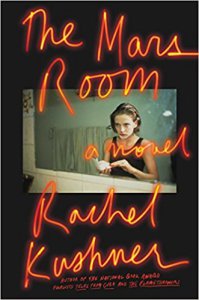
Then this happened: Waiting for me at home was Rachel Kushner’s new, ecstatically reviewed “The Mars Room,” which was on my list of five books to read next. It was, of all things, a library book, with a two-week checkout limit. I pounced. “Commonwealth” would have to wait.  

I just wrapped “The Mars Room,” a very good if never truly great page-turner set largely in a sordid women’s prison, much like “Orange Is the New Black,” with grim and funny detours streaking the story, including a few to the San Francisco strip club of the title. Kushner is good with grit, limning harrowing and humorous situations with a kind of streamlined tough-gal strut. And the final pages seize you hard. 

Before the Amsterdam trip, I borrowed two other titles on my list of five, Zadie Smith’s “NW” and Ottessa Moshfegh’s “Homesick for Another World,” neither of which I got around to thanks to the pleasingly time-consuming “Inseparable.” They remain fast on my reading list. 

61txVZFq-EL._SX331_BO1,204,203,200_

And yet: Dropping off “The Mars Room,” instead of getting the Smith or Moshfegh books, I got distracted and picked up two more books on my extended wishlist, Curtis Sittenfeld’s comic coming-of-age novel “Prep” and Jesmyn Ward’s National Book Award-winner “Salvage the Bones.” 

I get sidetracked in a snap when I’m around piles of books, my head on a pivot, eyes flashing, hands flipping pages, picking up and putting down volumes. So much to read, so many diversions, so many anxious postponements.

Of the two books I grabbed, I chose first to plunge into the poverty-stricken, pre-Katrina, Mississippi-set “Salvage the Bones.” So far, it is rapturously evocative, the prose raw and earthy and exquisite, the narrative quivering and propulsive.

Here is Ward’s description of a pit bull giving birth to puppies:

“Skeetah grabs the puppy’s rear, and his hand covers the entire torso. He pulls. (The mother) growls, and the puppy slides clear. He is pink. When Skeetah lays him on the mat and wipes him off, he is white with tiny black spots like watermelon seeds spit across his fur. His tongue protrudes through the tiny slit that is his mouth, and he looks like a flat cartoon dog. He is dead.”

If “Bones” eventually chokes — that’s far-fetched — I’ll do what I am wont to do: put it down and move on to the next title. But what will that be? “Prep” or

51at-ah4UzL._SX309_BO1,204,203,200_

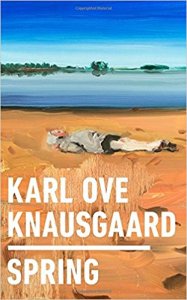
Even with two books before me, I said screw it and ordered Karl Ove Knausgaard’s “Spring,” a slim new memoir arriving in the States bubble-wrapped in effusive plaudits. The book is “poignant and beautiful,” a critic says. “Even if you think you won’t like Knausgaard, try this one and you’ll get why some of us have gone crazy for him.” (I’ve read five of his books and have gone crazy for him.)

“Prep” or “Spring” — I’m betting on the latter. Or will yet another title crash my consciousness and hijack the show? Likely.

Book fiends I know are afflicted with this disease of ravenousness, of greedy insatiability, of jonesing for the next fix. Books as lifeblood. Beats baking. Beats sports.

The saga continues, so much pulped wood before me, no end in sight. It’s an embarrassment of riches — words, language, poetry, morality, mortality, love and loss. And, as that, it’s a crazy blessing.

A darkly delightful book of the dead

For the record, family: Do not donate my body to science when I die. Let them harvest an organ or two, scoop out my eyes like melon balls, carve off a carpet swatch of skin.

Then burn me up good.

Scary to say, but my obsession with death, dying and the post-life has only rocketed since I recently re-read Mary Roach’s weirdly engrossing, and joyously gross, 2003 bestseller “Stiff: The Curious Lives of Human Cadavers.”

51AT2j73sjL._SX331_BO1,204,203,200_

The title nearly says it all: Roach’s beautifully reported book is a blunt, euphemism-free, aggressively lighthearted examination of exactly what happens to cadavers that are donated to science and research. (Cue: barfing emoji.)

Facts, history, grisly details and the author’s vivacious gallows humor make the unutterable utterly readable. Roach is smart; she pauses for philosophical reflection about what’s before her, providing a finish of deep and dignified meditation to what could have been perverted voyeurism catering to “Faces of Death” sickos. 

The breezy read features jarring chapter subtitles — “Human Crash Test Dummies and the Ghastly, Necessary Science of Impact Tolerance”; “On Human Decay and What Can Be Done About It”; “Medicinal Cannibalism and the Case of the Human Dumplings” — that are so graphic, they may be all you need to get it. For example, that first one: Yes, dead bodies are used as crash test dummies in vehicles. Splat.

Plunge into the pages and you’ll get the smells, sights and sounds of expired bodies rotting, ripping, being gutted and even crucified. (Scientists still want to know how Jesus died on the cross. Freshly dead bodies are a prime instructional aid. Pass the nails.)

The doctors and scientists Roach meets are a reticent assortment. But she intrepidly presses on. 

o-SYNTHETIC-CADAVERS-facebookSometimes a source will turn his back on her, suspect of her macabre motives.

“You want a vivid description of what’s going through my brain as I’m cutting through a liver and all these larvae are spilling out all over me and juice pops out of the intestines?” snaps a vexed forensics examiner. 

Roach responds to us, sotto voce: “I kind of did, but I kept quiet.”

“Stiff” rests on my growing, groaning shelf of superlatively morbid but essential books on mortality, like “How We Die,” “Final Exit,” “The Denial of Death” and other festive titles. I recommend them all. They will, while you’re still living, change your life.

Never done with Stephen Dunn

As sort of a literary snack, some lyrical Cheetos, I recently dipped into one of my favorite poetry books, Stephen Dunn’s “Different Hours.” It’s magnificent; so many fine poems, so many lines that quietly slash. The poems are all about wisdom and honesty and breakage, lovers and loss and burying a cat.

Stephen-Dunn
Dunn

I don’t care so much that the book won the 2000 Pulitzer Prize, though it surely deserved it. I do care that it contains this stanza:

I was burned by books early/and kept sidling up to the flame.

And I care even more that it has this bracing verse, from the final poem in the collection, “A Postmortem Guide (For my eulogist, in advance)”:

Tell them that at the end I had no need

for God, who’d become just a story

I once loved, one of many

with concealments and late-night rescues,

high sentence and pomp. The truth is

I learned to live without hope

as well as I could, almost happily,

in the despoiled and radiant now.

Those shimmering words shatter me, in a most positive fashion. (“In the despoiled and radiant now”!) The verse is frank but droll, vulnerable and confessional. It’s written with the points of melancholy stars.

Dunn, like his comrade in wry minimalism, Billy Collins, wields an unabashed colloquial touch, his plain-spokenness littered (glittered?) with joyous turns of phrase and often mischievous, tip-toeing humor.

He’s a master of subtlety, but any perceived simplicity is thoroughly deceptive. If you think Dunn’s poems are simple-minded, even pablum, you are sorely mistaken. You haven’t done the work.

The next 5 books I’ll be cracking open

Far before I’m done reading a book, I know firmly what volume I’ll be cracking next. I keep an ever-replenished list of titles. Something is always ready, waiting, like the upcoming course at dim sum. 

As I wrap up “Inseperable,” the excellent new biography of Chang and Eng, the original Siamese twins, I know what’s next. I’m taking a worn paperback of Kurt Vonnegut’s archly prophetic classic “Mother Night” (1962) on my trip to Amsterdam next week. Vonnegut’s breezy cynicism, swirled with empathy, a hesitant optimism and measured absurdism, feels just right for airplane reading.

After that, 10 books weigh down my list. But half of them get to jump the line. These are the next five books I’m plunging into:

516B2M5L8XL._SX324_BO1,204,203,200_I’ve read three of Zadie Smith’s fine novels — “Swing Time,” “On Beauty” and, the best of the bunch, “White Teeth” — so I’m revved for “NW, her acclaimed 2012 tragicomedy about a slice of London and how its human patchwork intersects and interacts. The intellectually rangy Smith has a sorcerer’s touch, conjuring crowded, complex stories that can be mesmerizing jumbles: granular, moving, funny and expansively human.
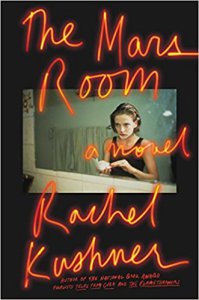
If Rachel Kushner’s wildly hailed fiction “The Flamethrowers” didn’t blow me away, it was still a fresh, propulsively entertaining epic about a young woman whose love of motorcycles, art and action hurl her on a picaresque through boho New York and radicalized Italy. In her new novel, the hotly awaited “The Mars Room, Kushner pinballs from the pitiless realities of a women’s prison to those in a San Francisco strip joint and beyond for a seedy and violent, harrowing but humorous skip through sordid demimondes. Raves wreathe the book already. “Heartbreaking and unforgettable … it deserves to be read with the same level of pathos, love and humanity with which it clearly was written,” gushes one reviewer.

41kvpzruegl-_sx329_bo1204203200_8.jpg

Our Shakespearean laureate, that lord of the Bard, Harold Bloom lasers in on one of the canon’s preeminent tragic figures in “Lear: The Great Image of Authority, a thin but typically volcanic volume that’s part of a series of portraits, including Iago, Falstaff and Cleopatra, titans all. Lear, fallen monarch, disgraced father, receives the full Bloomian treatment, a richly personal, prickly and cerebral exploration of the character and his enduring mythic stature.

Andrew Sean Greer’s “Less, winner of this year’s Pulitzer Prize for fiction, totally evaded my radar. I’m not even sure I’d heard of the novel until it cinched the award this month. I know so little about the bounding satire that I quote here from the dust jacket:

41wP7sR5mBL._SX321_BO1,204,203,200_

“Arthur Less will almost fall in love in Paris, almost fall to his death in Berlin, barely escape to a Moroccan ski chalet from a Saharan sandstorm, accidentally book himself as the (only) writer-in-residence at a Christian Retreat Center in Southern India, and encounter, on a desert island in the Arabian Sea, the last person on Earth he wants to face. Somewhere in there: he will turn fifty. Through it all, there is his first love. And there is his last.”

OK, I’m hooked.

A writer friend of mine won’t read Ottessa Moshfegh’s fiction, citing a gruesome quotient of blood and bodily fluids. I don’t know what she’s talking about because I’ve never read Moshfegh. Her stories “Homesick for Another World” have been called “eerily unsettling … almost dangerous, while also being delightful, even laugh-out-loud funny.” Characters are “unsteady” and the “grotesque and the outrageous,” a la Flannery O’Connor, “are infused with tenderness and compassion.”

51zp1zKT38L._SX328_BO1,204,203,200_

She has “a big mind, a big heart, blazing chops, and a political acuity that is needle-sharp,” crows the publisher. “The needle hits the vein before we even feel the prick.”

I think my friend is crazy. This sounds amazing.

And on things bookish, I finally discovered a well-tread site fully worth your while: Literary Hub. Brain-cracking interviews, essays, reviews, profiles — I won’t go on about it; just check it out.

Siamese twins: Freaks? Marvels? No. Human.

“There is the 19th-century obsession with abnormality — that insatiable desire of humans looking at other humans as monsters.” — “Inseparable” by Yunte Huang

Chang and Eng Bunker.jpg
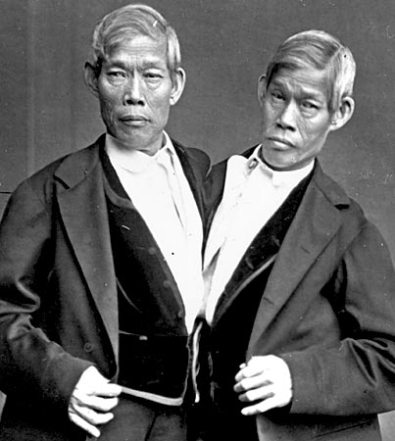
Chang and Eng Bunker, the “original” Siamese twins

Siamese twins don’t keep me up at night, don’t chill my bones, not like Julia Pastrana, enshrined in her time as the Ugliest Woman in the World, or the appetite-suppressing Grace McDaniel, the Mule-Faced Woman, that poor, poor dear.

Freaks they may be, but Siamese, or conjoined, twins aren’t freaky enough for me. They are marvelous and reality-bending, sometimes shocking but usually just remarkably human and, despite wincing deformities, almost normal. They are not, as so many freak show stars are reduced to, depraved monsters.

Take Chang and Eng, the most famous of all conjoined twins. Whisked from their native Siam (present-day Thailand) as teenagers by Western opportunists who swore to bring them back to their aggrieved mother in five years time, the twins embarked on a journey that would take them to America and England as wildly celebrated sideshow attractions. They would never return home. 

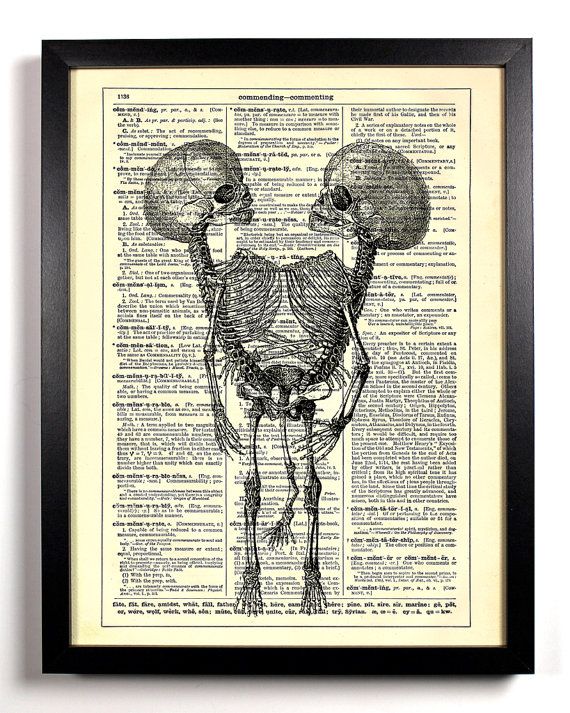
CraniopagusTwins-1024x253.jpg

It was the early 1800s and the boys, who became forever known as the “original Siamese twins,” wowed spectators used to ogling human marvels, from the limbless to the scale-covered and, later, the extreme likes of the Elephant Man and Jo-Jo the Dog-Faced Boy.

A London newspaper wrote, “Without being the least disgusting or unpleasant, like almost all monstrosities, these youths are certainly one of the most extraordinary freaks of nature that has ever been witnessed.”

That’s the start of the true story told in the sensitive new biography “Inseparable: The Original Siamese Twins and Their Rendezvous with American History” by writerly crack reporter Yunte Huang. It’s a strange tale, it’s a sad tale, one of courage, dignity, triumph and increasing oddness, yet one of naked humanity and crackling history, including illuminating nods to the Civil War, Herman Melville, Lincoln (who apparently liked cock fighting) and Mark Twain, who, transfixed, wrote a story based on the twins.

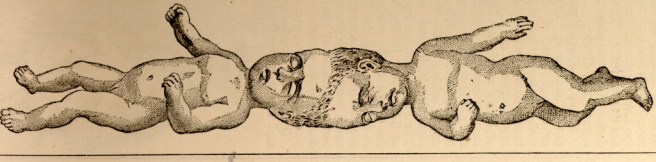
Conjoined twins have existed since at least recorded history, in royal courts (alongside impish dwarves and the cruelly deformed), Indian villages to brimming metropolises. “The occurrence is estimated to range from 1 in 49,000 births to 1 in 189,000 births, with a somewhat higher incidence in Southeast Asia and Africa. Approximately half are stillborn, and an additional one-third die within 24 hours,” notes a scientific journal.  a6667e8dffd824d02b052c8f2a63dba2

Those are abysmal survival odds. Indeed, the whole conjoined-twin phenomenon seems like a hateful prank played by a sadistic God. But somehow Chang and Eng made the best of it, despite inevitable exploitation on the sideshow circuit, invasive, humiliating medical examinations by gawking, prodding doctors, and of course racial prejudices of the era.

They were also comparatively lucky. Chang and Eng were joined by a mere cord of ligament at their sternum, as opposed to twins conjoined at their skulls or buttocks, sharing multiple organs, rendering them certifiably handicapped, facing heartbreaking physical hardships. (Bittersweet aside: If they were alive today, modern medicine could easily and safely separate Chang and Eng.)

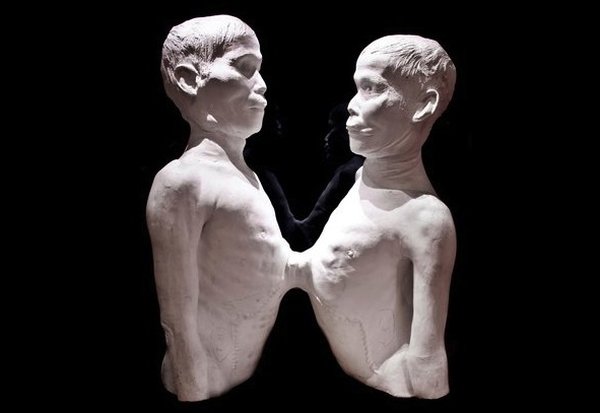
They were bound for life by “the connecting band — the key to the twins’ mystery,” writes Huang. The band looks like a slab of rubber stretched to the brink, rather like an arm on Stretch Armstrong, bridging their stomachs. The twins did share a fused liver, an oversized organ on permanent display in a pan of liquid at the Mütter Museum in Philadelphia. (I’ve seen it, twice. It is disgustingly glorious.)

chang_engjpg__600x0_q85_upscale.jpg__600x0_q85_upscale.jpg
Chang and Eng’s death cast at the Mutter Museum, Philadelphia

A single bellybutton was nestled in the center of the flesh tube, which actually grew with daily wear and tear. Once, “as Eng tried to stand up, he was pulled down by the fleshy string that had tied him to his brother,” says Huang. “Over the years, constant tugging had stretched the cord from its original four inches in length to five and a half, allowing a little more flexibility.” (Some Vaseline and a good masseuse might have done wonders.)

Here the story veers to, at minimum, vigorous eyebrow raising. After lucrative years on the exhibition circuit as “freaks of nature,” Chang and Eng moved to rural North Carolina where they bought land, owned 32 black slaves (!!) and married two white sisters and, spectacularly, sired 21 children. (They had separate genitalia.) In the book’s chapter “Foursome,” Huang explains how the twins had sex: gingerly. Tangled limbs, “Pardon me’s,” whispered apologies, averted eyes — one envisions a hot, or not so hot, mess.

During the Civil War, the Bunkers pledged allegiance to the Confederacy, which didn’t work out so well for the brothers financially. Soon they were on the freak circuit again to cover costs. They died of natural causes at age 62 in 1874.

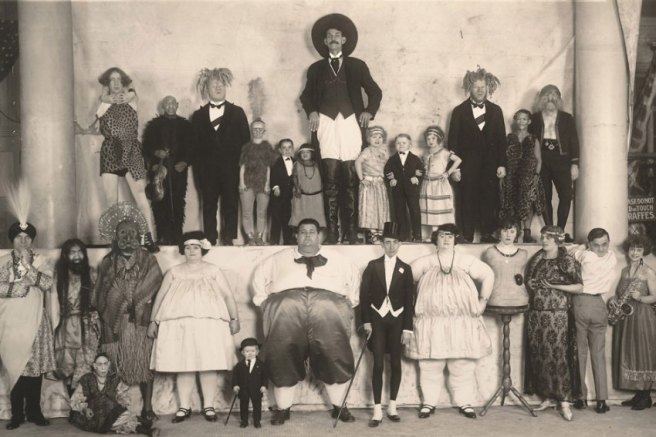
image-1142642-galleryV9-ovom-1142642.jpg
The remarkable cast of a 19th-century freak show.

“Freaks,” “marvels,” “wonders” — sideshow performers, trading in dubious self-exploitation, were labeled florid epithets to amplify their bizarre and exotic natures. It must have been a beating on their psyche and self-worth, robbing them of a portion of their soul, exposing themselves to dehumanizing gawking. It’s an ugly, despicable racket.

Chang and Eng might have, by virtue of their mostly normal appearances, been spared the worst of it, avoiding fainting audience members, brutish hecklers and degrading qualifiers, like “terrible” and “horrifying,” in their promotional material.

Yet nothing was ordinary for them. They were extraordinary, suffering under constant “otherness,” a state critic Leslie Fiedler so sharply dubbed “the tyranny of the normal.”

Still, they were in their own way normal. Wives, children, struggles, longevity, relative happiness. They were like the rest of us strivers and survivors — human, all too human.

A few things keeping me afloat

A glass half-empty sort of fellow, I maintain a suspect relationship with reality, an existential leeriness that has proven keenly unhelpful. Though I’ve fought it, I’m kind of stuck with it, a black and blue complexion not unlike a bruise. 

The world’s not helping — Trump, Syria, Israel, Bolton, the EPA, fires, flooding, shootings — but I’m still able to locate an array of things to be glad about. Small, but good.

I could mention the pleasures of last week’s birthday, my family’s sound health, my sister-in-law’s spiffy new car or the dog’s chewy glee over the pig’s ear I got him. I could mention my niece’s turquoise hair, my friend’s marriage or how the Stormy Daniels affair is closing in on the president like a vice. 

But I won’t, even though I just did. 

Here are a few other things currently leavening my oft-smudged outlook:

  • Last week saw the release of “Inseparable: The Original Siamese Twins and Their Rendezvous with American History,” a book this circus freak-show fanatic had to get, and did as a birthday present. Yunte Huang’s widely praised biography of famed conjoined twins Chang and Eng Bunker is a vast, panoramic narrative of the twins’ bizarre, unlikely life (wives, numerous children, slave ownership) in 19th-century America that deftly weaves details and personalities from U.S. history into a rich, fluttering tapestry. Elegant prose twins with magnificent detail.

61PpZ6teJWL._SX335_BO1,204,203,200_.jpg

  • The giddy anticipation of mulling world travels is a reliable endorphin. I recently posted my dual urges to go to Budapest and Amsterdam — the former I’ve never been to, the latter I’ve visited in quick, couple-days spurts. Always looking ahead, with one eye on the calendar and one on the map, I get a jolt just thinking about strolling new streets, eating exotic cuisine, ogling art, architecture and people. It’s already April. Time to start some serious research. (Spoiler alert: I’m leaning toward Amsterdam.) 
427490.jpg
Amsterdam
  • I’m captivated by the film “Ex Libris: The New York Public Library” by that doyen of documentarians, that genius of fly-on-the-wall observation, Frederick Wiseman (“High School,” “La Danse”). Released last year and running a whopping three and a half hours, the movie is a leisurely, painstaking amble through the hallowed marble halls, offices, shelves and auditoriums of the NYC institution. Wiseman’s eminent pointillist eye and febrile curiosity fashion an immersive experience inside everything from folios to fundraising, e-books to behind-the-scenes bureaucracy, programs to performances, community outreach to the organization’s pumping inner organs. Almost defiantly, “Ex Libris” is culturally kaleidoscopic. 

event-featured-John-Fraser-1507862176

  • Another birthday gift whacking the sweet spot is a squat, artisanally stylish bottle of Monkey 47 Schwarzwald Dry Gin, a German, handcrafted, batch-distilled, 47-percent alcohol (94 proof) beverage that tastes like an Everlasting Gobstopper in liquid form, swirling and multi-chromatic — fragrant, aromatic, smooth, rich and tangy. My brother was scanning the gin shelves and three individuals, one who worked in the shop, voluntarily told him that Monkey 47 was the best gin they’ve had. Three random people. He was sold. Now we both are.

monkey-47-schwarzwald-dry-gin-1-1.jpg