Midsummer miscellany

Four mini-blogs, bite-size essays, from eyewear to dog hair …

Shopping for new eye frames is about as thrilling as shopping for underwear — a little fun, but mostly a utilitarian ritual for a deadly pedestrian accessory. I got new frames this week to go with new prescription lenses, making me feel very old. I’ve had my current blue frames and lenses for two years and I felt like underwear shopping. Yesterday I took my new (burgundy) frames to the optician to get the fresh lenses. The whole deal cost an eye-singeing fortune — around $1,200 for frames, lenses and exam. The nice guy helping me said, “You don’t seem old enough for progressive lenses.” I sort of thanked him, then thought to myself, ha!

When it comes to a big juicy novel, I’m a restless reader. My standards are unreasonably high, and if a book hasn’t hooked me by page 70 or so, I close it and move on. I am not one of those chumps who strains to finish a book once they start it, no matter the quality. That’s obscene. I just closed Rebecca Makkai’s wildly praised novel “The Great Believers.” The Pulitzer finalist about a group of friends impacted by the AIDS crisis was worse than overly familiar and a mite trite, it was dull as dirt. So I started the also-acclaimed Adam Haslett novel “Imagine Me Gone,” a substantial (356 pages) story about a family of five facing mental and physical challenges that upend the unit and try the bonds of love. On page 89, I’m with it for now. But every so often it sags and I give it the stink-eye. Book, you are on perilous ground. Watch it.

Puffs and curlicues erupting over his face and body, the dog at last got a summer haircut. A professional groomer came to the house, bathed him in the sink, then took the razor to him good for more than an hour. Cubby now looks like a bewildered sea otter and it’s fabulous. Everything about him has shrunk — my, what tiny ears you have! — and it’s adorable. Thing is, now he’s licking his butthole and nether regions with frantic intensity, like he’s infested. It’s merely razor burn and getting used to the lack of locks, and if the past is any indication, he’ll stop licking presently. But it sort of drives everybody crazy, not least of all himself. Why are haircuts such trauma? Cubby and I both want to know.

My brother’s radar is exquisite. He knows my dubious tastes, my oddball obsessions, my disgusting fetishes. So it was Christmas in July when he recently gave me a gift of surpassing thrillingness: an immaculate wax double-wick candle of deformed conjoined twins skulls. Craig, my only sibling, said he got it for a Christmas present but couldn’t resist bestowing it now. He bought it at a local taxidermy/tattoo shop called Unlucky Rabbit that deals in deer heads to “Lesbians and Taco Trucks” bedroom candles. My kind of place. I’m a freak fanatic, sideshows, medical curiosities, monsters on down. For now, the Siamese twins skulls are on proud display, and I have no plans to torch them, they’re so gruesomely perfect. Still, lighting them and watching them melt into bone-colored goo would be its own grotesque beauty. Where’s the matches?

The terrible twos


No baloney about Bologna

Strolling and gawking among the glass-encased medical curiosities, from a face smothered in smallpox pustules to deformed conjoined twins, I was thinking of tortellini. Specifically, tortellini in brodo, stuffed pasta curls boiled and served in a zesty meat broth. Dinner. Yes. That’s what I was thinking.

I was at the Museo delle Cere Anatomiche — the anatomical museum — in Bologna, Italy, last week, and not even the bulging tumors and gleeful spreads of glistening guts could suppress my appetite for the city’s star cuisine. 

Tortellini in all its shapes and sizes, broths and sauces, is but one of the celebrated dishes in Bologna, which is renowned as Italy’s rightful food capital, or “La Grassa,” the well-fed or, more directly, the tubby. It’s one of the reasons I chose to go there. That and twisted, amputated limbs.

And, well, pasta bolognese. And Parmesan. And the world’s finest balsamic vinegar. And, naturally, Mortadella, which would almost pass as American baloney (Bologna, baloney — you see?) if it weren’t for the spots of white fat that marbles the Italian variety, as well as the way it’s sliced, paper-thin, like prosciutto. Oscar Mayer can only weep in shame.

Tortellini in brodo. Pasta ‘bellybuttons’ swimming in hearty meat broth.

It was a foodie trip, based in the region of Emilia-Romagna in northern Italy. The area’s medieval capital of Bologna is the seventh most populous city in Italy, and a mere thirty-minute train from Florence. The region boasts the city of Parma, known for Parmesan cheese and Parma ham, as well as the headquarters for such auto royalty as Ferrari and Lamborghini.

But sports cars don’t impress me — they’re like appliances, refrigerators or blenders, no matter if they’re painted a neon-pee yellow and can go 200 mph. So I skipped them for Modena, a small city (that has a Ferrari museum) best known for opera and balsamic vinegar (and, OK, Ferrari). 

The ancient, rustic region is where I booked a long lunch and balsamic “experience” that happened to take place deep in the wintry countryside on a sprawling family estate where mom, dad, son, daughter and cousin each produce their own balsamic vinegars, totally artisanal, completely blue ribbon. To reach the marketplace, a balsamic must be officially approved in strict quality control tastings by experts. These folks pass with a neat, and humble, familial pride. 

I was with a genial group of about ten fellow travelers. We feasted. Salumi (a spread of Italian deli meats), Parmesan of various ages, ricotta, risotto, quiche and more. We drizzled homemade, world-class balsamic on all of it. There was wine, too. Stuffed, we easily got our money’s worth (about $90). A long, edifying tour of the balsamic-making process — like wine, it’s made of grapes — preceded the pig-out. Ask me about the thick, tangy, reddish-brown liquid and I could likely answer with cocky erudition. 

Back to the university town of Bologna — it was more than I expected. My hotel was a twenty-second lope to the main city square, the yawning Piazza Maggiore, the kind of history-encrusted space that has you marveling as you sip a beer at a sidewalk cafe. 

The centerpiece is the Basilica of San Petronio, a stunning slab of Italian Gothic whose construction began in 1390 (the facade remains unfinished, the slackers). I can do a full-blown travelogue here, but we know how that goes — like listening to someone carry on about their “crazy” dream last night. Really, it was mostly about the food, and a breathtaking cocktail bar, Le Stanze Càfe, designed with real ancient frescoes, where I had lovely libations as I drank in the dazzling decor. 

I will say the anatomical museum, filled with miserable disease and morbid delights, created specifically for university medical students (yet it’s free for anyone), was a highlight of my stay. Human anomalies, freak shows, mystifying medical malformations, the two-headed, the three-legged, the Elephant Man fascinate me. It’s not amusing; generally it’s appalling. But curiosity is piqued, wonder is conjured, pathos pours forth. I kind of love it.

Thing is, I might love tortellini more.

Meat and cheese plate during a food tour in Bologna. That’s Mortadella on the left.

Pasta bolognese, a signature dish in Bologna. Noodles topped with beef, pork, wine, carrots, etc. Dynamite.

At the anatomical museum. Don’t worry. They’re made of wax.

50 great films with one-word titles

Sometimes when the days are slow and long and hot, I can just sort of geek-out and ponder random things related to my passions. Welcome to today, in which I spent a preposterous amount of time ticking off some of my favorite films that have one-word titles, from “Casablanca,” to “Goodfellas.”

It was a pointless exercise — massively pointless — but it was fun jogging my memory and eventually putting down a litany of terse titles, which always seem a bit more evocative than longer titles. As a lark, I chose 50 great films almost entirely off the top of my pointy head, and present them here in no order whatsoever. (Now it’s your turn.)

“Nashville” (1975); “Sunrise” (1927); “Amadeus” (1984); “Jaws” (1975); “Casablanca” (1942); “Airplane!” (1980); “Freaks” (1932); “Goodfellas” (1990); “Rebecca” (1940); “Heat” (1995):

“Detour” (1945); “Shrek” (2001); “Rushmore” (1998); “Ran” (1985); “Magnolia” (1999); “Oldboy” (2003); “Gilda” (1946); “Brazil” (1985); “Psycho” (1960); “Frankenstein” (1931):

“Duel” (1971); “Manhattan” (1979); “Eraserhead” (1977); “Se7en” (1995); “Yojimbo” (1961); “Notorious” (1946); “Lincoln” (2012); “Boyhood” (2014); “Chinatown” (1974); “Alien” (1979):

“Deliverance” (1972); “Spellbound” (2002); “Babe” (1995); “Sleeper” (1973); “Scarface” (1932); “Network” (1976); “Memento” (2000); “Hamlet” (1996); “M” (1931); “Breathless” (1960):

“Rashomon” (1950); “Stagecoach” (1939); “Ikiru” (1952); “Zelig” (1983); “Macbeth” (1971); “Klute” (1971); “Joker” (2019); “Cabaret” (1972); “Laura” (1944); “Metropolis” (1927) :

There are many more — “Bullitt,” “Contempt,” “Up,” “Repulsion,” “Gaslight,” “Slacker,” “Clueless,” “Thief,” “Locke” — but I wanted to keep the list at a tidy 50. I’d be here till Labor Day if I rounded up all the great single-title movies. But feel free to share your own.

You’ll notice I’ve made some glaring omissions of highly acclaimed films that simply don’t astonish me, and sometimes even rankle: “Fargo,” “Gladiator,” “Vertigo,” “Unforgiven,” “Zodiac” and “Casino.” Argue with me all you want, please.

Skulls, scales, piranhas and penises

Once I was strolling down the sidewalk in a small leafy city when I almost stepped on a dead baby bird. Gruesome and heartbreaking, about the size of a toddler’s palm, the chick bore hues of hot pink and bruised blue. Its livid, bulging eyelids were sealed, its featherless body as smooth as a plum. It was impressively intact. 

After a flush of shock and pity, I did what any sane person would do. I wrapped the freshly hatched corpse in a handkerchief, stuck it in my pocket, and took it home. 

I knew exactly what to do with the sad songbird that would never sing. I took a small, squat jar and dropped the creature in. Then I filled the jar with rubbing alcohol as a cheap formaldehyde substitute to preserve the bird. It looked like the baby floating in space at the end of “2001.”

“You’re nuts,” a friend said, grimacing at my latest specimen.

“If by nuts you mean genius, then you are correct, amigo,” I replied. 

Those were the days when I maintained a kind of ghoulish cabinet of curiosities, an array of animal bits and pieces that you might see in a really good, icky museum, like the Mütter in Philadelphia or the Kunstkamera in St. Petersburg, Russia. 

Jarred birth defect, Kunstkamera Museum, 2017

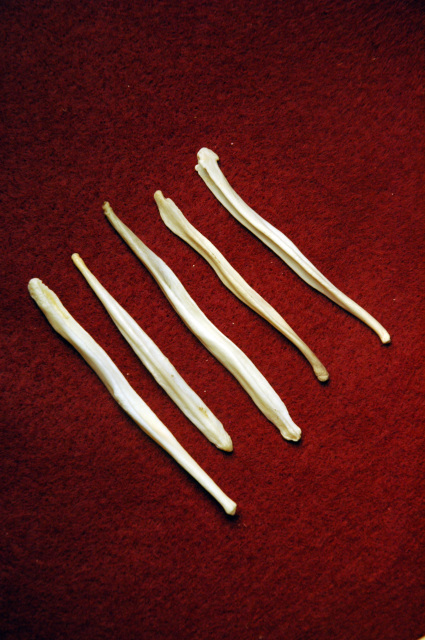
A minor collector of the morbid and marvelous, I was proud of my little spread on the mantel. It featured a perfect gopher skull I found in a forest that I boiled to get it ivory white; a shark jaw bought in Tijuana; a desiccated sea horse; an artfully mounted dried piranha; a skinny, three-inch coyote penis bone picked up at the wondrous Evolution Store in Manhattan; and, of course, the pièce de résistance, the newly jarred baby bird. 

All I needed were the famous bones of the Elephant Man to make my mini-museum world-class. Instead I had a penis bone. Of a coyote.

Coyote penis bones

My interest in this kind of fleshly ephemera goes back to when as kids we hunted lizards and snakes, captured frogs, tadpoles and the occasional crawfish. At the beach, we collected sand crabs, starfish and washed-up egg sacks from sharks.

It wasn’t callow mischief guiding us, but a dogged fascination with the slimy, squirmy world, our first real engagement with the natural sciences and coexistent creatures. Back then our main educational outlet for these things was TV’s “Wild Kingdom,” a show that pales woefully next to today’s über-slick “Planet Earth.” Yet it was good, eye-opening.

Even now, none of this bores me. Though I’ve since discarded my assortment of animal oddities, I love roaming the aisles and perusing the glass cases at the Mütter and the Evolution Store, gaping at furry and scaly taxidermy, jarred sharks, pickled human organs, and skulls of all species.

I’m not alone. The Mütter and Evolution are bustling tourist magnets, irresistible emporiums of the morbid and mortal, stocked with shocking notions and terrible beauty. (I just recalled I own t-shirts from the Mütter and Evolution. How could I forget?)

Meanwhile, my birthday is coming up. Here’s what you can get me, from Evolution:

Jaws in a jar. Beat that.

Books — visas to new vistas

I’m greedily tearing through “Interior Chinatown,” a tangy cultural satire by hot young writer Charles Yu. I’m savoring the book’s poppy humor, clever screenplay format and edifying critique of what it’s like to be Asian in America (bluntly: assimilation’s a bitch). The novel, which is also a scathing indictment of racial stereotyping in Hollywood, won this year’s National Book Award. It probably deserves it.

As I read, plunging into a world both comic and caustic, ordinary life churns on. I pop a mild tranquilizer (tranquility, wee), the snow melts into puddly archipelagos, the washing machine sloshes, the small gray dog curls up like a sow bug on the couch. These are not distractions, though I sometimes get sidelined by looking forward to my next book, no matter how good the current read is.

Like: 

  • “The Trouble with Being Born,” a collection of acrid aphorisms by E.M. Cioran, who calls birth “that laughable accident.” (Wait, did he write this for me personally?) 
  • I’ll revisit Virginia Woolf’s hypnotic “Mrs. Dalloway,” inspired by a recent essay extolling its literary radicalism. Not a simple read, Woolf challenges audience assumptions, and rewards them with rapture.
  • I’ll also take a second dip into “Sex and Rage,” Eve Babitz’s raffish auto-fiction, whose subtitle, “Advice to Young Ladies Eager for a Good Time,” is a brazen come-on. The book’s so saucy, such unfiltered fun, and the writing so ablaze, resisting it would be dumb self-denial.  
  • Then there’s “Geek Love” by Katherine Dunn, a rollicking freak show saga told by an albino hunchback dwarf. Echoing with the bearded lady’s cackle, this exotic family comedy has been called “a Fellini movie in ink.” Nirvana. 

It’s trite to note how reading has risen during the pandemic. That’s almost a year now of increased literary calories. And, gulp, plump we get. If you’re braving the prolix Russians, you’re assuming even more brain girth. Conversely, if your diet is J.K. Rowling, you could be anorexic. (And the knuckle-draggers who boast they don’t read? Mind rot — enjoy!)

Certain books, hence, are in high demand. I’m having a hell of time getting my mitts on Maggie O’Farrell’s award-winning historical fiction “Hamnet,” a speculative study of Shakespeare’s complex marriage, his young son’s death from the plague, and how that loss might have led the playwright to make his immortal “Hamlet.” The slavered-over tome is out of stock at (boo, hiss) Amazon and on back order at the local indie shop. All 66 copies in the county library system are checked out.

It can wait. I have the above books on queue, with a few other titles earmarked. You can never run out of choices, even if it leads you to reread a book or three, which is how you know you’ve struck a great one, like my current pleasure “Interior Chinatown,” a contender for a later revisit.

Literature is like another book, the passport. It slings you aloft, carries you to far-flung places. In these cloistered days, reading is the safest, most satisfying way to get out of your space, the claustrophobic chambers of the solitary mind. While we can barely leave home, books are effectively the new travel, transporting — and transcendent.

Fall reading officially begins … now

A Big New Book is being released tomorrow: Elena Ferrante’s “The Lying Life of Adults, the follow-up to her celebrated four-book Neapolitan Novels (“My Brilliant Friend,” etc.) that’s been awaited with clammy palms and mild hyperventilation around the world. They call it Ferrante Fever, the passion with which readers embrace her Naples-set, fiercely feminist fiction. In fact, so beloved and famous are her novels, of which I’ve only read two (heresy!), I will go into no more detail about their glittering renown. 

As reclusive and elusive as Sasquatch, Ferrante writes under a pseudonym and an impenetrable cloud of anonymity, so thick even her tireless English translator has never met her (him? they?) in person. The tenacity with which she preserves a faceless non-identity, shrouded in maddening mystery, makes Ferrante a sort of Banksy of literature. She’s been touted for the Nobel Prize, and we wonder how that would work — a fashionable no-show à la Bob Dylan? Does it matter?

41fHc-hEosL._SX342_BO1,204,203,200_

The publication of “The Lying Life of Adults” (which charts the thorny coming of age of a teenage girl) has been called the “literary event of the year” by those New York magazine types, and lots of slobber has soaked its impending release. 

I haven’t read the novel yet — I have a copy on hold, he panted — so I can’t say much more about it without paraphrasing the publicity notes and that will put all of us to sleep. When I finally crack it, I’ll share. 

Meanwhile, about the excellent book I just finished today … 

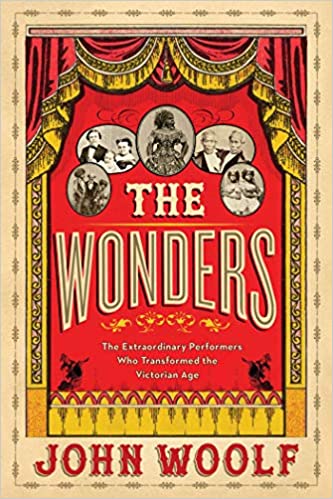
I have great faith in the tastes of London-based blogger Jessica, a native Ohioan who writes the funny and fascinating — and on the rare, lucky occasion, riotously scatological — Diverting Journeys. So when she recently reviewed the freak show history “The Wonders: The Extraordinary Performers Who Transformed the Victorian Age, I promptly grabbed a copy. A fellow enthusiast of the creepy and freaky — from baroque cemeteries to carnival sideshows and babies-in-jars museums — Jessica writes, “I genuinely loved this book. It was so fun to read, and was the perfect combination of cultural and medical history.” 

51Nh9MINwEL._SX331_BO1,204,203,200_Agreed. Author John Woolf weds sharp scholarship and anecdotal color about some of the most popular human oddities of the 17th to 20th centuries with accessible and mesmerizing verve. Some of the abnormalities are digestible — dude, you’re like the size of a Cabbage Patch Kid! — while others rattle: the rampant racial exploitation marring the sideshow circuit truly sickens. 
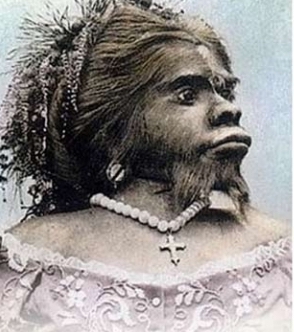
A “Wonders” sampling: the woman with a blimp-sized derriere and an XL labia; the original Siamese Twins (slaveholders, they), who both married and had like fifty children; an array of dwarfs who thrived as playthings in Europe’s royal courts; and two of my all-time favorites, Julia Pastrana, billed as the Ugliest Woman in the World, and Joseph Merrick, the eternally doomed Elephant Man. (Actually, Pastrana was also doomed. You cannot believe how she winds up.)

These are stories of amazement — you keep wondering how? and why? — and, too often, searing heartbreak. This book somehow manages not to shatter you, not by shirking facts, but by maintaining a tempered, dignified humanity that cleaves to historical reality. Shudder if you must. 

julia-pastrana-2
Julia Pastrana

My freakish fixation

When am I not thinking about the Elephant Man? 

I’m not just talking about the shattering 1980 film by David Lynch (still one of my favorite movies — see my appreciation here). I also mean the actual, real-life Elephant Man, née Joseph Merrick, the hideously deformed young Brit who, with considerable luck and one doctor’s wayward compassion, went from the squalid, dehumanizing freak show circuit to become the toast of Victorian London before he died at age 28 in 1890.

Merrick has been on my mind since I was yay high. Call it odd, perverse or, well, freakish, but the creepy and offbeat have clutched me in their thrall since my youthful exposure to Universal Horror flicks, campfire myths like Bigfoot and the Moth Man, and the most enduring gift I received on my eighth birthday, the thick book “Very Special People: The Struggles, Loves, and Triumphs of Human Oddities” by Frederick Drimmer.  

Josephmerrick1889

In the book, among the likes of Jo Jo the Dog-Faced Boy; Grace McDaniels the Mule-Faced Woman; the original Siamese twins; and Julia Pastrana, aka the Ugliest Woman in the World, was Merrick, perhaps the saddest story of them all. (Although Pastrana’s story is heartrending, bizarrely grotesque, and worth a look here.)

A speedy summary: In an unorthodox gesture of charity, Dr. Frederick Treves took in the incurable Merrick, who suffered from severe neurofibromatosis, at the Royal London Hospital, furnishing the sick, lost and abused sideshow veteran a dazzling new life of comfort, friends, celebrity visitors, room and board and more. Though his appearance still terrified the faint of heart, Merrick was embraced by mainstream society until his premature death. IMG_0581.JPG

(Merrick’s skeleton resides at the old Royal London Hospital, and a few years ago I visited hoping to see the bones. I was rebuffed, but I had the pleasure of the hospital’s special museum dedicated to Merrick’s life.) 

I know a lot about “The Terrible Elephant Man,” as he was billed on the road, not only from “Very Special People” and Lynch’s ravishing biopic, but from a slim paperback I bought in seventh grade, “The True History of the Elephant Man,” about which I wrote and presented a book report to my befuddled English class. 

What gets me about Merrick is his life story, one so rippled with tragedy and depravity, it curdles the soul as it breaks the heart. Living in a sooty black-and-white London of clanking, steaming machinery that ushered in the Industrial Revolution, Merrick’s old-timey milieu also enthralls (see the Lynch movie for a rattling immersion in time and place), and seems of a piece with his destitute, Dickensian plight. 

And the disease: The exotically gruesome, inconceivably savage affliction renders man into monster, whose corrupted flesh cannot conceal the gentle soul locked inside the twisted, tumored carapace.  

My fascination has become rather fanboy. (Elephant Man cosplay — I will have to pass.) Besides books about Merrick — including “Making ‘The Elephant Man’” by one of the film’s producers, which I just bought — I own the American, Turkish and Japanese posters of Lynch’s movie, as well as a coffee mug embossed with a period photo of Merrick looking dapper in a three-piece suit. 

the-elephant-man-japanese-movie-poster

Around the time I got the making-of book, I ordered what I’ve wanted for a long time, a t-shirt of the “Elephant Man” movie. This one is a silkscreen of the film’s Japanese poster art, fusing my passion for all things Japanese with my strange Merrick mania. 

A tad zealous, perhaps. But consider that Michael Jackson famously tried to buy Merrick’s bones. He was flatly refused. I once thought that Jackson was overreaching, being the creepy eccentric he was.

Nowadays, not so much.

When Halloween gets lost in translation

Pretty much kaput, Halloween means just about nothing to me nowadays. The thrill is gone. The chill is gone. I’m not 7, dig. 

Yet something about Halloween sticks, hovering like a blanket of graveyard fog. Each year I gladly inhale the occasion’s residual festive fumes, pumped in like so much giddy-making nitrous oxide. Hey, unlike zombies, I have a pulse.

Though costumes are long — and forever — doffed and I’ve retired the habit of sneaking morsels from the communal candy bowl (It’s for the kids, dammit!), I remain devoted to this perverse, very North American celebration of the gross, grim and ghoulish. (And, yeah, I lied: the Reese’s cups are mine.) 

But I effectively don’t partake in the big-picture party, unless you count sometimes serving as the eve’s Doorbell Dork, doling out Snickers and Tootsie Pops, smiling like the village idiot on cue when a particular and rather mystifying catchphrase (starts with trick) is shrieked by decked-out kiddies (and a few shameless, straggling grown-ups who can only dream they’re getting a Kit-Kat from this finger-wagging candy dispenser).

It’s a festival of enforced flamboyance. Excess is enshrined. Generally sane people douse themselves in corn syrup blood. Sex is flaunted in racy micro-fashions: cats and maids and devils. It’s masks and makeup and Marvel; wigs, witches and wizards; Pokémon, pirates and pop stars (and, yes, Pop Tarts) — the palette is as infinite as it is infantilizing. The id comes out to romp. 

2016.halloweenies
Halloween in Sevilla, Spain, 2016 — amateur hour.

In placid suburbia, lawn dioramas have grown ambitiously disgusting. I love the sinew-chewing zombies (with staticky sound effects), life-size, yoga-posed skeletons and tombstone-cluttered cemeteries, gnarled limbs popping out of the ground. I beseech you: gross me out.

It’s a bacchanal of fantasy and horror, whimsy and steroidal imagination. It’s pop cinema — slashers to superheroes — sprung to life. And it’s uniquely, wildly American (and, I hear, Canadian). 

2008
Halloween, Beirut, 2008 — not cool.

I’ve done Halloween in London, Paris, Beirut, Ho Chi Minh City, Kathmandu and Sevilla. As the locals tried to summon the spirit, they invariably botched the holiday, blundering with gauche costumes (er, blackface in Beirut and Paris) and feebly attended parties — strictly amateur hour, training wheels required.

Except when they’re not. Except when the night has been co-opted with the verve and vision matching the western prototype. All eyes on … Japan. It’s said that Japan has only been practicing Halloween in earnest for five years. But amateurs? Hardly.

The Japanese were born pros, built for Halloween. Nothing is lost in translation. Dress up and cosplay are daily mainstream occurrences. Stroll anytime through Tokyo’s Harajuku district for teen fashion so high, so rococo, it passes as a perpetual street costume party.

IMG_2777
Harajuku teen, Tokyo, in April 2006.

Which should make this year’s Halloween something special. I land in Tokyo on October 30, giving me less than 24 hours to steel for whatever that hyper-charged city has in store in the way of a woozy wingding.  

Because there is no way I’m not wading into the most outrageous Halloween hotspots — like bustling, youthful Shibuya, where a million revelers are expected — to get the full Japanese treatment: anime and cosplay characters, J-horror ghosts and vampires, video-game avatars and the universal diet of Star Wars, Harry Potter, Power Rangers and other mega-brands. (Oddly, Where’s Waldo? seems to still be popular. I’ll look into it.) 

This is what I wanna see, Halloween with kick (I’ll return with a full, bloody report):

https-hypebeast.com-image-2018-05-tt-1.jpg
Witches? Zombies? No idea but I’m thrilled. 

maxresdefault.jpg
Nerd, nerd, nerd, nerd and nerd. That’s five nerds. God bless them.

halloween-in-japan-shibuya-costumes-13-018-600x400.jpg
Grisly Disney: zombie versions of famous cartoon characters, including Minnie Mouse and Snow White.

halloween-costumes-2018-designboom-004.jpg
A gaggle of zombie fast food (flesh food?) servers. Do you want fingers with that human hamburger?

And the best for last …

best-for-last.jpg

Monkeys Sea, monkeys do

Why is everyone so down on Sea-Monkeys? People scoff when I bring them up, which is pretty much never, and the novelty item’s star ratings are piddling to pathetic at Amazon. (2.7 stars? Wha?) 

Sea-Monkeys rule. If you’re 7. But really, I’ve owned them at least 10 times as a kid (and, all right, as an adult), those trippy, creepy, itsy-bitsy, dimly disappointing crustaceans that swirl around a small plastic tank on your nightstand before dying off, one by one, until all that’s left is greenish, brackish water that smells like the devil’s bing-hole. My freakish, fun-loving, easily-fooled brain adores them.

Instant Life

They come up because I recently watched Penny Lane’s 2016 short film “Just Add Water: The Story of the Amazing Live Sea-Monkeys.” (See all 16 mind-tweaking minutes of it here.) 

It jogged a zillion memories of my 9-year-old self hatching what are actually microscopic brine shrimp (which are used primarily as fish food), hoping, always hoping, for the anthropomorphic little families of so-called Sea-Monkeys to appear when I followed the directions to concoct a peculiar potion. 

The famous advertisements in comic books of the 1960s-‘70s depicted happy, three-pronged-crowned sea creatures, naked part-fish/part-people, hanging out, smiling, doing their whateva Sea-Monkey thang. And it showed human purchasers gazing at a bowl of them, grinning like fools. It was wonderful. And for a kid who thought Bigfoot and the Elephant Man were the dope, implacably seductive.

769b00b1ac8a825dda9a097a96ed7078_XL.jpg

So you order the Sea-Monkeys. Miniature plastic tank that you fill with tap water — check. Then add Packet #1, the water purifier, which, according to the short film, actually contains the Monkey eggs, “giving the Sea-Monkeys time to get big enough for you to see them” in a 24-hour period. Packet #2 is really blue dye that makes the day-old Monkeys even easier to observe. (There’s a small racket going on here.) The other packet, #3, is Growth Food. It smells like algae and fish guts.

No matter, what is happening is science. Namely, “cryptobiosis,” or instant life, meaning the Sea-Monkey eggs are dehydrated like NASA space food and pop to life with the addition of water. Think Cup O’Noodles or Taster’s Choice instant coffee, but with tiny monkeys. That aren’t actually monkeys.

Brine shrimp are what they are. At best, they grow about a half-inch long. They have spindly, monkey-like tails as adults and they swim with fluttering angel’s wings, flapping in circles around the tank, nose-diving, eating food at the bottom and, most curiously, latching onto one another in possible monkey coitus. Baby Sea-Monkeys do happen.

I’ve had a Sea-Monkey live about a year or more — a personal record. It was massive. When it died, my college dorm-mate and I burned it in a funeral pyre. I wish I was joking.

55706_XXX_v1.jpg

Sea-Monkeys are a conflation of toy and pet, two of children’s favorite things. They are the brainchild of late eccentric inventor Harold von Braunhut, who created a “stage show, the illusion of instant life,” says the film.  

But the movie also reveals pure evil: Von Braunhut was an active and outspoken member of a major pro-Hitler white supremacist league. How to reconcile these two sides, the whimsical and the wicked?

“It’s the great mystery lurking behind the Sea-Monkey castle,” says Richard Pell of The Center for PostNatural History in the film. “How does the guy who invents all of these wonderful, playful fun things also promote such horrible ideas?”

I shake my head vigorously. I can’t answer this question. Some might even think Sea-Monkeys, those mutant, sci-fi creatures, are horrible ideas. Spawns of satan.

I then recall my own evil, sheer monkeyshines. As a kid, when I got bored with my tank-circling Sea-Monkeys, I once fed them to a trio of mail-order sea horses (who themselves croaked after about three days). Another time, I poured them into one of those hand-held water games of hoops or tic-tac-toe and swished them around like debris in a storm. Sea-Monkey sadist.

And yet here I am, decades onward, seriously considering buying for my birthday a Sea-Monkeys Ocean-Zoo for $12.98 from Amazon. I am so tempted I can hardly stand it.  

(For the Sea-Monkey completist — who isn’t? —  visit the official Sea-Monkey site here.)

LM-SEAMONK_2__37889.1503517902.jpg
Actual Sea-Monkeys, aka brine shrimp, in captivity