“Rather than make one’s argument come alive, clichés do the reverse. They capture a morsel of thought, cover it in batter, and fry it into mush.” — Mark Abley in The Walrus
For good measure, here’s a rogue’s gallery of flagrant clichés. As language guru William Safire put it (with a sardonic wink): “Last but not least, avoid clichés like the plague.”
Don’t cry over spilt milk; Selling like hotcakes; The rest is history; Every cloud has a silver lining; When it rains it pours; Don’t judge a book by its cover; Don’t beat around the bush; Don’t count your chickens before they hatch; It’s a dog eat dog world; To be honest; Basically; With all due respect; Giving it 110%. It is what it is; Paradigm shift; Walk the walk; Pushing the envelope; Thinking outside the box; The elephant in the room.
The goose is loose, the geese unleashed. They waddle from the nearby park into the residential hinterland of manicured landscapes, Christmas lawn ornaments and porches peppered with boxes from Amazon and UPS. A suburban snow globe.
Remarkably noisy, honking their own holiday songs (worlds out of tune), the geese are like plumed seasonal interlopers that just want to say hi to their human neighbors. And poop all over. And occasionally whip up a nest and lay eggs in your front yard (that happened, true). And spread disease. And … we’re getting ahead of ourselves.
You know they’re coming from their squawky honks (squawnks?). Those bestial blasts are something else — the primitive, tortured horns on a 1912 Ford Model T. Nasally and blustery and violent. Atonal, discordant, foul (fowl?).
The geese are here — it’s winter. The plump poultry galumph, don’t fly, south for the winter, a whopping three blocks south, the lazy bums. The park creek is frozen and perhaps food is scarce. They move in small gaggles of two to four, really just giggles.
And for the number of dogs in the neighborhood, they are a bold lot. Strut they do, chests thrust, hooting and blaring. They are so cocky that they can be mean, and they’re known to attack humans if “provoked.”
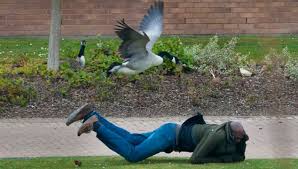
Exhibit A:
Experts at Rutgers University call this “Nuisance Behavior.” I’d say. “When protecting nests and goslings, geese can become aggressive. Attacks are rare, but they can cause injury to small children and pets.” That looks like a full-fledged adult to me, in full-blown duck and cover. Take note.
The Rutgerians explain that Canada goose flocks, which are what these are, head for places of “recreational purposes, such as parks, athletic fields, and shorelines.” (“Recreational purposes” — love that. Maybe geese enjoy hoops and the monkey bars.)
Next to knocking you to the ground, the geese bring all sorts of wonderful. “Accumulation of feces potentially creates a foul odor and slippery conditions, and these areas quickly become unattractive to people,” notes the panel with exceptional acuity.
We like, if do not love, the geese. Animals will be animals. Dookie is what they doo-doo. Yet the academics present a bona fide dark side: “Canada geese are carriers of bacteria and parasites that may be pathogenic to humans,” the most common being E. coli.
Rule No. 1: Do not pet the geese. Play it safe and don’t even look at them. They’ll probably give you the stink-eye anyway. No. 2: Wipe your shoes with a kind of horror-movie panic.
Jesus.
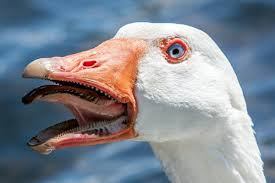
The more I learn about these geese the more they unnerve me. The more I want to purchase a crossbow. They are ornery, incontinent, complaining, belligerent and noxious. Plus, they’re homely devils.
Not long ago a story ran at thedodo.com with the headline “Why Are Geese Such Assholes?” The piece describes geese attacking humans, but implicates ducks, chickens and turkeys, too, as being “over the top,” says a woman.
“But as it turns out,” writes the author, “it’s actually for a very sweet reason. ‘The moms protect their eggs and young. The dads protect their families — their flock,’ ” says the same woman.
Best lines in the story: “A wildlife officer agrees that geese are just really scary into their kids. Like soccer mom scary.”
While I’m sort of reveling in reviling the creatures, there’s this factoid that should unsettle all air travelers, those with and without feathers: “Canada geese can be a significant threat to aircrafts … Of the approximately 95,000 bird-aircraft strikes that occurred in the U.S. since 1990, about 5,300 involved Canada geese.”
That seals it. I haven’t been assailed, squawnked at or otherwise molested by the local geese, those downy demons that make the occasional sojourn from the park to car-strewn streets, plop caca and hypothetically ravage a berserkly horrified human. But I’m taking no chances. Those beaks look ferocious, the flapping wingspans formidable. About now I’m thinking I need a fresh set of down pillows. Perhaps a comforter, too.
People, places and culture — little consolations — that are turning me on (saving me?) in the waning days of a sometimes unbearably tumultuous year …
Courtney Barnett — Guitar rock lives. Or so we can dream, a reverie persuasively advanced by grungy guitar-slinger Barnett, a pop-punk pixie who’s making some of the crunchiest, catchiest, folky-fuzzy rock around, music that sounds improbably lasting. A devout DIYer with a Grammy nod and fervent following, Barnett traces the raw, minimalist contours of Nirvana and the Pixies, with squalling distortion and a voice so uninflected that her Australian accent claws right through. That voice echoes the talk-singing and slightly nasal tones of Liz Phair, Patti Smith and The Hold Steady. Wincingly intimate, her jagged, jangly songs are shot through with personal drama and cutting irony. Often they’re downright hilarious. Choice cuts: “Pedestrian at Best,” “Debbie Downer,” “Avant Gardener,” “City Looks Pretty.” Watch her in concert HERE. And visit her squiggly world HERE.
“Night Train”: New and SelectedStories by Thom Jones —I didn’t even know Jones died two years ago. He’s one of my favorite short fiction writers and I kept wondering where in the hell he went, when he would publish again. I was alerted to his fate by this posthumous assemblage, plucked from Jones’ classic ’90s collections “The Pugilist at Rest,” “Cold Snap” and “Sonny Liston Was a Friend of Mine,” each worth owning, and cherishing. But with this chubby tome, featuring seven new stories, including the typically mordant title tale and spanning the biting, semi-autobiographical Vietnam War epic “The Pugilist at Rest” to the absurdist vermin mayhem of “Mouses,” Jones’ spare, sinewy, mean and bust-up funny realism comes into exhilarating focus. Fueled by grit, violence and the tough tenets of his hero Arthur Schopenhauer, this is essential contemporary fiction.
Gin and tonic at Angel’s Share—Last month I drank a gin and tonic with a Japanese gin I criminally did not get the name of at Angel’s Share, the dark, elbow-jabbing speakeasy in New York’s East Village. It was the smoothest, lightest, tastiest G&T I’ve ever sipped, spritzed with a gorgeously un-cloying tonic that was gently fizzy, not nose-tickingly fizzy. The drink was a perfect alchemical mingling of alcohol and mixer, a frosty masterpiece. (If only I could afford the $17 elixir more than once a year.)
“I Am Dynamite!”by Sue Prideaux — Penetrating and punchy, with an attractively light touch for the weighty subject, Prideaux’s new biography of Friedrich Nietzsche, one of my dearest great dead thinkers — atheism! nihilism! iconoclasm! self-invention! and more furrowed-brow brilliance — is like literary windshield wipers, a slashing text of clarification and demystification. Despite the luxuriously daunting walrus mustache and monumental scowl worthy of a grumpus Mount Rushmore, the German polymath — yes: a prickly, willful malcontent — wasn’t the poisonous philosophical force we’ve been warned of. (For one, he abhorred antisemitism.) Reason reigned, until it crumbled amidst the famous crack-up that would kill him at age 56. Dead: first God, then him.
Istanbul — First come the post-vacation blues: the immediate despondency felt when you return home from a great trip. Crap, it’s over. And then there’s the afterglow: the crazy satisfaction and rapture you feel when the depression burns off. Damn, that was the best trip ever! I got back from Turkey last month and I’m basking in the afterglow. I was mostly in Istanbul, one of few cities that can hurl me into a dream state that’s as wondrous as it is ineffable, an otherworldly stupor of sights, sounds and flavors, pocked by the lovable multitude of stray dogs and cats and the unfailingly caring and splendid people. I still savor my Istanbul lodgings, the über-charming boutique Hotel Ibrahim Pasha and, in Cappadocia in Central Turkey, the Pumpkin Göreme Restaurant and Art Gallery, where the cheap and divine fixed menu delivers the allure of Turkey on many plates. If I sound a little intoxicated by it all, I am.
Hagia Sophia, Istanbul
“Skate Kitchen” — The young women of this scruffy 2018 skateboard drama are hell on wheels — or is that Chanel on wheels? No way. The tribe of shredding female street teens are all about the clacking and scraping of boards on New York concrete, smoking spliffs and coupling with the opposite (or same) sex. The star here is bespectacled Camille (Rachelle Vinberg), a taciturn 18-year-old from Long Island who defies her mother for the skate parks and subways of Manhattan, where she’s promptly absorbed into a rowdy posse of all-girl skaters. The film is predictably sincere about teen rebellion equating to freedom and addressing, softly, teen politics and gender politics. Yet it works; it has kick. Crystal Moselle (2015’s hit documentary “The Wolfpack”) shoots with a meandering vérité camera, the city captured with gritty love and bloodied-knee realism, and music to match. The movie is on DVD and streaming. The trailer’s HERE.
Cubby the Wonder Dog— The perennially pampered pup, huge heart, small bladder, gives as good as he gets — hugs and snuggles, mutual adoration, tricks and treats, ribald chit-chat over Scotch and cigars. We love the mutt with our lives, no matter if he begs, bedevils the cats or poops and pees on occasion and off the Wee-Wee Pad. Spiritual creatures, dogs are fuzzy founts of friendship, besting humans, I’m afraid. I’m rotten when I wake up, until I see that damn dog wagging his curled tail and things fall into place. Mused author Thom Jones (see above): “Dogs have a way of finding the people who need them, filling an emptiness we don’t even know we have.”
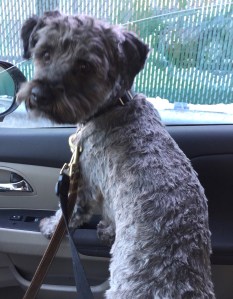
It’s dark out and the human couple are going crazy trying to corral their unleashed dog in the street near the park. Come on! they take turns beseeching the heedless hound.
The dog keeps circling them in wide arcs, mouth open, tongue wagging. He’s laughing at them. He’s having a ball. Catch me if you can!
Exasperation streaks the air. This little game is growing old. The dog doesn’t know this. It’s cold, it’s getting late, dinner beckons. Ha! says the dog. He is free, free at last. And he isn’t wasting this hard-won opportunity of open-range rambling.
Roxie! (breathless) Roxie! (impatient) Come on! (aggravated) COME. ON. (hair being pulled)
The empty leash rattles, human feet stomp and scamper, doggie nails tappy-tap against pavement. The animal runs, feints, twists around, runs in the other direction. The humans are hopeless.
There is no grand ending to this tableau. Eventually the drama fades, as it will. The dog is captured, the leash reattached. Feet shuffle away. If one listens closely, a dog pants and pants and says under his breath: Yes!
I own an old piece of luggage that is, at long last, the worse for wear.
It’s lost that luggin’ feeling.
For some 18 years it’s been my sturdy companion around the globe, from Israel and India to Morocco and Madrid; Egypt and China to Turkey and Poland; Thailand and Lebanon to Japan — and beyond. It carried worlds of stuff, from my underwear to a Turkish hooka; from Syrian soaps to ham from Spain and pirated DVDs from Vietnam.
All the rugged mileage this road warrior has incurred has aged it like a pugilist pummeled into premature dotage. Not helping are airport baggage handlers who hurl one’s precious parcels like sides of beef.
I’ve seen it. I actually watched through the ovoid plastic jet window a handler on the tarmac chuck my exact suitcase — mine — into the cargo hold like it was a sack of stinky refuse. It was almost heartbreaking.
My luggage — a 22-inch two-wheel roller made of thick nylon by the superb Pathfinder — is still functional. It’s just outmoded, beaten and battered, like shoes that are broken-in to just-right comfort but are scabby and gangrenous. It isn’t dead. But it is officially on Social Security.
Suitcase or basket case?
Scarred and scuffed, it’s a homely old comrade, chain-smoking, hard-drinking,occasionally finding itself in a barroom brawl. It has rolled around and seen the world, seen good times and bad, and, well, I’m out of clichés.
Strips of plastic peeled off the two beleaguered wheels a year ago and the zipper ripped off one of the front compartments that accommodates books, magazines and documents.
Without a quartet of spinning wheels, the bag is unwieldy, especially on streets and sidewalks. It can be frustratingly graceless, at once ratty and bratty.
All of this, of course, is just noisy throat-clearing to announce I have replaced the grizzled (yet forever faithful) Pathfinder with a newer model, the, huh-hum, Samsonite Silhouette Xv Hardside Spinner. Behold:
I haven’t used my new bag yet — I will next week when I return to Turkey — butI’ve taken my brother’s slightly older version on a few journeys. So the model has been test-driven, with flying colors. It’s a dynamo.
Recall my old bag is 22 inches long. The new one is 21 inches — total carry-on action if I choose. Samsonite offers a chart that says the 21-incher is the perfect size for a two-day trip, which means they’re bonkers.
As I did with the 22-incher, I stuff all I need into these bags with zero space issues, no problems. I don’t know what their product-testers are packing, but I can pack a good 10-day trip into bags this size. (Of course, I only pack a loincloth, foldable toothbrush and shower cap.)
Whatever. I’ve got the packing thing down. Cram, condense, fold clothes into origami. Give me 20 minutes and I’m ready to roll.
And nowadays that means rolling on four well-greased spinners.
Nothing in a home excites me more than bookshelves crammed and jammed with actual books, as opposed to knickknacks, tchotchkes and corny picture frames. Filled right, they are towering works of art, swirls of graphics and oceans of colors.
I love engorged, groaning bookshelves, whose heaving pulp cargo functions as stylish and classy decor, the jostling spines stringing rainbow rows of erudition, edification and entertainment. So gorgeous and seductive is a grand, brimming bookshelf, it’s almost erotic.
At minimum, it takes hundreds of volumes to stock an amply, aptly impressive bookshelf. It takes a collector’s fervor, an obsessive appetite for those bound squares of facts, fiction and, so often, beauty.
But there’s this: Do we actually read all the books in these sprawling collections? Or do they act largely as pretentious decor, literary plumage that flatters the owner?
That depends, but I know I rigorously try to read every title on my shelves, as nearly impossible and as crazily aspirational that proposition is. Still, I don’t see them as frills and frippery. I simply think walls of books look amazing. (Bookshops and libraries: Platonic ideals of aesthetic glory.)
I confess I don’t read all the books I acquire. One, the quantity is too great, especially when new books keep crashing my bulging bookosphere. Two, not every book is worth reading — too many just aren’t good enough.
So, as I’ve mused here before, I frequently dispense with books that aren’t thrilling me. The rate that I put books down at the 50-, 80- or 100-page mark is deplorable. It’s also necessary. I show no quarter.
“I own far more books than I could possibly read over the course of my remaining life, yet every month I add a few dozen more to my shelves,” writes Kevin Mims in this essay in the New York Times.
That is a sickness I know well. But mostly I’ve stopped this hoardish habit. I realize now that not every well-reviewed book or immortal classic is worth picking up.
I used to work in a corporate bookstore — the biggest bookstore in San Francisco at the time — and, like that ravenous kid in the candy store, the one with chocolate smeared all over his mouth, I couldn’t help but accrue a gigantic book collection. It fast became overwhelming, so I kept a list on a lined yellow notepad of all the books I hadn’t yet read, planning to cross titles off as I went. Sheer folly, that.
I have since evolved and have become the prince of the partially read book. Though my shelves boast more tomes that I have actually completed, the rejects are copious.
And then there are the books I haven’t even cracked yet, and may never get to. In his essay, Mims locates a term for this: “tsundoku, a Japanese word for a stack of books that you have purchased but not yet read. My personal library is about one-tenth books I have read and nine-tenths tsundoku.”
That doesn’t mean your fabulous bookshelves are mere pretty repositories, ceiling-scraping storage bins. They are libraries and all that that word implies: knowledge, art, stories, journeys, lives, cracking your head open with the world.
Says Mims:
A person’s library is often a symbolic representation of his or her mind. A man who has quit expanding his personal library may have reached the point where he thinks he knows all he needs to and that what he doesn’t know can’t hurt him. He has no desire to keep growing intellectually. The man with an ever-expanding library understands the importance of remaining curious, open to new ideas and voices.”
* Late postscript: I stumbled upon this nifty quote in my readings later today. It’s from “The Bookish Life,” an article by Joseph Epstein:
So many books are there in the world that no one can get round to even all the best among them, and hence no one can claim to be truly well-read. Some people are merely better-read than others. Nobody has read, or can read, everything, and by everything I include only the good, the beautiful, the important books.”
For the first time in my life, and hopefully the last, I called 911. It happened today, though it almost didn’t happen. The injured party of two, which did not include me or anyone I know, degenerated into a noisy confusion of bickering and dithering about if I should actually make the call.
Call it!
No, don’t call, I’m fine! Jesus!
Annoyed, I rolled my eyes and dialed.
I was outside the library when I heard a crash then piercing screams and old-man groans — drama and panic before a fine civic institution. A splendid fall day.
What happened was this: A woman is pushing an elderly man in one of those mini-wheelchairs, officially called transport chairs, when the conveyance hits a large uneven crack in the concrete, spins around and flips over.
The man, who’s attached to an oxygen tank, falls backward in the chair, landing on his back and bonking his head on the ground. There he is, stuck on his back, kneesairborne, moaning. His elbows appear to have gotten the worst of it, and they are scraped and bloody.
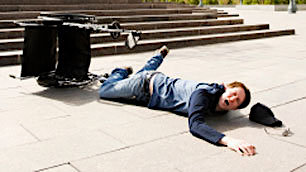
A highly inaccurate reenactment
Screaming and swearing, the woman, doughy and Weeble-shaped, tries to help him up, loses her balance, and falls on top of him, squishing the poor guy.
Get off me!
Goddmmit! Oh! Ack! Help!
The woman, brassy and braying, tries to get up and falls on her ass on the concrete. She is screaming and cussing. I try to help her up but she’s having none of it.
Oh! My knee! Aaaah!
Yadda yadda yadda.
She’s fine, a marvelous drama queen.
By now she’s really getting on my nerves, cussing and yelling at her supine companion whose head almost cracked open like a melon.
He, on the other hand, is calm and good-natured, with a crinkly sense of humor, even though he’s on his back on the concrete, knees in the air, tubes up his nostrils. He sort of looks like Hyman Roth in “The Godfather II” or Grandpa from “The Munsters,” except with a constellation of age spots across his olden face.
He asks me to place my foot under his head as a cushion and I do. It’s a ridiculous scene. She repeatedly swears she will sue the city. She takes a picture of the guy on his back. Don’t take a picture! he yells.
So I call 911 and the dispatcher keeps me on the line, asking a zillion questions about what’s happening, if the old man is on blood thinners (he is) and other questions I have no answers to. I can barely hear because the woman is screaming and swearing the whole time.
Can you call 911 for human obnoxiousness?
The aggrieved twosome looks — and acts — like a married couple, though she seems to be in her late 50s and he in his late 70s, early 80s. Daughter and father is more likely. Either way: a nightmare.
The EMS arrives apace, sirens wailing, lights twirling. Taking a final gander at the squabbling duo and circling medics, I saunter off, irritated, into the library. The guy is still on his back. She’s still squawking.
Eric Idle, one of the great Monty Pythonians, spoke in yesterday’s newspaper to say this: “I think I am an optimist by day and a pessimist by nighttime.”
I take this to mean that life’s workaday gunk, from headaches to the headlines, and the daily news cycle, that cataract of informational sewage, from Trump to pathologically unfit Supreme Court nominees, poisons him in a most unpleasant manner.
That he undergoes a sort of icky Dr. Jekyll/Mr. Hyde binary: By day he’s merry old Eric Idle (Jekyll), getting along hunky-dory, and by night, fangs sprout, thick hair unfurls on his hands and face, and his disposition waxes decidedly splenetic (Hyde).
Mr. Hyde, left, and Dr. Jekyll — same fella, different moods
For all that, Idle is evidently not a morning person. He says: “I can’t stand talking to people before lunch. I don’t think anybody civilized does.” (Hear, hear!)
I relate, to an extent. I am not a morning person. It takes a couple of hours, and at least one caffeinated elixir, for the early-hour crust to peel away, the nocturnal fog to burn off, my voice to clear from hoarsey to honeyed, my mood to shift from monosyllabic zombie to socially functional, with a possible grin if you’re really nice.
It’s like the transformation of the Wolf Man back to a regular bloke, while we’re trading in Universal Horror metaphors.
But Idle and I differ in that I am a pessimist by day and an optimist by night — polar opposites. I arise and experience the day as Hyde — hairy, harried — and then I cool off, wind down and digest the day’s doldrums and distress during the dark. I relax, anxiety dissipates, I operate in a less pressurized space, though I must say I miss Hyde’s chimpanzee orthodontics and senatorial eyebrows.
I rise in a murky mood. And, though it improves quite quickly, pessimism hovers over me during the daytime, an existential pall, a storm cloud poised to spit angsty, acid raindrops. I’m a little tense and the day’s news buffets me and only mixes me up more, stirs the pessimistic pot, which is really more like a cauldron, black and bubbly.
And then! The sun ducks, darkness falls like a stage curtain on the woozy light, and I slowly unwind. I once asked a therapist why this was — why my mood and my whole being gets, well, better at night. He had an answer that I cannot recall. It was some time ago. Bummer. I think it’s something about letting things go. Work is over. The night is yours. A splash of vino is poured. Fists unball.
I googled this phenomenon with imperfect results. All sorts of reportage about morning people vs. night owls popped up, but none of it addressed mood and state of mind, optimism vis-à-vis pessimism, focussing more on sleep habits, insomnia, and other folderol. There’s much about how some at night get droopy and others get galvanized, staying up later than the snoring household.
That’s not what I’m on about. It is noontime as I type this, warm, partly cloudy, just like me — warm and partly cloudy. Darkish thoughts percolate, I’m a little clenched, my forehead is a map of (mostly innocuous) worry. I am Mr. Hyde to Eric Idle’s enviable Dr. Jekyll.
But our roles will switch as the day progresses. Idle is slowly being filleted by life’s slings and arrows, so that by nighttime he will curdle with negativity. I’m already a wreck, lucky me. I’m Dracula (another Universal Horror allusion, you’re welcome), miserable in the sunlight, a goddam barrel of monkeys by night. We do what we can.
If you want to see a rat drink beer, click HERE. I’ll wait.
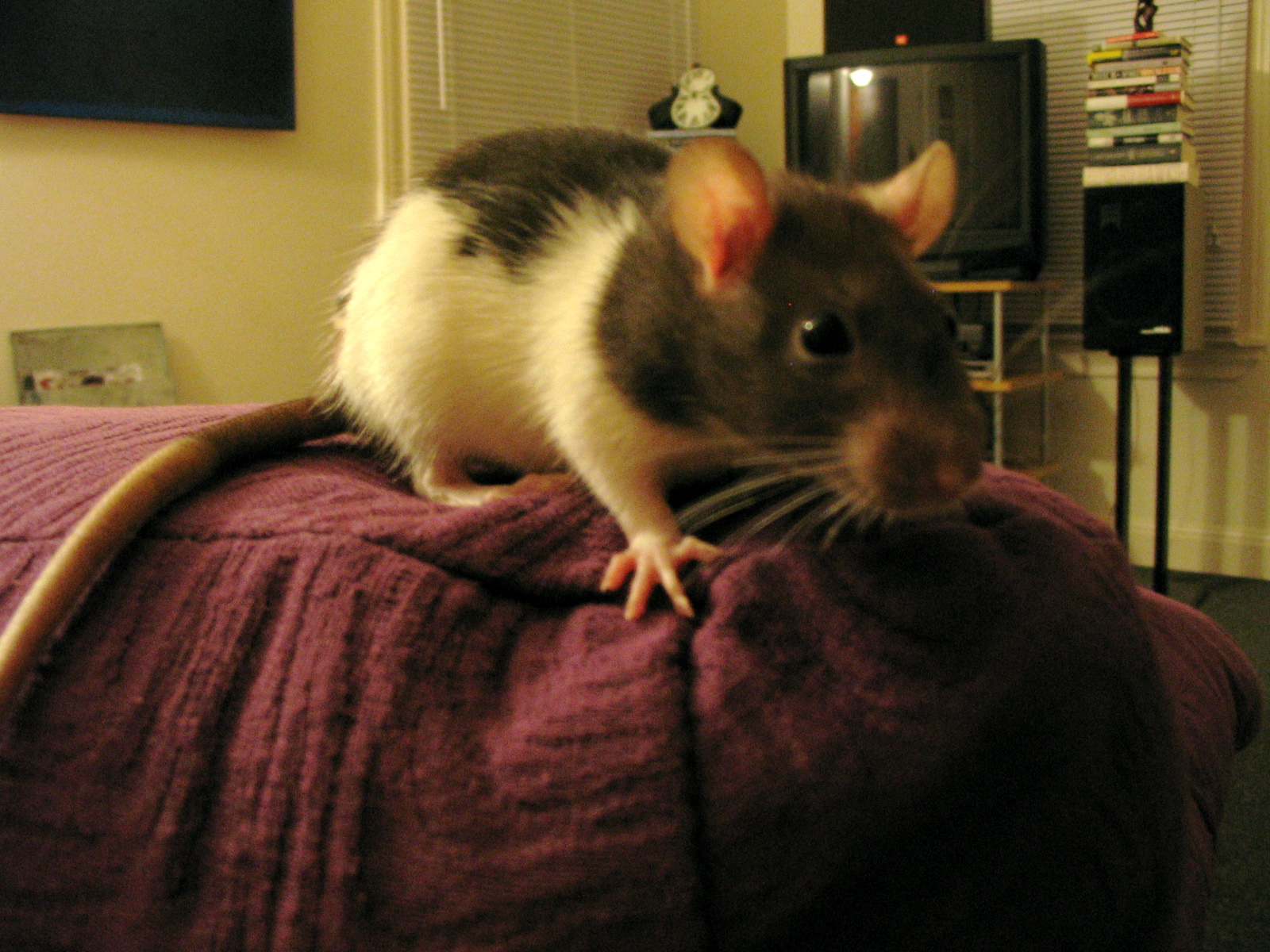
That’s Becky, my long-ago pet rat, whose both alarming and comical omnivorousness knew no bounds. Seriously: zero.
She’d chomp broccoli, rubber bands, towels, chickpeas, cheese, books, dog food, t-shirts, pizza, gecko lizards and crawly cockroaches. She’d guzzle wine and the above beer.
Becky shares pizza with a pal.
She once bit into a small tube of Super Glue. In a miraculous stroke, the glue was so old it had evaporated. The alternate results would have been grisly, even fatal, I’m certain.
But they are as smart, sweet, social, endlessly curious and affectionate as any animal, be it a dog, cat, piranha or wildebeest.
They play and wrestle, come when called, chill on your shoulder, build crafty nests from newspapers and less innocuous sources (like the fluffy guts of your sofa or that pricey box of Q-Tips), play fetch, groom with OCD avidity, swim, delight in belly rubs lying on their back, and so much more. Oh, and hoard. How they hoard. Hide all small valuables. (Becky stole my watch once. It took days to find.)
They’re like super pets that delight, entertain and nourish the heart and soul. As I’ve quoted in these pages before, rats are “cleaner than cats, smarter than dogs.” Whoever said that is just about spot-on and probably lives with a thousand rats and the authorities are onto him or her. A reality TV show is coming soon.
Becky going head-first into the glass, tippling a fine (cheap) cabernet.
Pets hold spiritual qualities with their power to elevate and expand one’s being. But, like dogs and cats, rats do it with a special, irresistible elan, magnetism and downright adorableness. Still, it’s different. For one, they don’t fart.
With their silky, curling pink paws (tiny starfish), twitching whiskers, itty-bitty tongue and translucent ears, gently nibbling buck teeth and enormous hearts, they’re lovable buggers.
Those thick wiry tails that whip around, made strictly for balance, are something else. The creatures squeak in pleasure and, science has proven, giggle like little girls. When treated right, Prozac they don’t need. (Though they’ll eat that as well.)
Like sharks, rats are exquisitely evolved specimens. Get this: They can collapse parts of their skeleton to squeeze under doors and through tight cracks. I’ve seen it. They are quicksilver with fur, superheroes with a super power, lacking only a cape and a ridiculous moniker.
Still life: Becky
An image I cannot shake: Becky drinking wine by dipping a paw in the liquid and licking the paw, like a cowboy drinking from the Rio Grande after days without water. (Her boozing was judiciously supervised — I only let her get a nice taste.)
And yet … well, rats will obliterate you. With a life-span of an average of two and a half years, they desert you far too quickly. They become your best friend and then, like a relationship gone bad, they end it, they vanish. They die. Usually it’s a respiratory disease or, more likely, cancer. It rips you to shreds.
Becky’s death was excruciating. I spent a lot of time and money on her, all of it beautifully worth it. Still, she had to go. She’s probably tearing up heaven, nibbling angel tunics, nesting in holy beards, gulping sacred wine. Being a worthy rat, not giving a crap.
All over Istanbul, they ramble and climb, pounce and shinny. These homeless street beasts tackle each other in play; hiss and strike in combat; scrounge and scavenge for the next meal. They barge into shops and curl up in chairs and beg for food at sidewalk cafes with various degrees of rough-hewn etiquette (claws, paws and purrs).
From the film “Kedi”
Most importantly, they insinuate themselves into the homes and hearts of many of this huge city’s denizens, soft souls who often regard the felines with an almost spiritual gravity, spurring the occasional display of soggy sagacity:
“Dogs think people are God, but cats don’t,” a cat-lover says in “Kedi,” a documentary about the thousands of stray cats of Istanbul. “Cats know that people act as middlemen to God’s will.”
I’m pretty sure I have no idea what that means.
“Kedi” (cat in Turkish, though it sounds a lot like kitty) is a well-received film from last year that lavishes the love — there’s not one hater in the whole picture, no one shooing away a cat with a broom — on Istanbul’s famed felines. It feels like a short film stretched taffy-like into a 79-minute feature that’s at once indulgent and superficial, while pleasant and lightly informative in an ingratiating PBS sort of way.
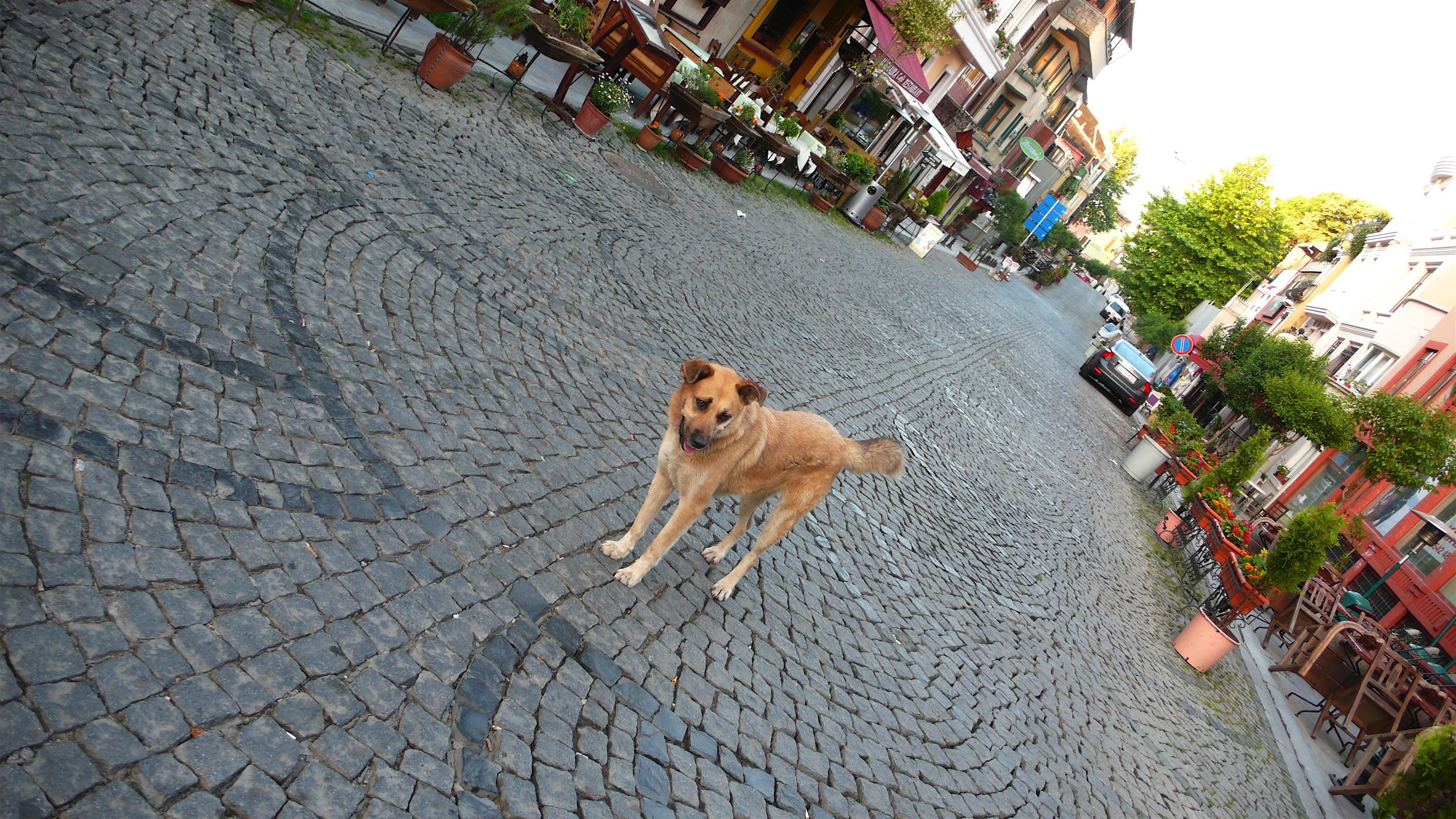
Someone in the movie declares the homeless kitties are the city’s soul, but on my few visits to Istanbul I saw far more stray dogs than cats. Like this winsome fella, who became my pal for nearly a month:
Istanbul, 2008
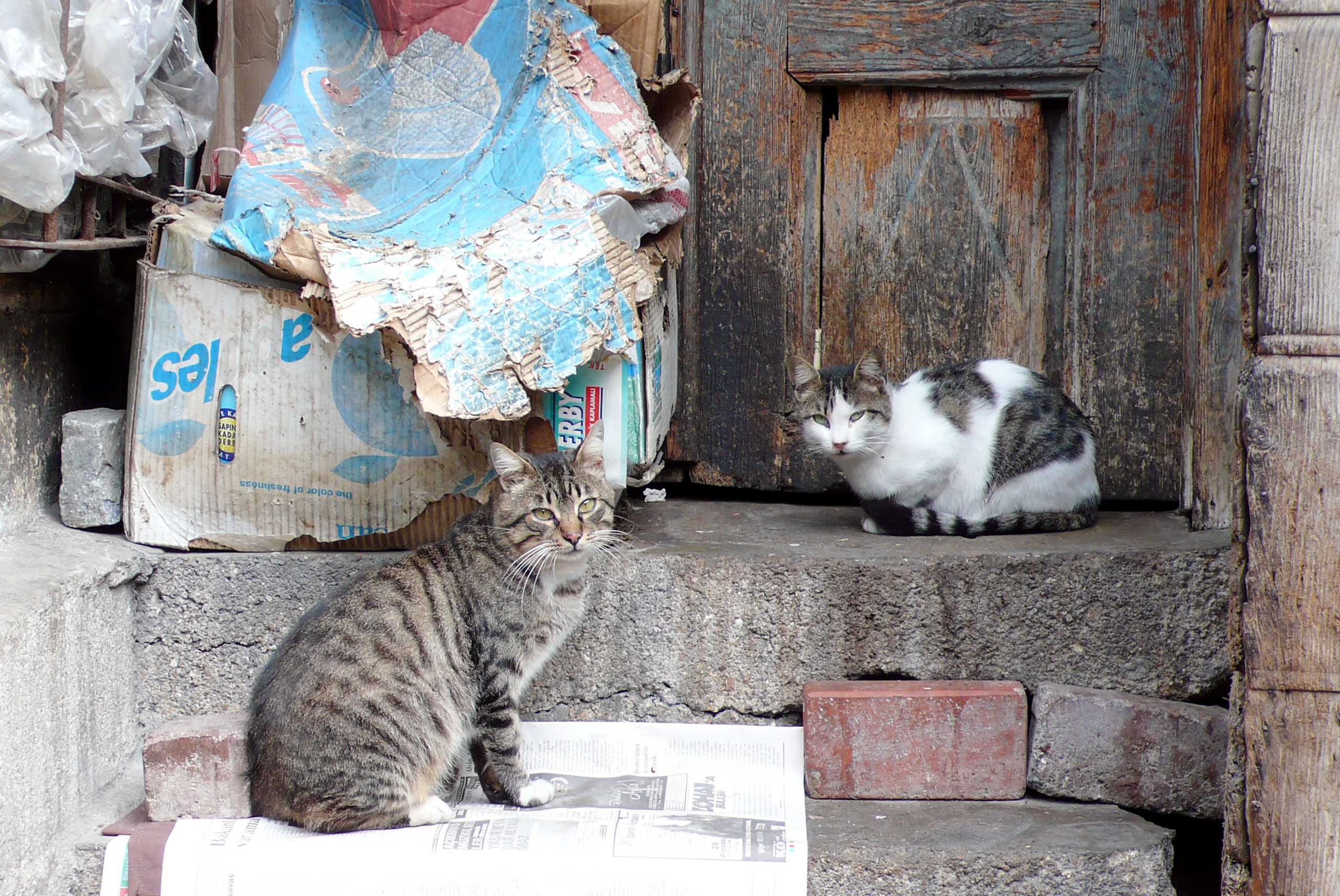
Still, I certainly saw many cats, such as this leery pair of scrappy, well-fed survivors:
Istanbul, 2008
In “Kedi” cats inhabit rooftops, cardboard boxes, markets, cemeteries, trees and awnings, and the film paints artful visions of the kitty stars, from Bergmanesque close-ups to whisker-level Steadicam action of running, jumping and chasing (mice beware).
The cats comprise a motley array, and I expect to see the kitty cavalcade when I return to Istanbul next month — toms, calicos, tortoiseshells, mamas nursing their babes, cats with patterns like a painter’s palette, or, one of the stars of “Kedi,” a female hellion dubbed “the neighborhood psychopath.”
From the film “Kedi”
Inevitably, kitty characters and personalities emerge, inescapably anthropomorphized. “It’s so fascinating,” says a simpatico fishmonger of the cats who not so mysteriously follow him around. “They’re just like people.”
We have two cats. They’re just like people: indifferent, solitary, narcissistic, wise, wily, incessantly hungry, jerks.
Yet in “Kedi” the humans are like grandparents who spoil their charges. A shopkeeper compares a kitty comrade to one of his children as he brushes her fur while she looks off into heavenly ecstasy. Another man compares the company of cats to the soul-soothing power of prayer beads.
Our cats provide the soul-soothing power of pooping, crotch-licking gremlins.
Taking care of these furry street urchins is, they say, their duty. They are cat custodians, and for many of them the animals supply a divine connection that is healing, curative and therapeutic.
How is this possible? one may ask. Cats purr and meow, but are otherwise as mute and inscrutable as the Sphinx. They scamper off a lot for no damn reason.
“I imagine having a relationship with cats must be a lot like being friends with aliens,” muses a dreadlocked woman in the film. “You make contact with a very different life form, open a line of communication with one another, and start a dialogue.”
As someone who talks to the animals, from cats to rats, I love that.
(“Kedi” stuff, including trailers, can be seen here.)






 I haven’t used my new bag yet — I will next week when I return to Turkey — but







 GNASHING.