Defending the unsung thrill of ‘Miami Vice’

It came on TV, caught my eye, and had me entranced all over again. 

Michael Mann’s virtuoso 2006 crime drama “Miami Vice,” streaming on Netflix, will hook you hard — that is, if you connect with the under-appreciated film. I do — I gave it four stars in my original review in a large daily newspaper — and I stand by it, despite a host of haters who can’t see masterly filmmaking for Colin Farrell’s facial stubble.

So I come to defend “Miami Vice.” Major publications — Rolling Stone, Entertainment Weekly, The Boston Globe, Variety — praised the film, with New York Times critic Manohla Dargis calling it “glorious entertainment” and extolling its cutting-edge digital camerawork. Still, unaccountably, the movie holds only a 45% rating at Rotten Tomatoes. Insanity.

At the end of 2009, the critics of Time Out New York chose “Miami Vice” as #35 of the 50 best films of the decade. That’s great, but I would place it higher than that. 

miami-vice-featured.jpg

It’s now something of a cult film, especially among younger critics and filmmakers. Harmony Korine notes how much it influenced his riotously outré “Spring Breakers.” One critic wisely said the film is a visual meditation on “failure and futility” and — I love this — “one of the most expensive art films ever made.”

Another critic, perhaps more to the point, wrote that the movie “has just laid the foundations for a new order of action films.” Indeed. 

This is my rave review from July 2006, a rebuke to the benighted:

Awash in the blacks and blues of a fresh bruise, Michael Mann’s “Miami Vice” plays hard and mean to thrilling, often harrowing effect. Mann, who was an executive producer of the influential 1980s television series on which the movie is ever-so-loosely based, obliterates the glib sunshine and pastel glamour of the show to forge a dark, frighteningly real universe of undercover law enforcement and globalized crime. 

It delivers what no other movie this summer has or likely will: the pure pleasure of watching an intricate, perfectly calibrated machine kick, shoot and crank with dazzling power and efficiency.

That might sound heady for a movie called “Miami Vice,” a title that instantly evokes Reagan-era gilt and South Beach deco. Don Johnson in a white linen blazer/pink T-shirt ensemble and an equally suave Philip Michael Thomas amid a backdrop of neon, glass bricks and palm trees — those soft-rock memories should be dispensed with. Instead, brace for an unflinching contemporary crime drama that makes no concessions to pop nostalgia or mocking remakes such as the no-brow “Starsky and Hutch.”

People forget that TV’s “Miami Vice” was more than its stylish, trend-making veneer, but a crack cop drama presenting sophisticated criminal situations through intelligent, movie-worthy writing that delved deep into character and emotion. Mann takes that as his springboard for a surprisingly emotional character-driven thriller that takes itself so seriously, there’s hardly a smile in the two-hour-plus epic.

51BH2nHmp+L._SX355_.jpg

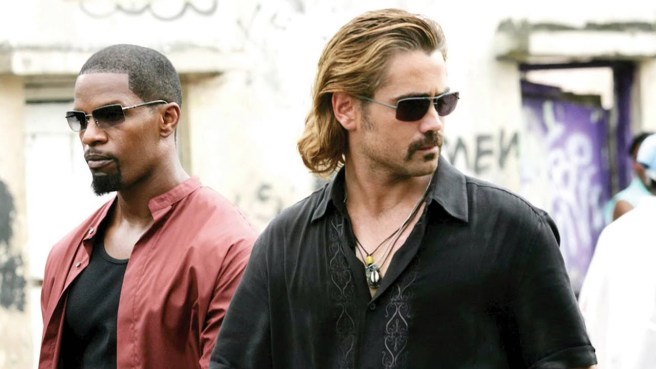
While the plot is as rudimentary as a “Miami Vice” TV episode — vice cops Sonny Crockett (Colin Farrell) and Ricardo Tubbs (Jamie Foxx) go undercover for the FBI to unravel a multi-tentacled, international drug ring — Mann laces it with the themes and macho philosophy he’s so obsessively explored in similarly expert crime pictures “Manhunter,” “Thief,” “Heat” and “Collateral.” 

His heroes are really antiheroes who dwell in the shadows of film noir, be it James Caan’s riven criminal in “Thief,” Tom Cruise’s solitary hitman in “Collateral” or a superb Farrell as an undercover agent who drifts dangerously over the line.

The complicated loner wavering between right and wrong — the blurring of human duality — fascinates Mann and has always been his subject. These men (Mann’s is a fiercely male-centric universe) are vessels for ideas and themes about choosing a way of life and pursuing it with as much iron-willed integrity the world will allow.

This is the loner’s existential struggle, which he carries out with a heavy heart and pensive mind. Working in either crime or law, he’s acutely aware of his mortality and life’s cruel vagaries. “Time is luck,” Farrell tells the woman (Gong Li) he falls in love with, as her life skids out. The same line is said in “Manhunter” — “Time is luck. I know the value of our days” — as well as “Heat,” when Robert De Niro’s career thief muses, “I know life is short, whatever time you get is luck.” (Sharp-eared Mann fans might also notice the reuse in “Vice” of the nicknames “sport,” from “Manhunter,” and “slick,” from “Heat.”)

Helicopters slash the skyline and power boats knife the ocean. High-tech surveillance gadgets crackle and heavy artillery blasts. Within the dizzying action and disorienting nation-hopping, a whip-fast Foxx and a brooding Farrell, who smolders with long, Johnsonesque hair and unchecked stubble, stand sturdy.

The actors’ chemistry is sufficient and both men cut intense, sympathetic figures, whether they are taking down scum — the movie crawls with furry creeps and bald thugs — or making passionate love to their women. Mann’s lingering depictions of sex are the epitome of adult intimacy rarely seen in a Hollywood film.
maxresdefault.jpg

There’s not a dud in the superlative cast: Li’s flinty fatale, Naomie Harris as Foxx’s cop girlfriend, John Ortiz as the drug middleman and Luis Tosar as the drug kingpin. Mann’s dialogue, funny and profane, has a hard, urban pop, and the soundtrack ripples with interesting choices, from spare electric guitar and moody synthesizers to songs by Moby and Audioslave.

How “Miami Vice” is put together is as compelling as the story and characters. A notorious perfectionist, Mann demands technical verisimilitude, nailing the intricacies of how criminals and cops think and operate, down to their clothes, words and twitches.

He and cinematographer Dion Beebe return to the handheld high-definition video they used in “Collateral,” bringing a grainy, documentary vibe to the action that’s unnerving. It’s non-style taken to high style, soaked in ocean blues and inky nocturnal blacks. There’s not a wasted shot.

Since 1995’s “Heat,” Mann has been our greatest living action-crime director, edging ahead of past giants Sidney Lumet, William Friedkin and John Frankenheimer. The technical bravura and artistic depth Mann brings to his films staggers. He respects his craft and his audience. “I ain’t playin’!” blurts a character in “Vice.” Neither is Mann.

A few things revving me up

I’m having a tricky time getting jazzed about too much lately — only Socrates rivals my sage discernment and penetrating taste — yet I am alive, blood sluices through my veins. Some things I’m digging:

dia-beacon
Richard Serra sculptures at Dia: Beacon, New York

Caustically hilarious British TV series “Fleabag”; Sigrid Nunez’s quietly affecting novel “The Friend”; the reliably stirring Dia: Beacon museum, so serenely cluttered with minimalist and sculptural masterworks; poetic Polish romance (and Oscar nominee) “Cold War”; and Weezer’s “Teal Album,” featuring frighteningly faithful covers of Toto’s “Africa” to Black Sabbath’s “Paranoid” and Michael Jackson’s “Beat It.” It’s a gas.

Mostly this entry is a sequel to my December year-end inventory of now-time enthusiasms, stuff getting my juices flowing. These are the current tops:

  • Jade Bird

Strumming an acoustic guitar, her long hair swinging, she sings in a hushed girlish voice before belting like a banshee, loosing a squall of blazing catharsis. She has pipes that purr, then roar, then come back. You sway to twangy folk, then rock with giddy fury. 

Intimate and Velcro-sticky, Bird’s music, performed acoustically or with a small band, circles Americana, punk and soulful indie pop. Country fans are drawn by her evocations of rocky, star-crossed relationships, and there’s country crunch in those folk-rock vocals. Her galloping cover of Johnny Cash’s “I’ve Been Everywhere” is a jam-session joy.

hbz-jade-bird-index-1535023013.png

In this 21-year-old Brit, the Dixie Chicks are at their fiercest, alongside a banging Liz Phair, Courtney Barnett, PJ Harvey and other steely indie royalty. Bird’s lyrics pop and sear. In the unreasonably rousing “I Get No Joy,” Bird sings with such speedy agility, she’s almost rapping:

“Psychotic, hypnotic, erotic, which box is your thing?/How many days a week, do you feel/Electric, connected, unexpectedly/Affected, what do you need?”

It’s a kind of sublime whiplash.

(Watch her HERE.)


  • “Capernaum”

His hair is a fluffy fiasco, a brown brushfire, his splotched face the seasoned mug of a gang member. He’s filthy and swears like a sailor. He’s homeless. He’s 12. 

In Nadine Labaki’s Beirut-set stunner, a nominee for the best foreign language Oscar, the boy, Zain, is a resourceful renegade in the scrappy mold of Huck Finn and Antoine Doinel in “The 400 Blows.” Fed up with his struggling parents and their feckless care of their many children, Zain takes them to court, accusing them of the crime of giving him life. It’s a preposterous idea, a satirical glance at the Lebanese judicial system.

181210-winkelman-capernaum-review-tease_exy4at.jpeg

Zain (the extraordinary Zain al Rafeea) fast becomes a tough street urchin who finds a gig babysitting the gurgling infant of an illegal Ethiopian refugee, played by Yordanos Shiferaw. (The film’s devastating cast of non-professionals play versions of themselves.) When the young mother is arrested, Zain is stuck taking care of the baby on his own. In this harrowing situation — the movie is a tart indictment of Beirut’s corrupt state of child welfare — the fathomless despair can be unbearable to watch.

“Capernaum” — the title means “chaos” — owes much to the children-centric neorealism of ‘80s and ‘90s Iranian cinema, from “The White Balloon” to “The Color of Paradise” — heart-renders told in raw, wrenching lyricism that aren’t without political undercurrents. It’s a street tale alive with miscreants and thieves and few kind gestures. It’s so gritty and grubby the camera lens almost seems smudged. Redemption, however, is in the air.

(Trailer HERE.)


  •  “Asymmetry”

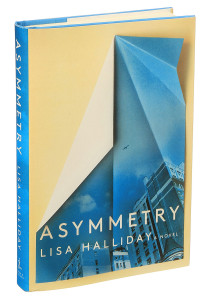
Beautifully written, radiantly spun and shot through with smashing intelligence, Lisa Halliday’s first novel “Asymmetry” bristles with humanity as it mingles conventional and unorthodox structures. It’s a literary feat kneading the fictional form like Play-Doh.

I’m only a third of the way through its brisk 271 pages, but I’m sold. (Being part-way in a book you’re relishing is where you want to be; there’s more on the way to savor.)

07bookhalliday2-superjumbo.jpg

The novel is chopped into three sections. I finished the first section, “Folly,” which traces the May-December romance between Alice, a 25-year-old aspiring writer, and Ezra Blazer, a famous author 40 years her senior. (If he rather resembles Philip Roth, it’s not chance: Halliday had a relationship with Roth while in her twenties.)

And so we get an old-fashioned affair of unpushy comedy and sweet asides set amidst Upper West Side means, with tender banter and the not uncomplicated theme of apprenticeship, much like a Woody Allen movie, without the deep-dish neuroses.

Alice has career issues, Ezra has health issues, and brewing in the background is the launch of the Iraq War. (The war plays a prominent role in the next section, “Madness.”) In this, one of The New York Times’ 10 best books of 2018 (and a favorite of Barack Obama), Halliday doesn’t flinch from the vagaries of love, including the sort, like Woody’s, peppered with literary chatter and throbbing with aching uncertainty.

The dialogue is unfailingly smart, wry, just right. Alice and Ezra conduct short, gem-cut conversations that bring a knowing grin:

“Is this relationship a little bit heartbreaking?” he said.

The glare off the harbor hurt her eyes. “I don’t think so. Maybe around the edges.”


  • “United Skates” 

In urban roller rinks across the country thousands of African-American roller-skaters are lacing up and getting down. Beneath rays of twirling disco balls an underground roller renaissance thrives among a force of skate buffs who throw after-dark rink parties and commit kinetic art on waxed wood floors: backflips and break-dances, tag-team acrobatics, backwards trains and other daredevilry. Many revelers simply trace ovoid loops in a kind of roller-boogie bliss.

With new and archival footage, much of it contagiously groovy, “United Skates” directors Dyana Winkler and Tina Brown chronicle the hip-hop-fueled scene with at once bracing and brooding electricity. They hopscotch the nation — Los Angeles to Baltimore — and capture the community-building soul of skating as well as the heartrending gentrification that’s swiftly shutting down classic rinks, dinosaurs of the ‘70s and ‘80s. Few will survive.

merlin_147232281_f4784760-d08e-4e67-b827-dda2964987c2-jumbo.jpg

Next to dwindling skate spaces, the film locates other troubles: the apparent profiling of black skaters at certain rinks that ban rap and the skinny wheels many black skaters prefer. When skaters organize “adult nights” — “Code for ‘black night,’” says one — police fill the parking lots and security is thick. No such hysterics are apparent on a typical “white” night. It’s a familiar microcosm of current race relations.

Yet the party rolls on. The subculture retains a die-hard exuberance not easily snuffed. The film’s final scenes are far from elegiac; against all odds they are tonically celebratory.

(Starting Feb. 18 on HBOTrailer HERE.)

Super Bowl? Super bored

It’s weird that I even know who’s playing in the Super Bowl this Sunday. Usually I’m hard-pressed to name the teams because frankly and emphatically I really, truly, rabidly don’t care. But, sure, Sunday’s face-off between the Cowboys and Dolphins should be something super neat-o. 

Yeah, I’m a riot — Rams vs. the Patriots, there we have it. And how that means absolutely nothing to me. Zip. It’s a gaping vacuum in my personal cosmos, a shrieking black hole of wild indifference. I won’t eat wings on Super Bowl Sunday. I won’t watch the inane commercials. Half-time band Maroon 5 makes me alternately apoplectic and very sad.  

i-dont-hate-your-team-i-hate-all-sports-4d65e.png

My antipathy to sports is long and legion. They never spoke to me — or is that grunted to me. I think of atavistic grunting when I think of sports, chiefly team sports, for which I reserve the most distaste.

Grunting, yelling and grab-ass — the team sports post-play repertoire. Players, those self-adulating egoists, shoot arms in Nixonian salutes, teeth bared. They thump their chests and leap onto the nearest teammate, bonking helmeted heads together. This is raw joy. Twisted, but still something recognizable as euphoria.

It’s a glee I do not share. I don’t care about that game-winning grand slam, swan-diving touchdown, three-point swoosh. Still, I am not wholly unmoved by athletic grace and skill. I know it when I see it, and I am often impressed. 

For instance, I recognize the poetry in a goal by Cristiano Ronaldo, a breathtaking feat of mathematical precision and almost tearjerking eloquence. I get it. I gasp.   

While athletics aren’t in my DNA, I enjoy the Olympics and I thrill watching individual competitors — track stars, skiers, surfers, gymnasts, cyclists — going for it, fueled by sheer will, determination and transcendent talent. 

6255307966_508f7e98d1_b

Though never a jock — I was more into rock — I played soccer for years, if pretty reluctantly. I kicked that habit for BMX and snow skiing — individual athletic expressions of reckless speed and airborne glory. Granted, I wasn’t terrific at either sport, but I had a blast. 

I’ve quoted author Roxane Gay before on this subject, and do so again: “As a child, I was uninterested in becoming athletic. I was not a team player. I was a dreamer, something of an oddball loner. I wanted to spend all my time with books.”

That was me. 

Bizarrely but not surprisingly, some sports fans can’t resist equating coming out as a non-fan to coming out out. “Gay” someone wrote on an online message board in response to a man who admitted he didn’t like sports. 

“Are you sure you’re a guy? When was the last time you checked?” wrote another genius. (Tony Hollowell’s book “I Have a Penis and I Hate Sports” is a rejoinder to such nincompoopery.)

This is what we’re dealing with. Homophobic taunts and pea-brained putdowns. Guys must love sports or they’re not entirely manly. Their virility is at stake. The jerry-rigged logic of that racks one’s head like blunt trauma.

Which brings me to what I really abhor about sports, besides the crushing tedium of the actual games: the fans and the culture. Yelling, all that yelling. The militaristic crowds that smack of the obscenely coarse rallies of a particular world leader. The mob mentality and animalistic tribalism that fosters brute behavior, not excluding the rare deadly riot. 

UGH.jpg

And the yelling. The endless yelling.

A level-headed sports fanatic wrote online why he thinks some people hate sports: “Sports tend to create a very superficial culture. Athletes are popular for primarily their athletic abilities, not necessarily for their philanthropy, intelligence, personality, or any number of gauges we tend to look for in friends or other role models.”

That’s pretty perspicacious coming from a fan, and I agree with almost all of it. 

Not being a fan is like being excluded from a humungously happening party, and it’s not always the most comfortable spot to be in. It’s akin to not liking “Titanic” or “Avatar” (I find both movies laughably bad) — you become the party-pooper, the hater, the other.

But that’s OK. As long as I don’t have to watch those movies again — or sit through Sunday’s interminable football game, that gigantic neon advertisement for numbskull primitivism and frenzied jingoism — I’ll be fine.

I’m not eavesdropping, really …

Recently here I chatted up the new local cafe, the exquisitely hip, I’ve-been-to-India, dump-Trump joint with the jaunty name. I decided to pop into the other local cafe, that name-brand one that just reopened after long renovation. I’m there now — I write in cafes often, a living cliché — and I’m people-watching with a touch of eavesdropping. It’s not at all creepy.

I see a poised, pert, put-together brunette chirping quietly with her friend — hale, happy twentysomethings talking about job interviews and uproarious Facebook posts. She looks like she loves dinner parties and charades. She fancies a good daiquiri. Her favorite TV show is “This Is Us.” I’m just surmising, but I know I’m right.

18187449
A hypothetical cafe scene. They look ecstatic.

Elsewhere overheard: “You know, Mary, I’m not comfortable making those calls.” 

Enter: a 60-ish gent in a baggy Bill Cosby sweater, with stubble that looks like powdered sugar sprinkled on his pink pate. “I begin my teaching tomorrow. Seventy students!” he tells his companion, a flute-thin young woman with lank auburn hair who, I’m certain, is a teacher’s assistant. 

The fellow is loud and a roaring bore. He gesticulates like a madman. She sips some coffee and it goes down the wrong pipe. The ensuing coughing fit is something to behold. Napkins fly. We sympathize.

“We’re getting off track here,” an elderly woman laughs. She’s talking to a slightly younger woman at a corner table about scheduling some sort of meeting at her home. “Should we do RSVPs?” the younger woman asks. 

I soon gather they’re organizing a book club. They are perusing a list of titles. The younger woman describes a book that’s “very well-written” that sounds like a kind of real estate thriller. The authors Andre Dubus III and Michael Frayn (“He’s British”) are mentioned. “The person who selects the book is the host of the meeting,” says the younger woman.

06booknunez2-print-articlelarge-v2

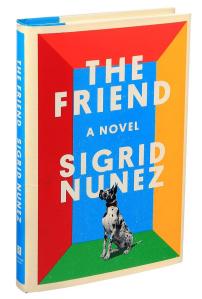
I want to chime in and suggest the novel I just finished, “The Friend,” Sigrid Nunez’s brisk, deceptively simple yet profound meditation on the writer’s life and friendships between people and dogs and people and people. It won the 2018 National Book Award. It’s lovely.

I pick the book. I’ll be the host. I’ll serve baked Alaska.

Someone just said “hypothesize” in mixed company. 

I ask the barista what she’s reading these days — we often yack about books — and she flashes her copy of the novel “The Secret History,” Donna Tartt’s 1991 cult smash. I kind of wrinkle my nose while evincing interest, and tell her I tried and failed to read Tartt’s 2014 Pulitzer-winning epic “The Goldfinch.” I read about half and put it down. The novel is divisive: You love it or loathe it.

She adores it. “What didn’t you like about it?” she asks. I thought it was cutesy, candied, implausible, whimsical and too redolent of Dickens. 

“It is Dickensian,” the barista says, and with that simple word my day is made.

Elephant adoption — it’s a real thing. Two ladies are talking about it. One explains that it costs $50 a year to adopt an African pachyderm and “each month they email you a picture and an update about your elephant.” She has an elephant. “I went to visit the orphanage in Nairobi,” she says. I suddenly want an elephant. 

“It’s my parents’ 43rd anniversary,” a 30-ish guy tells his friend. “That’s a long time to be sniffin’ someone else’s toots.” 

I missed most of the soliloquy, but a youngish man was rhapsodizing about coffee and espresso and the joys of sitting on his porch, and out of his mouth popped this phrase: “the waking beauty of life.”

Spectacular.

She’s depraved, debauched, despicable — and so lovable

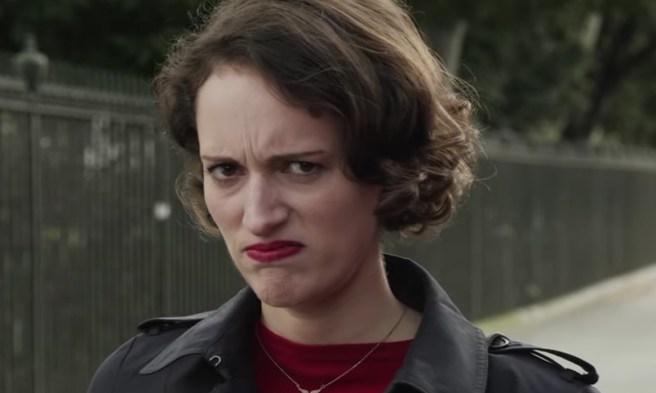
One of the piquant pleasures of the British TV comedy series “Fleabag” is how its protagonist, played by Phoebe Waller-Bridge, insistently pokes through the fourth wall with the impish gall and smug impetuosity of a naughty little girl. She winks, crinkles her nose, smirks, grimaces, makes snide comments, all of it right at the camera, meaning right at us.  

She wants us to be a part of her latest escapade, her latest squirmy moment, lest this young woman has to go it alone in her flailing, full-frontally narcissistic existence. As she says in the first episode, she has “a horrible feeling” she’s “a greedy, perverted, selfish, apathetic, cynical, depraved, morally bankrupt woman who can’t even call herself a feminist.”

Well. Now. Really. She’s not that bad. How could we love her so much, empathize with her so fully, if she was such a steaming heap of debasement? Even her self-anointed sobriquet, Fleabag, is more fitting for a scuzzy homeless tramp than the bitingly charming London cafe owner she is.

hero-landscape-screen-shot-2016-08-10-at-1.30.10-pm.jpeg
Fleabag (Phoebe Waller-Bridge), breaking the fourth wall with an uneasy reaction to the audience

Season one of Fleabag,” which premiered in 2016, is streaming on Amazon, with season two on the way. From online posts, viewers either adore or abhor Waller-Bridge’s character, which she created from her play of the same name. (Waller-Bridge stars in and writes all of the TV episodes.) “Hate the protagonist … She has no redeeming qualities and is totally unlikeable,” someone groused, and that’s enough of that.

So she’s divisive. Aren’t some of the most interesting women multifaceted? Don’t they chafe while they charm, pepper smarm with snark, own a bit of Mother Teresa mixed with, say, Sarah Silverman? “Fleabag may seem oversexed, emotionally unfiltered and self-obsessed, but that’s just the tip of the iceberg,” say notes from the “Fleabag” play.

With her floppy pageboy fit for a ’30s Hollywood starlet, natty outfits and Skittles-red lipstick, our anti-heroine exudes a glamor incongruous to her unsavory descriptives. Though she’s too surly to be screwball, she often recalls the great comedians of yore with kaleidoscopic facial expressions that match her shifting moods. Waller-Bridge plays light and dark with equal dexterity. She is a scintillating performer.

Fleabag has been called “an angry, confused young woman attempting to navigate life in London,” which is about right. Yet you can’t ignore her Olympian sex life, a tragicomic pastime that ends as these things do, with a droplet of satisfaction and a river of rue. 

With a rich, unsmiling sister, a fun, like-minded bestie and a mostly off-again boyfriend, Fleabag, who’s on the cusp of 30, is still working things out. She’s painted as a classic self-absorbed millennial, playing the field and playing out with scant regard for the collateral damage. Ever-so slowly we watch her crumble, perhaps implode. The show slyly builds to a dramatic pitch that’s truly poignant and confirms that there is little superficial about it.

“Fleabag” is TV’s best comedy, better than my other tops: the cinematic if shrilly hyperactive “The Marvelous Mrs. Maisel,” the near-perfect “Catastrophe,” the wry, wondrous “SMILF” and madly inventive “Atlanta.” (“High Maintenance” — you’ve slipped.) 

Super news: Waller-Bridge is bringing the stage version of “Fleabag” to the SoHo Playhouse in New York City for five weeks, Feb. 28 through April 7. Waller-Bridge wrote and stars, and I have a ticket.

As a one-woman show, she’ll be addressing the audience face-to-face, the fourth wall totally disassembled, the rubble kicked to the side. It should be tartly hilarious, cheeky and racy, and fantastically uncomfortable — just like the staggering series. 

7b045bb13ae2a10aa08920dc1cc35f25_750x600.jpg

McConaughey, the mensch

Meeting celebrities is easy. Interviewing them is a breeze. They are generally polished to a professional sheen. They know how to play the game, which is patently transactional. Some are harder than others (I’m squinting at you, Paul Thomas Anderson). Matthew McConaughey? He’s a cinch.

A good ol’ boy from East Texas, with a boingy twang, squinchy blue eyes, and bounding with bonhomie, McConaughey is much like what he seems: a smart, friendly dude you might want to shoot a shot with. He’s a charismatic lava lamp, alive and aglow.

To a journalist like me in 1998 — young, a smidge green — he was the most caring, amicable guy around. I was having a face-to-face interview with the actor in a Beverly Hills hotel room during a junket for “The Newton Boys,” Richard Linkater’s ill-fated western-comedy. A Texas guy, McConaughey was fascinated that I’d recently relocated from California to Austin for a newspaper job as a film critic. 

MM-e1521147029111.jpg

He seemed genuinely interested, and we talked all things Austin and Texas, acting and movies. And from the room balcony he pointed out the groovy ‘70s-style van in the parking lot that he was driving cross-country for the hell of it. He was 27. We bonded enough that he’d remember me for years afterward. 

Like when he was walking the red carpet at the premiere of his 1999 comedy “Edtv” and he spotted me, grabbed my hand, pulled me aside and asked me how I was enjoying my new Texas hometown. He was sincere and serious, with laser eye-contact, shutting out the bustle around him. Then he smiled wide, cheeks caving into dimples, before moving on down the line. 

He didn’t have to do that. He could have said hi, answered my softball questions and walked on. But he was cool, concerned, a gentleman. He had class. 

Months later, when I ran into him at a Wendy’s on the University of Texas campus before a rare screening of Vincente Minnelli’s 1958 “Some Came Running,” McConaughey seemed a little out of his element, a tad awkward, though he still made a point of making me feel welcome and an equal. He spoke in a hushed drawl. He barely smiled. He kept things low-key. I introduced him to my girlfriend. He bought a large Coke. He sat in the middle row, we sat in the back.

The relationship between journalist and subject/source is a dicey one. They are rarely seamless. There’s a give and take, a perilous reciprocity that often leaves one party feeling burned. And so there’s this:

McConaughey was working the red carpet for the local premiere of Kevin Costner’s 1999 baseball melodrama “For the Love of the Game” at UT. He was beaming, strutting out of a black limo, in all white and all alone.  

He isn’t in the movie, he was just a celeb guest at the gala. And he was chomping a hunk of gum like cud. He approached me affably, answered two questions, then sauntered into the auditorium, chased by hearty cheers. 

I report details. I like what’s called “color” in my stories. So in my piece about the screening I prefaced McConaughey’s quotes with: “He was conspicuously chewing a huge wad of gum.” Readers want to know each iota of their beloved celebrities’ behavior. This, I thought, was a telling detail — innocuous but revealing. Or so I thought.

TightInfantileBalloonfish-poster
Matthew, gum, chew.

In 2003, four years after this gum-chewing reportage, the Austin Film Society threw a 10-year anniversary bash for the release of Richard Linklater’s coming-of-age masterwork “Dazed and Confused,” which was made in Austin and co-starred a cocky, hilarious young newcomer named Matthew McConaughey. 

A red carpet press-line was formed. Here comes McConaughey, who I haven’t seen in four years. He is arm-in-arm with two young women, and chewing gum. I hurl him a question. He stops on a dime before me, and says, pointing to his mouth, “Tell them that I was ‘conspicuously chewing a huge wad of gum,’ you got that?” Dimples flashed, this time with a shit-eating grin, and he brusquely walked away with an up-yours swagger. 

Perhaps, just maybe, I had pissed him off.

Forward five years, to 2008. I hadn’t seen People Magazine’s Sexiest Man Alive (2005) since the “Dazed and Confused” screening and I was a little nervous as I was scheduled to interview him for the micro-indie comedy “Surfer, Dude” in Austin.  

He was there, in shorts and sandals, hair mussed and shaggy, mood ebullient. He greeted me with glowing teeth and cavernous dimples. He was almost ecstatic. He loved this movie. He was back. 

rgz chris sufer dude08.jpg
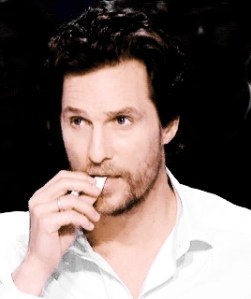
McConaughey during our “Surfer, Dude” interview

At the end of a very friendly chat, I screwed up the nerve to ask him about that day when he repeated back to me, “Tell them that I was ‘conspicuously chewing a huge wad of gum,’ you got that?”

He laughed heartily. “I didn’t like the use of the adverb ‘conspicuously,’” he told me, practically slapping my knee. “If you hadn’t used that word I wouldn’t have cared!” He was over it. We cracked up.

The intricate dance of writer and subject is a fragile one. Like that, it can topple in misunderstanding. It can snap on the perceived power of one simple word. But people, even movie stars with eggshell egos, are resilient, forgiving and, sometimes, like McConaughey, true mensches.

A transcendent dogumentary

They scramble and scrabble, bark and bound, nap and nuzzle, making an indelible imprint on their human pack leaders whose love for canines is crazily uncontainable.

Photos: Netflix

“Dogs,” a terrific six-part anthology series on Netflix, lushly shot by a squad of bravura documentarians (Glen Zipper, Oscar-nominated Amy Berg, et al.) , is a frank and unadorned look at the relationship between man and mutt. Heartrending and heartwarming, little is forced or pushily sentimental. Episodes provide spectacularly detailed snapshots of person, place and pup, and you strangely come away with a broader comprehension of life itself. Which makes the series certified art. 

Emotions organically erupt from an array of situations, be it a Labradoodle service dog that detects seizures in its epileptic owner with whooping barks; an imperiled Syrian war refugee that happens to be a yowling Siberian Husky; an aging golden Lab in a quaint Italian fishing village that dutifully follows his master onto Lake Como where they drift together; the fabulously groomed pooches of Japan and the uncharted culture of competitive grooming; a sanctuary in Costa Rica that’s home to 1,200 free-range strays; or New York City’s exploding rescue-dog phenomenon.

Each textured 50-minute portrait is framed within the big picture of the humans’ lives, from political to familial, together with the dogs’ often precarious realities. Funny, galvanizing, sad, uplifting and even spiritual, “Dogs” shows how beautifully symbiotic the two entities, hound and human, truly are.

Watch the “Dogs” trailer HERE.

Five irritants that shouldn’t irritate. But do.

1.  The copout final shot in the Chloë Grace Moretz LGBTQ drama “The Miseducation of Cameron Post.” Without resolving anything dramatically, director-writer Desiree Akhavan avoids the hard work of crafting an actual ending, letting her and her characters off the hook by sticking them in the back of a pick-up truck to literally drive off into the sunset, then: fade to black. Such open-ended fade-outs — what will happen to our beloved heroes? — are not only lazy but a rancid cliché of undercooked indie filmdom. (Wait. Was I supposed to say: Spoiler alert!)

miseducationofcameronpost.jpg

2.  The local wallpaper-tattooed hippie-hipster barista who, when asked how he’s doing, invariably replies, “Livin’ the dream!” (Spoken in a groovy Jeff Spicoli cadence.)

3.  Pro sports. I have no stomach for fans’ foaming-at-the-mouth, chest-thumping, near-nationalistic posturing, the players’ obscene paydays, the blanket machismo and braggadocio, the snarling, whooping competitiveness. It’s a gross, alien world that, save the occasional semi-civilized soccer match, I find revolting. Any artistry is sheer brute. I’m a bit like author Roxane Gay: “As a child, I was awkward, unathletic and uninterested in becoming athletic. I was not a team player. I was a dreamer, something of an oddball loner. I wanted to spend all my time with books.” Then there’s the waspish H.L. Mencken who injects venom: “I hate all sports as rabidly as a person who likes sports hates common sense.” Oh goodie: Football season is upon us.

Steelers-Fans.jpg

4.  If you don’t read the weekly book reviews by Dwight Garner in The New York Times, you are missing some of the freshest, funniest, metaphor-drunk reviews in mainstream newspapers. You are, alas, culturally bereft. But I have a pet peeve (even the best aren’t immune): his unfailing penchant to quote other writers in 99-percent of his essays. Not writers he’s reviewing — that’s expected and apropos — but other writers, as if he can’t think up his own ideas. (“As Hunter S. Thompson said about firearms …,” or “To quote Bob Dylan on heartache …”) It’s a crutch he can’t relinquish. I devour his stuff, but his quotation-happy habit stops me cold. (Yes, I use quotes, too, but I’m not writing for the rarefied Times.)

5.  Middling to bad stand-up comedy specials flooding Netflix. Such jollity as the new “Demetri Martin: The Overthinker,” a depressingly anemic stand-up hour showcasing a once-hilarious comic in full sputter. Also schticking up the streaming service: Patton Oswald, who, on stage, is a peg above pedestrian; Judah Friedlander, a wan, wannabe Mitch Hedberg; the meh Noah Trevor; the slick Iliza Shlesinger, all harpy cutes; the shrill, aggressively pregnant Ali Wong (watch how she practically weaponizes that big old baby bump); and floundering fat-joker Gabriel Iglesias.

1526664256163-AWCS2_00619_R
Ali Wong: irritating

But let’s cool down and depart with a smiley-face emoji, tongue out, winking. Netflix tucks sparkling gems into the mix, like Fred Armisen’s joyfully sui generis “Standup for Drummers,” John Mulaney’s knock-dead “Kid Gorgeous at Radio City,” Aussie comedian Hannah Gadsby’s devastating “Nanette” (caveat: she may change your life), and the beyond-words brilliant “‘Oh, Hello’ on Broadway,” starring John Mulaney and Nick Kroll, whose marksman satire is so inspired and athletically sustained, you’ll be craving the most overstuffed tuna sandwich you’ve ever seen. (Watch the show. Then you’ll know.)

4621-1.jpeg
Not irritating: “‘Oh, Hello’ on Broadway,” with Nick Kroll and John Mulaney

A catty catalog of cultural irritants

So many affronts, so little space. Ergo I will call out only six middle-brow cultural irritants that make me ponder the arc of civilization. Expect a sequel. For now, this:

th-2.jpegDavid Sedaris — Snicker-worthy at his very best, Sedaris, an author and humor essayist for The New Yorker, has made a cottage industry out of wan, admittedly embellished autobiography, droll pieces about his family, his lover and his privileged moves to the French and English countrysides. Turning life into literature, he is frank, irreverent, sassy, yet sensitive, as any good writer should be. And he is a good writer, even if his language is surprisingly prosaic, stylistically flat-footed. Overrated, with thousands flocking to theater-sized readings to hear his nasally, high-pitched deadpan, he’s not exceptionally funny or insightful, though he taps a reservoir of honest empathy. He’s a queer, urban Erma Bombeck, flattering a particular strain of hipster and sophisticate with teeny tee-hees.

U2-2014U2 — Because Coldplay is too obvious and Wilco too irrelevant, I’m picking on the most deserving of all bloated, self-important, grandstanding white-people bands. As much as I appreciate the group off-stage — humble, bleeding-heart humanitarians, endlessly concerned with leftie causes and global injustice — as a rock band they represent bombastic blandness. Recycled guitar riffs, repetitive drum beats (if Larry Mullen isn’t rock’s most boring drummer, I don’t know who is), Bono’s predictable pleas for world wonderfulness, and stadium shows of gargantuan gaudiness that exemplify the elephantine excess U2 so vocally rails against. They are an enigma, and forever annoying.

th-1.jpegWes Anderson — Once upon a time the promising filmmaker was so good — inventive, with witty stylistic flourishes and a big, boyish heart: “Bottle Rocket,” “Rushmore,” “Fantastic Mr. Fox.” But amid and after those gems, the dandy-as-director became the worst: a manic, preening showoff. Fussy, hyper-designed, mannered, cloying and overwritten — I’m looking at you, “Grand Budapest Hotel” — his movies are like stuffing fistfuls of pure cane sugar into a mouth filled with painful cavities. Cinematic sadism.

th.jpeg

Jimmy Fallon — Television’s embodiment of cutesy, mugging, please-love-me sycophancy. Dancing, playing charades, lip-syncing, giggling like a tipsy toddler, pitching guests marshmallow questions while fawning over them with googly eyes and panting tongue — “You’re so awesome!” — he’s the only TV personality I know of who looks like he’s going to piss his pants at any moment.

th.jpeg

Outdoor Music FestivalsMy nightmare epitomized. I’ve survived many of these, from Pearl Jam at San Francisco’s Polo Field to numerous Lollapaloozas and Days on the Green, to al fresco jazz festivals. Terrible, all of them. Acoustics meant to reach 100,000 people are stretched to gauzy echoes — bands have never sounded worse. Bare, sweaty, whooping flesh is crammed together in slick seas, unbudging, except for girls wiggling on their boyfriends’ shoulders blocking the view of miniature musicians on stage (thank god for JumboTron). Crushing summer heat. Rip-off food and drink booths. Hemp and beeswax candle vendors. Misting tents. Fragrant porta-potties with show-missing lines. Two more words: tie-dye.

bendahlhausofficial-neat-formal-man-bun-e1491414734529.jpgMan buns — This is simply inexcusable. Enough has been made about how embarrassingly stupid these pseudo-samurai top-knots are and yet men, mostly young, insist on sporting them (invariably with metrosexual beards, no less). Begging, wheedling, outright shaming, nothing can stop them. It’s a mass delusion — they honestly think they look cool and that these baleful hairballs are not the ultimate caricature of hipsterism run amok. I’ve actually seen seemingly sensible women with their arms around man-bunners. Yes! True! I have! Shoot me now.

The strange allure of the Progressive Insurance girl

She’s bubbly and beaming, high-volume, with a flip of dark hair and a face like a lollipop. She irks as she endears, bemuses as she bewitches. She’s a bundle of energetic contradictions, bursting here, retracting there. Her expressions blink and change like a neon sign. Her eyes are popping globes. And she just sold you a bunch of car insurance.

Flo is her name. She’s the spokeswoman for Progressive Auto Insurance, lighting up televisions in a series of commercials in which her perky cashier pitches the money-saving merits of Progressive to customers. She works in a sterile, all-white big-box store, and her florid makeup stands out like paint spilled in snow.

Flo

First she caught our eye; now she’s snatched our heart. Viewers are smitten. They’re crushin’. They want to know: Who’s that girl?

From a blog at HoustonPress.com, with the headline “The Cult of the Progressive Car Insurance Chick”:

“Am I the only one completely and totally enamored of the woman in the television ads for Progressive car insurance? You know, the ones starring that babelicious brunette named Flo with her ‘tricked-out name tag’ and her ’60s style eye makeup and her kissable red, red lips?”

No, sir, you are not. There’s more where that mash-note came from, out there in the blogosphere’s infinite confessional space: “She’s hot.” “She’s weird but, God, she’s fine!”

Others have naughtier ideas that they’re perfectly comfortable sharing with the world, even if we can’t do so here.

“It’s so weird,” says Stephanie Courtney, the actress who plays Flo.

We spoke to Courtney because we had to. We had to know if she was real or just a cartoon character. If she was at all like the effervescent Flo. If she really wore that much make-up and, hey, who does your hair?

Courtney has been playing Flo for several years. Which makes her the face and voice of Progressive, a peer of the Geico gecko (do they ever hang out, compare rates?) and the old Verizon guy. She follows in a heady tradition of corporate mascots, from Palmolive’s Madge to Tony the Tiger.

It’s been quite a ride for Courtney, a senior member of famed Los Angeles improv troupe the Groundlings. It began with a simple audition for a commercial. She showed up in a polo shirt and ponytail. She did some improvisation.

“They wanted someone with a lot of personality,” Courtney says by phone from her Los Angeles home.

They liked her and signed her.

Then, the look. That look.

They cut her hair, gave her bangs. They subjected her to two hours of hair and make-up.

“They tease my hair, spray it and stick the headband in it,” Courtney explains.

“And the makeup is like painting a portrait on my face,” she says, laughing. “It’s insane. It totally changes things on my face. It’s like having a mask on.”

One of Flo’s best-known lines is: “Wow! I say it louder.” (You had to be there.)

Courtney has popped up in the movies “The Heartbreak Kid” and “Blades of Glory,” and was one of four leads in the smart adult comedy “Melvin Goes to Dinner,” which won the audience award at South by Southwest in 2003. She also had a recurring role as a gossipy switchboard operator on the hit show “Mad Men.” And you may have seen her doing yoga in a Glade commercial.

The job pays well, Courtney hints. She doesn’t have to worry anymore about pesky things like rent.

How much is Courtney like flamboyant Flo?

“It’s me at my silliest,” she says. “You start off with a script, but at the end they usually let me put a little zinger in there. We put a little mustard on it. That’s when it gets fun.

“Flo could be one of my improv characters, always on and sort of cracked in a weird way.”

But who is Flo? What is she? People wonder …

Like this blogger: “Is it her fabulous comic timing, her over-the-top facial expressions, her cute-as-a-button retro flip? Or is it the slight hint of a bad girl that lies just under the surface? The promise of a tattoo under that checkout girl uniform? The possibility of a motorcycle parked out back?”

Her character has been compared to a vintage Vargas pin-up girl, ’50s burlesque dancer Betty Page and, adds Courtney, a “fetish chick.”

“I don’t know what it is,” she says. “The way I play her, she’s pretty much the most asexual thing on TV right now. I think the Geico lizard puts out more sexual vibes than Flo does. But I do think the cavemen are totally crushable.”

Though Courtney is married to a sixth-grade teacher, Flo appears alluringly single. So pine away, in the same brunette-crush way you did with Mary Ann on “Gilligan’s Island” and Velma on “Scooby-Doo.”

Because things couldn’t get much stranger than they already are for Courtney. Top this: People are dressing up as Flo for Halloween.

“That makes me so happy. But I do have to warn them that it takes two hours in hair and make-up,” she says. “I wish them luck.”