Quack, snort and other adventures in dining

I’m a relatively adventurous eater — I’ll nosh bone marrow, chicken hearts, snails, frog legs, foie gras, raw oysters, sea anemone, roe, goat, buffalo, pigeon, octopus — but, like most of us, I cleave to a less exotic, much less expensive daily diet. Those delicacies are for singular occasions, mostly while I’m traveling and living a bit high on the hog. (Hog, too, I eat that.)

IMG_0096
My grilled octopus, Barcelona.

Mulling a trip to Chicago, I’ve made a short list of restaurants offering casual to fine dining, from Rick Bayless’ Frontera Grill (Mexican) to Paul Kahan’s Avec (Mediterranean). Squeezed between those is Stephanie Izard’s popular Girl & the Goat, an ambitious family-style spot located in the city’s Randolph Restaurant Corridor in the West Loop.

I always scan the online menus before I make a reservation. Pushing past the goat plates, two dishes at Girl & the Goat had this fledgling foodie hooked: crispy duck tongues and wood oven roasted pig face. After a flinch, I promptly decided I’m having both.

These delicacies are inarguably a vegetarian’s writhing apocalypse. I know. We must move onward.

I have of course never had duck tongue. Beef tongue, perhaps. No idea what to anticipate, so I’ll allow the gustatory gurus at Serious Eats explain the specialty:

“Surrounded by a faint hint of meat and papery thin layers of cartilage, duck tongue is predominately a vehicle for juicy pockets of fat. At barely two inches in length, the tongue may seem small and insubstantial, but its flavor is intensely duck-like. When freshly fried, duck tongues are positively addicting with a crisp surface and a creamy, slightly fatty interior that melts in your mouth.”

This …

eend-met-zijn-uit-tong-30749275

… becomes this:

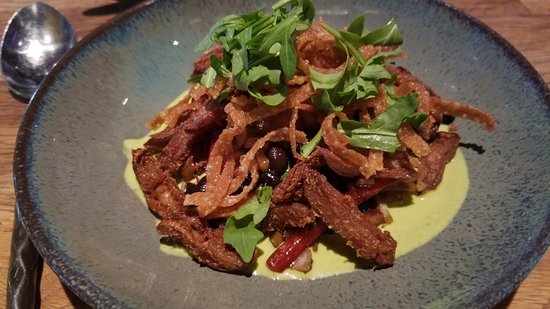
duck-tongue
Duck tongue with tuna and black bean poke, crispy wontons and piri piri.

Like duck tongue, no appetizing euphemism masks what pig face actually is: the meat and fat sliced off the face of a pig. I may have eaten pig cheeks before, but this is different, a full facial. Again, Serious Eats explains:

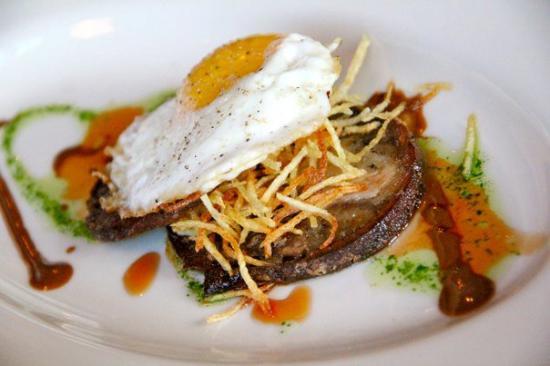
“It’s the multitude of harmonized flavors and textures that make the roasted pig face of one my favorite dishes ever. From the succulent wood-fired pig face patties, sweet maple gastrique, and tart tamarind vinaigrette, to the crispy potato sticks and gooey sunnyside-up egg, it’s clear why this is one of Girl & the Goat’s signature dishes.”

This …Cannon-and-Cannon-Meat-School-pig
… becomes this:

wood-oven-roasted-pig.jpg
Wood oven roasted pig face with sunny side egg, tamarind, cilantro, red wine-maple, potato stix.

As I momentarily salivate (daub, wipe), it strikes me that both meals are commendable for their use of animal parts that might otherwise, and usually are, thrown out with the beaks and snouts, offal rejects. This is mindful, sustainable cooking, but it’s also, let’s face it, delicious, deeply indulgent cooking, sinful, decadent, irresistible. (It’s a lot like the bone marrow I adore, seen below from my recent Russia trip.)

IMG_0910

Right, I haven’t tasted the duck and pig yet — maybe I’ll gag into my linen napkin — but my experiences with exotic, zany foods comprise a solid track record of gastronomical daring and concomitant success. In other words, I enjoy this kind of food, and I’m not only amenable to it, I’m beguiled by it, too.

Omnivorous by nature and choice, I will pursue my culinary escapades for the foreseeable future — that is, a very long time. Vegetarians may scowl and harrumph, and I get it. I can only respond with a lusty chomp and gulp and the thrill of tasting whole new worlds.

Museums of mortality — spooky, sublime

Last year I paid visits to those twin emporiums of ick and awe, the Mütter Museum in Philadelphia and the smaller but almost equally macabre Kunstkamera Museum in St. Petersburg, Russia. Festooned with bullet-riddled skulls, deformed fetuses crammed into jars, gnarled, twisted skeletons, diseased human organs, rusty surgical tools and random gangrened digits, these palaces of the perverse satisfied the ghoulishly curious. They were extravagantly ack-inducing, deliciously quiver-making. Paradise.

o-5
He’s checking his texts.

As noted earlier, I’m deliberating my next journey, and, because I went large last year, I’m thinking small this year. Which means I might go to Chicago, a 2.5-hour flight away. And which means, more importantly, the International Museum of Surgical Science, a less squishy warehouse of medical wonders than the two above, but still a marvelous assemblage of stuff that spurs contemplation about our mortal flesh and all that can go wrong with it via disease, accident and sheer shitty luck.

Highlights include a vintage iron lung machine (can I climb inside?), an exhibit about pain and anesthesia through the ages and one about the history of wound healing (“From the use of herbal ointments and therapeutic clays among prehistoric hunter-gatherers to Galen’s treatment of injured gladiators in Ancient Rome, the care of wounds is among the earliest applications of medicine”), and the museum structure itself, an elegant, historic lakeside mansion. And who could pass up the exhibit “A History of Blood Transfusion: 350 Years of Apparatus Advancement”?

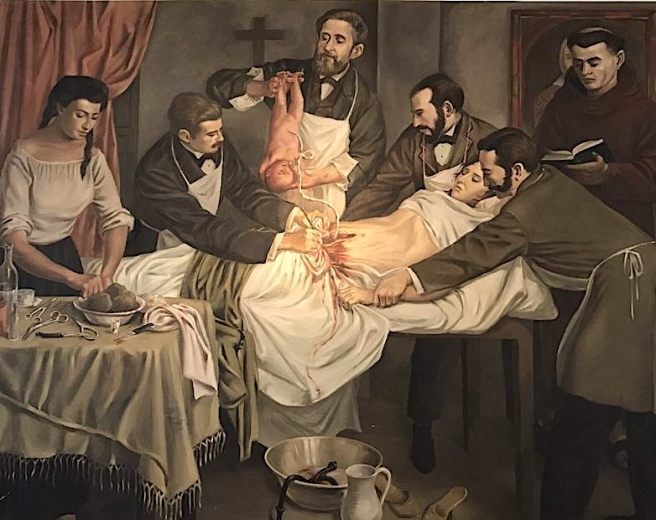
Caesarean section.jpg
Mural of early Caesarean section. Gleefully gruesome.

Reviewers note that the four-story manse is compact and, naturally, its array of freakish displays is no match for Philly’s world-class Mutter. Small is all right; I enjoy a good bite-size museum, especially one of such narrow scope. Sort of like the Russian Vodka Museum or Tokyo’s Meguro Parasitological Museum.

polio-machine
Iron lung machine. May I?

For more grim exhilarations, I pivoted my research to Chicago cemeteries — I’m always up for a calming stroll through deathly opulence — but decided to skip the offerings. Several notable cemeteries pock the area, boasting the resting holes of everyone from Al Capone to Jesse Owens, Emmett Till to John Belushi, Gene Siskel to John Hughes. I sought out film critic Roger Ebert’s grave, but he was cremated and his ashes are kept by a private party, most likely his lovely widow Chaz.

We should all be so lucky. Cremation is the way to go, although I don’t want my cremains kept by anyone but the wind and the water -— whoosh. Thoughts like these will surely visit me at the Surgical Science Museum, a place rife with death and decrepitude. But they won’t get me down. They’re wondrous in their way and, far from depressing, something of a mind-reeling, soul-stirring tonic for the living.

belushiagnes.jpg

Visual antidotes to winter’s vicious freeze

With my love of cold weather, my fervent devotion to fall and winter, to thick jackets, chapped lips and goosebumps, I’ve come to the conclusion that I am part polar bear, part moose.

I relish the big chill. I rather enjoyed the “bomb cyclone” that recently tormented the entire East Coast. Undoubtedly, the swirling mega gusts and ravaging ice storms truly unsettled. I’m actually no fan of voluminous snowfall. Slush, mush, argh. But give me some solid 30s and 40s F and I get to bundle up, thrill with the chill and, this is critical, not sweat.

Yet things are warming up, and this week the New York area will enjoy an inhumanely balmy 60 degrees — a wee too warm, but my survivalist instincts will kick in.

It is said winter lovers are a rare breed, anomalous, daft. I ask: Why don’t more people hate summer? Baffling. I loathe the warm months. It’s a me thing. Shorts and I are on rancorous terms.

I’ve traveled wide and far in positively scorching, humid, sweat-sodden climes and I thought this quintet of watery photos from said journeys might warm up the cold-adverse reader, reminding you of the great thaw to come, soon. All too soon. Splash.

IMG_1877.jpg
Boy leaping into river in Ho Chi Minh City, Vietnam.
IMG_1875.jpg
Vietnamese kid after his plunge.
IMG_0117.jpg
Girl splashing in fire hydrant, summer, Brooklyn, NY.
P1020908.jpg
Boys in Istanbul, Turkey.
P1020909.jpg
Those Turkish boys, loving it.

Overrated travel spots? You decide.

Stumbling through the web today, my eye caught a bit of click-bait I couldn’t resist. Headlined “Overrated Places That Aren’t Worth Visiting,” and located at YourDailyDish, it appealed to my love of lists, penchant for snark and discriminating view of world travel.

A pithy, withering litany of 21 so-called overrated spots, laced with a pinch of snide drollery, the dishonor roll is little more than a light-hearted provocation for easily distracted web surfers. There are surely a billion such lists out there, better, funnier, more substantive, more informative. But this one, despite some dubious grammar, boasts surprising off-the-beaten-track locales that may raise eyebrows.

The list is pure meringue that you can’t take too seriously, and you can make a sport of comparing your impressions of a place to the shamings here. I, for one, can attest that Miami, Las Vegas and contemporary art museums earn their slots. The Great Wall of China, not so much.

502963868.jpg

The list follows below. Each name is a hyperlink to its web page. (Caveat: the pages are larded with obnoxious yet easily dodged ads.)

  1. The Terraced Rice Fields in Vietnam
  2. Seasonal Waterfalls
  3. The Great Wall of China
  4. Manneken Pis in Brussels
  5. La Bocca Della Verità in Rome
  6. Four Corners Monument
  7. Plymouth Rock in Massachusetts
  8. Contemporary Art Museums
  9. The Confucian Temple of Shanghai
  10. Empire State Building, NYC
  11. Leaning Tower of Pisa
  12. Miami
  13. Niagara Falls
  14. Mount Rushmore
  15. Venice, Italy
  16. Las Vegas
  17. Statue of the Little Mermaid in Copenhagen
  18. The Hollywood Walk of Fame
  19. Champs-Elysees, Paris
  20. Cabo San Lucas, Mexico
  21. Blarney Stone, Ireland

vegas-burj-al-arab.jpg


The welcome problem of where to go next

Wanderlust is a malady, chronic and unquenchable. It’s a greedy thing. It wants, desires. It pulses with passion. A lust to wander — exactly as advertised. Lust isn’t a neutral word. It implies the untamable, the uncontainable. It’s hot to the touch.

I’m forever locked in wanderlust’s fevered clutches, craning my neck in search of the next journey somewhere far away. I need to move. I demand experience. I devour culture. I like airplanes.

This year found me bounding near — D.C., Philadelphia, Boston — and swanning far — London, Montreal, St. Petersburg, Russia. Last year was Spain, for the second time; the year before, Paris, for the fifth time. If all that hadn’t broke the bank, I’d now be giddily racking my brain and scanning maps to locate my next adventure.

Let’s do it anyway. Where next?

Obvious contenders are places I haven’t been, from Central and South America to Kenya and Iceland; from Indonesia and Ireland to Singapore and Stockholm.

But I’m picky. I won’t name names, but some places just don’t seem culturally rich enough, or they’re too mojito-on-the-beach boring, or they’re totally repellent in an I-don’t-want-to-be-beheaded way. Too hot. Too cold. Too aesthetically barren. Let’s not forget places with unconscionable alcohol bans.

Though I enjoyed insanely sweaty jaunts in Thailand, India, Egypt and Vietnam (the latter was best), I mostly spurn hot, tropical climes. I don’t do palm trees. Sand: the great deal-breaker. No matter where I go, early spring and early fall are my optimal travel times.

IMG_1889.jpg
Ho Chi Minh City, Vietnam

I go for cities, jostling, clamorous metropolises, be it Shanghai or Barcelona, Berlin or Mumbai, Tokyo or Hong Kong, Istanbul or Marrakesh. That to me is where the action is, not enveloped in frothing seawater on a Boogie Board or panting across sinuous mountain hiking trails.

Before choosing Russia for my recent fall trip, I looked hard at South Africa, but decided it was both too expensive and too outdoorsy. There is fairly cosmopolitan Cape Town, known mostly for its seaside “scenery” — cliffs and water and the like. Victoria Falls and overpriced safaris could not seal the deal. I’m not mad about seeing hyenas in their natural habitat, when all is said and done. (Why do tourist safaris seem so canned, so kind of phony?)

Some time ago I came close to buying tickets to Argentina — zesty Buenos Aires! Wine! Steaks! — and Brazil, until I peered closer at the year-round temperatures and the Brazilian proclivity for volleyball and Speedos. Only Rio’s storied favela piqued my interest in the end, so I swiftly looked elsewhere for the next journey.

I picked Istanbul for its European patina and Ottoman exoticism, and, once there, was instantly won over by its luminous culture, wonderful people, Old World beauty, dazzling mosques and cobblestone-y charms. A weekend trip to the fairy-tale cave village of Cappadocia topped a perfect two-week vacation. I have since returned to Istanbul, and will surely go back.

P1030589_1.jpg
Blue Mosque, Istanbul

But not now. I’m looking for the new, the untouched, the virgin vacation. Japan oddly beckons, but I’ve been there twice, though I’d like to dedicate more time to Kyoto; I think I rushed it. Swaths of Northern Europe — Norway, Sweden, Switzerland, Denmark — fail to excite. I’ve come close to trying Hungary, mostly for the Gothic visions of Budapest, but there doesn’t seem to be enough cultural ballast to sustain a full trip. Prague is near Hungary, but I’ve done that and wasn’t bowled over. A bit too touristy, a bit too lightweight.

I’ve been to Poland, Mexico, China, Austria, Nepal, Cambodia, Beirut and Israel. But I’ve never been to Australia, and I don’t yen to go, for many of the reasons noted above. (“Sun and fun” as an ideal does not compute.) Toronto looks … meh. Indonesia seems too balmy, if unspeakably gorgeous.

IMG_2159.jpg
Angkor Wat, Cambodia

This is a crazily superficial, obscenely first-world conundrum to be stuck in. I’ll pry myself loose when the time comes, when I’m ready for the next big trip (Chicago? Taiwan? South Korea?). Meanwhile, I gaze at my suitcase with longing, hoping to fill it soon, even if I have nowhere to go. Wrote Stephen Sondheim: “Stop worrying where you’re going … If you can know where you’re going/You’ve gone.” 

Frustration to ‘The Firebird’ — the sublimity of St. Petersburg

In St. Petersburg, Russia, catching an Uber the hell out of the Alexander Nevsky Monastery was nigh impossible and immaculately exasperating — client and drivers just could not connect and a flurry of cancelled rides ensued — so I found myself trekking down bustling Nevsky Prospect, the main thoroughfare in this wonderfully massive city, pocked with shops and banks and restaurants, groceries and souvenir kiosks. I strolled contentedly (ignore the steam poofing from my ears) till I could stroll no more, and located a spot at a landmark from which to finally hail an Uber ride. (Did I mention the average Uber fare ran me about $1.50 US? A dollar-fifty. Yes, at this point I’m grinning.)

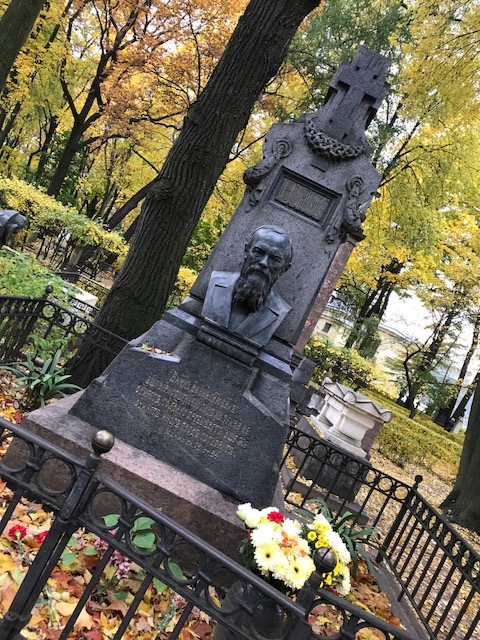
What I was doing at the famed, winsome Alexander Nevsky Monastery, at the tippity-top of Nevsky Prospect, was looking at graves, mostly those in the famous Tikhvin Cemetery, where Dostoyevsky, Tchaikovsky, Mussorgsky, Rimsky-Korsakov and other brand-name bodies lie.

img_0846.jpg

For about $7 US, one is invited to amble the leafy paths of the 19th-century burial grounds and, with map in hand, á la those furnished at the unsurpassed cemeteries of Paris, seek out the eternal mattresses of the famous and infamous. The weather was cool, distinctly autumnal, the leaves turned and fallen. It was bliss.

Dostoyevsky lurched at me:

IMG_0848.jpg

As did this distressed woman, who perhaps witnessed my Uber travails:

IMG_0853.jpg

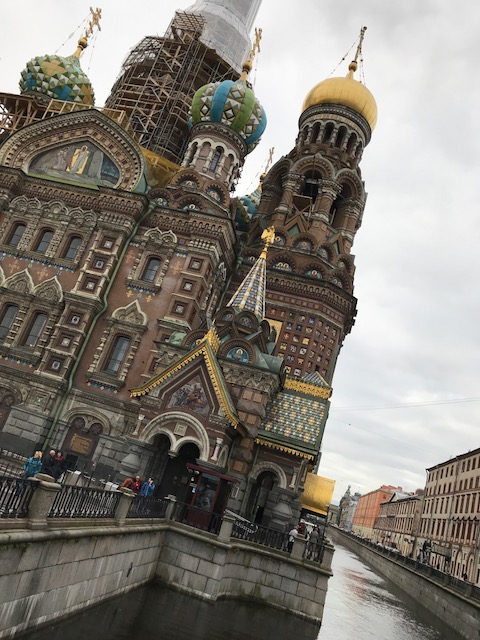
For this visitor, St. Petersburg was glorious that way, in its vibrant, tumultuous history, which is epic and bracingly complex, riddled with shake-ups, triumphs, reversals, oustings, wars, creeps (that’s you, Rasputin), revolutionaries (that’s you, Lenin), and cataracts of blood. Where else would there be this, the knockout, perversely titled Church of the Savior on Spilled Blood, the spot where Alexander II was assassinated by a terrorist bomb:

BLOOD 1.JPG

INSIDE CHURCH.jpg

Endless canals stream through St. Petersburg, requiring scores and scores of small bridges, reminiscent of Amsterdam and its canals, or Paris and the regal Seine.

IMG_0888.jpg

IMG_0889.jpg

And, as I boasted in an earlier entry, I located unfettered beauty at the ballet in the legendary Mariinsky Theatre. I watched, and reveled in, Stravinsky’s landmark fairytale “The Firebird,” perched in a fine dress circle seat. It was lush and extravagant. My view:

THEATER.jpg

Bonus shots: The Winter Palace, once the official home of the czars in the 1700s, in the sprawling Palace Square. This is the main building of the boggling Hermitage Museum.

HERMT.jpg

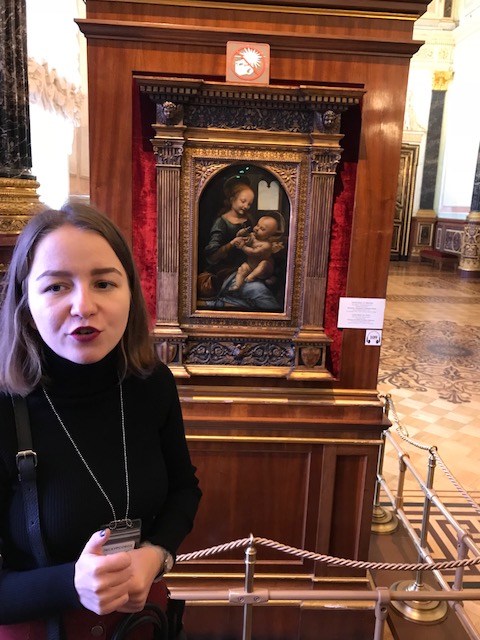
Below, a Hermitage guide describes Leonardo da Vinci’s exquisite “Madonna and Child” from 1478:

IMG_0809.jpg

And that’s all from Russia. I’ll spare you the food porn.

Tippling, Russian style

In St. Petersburg, Russia, recently, no one in a bar bumptiously offered me a shot of vodka as I had been cautioned they would. (Sad face emoji.) The only offers came from poised waiters in nice restaurants — not from chummy, drunky, rambunctious imbibers who wanted me to be their new American comrade in guzzling. This, surely, is a good thing.

I took it slow and easy, tossing back my first shots of the typically clear, but sometimes amber, libation in the controlled environment of the illuminating Russia Vodka Museum, an expansive and engrossing shrine to Russia’s national beverage.

IMG_0871
Guide Veronica explaining the vodkas I was about to gulp.

In a brisk and fact-packed 30 minutes I was shown the place by the delightful, fluently-English Veronica as my personal guide. I learned scads about the history of Russian vodka, from pre-Ivan the Terrible days in the 12th century to Putin’s relationship with the gullet-stinging spirit. The museum is top-shelf, full of text (in Russian, alas), colorful bottles, distillery artifacts, Stalin-era propaganda and unintentionally comical human wax figures. It’s thorough and classy.

If you opt for it — and you must — the tour concludes with a vodka tasting of three regional samples, and includes “chasers” of pickle, herring and onions and something else that escaped me but was fishy and delicious. The tour and tasting cost barely more than $10 US, a steal.

IMG_0872.jpg
Three shots, three edible chasers.

Before my only official shot of vodka in a bar-restaurant setting, I became a regular at the enchanting Dead Poets, a relaxed, stylish gastrobar where the bartenders are hipster mixologists with expert instincts and eye-crossing dexterity. They fashion quite the concoctions — like my favorite, the whiskey sour, which they do with care and panache — that are elaborate and fanciful but just the right amount of modest and unembarrassing. Nothing was too fru-fru, too tawdry, despite the simpatico bartenders’ twee haircuts and rococo facial hair.

IMG_0858.jpeg
Best whiskey sour, ever. Notice the egg-white froth.

No, my sole shot of ice-cold vodka (curiously, the shots at the museum were room temperature) occurred at the acclaimed Duo Gastrobar, a tiny, mid-range restaurant, serving delectable meals, like amazing bone marrow with ginger sauce and crunchy apple pork rib.

Dessert menu? Pass. Let’s move on to liquid pleasures. For about $4 Duo offered one kind of vodka, the classic Beluga Noble, in a shot. Vodka in Russia, they say, must be served chilled, otherwise send it back. This was a frosty, good-sized shot, with lemon slices to bite after quaffing it down. Vodka, of course, is the smoothest liquor to shoot, as it tastes of hardly more than alcohol fumes. It has character if scant flavor.

IMG_0913
The lone chilled vodka shot in Russia.

As he delivered it, my server volunteered his confusion as to why vodka is his country’s national drink when tequila and whiskey, for instance, contain so much more texture and nuance. True, I nodded, and we laughed. But it was bracing and fine and if I wasn’t heading over to another bar, the youthful, disco-lighted Mishka, where drinks are two-for-one during a very long happy hour, I’d have ordered another. When in Russia …

Those jarred babies — not quite jarring enough

As promised I made it to the Kunstkamera Museum in St. Petersburg, Russia, last week. Also known as the Peter the Great Museum of Anthropology and Ethnography — the oldest museum in Russian, opened in 1727 — it’s also known to connoisseurs of the grisly and gross as the Great Hall of Deformed Human Fetuses in Jars (not really). It’s a delight.

IMG_0865

And yet there aren’t as many specimens as I was hoping for, nor was there much in the way of the truly macabre. A few tweaked human skeletons — that fella’s really gigantic — a two-headed stuffed fox and some rusty surgical tools complemented the array of squishy, floating babies. Those twisted wee ones delivered the goods, a frisson of the freakish that some of us crave.

I was expecting more in the way of anatomical and medical exhibits, but the museum is largely dopey ethnographical artifacts — Native American beads and pottery, African huts, Eskimo furs, in tiny dioramas — you can see at your local natural history museum, but newer and brighter. There’s just one small floor of jarred bambinos and gnarled bones. It’s up top. Follow the arrows, greedily.

IMG_0864

It’s pretty good — three stars — but not quite enough to nourish its reputation as a world-class repository of the ghastly. I went for the morbid, not the ethnography, and found myself in and out in 30 minutes or less.

Philadelphia has Kunstkamera beat. Its famed if smaller Mütter Museum is a richer, more concentrated, more intense experience: jarred fetuses; innumerable human skulls both ghoulish and elegiac; various startling skeletons of the diseased, deformed and degraded; cankered floating body parts; chilling surgical devices; and the topper, Chang and Eng’s death cast and conjoined livers.

IMG_0866
Giant’s skeleton at Kunstkamera Museum

I don’t want to knock its Russian counterpart, but the Mütter, as specifically a physician’s institution, is more complete and well-rounded, satisfying the more ambitious demands of creep-seekers. Kunstkamera is very much worth a visit — do go — but know its limitations. While it offers a world of wonder, the Mütter offers galaxies.


Travel travails: trying to jettison on-the-road angst

Just before I embark on my vacations people reflexively ask if I’m excited and looking forward to it, assuring me I’ll have a wonderful time and wads of other tinkly bromides. Invariably I grimace and nod, “Yeah. I think so … Sure. OK, thanks.”

But I’m never sure, and it’s not OK. As I pack and prepare I’m a minor wreck, wracked, withdrawn — enthused, yes, but freighted with the cargo of myriad far-off what-ifs and other terrifying variables.

0a1a-70

I have no qualms about flying; I like flight. My innate angst resides in about, well, pretty much everything else: Flight on time! Make my connection! Will it rain at my destination! Will my Airbnb be as cool as the photos! Will I be able to communicate with the locals! Will I get robbed! Will I contract a food-borne illness! Is that baby-jar museum as rocking as it looks!

I had a small stroke applying for my Russian visa recently. As I’ve noted earlier, it was a multi-tentacled task and very pricey. With the stroke, I developed a bleeding ulcer. For some reason this trip — much more than my jaunts to China, Vietnam, Egypt, Lebanon and Syria — has me more angsty than ever.

I write this today attempting to relax in United Airlines Terminal C at the airport, from which I’ll depart to St. Petersburg, Russia, with a brief stopover in Zurich, Switzerland. I have mere minutes to catch my connecting flight. The layover is impossibly miniscule.

It is not promising. I have four stomach-twisting inklings: 1) I will miss my connection. 2) I will be spending the night in Switzerland, on my dime. 3) My luggage will be in Russia. 4) I will lose a day in St. Petersburg. (Bonus inkling: I will sob.)

Unknown.jpeg

Besides that eventuality, I am also worried about the fact that you can’t drink the water in Russia — it will do a number on you. That’s barely a concern. Bottled water is a cinch and I’ve done the don’t-drink-the-water routine in several countries. But will the hair dryer work sufficiently? Will I fumble financial transactions, not knowing well the rubles/dollars exchange? Will my accommodations’ TV have satellite or simple local cable (I kinda need my CNN)?

These are obscenely, stupidly first-world worries, of course. I do swimmingly out of my comfort zone while traveling and I revel in the developing-country experience. I’ve proven it repeatedly. But I’m weirding out a little this time.

Relax, you’ll have a great time, they say. And I believe them, shakily. I’m conjuring my own anxieties via my own dark thoughts. These are fictions. I’m in the airport, through security, decompressing, with hours till my flight. I have a glass of wine. The journey has begun, and it’s not half bad.

P1010656.JPG
The Himalayas, out the window, above Nepal.

Stray, dogged thoughts about the world’s street mutts

The coolest friend I met on back-to-back trips to Istanbul was a dog.

I met the stray during a May visit and then, staying in the same area of Sultanahmet, met up with her again in October. She recognized me immediately and we enjoyed a fast, happy reunion. She jumped on me and her tail swept like a furious broom.

Stray dogs are plentiful in Istanbul and are protected by the city. Each dog is registered, one of their ears pierced with an official tag. My pal wore a red tag on her floppy left ear, leading me, with a poverty of imagination, to call her Red Tag.

P1030568_1

Medium-sized, camel-colored and sweet as a peach, Red Tag wasn’t always around and she didn’t follow me through the city. She had a life of her own. I would see her by my boutique hotel in the morning and in the evening, and she would sit near me at my nearby watering hole at night. One night she hung out with a group of people as we caroused by the Hagia Sophia, staying up till dawn, a trooper.

P1020788.JPG
Red Tag at dawn after staying out all night with human revelers.

I didn’t spoil Red Tag, though I did occasionally buy her a can of tuna to nosh on as a treat. Street dogs unavoidably crack my heart, and my first instinct is to feed them. Near Gallipoli, Turkey, I bought a stray puppy a can of tuna that she gobbled up gratefully.

P1020721
Tuna for a puppy in Turkey.

It’s not always so. In India I bought some peanuts, the only nearby food, for a crazy puppy that ignored the offering. Another Indian dog rebuffed the samosa I tried to give it. Rice wasn’t appreciated by mongrels in Vietnam. For some reason I assumed these derelict doggies would eat anything.

These memories bubbled up while reading a recent story about street dogs in The New York Times titled “Stray Dogs Started Turning Blue. Then the Street Mobilized.” It’s a great, heartening article about how well strays in India are treated and protected. Even though I’ve been to India, it’s an eye-opener:

nepal
India pup, with cow hoof.

“India has some of the most pro-dog laws on the planet. It is illegal here to kill healthy strays, and the result is millions of them — perhaps as many as 30 million across the country. Packs of dogs trot through the parks, hang around restaurants for scraps (which they usually get), and sprawl on their bellies inside railway stations as rushing commuters leap over them.”

This is a far cry from, say, China, where dogs are rounded up as people food or killed outright as pests. Sickening.

In Hanoi I saw an actual “dog restaurant.” Outside was a silver bowl filled with cooked dog paws and, ironically, a chained German shepherd serving as a guard dog. Eating dog is a kind of virility ritual — it’s a guy thing — and when a table of drunken men spotted me spotting them, they tried to rope me to their table, yelling and gesticulating. Later, in an open-air market, I saw dog carcasses basted like turkeys for sale.

Is this cruelty or culture? A culture of cruelty, I say. But let’s not wade into pitched arguments of moral relativism and abject hypocrisy here and now. Later. Maybe.

Red Tag, terrible as it is to think, has probably passed by now. It’s been a while and she seemed to have some age-related arthritic issues when we hung out. She was kind of a loner, but I saw she had friends that curiously looked a lot like her. She was protected by a big-hearted city that coddles its stray dog population, much as India is demonstrating to its mutts and mongrels. I always feel so bad for street dogs in my travels — mangy, mistreated, malnourished. This delivers a whisper of hope.

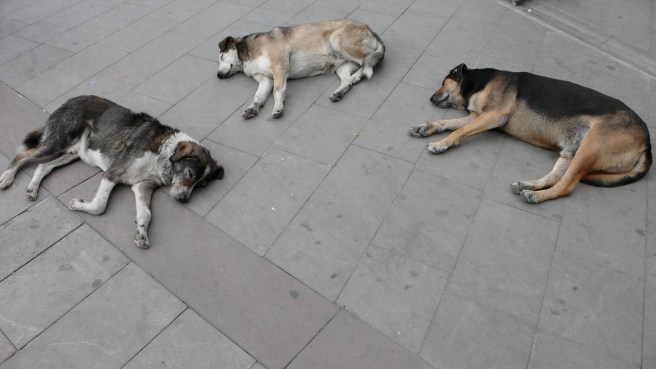
P1030245_1.JPG
Street hounds of Istanbul. Let sleeping dogs lie.