As a childhood KISS fan, this makes my stomach twist. Trump has tapped the grizzled glam rockers as inductees to the Kennedy Center Honors this year, a tribute so perfectly tawdry, I don’t think many get the irony, the hilarity.
KISS, whose integrity has always been dubious, is reportedly not a fan of our portly prez, calling Trump a “true danger to democracy,” but now of course say they’re “honored.” Trump says he picked the bawdy band because they’ve “made a fortune,” which is true, but a repugnant reason to exalt them. He’s also trying to irk the libs, of course. Funniest snub: Tom Cruise dissed Trump’s induction. That’s why he’s a big-screen action hero who can practically fly, without a cape. (Seen the Photoshop illustration of Trump as Superman, cape and all? You’ll vomit.)
Trump’s so stupid he doesn’t even know what culture is. He also elected disco queen Gloria Gaynor for the honors, evidently unaware that her biggest hit “I Will Survive” is a celebrated gay anthem — a song he loves with ignorant gusto. It’s much like the Village People’s comically transparent “YMCA,” a Trump theme during his campaigns that he would clap to like a bloated orange oaf.
The bigot is blind. And deaf. Our tinpot despot has a tin ear.
Here he comes. Yes, he is coming. I don’t see him. I hear him. From afar. He’s whistling, oh-so carefree, head swaying, body grooving. And he’s doing it loudly and without a whit of shame or self-consciousness. Notes swirling from his pursed lips for all to hear.
This middle-aged guy, this oblivious songbird, comes to the cafe almost every time I’m there, which is a lot. He sports sunglasses, a down vest, chinos. And he strolls around whistling, sometimes to a song of his choosing, often to whatever is playing on the cafe stereo. Tweetle-lee-dee …
Why am I so vexed by a man who whistles merrily about a coffee shop? Whistling, it’s said, is a symptom of happiness. One site muses: “Are whistlers so insanely happy that they have some overly elevated level of joy? So much so that it bubbles up and spills out in the form of air molecules passing over the tongue and through their lips?”
If so, am I just madly envious of this fellow’s happy mien? His ability for unfettered glee to pour out and tweetle in everyone’s eardrums unbidden? He’s not a bad whistler. He’s actually fairly adroit, a mini jazz-flute maestro vamping on his facial wind instrument.
No, I am not envious. I have no idea if he’s inflated with uncontainable ecstasy, though he appears pretty content and confident with his hands-in-pocket swagger. It’s that his music is like a yappy-dog bark, nails on a chalkboard. Then again, I can’t whistle enough to call a dog.
Yet I give him license. Whistling Willie, I’m convinced, is simply indulging a bad habit. His tuneful penchant is pure reflex, like the drummer who instinctually taps the table with his fingers. We all have tics, mannerisms and foibles, even if they’re not as piercing and public as full-throated whistling. The dude’s just doing his thing.
The lip-doodling is pretty damn distracting (otherwise I wouldn’t be grousing) when I’m trying to read and write. “If you’re an anti-whistler type, short of duct tape, how can you keep your focus when Tweety Bird starts up?” asks the above web site, Screenflex (a portable room divider company!).
There are no answers. There is only discipline. Tune out the tunesmith. But it’s not just the “music” that kills me. It’s the brazen indifference to his fellow folks, inflicting, without a flinch, his own song list on strangers, like the lunk who hoists a blaring boom-box strutting down the street for all to hear, no matter individual taste and basic social decorum. It’s the principle.
My whistler, my personal Bobby McFerrin, who’s probably a swell human being, despite the cloud of patchouli cologne he resides in, just needs a touch of self-awareness to wake him up — perhaps an actual whistleblower to call him out, bawl him out, and slip a cork into that irksome “O” on his face.
Two songs from the early ‘80s are banging about my brain and I can’t purge, flush or exterminate them. I go to bed with them, and they alternate, like an A-side and a B-side. And I wake with them, wailing away while I brush my teeth, shower, get dressed, make coffee. Such are pesky earworms, those maddeningly sticky tunes that get jammed in your head like taffy to teeth.
I won’t name the songs, because they’re obscure hard rockers that long ago went poof in the annals of music history. They’re sort of embarrassing. (Heard of the defunct bands Violation or Vandenberg? Thought not.)
Yet somehow my teenage lizard brain fished out these tunes from the primordial goo of the ’80s and decided it would be nostalgic fun to hear them over and over again. The songs are notable for dynamic drums, which as a fledgling drummer I studiously emulated. (I still enjoy the drums on both tracks, but they don’t inspire me as they used to. Feh, I say now. I can do that.)
So my head burrowed into the random past and found these songs, and now I can’t shake them. It’s been a full week and they won’t go away. I finally listened to them on Apple Music, a grave mistake that merely branded them further into my brain.
Earworms can be joyful or torturous. Classic torments are the Chili’s “Baby Back Ribs Jingle” and anything by Barry Manilow. Happy ones are, say, the Chili Peppers or anything by Abba. I’m spit-balling here.
My vexing earworms fall between good and evil, the gray zone that’s almost worse than flat-out terrible. Earworms — that’s what they call ‘em. But these are more like ear boa constrictors. They suffocate you before they devour you. Whole.
1.One of my least favorite things in the world, after e-scooters and ravers, is sweating. Which means I am not a happy fellow. Why? Right. Because I am sweating. And rather a lot, swamp-ass and all. Somehow I thought it’d be a swell idea to take a brisk walk in the 92-degree blech of midsummer. The light sweat I produced outside — a mere film — quickly metastasized into a profuse drenching once inside. Forty minutes later, in powerful AC, it has yet to subside. How bad is it? The dog is licking me avidly, like I’m a giant piece of beef jerky.
2.House of Terror — how kicky is that for the name of a major tourist attraction? It’s real, and it’s not a ride at your local carnival. This daunting museum is in Budapest, where I head this fall, and it isn’t about ghouls and goblins. Or, well, it sort of is. Per its description: “It contains exhibits related to the fascist and communist regimes in 20th-century Hungary and is also a memorial to the victims of these regimes, including those detained, interrogated, tortured or killed in the building.” History writ large. And horrible. I’m so there, with solemn intentions, despite the thrilling name.
3.Just finished Paul Harding’s newish novel “This Other Eden” on the dazzling strength of his first book, the 2009 Pulitzer Prize-winning “Tinkers,” which is uniquely mesmerizing. “Eden” limns Black American history in its many facets, including, troublingly, eugenics. Harding is an uncompromising stylist, forging gorgeous, gem-cut prose that’s sometimes too infatuated with itself, yet nevertheless tells a fascinating story. Harding writes like few others — Cormac McCarthy and Faulkner come to mind — but he can stumble on his own lush verbiage. He is a flawed master.
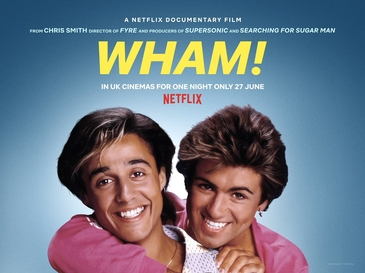
4.The new documentary about massive but short-lived Brit pop duo Wham! — aptly titled “Wham!” — is out on Netflix, and the trailer promises a bubbly, bubblegummy, bing-bang time (“Wake Me Up Before You Go-Go,” anyone?). The movie, a giddy romp directed by crack documentarian Chris Smith, isn’t, alas, as brawny as frontman George Michael’s uncrackable Aqua Net helmet. It’s strictly for googly-eyed fans who can’t be bothered with pop music history, laser-focusing on bandmates’ Michael and Andrew Ridgeley’s frolicsome BFF status and their improbable rise from cheesy teen wannabes to slick arena-fillers. Critically missing in this narrow nostalgia trip is cultural context, as if Wham! exploded in an ‘80s vacuum, with little competition and no help from juggernauts like MTV. And it doesn’t even footnote Michael’s untimely, and seismic, death as a solo artist. Wham! Bam! Thud.
5. Speaking of the dog (see #1), Cubby was recently shorn like a poor gray sheep, which I documented here. The good news: his hair is growing back in the summer swelter. He no longer resembles a fuzzy Pringles can — he’s not so tubular — and he’s stopped nipping the parts that were so short, pink flesh was exposed. He’s returning to his bushy self, and his attitude is boinging back — a little cocky, vain with a scruffy bedhead sheen, and as fierce around the UPS folk as one can be behind a closed door. His yawps and barks still shatter glassware, but that’s OK. Pretty soon he’s going to look like Slash again and the process will start all over. Our little lamb chop.
6.Then there’s this: I was strolling in the summer heat (see #1 again) and some shitty beat-up compact sedan roared past me, easily doing 50 to 60 in a residential 25 zone. Startled (and pissed), I yelled, “Slow down!” The driver flipped me off and I reflexively returned the gesture. He barreled into oblivion. Then I thought: Smart. That’s a good way to get yourself killed. Jackass might have a gun, might want to turn around and use it. Sweating like a madman, I kept walking, ruffled, looking at the world in a slightly different shade.
Celebrity booze brands, from Jay-Z’s cognac to George Clooney’s tequila, are an unseemly fad — how much money and branding do these flush hobbyists need?
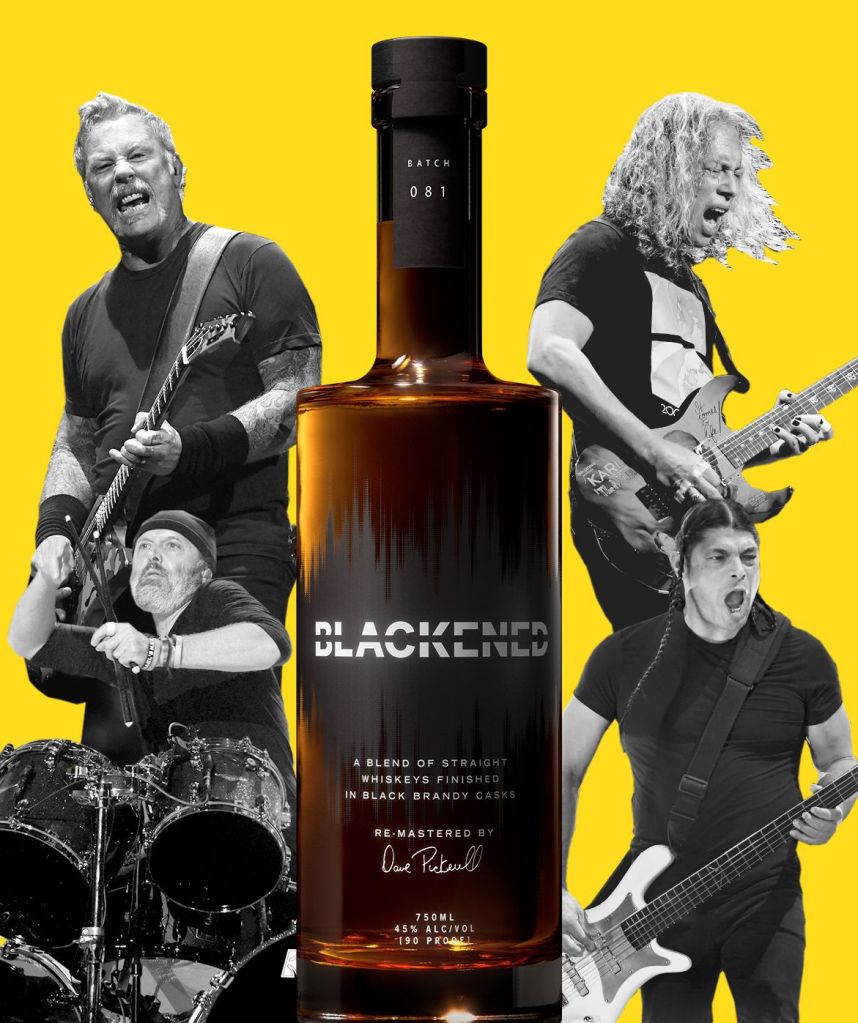
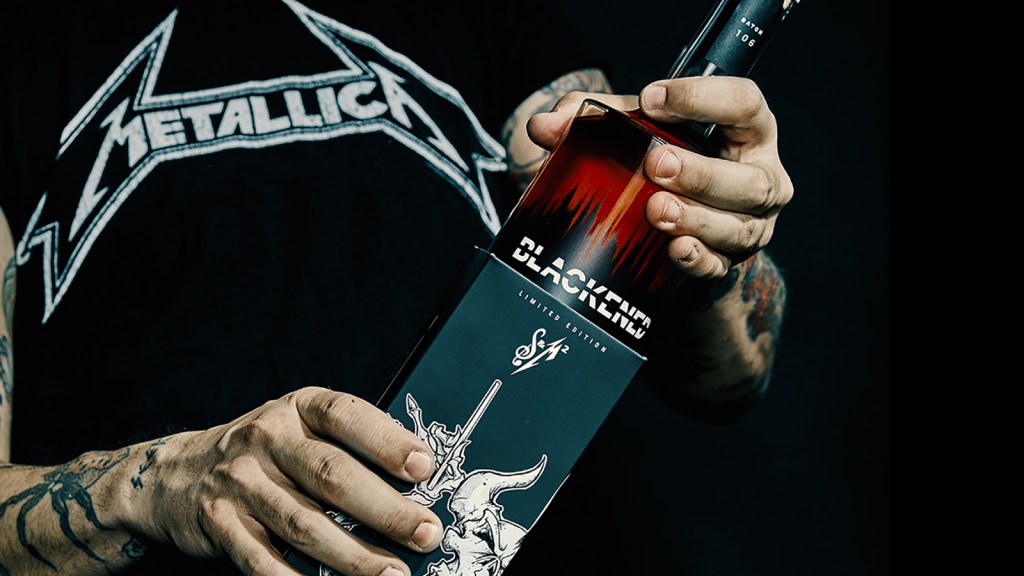
Yet the new Metallica Blackened Whiskey has me rapt, not only because I’ve been a band fan for years, but because the snarling spirit trumpets its own acrobatic gimmickry, something that recalls how members of KISS mixed their own blood into the ink of the 1970s KISS comic books for an extra drizzle of puerile publicity.
This is far less theatrically cynical. But still comical. Metallica’s zesty drink — notes of honey, oak, caramel, the usual — has been given the band’s trademarked “Black Noise Sonic Enhancement” while in the finishing whiskey barrels.
It’s as dorky as it sounds: songs from Metallica’s landmark 1991 Black Album — “Enter Sandman,” “The Unforgiven,” etc. — are “played to the barrel causing the whiskey inside to move and interact with the wood. The whiskey is pummeled by sound, causing it to seep deeper into the barrel, where it picks up additional wood flavor characteristics.”
I believe that (ooh, shake it, Sandman). I just don’t believe it makes a whit of difference. As it is, the sip is solid — toasty, tangy — especially when tippled to “Whiplash,” circa 1982.
The market is lousy with famous booze dilettantes. Cameron Diaz moves her own wine. Bob Dylan hawks Heaven’s Door Whiskey. Wild Turkey Longbranch Bourbon reeks of Matthew McConaughey’s honeyed East Texas drawl. And coolest of all, Irish Celt-punk rockers The Pogues push Pogues Irish Whiskey.
Thrash royalty that they are, Metallica aren’t too dignified to gussy up their whiskey with frippery — don’t forget the dubious Black Noise Sonic Enhancement process. Lending it a luster of collectibility, the painted corked bottle comes in a Black Album-emblazoned box and includes a cocktail recipe booklet and a (totally useless) Metallica whiskey coin that’s worth minus 50 cents on the black market. (For the record, “Blackened” is the title of the first track on the group’s elephantine 1988 LP “… And Justice for All.”)
So how, really, is the stuff? At $45, it’s no hooch. I admit my face puckered into an asterisk on the first dram of Blackened, but that’s normal for me — I feel the burn. Notes of butterscotch and mint soon blossomed from the mix of bourbons and ryes selected by Master Distiller Dave Pickerell.
I poured more, though not too much, lest Blackened become blackout. I bet the guys in Metallica, who were once dubbed Alcoholica for their prodigious swigging skills, would love that. They might even dedicate a song to me, perhaps one of my favorites off the Black Album: the aptly titled “Sad But True.”
It is dusk and the piano man slides onto his bench and begins playing in the vast hotel lobby, which is arranged with socially distanced dining tables and bar seats for a pop-up piano lounge vibe.
A sad smattering of customers eat and drink and, shhh, the piano man is tinkling his heart out, swaying ever so gently to his own one-man band. He presides over the shiny black baby grand with quiet authority, as much groovy gravitas as one can muster in a chain hotel that’s trying really hard.
What am I doing here, listening to the piano man on a frigid Tuesday evening? That’s a short, spectacularly uninteresting story, reader, so we move onto the lonely man tickling plaintive keys, which are surely moist with his falling tears.
The piano man performs sans face mask but with a natty blue scarf round his neck, evoking a Lake Tahoe lodge feel (the fireplace crackles). He should be wearing a face mask because he is not a singing piano man. He performs instrumentals of dubiously hip pop standards — “As Time Goes By,” “Moondance” — frilling the tunes with jazzy tinsel and rococo flourishes, the filigreed doodles of the creatively restive.
Without singing, this piano man (lower case) is unlike Billy Joel’s iconic Piano Man (upper case), who is implored to: Sing us a song you’re the piano man/Sing us a song tonight/Well we’re all in the mood for a melody/And you’ve got us feelin’ alright.
That’s not quite the scene in the hotel lobby bar this night. No one is making requests. No one is tossing five-spots at the resident artiste. (Where, oh piano man, is your tip jar tonight?) No one is “in the mood for a melody.” Alas, no one is listening.
He’s playing “Tiny Dancer.” He ponders his life as he does.
I am transfixed. The piano man is good. The euphony, the dexterity! Those gliding hands are mad-nuts, and he doesn’t even glance at them. He scans the near-empty room, eyes half-mast, perhaps in a self-induced fugue state. What is the piano man thinking?
I took piano lessons as a wee one. I learned exactly one song. It was 12 seconds long and had these lyrics: “Here we go, up a road, to a birthday party.” Fact: It’s the easiest piano tune ever, making “Chopsticks” seem like Chopin. I mangled it every time.
I figure if I have one more cocktail I’ll sidle up to the piano and join our hero in a duet of “MacArthur Park,” he on the keys, me out of key.
The piano man is an island, no tipsy admirers warbling along with the tunes, patrons shuffling past without so much as a knowing smile or polite nod. He is a rock of existential solitude, abandoned by rotten weather, Covid, the Tuesday night blues. He’s a street busker in a ghost town. The misunderstood genius, honored only after his tragic, Mozartian death.
The piano man as metaphor. I think we’ve heard that song before, played to the tune of “I’m So Lonesome I Could Cry.”
The piano man’s shiny black berth, the day after his show.
I’m having a tricky time getting jazzed about too much lately — only Socrates rivals my sage discernment and penetrating taste — yet I am alive, blood sluices through my veins. Some things I’m digging:
Richard Serra sculptures at Dia: Beacon, New York
Caustically hilarious British TV series “Fleabag”; Sigrid Nunez’s quietly affecting novel “The Friend”;the reliably stirring Dia: Beacon museum, so serenely cluttered with minimalist and sculptural masterworks; poetic Polish romance (and Oscar nominee) “Cold War”; and Weezer’s “Teal Album,” featuring frighteningly faithful covers of Toto’s “Africa” to Black Sabbath’s “Paranoid” and Michael Jackson’s “Beat It.” It’s a gas.
Mostly this entry is a sequel to my December year-end inventory of now-time enthusiasms, stuff getting my juices flowing. These are the current tops:
Jade Bird
Strumming an acoustic guitar, her long hair swinging, she sings in a hushed girlish voice before belting like a banshee, loosing a squall of blazing catharsis. She has pipes that purr, then roar, then come back. You sway to twangy folk, then rock with giddy fury.
Intimate and Velcro-sticky, Bird’s music, performed acoustically or with a small band, circles Americana, punk and soulful indie pop. Country fans are drawn by her evocations of rocky, star-crossed relationships, and there’s country crunch in those folk-rock vocals. Her galloping cover of Johnny Cash’s “I’ve Been Everywhere” is a jam-session joy.
In this 21-year-old Brit, the Dixie Chicks are at their fiercest, alongside a banging Liz Phair, Courtney Barnett, PJ Harvey and other steely indie royalty. Bird’s lyrics pop and sear. In the unreasonably rousing “I Get No Joy,” Bird sings with such speedy agility, she’s almost rapping:
“Psychotic, hypnotic, erotic, which box is your thing?/How many days a week, do you feel/Electric, connected, unexpectedly/Affected, what do you need?”
His hair is a fluffy fiasco, a brown brushfire, his splotched face the seasoned mug of a gang member. He’s filthy and swears like a sailor. He’s homeless. He’s 12.
In Nadine Labaki’s Beirut-set stunner, a nominee for the best foreign language Oscar, the boy, Zain, is a resourceful renegade in the scrappy mold of Huck Finn and Antoine Doinel in “The 400 Blows.” Fed up with his struggling parents and their feckless care of their many children, Zain takes them to court, accusing them of the crime of giving him life. It’s a preposterous idea, a satirical glance at the Lebanese judicial system.
Zain (the extraordinary Zain al Rafeea) fast becomes a tough street urchin who finds a gig babysitting the gurgling infant of an illegal Ethiopian refugee, played by Yordanos Shiferaw. (The film’s devastating cast of non-professionals play versions of themselves.) When the young mother is arrested, Zain is stuck taking care of the baby on his own. In this harrowing situation — the movie is a tart indictment of Beirut’s corrupt state of child welfare — the fathomless despair can be unbearable to watch.
“Capernaum” — the title means “chaos” — owes much to the children-centric neorealism of ‘80s and ‘90s Iranian cinema, from “The White Balloon” to “The Color of Paradise” — heart-renders told in raw, wrenching lyricism that aren’t without political undercurrents. It’s a street tale alive with miscreants and thieves and few kind gestures.It’s so gritty and grubby the camera lens almost seems smudged. Redemption, however, is in the air.
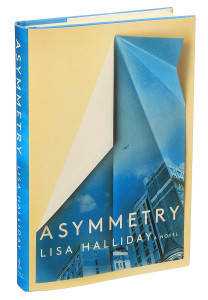
Beautifully written, radiantly spun and shot through with smashing intelligence, Lisa Halliday’s first novel “Asymmetry” bristles with humanity as it mingles conventional and unorthodox structures. It’s a literary feat kneading the fictional form like Play-Doh.
I’m only a third of the way through its brisk 271 pages, but I’m sold. (Being part-way in a book you’re relishing is where you want to be; there’s more on the way to savor.)
The novel is chopped into three sections. I finished the first section, “Folly,” which traces the May-December romance between Alice, a 25-year-old aspiring writer, and Ezra Blazer, a famous author 40 years her senior. (If he rather resembles Philip Roth, it’s not chance: Halliday had a relationship with Roth while in her twenties.)
And so we get an old-fashioned affair of unpushy comedy and sweet asides set amidst Upper West Side means, with tender banter and the not uncomplicated theme of apprenticeship, much like a Woody Allen movie, without the deep-dish neuroses.
Alice has career issues, Ezra has health issues, and brewing in the background is the launch of the Iraq War. (The war plays a prominent role in the next section, “Madness.”) In this, one of The New York Times’ 10 best books of 2018 (and a favorite of Barack Obama), Halliday doesn’t flinch from the vagaries of love, including the sort, like Woody’s, peppered with literary chatter and throbbing with aching uncertainty.
The dialogue is unfailingly smart, wry, just right. Alice and Ezra conduct short, gem-cut conversations that bring a knowing grin:
“Is this relationship a little bit heartbreaking?” he said.
The glare off the harbor hurt her eyes. “I don’t think so. Maybe around the edges.”
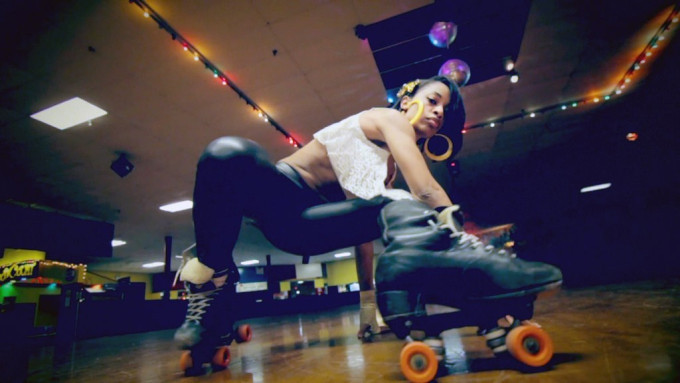
“United Skates”
In urban roller rinks across the country thousands of African-American roller-skaters are lacing up and getting down. Beneath rays of twirling disco balls an underground roller renaissance thrives among a force of skate buffs who throw after-dark rink parties and commit kinetic art on waxed wood floors: backflips and break-dances, tag-team acrobatics, backwards trains and other daredevilry. Many revelers simply trace ovoid loops in a kind of roller-boogie bliss.
With new and archival footage, much of it contagiously groovy, “United Skates” directors Dyana Winkler and Tina Brown chronicle the hip-hop-fueled scene with at once bracing and brooding electricity. They hopscotch the nation — Los Angeles to Baltimore — and capture the community-building soul of skating as well as the heartrending gentrification that’s swiftly shutting down classic rinks, dinosaurs of the ‘70s and ‘80s. Few will survive.
Next to dwindling skate spaces, the film locates other troubles: the apparent profiling of black skaters at certain rinks that ban rap and the skinny wheels many black skaters prefer. When skaters organize “adult nights” — “Code for ‘black night,’” says one — police fill the parking lots and security is thick. No such hysterics are apparent on a typical “white” night. It’s a familiar microcosm of current race relations.
Yet the party rolls on. The subculture retains a die-hard exuberance not easily snuffed. The film’s final scenes are far from elegiac; against all odds they are tonically celebratory.





 GNASHING.