“Life is short. Type fast.”
— Writer’s adage that’s been kicked around a lot. Heed it.
WONDERING. WANDERING. WHATEVERING.

“Life is short. Type fast.”
— Writer’s adage that’s been kicked around a lot. Heed it.
I’ve been journaling since 1994, and the unrelieved banality of my journals not only disappoints me, it lances me, makes me realize how crushingly uneventful, how downright nondescript, my life has mostly been.
Or has it?
Of course there are highs and lows recorded in the reams of pages I clutch and possess with paternal jealousy, some on paper, such as Moleskin notebooks, but most in digital files stored on my well-backed-up laptop.
That much verbiage can’t be all bad, and some of it, I humbly admit, is pretty all right. I’ve lived loudly. I’ve loved amply. I’ve travelled widely. I’ve won awards. I engage my myriad interests. And my friends and family are tops.
Rereading some old entries has triggered surprise and delight at a deft phrase, a funny observation, a jolting memory, or a nostalgic or sentimental rush. And none of it is performative; it’s for me and me only.
I have perused past journals raptly, and felt a strange exhaustion afterward, as if the words exhilarated me, hauling me through a woozy time-warp. Like: getting violently ill twice in Thailand in ’95; the great break-up of ’01; being shortlisted for a Pulitzer in ’06; Mom’s death in ’19; Dad’s passing the following year; and so much more.
I’ve done a decent job filling life’s canvas and, with equal fervor, filling pages about it all. This is starting to sound like a valediction, like I’m in hospice or something. That’s hardly the case. I’m merely musing, and that’s what journaling is about — navel-gazing, woolgathering, reflection and introspection. It’s capturing the milestones and the millstones, the highlights and the lowlights.
Almost always it’s simple recording, dull, everyday stenography. Like this I typed yesterday: “I lie in bed, trying to wrest another hour or so of sleep from the morning, and all it amounts to is tossing and turning and amplified anxiety, ugly thoughts and visions. It is torture.”
It can be dark, indulgent, meaningless, like the above. Even so, getting it down is the heart of the process. Journaling is purging, an irrigation of the brain and pipes of the soul. If lucky, it provides fuel for future scribblings.
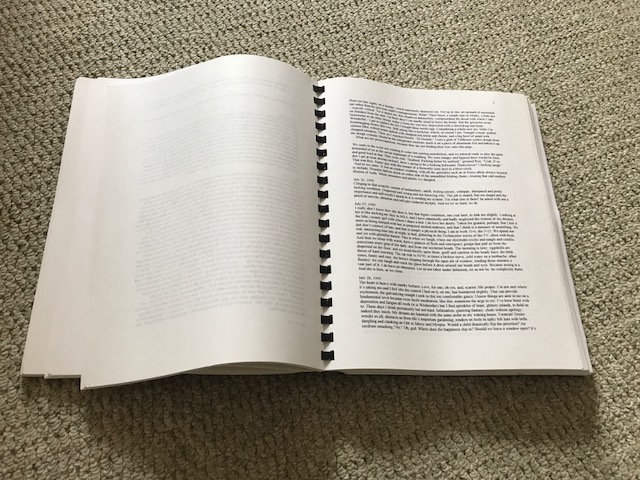
A famous writer says to “mine your journals” for essay and blog material, something I’ve taken to heart. Dreary daily bulletins can be spun into content, stories, little narratives. Sometimes they are inspired, like gold; other times (too often), they’re gruel.
So now when I return to this post’s opening graph, I think it’s all wrong. My journals aren’t reserves of the uneventful and the nondescript — the banality of drivel — but contain just enough substance of a full life.
I’m no journaling master. And I obviously haven’t mastered this life thing. Last week in the airport, on the way to Scotland, I did some journaling. I’ve plucked a snippet from that entry, a sentiment that holds true for that trip, for writing, and for life as a whole:
“I still don’t know what in the hell I’m doing. I really don’t.”
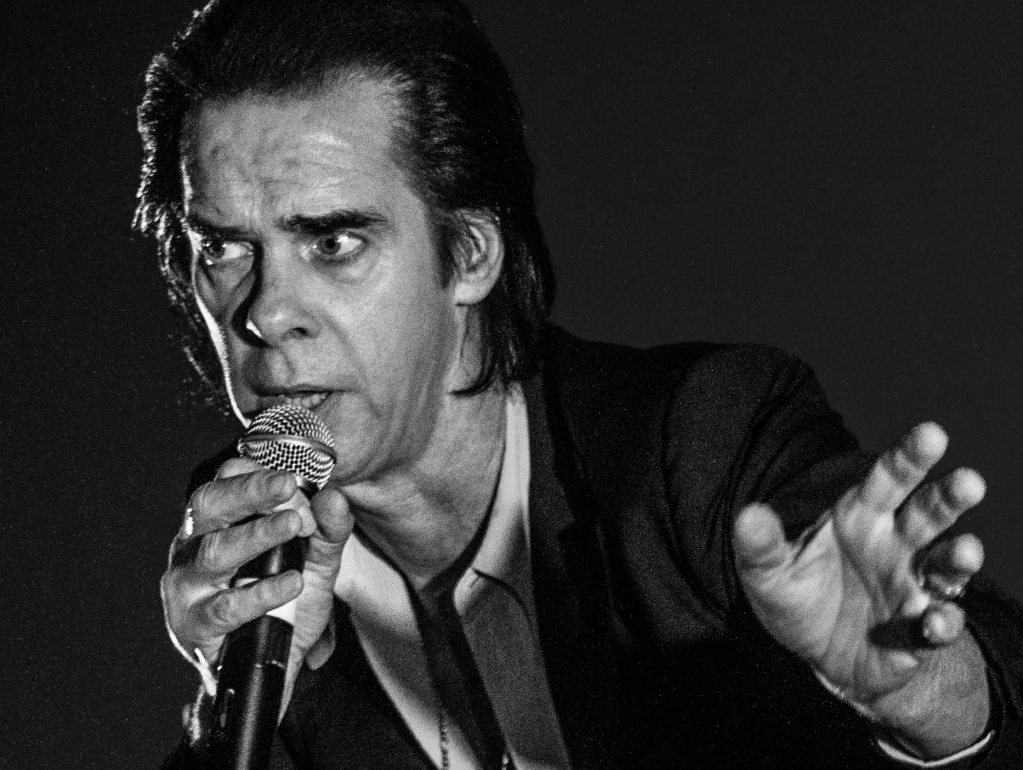
Nick Cave — Australian musician, composer, filmmaker, writer, artist, actor, all-around Renaissance man, with slick black hair and natty suits hanging off a long, pencil-thin frame — runs a sage, funny and heartbreakingly sincere advice column on his website The Red Hand Files. His counsel is so sharp and impassioned, you wonder: What can’t the guy do? I bet he can fly.
Recently, a precocious 13-year-old boy wrote in, asking this: “How do I live life to its absolute fullest, and not waste my potential? Especially as a creative. Also, what is a great way to spiritually enrich myself, in general, and in my creative work?”
I relished Cave’s response so much, I am excerpting a chunk of it here.
These are, to me, words to live by:
“Read. Read as much as possible. Read the big stuff, the challenging stuff, the confronting stuff, and read the fun stuff too. Visit galleries and look at paintings, watch movies, listen to music, go to concerts — be a little vampire running around the place sucking up all the art and ideas you can. Fill yourself with the beautiful stuff of the world. Have fun. Get amazed. Get astonished. Get awed on a regular basis, so that getting awed is habitual and becomes a state of being.”
Talking on the phone with my Dad once in my early twenties, I used the word “funner” as an adjective and, stickler that he was, he busted me.
“That’s not a word,” he intoned.
Oh. I sat there chastened, my cheeks pink.
I was a burgeoning word freak but Dad was the authority, the maestro, a journalist and wordsmith for decades who loved dissecting language, adored puns (he was the worst!), and collected clichés with a far-flung dream of making a board game out of all the hoary, hackneyed maxims, platitudes and banalities he scribbled down on everything from receipts to cocktail napkins.
Say something nakedly trite and he would call you out — ha! — scramble for a pencil and jot down the howling cliché you dared utter. Can you imagine what kind of game that would be? Either brilliant. Or inordinately annoying. Anyway, it never came to be.
Back to “funner.” Apparently that isn’t a real word. At least according to my father. And that has stuck ever since. I never say “funner.” Yesterday my brother used the word “funnest” and I pulled a Dad and said that’s not a word. My brother gave me the stink-eye and started making a voodoo doll of me.
But I was wrong. Sort of.
Here’s what the New Oxford American Dictionary says: “The comparative and superlative forms funner and funnest should only be used in very informal contexts, typically speech.”
That’s good news — informal contexts, typically speech. Just how I used funner.
However, an online teacher says this: “The next time students ask why they can’t say ‘funner,’ I say it’s because ‘fun’ was originally only a noun and the -er and -est forms are not commonly accepted. Stick to ‘more fun’ and ‘the most fun.’ ”
And another site avers: “There’s something funny about the word funner. It has the sound of a word twisted for the sake of a game of Scrabble, and any mention of it is liable to draw the response of, ‘Do you mean more fun?”
No! I mean funner! There, I said it, so many years later. Funner.
So, Dad, on this count you might have been off. I’m using funner as an adjective — better late than never. And with that phrase I’ve given you a moldy cliché for your board game, which would have surely been the funnest game of clichés ever.
Language is always evolving, especially between the formal and the colloquial. Take “over” vs. “more than,” for example. Both are now used to mean more than if used before a number or quantity, as in “This cost over four dollars.” That once was a stylistic no-no, but increasingly “over” is an acceptable substitute.
I’m a word nerd. Love the language, love quips, innuendos, alliteration, even puns, which come tragically easy to me. I like big hairy words that have tentacles and teeth.
I do indeed find words fun. I find writing funner. I find finishing writing funnest of all.

“I majored in journalism because I wanted to be a writer, but the whole point of journalism is to cut out all the good stuff.”
— Lucia Berlin, ‘Dear Conchi’

Funny how you can admire a book without fully liking it. That’s the case with the lavishly overpraised memoir “Stay True” by New Yorker writer Hua Hsu, which was named one of the 10 best books of the year by The New York Times and made book reviewers get all moist.
It’s a baffling response to a book whose prose contains no electricity, no buzz. A book that rather lies there, dry, ho-hum and humorless.
And yet Hsu reveals authorial gifts by showing what even a mildly engaging story can do: carry you along with raw pathos, stripped of punch and pyros. Though the book sputters at the half-way point — Hsu’s early years at UC Berkeley in the ‘90s aren’t as novel or riveting as he thinks they are — it occasionally grazes the profound with ranging reflection that delivers a spurt of substance.
Still, missteps abound. Women, for instance, are almost totally absent for most of the book, noted in passing by first names only, granted the vaporous texture of ciphers. I don’t recall one speaking, even when Hsu at last finds a dimly sketched girlfriend.
Not even his Asian identity issues (he’s Taiwanese American), his mania for alt-music, or especially the zines he publishes pop off the page. These are exciting topics, but we’re left thirsting. While a huge fan, I find most New Yorker writing to be self-consciously restrained and prim. Staff writer Hsu suffers from a chronic case of New Yorker-itis.
But at least it feels real, which memoirs like Mary Karr’s aptly titled “The Liars’ Club” definitely do not. Which makes “Stay True” also aptly titled. (I find pretty much all memoirs to be 15-20% made up — there’s simply no way such decades-spanning reportage can be true — but that’s pulp for another blog.)
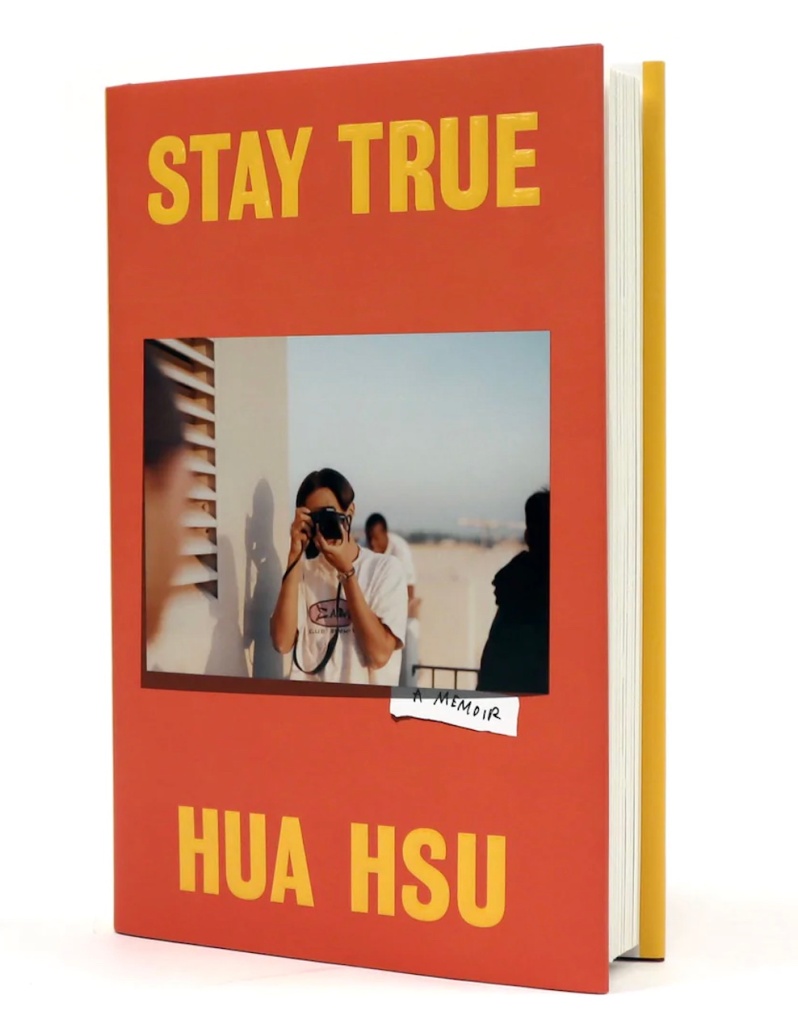
This book is about friendship and the violent loss of it and the hole it leaves. Hsu meets his friend Ken — who’s mostly depicted as a one-dimensional cut-out — at college and they become best bros (Ken is in a frat, something initially anathema to the “outsider” Hsu). Ken is soon ripped from the narrative and we’re supposed to be crushed.
But the loss of a character we barely knew is treated with a remove that makes it hard to share an emotional wallop. Believing otherwise, Hsu writes: “I was a storyteller with a plot twist guaranteed to astound and destroy.”
Not quite. “Stay True” misses its mark, but by feet, not yards. A few sentences jiggle with magic — “Their beats sounded like death rearranging furniture in the underworld,” Hsu notes about a rap group — and the closing passages of this slim volume emanate a cathartic warmth that’s AWOL in the gangly prose of the first 100-plus pages.
In the end, Hsu wants the truth to pierce. Here, it merely pinches.
***
Ten books I really liked this year:
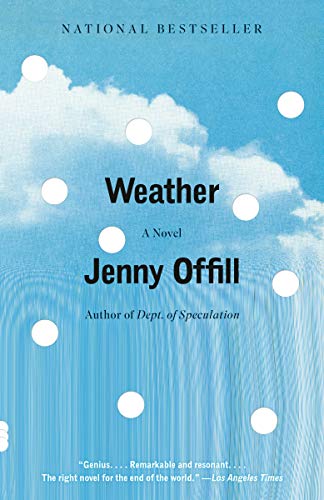
“Asymmetry” (Lisa Halliday); “Eleven Kinds of Loneliness” (Richard Yates); “The Copenhagen Trilogy” (Tove Ditlevsen); “Heat 2” (Michael Mann and Meg Gardiner); “Either/Or” (Elif Batuman); “How Should a Person Be?” (Sheila Heti); “Weather” (Jenny Offill); “Wildlife” (Richard Ford); “A Manual for Cleaning Women” (Lucia Berlin); “The Idiot” (Elif Batuman).
As a kid, from ages seven to 17, I had subscriptions to sheaves of magazines I eagerly awaited to hit my mailbox — Dynamite, Ranger Rick, Hit Parade, Modern Drummer, BMX Action, Omni, Heavy Metal, Movie Monsters and more.
Each title represented a discrete passion — showbiz, animals, rock, drums, science, bikes — and the glossy journals were bibles of my interests. I read them rapt, lapping up interviews, gossip, photos, front-of-the-book ephemera, often scissoring them to bits for bedroom wallpaper and school-locker decor. (Try that with an online subscription.)
At about 17, I started reading the local newspaper, the San Francisco Chronicle, with a new seriousness that went beyond comics “Bloom County” and “The Far Side.” I loved the stylish writing, current events, cranky columnists and clever critics. It was a daily feast, and each week I’d spend up to three hours poring over the overstuffed Sunday edition, an inky ritual I savored.
I also read lots of books — “Charlie and the Chocolate Factory” to freak show biographies; “Slaughterhouse-Five” to Jim Morrison’s (dreadful) poetry — but that’s a given. When I was eight I read the fat paperback of Peter Benchley’s “Jaws,” and I’m still proud of it.
But is it normal, for a boy at least, to spend so much time with the written word, reading? Shouldn’t he be outside, say, throwing balls, or blowing things up?
While I hated most sports — except soccer, skiing and BMX — I was your average knee-scraping, war-playing, B.B.-gun-shooting, lizard-catching, fire-setting, doorbell-ditching, girl-crazy, grungy little scamp.
Still, I adored words and what they imparted — ideas, information, whole worlds. I used to wade through our World Book encyclopedias and ginormous Mirriam-Webster dictionary just for fun. My best friend Gene and I wrote little books about devils, murder and other unspeakable mischiefs. We had a thing for horror.
But did all that bibliophilia and word-love mean I was a giant wuss?
This week teacher and novelist Joanne Harris — bestselling author of “Chocolat” — said that reading is far more rare in boys than girls, for rather macho reasons:
“When I was teaching boys particularly, I found that not only boys did not read as much as girls but they were put under much more pressure by parents, largely fathers, to do something else as if reading was girly,” she said via LitHub. Boys, apparently, “ought to be out playing rugby and doing healthy boy things.”
And I reply: Can’t boys do both — reading and “healthy boy things” — like I did (and what’s a healthy boy thing, anyway)?
Forbes reports that boys are way behind girls in reading comprehension and writing skills, because “reading and writing are stereotypically feminine endeavors, and boys tend to avoid anything that’s remotely feminine. In other words, it’s just not cool to read, because reading is for girls.”
This is clumsy and reductive (and offensive) reasoning, more fitting for the playground than a hard, rational study. Reading is for girls? You don’t say.
What then to make of all the wildly famous male writers overpopulating the literary canon who have (unjustly) eclipsed their female counterparts? Call Hemingway or Mailer a wuss and see where that lands you.
I don’t doubt that girls read more than boys; I’ve seen it borne out. If it’s because boys are discouraged and intellectualism is deemed unmanly, then we have a real societal problem. I don’t have the answers — just my umbrage — but if you have any thoughts, please comment.
I know many bibliophobes, people, almost all male, who would never think of strolling the living, fragrant stacks of a bookstore, or simply pick up a book for that matter. To me, they’re the wussies, un-evolved, willfully ignorant, with the vocabulary of third graders and the critical thinking skills of a hubcap. I don’t trust adults who don’t read. Philistinism is a cultural crime.
World travel has largely usurped my juvenile need to start fires and catch lizards, but I still read at a mad clip and write as much as I can. Call me a sissy. I’m having a ball.
“There was a point while writing when I felt the kind of self-loathing that I haven’t felt since middle school. I texted a bunch of my writer friends, and they all either said, ‘Yeah, buddy, welcome to being an author,’ or ‘Why do you think so many of us drink so much Scotch?’ ” — actor/writer Kal Penn
Sometimes writing, the very act of it, makes me sick. It’s not uncommon after a productive session, the kind when time flies in a flurry of unblocked industry, words and ideas popping, that I’m left with a residue of inexplicable malaise. I am drained, depressed, deflated. I dread returning to the page to see the massacre I have committed, and I dread facing the hard work it will require to repair it.
Writing is an out-of-proportion existential crisis for me, because too often it’s an unsparing referendum on my talent. If I write OK then I can, at best, momentarily relax. If I write badly then it’s a fiasco and I am a failure and a fraud and scrambling for a horse pill of strychnine.
Self-flagellation is as twinned with writing as the tip-tap of the keyboard. Rarely will I re-read an article once it is published or posted. When I do, invariably it’s a letdown. What I thought was good, sometimes better than good, is without fail crushingly mediocre, a lance through the writer’s rice-paper soul.
Dramatic? You bet. Most writing is performative, for the reader and the writer. So you are on, and the show had better be good. Unless you’re a hack and I can’t even think about that option. That’s worse than anything.
During an interview for my second newspaper job, I told the managing editor that writing was a physical act for me, not just a mental one. I meant that I invest so much of myself into crafting a story, taxing my brain, getting the blood flowing, almost squirming in my seat, that I actually exhaust myself if I’m doing things right. Nuts. I know.
I wish I was a kinder self-critic. Life would be easier. I would wince less. The ulcer might stop screaming. But I’m not. I’m a dick to myself.
I know writers who fa-la-la through the process, whipping out ribbons of words they’re proud of in a sliver of the time it takes me, a real bleeder. They float on air, eluding the bruising hangover I experience upon a project’s completion. Their confidence has buoyancy, like a big fat dumb balloon. (The upshot: their stuff is usually crap.)
They lack — lucky dogs — the perfectionist’s curse, knowing that whatever you have just sweat over is anything but pristine. In his quote at the top of this post, Kal Penn is learning the pain of prose that comes with a passion for craft, the “self-loathing” that leads so many writers, me included, to pour a Scotch or three.
And yet, really, come now, writing is fantastic, even when it’s excruciating — just like human love. Scotch? I get drunk on words, mostly others’ and, on that very rare occasion, my own. It’s true. And it’s an unmatchable high. I can like what I type. It’s happened. It happens. It will happen. So I keep going, the burn be damned.
There. I said it. Drink up.
Good, bad, worshipful, scandalous — writer Philip Roth is making boldfaced headlines again, four years after his death. His largely acclaimed new biography and its author Blake Bailey are under fire, while publications like The New York Times are issuing fresh appraisals of his almost 30 novels and memoirs, like this and this.
This longtime Roth fan joins the chorus. I haven’t tackled all of his books but I have read his most celebrated titles, from “Goodbye, Columbus” (1959) to “Nemesis” (2010) and many in between. What follows are my five favorite Roth novels, with an obligatory postscript about a glaring omission.
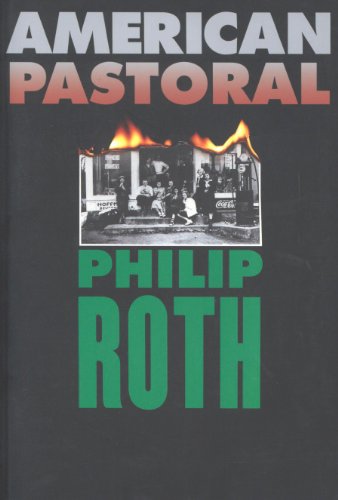
1. “American Pastoral” (1997) — Roth’s Pulitzer Prize-winner may be the best novel I’ve ever read. It’s deep, thorny, complex, timely and so rich with perception and wisdom — communicated in ferocious, passionate prose — that you’re stuffed after each sitting. But it’s not difficult. Tracing the life of one Swede Levov and his daughter’s radical political terrorism in 1968, “Pastoral” gradually becomes an epic tragedy about recent American history and our hero’s inevitable descent. A biting, indelible masterpiece.
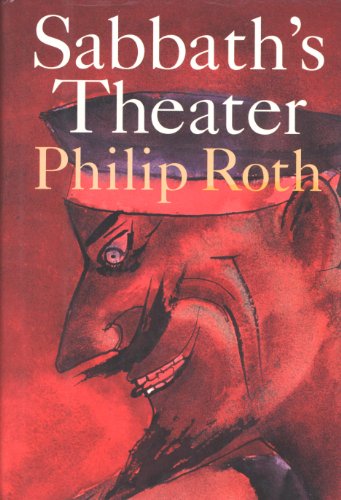
2. “Sabbath’s Theater” (1995) — Raunchy, stylized, rip-snortingly funny and aggressively profane, this cathartic gush of undiluted id is Roth at his sweatiest and most swinging, a big bite of eros that “shows off his linguistic verve and his unparalleled ability to stare unblinkingly into the psyche of a depraved scoundrel,” raves one critic. Winner of the National Book Award, this feverish, in-your-face opus isn’t easy, and it shouldn’t be. What it is: crudely sublime.
3. “The Human Stain” (2000) — A dean of a college faculty is ousted after he makes a loaded, if ultimately benign, remark interpreted as racist. He holds a shocking life-long secret close to his vest in this, “one of Roth’s most complex moral conundrums,” which came out during similar dramas unfolding in academia and beyond. The book bristles with Roth’s fanged moralism; the writing is poignant, alive, uncompromising.

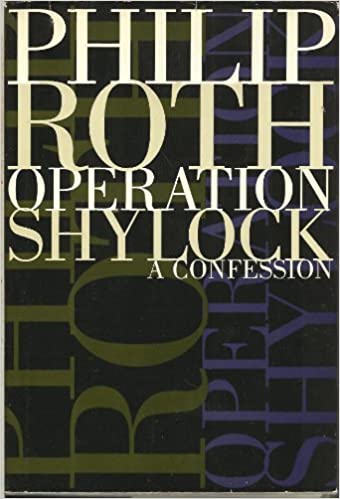
4. “Operation Shylock” (1993) — What could have flopped as an elaborate literary stunt winds up one of Roth’s richest masterworks. “His best use of autobiography and his most incisive use of meta-techniques,” a critic writes, “the novel pits Philip Roth against an imposter, a man going around using Roth’s name and identity to proselytize about the necessity for Jews to return to Europe.” Crazy, but that’s its brilliance. Roth’s facility with form proves, again, formidable, his wit and playful intelligence on dazzling display.
5. “Everyman” (2006)— A meditation on “one man’s lifelong skirmish with mortality,” this slim book, part of a quartet of late shortish novels, marks Roth’s return to the profoundly personal following the speculative politics of “The Plot Against America.” Haunted by death, the protagonist looks back on his life, from childhood, marriage and divorce, to old age and sickness, all the while reflecting on the inevitable — his own impending demise. Bracingly elegiac.

P.S. About that other famous book everyone so adores, the one in which the hero masturbates with a piece of liver: Don’t overestimate the frenzied gimmickry of “Portnoy’s Complaint,” a worthy early volume (1969) whose onanistic perversities, both smug and farcical, fuel the novel’s shrill pitch. I like this ribald coming-of-age comedy well enough, but it’s more exhausting than exhilarating, minor Roth at its most breathlessly attention-hailing. It made him a literary star.

These days, I seem to only get high on the fumes — the thick, inebriating perfume — of words. I just read a fine passage in my current book and it brushed the orgasmic. To write like that, to make literary music, is the best thing, the very best thing. It matches, maybe surpasses, love.
Too much? Too loopy? Probably. But great art does that — it makes you dizzy. During the pandemic captivity, I’m reading with fiendish greed, in oceanic gulps. I’m buying with crazy zeal. And you probably can’t get that book you want at the library because I already checked it out. Terribly sorry.
More than ever, I grab the written word for solace, inspiration and spiritual nutrition. Yet while I crack mounds of books, I don’t always finish them. I am a notorious book-slammer, shunting aside titles that don’t rivet me by page 50 or so. Mediocrity won’t cut it. I’ve had enough meh, oof and blah. Especially this year.
These are grim days — both of my parents died in the past year; the Covid terror seethes; the Trump shit-show blunders on; some personal turmoil has body-slammed me; pick your catastrophe — and lots of us look to art for escape, empathy and temporary amnesia.
Art extends beyond the written word, of course, so I’m still listening to music, watching films and TV shows and streaming all manner of streamy abundance.
Stuff that stands out: the wise, tartly funny Pamela Adlon comedy “Better Things,” in which Adlon plays a frazzled single mother of three offbeat daughters and simply tries to, well, cope; the bizzaro “Pen15,” a cringe comedy starring two 30-something women playing seventh graders with boggling juvenile verisimilitude; and “The Crown,” that tea-time telenovela about British royalty that entrances, despite me caring less about the real Royals than I do about carbuncles.

I always have to nitpick at year’s end, too. Always. If the just-fine though room temperature chess drama “The Queen’s Gambit” missed the sublime, it ably outclassed other hot streamers, like the broad, shrill “Schitt’s Creek” and the animated “BoJack Horseman,” whose mordant mopiness was mistaken for hip profundity. (Speaking of adult animation, does anybody still watch “Archer,” the subversive, devilishly clever cartoon on FX? Join me.)
Thanks to Covid-contorted release formats, I’m behind on new movies, especially presumptive Oscar contenders. I did try to watch David Fincher’s tediously diffuse “Mank” but couldn’t finish it, and, yes, I can tick-off all of its esoteric Hollywood references. I’m skipping Spike Lee’s Vietnam fantasia “Da 5 Bloods” for two reasons: It doesn’t look very good and Lee’s track record of great films is plain disheartening. (I will also be skipping “Wonder Woman 1984,” grumbled grandpa.)
This is what kind of year it’s been: Mere weeks ago I watched and can recall almost nothing about the admired indie “First Cow” by Kelly Reichardt, one of my favorite minimalist filmmakers, except that some guys make yummy biscuits. I’m renting the scruffy period piece again to see what I’m blanking on.
Movies I’m looking forward to include the adaptation of August Wilson’s “Ma Rainey’s Black Bottom”; Frances McDormand in “Nomadland” (by the director of 2017’s extraordinary “The Rider”); the viral documentary “My Octopus Teacher,” about a grown man befriending a gorgeously slithery mollusk; and Frederick Wiseman’s typically sprawling doc “City Hall.”

And yet for all that — let’s swoop back to the start of this entry — books are my sweet spot right now. In the past few tumultuous months I’ve savored “Those Who Leave and Those Who Stay,” the ravishing third novel in Elena Ferrante’s four-part Neapolitan series; Jess Walter’s jaunty period saga “The Cold Millions”; and “Leave the World Behind,” Rumaan Alam’s quiet thriller about race, class, marriage and other thorny things.
But what’s providing the most satisfying literary kicks are titles from the New York Review Books Classics series, an eclectic spread of fiction and nonfiction from the past, each book a minimally designed paperback that bespeaks worldly elegance. Called “discoveries” by the publisher, the books are “established classics and cult favorites, literature high, low, unsuspected and unheard of.”
I now own 13 terrific novels from the series, with another — Leonard Gardner’s gritty boxing drama “Fat City” — on the way. Today I’m reading the noirish “Nightmare Alley” by William Lindsay Gresham (midgets, mediums, mendacity). Before that was the twisty, eerily timely crime thriller “The Expendable Man” by Dorothy B. Hughes, who wrote cult classic “In a Lonely Place,” part of the series I also devoured.

What’s getting me is the power of words, the emotional and psychic heft, the sheer salve of art, and the attendant awe. I’ve always loved books and any words on paper (and screen), but I seem to love them more in the rotten times, a stretch so shitty, I haven’t touched this blog in over three months. I hadn’t the urge nor the heart. Fall, my favorite season, gone wasted.
Maybe I’m uncoiling from a prolonged flinch. I don’t know. But this, now, during some of the very bleakest days, is where I’m at. Turning the page in another chapter.

