I believe this is the best combo of in-house self-quarantine (minus a tall whisky):
WONDERING. WANDERING. WHATEVERING.

I believe this is the best combo of in-house self-quarantine (minus a tall whisky):
Like many of you, we are grumblingly housebound during the seismic spread of the coronavirus, aka the Trump Pandemic, a little scared, a lot curious, shuffling clenched and downcast in a novel world of social paralyzation and dystopian edicts, woozy with the surreal and unthinkable. Enter: takeout, Amazon, streaming movies, books we should have read eons ago, board games, bottomless web surfing, asphyxiating boredom, idle nose picking, staring contests, etc.
The end is nigh.
Or not.
Yes, bars, restaurants and even Starbucks are shuttering, and it’s a cataclysmic cluster-boink. I can’t even get a haircut now, so by July I’m going to look like Weird Al Yankovic.
But if you have the gall, guts and lunacy, there are ways out. Like zooming to far-off lands that may well be (yes, they will be) infected. Peek yearningly at PlanMoreTrips, a new site that promises, with a pinch of perversity, to “Find the Best Corona Virus Flight Deals,” like: a $137 roundtrip from New York to Lima, Peru; a $43 roundtrip from Dallas to Las Vegas; or a $231 roundtrip from New York to Barcelona.

All of that makes me want to travel badly; I strain at my leash. But it’s a global crap-storm out there. I don’t want to go to Paris when the D’Orsay and the Louvre and Frenchie restaurant and my three favorite cinemas in the Latin Quarter are closed. (Though I still kinda really do.) And of course I don’t want to get ill or make anyone else sick. So we sit. We stew. We play Scrabble. Shit.
Now for some random, corona-free stuff (just what you were waiting for) …
— Cubby the hirsute hound finally got a haircut. In puppy parlance, he was groomed. While his body is shorn and tiny now, almost tubular, like a Pringles can, the Baron Munchausen beard and mustache remain, rather regally. And all that hair removal revealed something we always suspected was there, but never saw: a bright pink butthole. Sorry, but it’s true. And it’s strangely alarming, yet delightful too. He’s got one! He’s even less freakish than we thought! Good boy.
— Spring dispirits for many reasons. Besides sunshine and heat and bugs and pollen, and everybody chirping about such delirious wonderfulness (they’re all wack), there are insane allergies some of us contend with. Actually, I combat them daily, through all climes, so I can’t blame the new season, as much as I detest it. (Did I mention swimming pools, barbecues and shorts?) Thing is, my allergy meds barely work, if at all. Runny nose, watery eyes are my main symptoms, and they could not vex me more. I’ve tried an array of meds. This week I’m moving on to Flonase. Can anyone vouch for this pricey nasal spray? (Gross, right?)
— Timely thought: “Either God can do nothing to stop catastrophes like this, or he doesn’t care to, or he doesn’t exist. God is either impotent, evil, or imaginary. Take your pick, and choose wisely.” — Sam Harris, author of “The End of Faith”
— Serious film fans know Werner Herzog — prolific auteur of mind-tweaking features (“Fitzcarraldo,” “Aguirre, the Wrath of God”) and consciousness-rattling documentaries (“Grizzly Man,” “Cave of Forgotten Dreams”) — as a brilliant iconoclast, Germanic chaser of “ecstatic truth,” and venerated pop culture polymath (he’s voiced himself on “The Simpsons” and plays a villain in the “Star Wars” series “The Mandalorian”). This week, he’s interviewed in a New York Times Magazine Q&A under the unsurprisingly prickly headline “Werner Herzog has never thought a dog was cute.”It’s typically profound and brain-expanding. “How do we give meaning to our lives?” Herzog says. “That question has been lingering over my work and life. That’s what I’ve been pursuing for a very long time.” And from there, he’s off.
— The other day, Yahoo!, the oddly antiquated web server, rapped my knuckles with a stern warning to be a nice boy. An admonitory email landed in my rarely used Yahoo! mailbox, part of which reads:
“It has come to our attention that you may have violated the terms of service on Yahoo! Please reread the terms and cease any use of your account that may violate them. If your use of your account is brought to our attention again, we may terminate it without further notice.”
I’m shaking in my sneakers, big bad Yahoo! (Thank you for providing the exclamation point I otherwise would have furnished in that sentence.) My crime: replying to a couple of comments on a Trumpian news story on the site, which unaccountably attracts a large, semi-literate, far-right readership. The comments, dumb as dirt, borderline racist, the usual vile cant, set off my volcanically anti-Trump triggers and, helplessly, I typed some half-baked responses, teeth grit, smoke poofing from orifices.
Perhaps stooping to the commenters’ level, I called them ignorant hillbillies who should skitter back down the holes they crawled out of — or some such balderdash of which I am not proud. I used no curse words (wait, isn’t “hillbilly” an expletive?) and hardly drew outside the lines. Yahoo! is having none of it. I broke the rules. I upset some Neanderthals and a corporate legal department. To the corner I go. Such a bunch of … yahoos.

Cubby the wonder dog has gone a very long time without a good, healthy grooming. His face is downright Ewokian, that wet button nose struggling to peek out from the furry foliage. His brows are thick, heavy, senatorial. His body would make Bigfoot blush. Such inordinate overgrowth is witnessed in only the most luxuriant jungle weaves and tangles, invoking machetes, flamethrowers and scythes fit for Death himself.
Cubby, we submit, needs a haircut.
He knows it, we know it. Supercuts knows it. As does the kid down the block who mows the neighbor’s lawn for five bucks.
Seriously, clippers and razors should be at the ready. Cubby fears and loathes the grooming ordeal — sedatives required — and we sympathize. And so we let him go, and grow. But it’s in his best interest to be shorn, for comfort, hygiene, and to not look like David Letterman.
Right now, three months after the photo below was taken, Cubby’s corkscrewy fur looks like swirling oceans of gray Reddi-wip, curling waves lurking with mythical sea monsters. If you think he looks lush here, you should see him now. To namecheck another “Star Wars” critter, he’s wildly Chewbaccian. I live with a barking, carpet-staining Wookiee.
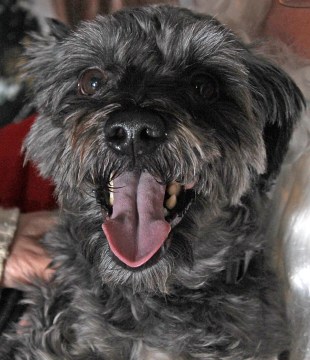
Then again, here’s what he looks like after a spanking professional shearing. Such grooming makes him appear bald and sprightly, thinner, a bit rat-like, though retaining that preposterous Spaghetti-O tail (which I adore). Gone are the Austro-Hungarian mustache and frowzy Haight-Ashbury beard. (Gone too is that panting smile, curiously.)

All of which is to say: 1. A barbershop chair awaits Cubby’s fuzzy tush. 2. Call it a springtime trim, ripe for warmer days. 3. Wanted: Dog groomer who can handle a hirsute hound that’s neurotic, nervous and Xanax-popping, and may require a John Deere to cut mighty scrubland. We exaggerate, a little.
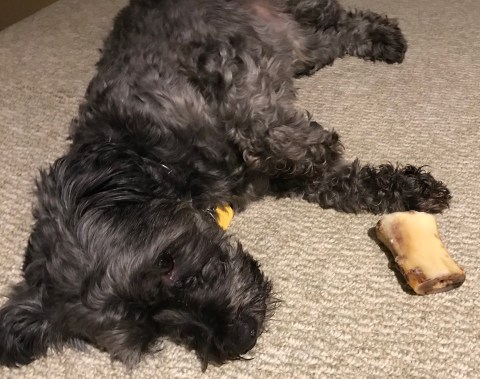
I thought it’d be nice for Cubby the dog to have, at long last, a true, honest-to-god bone, the kind dogs spend hours gnawing and worrying, trying to get at every last nip and nibble of gristle and gore and marrow, keeping boredom at bay, digging into denuding the hunk of flesh-coated cow skeleton with grunting determination, tail-wagging vim and feral gusto. I thought it’d be a fitting Christmas present for the rescue hound who hasn’t experienced all the things prototypical cartoon dogs (see Marmaduke bury his bone in the backyard like treasure) have enjoyed in their inky realms, a rite of passage, like college graduation, or circumcision.
So the other day I impulsively bought a $6 beef bone at Whole Foods, which was wrapped in that red fishnet nylon in which holiday pet stuff is so often swaddled — festive but peculiar. My plan was to present the bone to Cubby on Christmas morning, per the whole gifting hullabaloo. But at home, when he sniffed it out in the grocery bag with disarming excitement, I decided I wanted right there and then to see how this would all play out: Cubby the beef bone virgin getting his first totally supreme chew chunk. It went …
Hang tight. I digress. First, in the seasonal spirit, Cubby was forced to do what so many little boys and girls must do: get their picture taken with Santa Claus. Children over 3 years old tend to love this ritual because Santa asks what they want for Christmas. It’s like sitting in the lap of a magic, wish-granting genie. (Those under 3 tend to use Santa’s lap as a red velvet diaper, bawling all the while.)
Pretty sure Cubby’s Santa, part of a charity for Doggie Daycare, didn’t ask what the dog wanted for Christmas (and if he did, I hope Cubby replied: “A big, real-life bone, Santa!”)
So here he is, posing, pantingly, with the third least convincing Santa Claus ever, be he at the North Pole, Macy’s or in the mall atrium:
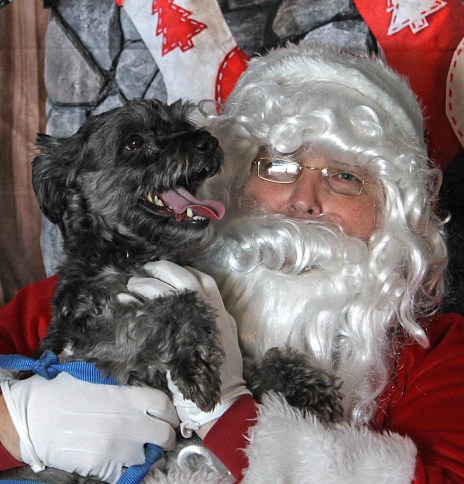
If Santa looks befuddled, Cubby looks mortified, thinking, “For Christ’s sake — really?” That wide canine smile is pure theater, gleaming fakery, a gaping signal of full-body shock. (It’s exactly the kind of “smile” I pull out of my bag of humiliations for those mechanically posed group shots on “special occasions.”)
Cubby survived the photo shoot with Santa Paws. The bone was a slightly different story. He loved the smell of it but he didn’t quite know what to do with it. It was big, a fist-sized rock, and Cubby is not so big. Frankly, he acted weird about the whole thing, unnerved, as if an alien creature had been introduced into the house.
He sniffed it and gingerly circled it. He daubed it with tentative licks. When the cats sauntered past, Cubby suddenly became proprietary — this is mine — and angrily chased them away.
And then it happened. Cubby gripped the marbled brick in his little maw and trotted about with it. Acceptance!
As this mating ritual played out, I thought the dog was nuts. Not only was he acting neurotic, he was putting off chomping on this amazing bone that had meat and sinew baked on the outside that he eventually tore off with his front teeth, stripping it like bark, before digging into the tunnel stuffed with roasted marrow.
He worries it fiendishly and greedily, like there’s gold inside. (And there is. Anybody who’s had bone marrow in a better restaurant knows what culinary pleasures await.)
Cubby’s horizons keep expanding. He learns new things all the time. I look at the big bone experience as a critical test of true doghood.
He passed.
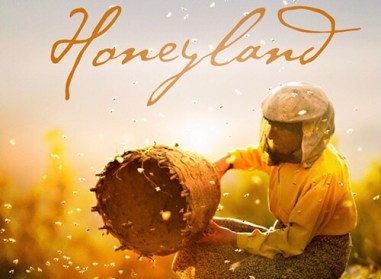
1. “Honeyland” — In this gorgeously observant documentary, weathered Hatidze lives in the rocky Macedonian mountains, where she cares for her ailing mother and tends to several beehives that produce honey for a tenuous livelihood. A large, rowdy family moves next door and decides to try beekeeping, but without expertise, they flail and almost comically get stung more than they harvest the sweet goo. Tensions arise between the neighbors, but this achingly humanistic look at an exotic if seriously impoverished way of life is mostly a portrait of Hatidze, a steely, lonely woman who has as much soul as those mountains can contain.
2. “Booksmart” — Barreling forth with raunchy vigor and unbridled zest, this coming-of-age comedy screams fun. Almost literally: There’s a lot of screaming — in surprise, horror and explosive joy. An amplified spin on school-days greats — “Dazed and Confused” to John Hughes — “Booksmart” piles on twists with a sharp, knowing eye that zooms in on the timely and topical, from female power and LGBTQs, to bullying and the corrosive effects of cliques, and, yah, the liberating if daunting pull of sexual exploration. Starring a terrific Beanie Feldstein and Kaitlyn Dever as boundary-pushing besties, who learn, in a fleeting haze, that maybe bongs are as fun as books.

3. “Pain and Glory” — Antonio Banderas, broken-in yet handsomely fit, plays an aging, ailing film director re-encountering figures from his past: his disapproving mother and a former lover, to an actor in one of his most famous movies. Pedro Almodóvar’s lavish drama, revealing the artist in peak form, brimming with soul, pinballs through time for a richly felt reflection on life, love, art and mortality.

4. “The Chambermaid” — Ghostly quiet and meticulously observant, this narratively spare but humanely complex Mexican drama follows a hotel maid on her monotonous rounds, evincing stark lines of class. What slowly unfurls is an unsparing character study that’s as hermetic as it is riveting.

5. “American Factory” — When a Chinese company takes over a closed General Motors factory in Ohio, an epic culture clash erupts in this fascinating and timely documentary. A Chinese billionaire opens a glass factory in the empty GM facility, hiring two thousand blue-collar Americans. Things seem good until they don’t, and the stark differences between high-tech China and working-class America are exposed for explosive tension and real-life drama.

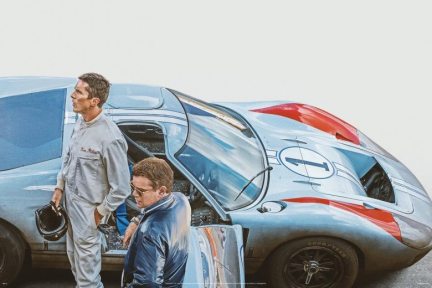
6. “Ford v Ferrari” — A gas. This based-on-a-true-story traces how the Ford company chased, literally, Ferrari in the pursuit of engineering the fastest racing car possible. Matt Damon and Christian Bale are at their charismatic peaks as driving rivals slash pals who ping off each other, willing pawns in the big contest.
7. “Non-Fiction” — Olivier Assayas’ French dramedy is a tireless, tonic gabfest that had me speed-reading the flurry of subtitles more than drinking in the faces and colors of the bustling scenes. That’s no complaint. The profusion of words — intelligent, eloquent, biting — brim with ideas, humor, pain and pathos, for an enveloping artful experience. You want to know the fork-tongued characters, led by an enchanting Juliette Binoche, because of the literary, arty cosmos in which these writers, editors and actors orbit.

8. “Parasite” — A totally implausible class fantasy set in South Korea, Bong Joon Ho’s comic-horror parable is a bit too on-the-nose meditation on wealth vs. poverty. Yet it soars with a warped originality and off-kilter atmosphere that never quite lets on where it’s going. There will be blood.

9. “The Last Black Man in San Francisco” — At once arty, elegiac, poetic and tough-minded, this is a tale, a beautiful reverie, that strikes on topics of race and class and gentrification with sparks and lyricism and primary-color Spike Lee sizzle. It’s something singular, and it slowly intoxicates with its emotional and sociological depths.

10. “Her Smell” — Elisabeth Moss’ performance in this shambolic punk-rock portrait is as athletically interior as it is exterior, spiked with physical fits and childish spasms. In my favorite performance of the year, Moss plays Becky, volatile front-woman of a female punk band she’s struggling to keep together between coke binges and flame-throwing hissy fits. The actress stirs up a cackling, hand-flinging cauldron of Courtney Love, Blanche DuBois and Gena Rowlands in “A Woman Under the Influence.” It’s all raw nerve, and Moss commits to her anti-heroine in a self-immolating blaze.

The rest (in alphabetical order):


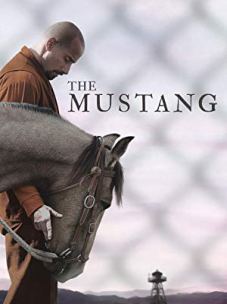


(Acclaimed movies I have yet to see: “Little Women,” “Uncut Gems,” “Portrait of a Lady on Fire,” “The Lighthouse,” “Queen & Slim,” “Varda by Agnès.” One that conspicuously didn’t make the cut, Noah Baumbach’s both flat and histrionic “Marriage Story.“)
* Bonus fun — Gaseous, over-worshipped disappointments by auteur royalty:

A freestyle digest of stuff — anecdotes, lists, thoughts, opinions …
 In 2007 I interviewed actor Paul Rudd at the South by Southwest Film Festival in Austin, Texas. He was charming, funny and absurdly laidback. As he answered one of my questions he blurted out a lengthy, earth-rattling burp. “Whoa,” I laughed, “what flavor was that?” Rudd replied: “You know what’s weird? It wasn’t a flavor so much as an actual scent, like a potpourri, a mixture of peppermint and brisket. I went to (barbecue joint) The Salt Lick last night, and I ate brisket. I’ll tell you something: It was very different than my Nana’s brisket.”
 Ben Lerner’s “10:04” is a breed of intellectual masterpiece, a novel I’ve praised here before. His 2011 debut “Leaving the Atocha Station” is also remarkable, the work of a poetic brainiac with torrents to say, crackling with life observations. His new novel, “The Topeka School,” is his most acclaimed yet — and I’m not sure why. I read fully half of it, and while the writing is pristine, the thinking impressive, I got lost in the choppy, distracting narrative thread. Unmoored, I put it down, migraine emerging. Yet I’m not through with the scandalously young Lerner. I’m taking “10:04” on my 14-hour flights to and from Japan — my third communion with that radiant auto-fiction.
My list of favorite cities has shifted just-so over time, and will likely keep doing so. For now: 1. Paris (eternally tops); 2. Istanbul; 3. Tokyo (this may change after my upcoming visit); 4. New York; 5. London; 6. San Francisco; 7. Sevilla; 8. Amsterdam.

The New York Review of Books is hallowed home to academic think pieces about all things, from politics to poetry, by some of our most prodigious and stylish writers: Zadie Smith, Adam Kirsch, Marilynne Robinson, Jonathan Lethem, Rachel Cusk. Why then do I find the essays gassy, tedious, enervating, as long and dry as the Sahara? Never, not once, have I read more than a third of one. (It’s me, I know.)  Rightful cult classics, “John Wick” and “John Wick: Chapter 2,” starring a lank-haired, bullet-proof Keanu Reeves, are action-flick orgies, chop-socky pistol poetry of a kind unseen since the heyday of John Woo’s “The Killer” and “Hard-Boiled.” I could barely wait for this summer’s “John Wick: Chapter 3 – Parabellum.” And then, ugh. Grindingly repetitive (though that urban horse chase is nifty), drawn out and mired in its own smug formula — with a wider narrative scope that attenuates rather than expands the affair — this one is all diminishing returns. The film runs 131 minutes. I quit it, bored, fatigued, with 40 minutes left to go. This Wick is no longer lit.

It’s still hard to reckon, a year after his death, that American novelist Philip Roth never won the Nobel Prize in Literature. Like most awards, it’s a scam, a sham. Roth was one of the greatest, dwarfing most writers who have indeed won the prize. That he received only a single Pulitzer — for 1997’s astonishing “American Pastoral” — is itself a gross dishonor. Every once in a while this pops into my head and I get all rankled. 
Gusty and blustery, a wind storm howls, churning treetops like crumpled paper, flinging acorns that pelt cars and roofs, dropping like small rocks, falling leaves twirling, the house creaking, windows rattling and Cubby the dog, shaking, leaps into my lap, where he curls into a donut, glancing up with fraught brown eyes that say, simply: “Papa.” This lasts all day. 
When I wrote about film in Austin, a particular local celebrity didn’t like me. That’s because I didn’t write super stuff about her — one Sandra Bullock. I thought she was a cutesy hack, all dimples and snorts, with dismal taste in roles. Knowing she told a colleague that she wanted my “head on a stick,” I won’t deny a small surge of pride.

As people grow up, they internalize this idea that wondering about death is ‘morbid’ or ‘weird.’ They grow scared, and criticize other people’s interest in the topic to keep from having to confront death themselves. … Most people in our culture are death illiterate, which makes them more afraid.” — Caitlin Doughty

Children, meanwhile, fueled by unfettered curiosity and innate innocence, don’t always harbor silly adult fears of death. They’re allowed to, expected to, wonder about death and dying. It’s a learning process; it’s not “morbid” or “weird.” It’s eye-opening, mind-inflating. Asking questions about it is a step closer to not being “death illiterate.”
The quote topping this post is from Caitlin Doughty’s new book, the funny and informative “Will My Cat Eat My Eyeballs?,” whose subtitle is “Big Questions From Tiny Mortals About Death.” That means both wiggy and weighty queries from children about death, inquiries she routinely receives as a death-chick rock star: mortician, author, podcaster, “death activist” and “funeral industry rabble-rouser.” In the book Doughty answers 34 kid-friendly (well, kinda) questions about death and dying, and a bit beyond.
A total pro, her attitude is cheeky, frisky and upbeat, often with a wink. It’s hardly just kid’s stuff. She applies sweeping research and her own mortician’s know-how, a braid of science, craft, technology and, unavoidably, morbidity. It gets gleefully icky at times.
Doughty goes into gripping, grisly detail about livor mortis (“bluish color of death”), rigor mortis (“stiffness of death”), putrefaction, embalming, burial, cremation ovens, blood draining, organ donation, and, #1 on the hit parade, postmortem gas.
And she does it with oozy, crunchy, gelatinous eloquence:

Now, on to questions, a sampling of the kids’ queries, which on average yield two- to three-page responses in Doughty’s book. In brief, inquiries include:
About the book’s titular question, “Will My Cat Eat My Eyeballs?” — this refers to the dreaded scenario of you dying alone in your home, your corpse left for days and your unfed pet, well, getting hungry. Doughty relishes this one.

“No, your cat won’t eat your eyeballs,” she writes. “Not right away, at least.”
That’s the short answer.
The longish answer shivers with excitement:
“Cats tend to consume human parts that are soft and exposed, like the face and neck, with special focus on the mouth and nose. Don’t rule out some chomps on the eyeballs,” Doughty says, but more likely your feline friend will dig into the lips, eyelids and tongue.
And what about Pepi the peaceful poodle, human’s best friend, your cuddle buddy?
“Your dog will totally eat you,” Doughty assures.
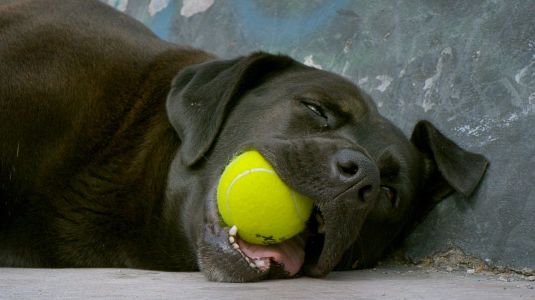
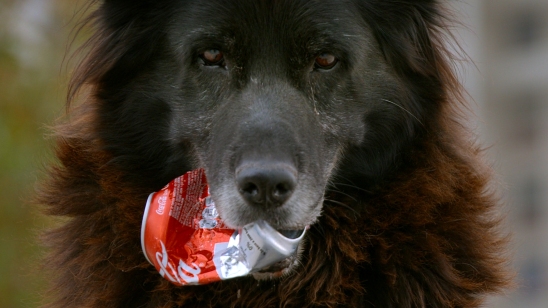
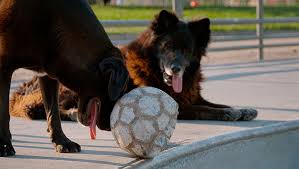
“We die — that may be the meaning of life,” said author Toni Morrison, who died Monday. “But we do language. That may be the measure of our lives.”
I‘ve tried many times to watch “The Princess Bride,” “Stand By Me” and “When Harry Met Sally,” but I’ve never been able to get through any of them. They are ham-handed. They aren’t funny. They clunk. That Rob Reiner directed all of them is strictly coincidental.

I swear, Cubby the dog has a perverse crush on the female cat Tiger Lily. He gawkily flirts with her, and her eye-rolling indifference is touching. Such inter-species passion is a spectacle. I sure hope I don’t see a newborn kitten that barks.
I jot in my journal pretty much every day with purpose and the fugitive hope of substance. The author Yiyun Li writes, “How did I forget to start each and every page of my journal with the reminder that nothing matters?” My head nods vigorously.
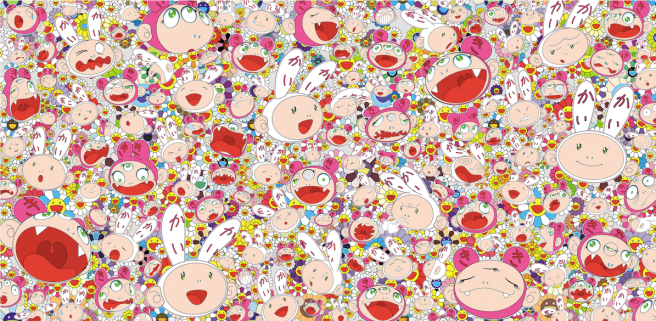
The last time I went to Japan I got hooked on the sizzling pop art of Takashi Murakami, whose work spans painting, sculpture, fashion, merchandise and animation. It’s fun and whimsical and dazzlingly colorful — and not a little geeky. His subject matter is cute (kawaii), psychedelic and satirical, with well-trod motifs: smiling flowers, mushrooms, skulls and manga culture. Murakami could be the Jeff Koons of Japan. I’m going there soon. My goal is to get Murakami’d, big time.
A few years ago I discovered I had an adult-onset allergy to shrimp and prawns. It’s like the second worst thing that’s ever happened to me.
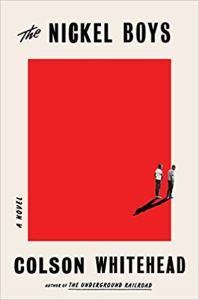
A fan of novelist Colson Whitehead, I’m deflated by his new, lavishly overrated book “The Nickel Boys.” It lacks energy, momentum and finally fizzles at the halfway mark. So I put it down (I also couldn’t get into his early novel “John Henry Days,” though I’m all about “The Intuitionist” and “The Underground Railroad”) and picked up Haruki Murakami’s “Norwegian Wood.” I’ve read one other Murakami novel, “The Wind-Up Bird Chronicle,” and I almost threw it against a wall. The edge is where I live.
Tonight we popped a bottle of Suntory Whisky Toki, “blended Japanese whisky that is both groundbreaking and timeless.” It is silky and smoky with strong, sweet vanilla notes. I think none of us is going to bed.
Quentin Tarantino has made 9½ movies. He has made only two masterworks, “Reservoir Dogs” and “Pulp Fiction.” That was a very long time ago. The rest of his oeuvre seesaws from juvenilia to junk. As critic David Denby wrote on the release of the imbecilic “Inglourious Basterds”: “Tarantino has become an embarrassment: his virtuosity as a maker of images has been overwhelmed by his inanity as an idiot de la cinémathèque.”
Intimacy is scary. Love is scarier. Someone recently dubbed the phenomenon “the terror of loving.” I like that. Its precision is chilling.
I am typing most of this in the air, row 45, seat G, on United flight 497 to San Francisco. You might say I’m skywriting. Forget I just said that.
There’s a monkey on my back.
Several, actually. And they want my money. Every time I open a website, they are there, pawing at me.
The animals are macaques, with pomegranate faces and heads hooded in fuzzy Eskimo parkas rimming wise, frowning visages of grizzled monks or mystics. They are bathing and grooming and picking at each other in hot springs at the Jigokudani Wild Snow Monkey Park in Japan. They look to be suffering chronic mites and fleas.
 They are world-famous monkeys; you see them in every other wildlife documentary, steam rising around their half-submerged bodies. These simian superstars are chillaxing in a simmering jacuzzi nestled amid frosty mountains. And they pick and pick.
I, for one, can’t avoid their pink, pensive faces. They want me to come visit them, terribly. Ever since I began researching hotels, food tours and day trips in Japan, the insistent monkey pop-up ad, hectoring click-bait, has infiltrated all of my most visited sites, from The New York Times to Rotten Tomatoes. I can’t get the goddam monkeys out of my sight. Fortunately, they’re cute and furry. Unfortunately, they’re expensive.
For about five seconds it’s tempting to actually take the ad up on its offer with a simple click: $146 for eight hours of touring, including one (one!) hour at the monkey sanctuary; time at the famed Zenko-ji temple; lunch; some sake sipping; and, really, not much else. Bullet train transportation is not included (rip!).
And can you believe this: “Guests are not permitted to touch, feed or bathe with the monkeys at any time.” I guess I won’t be bringing a towel and a bar of Dial.
So the deal effectively stinks, even if you do get a brief (dry) encounter with the enchanting, lightly parboiled macaques.
Yet more caveats abound, and they are dire. I came across an alarming blog post titled “Why Seeing the Snow Monkeys in Japan Sucked” (read it in full HERE). A grisly excerpt:
“Instead of a snow-covered paradise, I was standing in what felt like a construction site full of rubble, with piles of rocks and exposed cables forming a backdrop against the commotion. I watched in dismay as staff at the Jigokudani Monkey Park threw food at the agitated macaques until they began to screech and fight on the damp mud. This was one of the worst animal encounters I’d ever experienced.”
No monkeys for me. See no evil, hear no evil, speak no evil. Click no evil.


