One magnificent mollusk

Coiled near its rocky den, the octopus slowly unfurls a tentacle like a flower blooming in a time-lapse photo to the human hand before her. It glances the hand then suddenly sucks it, gently pulling it toward her. The moment carries the pitter-patter of courtship, of holding hands for the first time. Could this be love?

“That’s when you know there’s full trust,” says the owner of the suction-cupped hand, free diver and filmmaker Craig Foster, in his remarkable documentary “My Octopus Teacher.” A viral smash, the Netflix film has been shortlisted for the best documentary Academy Award. Really, it deserves a special accolade, say, Best Buddy Picture Between Man and Mollusk. The movie is something else: devastating octo-poetry. 

A simple story about a grown man befriending a gorgeously slithery cephalopod in the swaying kelp forests of South Africa, the film depicts the burly, soft-spoken Foster as a dedicated student of the ocean who is truly moved by the relationship he forges over a year with the sea animal that remains unnamed. (I suggest Octavia.)

Part of his lesson is noticing the striking similarities between us and these “alien” creatures, the way connection, interspecies or not, is essential and a well of bracing contentment. “It does give you this strange level of octopus joy,” notes Foster, saying words that have likely never been uttered before.

As a pupil, Foster is a keen observer, learning by watching his silent friend do what she does: hunt, hide, jet, crawl, swim and, sometimes, walk on two legs on the ocean floor. That trippy spectacle, both funny and boggling, is one of many scene-stealers.

She’s a gelatinous chameleon, enacting stunning physical transformations with her bulbous head, serpentine legs and polka-dot suckers to blend seamlessly into the Day-Glo surroundings. Her effortless shape-shifting is part of the movie’s multi-pronged magic.

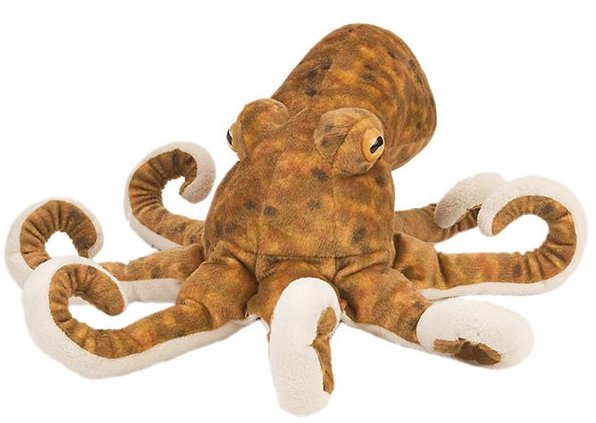
“My Octopus Teacher” reminds me of many oceany things, like the charmingly odd adopt an octopus campaign at the World Wildlife Fund, where for a $55 donation you get a plush stuffed octopus, a photo, an adoption certificate and other tentacular goodies. It never occurred to me that octopuses were endangered, but WWF says they’re “vulnerable to toxins and pollution,” yet doesn’t that cover just about everything? (Please send me $55. I am endangered. My plush doll is amazing.) 
As much as I love watching the delightful octopus in the movie, I love even more putting octopus in my mouth. Almost unavoidable on midscale restaurant menus — perhaps another reason they’re endangered — grilled octopus is hot stuff, up there with bone marrow and short ribs. Both chewy and silky, the meat has a mild sea-foody flavor complemented by a good fiery sear. Here’s a spectacular piece I scarfed in Barcelona:

I don’t want to eat the movie’s affable octopus. She’s a darling — adorably clever, wily and pretty, much like the picture itself, which is also fairly wrenching (brace for some drama). 

It’s an elemental tale rife with homey pleasures: the hand holding, the snuggling, the mutual respect. The bond is inexplicable but palpable, right there on screen, like when Foster’s new BFF seems to be tailing him through the sea.

“That’s one of the most incredible feelings,” he beams, “to be followed by an octopus.”

It’s fantastic, and it almost breaks your heart.
Loving animals, doggedly

As I was scratching the dog’s belly today, he squeaked out a tiny fart that I excused him for since, as far as I know, he can’t speak English and isn’t versed in basic human etiquette. I kept scratching and he emitted customary groans that I tend to interpret as vague doggie ecstasy. Sounds coming from both ends, très stereophonic.

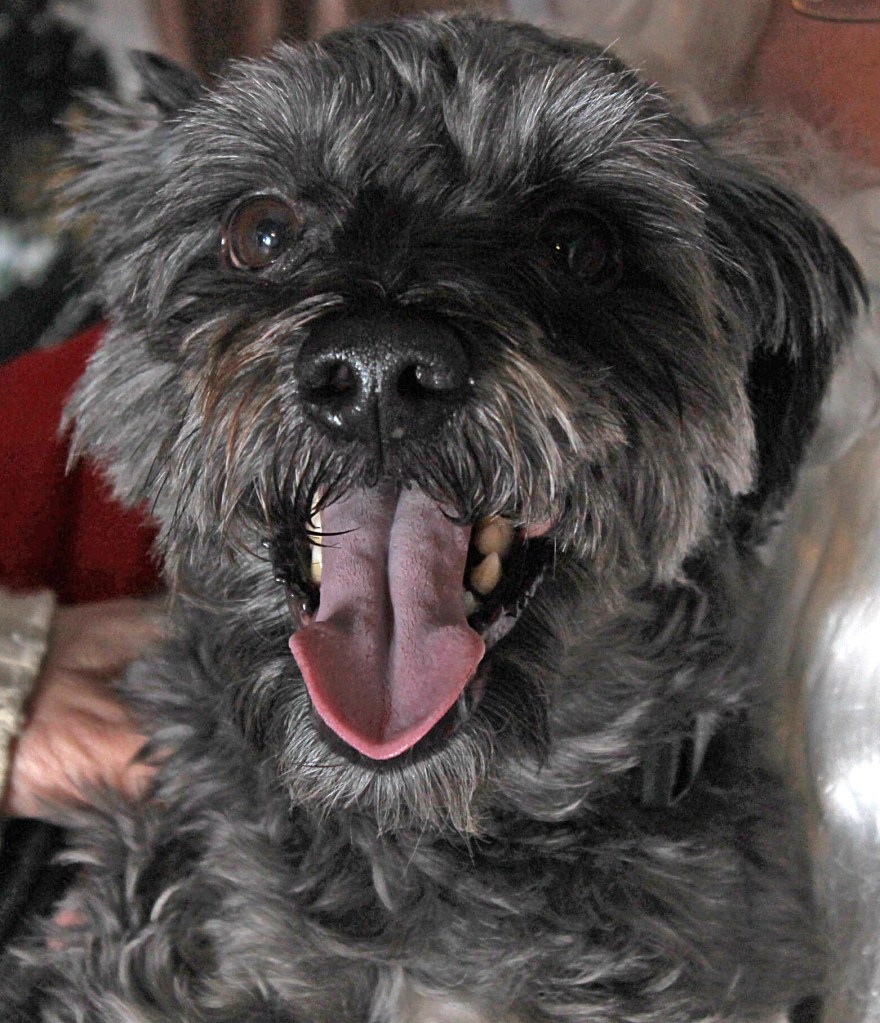
Cubby the Wonder Mutt likes to lie on his back, supine, head tossed back, eyes squinched, rear legs spread-eagle, his pee-pee out in all its centerfold glory. He’s a good dog, as they say — always “good,” never “great” or “fabulous,” why is that? — even if he resembles one of those diabolical pygmy hellions, an Ewok. Compare, contrast: 

OK, not exactly, but sometimes I glance at him and scream in fleeting horror.

Animals, like ol’ Cubs, are always on my mind. For some reason, I’ve been watching more YouTube junk than normal and it seems like half the videos are prefaced with ads for heart-curdling, soul-gutting animal causes. 

They’re the kind that show emaciated puppies and starving bony horses and shivering dogs with so much eye goop they can barely see. It screws everything up. I don’t even feel like watching the video I was set to watch after those damn commercials. 

They get me every time. So there I go, helplessly dropping cash into the coffers of PETA, the Humane Society and other groups, like the crazy one for abused donkeys in India and the World Wildlife Fund’s stupendous adopt an octopus program. 

And I recently joined the ASPCA’s modest monthly membership, which amounts to an obscenely affordable 63 cents a day. I told them to save resources and keep the free t-shirt, which would only wind up as a dust rag. Pretty soon, thanks to all my donations, I’m going to own about 14 complimentary animal calendars that I really do not want.

I think I’m so nuts about animals and their welfare because I was raised with a rotating menagerie of pets: dogs, cats, rats, turtles, fish, rabbits, hens, salamanders. And I was scarred by “family” films like “Old Yeller” and “Where the Red Fern Grows” that only make you love animals more and hate sadistic filmmakers. Even “Charlotte’s Web” planted a screwdriver into my heart, and she was just a crummy spider. (Even now I don’t kill spiders. I scoop them up and plop them outside.)

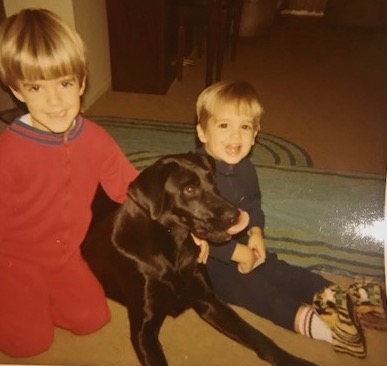
I hate to rate my animals, but since Cubby is in the other room probably flashing the neighbors on his back, I present the best dog my family ever had, a black Lab dubiously named Spooker. That’s her below, the one flicking her tongue. (I’m the one with the righteous tiger slippers; my brother Craig sports the scandalous red onesie.)  

Usually when I profess my love of animals I essentially mean dogs. I care a lot about monkeys, mice and manatees, but I can’t say I love them. Even as tykes, you can see how much we love our big black Lab, our companion, our third parent, protector and pal. Dogs are furry clichés: loyal, cheerful, eager, bursting with unconditional love, even if that means the occasional, totally misguided leg hump. That’s a pretty good package. 

Cubby fits the bill. He sort of represents all animals for me — penguins, porpoises, platypuses, the random narwhal — and so by caring for him I’m embracing the whole animal kingdom. 

That sounds super corny, and re-reading that sentence makes me shudder. But it’s true. Cubby contains multitudes. He’s small in body, big in heart. He lavishes affection on us and only asks in return walks, food, and heartfelt belly rubs, the kind that make him groan and wheeze like a 79-year-old with emphysema. Sometimes if you press just right, he produces the tortured warbling of bagpipes. Then he slowly passes out.

A good dog indeed. No. A great dog. How about a fabulous dog.

Turning the page, in literature and life

These days, I seem to only get high on the fumes — the thick, inebriating perfume — of words. I just read a fine passage in my current book and it brushed the orgasmic. To write like that, to make literary music, is the best thing, the very best thing. It matches, maybe surpasses, love.

Too much? Too loopy? Probably. But great art does that — it makes you dizzy. During the pandemic captivity, I’m reading with fiendish greed, in oceanic gulps. I’m buying with crazy zeal. And you probably can’t get that book you want at the library because I already checked it out. Terribly sorry.

More than ever, I grab the written word for solace, inspiration and spiritual nutrition. Yet while I crack mounds of books, I don’t always finish them. I am a notorious book-slammer, shunting aside titles that don’t rivet me by page 50 or so. Mediocrity won’t cut it. I’ve had enough meh, oof and blah. Especially this year.

These are grim days — both of my parents died in the past year; the Covid terror seethes; the Trump shit-show blunders on; some personal turmoil has body-slammed me; pick your catastrophe — and lots of us look to art for escape, empathy and temporary amnesia. 

Art extends beyond the written word, of course, so I’m still listening to music, watching films and TV shows and streaming all manner of streamy abundance. 

Stuff that stands out: the wise, tartly funny Pamela Adlon comedy “Better Things,” in which Adlon plays a frazzled single mother of three offbeat daughters and simply tries to, well, cope; the bizzaro “Pen15,” a cringe comedy starring two 30-something women playing seventh graders with boggling juvenile verisimilitude; and “The Crown,” that tea-time telenovela about British royalty that entrances, despite me caring less about the real Royals than I do about carbuncles.

“Pen15” (yes, these ‘girls’ are really in their thirties)

I always have to nitpick at year’s end, too. Always. If the just-fine though room temperature chess drama “The Queen’s Gambit” missed the sublime, it ably outclassed other hot streamers, like the broad, shrill “Schitt’s Creek” and the animated “BoJack Horseman,” whose mordant mopiness was mistaken for hip profundity. (Speaking of adult animation, does anybody still watch “Archer,” the subversive, devilishly clever cartoon on FX? Join me.)  

Thanks to Covid-contorted release formats, I’m behind on new movies, especially presumptive Oscar contenders. I did try to watch David Fincher’s tediously diffuse “Mank” but couldn’t finish it, and, yes, I can tick-off all of its esoteric Hollywood references. I’m skipping Spike Lee’s Vietnam fantasia “Da 5 Bloods” for two reasons: It doesn’t look very good and Lee’s track record of great films is plain disheartening. (I will also be skipping “Wonder Woman 1984,” grumbled grandpa.)

This is what kind of year it’s been: Mere weeks ago I watched and can recall almost nothing about the admired indie “First Cow” by Kelly Reichardt, one of my favorite minimalist filmmakers, except that some guys make yummy biscuits. I’m renting the scruffy period piece again to see what I’m blanking on.

Movies I’m looking forward to include the adaptation of August Wilson’s “Ma Rainey’s Black Bottom”; Frances McDormand in “Nomadland” (by the director of 2017’s extraordinary “The Rider”); the viral documentary “My Octopus Teacher,” about a grown man befriending a gorgeously slithery mollusk; and Frederick Wiseman’s typically sprawling doc “City Hall.”

“My Octopus Teacher”

And yet for all that — let’s swoop back to the start of this entry — books are my sweet spot right now. In the past few tumultuous months I’ve savored “Those Who Leave and Those Who Stay,” the ravishing third novel in Elena Ferrante’s four-part Neapolitan series; Jess Walter’s jaunty period saga “The Cold Millions”; and “Leave the World Behind,” Rumaan Alam’s quiet thriller about race, class, marriage and other thorny things.

But what’s providing the most satisfying literary kicks are titles from the New York Review Books Classics series, an eclectic spread of fiction and nonfiction from the past, each book a minimally designed paperback that bespeaks worldly elegance. Called “discoveries” by the publisher, the books are “established classics and cult favorites, literature high, low, unsuspected and unheard of.”

I now own 13 terrific novels from the series, with another  — Leonard Gardner’s gritty boxing drama “Fat City” — on the way. Today I’m reading the noirish “Nightmare Alley” by William Lindsay Gresham (midgets, mediums, mendacity). Before that was the twisty, eerily timely crime thriller “The Expendable Man” by Dorothy B. Hughes, who wrote cult classic “In a Lonely Place,” part of the series I also devoured. 

My NYRB Classics collection

What’s getting me is the power of words, the emotional and psychic heft, the sheer salve of art, and the attendant awe. I’ve always loved books and any words on paper (and screen), but I seem to love them more in the rotten times, a stretch so shitty, I haven’t touched this blog in over three months. I hadn’t the urge nor the heart. Fall, my favorite season, gone wasted. 

Maybe I’m uncoiling from a prolonged flinch. I don’t know. But this, now, during some of the very bleakest days, is where I’m at. Turning the page in another chapter.

Freud, meet Fido

And so the dog, small and fleecy, plops down for a nap on the couch, and he is out. Which means at any moment the show will commence, an alternately startling and amusing bugaloo of twitches and flinches, pop dancing by way of late Katharine Hepburn and robot street performers. Cubby, the peerless pup, is about to dream. And it’s a marvel. 

Behold, he’s off. Stubby legs kick and quiver. Furry eyebrows twitch. Lips tremble and emit muffled woofs and squeaky whines. As he hyperventilates, his rib cage rises and falls, a small basketball being pumped. It appears he is running in place. Outstanding.

Until, that is, I recall how traumatic dreams can be. Mine, at least, are nocturnal ordeals, dark and gnawing, filled with ragged memories and wraithlike faces from prior lives. They’re about 35% anodyne and 65% anguish. I typically awake from them with a small head throb, a daub of sweat, an aftertaste of dread: the dream hangover. I might as well have met Freddy Krueger.

dog-dreams-about-you-dreaming-dog-750x440
This is not Cubby, but you know he’s ecstatically dreaming.

So, no matter how entertaining his dream exhibitions are (oh, and they are), I worry about the substance of Cubby’s nap-time reveries. What’s he woofing at? Why the whine? Is he chasing, or being chased? Is he yawping at the postman, as in everyday life, or is he after an intruder? Is he playing with us, scampering off with his crazy bone?

Whatever is happening, he is assuredly dreaming. Anyone with a dog knows they do this. One doggie site says “dogs are similar to humans when it comes to sleep patterns and brain wave activity. Like humans, dogs enter a deep sleep stage during which their breathing becomes more irregular and they have rapid eye movements (REM).”

Bonus factoid: “Research suggests that small dogs dream more than larger dogs. A Toy Poodle may dream once every ten minutes while a Golden Retriever may only dream once every 90 minutes.” Meaning, compact Cubby is a dream machine. (“We infer that dogs can have nightmares, too,” adds the American Kennel Club, with worrying certitude.)

Sometimes Cubby’s slumbering exhalations sound heavy, husky, demonic. Is he having a nightmare, or is he being naughty and promiscuous? Maybe he’s rocking a death metal show. “The dream is the liberation of the spirit from the pressure of external nature, a detachment of the soul from the fetters of matter,” wrote Freud, the original cigar-sucking dream guru. He added: “Dreams are never concerned with trivia.”

So maybe Cubby isn’t just frolicking with a bone during his alarmingly kinetic dream states, which resemble nothing less than a buckling seizure or a zippy electrocution. I’ve said here that Cubs is a deep character, a wise old soul, vigorously seeking meaning in his transience, pawing to the bottom of the mysteries of the conundrum called life. Merely chasing cats is unworthy of his elevated subconscious; sniffing Bowzer’s butthole is extravagantly beneath him.

The id, that deep sea of sloshing neuroses, engenders the happy and the hellacious and everything in-between. In sleep, you might trip joyously in love — or you might be scorched to a pork rind by a weirdly random dragon. Closing eyes, placing head to pillow, is a fraught crap shoot. 

Cubby’s not dreaming about dragons, we’re certain of that. His purview is relatively minuscule. Despite his rich introspection, I’m pretty sure he doesn’t know what TikTok, J.Lo or The Rock are.

I’m also sure I will never know what populates the dog’s leg-twitching dreamscapes. In the end, it doesn’t matter. Yet with Freudian reflection, I will ponder these deep enigmas. Let me sleep on it.

Homebound, book-bound

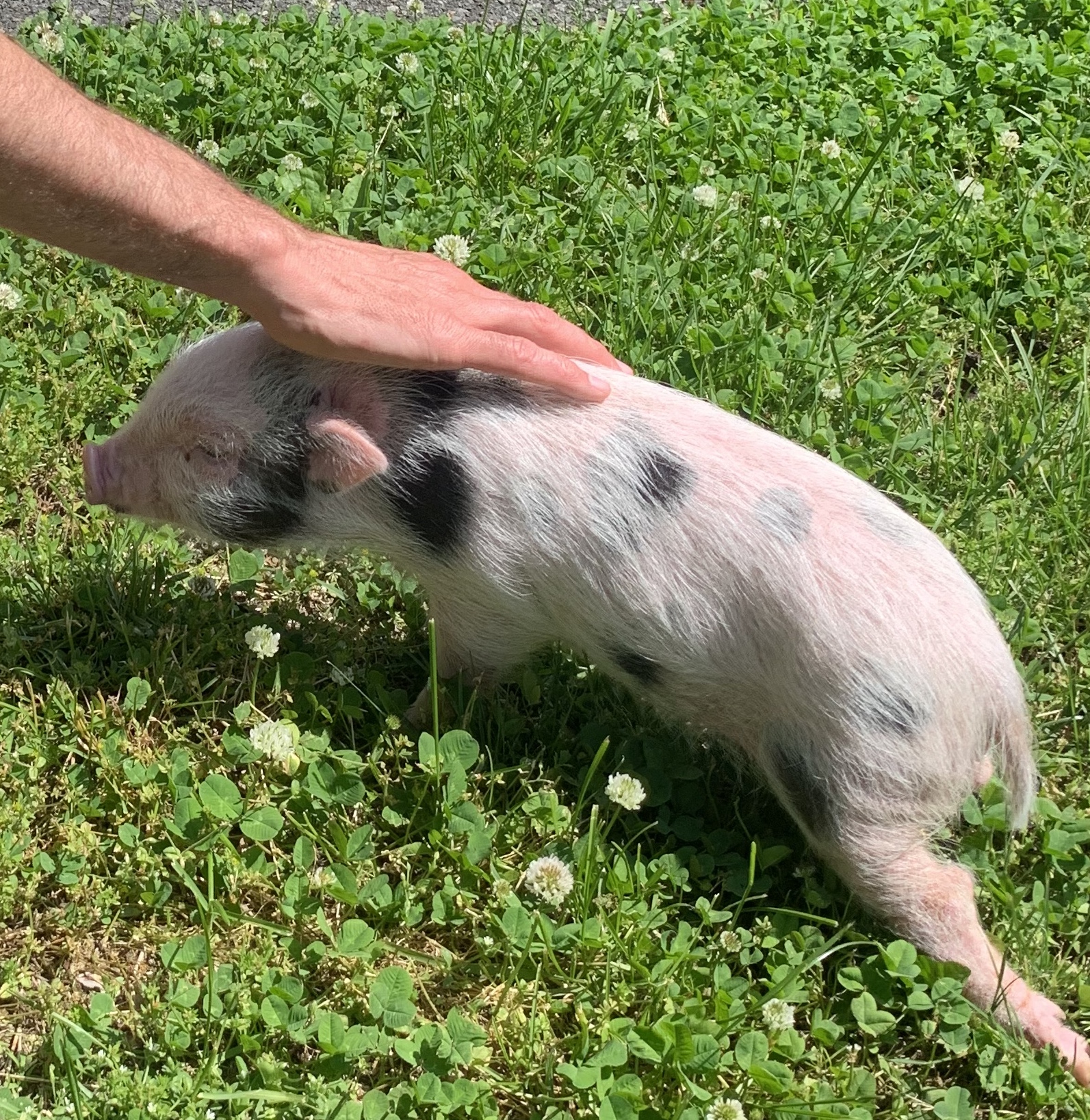
The neighbors down the street have acquired a tiny spotted piglet and that means nothing, because that’s not what I’m here for. Just thought I’d mention it as a friendly neighborhood bulletin, despite its thoroughgoing irrelevance to anything on this page.

I’m here to talk books — books I’m gathering around me like a collective paper blanket during the sheltering in place (my least favorite term for the eternal quarantine). I have mentioned I’m ordering new and used books hungrily, and now the stacks are rising precariously. Somebody stop me. 

51ha+QWsOXL._SX329_BO1,204,203,200_

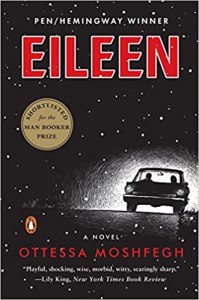
Over time I’ve read three or four novels and story collections by the daring, queasily beguiling Ottessa Moshfegh, whose darkly defiant streak, which runs from addiction to murder, poop to pathologies, has never been as palpable as in her 2016 debut “Eileen.” I just gobbled up the slim novel and I’m savoring its bitter aftertaste. I wanted to be ready for Moshfegh’s much-anticipated novel “Death in Her Hands,” coming out in two weeks. Hardly a spoiler: It’s being called perverse and strange. Bring it on.  

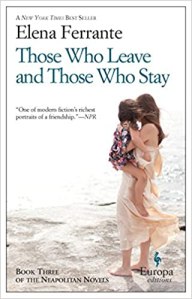
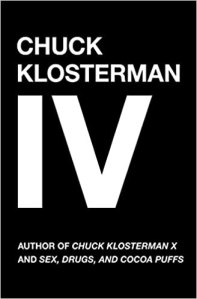
In a snap of energetic laziness, I skipped the first two books in Elena Ferrante’s universally lauded series The Neapolitan Novels, which kicks off with “My Brilliant Friend,” opting instead to watch the first two parts in the epic HBO adaptations (luminous, devastating). Now I’m into the third book, “Those Who Leave and Those Who Stay” and it makes me anxious: How much lush, moving prose did I miss by not reading the first two books? Yet another literary project materializes. 519LmMYfn-L._SX318_BO1,204,203,200_There’s a handful of hip, youngish, mostly male writers I avoid because of both their grating public images and callow, look-at-me writing (see ya, Dave Eggers). Journalist Chuck Klosterman, who specializes in rock and pop culture at large, has always made my belly twist at the teensy bit of his I’ve read in the likes of Spin magazine. He’s published loads of essay collections, like “Sex, Drugs, and Cocoa Puffs” and “Chuck Klosterman IV: A Decade of Curious People and Dangerous Ideas,” the latter of which I swallowed hard and purchased. Surprise — it’s damn good. With a mix of irreverence and shaggy erudition, humor and a swingingly unadorned style, the author asserts a penetrating, smarter-than-his-subjects but not condescending attitude on everyone from Britney Spears and Radiohead to Metallica and Robert Plant. A pop culture polymath, a smart-aleck with a laser-pointed pen, Klosterman is good company.
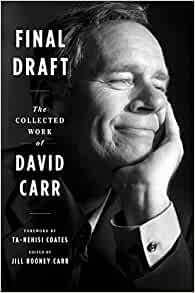
41N3Bj9x7IL._SX326_BO1,204,203,200_Also a delight are the words of the late David Carr, the New York Times media columnist who in 2015 dropped dead in the Times newsroom, a fact that might have tickled the celebrated super-journalist. “Final Draft,” a new collection of his writing from the past 25 years, reveals a passionate pro and consummate stylist at his best. We get reportage and ruminations on racism, personal addiction, media blowhards, personalities and the often checkered texture of journalism itself. Carr was a star. This book shows why. Unknown And now, the pig:
IMG_6001

Dog Splayed Afternoon

CubbyThis is Cubby, über-hound, chillaxing on the cool wood floor on a balmy late-spring day. Sprawled out in sharp symmetry, almost X-shaped, he looks like a doggie cookie-cutter, or the puppy piece in Monopoly, or a pendant dangling from the neck of a dog lover of strenuous devotion. In a word, he looks amazing. Like an artwork Jeff Koons could only dream of, or a taxidermist’s dampest fantasy. He would look stunning on a mantel, a small, regal canine, with a muzzle oh-so fluffily bearded.

Cubby knows none of this. If he had heard the above during his spread-out siesta, he’d be all, “Enough. Leave me alone. I am napping on the cool floor, dreaming of squirrels, fire hydrants, and fat kielbasas. You are a ridiculous man. Be gone … zzzzz.”

What we have here is a tableau titled, say, “Dog Day Afternoon.” Or “Dog Splayed Afternoon.” Some kind of post-modern still-life William Wegman could appreciate in all its unposed dogitude. (Although, of course, Wegman meticulously poses his long-suffering Weimaraners, what with their fancy clothes and anthropomorphic exertions.)

So what we have is less Wegman and more found art. Cubby, surely warm under that carpet of curls, located open range in the cool foyer, plopped down and stretched out from his head to his pom-pom tail. He exhaled and sighed: Goddam.

And this is how we found him, still as a statue, a statue of such accidental perfection it might be worth lots of money. Certainly, because his preternatural pose notwithstanding, Cubby, that cuddliest of canines, is worth a million bucks.

Buyers?

You must remember this 

I own a stockpile of childhood memories (a disproportionate number of them featuring poo) that I access often and for the most part fondly — distant, dreamlike time travel that reminds me I’m alive and have lived. 

Randomly: There’s the time my mom got sprayed and drenched by a blubbery walrus at SeaWorld when I was 8. My first real kiss with Stephanie when I was 12. My dad taking us to a live taping of “The Tonight Show with Johnny Carson” at 14. Playing drums in my first professional rock concert at 17. And when a kid peed all over my back while I was stationed at a urinal in the boy’s bathroom. I was 7, and wearing a brand-new shirt to boot. Yeah, I bawled. (The fact that I never made a voodoo doll of that kid is miraculous.) 

Those are youthful flickers. I’m skipping adult flashbacks — like when I was detained by Hezbollah in Beirut, or when I got acupuncture and almost puked — in favor of more faded scrapbook pages, not all of them fully innocent or delightful, but mostly far enough in the past that any sting has been blunted. (Strike that: a guy pissed all over me.) 

It’s smart to wax philosophical about these things. “Memories warm you up from the inside,” writes novelist Haruki Murakami. “But they also tear you apart.”

True that. I harbor some memories that are seared in my consciousness as if by a cattle brand, and I wince to this day. Still others are sublime and soaring, pleasures to revisit and revel in, visions that, as Murakami says, “warm you up from the inside.” Memories are agents of powerful, sometimes bulldozing, emotions. They hit you right here. They are not to be trifled with.

Summer memoriesMore remembrances, good, bad, ugly: At age 9, my best friend and I got our impish hands on some shotgun shells and threw them into a backyard fire in hopes they’d blow off (they didn’t). Selling lemonade from a curbside stand, my gal pal and I — we were about 7 — beseeched a passing teenage driver to buy a tasty beverage. He flipped us off. We were scandalized between giggles. My black Lab killed the neighbors’ cat. A few of us mischief-makers planned to dig a giant hole, cover it in leaves, and invite a neighbor kid over to fall into the pit. Digging the hole was so hard, I abandoned the plan within minutes. 

These are piquant memories, fragmentary yet oddly enduring. Evoking them — like seeing that dead horse in the road after it was hit by a car when I was 6 — is bittersweet.

I retain a catalog of episodic nostalgia, musty but living organisms that are easily accessible and flicker like short films across slabs of my brain: the hippocampus, neocortex and amygdala. Exhuming them is akin to fanning a Polaroid, waiting to see the image, with great and terrible affection.

Fido meets the face mask

What, social distancing with the dog? Six feet apart? Are we going to scratch his belly with a broom stick? Throw the ball and ask him to please not return it, or to drench it in Purell first? And, pshaw, a mutt mask, too? How is he possibly going to blithely lick his loins?

Fortunately, most of this scenario is wryly fictive. Yet we tried the face mask and the bristling, headstrong Cubby was having none of it. He ate it. Cubby, so marvelous he should wear a cape, isn’t falling for all this preventive Covid-19 twaddle. He scoffs, nay, woofs, at it. 

dogmask
Not Cubby. Just a stunt dog.

Is he being irresponsible, a paragon of screw-you selfishness? Is he following in the paw tracks of our dear leader in all his voluptuous stupidity? Is Cubby, heaven forfend, a far right anti-vaxxer, who protests outside capitols to “liberate” shut-down states? Is it OK to put down a dog that is spry and healthy but whose mind is politically poisoned?

We go too far. The dog is none of that, despite his puzzling penchant for “Fox & Friends.” He’s actually kind and magnanimous. He’s wise, thoughtful, deep. He’s voting for Biden. He’s a good dog.

Rossy is a good dog, too. Who is Rossy? This is Rossy: 

rossy-blog-768x576-1.jpgRossy, in a word, is a charity case. A sickly street dog, Rossy was taken in by the brimming hearts at Animal Rahat, an India-based rescue sanctuary for all manner of “beleaguered animals,” which I previously mentioned here. Rossy is goo-gooed over by visiting school children and hangs out and plays with the local menagerie of misfits over acres and acres of open land. 

This pampering paradise “allows elderly and ailing animals to be retired from lives of daily toil” and rescues imperiled pups and other critters from assorted accidents (falling into wells is a big problem). Nursed back to health, dogs and donkeys and camels and cows roam free, routinely fed, bathed and lovingly socialized. 

As he watches me type this, Cubby’s curly ears prick up and his head cocks to the side. We are in a donating mood during this deepened charitable moment when giving is grace. 

I lean toward animal causes — local shelters, the Humane Society, ASPCA, PETA, Animal Rahat — all of which have plucked my heart strings with the virtuosic brio of Eddie Van Halen playing “Eruption.” It’s music to my ears.

Himself a rescue pup, Cubby is also pledging gifts to these groups, his furry families, though I’m not sure what he can contribute; he’s rather broke. Could it be the tooth-scarred bully bone? The moist, balding tennis ball? The mini Yoda doll, both squeaky and skeevy. (Dog slobber — destroyer of worlds.)  

It doesn’t matter. I’ll spot him with my monetary donations. Watching me is a good lesson in altruism during these darkly divisive times when much of the country is in suicide mode — no masks, frolicking on crowded beaches, flagrant body contact, toting large guns in packed public spaces — and the “president” advances brain-exploding lies, toxic misinformation and Machiavellian myopia.

Speaking of individuals who elect vanity over safety, Cubby still won’t wear a face mask. Even the mailman wears one, and his arrival at the porch is a cue for Cubs to shed his angelic image. He rockets off the couch, furiously scratches the paint off the door, barking and howling uncontrollably, like a very pissed-off banshee. It’s nearly cinematic.

We sigh. We yell. We shake a fist.

Hey, Cubby. Cut the crap.

Pin the tail on a good cause

I don’t care what they’re doing, where they are, or what condition they’re in — donkeys unfailingly crack my heart. That includes old brooding Eeyore, even if his despondency seems almost willed, like the chump shrugged and gave up and became a droopy black cloud of clinical donkey depression. (How does chipper Pooh put up with him?) 

Eeyore, a stuffed animal held captive by Disney, isn’t my concern. It’s real donkeys, which always look pitifully downcast, afflicted and abused. I’ve seen them in Egypt, Turkey, Syria, China, Thailand, India, Mexico, Morocco. These distant relatives of horses are exploited largely as beasts of burden, weighed down with pound after backbreaking pound of cargo, whipped and lashed, mostly in Asia and Africa. In China, which owns the bulk of the world’s 41 million donkeys, donkey meat is a delicacy. (Alongside cat, dog, rat, shark, horse, snake, porcupine, raccoon, deer — it’s a hell of a menu.)

I was reminded of the donkey plight — I generally try to banish thoughts of wretched pack animals — when I was distracted by an online ad for the Indian animal sanctuary Animal Rahat, which rescues cows, bulls, dogs, birds, camels, snakes, donkeys and more from rampant hazards, neglect and abuse across the despairing subcontinent.  

2007-03.donkeys-hauling-bricks-at-brick-kiln-4.jpgThe ad spotlighted donkeys, which, as mentioned, I reserve a soft spot for. Photos of emaciated, crestfallen, injured animals accompanied a plea to sponsor donkeys for as low as $12. That donation would provide vaccinations and antibiotics for 30 donkeys. I immediately clicked my PayPal account. (The donation funnels through PETA, which sends it to Animal Rahat.)  

The creatures have it as bad as imagined, and worse. Says Animal Rahat: 

“It’s a common belief in India that ‘beasts of burden’ don’t need as much nourishment as other animals, so they are commonly left to scavenge through garbage piles to find food scraps. It’s only a matter of time before our vets are called out to provide these neglected animals with emergency treatment after they swallow plastic and sharp objects.”

I read more, I donated more. I’m in the mood. I know this is Covid-19’s moment, but animal causes are in perpetual panic. The virus is exacerbating the situation. I’ve also given money to PETA, two local animal shelters and the SPCA. I’m sure I’ll do more.

The damn donkeys. They captured my heart, with those big dewy eyes, pointy vertical ears and stout mini-horse bodies. The mounds of bricks strapped to their backs didn’t hurt. Maybe I’m a pushover, a fool. Maybe I’m one of them, just an incurable jackass. Fine.  080319-8-blog-3-768x576.jpg

(“Rahat,” incidentally, means “carefreeness” or “insouciance” in Urdu. I like it. For more about Animal Rahat, go here.)