Lorrie Moore astonishes, still, her writing shiny, poetic and brainy, the best kind of literature. It’s massively, richly human, striking each note, from humor to horror and all in between. She’s a blistering deterrent for ever trying to commit fiction. If I can’t be that good, I don’t want to be anything — that’s my thinking. My stabs at fiction have been leaden, lame, laughable.
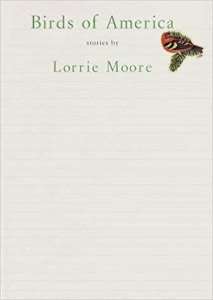
I am re-reading Moore’s acclaimed story collection “Birds of America.” On its release in 1998, a writer friend and I were both reading the book, and I told him that her writing made me jealous, defeated. “Oh, not me,” he said. “It inspires me.” (That from the guy who was a two-time Pulitzer Prize finalist in his early 20s.)
Today Moore’s ecstatic prose inspires me, too, provides oomph, a kick to my motivational motor, spurring me to tap the keys and say something, anything. That can be dangerous. If it’s any good, most writing is. (I know — that’s axiomatic.)
What I mean is, I can write stuff so sloppy, witless and rancid that it’s actually toxic — it wounds and discourages. Then I can pick up a book by Moore or her peers (say, Alice Munro or Tobias Wolff) and be pacified by sheer beauty and slashing craft and get revved again at the possibilities — the old can of spinach.
Moore’s written four story collections: “Self-Help,” “Birds of America,” “Bark” and the brand-new anthology “Collected Stories” from the prestigious Everyman’s Library Contemporary Classics. And three novels: “Anagrams,” “Who Will Run the Frog Hospital?” and “A Gate at the Stairs.”
I read the latter and liked it, but I don’t remember much about it. “Birds of America” is different. It’s stickier, droller, more dynamic, more prismatic. It’s spiky, empathic, bright and cynical. Though she’s no maximalist, less isn’t Moore:Her words contain worlds. (And her titles are often titillations: “Which Is More Than I Can Say About Some People”; “People Like That Are the Only People Here.”)
I forgot to mention the stories are also crackingly funny. Moore’s effortless humor, mostly of a mordant strain, ribbons through the dramas organically. She’s no stand-up comedian like novelist Gary Shteyngart, who’s forced and erratic. With sociological rigor, she locates the dark laughs baked in the everyday.
She is particularly good at the jolt-laugh of the unexpected:
“The next time Bill saw her, it was on her birthday, and she’d had three and a half whiskys. She exclaimed loudly about the beauty of the cake, and then, taking a deep breath, she dropped her head too close to the candles and set her hair spectacularly on fire.”
And she’s bracing when she goes darkly wise:
“This is what he knows right now, with dinner winding up and midnight looming like a death gong: life’s embrace is quick and busy, and everywhere in it people are equally lacking and well-meaning and nuts.”
My next book purchase will be “Bark,” Moore’s 2014 story collection, which I find hard to believe I don’t already own. I’ve put it off, sure that it can’t touch the brilliance of “Birds,” that it’s a disappointment in waiting. But revisiting her masterpiece blots out doubt. How can it be weak or wan? It can’t, I say. It can’t.
Thanks to the collective corona cloistering, I’ve been ordering books online, greedily. With libraries and bookshops closed, I’m buying used books from third-party sellers on Amazon and new titles from New York indie institution McNally Jackson.
Unquenchably, I’m ingesting words in the yawning vacuum of self-quarantine. Reading is nearly as nourishing as food. This is what’s on my literary plate.
I met “Birds of America” author Lorrie Moore at a book signing for that acclaimed 1998 story collection, and she wasn’t the most jolly person in the room. She was frosty to her gathered admirers, but I don’t hold that against her. Moore’s edge informs her tart, smart fiction, which is also infused with emotional immediacy and pocked with laughs. With stories like the award-winning “People Like That Are the Only People Here,” the book is a contemporary classic that hasn’t aged a whit.
Death looms these grim days, though mortality is always on the mind of this moody Cassandra. Long ago I read the updated edition of “The American Way of Death,” Jessica Mitford’s definitive 1963 exposé of the funeral racket, and I’m back at it, if not for the dazzling reportage and head-shaking stats — upshot: funeral peddlers are exploitative swindlers — then for purely great writing that makes a dismal subject pop. The book is not only essential muckraking, but lavish literary satire, nipping at a venal industry with the toothy, pit bull wit of Pauline Kael. This tangy volume is one big reason I will be cremated and thrown to the wind.
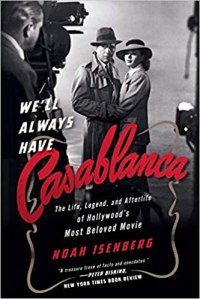
While rereading books like the above, I’m also rewatching some favorite flicks, including “Casablanca,” the evergreen masterpiece in which every element of fine filmmaking miraculously falls into place. I love a good movie book so I clicked on Noah Isenberg’s “We’ll Always Have ‘Casablanca’: The Legend and Afterlife of Hollywood’s Most Beloved Movie,” the gawky title of which tells you just what you’re delving into. I haven’t cracked it yet, but I’m hoping for historical Hollywood gold on par with the recent knockout “The Big Goodbye: ‘Chinatown’ and the Last Years of Hollywood.”
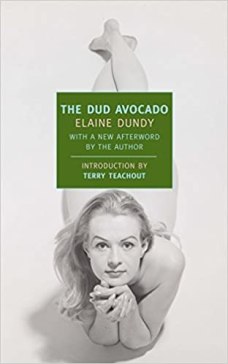
Dreaming about Paris, I tripped upon the site for fabled English-language bookshop Shakespeare and Company, that grand, musty emporium on the Left Bank,where I scrolled staff recommendations for Paris-set stories. Never mind its racy cover, I was lured to Elaine Dundy’s cult comic classic “The Dud Avocado,” a romp tracing the libertine escapades of a comely young American woman in the French capital who yearns to exist out loud. Called a “timeless portrait of a woman hell-bent on living,” the novel seems unlikely to disappoint this thwarted traveler pining for Paris. On the note of cult classics, “Airships,” Barry Hannah’s award-winning collection, promises “20 wildly original, exuberant, often hilarious stories that celebrate the universal peculiarities of the new American South.” The book hasn’t arrived yet, but it’s highly anticipated after being called “one of the most revered short story collections of the past 50 years, remaining a vital text in the history of the American short story.” And this snippet from it makes me sort of love it already: “What a bog and labyrinth the human essence is … We are all over-brained and over-emotioned.”
Raymond Chandler’s crackling and complex detective noir “The Big Sleep” scorches with style. The novel, a total delight, introduces private eye Philip Marlowe, literature’s great existential antihero, a shrugging loner with a gun, cigarettes and devastating wit. Chandler crams it with so many ravishing lines, images, similes, he elevates pulp to high literature. Marlowe, all slow-burn aplomb, speaks and thinks like the consummate smart-aleck tough: “I don’t mind if you don’t like my manners,” he grumbles. “They’re pretty bad. I grieve over them during the long winter evenings.”
“Death Comes for the Archbishop” is a western in priest’s clothing. Set in the mid-1800s, Willa Cather’s elegant epic about a gentle French bishop spreading Catholicism through Mexico and its southwest territories braids American history with lush spirituality and, at times, a mean Cormac McCarthy crunch. The title is a major spoiler, like Tolstoy’s “The Death of Ivan Ilyich,” but Cather knew what she was doing, and the foregone conclusion hits hard — and beautifully. Her eloquence is breathtaking, and the glistening lyricism comes out of nowhere to stun. Here Cather describes two men running through the desert: “They coursed over the sand with the fleetness of young antelope, their bodies disappearing and reappearing among the sand dunes, like the shadows that eagles cast in their strong, unhurried flight.”
Books and movies. I do a lot of both during the hibernating winter months. I’ve plowed through some good books so far this season, with more to come …
Stripped-down realism is so refreshing. That’s what Elizabeth Strout’s cold-water splash “Olive, Again” delivers in the return of the author’s forever-stubborn, wryly splenetic septuagenarian Olive Kitteredge, reluctant heroine of the eponymous, Pulitzer-winning novel from 2008 (“Olive Kitteredge”). The matte finish of ordinary life somehow glistens in these prosaic pages, as Olive and her kin and the locals of small Crosby, Maine, get on with life with all the grace they can muster. Amid the deceptive, lulling ordinariness emerges Olive, who gives just about everyone a pain in the ass.
“God, Olive, you’re a difficult woman,” says a suitor. “You are such a goddamn difficult woman, and fuck all, I love you. So if you don’t mind, Olive, maybe you could be a little less Olive with me, even if it means being a little more Olive with others. Because I love you, and we don’t have much time.” The truth as prod — perfect.
Unfailingly elegant, with literary punch and panache, Christopher Isherwood’s classic 1964 “A Single Man” follows George, a gay, British, middle-aged English professor in suburban Southern California, as he manages life after the death of his partner. Solitude reigns, though George experiences symphonic emotions, from fury to attraction, all in finely wrought descriptives. Called a “lyric meditation on life as an outsider,” the novel is at once explosively alive and exquisitely melancholy.
In Kevin Wilson’s quirky, arguably gimmicky, new novel “Nothing to See Here,” the main attractions are 10-year-old twins who self-combust when stressed or agitated. Right: they go up in flames. Yet the young author doesn’t belabor the peculiarity, mingling a heavy heart with a breezy tone that depicts events in buoyant deadpan. And while the conflagrations are certainly a metaphor for something, I’m not sure what that is. (Wilson’s fires are more light than enlightening.)
When the twins’ caretaker Lillian first witnesses one of their freak shows, she shakes off the shock and mildly observes, “Then, like a crack of lightning, she burst fully into flames, her body, a kind of firework, the fire white and blue and red all at once. It was beautiful, no lie, to watch a person burn.”
The book is clearly some fun, though it’s braided with furrowed, moving passages about taking care of people, avoiding pain and erasing past hurts. “How did anyone keep this world from ruining them?” Lillian wonders. “I wanted to know. I wanted to know so bad.”
Garth Greenwell’s fawned-over “Cleanness” is more than its homoerotic parts, excuse the imagery, though it certainly is that, too. This novel (or is it a story collection?) sketches a psychosexual character study of an American teaching in Bulgaria, sifting through his cluttered past of intimacies. We see (smell, feel) it all in a journey of desire, love and loss.
This follow-up to Greenwell’s adored “What Belongs to You” falters a bit in a cluster of sex scenes dominating the final stories. It becomes repetitive, fetishistic, rather dull. And yet you don’t give up, because the writer knows exactly how to lull you, with a masterly, agreeable control that’s never pushy.
On the nightstand now: The brand-new “The Big Goodbye: ‘Chinatown’ and the Last Years of Hollywood” by crack showbiz historian Sam Wasson. Propulsive prose, staggering detail and wise reflection turn this history into a 3D pop-up book of period L.A., pinballing from the Manson murders and its impact on hot auteur Roman Polanski (who would, of course, helm “Chinatown”), to the creative relationship between Jack Nicholson and screenwriting eminence Robert Towne and the very seeds of SoCal noir. And that’s just up to page 70.
Concerned largely with the making of a quintessential masterwork of ‘70s film, the book promises to be “the defining story of the most colorful characters in the most colorful period of Hollywood history” and is being compared to classic, unflinching making-of studies “The Devil’s Candy”and “Easy Riders, Raging Bulls.”
One of the best books I read last year was the pungent novel “Fleishman is in Trouble” by Taffy Brodesser-Akner. Studded with surgical social perceptions, mordant laughs and vibrating relevance, it’s dubbed a “timely exploration of marriage, divorce, and the bewildering dynamics of ambition.” If you’re married, or divorced, beware: It has teeth.
I attended a recent discussion and Q&A with Brodesser-Akner, led by one of her editors at The New York Times Magazine and complemented by a full house of admiring readers. The discursive confab was funny, at times boisterous, always sharp.
The author is well-known for her smart and sassy celebrity profiles in the NYT Magazine. Among her most famous, and infamous, subjects are Bradley Cooper, Tom Hanks and Gwyneth Paltrow. Some interviewees have not been taken by her resulting articles, but, as a one-time celebrity profiler, I had to applaud when she said that she couldn’t care less what her subjects think of what she’s written about them; she cares only what her editors and her readers think. Truth first, feelings second. Or even sixth.
Brodesser-Akner’s novel — a smash bestseller, award-winner and named a best book of 2019 by numerous publications — is being turned into a TV series for FX that she is writing with utmost fidelity to the source, she says.
With a showy, dimply smile, big laugh and swift, expansive wit, Brodesser-Akner regaled some 100 fans, chatting about her book’s characters and motivations, responses to the novel, the jump from journalism to fiction, family, parenthood, marriage and TV writing.
Some snippets:
— “I always just wanted to be a writer. I always wanted to make my money writing. I went to film school because I wanted to be a writer and that program had no math or science requirements, which fit my educational criteria. I fell into journalism when I found out after college that they didn’t just hire you to write screenplays. I looked in The New York Times, which used to have a robust jobs section, and there was a job there for a magazine called Soaps In Depth. And I got a job there. A year later, because of my tremendous productivity and my rapport with my subjects [she laughs], I was approached by a larger soap opera magazine.” [From there, she contracted with GQ and the Times.]
—About writing personality and celebrity profiles: “You come in with the stakes being pretty low. Profiles have been so done to death that all you have to do is make sure they’re true, and then you can experiment with them. It’s like what they say about chefs and roast chicken: When chefs all get together they make for each other roast chicken, because that’s the thing you’re supposed to show from this place of plainness what you can do with it. And that’s how I think of profiles: the roast chicken of journalism.”
—On midlife, a looming theme in the novel: “Midlife is pretty shocking. I did not know how confusing it would be at this particular age. It’s like a second adolescence. But at least when I was an adolescent I thought I knew what I was doing. Now I know enough to know that I don’t. And there’s the constant strains of contentment and being distraught being in line with each other. It’s the way I feel about the suburbs. I can walk down the block and think, ‘This is beautiful. Wait, what kind of person finds this beautiful?’ That’s middle-age for me.”
—About turning “Fleishman is in Trouble” into a nine-episode TV series: “I am writing it now, and it is very hard to write television. They want it very faithful to the book, at least for the first season. They talk about a second season because that’s all they can do. That’s all TV executives do. They’re sharks; they can only swim forward. They want it to mimic the book as much as possible, which sounds easy and it is not. What’s hard about it is if you think about what my specific skills are — when there is no story, I can still write a story. I came to prominence on a story about Nicki Minaj in which I went to interview her and she remained asleep for the duration. I wrote 6,000 words about it. It was a rollercoaster.”
—On going from magazine to fiction writing: “Magazine to fiction writing was amazing. Because the book was like a profile — that’s how I kept it in my head, it’s just a long profile that I’m making up. The hardest part of it was, whereas I think I’m a decent observer of people, to make people up and then have to observe them is to kind of deny what is so amazing about people, which is that they always contradict themselves and they’re unpredictable. Whereas creating something is to make up a series of predictable things.”
— “When I decided to write (the novel), I had this gut feeling of: ‘Oh, this is the one.’”
I might be a tad late on this, but I’ve just discovered the marvels that are the mighty, mini hardbacks of the Picador Modern Classics series. I’ll be brief, out of breathless excitement and, well, what can I possibly add to the unadorned fact that these books exist and that, from what I can tell, there are only 12 titles available in this novel (pun, intended) format?
So, like the books themselves, I will be compact.
But I repeat, with a shill’s enthusiasm, I am enamored of these brilliantly itty-bitty books, which are about the same dimensions of an iPhone 11 — if thicker, more paper-y, less glassy (and, alas, devoid of Siri’s seductive, dulcet tones).
At less than six inches tall, the books are made for pockets, but they are still chunky, quality hardbacks, running about $16 list. They’re so adorable and beautifully designed, they’re practically edible, or at least highly collectible.
I just finished Christopher Isherwood’s devastating novel “A Single Man” in the Lilliputian edition. (My review: radiant.) Now I’m re-reading Marilynne Robinson’s lyrical 1980 masterwork “Housekeeping.” Rarely do I get the urge to make a phone call on it, as mostly I’m wholly aware it is a book.
Other titles in the Picador collection include Denis Johnson’s masterly, evergreen stories “Jesus’ Son”; Joan Didion’s indelible essays “Slouching Toward Bethlehem”; Jeffrey Eugenides’ breakout novel “The Virgin Suicides”; Michael Cunningham’s shrewd reinvention of “Mrs. Dalloway,” “The Hours”; and Susan Sontag’s landmark study “Regarding the Pain of Others.”
That means there are five more worthy titles to check out in the series. Do so HERE.
I had long worried that I was incapable of having a profound experience of art and I had trouble believing that anyone had, at least anyone I knew. I was intensely suspicious of people who claimed a poem or painting or piece of music ‘changed their life,’ especially since I had often known these people before and after their experience and could register no change. … The closest I’d come to having a profound experience of art was probably the experience of this distance, a profound experience of the absence of profundity.”
This painting kills me. It’s titled “Brave Cone Dog” and it’s by a wry, puckish character named Brandon Bird, who makes very witty pop art. I don’t have much to say about the minimalist image, because it speaks (morosely, piteously, hilariously) for itself. I own a framed print of it, and everyday it stirs in me an emotional milkshake.
“Brave Cone Dog”
This I like, from a recent book review: “Walter Benjamin wrote that a truly great sentence is one that’s been burnished to perfection, then sabotaged in some respect. Wounded or weakened just sufficiently to seduce.”
As a kid, I was a quivering hypochondriac. To wit: At age 7 I had a cramp on the left side of my belly that lasted a couple hours. Convinced it was appendicitis, I curled into a ball in my parents’ empty bed and envisioned horrors of surgery and gloom and, yes, death. The cramp subsided and I proceeded to watch TV, tear-streaked. Around age 9 I had a swollen bruise on my knee that I mistook for a malignant tumor. I crumpled on my bedroom floor in a sleeping bag, too distraught to clamber into bed, and imagined losing my leg to certain amputation. Later, I calmed and accepted that it was just a bruise and I watched TV, tear-streaked. I still often misdiagnose myself, hurling me into fleeting, fluttery hysteria. Then I watch TV, tear-streaked. Reader, WebMD is your foe.
In this week’s “By the Book” column in The New York Times, singer-author-badass Patti Smith is asked “What’s the last great book you read?” She replies:
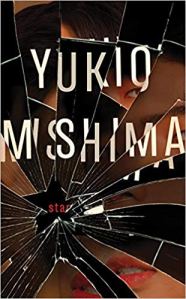
Recently I was captured by two small, addictive works. “Kingdom Cons,” by the Mexican author Yuri Herrera, floored me. … And “Star,” by Yukio Mishima, is a startlingly modern, hypervisual jewel; it could be a really interesting movie. Both books were mesmerizing, seeming to fall in my hands from an alternative sky.
As I’m doing a semi-immersion in Japanese literature and film in preparation for a fall trip to Japan, I picked up “Star,” which is about a hot movie actor in existential distress. From Smith’s zippy description, I expect glitter and diamonds.
At the cafe today, a 30-something hipster in a wool fedora, four-day stubble and ratty Chuck Taylors sans socks sat next to me, slipped on headphones and went on to loudly tap his feet and roll his head, wearing an imbecilic grin, all but dancing in his seat. I wanted to spill his kombucha. Was I wrong? And: He wore a large thumb ring.
One of the Japanese movies I’m revisiting before I go to Japan is “Ichi the Killer,” a shock-cinema bloodbath from bad boy auteur Takashi Miike (say: Meek-a). About a kidnapped yakuza boss, his punky minion — a psychopathic sadomasochist whose specialty is baroque disfigurement — and the titular hero, a bullied weakling out for revenge, this notoriously twisted crime comedy was tonic jazz the first time I saw it. Now it mostly plays as an extreme exercise in tedious transgression: How disgusting can we get? Bloated with rape, murder, drugs, gangsters, prostitution, masturbation, self-mutilation, unthinkable torture, disembowelment and ample amputation, the film is set in the sometimes seamy nightlife district of Shinjuku in Tokyo. Which is where I’m staying.
I‘ve owned pet rats named Phoebe, Becky, Tammy and LaShonda. A friend told me I’d inadvertently given the rats the names of receptionists at construction companies.
The other day I actually saw a guy rollerblading in the neighborhood. That is something you cannot unsee. It’s sort of like seeing someone on a unicycle.
Words I love: blithe, bloviate, evanescent, loquacious. Let’s add nincompoopery to the list.
Sally Rooney’s sophomore novel “Normal People” is soft, stingy with lyricism, psychologically wispy, and not altogether gripping. I like it (I do!), but it isn’t an essential read, and it certainly doesn’t deserve the drooly commotion surrounding its recent arrival. I’d give it an ambivalent B.
Rooney wrote this and her prior, similarly vaunted novel “Conversations with Friends” before she was 28, and both books betray the Irish author’s — here the grizzled elder clears his throat — youth and callow inexperience in love and literature.
In the latter instance I mean she is a plain, safe, lukewarm stylist, who, while honing a palpable personal voice, lacks the assertive confidence, the prosey musculature of a more seasoned writer. Rachel Cusk she is not.
Yet the author’s inexperience in tracing the contours of youthful relationships, both romantic and platonic, has also proven her strength, even her selling point. She understands her young characters, their collegiate insecurities and romantic gamesmanship. It has earned Rooney the title of the “first great millennial novelist” from a magazine that should know better.
“Great” is too strong a descriptive. Rooney’s feathery comedies are decidedly not great. They are good, quite good. Greatness isn’t hers yet. As one publication said of “Normal People,” it is “in some ways like the slightly less impressive follow-up album by a beloved band.” Another called it a rush job.
Still, the sycophantic likes of Vanity Fair imbibe the buzz: “The Church of Sally Rooney started to form around the release of her first novel, ‘Conversations with Friends,’ in 2017. Heralded by everyone from Sarah Jessica Parker to Zadie Smith, Rooney immediately became Someone You Need to Know About.”
It’s the hype-machine in clanking action, unctuous celebrity journalism at its finger-licking gooiest. (Church? Sarah Jessica Parker? “Someone You Need to Know About”in Gen Y caps? Certified bull-bunk.) Elsewhere, some genius crowned Rooney “Salinger for the Snapchat generation.” We can never unsee that.
“Conversations with Friends” and its hasty follow-up “Normal People” are sharp-eyed comedies of manners set in and around Dublin, lightly plotted stories about struggling twentysomethings looking for love, college scholarships, jobs and purpose. Also coming into vigorous play: literature, class frictions, social jockeying and plentiful sex.
Her dialogue is naturalistic, stripped down, never fiery or memorable, cutting or discernibly clever. The books are light on their feet, fitfully sparking to life with taut passages and startling scenes of social discomfort.
They are breezy and easy books, eons from the thorny ruminations of Philip Roth or plush poetics and thematic heft of Toni Morrison. They’re more like Anne Tyler lite.
Amid stubbornly lean prose, literary beauty is scarce. Two passages in “Normal People” poked me in the eye for their uncharacteristic flair: “The sky was extremely blue that day, delirious, like flavored ice,” Rooney almost effuses.
Only 12 pages later, she again swoons over the amazing azure of the heavens:“The sky is a thrilling chlorine-blue, stretched taut and featureless like silk.”
But she’s just playin’. Her allergy to the florid is concrete. Typical sentences, surgically removed of metaphor, run more like this: “Lorraine covers her mouth with her hand, so he can’t make out her expression: she might be surprised, or concerned, or she might be about to get sick.” That, reader, is on the more colorful end of the Rooney spectrum.
Last week “Normal People” crashed the NYT bestseller list at No. 3. Maybe it deserves it. I enjoyed it for all my nitpicking. Yet I wonder who reads Rooney with the avidity of Sarah Jessica Parker or Zadie Smith (who at Rooney’s age was already a true literary giant).
Rooney’s smart little beach reads — people boast about how they gulp her books in one sitting — are crisp divertissements. But they are lacking, in weight, import, poetry, the stuff of lasting literature. I give her a B, for now. Though the promise she shows tells me that grade may rise with each new book. We read and watch. And hope.
Denis Johnson — novelist, poet, playwright — wrote mad sentences. The author of the swooning novella “Train Dreams,” harrowing Vietnam War epic “Tree of Smoke” and, most famously, the indelible stories in “Jesus’ Son,” left behind a pageant of ravishing prose, much of it festooning the darkly lyrical stories in “The Largesse of the Sea Maiden,” released last year after his death in 2017 at age 67.
I was reminded of his genius when I saw that this last book is a finalist for the National Book Critics Circle Award, whose winner will be announced next month.
I ran across a couple of brief, bleakly reverberating quotes from “Sea Maiden” that I’d scribbled in my journal. If Johnson could be grim, his poetics were reliably heartrending.
I’m getting depressed … you forgot to say prepare to fall down through a trap door in the bottom of your soul.”
Yeah boy he dragged me down to his jamboree. Dragged me down through the toilet formerly known as my life. Down through this nest of talking spiders known as my head. Down through the bottom of my grave with my name spelled wrong on the stone.”
I’m having a tricky time getting jazzed about too much lately — only Socrates rivals my sage discernment and penetrating taste — yet I am alive, blood sluices through my veins. Some things I’m digging:
Richard Serra sculptures at Dia: Beacon, New York
Caustically hilarious British TV series “Fleabag”; Sigrid Nunez’s quietly affecting novel “The Friend”;the reliably stirring Dia: Beacon museum, so serenely cluttered with minimalist and sculptural masterworks; poetic Polish romance (and Oscar nominee) “Cold War”; and Weezer’s “Teal Album,” featuring frighteningly faithful covers of Toto’s “Africa” to Black Sabbath’s “Paranoid” and Michael Jackson’s “Beat It.” It’s a gas.
Mostly this entry is a sequel to my December year-end inventory of now-time enthusiasms, stuff getting my juices flowing. These are the current tops:
Jade Bird
Strumming an acoustic guitar, her long hair swinging, she sings in a hushed girlish voice before belting like a banshee, loosing a squall of blazing catharsis. She has pipes that purr, then roar, then come back. You sway to twangy folk, then rock with giddy fury.
Intimate and Velcro-sticky, Bird’s music, performed acoustically or with a small band, circles Americana, punk and soulful indie pop. Country fans are drawn by her evocations of rocky, star-crossed relationships, and there’s country crunch in those folk-rock vocals. Her galloping cover of Johnny Cash’s “I’ve Been Everywhere” is a jam-session joy.
In this 21-year-old Brit, the Dixie Chicks are at their fiercest, alongside a banging Liz Phair, Courtney Barnett, PJ Harvey and other steely indie royalty. Bird’s lyrics pop and sear. In the unreasonably rousing “I Get No Joy,” Bird sings with such speedy agility, she’s almost rapping:
“Psychotic, hypnotic, erotic, which box is your thing?/How many days a week, do you feel/Electric, connected, unexpectedly/Affected, what do you need?”
His hair is a fluffy fiasco, a brown brushfire, his splotched face the seasoned mug of a gang member. He’s filthy and swears like a sailor. He’s homeless. He’s 12.
In Nadine Labaki’s Beirut-set stunner, a nominee for the best foreign language Oscar, the boy, Zain, is a resourceful renegade in the scrappy mold of Huck Finn and Antoine Doinel in “The 400 Blows.” Fed up with his struggling parents and their feckless care of their many children, Zain takes them to court, accusing them of the crime of giving him life. It’s a preposterous idea, a satirical glance at the Lebanese judicial system.
Zain (the extraordinary Zain al Rafeea) fast becomes a tough street urchin who finds a gig babysitting the gurgling infant of an illegal Ethiopian refugee, played by Yordanos Shiferaw. (The film’s devastating cast of non-professionals play versions of themselves.) When the young mother is arrested, Zain is stuck taking care of the baby on his own. In this harrowing situation — the movie is a tart indictment of Beirut’s corrupt state of child welfare — the fathomless despair can be unbearable to watch.
“Capernaum” — the title means “chaos” — owes much to the children-centric neorealism of ‘80s and ‘90s Iranian cinema, from “The White Balloon” to “The Color of Paradise” — heart-renders told in raw, wrenching lyricism that aren’t without political undercurrents. It’s a street tale alive with miscreants and thieves and few kind gestures.It’s so gritty and grubby the camera lens almost seems smudged. Redemption, however, is in the air.
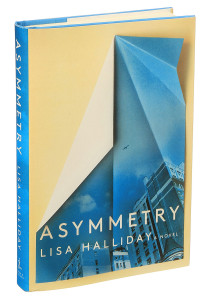
Beautifully written, radiantly spun and shot through with smashing intelligence, Lisa Halliday’s first novel “Asymmetry” bristles with humanity as it mingles conventional and unorthodox structures. It’s a literary feat kneading the fictional form like Play-Doh.
I’m only a third of the way through its brisk 271 pages, but I’m sold. (Being part-way in a book you’re relishing is where you want to be; there’s more on the way to savor.)
The novel is chopped into three sections. I finished the first section, “Folly,” which traces the May-December romance between Alice, a 25-year-old aspiring writer, and Ezra Blazer, a famous author 40 years her senior. (If he rather resembles Philip Roth, it’s not chance: Halliday had a relationship with Roth while in her twenties.)
And so we get an old-fashioned affair of unpushy comedy and sweet asides set amidst Upper West Side means, with tender banter and the not uncomplicated theme of apprenticeship, much like a Woody Allen movie, without the deep-dish neuroses.
Alice has career issues, Ezra has health issues, and brewing in the background is the launch of the Iraq War. (The war plays a prominent role in the next section, “Madness.”) In this, one of The New York Times’ 10 best books of 2018 (and a favorite of Barack Obama), Halliday doesn’t flinch from the vagaries of love, including the sort, like Woody’s, peppered with literary chatter and throbbing with aching uncertainty.
The dialogue is unfailingly smart, wry, just right. Alice and Ezra conduct short, gem-cut conversations that bring a knowing grin:
“Is this relationship a little bit heartbreaking?” he said.
The glare off the harbor hurt her eyes. “I don’t think so. Maybe around the edges.”
“United Skates”
In urban roller rinks across the country thousands of African-American roller-skaters are lacing up and getting down. Beneath rays of twirling disco balls an underground roller renaissance thrives among a force of skate buffs who throw after-dark rink parties and commit kinetic art on waxed wood floors: backflips and break-dances, tag-team acrobatics, backwards trains and other daredevilry. Many revelers simply trace ovoid loops in a kind of roller-boogie bliss.
With new and archival footage, much of it contagiously groovy, “United Skates” directors Dyana Winkler and Tina Brown chronicle the hip-hop-fueled scene with at once bracing and brooding electricity. They hopscotch the nation — Los Angeles to Baltimore — and capture the community-building soul of skating as well as the heartrending gentrification that’s swiftly shutting down classic rinks, dinosaurs of the ‘70s and ‘80s. Few will survive.
Next to dwindling skate spaces, the film locates other troubles: the apparent profiling of black skaters at certain rinks that ban rap and the skinny wheels many black skaters prefer. When skaters organize “adult nights” — “Code for ‘black night,’” says one — police fill the parking lots and security is thick. No such hysterics are apparent on a typical “white” night. It’s a familiar microcosm of current race relations.
Yet the party rolls on. The subculture retains a die-hard exuberance not easily snuffed. The film’s final scenes are far from elegiac; against all odds they are tonically celebratory.

 She is particularly good at the jolt-laugh of the unexpected:

 Raymond Chandler’s crackling and complex detective noir “The Big Sleep” scorches with style. The novel, a total delight, introduces private eye Philip Marlowe, literature’s great existential antihero, a shrugging loner with a gun, cigarettes and devastating wit. Chandler crams it with so many ravishing lines, images, similes, he elevates pulp to high literature. Marlowe, all slow-burn aplomb, speaks and thinks like the consummate smart-aleck tough: “I don’t mind if you don’t like my manners,” he grumbles. “They’re pretty bad. I grieve over them during the long winter evenings.”







 GNASHING.