Art can’t save you. It can give you glimpses of something beautiful, maybe even something redemptive, but there’s nothing there to hold onto. Art is a means, not an end.”
— poet Christian Wiman

WONDERING. WANDERING. WHATEVERING.

Art can’t save you. It can give you glimpses of something beautiful, maybe even something redemptive, but there’s nothing there to hold onto. Art is a means, not an end.”
— poet Christian Wiman
Why is everyone so down on Sea-Monkeys? People scoff when I bring them up, which is pretty much never, and the novelty item’s star ratings are piddling to pathetic at Amazon. (2.7 stars? Wha?)
Sea-Monkeys rule. If you’re 7. But really, I’ve owned them at least 10 times as a kid (and, all right, as an adult), those trippy, creepy, itsy-bitsy, dimly disappointing crustaceans that swirl around a small plastic tank on your nightstand before dying off, one by one, until all that’s left is greenish, brackish water that smells like the devil’s bing-hole. My freakish, fun-loving, easily-fooled brain adores them.

They come up because I recently watched Penny Lane’s 2016 short film “Just Add Water: The Story of the Amazing Live Sea-Monkeys.” (See all 16 mind-tweaking minutes of it here.)
It jogged a zillion memories of my 9-year-old self hatching what are actually microscopic brine shrimp (which are used primarily as fish food), hoping, always hoping, for the anthropomorphic little families of so-called Sea-Monkeys to appear when I followed the directions to concoct a peculiar potion.
The famous advertisements in comic books of the 1960s-‘70s depicted happy, three-pronged-crowned sea creatures, naked part-fish/part-people, hanging out, smiling, doing their whateva Sea-Monkey thang. And it showed human purchasers gazing at a bowl of them, grinning like fools. It was wonderful. And for a kid who thought Bigfoot and the Elephant Man were the dope, implacably seductive.
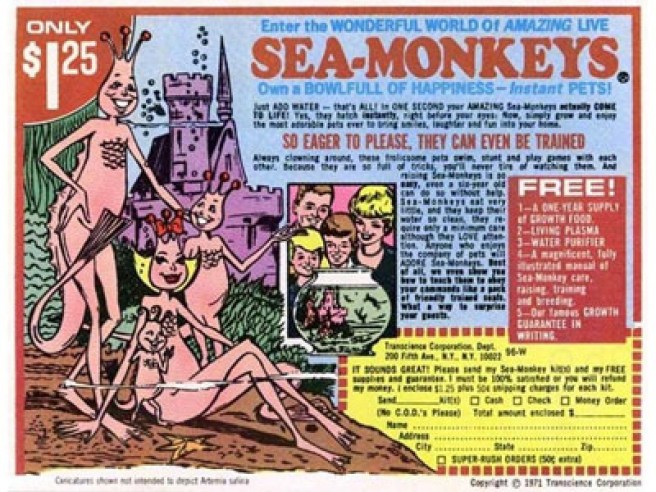
So you order the Sea-Monkeys. Miniature plastic tank that you fill with tap water — check. Then add Packet #1, the water purifier, which, according to the short film, actually contains the Monkey eggs, “giving the Sea-Monkeys time to get big enough for you to see them” in a 24-hour period. Packet #2 is really blue dye that makes the day-old Monkeys even easier to observe. (There’s a small racket going on here.) The other packet, #3, is Growth Food. It smells like algae and fish guts.
No matter, what is happening is science. Namely, “cryptobiosis,” or instant life, meaning the Sea-Monkey eggs are dehydrated like NASA space food and pop to life with the addition of water. Think Cup O’Noodles or Taster’s Choice instant coffee, but with tiny monkeys. That aren’t actually monkeys.
Brine shrimp are what they are. At best, they grow about a half-inch long. They have spindly, monkey-like tails as adults and they swim with fluttering angel’s wings, flapping in circles around the tank, nose-diving, eating food at the bottom and, most curiously, latching onto one another in possible monkey coitus. Baby Sea-Monkeys do happen.
I’ve had a Sea-Monkey live about a year or more — a personal record. It was massive. When it died, my college dorm-mate and I burned it in a funeral pyre. I wish I was joking.

Sea-Monkeys are a conflation of toy and pet, two of children’s favorite things. They are the brainchild of late eccentric inventor Harold von Braunhut, who created a “stage show, the illusion of instant life,” says the film.
But the movie also reveals pure evil: Von Braunhut was an active and outspoken member of a major pro-Hitler white supremacist league. How to reconcile these two sides, the whimsical and the wicked?
“It’s the great mystery lurking behind the Sea-Monkey castle,” says Richard Pell of The Center for PostNatural History in the film. “How does the guy who invents all of these wonderful, playful fun things also promote such horrible ideas?”
I shake my head vigorously. I can’t answer this question. Some might even think Sea-Monkeys, those mutant, sci-fi creatures, are horrible ideas. Spawns of satan.
I then recall my own evil, sheer monkeyshines. As a kid, when I got bored with my tank-circling Sea-Monkeys, I once fed them to a trio of mail-order sea horses (who themselves croaked after about three days). Another time, I poured them into one of those hand-held water games of hoops or tic-tac-toe and swished them around like debris in a storm. Sea-Monkey sadist.
And yet here I am, decades onward, seriously considering buying for my birthday a Sea-Monkeys Ocean-Zoo for $12.98 from Amazon. I am so tempted I can hardly stand it.
(For the Sea-Monkey completist — who isn’t? — visit the official Sea-Monkey site here.)

The guy says something funny, clearly amusing himself.
He cracks up, throws his head back, mouth agape.
And then he does it: He claps.
One big resounding slap of the hands, like some sort of madman, a yukking narcissist applauding his own magnificent sense of humor. (Briefly springing to mind: a comic-book villain, rubbing his hands together as he cackles malevolently.)
What really is he and so many others who perform the laugh-clap doing? Something strikes you as funny and laughter peals forth. Got it. And then you do a thwacking clap, a percussive note accentuating your uncontainable delight. Add a snort to the mix and you’ve got a symphony.
The dreaded laugh-clap is cousin to the har-har knee-slap, which is rather outmoded, more of an uncle-in-overalls gesture. The foot stomp: same.
The laugh-clap, however, never goes out of style. I see — and hear — them all the time, and I cannot fathom their purpose or impetus. Where do they come from? The tipsy, the assertively gregarious, sports fans, frat boys, theater majors — it infects a cross-section of chortler. You’ve seen them, laughing, clapping, having a good old time while giving a round of applause to … something.
The most egregious high-profile offender is Jimmy Fallon, the cutesy, infantilized host of “The Tonight Show.” The guy will laugh at anything. He will chortle, titter, guffaw and giggle. Almost always he will clap.
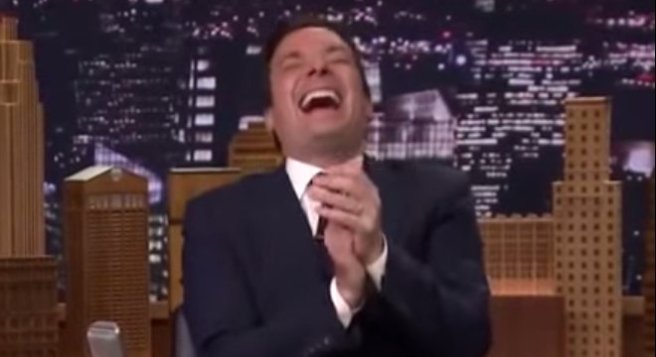
There’s an actual online message board “Jimmy Fallon Laughing & Clapping.” It’s terribly unenlightening in its attempts at parsing what’s wrong with Laughing Boy — who knows what makes these characters tick? — but at least it exists, a sort of douche-o-meter.
Many posters call Fallon’s overreactions to even the featheriest of tickles “fake,” which is, we all know, high treason in comedy. (Watch a video compilation of Fallon laugh-clapping HERE. Beware: It may irritate you to death. Literally.)
“Did you ever see him on SNL? Every thing, at that moment, is the funniest thing ever and ol’ Jimmy just has to laugh,” notes one messenger.
Another one, who, while calling Fallon a “prepackaged predictable politically correct vanilla product,” seems to come to the host’s defense:
“You can only express so much excitement through a laugh — you have to add some other form of how funny something is.”
Adding a dimension to the old grizzled snigger, when boring, limited laughter isn’t good enough. They make it sound like an art form, say, a popular new dance, the Laugh-Clap.
Natch, this is nothing but a quibble, a Seinfeldian social moan that amounts to empty venting. I still don’t get the laugh-clap. I don’t like it. Yet one poster offers possibly the most clear-headed and charitable view that I’ll swallow for now:
“It’s an appreciation for joy.”
Sure, I took a nip on my trip this week to Charleston, South Carolina, not on the basis of “When in Rome …,” though there was a bit of that. No, I just like a good cocktail or Scotch or beer, particularly in a nicer establishment, like a fine restaurant or stylish bar/saloon. (Or salon: Where I get my hair cut, they serve free Prosecco, a nice Kardashian flourish.)
And, as part of what became something of a foodie journey (see that part here), I hit a lot of those places. My slogan: No driving, no hangovers, no regrets.
Right before my three-day trip to Charleston, I blogged about the award-winning small-batch boutique distillery I had my sights on, High Wire Distilling Co., on bustling — one might say boozy — King Street.
I made it, and took the short tour — the place is fashionably cozy and drips with hip — and partook in the tasting flight. The tour was $5, as was the tasting. (I also bought a bottle of the Hat Trick Extraordinarily Fine Botanical Gin for a reasonable $27.)


The High Wire tasting flight. Left to right: Hometown Vodka; Hat Trick Extraordinarily Fine Botanical Gin; Hat Trick Barrel Rested Gin; and New Southern Revival Brand Rye Whiskey. Especially for how early in the day these were imbibed — noon shots on an empty stomach? — each libation exerted kick and fire and were exceptionally complex.

At this upscale bistro I sipped the Nordic Witch — “bright and herbal, this witch is ready to head south for spring” — made of Old Tom Gin, Strega, Linie, Aquavit, Lime and Peychaud’s. It was superlative, swirly and tangy, but it was so small, I didn’t even take a picture of it.
With dinner I had a Classic Whiskey Sour that hit the spot:

Husk has one of the coolest, most coveted little bars in the city (big patio for you patio people), with potions to match. Waiting for a dinner table, I ordered a tasty Gin-Based Drink Special, whose name and ingredients I foolishly didn’t commit to memory.
But here it is:

During dinner I got the toothsome and bracing Option Bee: Earl Grey-Infused Local Gin, Yellow Chartreuse, Honey, Lemon and Egg White. Below:

My penchant for gin is glaring and at this classy, streamlined drinkery I stuck to my beloved botanicals with the assertive “Clover Club” — Hendrick’s Gin, Raspberry Preserves, Dry Vermouth, Lemon and Egg White — followed by the satisfactorily simple “PGT (Proof Gin and Tonic)” — Hendrick’s Gin, Lemon Bitters, Cucumber.
Proof’s a neat place on crawling King Street, and I would have returned with more time.

Slathered in ersatz grunge and lacking snarly attitude, The Griffon touts itself as the authentic dive bar in Charleston, and apparently a lot of people who haven’t been to Charleston’s The Recovery Room or Dirty Franks in Philly actually believe this. This bar is a poser dive if ever there was one, a faux dump made to look beaten and badass with floor-to-ceiling wallpaper compiled of signed $1 bills. It tries awfully hard, and it made me kind of sad. The Griffon is the Planet Hollywood of dives, a cosplay simulacrum, a movie set. Spotless bathrooms? Yep. Tourists only. I had a $4 bottle of Miller Lite. Then I skedaddled.


I did it right, I nailed it. During my quick foodie tour through Charleston, South Carolina, I sidled up to the bars at five restaurants I urgently wanted to hit, the places that songs are written about, that journalists spill fragrant ink over, that Uber drivers gasp in amazement, “You got into (restaurant name here)?”
I researched and read. The internet was my friend. I watched Anthony Bourdain and “Chef’s Table” and “The Mind of a Chef.” I emailed eateries for the tricks and maneuvers that would guarantee I’d get in without a dinner reservation. (Simple: Arrive well before 5 p.m. Wait outside. When the doors open, nab a seat at the bar. Eat. Drink. Rejoice.)
Charleston is a powerhouse food destination, cutting-edge and farm fresh, and not one thing I ate was less than exemplary. Vittles vaulted me to that pleasure zone, a kind of palate paradise, where you sigh and go, Yeah.
Where and what I ate:
(Assume I loved every dish, passionately, and click the restaurant name for more info.)

Wood Fired White Stone Oysters, Green Garlic Butter, Lemon Vinegar, Fermented Chilies, served on a bed of rock salt

Confit Duck “Cassoulet,” Heirloom Peas, Lowland Farms Brassicas, Pot Likker Broth, Pan Fried Farm Egg

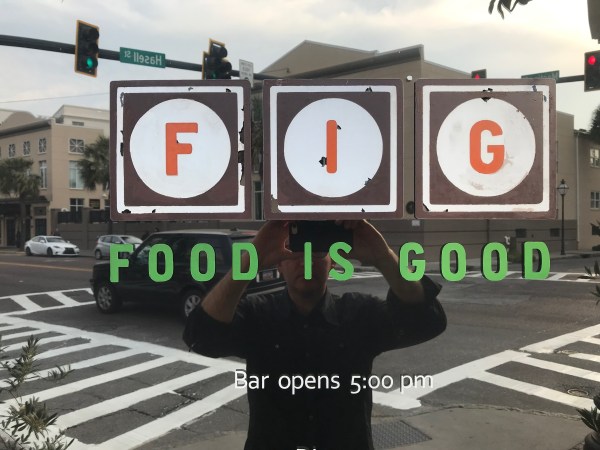
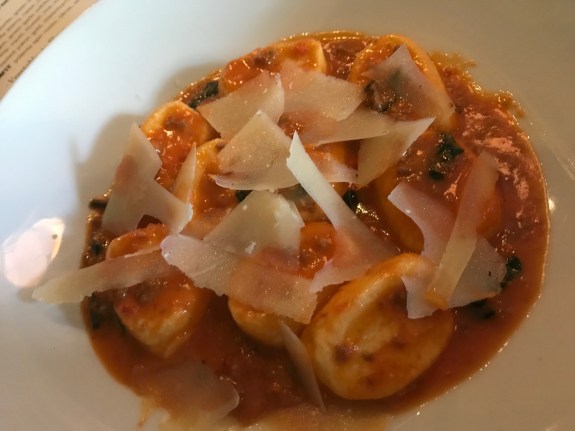
Ricotta Gnocchi alla Bolognese Parmesan, Mint

A dazzling Chicken Confit with Brussels Sprouts and Fig (and lots of other complex goodness I can’t remember) over Polenta
A little about FIG: “The name is an acronym for ‘Food Is Good,'” writes Bon Appetite, “a simple epithet that doesn’t do justice to the level of cooking set forth by Mike Lata, the godfather of Charleston restaurants (he also owns The Ordinary).”
Speaking of The Ordinary …
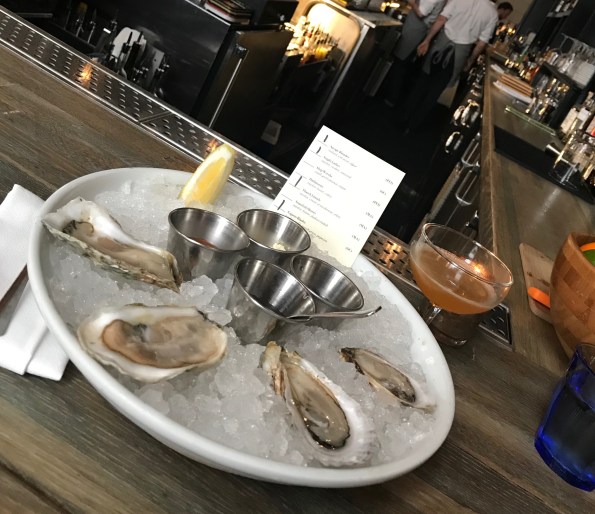
A quartet of immaculate, sweet and salty raw oysters, hand-chosen by the suave server/bartender. The orange beverage to the right is the zesty House Daiquiri: Plantation Old-Fashioned Traditional Dark Rum, Plantation 5-year Rum, Cane, Lime.

Crispy Oyster Slider with a whisper of jalapeño (unbelievable)

New England Style Fish Chowder with Oyster Crackers — better than you think. A knockout loaded with generous chunks of white fish and potatoes.
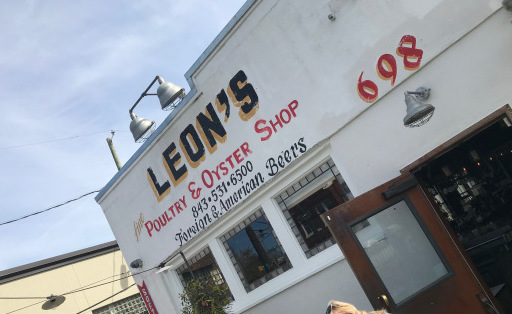
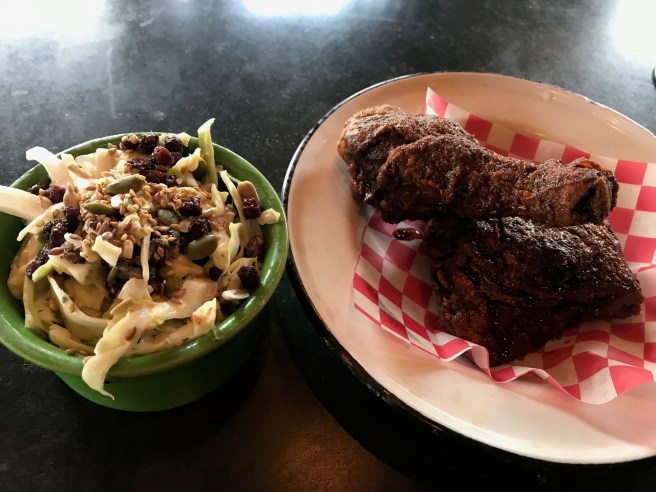
Spicy Two-Piece Dark Meat Fried Chicken with Cole Slaw: Buttermilk Dressing, Currants, Seeds
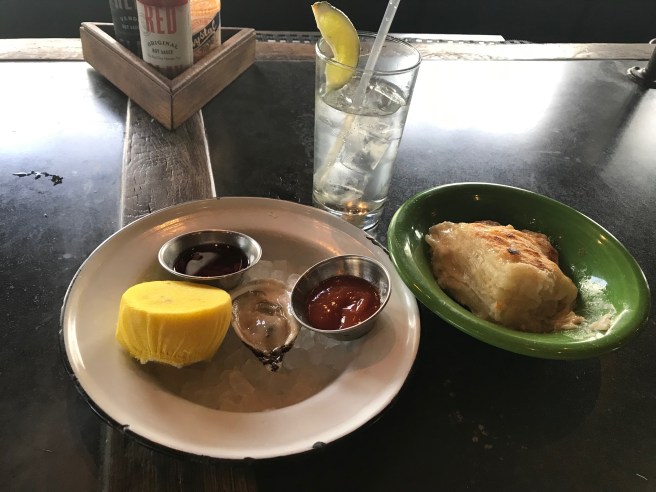
Second visit: Four Raw Oysters (only one shown here), Signature “Old School” Scalloped Potatoes (divine) and a Gin & Tonic
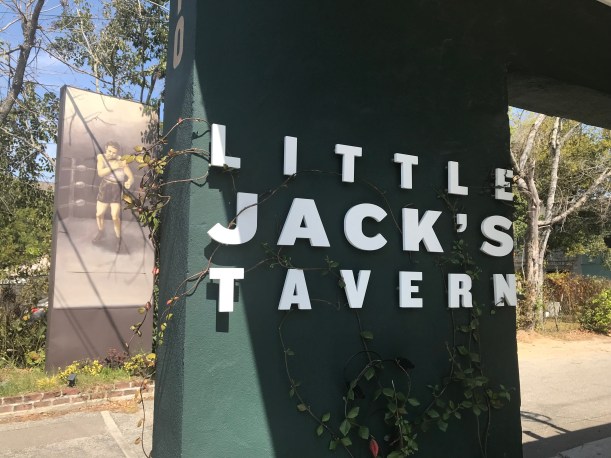

The famous Tavern Burger, a 4-ounce Patty Topped with American Cheese, Tangy Tavern Sauce, Griddled Onion on a Sesame Bun, with House Salad. This glorious, glorified slider goes for a mean $15, and it’s worth it. So hypnotic I couldn’t even focus the camera. My eyes were crossed.
I leave Sunday for three days in Charleston, South Carolina, and already I can smell the aromatics and botanicals, those ultra-fragrant plant compounds often used in alcoholic potables, most popularly in gin. Aromatics and botanicals furnish a strong herbal, floral or fruity tang that sets flowery, pungent gin apart from insipid vodka, which tends to smell and taste like undiluted alcohol (and which is why producers are always grossing up their swill with flavors like cherry, vanilla, mango and peppar, whatever that is).
In Charleston is the award-winning High Wire Distilling Co., which claims to be the city’s first distillery since Prohibition. Like a boozy boutique, the outfit “produces a distinctive line of small batch spirits, including gin, rum, whiskey, and vodka using premium, specialized ingredients.”
I’m there.

And I’m taking the $10 tour and tasting, which (more canned copy here) “provide an overview of the distilling process and allow guests an opportunity to see the still, mash tun, fermentation tanks, barrel aging, and bottling operations.” Tour-takers “receive a traditional tasting flight of four High Wire spirits.” (Yes!)
This has got to beat the tragic, gimcrack Heineken Experience brewery tour I signed up for in Amsterdam last year (my head still hurts from the strobes and electronica). And it might just match the exemplary Russia Vodka Museum in St. Petersburg, where the tastings exuded high European class. Or the fine, frothy, free tour of the Sam Adams Brewery in Boston.
I have my eye on one of High Wire’s specialty gins, which goes for $27 a bottle (I don’t yet know the size), the “Hat Trick Extraordinarily Fine Botanical Gin,” described in detail:
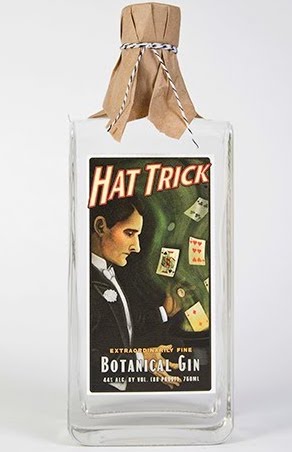
“Made with crushed juniper berries and fresh lemon and orange peel, this bright and flavorful gin is well-balanced and pleasing to the palate. Balancing botanicals include licorice root, angelica root, coriander, and cardamom. From a straight up martini to a more complex Fitzgerald, this gin dazzles even the most discerning gin drinker.”
Proof: 88
Tasting Notes: Floral, licorice, lemon, orange, pine, rounded/full texture, well-balanced, long finish.
Cocktails: Gin & Tonic, Martini, Fitzgerald, Collins, Negroni, Gimlet, Martinez, Gin Gin Mule
I’m sure I don’t know what at least three of those cocktails are, but they sound ravishing with this nifty gin, which, you never know, might suck. I’ll taste it during the tour’s tasting segment. If I like it, I’m buying a bottle. And then, you know, drinks on me.
A pair of new documentaries — one about a famous disco club, one about an infamous/classic comic book flick — caught my eye and my fancy. They’re both worth checking out.
In Matt Tyrnaue’s sparkly “Studio 54,” the supreme disco saturnalia of ‘70s New York is enshrined as a Felliniesque funhouse of fame, freaks and fortune, a shaken snow-globe of gilded sin and glittered celebrity: Andy Warhol, Truman Capote, Michael Jackson, Liza Minnelli, Mick and Bianca Jagger, Cher, to name-drop a few pampered regulars.

Though notorious for its ruthless, velvet-rope exclusivity, the cavernous club was a haven for LGBTs where sex, drugs and romp ’n’ roll played out among gyrating bodies and unrepentant theatrics: fog, snow and wind machines; glitter, confetti and balloon drops. For 33 publicity-pumped months, 54 was the hottest ticket in town, perhaps the world.
With input from club patrons and associates, and miles of bracing archival footage, Tyrnaue first makes a case for 54’s throbbing fabulousness — well-trod glitzstory — and how it sprang from disco’s post-Vietnam, post-Watergate, let’s-party zeitgeist.
Attention then pivots to 54’s founders, best friends from Brooklyn, Ian Schrager and Steve Rubell, regular guys who wanted to “change the universe, invent the world,” recalls Schrager. (Though Rubell died at 45 from complications of AIDS, in 1989, the doc is rife with vintage footage of the impish, devil-may-care co-founder.)
In this parable of excess, hubris and the perils of having a ball, antiheroes Schrager and Rubell play hard and fall hard, taking their precious property with them. “They thought they were so important that they could do anything,” says author Steven Gaines.
An arrest for selling alcohol without a liquor license leads to raids on the club, uncovering drug possession and skimmed cash. With legendary pit bull Roy Cohn as their lawyer, the duo pleads guilty to a gasping $2.5 million in tax evasion. They each get three and a half years in prison. They sell Studio 54 from the pen and, by aiding feds with other tax-evasion cases, reduce their sentences.
Anatomizing the implosion of an empire, “Studio 54” lends enlightening texture to an oft-sensationalized cultural moment. “When I look back on it now, it was so preposterous,” says Schrager, today a successful hotelier. “What were we thinking?”
Streaming on Netflix. Trailer here.

It’s hard to recall that before he was a fair-haired galactic god the character Flash Gordon, in 1980’s kitschy cult movie of the same name, was a star quarterback for the New York Jets. And that was the quasi-superhero’s so-called superpower that would save the world — his football-chucking athleticism. Odd, yet so righteously all-American.
Exalted in Lisa Downs’ adoring doc “Life After Flash,” Flash (played by young, ripped ex-Marine Sam J. Jones) finds himself accidentally rocketed into space to a cornea-curdling cuckoo land of soaring hawkmen, green-faced midgets and the estimable Max von Sydow bedecked in flummoxing Fu Manchu facial hair and a flowing red silk cloak.

This is the planet Mongo and von Sydow, clinging to his dignity, is nefarious, wizardly Emperor Ming the Merciless. You either accept this or stroll over to “The Goonies” booth.
A film-nerd’s dream, the doc embraces, nay, bearhugs, Flash and his jut-jawed mythology, enlisting a galaxy of voices — Stan Lee, director Robert Rodriguez and a passel of genre performers — to lionize the film in a richly informative orgy of nostalgia. (Natch, most of the interviews happen at Comic Con and similar geekoid jamborees.) The movie’s actors and director Mike Hodges delightfully chime in.
Bluff but affable, blocky and bulked-out as if made of Legos, Jones, 64, is the cynosure of the doc, except when he’s not. His life is mildly interesting: Hollywood, surprise, proved a rocky road, and his personal travails are par for the course.
But it’s the backstage drama of making “Flash Gordon” that grips. From legendary producer Dino De Laurentiis’ run-ins with Jones and the pre-CGI effects out of an Atari game gone berserk; to Queen’s gloriously operatic theme song, which co-star Topol calls “the best thing in the movie,” and the running squabble about the film as a straight-faced epic or comic-book send-up.
In this classic pop-culture resurrection narrative — as middle-aged fans crave a nostalgia fix, Jones is cool again — there is good news. Jones lands a self-parodying role in the hit Seth McFarland comedies “Ted” and “Ted 2” and revels in signing autographs and posing for selfies — no Flash in the pan. “Did I ever want to step away from being the image of Flash Gordon?” Jones asks. This rollicking portrait provides the answer: not in a million light years.
On iTunes, Google Play and Hulu; on Blu-ray and DVD on March 26. Trailer here.

Great piece in the April issue of Harper’s Magazine titled “Like This or Die” by Christian Lorentzen. He’s a critic taking aim at the soggy state of criticism, and his article is by turns scathing and amusing and devastating.
After noting that “clichés are pandemic” in newspaper book reviews, Lorentzen says “Endless lists of book recommendations blight the landscape with superlatives that are hard to believe.” (Guilty as charged: The New York Times and New York magazine.)
He goes on:
The basic imperatives of the review — analysis and evaluation — are being abandoned in favor of a nodding routine of recommendation. You might like this, you might like that. Let’s have a little chat with the author. What books do you keep on your bedside table? What’s your favorite TV show? Do you mind that we’re doing this friendly Q&A instead of reviewing your book? What if a generation of writers grew up with nobody to criticize them?”
His sentiments remind me of the youth-pandering boosterism of Vulture and the somewhat more adult slavering of Vanity Fair, to name two obvious culprits that more often than not elect fuzzy over fulmination. They are hardly alone in hailing mediocrities like Netflix’s “Bojack Horseman” and “Stranger Things,” floridly overpraised series that reveal a critical desperation to like stuff.
Being honest isn’t the same as being sadistic. “Negativity is part of the equation,” Lorentzen says, “because without it positivity is meaningless.”
More from the article, which can be read here:
What jars is the self-satisfaction expressed by people who should know better. Editors and critics belong to a profession with a duty of skepticism. Instead, we find a class of journalists drunk on the gush. In television, it takes the form of triumphalism: a junk medium has matured into respectability and its critics with it. In music, there is poptimism, a faith that whatever the marketplace sends to the top must be good.”
“Wait, she has a Snow White tattoo?” the woman says, chuckle-gasping.
“And it’s just the words ‘Snow White,’” explains one of three girlfriends sitting at a cafe table, prompting bemused guffaws.
“Why didn’t she get a picture of Snow White?” asks the first woman to peals of laughter.
It’s tattoo talk, today and probably everyday, somewhere, everywhere. Chatty, a little catty, dappled with chortles and bewilderment. This conversation veers from one of the women describing her two modest tattoos (arm, shoulder) to another declaring she would never befoul her unspoiled flesh with eternal ink.

“I just know my siblings regret their tattoos and so do a lot of my friends,” she says. “That’s why I don’t want one.” (She doesn’t trust her own judgement, we think, judgmentally.)
“My brother has some dumbass tattoos,” she goes on. “He has one that says ‘Taking Care of Business.’ I mean, what is that?”
We nod from afar. Yeah, what is that? (Googling frantically: It’s not only the motto of Elvis Presley, but it’s the name of his band and a very popular tattoo. Approved.)
“I really like tiny, simple tattoos, like a small heart behind the ear,” avers the third woman, who, like her cohorts, is in her late-20s, early-30s, total guesstimate.
The age range is ripe for tattoo chatter. It’s said that 47% of millennials have one or more tattoos. That’s stupefying. And, well, stupid.
Getting inked is the worst kind of impulsive act, like going to Cancun or getting married, and the buyer’s remorse is knee-buckling and tear-stained. And irrevocable.
Tattoos are fatuous and juvenile self-expressions, be it tribal calligraphy or a curvaceous mermaid; an emblem of romantic love or a big dumb damn dragon thing curling and cascading across magnificent acreages of flesh. Tramp stamps? You can only pinch the bridge of your nose and shake your head.
Confession: As a kid the one prize I wanted most from my Cracker Jack box was the tiny book of temporary tattoos that appeared as blue and green smears on my arm. (Always, I put too much spit on them.) Much higher quality temp tats came in the vinyl record of “KISS Alive II,” and I loved them. (See them HERE.) Luckily, they washed off like that.
Sometimes tats are cute or clever — a friend in the computer biz got a small tattoo of the MacBook power button on her wrist — and sometimes they are fraught with reckless sentimental import. Refer to the bloke below who emblazoned his son’s face on his face. (My favorites are face and neck tattoos. Oh, now you’ve really done it.)

The three women in the cafe are discussing what kind of tattoo another friend should get. One suggests she get something like the name of the band Abba or Buffy from the TV show “Buffy the Vampire Slayer.” Another tosses out Britney Spears or Borat.
“It’s got to be fucking cheesy,” says one of them. It’s permanent skin art, body cartoons. Can it be anything but?
It came on TV, caught my eye, and had me entranced all over again.
Michael Mann’s virtuoso 2006 crime drama “Miami Vice,” streaming on Netflix, will hook you hard — that is, if you connect with the under-appreciated film. I do — I gave it four stars in my original review in a large daily newspaper — and I stand by it, despite a host of haters who can’t see masterly filmmaking for Colin Farrell’s facial stubble.
So I come to defend “Miami Vice.” Major publications — Rolling Stone, Entertainment Weekly, The Boston Globe, Variety — praised the film, with New York Times critic Manohla Dargis calling it “glorious entertainment” and extolling its cutting-edge digital camerawork. Still, unaccountably, the movie holds only a 45% rating at Rotten Tomatoes. Insanity.
At the end of 2009, the critics of Time Out New York chose “Miami Vice” as #35 of the 50 best films of the decade. That’s great, but I would place it higher than that.

It’s now something of a cult film, especially among younger critics and filmmakers. Harmony Korine notes how much it influenced his riotously outré “Spring Breakers.” One critic wisely said the film is a visual meditation on “failure and futility” and — I love this — “one of the most expensive art films ever made.”
Another critic, perhaps more to the point, wrote that the movie “has just laid the foundations for a new order of action films.” Indeed.
This is my rave review from July 2006, a rebuke to the benighted:
Awash in the blacks and blues of a fresh bruise, Michael Mann’s “Miami Vice” plays hard and mean to thrilling, often harrowing effect. Mann, who was an executive producer of the influential 1980s television series on which the movie is ever-so-loosely based, obliterates the glib sunshine and pastel glamour of the show to forge a dark, frighteningly real universe of undercover law enforcement and globalized crime.
It delivers what no other movie this summer has or likely will: the pure pleasure of watching an intricate, perfectly calibrated machine kick, shoot and crank with dazzling power and efficiency.
That might sound heady for a movie called “Miami Vice,” a title that instantly evokes Reagan-era gilt and South Beach deco. Don Johnson in a white linen blazer/pink T-shirt ensemble and an equally suave Philip Michael Thomas amid a backdrop of neon, glass bricks and palm trees — those soft-rock memories should be dispensed with. Instead, brace for an unflinching contemporary crime drama that makes no concessions to pop nostalgia or mocking remakes such as the no-brow “Starsky and Hutch.”
People forget that TV’s “Miami Vice” was more than its stylish, trend-making veneer, but a crack cop drama presenting sophisticated criminal situations through intelligent, movie-worthy writing that delved deep into character and emotion. Mann takes that as his springboard for a surprisingly emotional character-driven thriller that takes itself so seriously, there’s hardly a smile in the two-hour-plus epic.

While the plot is as rudimentary as a “Miami Vice” TV episode — vice cops Sonny Crockett (Colin Farrell) and Ricardo Tubbs (Jamie Foxx) go undercover for the FBI to unravel a multi-tentacled, international drug ring — Mann laces it with the themes and macho philosophy he’s so obsessively explored in similarly expert crime pictures “Manhunter,” “Thief,” “Heat” and “Collateral.”
His heroes are really antiheroes who dwell in the shadows of film noir, be it James Caan’s riven criminal in “Thief,” Tom Cruise’s solitary hitman in “Collateral” or a superb Farrell as an undercover agent who drifts dangerously over the line.
The complicated loner wavering between right and wrong — the blurring of human duality — fascinates Mann and has always been his subject. These men (Mann’s is a fiercely male-centric universe) are vessels for ideas and themes about choosing a way of life and pursuing it with as much iron-willed integrity the world will allow.
This is the loner’s existential struggle, which he carries out with a heavy heart and pensive mind. Working in either crime or law, he’s acutely aware of his mortality and life’s cruel vagaries. “Time is luck,” Farrell tells the woman (Gong Li) he falls in love with, as her life skids out. The same line is said in “Manhunter” — “Time is luck. I know the value of our days” — as well as “Heat,” when Robert De Niro’s career thief muses, “I know life is short, whatever time you get is luck.” (Sharp-eared Mann fans might also notice the reuse in “Vice” of the nicknames “sport,” from “Manhunter,” and “slick,” from “Heat.”)
Helicopters slash the skyline and power boats knife the ocean. High-tech surveillance gadgets crackle and heavy artillery blasts. Within the dizzying action and disorienting nation-hopping, a whip-fast Foxx and a brooding Farrell, who smolders with long, Johnsonesque hair and unchecked stubble, stand sturdy.
The actors’ chemistry is sufficient and both men cut intense, sympathetic figures, whether they are taking down scum — the movie crawls with furry creeps and bald thugs — or making passionate love to their women. Mann’s lingering depictions of sex are the epitome of adult intimacy rarely seen in a Hollywood film.
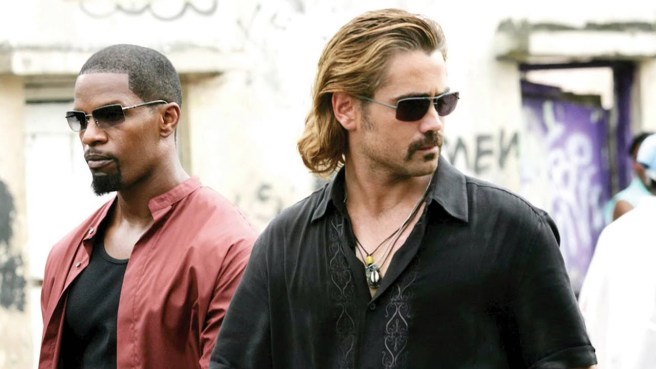
There’s not a dud in the superlative cast: Li’s flinty fatale, Naomie Harris as Foxx’s cop girlfriend, John Ortiz as the drug middleman and Luis Tosar as the drug kingpin. Mann’s dialogue, funny and profane, has a hard, urban pop, and the soundtrack ripples with interesting choices, from spare electric guitar and moody synthesizers to songs by Moby and Audioslave.
How “Miami Vice” is put together is as compelling as the story and characters. A notorious perfectionist, Mann demands technical verisimilitude, nailing the intricacies of how criminals and cops think and operate, down to their clothes, words and twitches.
He and cinematographer Dion Beebe return to the handheld high-definition video they used in “Collateral,” bringing a grainy, documentary vibe to the action that’s unnerving. It’s non-style taken to high style, soaked in ocean blues and inky nocturnal blacks. There’s not a wasted shot.
Since 1995’s “Heat,” Mann has been our greatest living action-crime director, edging ahead of past giants Sidney Lumet, William Friedkin and John Frankenheimer. The technical bravura and artistic depth Mann brings to his films staggers. He respects his craft and his audience. “I ain’t playin’!” blurts a character in “Vice.” Neither is Mann.
 GNASHING.