Frustration to ‘The Firebird’ — the sublimity of St. Petersburg

In St. Petersburg, Russia, catching an Uber the hell out of the Alexander Nevsky Monastery was nigh impossible and immaculately exasperating — client and drivers just could not connect and a flurry of cancelled rides ensued — so I found myself trekking down bustling Nevsky Prospect, the main thoroughfare in this wonderfully massive city, pocked with shops and banks and restaurants, groceries and souvenir kiosks. I strolled contentedly (ignore the steam poofing from my ears) till I could stroll no more, and located a spot at a landmark from which to finally hail an Uber ride. (Did I mention the average Uber fare ran me about $1.50 US? A dollar-fifty. Yes, at this point I’m grinning.)

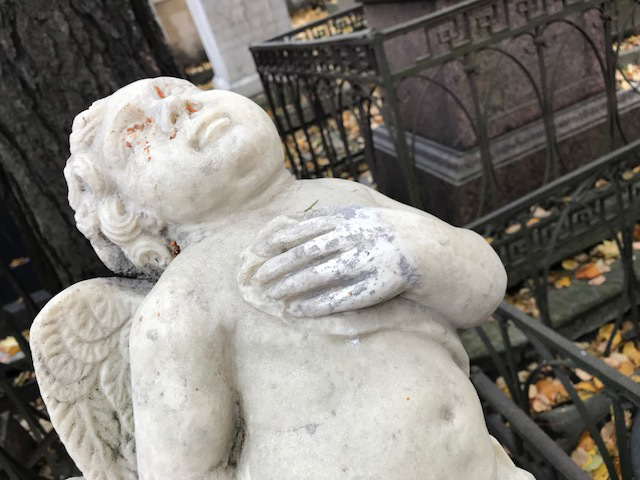
What I was doing at the famed, winsome Alexander Nevsky Monastery, at the tippity-top of Nevsky Prospect, was looking at graves, mostly those in the famous Tikhvin Cemetery, where Dostoyevsky, Tchaikovsky, Mussorgsky, Rimsky-Korsakov and other brand-name bodies lie.

img_0846.jpg

For about $7 US, one is invited to amble the leafy paths of the 19th-century burial grounds and, with map in hand, á la those furnished at the unsurpassed cemeteries of Paris, seek out the eternal mattresses of the famous and infamous. The weather was cool, distinctly autumnal, the leaves turned and fallen. It was bliss.

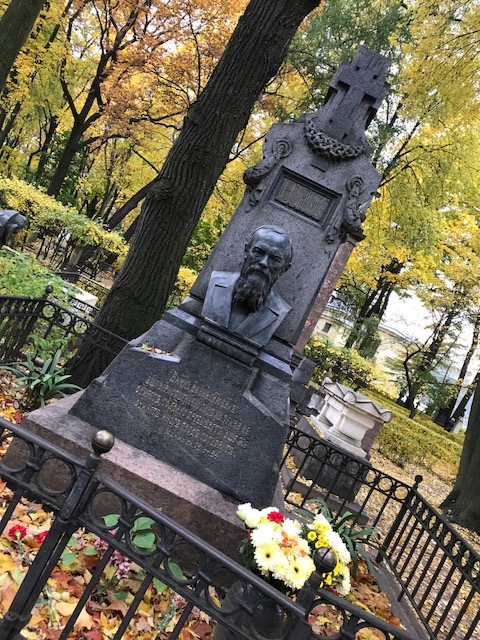
Dostoyevsky lurched at me:

IMG_0848.jpg

As did this distressed woman, who perhaps witnessed my Uber travails:

IMG_0853.jpg

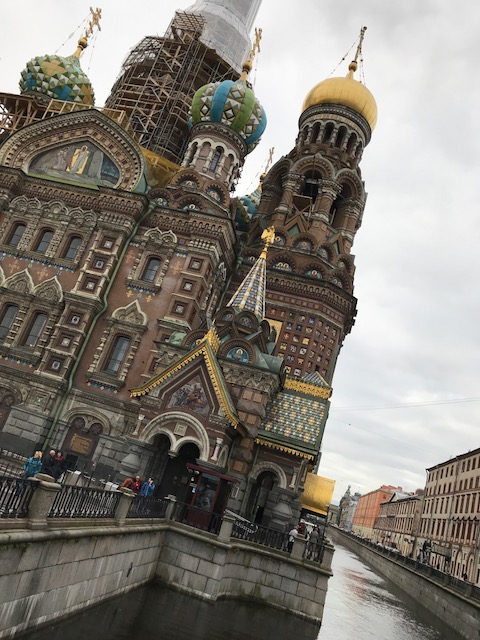
For this visitor, St. Petersburg was glorious that way, in its vibrant, tumultuous history, which is epic and bracingly complex, riddled with shake-ups, triumphs, reversals, oustings, wars, creeps (that’s you, Rasputin), revolutionaries (that’s you, Lenin), and cataracts of blood. Where else would there be this, the knockout, perversely titled Church of the Savior on Spilled Blood, the spot where Alexander II was assassinated by a terrorist bomb:

BLOOD 1.JPG

INSIDE CHURCH.jpg

Endless canals stream through St. Petersburg, requiring scores and scores of small bridges, reminiscent of Amsterdam and its canals, or Paris and the regal Seine.

IMG_0888.jpg

IMG_0889.jpg

And, as I boasted in an earlier entry, I located unfettered beauty at the ballet in the legendary Mariinsky Theatre. I watched, and reveled in, Stravinsky’s landmark fairytale “The Firebird,” perched in a fine dress circle seat. It was lush and extravagant. My view:

THEATER.jpg

Bonus shots: The Winter Palace, once the official home of the czars in the 1700s, in the sprawling Palace Square. This is the main building of the boggling Hermitage Museum.

HERMT.jpg

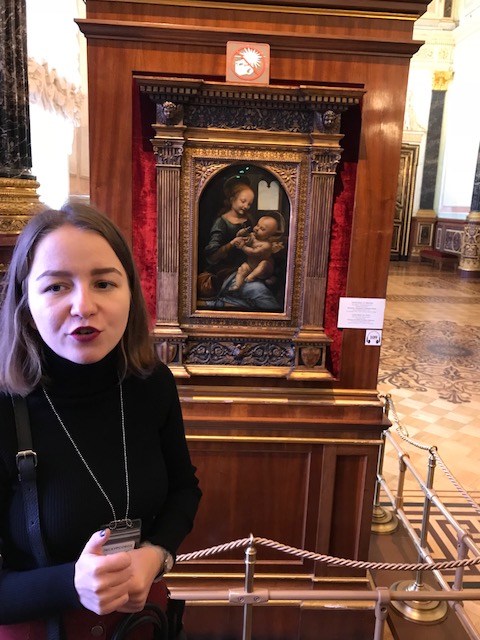
Below, a Hermitage guide describes Leonardo da Vinci’s exquisite “Madonna and Child” from 1478:

IMG_0809.jpg

And that’s all from Russia. I’ll spare you the food porn.

Tippling, Russian style

In St. Petersburg, Russia, recently, no one in a bar bumptiously offered me a shot of vodka as I had been cautioned they would. (Sad face emoji.) The only offers came from poised waiters in nice restaurants — not from chummy, drunky, rambunctious imbibers who wanted me to be their new American comrade in guzzling. This, surely, is a good thing.

I took it slow and easy, tossing back my first shots of the typically clear, but sometimes amber, libation in the controlled environment of the illuminating Russia Vodka Museum, an expansive and engrossing shrine to Russia’s national beverage.

IMG_0871
Guide Veronica explaining the vodkas I was about to gulp.

In a brisk and fact-packed 30 minutes I was shown the place by the delightful, fluently-English Veronica as my personal guide. I learned scads about the history of Russian vodka, from pre-Ivan the Terrible days in the 12th century to Putin’s relationship with the gullet-stinging spirit. The museum is top-shelf, full of text (in Russian, alas), colorful bottles, distillery artifacts, Stalin-era propaganda and unintentionally comical human wax figures. It’s thorough and classy.

If you opt for it — and you must — the tour concludes with a vodka tasting of three regional samples, and includes “chasers” of pickle, herring and onions and something else that escaped me but was fishy and delicious. The tour and tasting cost barely more than $10 US, a steal.

IMG_0872.jpg
Three shots, three edible chasers.

Before my only official shot of vodka in a bar-restaurant setting, I became a regular at the enchanting Dead Poets, a relaxed, stylish gastrobar where the bartenders are hipster mixologists with expert instincts and eye-crossing dexterity. They fashion quite the concoctions — like my favorite, the whiskey sour, which they do with care and panache — that are elaborate and fanciful but just the right amount of modest and unembarrassing. Nothing was too fru-fru, too tawdry, despite the simpatico bartenders’ twee haircuts and rococo facial hair.

IMG_0858.jpeg
Best whiskey sour, ever. Notice the egg-white froth.

No, my sole shot of ice-cold vodka (curiously, the shots at the museum were room temperature) occurred at the acclaimed Duo Gastrobar, a tiny, mid-range restaurant, serving delectable meals, like amazing bone marrow with ginger sauce and crunchy apple pork rib.

Dessert menu? Pass. Let’s move on to liquid pleasures. For about $4 Duo offered one kind of vodka, the classic Beluga Noble, in a shot. Vodka in Russia, they say, must be served chilled, otherwise send it back. This was a frosty, good-sized shot, with lemon slices to bite after quaffing it down. Vodka, of course, is the smoothest liquor to shoot, as it tastes of hardly more than alcohol fumes. It has character if scant flavor.

IMG_0913
The lone chilled vodka shot in Russia.

As he delivered it, my server volunteered his confusion as to why vodka is his country’s national drink when tequila and whiskey, for instance, contain so much more texture and nuance. True, I nodded, and we laughed. But it was bracing and fine and if I wasn’t heading over to another bar, the youthful, disco-lighted Mishka, where drinks are two-for-one during a very long happy hour, I’d have ordered another. When in Russia …

Those jarred babies — not quite jarring enough

As promised I made it to the Kunstkamera Museum in St. Petersburg, Russia, last week. Also known as the Peter the Great Museum of Anthropology and Ethnography — the oldest museum in Russian, opened in 1727 — it’s also known to connoisseurs of the grisly and gross as the Great Hall of Deformed Human Fetuses in Jars (not really). It’s a delight.

IMG_0865

And yet there aren’t as many specimens as I was hoping for, nor was there much in the way of the truly macabre. A few tweaked human skeletons — that fella’s really gigantic — a two-headed stuffed fox and some rusty surgical tools complemented the array of squishy, floating babies. Those twisted wee ones delivered the goods, a frisson of the freakish that some of us crave.

I was expecting more in the way of anatomical and medical exhibits, but the museum is largely dopey ethnographical artifacts — Native American beads and pottery, African huts, Eskimo furs, in tiny dioramas — you can see at your local natural history museum, but newer and brighter. There’s just one small floor of jarred bambinos and gnarled bones. It’s up top. Follow the arrows, greedily.

IMG_0864

It’s pretty good — three stars — but not quite enough to nourish its reputation as a world-class repository of the ghastly. I went for the morbid, not the ethnography, and found myself in and out in 30 minutes or less.

Philadelphia has Kunstkamera beat. Its famed if smaller Mütter Museum is a richer, more concentrated, more intense experience: jarred fetuses; innumerable human skulls both ghoulish and elegiac; various startling skeletons of the diseased, deformed and degraded; cankered floating body parts; chilling surgical devices; and the topper, Chang and Eng’s death cast and conjoined livers.

IMG_0866
Giant’s skeleton at Kunstkamera Museum

I don’t want to knock its Russian counterpart, but the Mütter, as specifically a physician’s institution, is more complete and well-rounded, satisfying the more ambitious demands of creep-seekers. Kunstkamera is very much worth a visit — do go — but know its limitations. While it offers a world of wonder, the Mütter offers galaxies.


Travel travails: trying to jettison on-the-road angst

Just before I embark on my vacations people reflexively ask if I’m excited and looking forward to it, assuring me I’ll have a wonderful time and wads of other tinkly bromides. Invariably I grimace and nod, “Yeah. I think so … Sure. OK, thanks.”

But I’m never sure, and it’s not OK. As I pack and prepare I’m a minor wreck, wracked, withdrawn — enthused, yes, but freighted with the cargo of myriad far-off what-ifs and other terrifying variables.

0a1a-70

I have no qualms about flying; I like flight. My innate angst resides in about, well, pretty much everything else: Flight on time! Make my connection! Will it rain at my destination! Will my Airbnb be as cool as the photos! Will I be able to communicate with the locals! Will I get robbed! Will I contract a food-borne illness! Is that baby-jar museum as rocking as it looks!

I had a small stroke applying for my Russian visa recently. As I’ve noted earlier, it was a multi-tentacled task and very pricey. With the stroke, I developed a bleeding ulcer. For some reason this trip — much more than my jaunts to China, Vietnam, Egypt, Lebanon and Syria — has me more angsty than ever.

I write this today attempting to relax in United Airlines Terminal C at the airport, from which I’ll depart to St. Petersburg, Russia, with a brief stopover in Zurich, Switzerland. I have mere minutes to catch my connecting flight. The layover is impossibly miniscule.

It is not promising. I have four stomach-twisting inklings: 1) I will miss my connection. 2) I will be spending the night in Switzerland, on my dime. 3) My luggage will be in Russia. 4) I will lose a day in St. Petersburg. (Bonus inkling: I will sob.)

Unknown.jpeg

Besides that eventuality, I am also worried about the fact that you can’t drink the water in Russia — it will do a number on you. That’s barely a concern. Bottled water is a cinch and I’ve done the don’t-drink-the-water routine in several countries. But will the hair dryer work sufficiently? Will I fumble financial transactions, not knowing well the rubles/dollars exchange? Will my accommodations’ TV have satellite or simple local cable (I kinda need my CNN)?

These are obscenely, stupidly first-world worries, of course. I do swimmingly out of my comfort zone while traveling and I revel in the developing-country experience. I’ve proven it repeatedly. But I’m weirding out a little this time.

Relax, you’ll have a great time, they say. And I believe them, shakily. I’m conjuring my own anxieties via my own dark thoughts. These are fictions. I’m in the airport, through security, decompressing, with hours till my flight. I have a glass of wine. The journey has begun, and it’s not half bad.

P1010656.JPG
The Himalayas, out the window, above Nepal.

The strange allure of the Progressive Insurance girl

She’s bubbly and beaming, high-volume, with a flip of dark hair and a face like a lollipop. She irks as she endears, bemuses as she bewitches. She’s a bundle of energetic contradictions, bursting here, retracting there. Her expressions blink and change like a neon sign. Her eyes are popping globes. And she just sold you a bunch of car insurance.

Flo is her name. She’s the spokeswoman for Progressive Auto Insurance, lighting up televisions in a series of commercials in which her perky cashier pitches the money-saving merits of Progressive to customers. She works in a sterile, all-white big-box store, and her florid makeup stands out like paint spilled in snow.

Flo

First she caught our eye; now she’s snatched our heart. Viewers are smitten. They’re crushin’. They want to know: Who’s that girl?

From a blog at HoustonPress.com, with the headline “The Cult of the Progressive Car Insurance Chick”:

“Am I the only one completely and totally enamored of the woman in the television ads for Progressive car insurance? You know, the ones starring that babelicious brunette named Flo with her ‘tricked-out name tag’ and her ’60s style eye makeup and her kissable red, red lips?”

No, sir, you are not. There’s more where that mash-note came from, out there in the blogosphere’s infinite confessional space: “She’s hot.” “She’s weird but, God, she’s fine!”

Others have naughtier ideas that they’re perfectly comfortable sharing with the world, even if we can’t do so here.

“It’s so weird,” says Stephanie Courtney, the actress who plays Flo.

We spoke to Courtney because we had to. We had to know if she was real or just a cartoon character. If she was at all like the effervescent Flo. If she really wore that much make-up and, hey, who does your hair?

Courtney has been playing Flo for several years. Which makes her the face and voice of Progressive, a peer of the Geico gecko (do they ever hang out, compare rates?) and the old Verizon guy. She follows in a heady tradition of corporate mascots, from Palmolive’s Madge to Tony the Tiger.

It’s been quite a ride for Courtney, a senior member of famed Los Angeles improv troupe the Groundlings. It began with a simple audition for a commercial. She showed up in a polo shirt and ponytail. She did some improvisation.

“They wanted someone with a lot of personality,” Courtney says by phone from her Los Angeles home.

They liked her and signed her.

Then, the look. That look.

They cut her hair, gave her bangs. They subjected her to two hours of hair and make-up.

“They tease my hair, spray it and stick the headband in it,” Courtney explains.

“And the makeup is like painting a portrait on my face,” she says, laughing. “It’s insane. It totally changes things on my face. It’s like having a mask on.”

One of Flo’s best-known lines is: “Wow! I say it louder.” (You had to be there.)

Courtney has popped up in the movies “The Heartbreak Kid” and “Blades of Glory,” and was one of four leads in the smart adult comedy “Melvin Goes to Dinner,” which won the audience award at South by Southwest in 2003. She also had a recurring role as a gossipy switchboard operator on the hit show “Mad Men.” And you may have seen her doing yoga in a Glade commercial.

The job pays well, Courtney hints. She doesn’t have to worry anymore about pesky things like rent.

How much is Courtney like flamboyant Flo?

“It’s me at my silliest,” she says. “You start off with a script, but at the end they usually let me put a little zinger in there. We put a little mustard on it. That’s when it gets fun.

“Flo could be one of my improv characters, always on and sort of cracked in a weird way.”

But who is Flo? What is she? People wonder …

Like this blogger: “Is it her fabulous comic timing, her over-the-top facial expressions, her cute-as-a-button retro flip? Or is it the slight hint of a bad girl that lies just under the surface? The promise of a tattoo under that checkout girl uniform? The possibility of a motorcycle parked out back?”

Her character has been compared to a vintage Vargas pin-up girl, ’50s burlesque dancer Betty Page and, adds Courtney, a “fetish chick.”

“I don’t know what it is,” she says. “The way I play her, she’s pretty much the most asexual thing on TV right now. I think the Geico lizard puts out more sexual vibes than Flo does. But I do think the cavemen are totally crushable.”

Though Courtney is married to a sixth-grade teacher, Flo appears alluringly single. So pine away, in the same brunette-crush way you did with Mary Ann on “Gilligan’s Island” and Velma on “Scooby-Doo.”

Because things couldn’t get much stranger than they already are for Courtney. Top this: People are dressing up as Flo for Halloween.

“That makes me so happy. But I do have to warn them that it takes two hours in hair and make-up,” she says. “I wish them luck.”

Stray, dogged thoughts about the world’s street mutts

The coolest friend I met on back-to-back trips to Istanbul was a dog.

I met the stray during a May visit and then, staying in the same area of Sultanahmet, met up with her again in October. She recognized me immediately and we enjoyed a fast, happy reunion. She jumped on me and her tail swept like a furious broom.

Stray dogs are plentiful in Istanbul and are protected by the city. Each dog is registered, one of their ears pierced with an official tag. My pal wore a red tag on her floppy left ear, leading me, with a poverty of imagination, to call her Red Tag.

P1030568_1

Medium-sized, camel-colored and sweet as a peach, Red Tag wasn’t always around and she didn’t follow me through the city. She had a life of her own. I would see her by my boutique hotel in the morning and in the evening, and she would sit near me at my nearby watering hole at night. One night she hung out with a group of people as we caroused by the Hagia Sophia, staying up till dawn, a trooper.

P1020788.JPG
Red Tag at dawn after staying out all night with human revelers.

I didn’t spoil Red Tag, though I did occasionally buy her a can of tuna to nosh on as a treat. Street dogs unavoidably crack my heart, and my first instinct is to feed them. Near Gallipoli, Turkey, I bought a stray puppy a can of tuna that she gobbled up gratefully.

P1020721
Tuna for a puppy in Turkey.

It’s not always so. In India I bought some peanuts, the only nearby food, for a crazy puppy that ignored the offering. Another Indian dog rebuffed the samosa I tried to give it. Rice wasn’t appreciated by mongrels in Vietnam. For some reason I assumed these derelict doggies would eat anything.

These memories bubbled up while reading a recent story about street dogs in The New York Times titled “Stray Dogs Started Turning Blue. Then the Street Mobilized.” It’s a great, heartening article about how well strays in India are treated and protected. Even though I’ve been to India, it’s an eye-opener:

nepal
India pup, with cow hoof.

“India has some of the most pro-dog laws on the planet. It is illegal here to kill healthy strays, and the result is millions of them — perhaps as many as 30 million across the country. Packs of dogs trot through the parks, hang around restaurants for scraps (which they usually get), and sprawl on their bellies inside railway stations as rushing commuters leap over them.”

This is a far cry from, say, China, where dogs are rounded up as people food or killed outright as pests. Sickening.

In Hanoi I saw an actual “dog restaurant.” Outside was a silver bowl filled with cooked dog paws and, ironically, a chained German shepherd serving as a guard dog. Eating dog is a kind of virility ritual — it’s a guy thing — and when a table of drunken men spotted me spotting them, they tried to rope me to their table, yelling and gesticulating. Later, in an open-air market, I saw dog carcasses basted like turkeys for sale.

Is this cruelty or culture? A culture of cruelty, I say. But let’s not wade into pitched arguments of moral relativism and abject hypocrisy here and now. Later. Maybe.

Red Tag, terrible as it is to think, has probably passed by now. It’s been a while and she seemed to have some age-related arthritic issues when we hung out. She was kind of a loner, but I saw she had friends that curiously looked a lot like her. She was protected by a big-hearted city that coddles its stray dog population, much as India is demonstrating to its mutts and mongrels. I always feel so bad for street dogs in my travels — mangy, mistreated, malnourished. This delivers a whisper of hope.

P1030245_1.JPG
Street hounds of Istanbul. Let sleeping dogs lie.

A gallery of the ghoulish in Russia

If jarred fetuses bother you, if pickled body parts give you the heebie-jeebies, look away, click away. You have two seconds …

Let’s proceed.

KunstKamera-Museum-Petersburg-660x495

For my tiresomely upcoming trip to St. Petersburg, Russia, I’ve found the East’s beautiful cousin to America’s incomparable cathedral of the grisly, the Mütter Museum in Philadelphia. It’s the Kunstkamera Museum, aka the Peter the Great Museum of Anthropology and Ethnography. I have to quote the web to get it right and concise (apologies):

“The Kunstkamera is the first museum in Russia. Established by Peter the Great and completed in 1727, it hosts a collection of almost 2,000,000 items. Peter’s museum was a cabinet of curiosities dedicated to preserving ‘natural and human curiosities and rarities.’ “

OK. We got it. (Wait. Two million items? Yes!)

Now let’s get to jarred babies. To unvarnished ghoulishness. To this:

images.jpeg

I’ll get to more such stuff for you, via words and pictures, when I get there in a week or so. I imagine this is a mummy, or someone took a picture of me after last night’s bender.

Now some beauty before we all upchuck. The museum resides in a typically wedding-cakish palace-like edifice so common in St. Petersburg:

kunstkammer-on-vasilevskiy-island-in-st-petersburg.jpg

Right, but let’s not forget its contents:

new_kuntskamera003.jpg
Three heads are better than one.

Reviewing the museum online, a visitor notes that a highlight is the “fetus floor” (well, yeah); another notes the evocative scientific instruments (probably chilling in a “Dead Ringers” way); and yet one more declares: “After traveling over 50 countries, that’s the most bizzare thing I’ve ever seen in my life. It’s really gross.” (Jittery excitement.)

Why is this appealing? I can’t quite nail it, but I know it’s the same reason why wide-eyed, slack-jawed throngs packed freak shows of yore, why giggly gaggles of school children are whisked to the Mütter Museum, why macabre taxidermy and bone specimens are top sellers at the crowd-pleasing Evolution store in New York’s SoHo.

Kunstkamera5.jpg

We are curious about mystery, the outré, the weird and wondrous. We are strangely enriched and even, with a flinch, comforted confronting the repellent and gasp-inducing. It’s not a game. Gallows humor may tinge the experience — hey, that looks like Uncle Mike! — but it’s surely not ha-ha funny. It’s about expanding the mind and the world of earthly experience. It is, with a peculiar poignance, about us. 

Brushing aside loneliness to bask in solitude

loneliness.jpg

“Solitude must be welcomed rather than feared. In the mental and moral equipment of a radical or critical personality, this realization is of the essence.” — Christopher Hitchens

I’m the inveterate navel-gazer, the incorrigible woolgatherer, the loner who picks his moments in the spotlight and never gets dragged into them. Hardly the social butterfly, I prefer the cozy gloom of the cocoon. While getting out is good, solitude is golden.

I’ve traveled the world with girlfriends, but usually it’s a solo affair — much easier, more peaceful, more relaxed. I meet people on the road, lots, and those fleeting encounters are just the right measure of intimate human contact.

I once had a friend meet me in Japan for part of a vacation and I wrote in my journal, almost as a reminder, semi-dreading the company, “I walk the Earth alone.” I was being facetious. Unfortunately my friend read this. She was light years from amused.

“Hell,” said Sartre, “is other people.” One wonders if he said this with a wink or a wince.

“Let me tell you this: if you meet a loner, no matter what they tell you, it’s not because they enjoy solitude. It’s because they have tried to blend into the world before, and people continue to disappoint them.” — Jodi Picoult

I’ve never understood people who can’t be alone. I have friends who would never conceive of going to a movie by themselves. I’ve never understood extroverts. I’m the sort who ducks down a different aisle if I spot an acquaintance in the grocery store. I’m sort of like a film noir antihero, alone in my trench coat, head bowed, buckled with ennui, smoking like a fiend, trying to make my way in an unjust world. (Ha.)

I have a mild misanthropic streak, an anti-social strain, though I’m no solitudinarian — actual word! — or recluse. It’s nothing severe enough to prevent me from enjoying a good party or get-together, even if I’m occasionally the guy who leaves early through the back door without saying proper farewells. (“People-proof your heart,” sang the Posies.)

My own skin doesn’t fit well. Which means comfort among others doesn’t come easy. Traveling, I love to read in cafes, scribble in journals at bars, roam streets, cathedrals and cemeteries alone, without the nattering of companions. I move to my own beat, that of a different drummer — and, as a longtime drummer, a pretty good drummer.

“I don’t like being able to be reached. I enjoy my solitude. Even people having my phone number seems like too much.”Brie Larson

Yes, I quoted Brie Larson. But I like her style here, despite her unbridled exhibitionism as an Oscar-winning actress and all the happy-face fraudulence that it demands. I searched her images and they’re topless this and bikini that. She shares that brainless visual cotton-candy with a boundless global viewership. So much for solitude. And yet I believe her quote, and wholly relate.

She probably doesn’t like to be reached because she gets six thousand calls a day. I don’t get any, maybe two, and it’s still too much. Even marketing calls feel like an invasion on my solo-hood. When my phone rings my first response is, Who the —-?

“Loneliness is the poverty of self; solitude is the richness of self.” — May Sarton

There is indeed a difference between loneliness and solitude, and the gulf is dramatic. Loneliness yearns for something more, usually other people, to fill an existential hole. There’s a neediness, even a dependence and desperation, there. It enshrines incapacity.

In solitude one reaps energy from oneself, without the jumper cables of outside forces. You create your own space on your own terms, with your own powers, cultivating your mind, with the option of joining the wide world at anytime. Great freedom defines solitude. It’s the incubator of creativity and art. It’s the locus of self-communion. And, far from being bereft and desolate and unduly selfish, it’s all rather invigorating, nourishing and exhilarating.

shutterstock_194414510.jpg

Booking the right book for your travels

My Russian visa finally arrived after an intensive, grueling process that cost half as much as my flight to St. Petersburg. It shouldn’t be so difficult, so discouraging — do they actually want visitors, you begin to wonder.

Visa-to-Russia-from-Usa-and-Canada-Featured-Image

In Turkey you go to a counter first thing off the plane and buy a $20 visa sticker for your passport and you’re done. It takes 15 minutes. Syria was a bit more involved: I had to send about $100 with my passport to the nearest consulate, they stamped it and sent it back. (There was more to it than that, in my case. I had to get a whole new passport because mine had an Israel stamp, a no-no with Syria.)

But enough with the pesky visa. The minor ordeal is over, let’s hope, despite the irretrievable hideousness of my visa photo, in which I look like a low-grade Russian street gangster. I can’t get over it. The customs inspectors will probably block my entry and send me home.

On to the next level of travel planning — what book to bring for leisure reading in the airport, on the plane and wherever else down time must be occupied. This is serious. A few times I’ve taken the “wrong” book on trips only to realize at page 30 that I don’t like it and I’m then screwed until I find an English-language bookstore at my destination. (“Moby-Dick” and Malcolm Lowry’s “Under the Volcano” were two of those.) A book I bought in the Amsterdam airport was Ian McEwan’s brilliant “Enduring Love” — a blind score after I purposely left the book I’d brought on the plane.

lolita-cover

Now, instead of risking disappointment on an untested title, I stick to classics and favorites. Rather recently I brought “Franny and Zooey” to Paris, “Catcher in the Rye” to Spain (yes, a little Salinger kick), “Stoner” to California and so on. For Russia I’ve picked a novel by a Russian titan which ranks in my top two or three favorite novels of all time: “Lolita” by Nabokov. One, there’s the Russia tie, even though he wrote the America-set book in English. Then there’s the fact that it’s a known quantity of peerless quality. I’ve read it twice, and now is the perfect moment to revisit. (As queasy as I can get about the subject matter, Nabokov’s extravagant prose, so transcendent religions could be founded on it, eclipses moral squirming.)

I also assign pre-reading — homework — for my journeys. Besides the sights and practicalities of guide books, I peek and poke through histories, ransack the web and watch as many documentaries on culture and history I can find. That means a lot about the Czars, Lenin and Stalin for this vacation. Today I picked up — more like lugged — David Remnick’s Pulitzer-winning doorstop “Lenin’s Tomb: The Last Days of the Soviet Empire.” It’s thick, it’s heavy and, so far, bloody and gripping.

speak_memory.large_

And my planned visit to the free Nabokov House Museum, the author’s home from his birth in 1899 to 1917, necessitated grabbing Nabokov’s celebrated autobiography “Speak, Memory,” which I read many years ago. Much of the book is set in the house, a repository of writerly ephemera, artifacts, decor, desks and his beloved butterflies.

This Nabokov jag dovetails nicely with my St. Petersburg trip. I will read part, maybe all, of the autobiography, leaving me with “Lolita” to crack in the airport in a few weeks. Meantime, I have the Remnick opus, “Lenin’s Tomb,” to hold me over, all 12 pounds of it. Reading’s a huge part of travel, I think, and I wouldn’t have it any other way. It’s informative, transformative, and it propels you just a little bit further on your voyage with words, wit and wisdom. It enriches, expands, excites. It’s like its own whopping journey.

My romance with travel — quote of the day

P1000486.JPG
Paris

“Traveling is the great true love of my life. I have always felt that to travel is worth any cost or sacrifice. I am loyal and constant in my love of travel, as I have not always been loyal and constant in my other loves. I feel about travel the way a happy new mother feels about her impossible, colicky, restless newborn baby — I just don’t care what it puts me through. Because I adore it. Because it’s mine. Because it looks exactly like me. It can barf all over me if it wants to — I just don’t care.” — Elizabeth Gilbert

P1030532_1.JPG
Istanbul
143C59B0-8CE1-4A64-94D3-832306AA8DFF.jpg
Paris