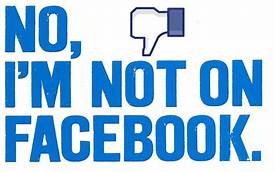
A few years ago, I did something harebrained: I joined Facebook.
Mere hours later, I quit the network, deleting my profile in its gurgling infancy. I joined right around midnight. I hit delete early the next morning. I did so with a massive sigh of relief: What was I thinking?
What was I thinking?
I was thinking, gee, maybe, as all my friends tell me, I’m missing out on some electronic fun, unfettered 24-hour socializing, photo and content sharing. I could post my marvelous travel pictures. I could see what long-lost pals are up to. I could crow about my fabulous life, crack wise and click the “like” icon with fulsome abandon. I was feeling adventurous.
Before, none of that had sounded attractive in the least. For some reason, in a momentary lapse of sanity (was it the pinot noir?), it did. And then it didn’t again. Cue the cold sweat the next morning. Cue the get me the hell off this thing panic.
During my rash registration I invited several friends to “friend” me, or whatever it is one does to connect on Facebook. By the morning I had a small tribe of friends, cyber-pals, some of whom, to my horror, had posted pictures of me on my page. I felt exposed and mortified. My instincts were spot-on: Facebook wasn’t my bag.
It’s all about sharing, and I’m not a big sharer. I don’t really want oodles of people to know what I’m up to. I certainly don’t want to see someone’s family photos snapped at Disneyland. I also don’t want to hear about so-and-so’s chronic illness. And that endless stream of (totally unreliable) information trickling down the page smacks of so much irksome spam.
Facebook and its ilk, from Twitter to Instagram, I think, are for people who like to share, show and showoff. They must be connected to feel alive, validated. There’s a boastful, presumptuous strain at work. Obsessively scanning their phones, staring in a locked zombie state, I see inborn extroverts, the gabbers, those tautly comfortable in their skins, the socially amenable and acutely people-ly. I see the FOMO syndrome. I see neediness.
What is this blog if not a way to connect? you might ask. It’s really just a billboard on which to write stuff. It’s far from a network. Any connections are stubbornly vague and mostly through distant “likes” and the rare comment. It’s written largely behind a scrim of anonymity. My last name is nowhere to be found and, save for the picture of me as a kid on the “About” page, there are no photos of me. I can be irrationally shy.
Facebook is even less alluring amid current reports of vast security breaches plaguing the network. The data and privacy of 50 million Facebook users have been compromised, prompting a social media backlash, a call to #DeleteFacebook. People from all walks (even Cher!) are deleting their profiles with great, groaning exertion, extracting themselves from what is arguably an addiction for many. (Unfortunately, some Facebook accounts represent charities and small businesses that can’t afford to nix their profiles.)
Party-pooper, anti-social, misanthrope, grandpa-grumpus — call me what you will. I connect in my own ways — email, texts and calls: perfectly efficient — without waving my arms in the air to get attention and unloading my life on fellow Facebookers. I share things on this blog, of course — it sometimes reads like a journal — but reading an entry is not a social transaction. It’s smaller than that.
We’re told to live out loud. Some of us prefer to turn it down a notch. Not to put it on mute — where’s the fun in that? — but at a setting more like a conversational nudge, not a bullhorn.
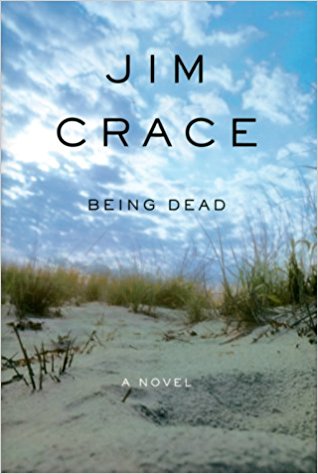
“He had learned the worst lesson that life can teach — that it makes no sense. And when that happens the happiness is never spontaneous again. It is artificial and, even then, bought at the price of an obstinate estrangement from oneself and one’s history.”
I know a handful of adult humans who, without a whiff of shame or embarrassment, blithely admit they don’t read. This is not only startling to me, it’s seismically appalling.
They (our president included) don’t get the appeal, they have no use for words or language or a particular type of storytelling that is expressly non-passive, that’s indeed near-immersive. I’m trying hard not to sound snobbish about this. It’s like the sports fan whose passion eludes the non-sports fan or the punker who has no interest in Bach or Bartok. We are who we are.
This bibliophile will never understand, and trying to understand the bookless simply exhausts me.
What I am — and here I quote one of the most apt descriptions I’ve seen — is “a person who considers reading an emotionally instructive and intellectually legitimate form of lived experience.”
That’s Alice Gregory reviewing Lisa Halliday’s new fiction “Asymmetry,” which I plan to grab once I finish Evan S. Connell’s smashing 1959 novel “Mrs. Bridge.” Gregory’s account of the serious reader made me even gladder to be one and sadder for those who are not.
Good essay at Slate today titled “The Reviewer’s Fallacy,” which includes the subhead: “When critics aren’t critical enough.” When I read that line I let out a resounding if whispered Hallelujah!
The article, by the terrific Ben Yagoda (see his knockout book “The Sound on the Page: Style and Voice in Writing”), discusses the rankling discrepancy between the opinions of professional critics and regular consumers of books, movies and music, and wonders why so many critics exalt so much art that just plain bites.
“Critics,” Yagoda writes, “have been charged with being offenders of a few specific types:
Over-intellectual nitpickers who blame works for not being what they were never intended to be: the ‘Daddy’s-Home-2’-isn’t-Molière syndrome.
Soft touches who’re in the pockets of studios and record labels. Most egregiously, ‘quote sluts’ supposedly craft money notices for the express purpose of being featured in display ads.
Chummy logrollers — a perception heightened in the social media age. In a 2012 Slate piece called ‘Against Enthusiasm,’ Jacob Silverman wrote, ‘if you spend time in the literary Twitter- or blogospheres, you’ll be positively besieged by amiability, by a relentless enthusiasm that might have you believing that all new books are wonderful and that every writer is every other writer’s biggest fan.’ ”
I know the types. I reviewed films at a major daily newspaper for 12 years, and, despite some very kind accolades, I wasn’t the most popular guy in town. To many readers, I was a naysayer, a contrarian, a hard-ass (and, yes, an asshole). To me, I was simply honest, discerning, discriminating. When you saw as many movies as I saw — about 10 a week — it gets easy to winnow the wheat from the chaff. Your crap-detectors become sharper, more attuned, and your patience for mediocrity and flat-out bilge shrivels and dies. You get tough. Compromise is the critic’s kryptonite.
“It can be argued that 90% of film, literature, consumer goods, etc. is crap,” Yagoda quotes sci-fi author Theodore Sturgeon as saying, promptly agreeing with him: “It’s inarguable that the majority of what comes down the pike, in any medium, is mediocre or worse.”
As a persnickety reader, finicky TV watcher and choosey filmgoer I emphatically concur with Sturgeon and Yagoda’s furrowed-brow attitude, which is one of frequent disappointment, confusion (people actually like this rot?) and exasperation. Being a Negative Nelly can be a lonely spot. For instance, I’m not crazy about the acclaimed series “Stranger Things.” The stance has made me few friends. I think even the dog is angry at me.
Critics, Yagoda argues, are often suckers. They “fall prey to a sort of hermeneutic Stockholm syndrome. They experience so much bad work that they get inured to it. They are so thankful for originality, or for a creator’s having good or arguably interesting intentions, or for technical proficiency, or for a something that’s crap but not crap in quite the usual way, that they give these things undue credit. You see this in reactions to Coen brothers films.”
Love that Coen brothers dig. Yagoda’s article is well worth a look — the link is in the opening graf of this entry — and includes trenchant quotes about softball criticism from George Orwell and Elizabeth Hardwick, who says — and “Sweet, bland commendations fall everywhere upon the scene; a universal, if somewhat lobotomized, accommodation reigns.”
It pains me to stop reading a book I’m not fully enjoying, not wholly invested in, but I do it so often it’s hard to make a case for any actual suffering. So, OK then: it doesn’t really pain me to put down a book I’ve already read 100 pages of. What pains me is the time I wasted on mediocrity, which — mediocrity, that is — is about the worst thing ever.
So onto books I recently sealed shut far before they reached the final page — all of which are highly acclaimed novels, and some are even scorching hot titles of fall 2017. My credo: Never trust the bestseller list, and feel no guilt spurning award winners.
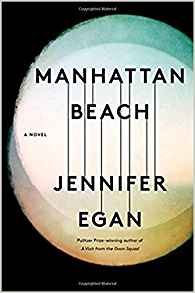
I waited long and pantingly for Jennifer Egan’s new historical epic “Manhattan Beach,” because: 1) I’m a fan of her earlier novels “Look at Me” and the Pulitzer-winning, unfortunately titled “A Visit from the Goon Squad,” and: 2) the new book marched in on a drumbeat of salivating hype.
Fail. “Manhattan Beach” isn’t bad, it’s just not great. This is Egan’s first foray into a more stately, time-tested form — the historical novel — and it’s a bit of a trudge. She’s usually more the bouncy stylist, a lot more fun, orange zest. She’s a maestro, sure, but I had to put down this eye-glazer about a third of the way in. Want a synopsis, raves, an excerpt? Go here. I can’t deal.
Two other much-exalted novels I couldn’t cozy up to due to their overarching tepidness were Celeste Ng’s family drama “Little Fires Everywhere” and Elif Batuman’s girl-goes-to-college dramedy “The Idiot.” The stories are undercut by soft, cooing voices, a bourgeois middle-brow blah, despite daintily turned phrases and surgical control. Fatally, they are short on wisdom, philosophy and epiphany. There’s no crunch.
Slightly better is Jesmyn Ward’s National Book Award winner “Sing, Unburied, Sing,” a tough, Faulknerian, mixed-race odyssey through rural Mississippi that’s very much of this racially attuned American moment and all that. Yet I found the drama ordinary and obvious. “Sing” didn’t sing.
So I picked up — and soon put down — “The Group,” Mary McCarthy’s celebrated 1963 novel about a bevy of privileged young white women making their way in a gilded New York City (it was a huge influence on Candace Bushnell, creator of “Sex and the City”). It’s a period piece, set in the 1930s, and it feels dusty. Cluttered and clammy, the fine stylist McCarthy’s tale is a dense compendium of social mores, money, neuroses and debutante gleam. It’s claustrophobic with cattiness.
Looking for another book, I considered reading Murakami’s “Kafka On the Shore.” And then I remembered how precious and irritating his “The Wind-Up Bird Chronicle” was in its forced, flatulent fancifulness.
I soon stumbled upon a suggestion, the high-flying 1990 British satire “The Buddha of Suburbia” by Hanif Kureishi, which has been called “raunchily, scabrously brilliant.” I’ve cracked it and I am happy to report I’m enjoying its comic kineticism just fine.
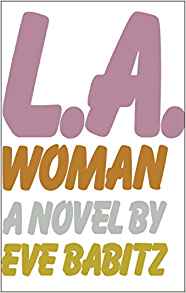
Yet I don’t think it will outclass the last book I finished, about a week ago, the short novel “LA. Woman” by Eve Babitz, my go-to gal last year for swooning fiction (I polished five of her books in 2017 with swooshing alacrity).
Soaked in sunsets and squalor, glamor and grit, “LA. Woman” traces the squiggly trajectory of a young Jim Morrison groupie through the titular city with a constant stream of poetics and epiphany. It’s funny and mean. It’s about Los Angeles. And life.
Idea of the week: “Some real talk: most writing isn’t worth consuming.”
This both striking and self-evident statement was plucked from a purposely (and pleasingly) provocative essay titled “The Case Against Reading Everything,” by Jason Guriel at The Walrus. It’s a good line, because it’s irrefutably true, and because it comes from a site called … The Walrus.
No way.
Guriel is impugning the moldy axiom that all honest writers must “read widely” — that is, indiscriminately, catholically, voraciously, hoovering the latest hardbacks, pounding down poetry, gobbling it all, from Bellow and obituaries to Cervantes and cereal boxes. It’s the old “balanced diet” theory. He’s not having it.
Neither am I. It’s an unrealistic ideal, reading it all, though I freely admit to reading obits and cereal boxes. In my twenties, I tried strenuously to read wide and far, from the gilded canon to contemporary classics, and I about hurt myself. The volume of verbiage is simply too monstrous, overwhelming and intimidating. I now embrace my blindspots (“Infinite Jest,” sci-fi, “Ulysses,” anything by J.K. Rowling) and guiltlessly shun writers I don’t feel a quick kinship with.
In college, a tough-minded journalism professor chuckled when I told him about the stacks of books taunting me and my ironclad will to conquer them. “You must be selective,” he said, and I deemed him very wise.
To this day, with impunity, I put down books that don’t regale me 110-percent, even if I’m half-way through them. Long ago, I literally dropped in the garbage John Grisham’s “The Firm” with only 50 pages out of 544 pages left. (A bratty gesture, I know, yet one unencumbered with regrets.)
It’s the quality, the intensity, not the breadth of one’s reading that counts. It’s about focus and concentration — concentrating on the works and writers that nail your sweet spot and eschewing inconsequential distractions. Says Guriel:
“The call to ‘read widely’ is a failure to make judgments. It disperses our attention across an ever-increasing black hole of mostly undeserving books. Whatever else you do, you should not be reading the many, many new releases of middling poetry and fiction that will be vying for your attention over the next year or so out of some obligation to submit your ear to a variety of voices. … Instead, shutter your ear against mediocrity. To fall in love with language, don’t fan out. Fall down a rabbit hole. Cynthia Ozick wanted to be Henry James. Nicholson Baker has a whole book about his obsession with John Updike.”
I’ve fallen down many rabbit holes, becoming a near completist of Philip Roth and, yes, Nicholson Baker. I was religious in my ardor for former San Francisco Chronicle humor columnist Jon Carroll, and marveled at New Yorker film critic Anthony Lane’s linguistic paradiddles (until, that is, he became wearisome, cutesy and gassy, a fallen hero).
Rabbit holes are thrilling. I most recently tumbled into that of L.A.-centric novelist Eve Babitz, snarfing up five of her groovily stylish books in a matter of weeks. I did what Guriel suggests, fell in love with the language, shuttered my ear against mediocrity. It was to me what reading is all about. It was like a spell — a love affair without the doom.
“The world’s small, breathing denizens, its quaking congregations and its stargazers, were fools to sacrifice the flaring briefness of their lives in hopes of paradise or fears of hell. No one transcends. There is no future and no past. There is no remedy for death — or birth — except to hug the spaces in between. Live loud. Live wide. Live tall.’’
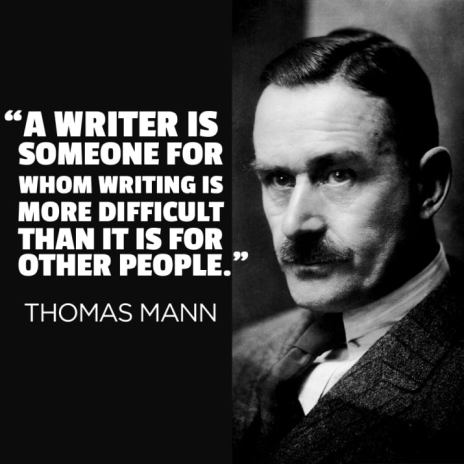
The quote about writing from “Death in Venice” novelist Mann has for decades been my favorite assessment of the craft, even, if you will, my mantra. I present it because just days ago in The New York Times an op-ed writer echoed it crisply: “If you find writing easy, you’re doing it wrong.” This is something I have staunchly believed, and still do. Writing’s a bitch.
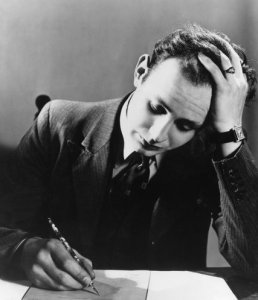
I’ve written so long and hard that my head hurt, that I’ve become physically wobbly, a wet noodle. And compounding the physical complaints was the inexorably depressing notion that what I just spent hours extracting, exhuming, molding and crafting was irrefutable crap.
“There is nothing to writing. All you do is sit down at a typewriter and bleed.” — Ernest Hemingway
A journalist colleague once called me a bleeder, because I am so slow and painstaking a writer. I’ve spent six hours on a 700-word article, I’m ashamed to admit. That isn’t the norm, but it also isn’t uncommon. Every word — no: every syllable — counts.
My best friend as a writer is so rudimentary I shouldn’t even have to mention it, and that’s reading. Yet I know many writers who don’t get this. What reliably dumbfounds me is how little so many of them actually, actively read. Television has usurped reading as a cultural pastime, confused as literature as it is. I guarantee watching TV is not going to improve one’s prose skills (teleplay-writing skills, maybe). Too many would-be writers are aspiring illiterates. A fact.
As the greats have harrumphed :
“The greatest part of a writer’s time is spent in reading, in order to write; a man will turn over half a library to make one book.” — Samuel Johnson
“Write. Rewrite. When not writing or rewriting, read. I know of no shortcuts.” — Larry L. King
If you don’t have time to read, you don’t have the time (or the tools) to write. Simple as that.” — Stephen King
Done correctly, writing is work, grueling toil. It’s fun (when it’s going well), but not that much fun. Still, creating and thinking are so gratifying that it’s worth it. It takes time, hours and hours. Listen to Louis Menand of The New Yorker:
“Writing, for 99-percent of people who do it, is the opposite of spontaneous. Chattiness, slanginess, in-your-face-ness, and any other features of writing that are conventionally characterized as ‘like speech’ are usually the results of laborious experimentation, revision, calibration, walks around the block, and recalibration. … Writers are not mere copyists of language; they are polishers, embellishers, perfecters. They spend hours getting the timing right so that what they write sounds completely unrehearsed.”
That’s as hard as it sounds, and, without the most gimlet-eyed editor, failure is inevitable. But we try. We do the work. We grind, grope for the felicitous simile and metaphor, strive for the perfect punctuation, the poetic stroke, the tickling aside. We do, yes, bleed. Sympathy is unfitting for such a self-involved venture. The only reward is to be read.
These are a few quotes about the arts that I’ve carried around for a while. I believe they’re intellectual gold:
On art:
“Art, love and God — they’re dumb words, and probably the dumbest is art. I don’t know what it is, art. But I believe in it, so far.” — Damien Hirst
*
“The last hope is that art may transmute the disappointments of life into something more radiant and stable; the lasting bitterness is that although art may guide ‘what pangs there be/Into a bearable choreography,’ it does not repair the original life-rift.” — Helen Vendler, with excerpts from poet James Merrill
*
On theater and art:
“The new generation of theatergoers are suburban know-nothings dumbed down to the point of expecting art to be some kind of inclusive, fraudulently life-affirming group-grope, instead of what it is: arrogant, autocratic, and potentially monstrous!” — David Hirson, “Wrong Mountain”
*
On acting:
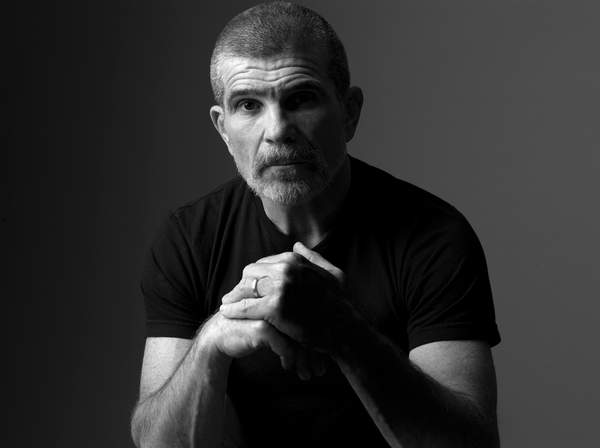
“If you intend to follow the truth you feel in yourself — to follow your common sense, and force your will to serve you in the quest for discipline and simplicity — you will subject yourself to profound despair, loneliness, and constant self-doubt. And if you persevere, the Theatre, which you are learning to serve, will grace you, now and again, with the greatest exhilaration it is possible to know.” — David Mamet
*
On writing:
“One must be drenched in words, literally soaked in them, to have the right ones form themselves into the proper patterns at the right moment.”— Hart Crane
“What writers hear when they are trying to write is something more like singing than like speaking. Inside your head, you’re yakking away to yourself all the time. Getting that voice down on paper is a depressing experience. When you write, you’re trying to transpose what you’re thinking into something that is less like an annoying drone and more like a piece of music.” — Louis Menand
*
“More than ever, critical authority comes from the power of the critic’s prose, the force and clarity of her language; it is in the art of writing itself that information and knowledge are carried, in the sentences themselves that literature is preserved. The secret function of the critic today is to write beautifully, and in so doing protect beautiful writing.” — Katie Roiphe
The headline above says “a reclamation,” by which I mean a reclaiming of bits of culture that have been acknowledged or acclaimed yet buried beneath indifference, ignorance or more accessible cultural detritus.
unsung |ˌənˈsəNG|not celebrated or praised; unacknowledged.
From food to film, I’m highlighting the forgotten, the forsaken and the downright dissed, retaining due respect to exceptional cultural finds.
These are the unsung. Some of them are the merely undersung — things that either had their day in the sun and were left for dead, or never got the plaudits they deserved.
Any culture buff worth his “House of Thrones” or “Game of Cards” knows where the good stuff is. So accept this as Quality Unsung Stuff 101, a nudge, some tips, a torch alighting on the unjustly obscure.
Film
Quick: Have you seen “Sweet Smell of Success” (1957), “At Close Range” (1986), “Naked” (1993), “The Dead Zone” (1983) or “Tangerine” (2015) ? If not, then you have some serious, very pleasurable, movie viewing in store.
But I’m not here to discuss those under-sung films, which are largely known and well-regarded. From a sea of ignored or lost titles, I’ve tapped three under-appreciated, fairly unseen movies, the minimalist masterworks “Locke” (2014), “Chop Shop” (2007) and “Wendy and Lucy” (2009).
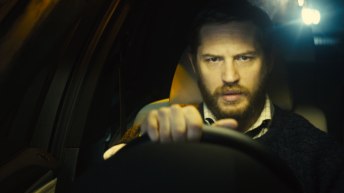
* “Locke” — A desperate everyman (the brilliantly intense Tom Hardy) is in the driver’s seat, literally, for the movie’s entire 85 minutes. Yes, he’s driving the whole time. The camera never leaves him as he negotiates by smart phone the personal tumults on the winding highway of life. It sounds grueling, squirmily static. It’s not. It’s gripping, utterly.
* “Chop Shop” — A small-scale drama about an orphan boy in Queens who works for an auto chop shop and how he deals with suspicions that his teenage sister is dabbling in prostitution. The writer-director, minimalist maestro Ramin Bahrani, is, like the neo-realists before him, a steadfast humanist, and this fascinating slice of grubby life brims with heart — and heartache.
* “Wendy and Lucy” — A girl and her dog. There you have it in Kelly Reichardt’s grim but soulful tale of a homeless woman (Michelle Williams) and her faithful hound Lucy as they get by as best they can. Lucy gets lost. Drama unfurls. It’s sad, funny, and inexorably stirring. The dog, a natural, is something special. (See my full review here.)
***
Pop Music
Alt-rock’s embarrassment of riches in the ‘90s — Nirvana, Smashing Pumpkins, Breeders, Soundgarden, Radiohead, PJ Harvey, Beck — birthed its share of one-hit/no-hit wonders, from Spin Doctors to Blind Melon.
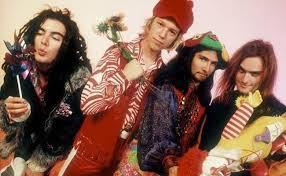
Somewhere in between it all was Jellyfish, a Bay Area power-pop band that tossed the harmonic velcro hooks of the Beatles, Beach Boys, Queen, ELO, Supertramp, Cheap Trick and even, gulp, the Partridge Family into a bottle, shook it up and let it fizz all over the place. It was poppy, heady psychedelic bliss, both dreamy and driving. It sounded like Skittles.
Jellyfish
On only two albums, “Bellybutton” and “Spilt Milk,” the woolly quartet confected soaring, careening, crashing four-part harmonies over surgical melodies and thwumping beats. The songs were so catchy and joyous that each one sounded like a hit from a bygone time. Band members looked like a Haight Street circus and their shows, like their music, were carnivalesque.
“Is Jellyfish the great lost band of the 90s?” a music site recently wondered. Decidedly, yes. The band was soon elbowed out by the grunge assault, eclipsed by angst, drugs and scratchy flannel — and some of the best music of the past 25 years.
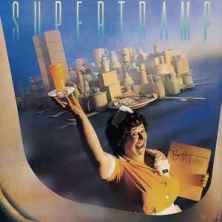
An obvious Jellyfish forebear, Supertramp is hardly an unsung pop group. It sold millions of its 1979 album “Breakfast in America,” a masterpiece of jangly, sophisticated, hyper-harmonic rock that spawned four chart-topping hits like “The Logical Song” and “Take the Long Way Home.”
Supertramp’s 1979 smash “Breakfast in America,” which seems all but forgotten.
But where’s that record now? FM radio and the general public seem to have forgotten it, paying excessive deference to the Billy Joels and Led Zeppelins. If not unsung, “Breakfast in America” is an example of the under-sung, a victim of cultural amnesia. Stream it sometime. The pop perfection you’ll hear is kind of overwhelming.
***
Food
For food tourists and inveterate foodies, it’s by now hackneyed to actively consult career food adventurer Anthony Bourdain on where to go and what to eat when you get there. But that’s just what I did before a recent London trip. Watching one of his shows in which he prowls London for the tastiest, highest quality dishes, I took notes and underlined what he called his favorite plate — his “death row” meal — the Roast Bone Marrow and Parsley Salad at St. John in the East End.
My bone marrow feast, London.
Though you can find it on many fine-dining menus — it was rather trendy a few years ago — bone marrow remains an unsung specialty that repels the squeamish and excites daredevil palates. At St. John the bone segments were hot, the oily, meaty marrow even hotter. There’s a special way to eat marrow, and the server carefully tells you how. With a thin scooper, you scrape out the marrow and, like brown-pink butter, spread it on crusty bread, top with chunky salt granules and parsley sprigs. Excavating the marrow isn’t always easy. Eating the delicious protein is.
Japanese ramen, that soupy, slurpy noodle bowl, is a longtime favorite, but lately I’ve been almost exclusively forgoing the broth, opting for liquid-free ramen called mazeman, which still, despite growing popularity, hovers in the sphere of the unsung yummy. I rarely see people ordering it at my go-to ramen spot, safely sticking to the traditional hot soup.
Without broth, ramen is like a bowl of zesty, hearty pasta, thick, seasoned noodles topped by a medley of meats, veggies and a shiny soft-boiled egg. You mix it all up and an umami tsunami emerges, dangling between chopsticks.
The dish is lionized in season two of the fine Netflix comedy “Master of None,” when Dev (Aziz Ansari) has it for the first time. After his second bite, he exclaims, “You know what? Fuck broth!” I must concur.
***
Books
“Stoner” is a stunner. John Williams’ 1965 novel, tracing the wearied footsteps of professor William Stoner, was reissued in 2006, and, despite a surge of attention, remains, alas, relegated below the unsung heading.
A shame, because the writing is surpassingly exquisite, the characters and place crackling with verisimilitude, the emotional dividends reverberant. Though Stoner is quite the sad sack, locked in an unsatisfying job, fissured marriage and the shackles of a deep existential malaise, the book is too splendid to be depressing.
Also unsung: Nicholson Baker’s ridiculously cerebral satire of the everyday “The Mezzanine” — something of a cult item — and Richard Yates’ devastating marital drama “Revolutionary Road,” which, despite being a Leonardo DiCaprio film, seems woefully overlooked as literature.
And, as I’ve mentioned a few times here, seek out Eve Babitz, especially her zesty ’70s novels, freshly reissued, “Eve’s Hollywood” and “Sex and Rage.”
***
Cities
It seems only elite travel scribes and savvy globe-trekkers talk much about the resplendence of Istanbul, one of my very top cities, a paradisiacal world of ancient mosques and prayer-swirling minarets, exotic eats, riotous bazaars, deep-dyed tradition, and some of the kindest people I’ve ever met.
My Istanbul, 2008.
Straddling the best of Europe and Asia, Istanbul’s distinctly Middle Eastern tang and cobblestoney Old Europe patina is singular. It has seas and waterways and tall hills cluttered with colorful buildings, both old and breathtakingly modern. The whole city braids the new and the historic, and the result is the exhilarating essence of truly transporting travel.
If you can blot out the hypothetical perils and hypocritical politics, Jerusalem is a delirious fount of history and culture. Nudge aside the vexing fanaticism infesting the Old City — actually, spectacles of devotion, like a Christian pilgrim hauling a giant cross down the Via Dolorosa, are pretty enthralling — and suddenly you’re in a Disneyland of the devoted.
The Western Wall, Temple Mount, Mount of Olives, East Jerusalem — it’s all utmost fascination, even for this unbudging agnostic. Short bus rides away are Masada, the Dead Sea and Bethlehem. The volume of history, religion and culture is gobsmacking. I’m going back.
For unhinged nightlife, try suave, seaside Beirut, where taxis cram narrow, bar-riddled streets and well-attired revelers roar and carouse. During the seven nights I was there, I hit both bustling, elbow-jostling bars and cozy cafes. The partiers were friendly, the drinks strong and the troubled city’s old sobriquet, “Paris of the Middle East,” seemed fitting again.
***
TV
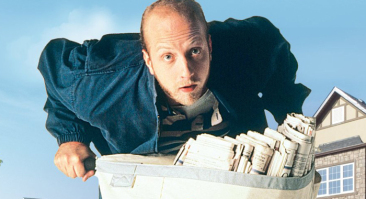
Many of you will think I’m nuts for this one, but I really do believe Chris Elliot’s wacko ’90s sitcom “Get a Life” was underrated, unloved, misunderstood and, of course, completely unsung. I also believe it was a giddy Dadaist exhibition of minor genius. All right — full-on genius.
Elliot — balding, tubby, irretrievably nerdy and awkward (and weird as hell) — played Chris Peterson, a 30-year-old paperboy who lived above his parents’ house. He had a best friend, went on the occasional, entirely improbable date, took his first driver’s test, built a submarine in his bathtub and nurtured a mordant enmity with his best friend’s wife founded on hilarious fusillades of sarcasm.
The show, which didn’t last long on Fox (surprise!), operated on an alien wavelength that either annoyed or enraged viewers who didn’t get it. There was a pinch of the Marx Brothers’ anarchic DNA in the show’s ambient absurdism. But mostly it was Elliot’s screwily non-sequitur sense of humor that shaped “Get a Life.” Charlie Kaufman (“Being John Malkovich,” etc.) was a contributing writer on the program, if that helps explain things.
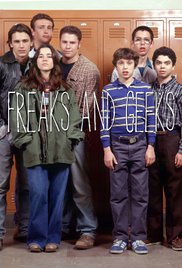
This one’s a no-brainer: “Freaks and Geeks” had Judd Apatow producing and starred Seth Rogen, James Franco, Jason Segel, Linda Cardellini and Martin Starr. The whip-smart dramedy about outlier high school cliques, the stoners and the nerds, captured school days more incisively, humorously and humanly than any work of art since “Dazed and Confused.”
And because it was so good, it was naturally cancelled after 12 episodes, in 2000, only to mushroom into a cherished cult darling that reliably makes magazines’ “best TV shows ever” lists. Unsung? This one’s pretty sung.

 Facebook is even less alluring amid current reports of vast security breaches plaguing the network. The data and privacy of 50 million Facebook users have been compromised, prompting a social media backlash, a call to #DeleteFacebook. People from all walks (even Cher!) are deleting their profiles with great, groaning exertion, extracting themselves from what is arguably an addiction for many. (Unfortunately, some Facebook accounts represent charities and small businesses that can’t afford to nix their profiles.)


 Done correctly, writing is work, grueling toil. It’s fun (when it’s going well), but not that much fun. Still, creating and thinking are so gratifying that it’s worth it. It takes time, hours and hours. Listen to Louis Menand of The New Yorker: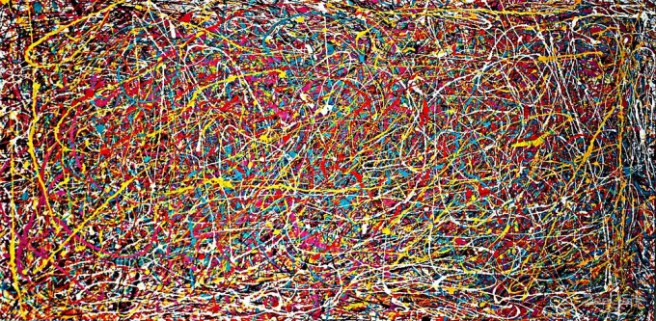





 This one’s a no-brainer: “Freaks and Geeks” had Judd Apatow producing and starred Seth Rogen, James Franco, Jason Segel, Linda Cardellini and Martin Starr. The whip-smart dramedy about outlier high school cliques, the stoners and the nerds, captured school days more incisively, humorously and humanly than any work of art since
