9 best films of 2019 (so far)

In no particular order, the movies I’m excited about at the year’s half-way point …
Climax-Banner.jpg

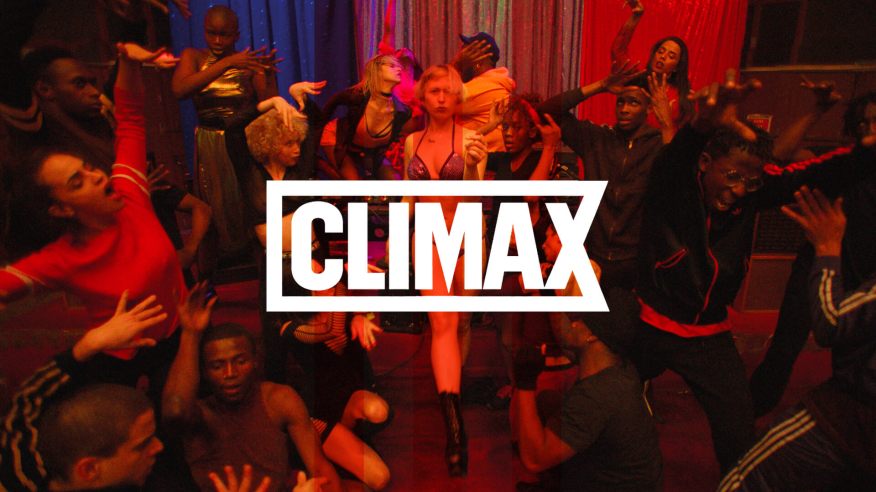
“Climax”

Puckishly sadistic, Gaspar Noé and Lars von Trier remain cinema’s great pessimists, glib nihilists and gleeful provocateurs. Look, without flinching, at Noé’s masterwork “Irréversible” or von Trier’s “Antichrist” and you’ll see my point. With the head-spinning, hallucinogenic swirl of body (and camera) movement that is “Climax,” Noé takes his visual and thematic tics past the edge of woozy chaos. When an extraordinarily talented dance troupe’s party is ruined by a bowl of LSD-spiked punch, hell uncorks with fury. What was a glorious pageant of writhing bodies becomes a descent into a violent nightmare of screeching, thrashing individuals trying to relocate reality. The camera rides a liquid wave of neon hues, racing and corkscrewing down halls and weaving through rooms. Frequently indulgent and meandering, with no real characters or story, just sensation and electro-shock, the film is pure immersion, a sustained climax. I didn’t say it was pleasant. But it is novel, and queerly riveting. And purely Noé. Watch the trailer HERE.

last_black_man_in_san_francisco_ver3.jpg

“The Last Black Man in San Francisco”

At once arty, elegiac, poetic and tough-minded, this is a tale, a beautiful reverie, that strikes on topics of race and class and gentrification with sparks and lyricism and primary-color Spike Lee sizzle. It’s something singular, and it slowly intoxicates with its emotional and sociological depths. Following Jimmie Fails (played by the actor of the same name — he’s as charismatic as a young Don Cheadle) as he presses to reclaim the giant Victorian home of his grandfather, the film is both a call to honoring blood bonds and a plaintive hymn to a troubled city. Joe Talbot directs (and co-writes) with soaring vision and intense feeling. The result is dire, daring, dreamy. Trailer HERE.
honeyland.jpg

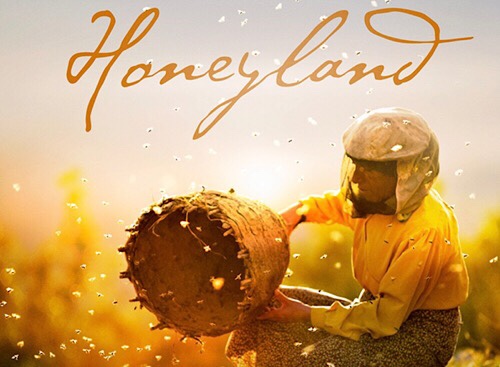
“Honeyland”

In this gorgeously observational documentary, weathered, middle-aged Hatidze lives in the rocky Macedonian mountains, where she cares for her ailing mother and tends to several beehives that produce honey for a tenuous livelihood. A large, rowdy family moves next door and decides to try beekeeping, but without expertise, they flail and almost comically get stung more than they harvest the sweet goo. Tensions arise between the neighbors, but this achingly humanistic look at an exotic if seriously impoverished way of life is mostly a portrait of Hatidze, a steely, lonely woman who has as much soul as those mountains can contain. The doc won a record three awards at Sundance 2019, including for its ravishing cinematography. Trailer HERE.

mustang.jpg

“The Mustang”

Breaking a horse is a bitch. Triple the challenge if it’s a rearing, snorting wild desert mustang. That’s what Roman (Matthias Schoenaerts) is tasked with as a violent criminal in a Nevada prison program in which convicts break mustangs for auction, preparing them for work in law enforcement. “We’re not training these horses for little kids’ birthdays and pony rides,” growls Bruce Dern’s crusty bossman, who knows both man and horse require an especially prickly strain of tough-love. If Laure de Clermont-Tonnerre’s feature debut falls into a formulaic groove — the apex of the depiction of trust-building between human and wild horse remains Carroll Ballard’s 1979 “The Black Stallion” — the film doesn’t flinch from gritty, violent twists. The dangerous dance between Roman and his horse Marcus retains tension, as the two captives, both scrappy and obstinate, circle each other in a face-off that could end in injury and defeat, or mutual respect and friendship. Roman’s frustration boils — “Just fucking listen to me!” he snaps. “I’m not going to hurt you! You hear me, you stupid animal!” — and it’s no surprise the horse is listening. Trailer HERE.
her smell.jpg

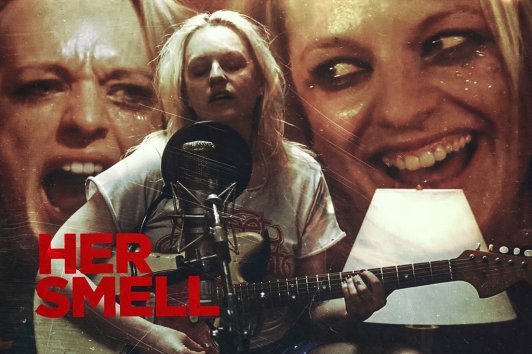
“Her Smell”

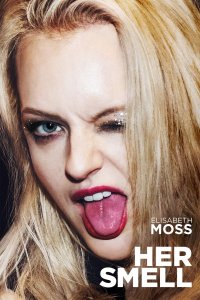
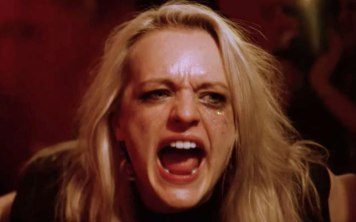
Elisabeth Moss’ performance in this shambolic punk-rock portrait is as athletically interior as it is exterior, spiked with physical fits and spasms like a lunatic child in a druggy tantrum. In my favorite performance of the year, Moss plays Becky, volatile front-woman of a female punk band she’s struggling to keep together between coke binges and flame-throwing hissy fits. The actress stirs up a cackling, hand-flinging cauldron of Courtney Love, Blanche DuBois, Charles Manson and Gena Rowlands in “A Woman Under the Influence.” It’s all raw-nerve, and Moss commits to her anti-heroine in a self-immolating blaze. She’s as shattering as this ballsy, surprisingly sensitive film by writer-director Alex Ross Perry. Trailer HERE.

Booksmart-Movie-2019-900x506.jpg

“Booksmart”

Barreling forth with raunchy vigor and unbridled zest, this breakneck coming-of-age comedy, actress Olivia Wilde’s impressive directorial debut, screams fun. Almost literally: There’s a lot of screaming — in surprise, horror and explosive joy. An amplified spin on school-days greats — “Dazed and Confused,” John Hughes’ oeuvre and last year’s “Lady Bird” and “Eighth Grade” — “Booksmart” piles on twists with a sharp, knowing eye that zooms in on the timely and topical, from female power and LGBTQs, to bullying and the corrosive effects of cliques, and, duh, the liberating if daunting pull of sexual exploration. Starring a terrific Beanie Feldstein and Kaitlyn Dever as boundary-pushing besties, who learn, in a fleeting haze, that maybe bongs are as fun as books. Trailer HERE.
46084844_685873568460655_5249823622087835648_n.jpg

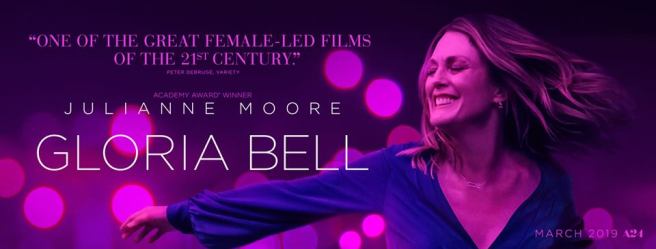
“Gloria Bell”

A glowing Julianne Moore — is there a more radiant actress? — assumes the title role in this sweet, ebullient, slightly melancholic snapshot of a middle-aged divorced woman seeking love and connection in modern Los Angeles. A touching remake of the 2013 Chilean film “Gloria,” by the writer-director of that movie, Sebastián Lelio, the movie follows its wise, free-spirited character onto her favorite place, the dance floor, where she finds romance with a nice guy (a fine, empathetic John Turturro) and all the attendant delights, complications and disappointments of love. No matter how sore things get, Gloria’s joie de vivre stays infectious. Trailer HERE.
NON FICTION.jpg

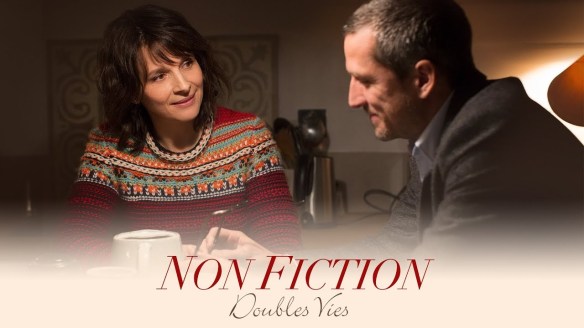
“Non-Fiction”

French writer-director Olivier Assayas‘ dramedy is a tireless, tonic gabfest that had me speed-reading the flurry of subtitles more than drinking in the warm faces and colors of the bustling scenes. That’s no complaint. The profusion of words — intelligent, eloquent, biting — brim with ideas, humor, pain and pathos, for an enveloping artful experience. You want to know the fork-tongued characters, led by an enchanting Juliette Binoche, because of the literary, arty cosmos in which these writers, editors and actors orbit. It’s heady and human: They’re just people, with all of our people-ly problems, and it’s more exciting than you think. Part tart publishing-world satire, part feast of infidelity, part anatomy of midlife crises, “Non-Fiction” is light on plot, more enmeshed in ideas about love and life, loyalty between friends and lovers, and, in a topical concession, a pointed conversation about new media vs. the printed word. It’s like a Gallic Woody Allen comedy, without the tootling clarinet and stammering, gesticulating neuroses. Trailer HERE.

souveneir.jpg

“The Souvenir”

Not an easy film, Joanna Hogg‘s elusive, divisive relationship drama is boobytrapped with qualities that repel people from the arthouse. It’s glacial, elliptical, remote. It makes you work with loosely hanging scenes, a jagged structure and oblique characterizations. I broke a small sweat trying to solder the plot together, identify with the actors and figure out where Hogg was taking me. The entry point is young film student Julie, played with winsome diffidence by Honor Swinton Byrne. Julie’s lover Anthony (Tom Burke) is a heroin addict, a secret until it’s not, which inevitably snarls their relationship. The story is mostly scenes of the couple muddling through their unconventional, occasionally off-putting upper-middle-class affair. With drugs. And spats. And sex. And dinner parties. And the making of a student film. And an IRA bombing. Somehow, Hogg’s disparate elements crazily fall together. Trailer HERE.
Drumming up memories

I’m on seedy Broadway in San Francisco, on stage in a smoke-choked, beer-splashed nightclub called Mabuhay Gardens, aka The Mab, a DIY punk dive nestled amidst a blinking drag of vintage strip joints, including the storied Condor.

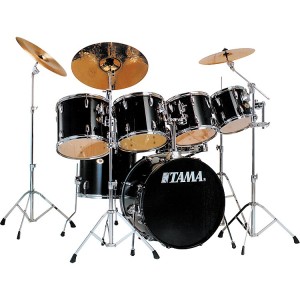
449098000000000-00-750x750I’m playing drums, a 7-piece Tama kit that exudes hard rock, in a band with an Aerosmith-y tang called Cheater. Long hair, striped pants and songs like “Knocking Down Your Door,” “Live for Today” and the inimitable “The Girl’s a Fish,” an infectious groove featuring double-bass kick pedals and cowbell. You heard that right.

This night was my second performance ever before a live audience. Prior to it, by mere weeks, I played a high-school talent show in a metal band named Enforcer. We covered Queensrÿche’s “Queen of the Reich” and Metallica’s “For Whom the Bell Tolls” — the first song fast and filigreed and vocally demanding; the second a raw, elemental, melodic stomp that’s become a Metallica classic.

As a nervous introvert, playing before a crowd was no small feat. I could barely give a speech in English class. It was a social and psychological breakthrough, and a dream come true. Rock was my destiny, and I was living it. And having a blast.

That is until my first “professional” show at The Mab. During the second song in Cheater’s set, the nylon strap on my right-foot bass pedal snapped, cutting off all right-pedal action, which meant I had to play with my left-foot pedal. Big problem: the left-foot pedal was strictly for double-bass play; my left foot coordination was weak, only apt for chh-chh high-hat work. (Now, if I had had only one pedal that night, the show would’ve been over.)

I choked. Instead of finishing the song with my left foot, I stopped playing altogether, meaning the band stopped, too — a concert faux pas. It took a few minutes to figure out that I had to keep going with one pedal — the left one, with which, again, I had minimal coordination. I am not ambidextrous.

Mortified and furious, as I was, my bandmates glared at me, then went ahead with the next song, “The Girl’s a Fish,” which demanded heavy double-bass footwork. I faked it with the left pedal, as I did during the rest of the set. The result was passable. Yet, by concert’s end, I was so mad at myself, so totally disappointed, I kicked drums and tossed cymbals to the point that the rear-entry doorman told me to cool it. An auspicious beginning to my awesome rock ’n’ roll career. I went home alone and moped grievously. 

A year later, post-Cheater, my scrappy garage band again played the high-school talent show. For some reason, the vice-principal thought our group could sell tickets, so he asked me to organize a band for the show. This time we were called THC, and we were more ambitious and ready to show-off than the year before. We wanted to shock and awe, to all-caps ROCK. (Though we ditched the smoke bombs from before.)

2db9a1ec682ed21d9492c60b55bec05bThis time we covered Iron Maiden’s “The Trooper” and Metallica’s “The Four Horsemen,” a seven-minute opus of relentless time changes and merciless riffs that amounts to about six songs in one. The songs proved ferocious, byzantine metal symphonies best left to virtuosos and masochists. I beat off more than I could chew, excuse the potentially repulsive pun.

And yet another mishap bedeviled me. This time my monitors konked out during an especially complex passage in “The Four Horsemen” and abruptly I couldn’t hear the rest of the band. I lost my place and had to stop playing for several seconds. It was humiliating. When the sound finally returned, the guitarists shrewdly cut to the song’s main riff and we finished with a flourish. Still, I was rattled instead of rocked.

Soon after, I sat in with a band called — wait for it — Mistress. The deal was I would record a demo tape with them and call it a day. I wound up doing that and a show at Mabuhay Gardens. With songs unironically titled “One Touch” and “We’ll Fight” — all heavier and more intricate than anything by Cheater — we played the San Francisco club without a hitch. Members of Cheater were in the crowd, cheering us on.

TD25KVSet-large
Electronic Roland kit with double-bass pedals

It’s been some time since I drummed. My last kit was a five-piece Roland electronic rack, with one acoustic touch — an 8-inch Zildjian splash cymbal to furnish shimmery accents. I kept my DW double-bass pedal with the set, and stuck with Vic Firth American Classic drumsticks that were a cross between jazz and rock style. I played hard, reducing them to splinters.

I was never a great drummer, mostly competent, deftly intermediate, even though I took lessons from the eminent Jeff Campitelli, the most affable pro and unfailing mensch, who was teaching Metallica’s drummer, Lars Ulrich, at the same time. (A secret: It’s all in the wrists, not the arms.)

I love the instrument, and to this day when I hear a favorite song, I might just erupt into spontaneous air drums. Thing is, I’m kind of a better air drummer than an actual drummer (cue rim-shot).

I miss the crisp metallic thwack of the snare and thuddy boom of the kick drum; the brassy, splashy explosion of a crash cymbal and pingy, bell-like precision of a ride cymbal. I miss being a song’s pulse and heartbeat, of driving it with thrust, swing, exactitude, and occasional fury. Musicianship, I am certain, is an exquisite madness.

What’s in a name? Lots apparently

“When you’re a white, blonde-haired, blue-eyed woman named LaKiesha, life can get complicated.” 

So begins an excellent CNN.com story that continues: “Strangers burst out laughing when you tell them your name. Puzzled white people ask what your parents were thinking. Black people wonder if you’re trying to play a bad joke.”

190609180750-lakiesha-francis-super-169.jpg
LaKiesha Francis

The story’s headline is “What it’s like to be a white woman named LaKiesha,” and what follows by reporter John Blake is a probing, provocative account of life for a very white LaKiesha Francis in small-town Ohio because of her exotic birth name, and what it means when a white person has a “black” name and a black person has a “white” name. 

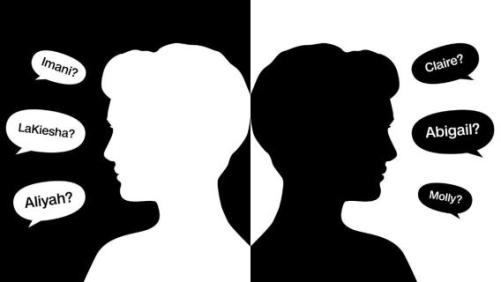
“We hear a lot about what are known as ‘black-sounding’ names these days,” Blake writes. “What LaKiesha has discovered is that the names of Americans are as segregated as many of their lives. There are names that seem traditionally reserved for whites only, such as Molly, Tanner and Connor. And names favored by black parents, such as Aliyah, DeShawn and Kiara. … But when you move through life with a name that violates those racial and ethnic boundaries, LaKiesha has found that people will often treat you as an imposter.”

unnamed-file.jpgFurther proof of name prejudice and name politics is this 2006 ABC report on “whitest” and “blackest” names:
“Studies of résumés found that people with black-sounding names are less likely to get callbacks. ABC put 22 pairs of names to the test, posting identical résumés except for the names at the top. The résumés with the white-sounding names were actually downloaded 17 percent more often by job recruiters than those with black-sounding names.”

Toxic and pernicious, let’s call this what it is: flagrant racism. Both of these articles are so powerful and troubling on their own — do click their links — that I have little of substance to add to them. My reactions are as visceral as intellectual, and putting them into words would likely be messy.

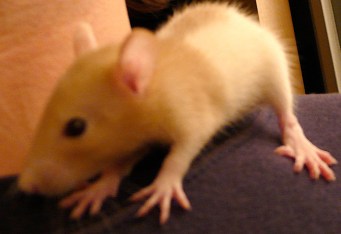
Yet I have my own modest story about appropriating a so-called black name. A long time ago I bought a white and ginger pet rat. I named her LaShonda for no greater reasons than I thought it was cute and cheeky. And fitting. Like her, it was adorable, full of spirit.

But then I started second-guessing the name. What would vets and their receptionists think when I brought in a white rodent named LaShonda? When I told friends her name the response was usually laughter. What had I done? Was I making fun of a black name? Or, as I believed, was I giving my pet the coolest name I could think of? (I thought of changing it, but LaShonda mysteriously died in her cage after only three weeks.)

P1010172.jpg
This is actually Tammy the rat, but she is practically a twin of the late LaShonda.

Would LaShonda have faced the same backlash LaKiesha Francis does? Would she have been treated as an imposter, her job applications put at the bottom of the pile because of her exotic moniker? Would she have been bullied by other rats? Would she have legally changed her name to Carol or Gertrude? Would she have resented me for putting so much social pressure on her?

“It can be exhausting constantly explaining yourself to white people, even though you’re white,” writes Blake. I believe it. LaKiesha and LaShonda “sound” black, but expectations are upended, confusion reigns and mockery and resentment are possible outcomes.  “A name isn’t just a name, according to history and social science,” Blake says. “Give someone the wrong name and it can become a burden.”

Funerals in the forest

I’ve talked here before about how to dispose of my body after I croak. I have particular, peculiar, deeply secular ideas. First, do not bury me; I am not landfill. Second, do cremate me; you can put my ashes in a curvy hourglass, a swirling snow globe, or a Magic 8 Ball to be shaken for answers to imponderable cosmic queries, such as, “Does Suzy like me?”  

These are some very real alternatives, as well:

* As I’ve written here, Washington State is considering allowing human remains to be disposed of and reduced to soil through composting. It works like this: Decomposing bodies crumble and decay into soil and are dispersed to help flowers and trees thrive. There’s no coffin, no chemicals, no pricey cemetery plot and none of the fossil fuels used in cremation. Eco-ecstasy.

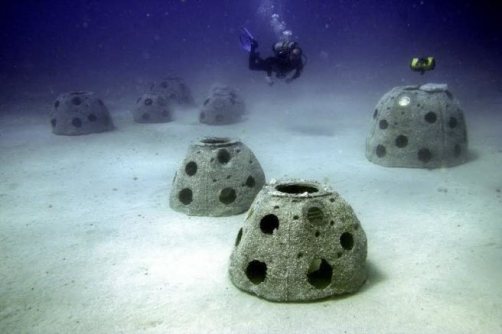
* In another post I described the underwater reef ball, an eco-friendly, reef-building sphere of cement in which your ashes are placed and then sunk to the bottom of the sea. First you’re cremated. Then your ashes are stirred with concrete and shaped into a hollow, hole-pocked reef ball. Resting on the seafloor, its goal is to provide a teeming marine habitat for fish, coral and other sea critters.

image.jpg

Now there’s another option, which I saw in the Times. “Could Trees Be the New Gravestones?” the headline asks. It’s a bit cryptic, but read on and it’s all about forest funerals. The first thing that popped to mind was hiding a corpse in the woods, throwing some leaves over it, and running. 

But no. This is about a respectable body receptacle, a burial place for human (and pet) ashes deep among towering trees, verdant ferns and Chia-lush moss, a sylvan Eden of mist and dew, deer, butterflies and half-men, half-goats. You want to be buried in beauty, this is your spot.

Better Place Forests, a Bay Area start-up, is “buying forests, arranging conservation easements intended to prevent the land from ever being developed, and then selling people the right to have their cremated remains mixed with fertilizer and fed to a particular tree,” the Times says. (Fed to a particular tree — Mother Nature’s bottomless buffet chomps on.) vc_insidersguidetocaliforniasredwoodcoast_st_rm_ea6f8r_1280x640.jpgIt sounds a lot like Washington State’s human composting proposal, but Better Place Forests seems to have this thing up and rolling with a tree-specific blueprint. The company emailed me this simplified explanation of how its “memorial forests” work:
  1. You choose a tree in one of our private, permanently protected forests.
  2. Under this tree, you spread ashes of family members and pets for generations to come.
  3. Our forests are easy to reach. Your family can visit your tree at any time.

Along with flowers, bring a backpack, picnic spread, bottle of rosé and bug spray.

So far, only two forests are taking cremains: one in Point Arena on the ocean-sprayed coast of Northern California and the dense Santa Cruz Forest, where 6,000 trees are available on 80 acres. Spots in Seattle, Denver, Portland and Flagstaff are in the works.

Dying is easy; paying for it is hard. What’s your budget? What kind of tree do you want to be eaten by? Some of the nitty-gritty (boldface mine):

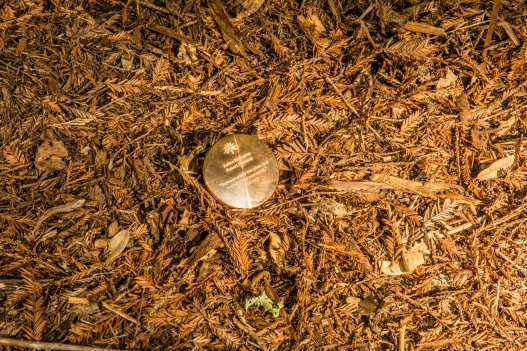
“Customers come to claim a tree for perpetuity. This now costs between $3,000 (for those who want to be mixed into the earth at the base of a small young tree or a less desirable species of tree) and upward of $30,000 (for those who wish to reside forever by an old redwood). For those who don’t mind spending eternity with strangers, there is also an entry-level price of $970 to enter the soil of a community tree. (Cremation is not included.) A steward then installs a small round plaque in the earth like a gravestone.”

I don’t know about you, but I’m not doing “a less desirable species of tree” (sorry, pine) or the community tree, which smacks of a pauper’s grave — fine for Mozart but not moi. I’m going for it — 30K to snuggle up to an ancient, majestic redwood, a barky skyscraper that kisses the clouds and tickles the sun. That sounds lovely. I’ll be dead, but still.

How strange to be sprinkled at the base of a giant tree in a vast shadow-dappled forest. Will an impish fox come dig me up, uprooting the whole rest-in-peace thing? Might a small-bladdered hiker use my tree as a makeshift urinal? Even stranger, could a fern sprout where my ashes are buried like in the book “Where the Red Fern Grows”?

That would be deliciously nuts — what color would my fern be? — and as surreal, incomprehensible and amazing as death itself.

Now, where do I sign up?

(The company’s video pitch is HERE.)

merlin_155601582_ab30cd88-747a-4c47-852f-f6b4d0b79d11-superJumbo.jpg
“A small round plaque in the earth like a gravestone.” They’re not kidding. That looks to be about the size of a silver dollar.

Random reflections, wryly

I have never done karaoke, and I never will.

I don’t understand runners. I don’t know what in the world they are doing.

Dancing — a faint memory from my roaring twenties that I hope goes away.

Reggae is the devil’s flatulence.

A good, mean rollercoaster mainlines an unparalleled high. 

There is nothing sexier than a comely woman reading a book. 

Cars. I will never get them. They are like refrigerators — necessary appliances.

‘Good dog’ is redundant.

People who purposely don’t travel are unevolved and sad. (And people who say Munich is better than Paris are the most unevolved and most sad.)

Going to the movies alone is the best.

Religion is so radically misunderstood, so repulsively knotted up, we should hit delete and start all over again.

I am constitutionally incapable of playing charades.

Giving money to your alma mater is strictly for suckers.

Unless you’re doing it to a tiny child, the high-five is socially questionable. Fist-bumps — criminal.

There are worse things than tongue piercings. Though I can’t think of anything.

When an adult says they’re “reading” Harry Potter, they’re not really reading at all.

Sushi is sublime. I’ll even eat the grocery store crap.

I‘m thinking of going back to Japan. The more I think about it, the crazier I get.

I have this thing that if someone tells me they don’t read, I want to go back in time to the moment where I hadn’t met them.

Carnivals are disgusting and revolting. I adore everything about them. Even those poor goldfish.

I can’t do the Great Outdoors. It’s the outdoors part that gets me.

I like sharks a lot. If one bit me, it would probably like me too.

Pet rats are like itty-bitty dogs — highly intelligent, funny, trainable, social, responsive. They drink beer and eat anything and, well, everything. Then at about 2-years-old they die and shatter your heart into 10,000 pieces. They’re the best.

If, in a post-apocalyptic world, all sports were wiped out, I wouldn’t care a whit. Take the fans first.

I was thinking of going to a local food festival and parade. Temporary insanity just creeps up on you.

roller-coaster-149508746-57ac7eb45f9b58974ace1b67.jpg
Good.
keep-calm-and-love-reggae-d001012131649.png
Evil.
_105702604_shark976.jpg
Cool.
Tongue-Piercing-Girl_620x349.jpg
Fool.

The best performance of the year (so far)

Writer-director Alex Ross Perry and actress Elisabeth Moss have a special relationship: He puts her through the wringer and she acts her guts out. 

In two films, this year’s “Her Smell” and 2015’s “Queen of Earth” — deep-dish psychological studies of women flailing and wailing on the verge — the result is explosive symbiosis, a convulsive give and take between a director who lays out a vision and lets his muse run with it at breathtaking velocity. 

p16645992_v_v8_aa

Run she does, maybe too far, too fast (as some have argued). Moss’ performance in “Her Smell” is athletically interior and exterior, jagged with physical fits and spasms like a lunatic child having a druggy temper tantrum. It’s my favorite performance of the year so far. 

Moss plays Becky, volatile front-woman of a female punk band she’s struggling to keep together between coke binges and flame-throwing hissy fits. The actress stirs up a hot, cackling cauldron of Courtney Love, Blanche DuBois, Charles Manson and Gena Rowlands in “A Woman Under the Influence.” It’s all raw-nerve, and Moss commits to her anti-heroine in a self-immolating blaze.

Eyes drizzling mascara, teeth gnashing, arms and hair thrashing, lipstick smeared with a paint-roller, Moss spews apoplectic, apocalyptic poetry in what’s less a performance than a detonation of eye-popping possession. It’s an electric and crazily entertaining one-woman show, the kind Oscar never sees and wouldn’t know what to do with anyhow.

09-elisabeth-moss-her-smell-4

What grabs you is the devotion Moss brings to both Becky in “Her Smell” and the more quietly unhinged, clinically depressed Catherine in “Queen of Earth.” Dramatically different than her more contained, yet reliably strong women in “Mad Men,” “The Handmaid’s Tale” and “Top of the Lake,” these characters are solipsistic, narcissistic, unbalanced, straight-up unwell. 

Director Perry grants them close-up, single-take soliloquies that are so chiseled they avoid becoming indulgent workshop exercises. The camera eye stares Moss down, never letting her off the hook. Moss gives right back. You watch shaken, exhilarated.

It’s important to note Moss isn’t performing in a vacuum, despite the fact the characters, especially punker Becky, would make arresting (abrading?) Off-Broadway solo turns. Both films have slight but linear stories — they are the definition of soul-baring character examinations — populated with superb co-stars, from the bandmates and manager (Eric Stoltz, wonderful to see you) in “Her Smell” to the great, flinty Katherine Waterston as Moss’ increasingly estranged best friend in “Queen of Earth.”

Without other players, Moss’ fascinating creations would just be feral, foundering head cases bouncing off the walls and slipping into oblivion. Her cast-mates keep Becky and Catherine in reality, our world. They are friends and antagonists, yang to Moss’ yin, and they haul her from the edge.

Still, what this formidable actress pulls off on her own, between her and the camera, is remarkable. With scary conviction, she summons wrenching human meltdowns in all their grim and glorious beauty.

images

“Her Smell” and “Queen of Earth” are on DVD and several streaming outlets. 

“Her Smell” trailer HERE.

“Queen of Earth” trailer HERE.

The story behind my blog photo

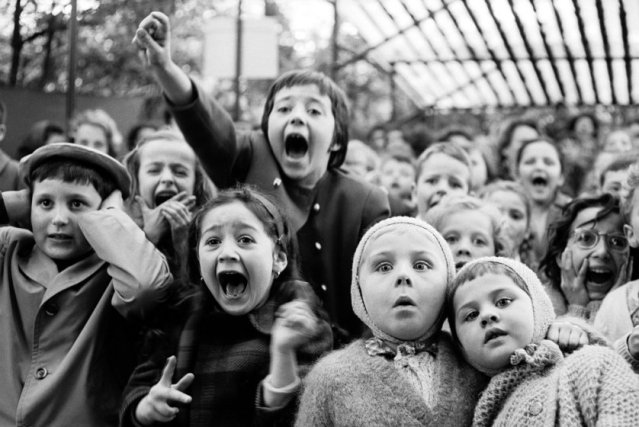
People have asked me if the photograph above this blog is is a screen-shot from Francois Truffaut’s “The 400 Blows,” as it resembles a scene from that classic 1959 film. It is not.
It is Alfred Eisenstaedt‘s ecstatic picture of kids at a Parisian puppet show, “Saint George and the Dragon,” at an outdoor theater in 1963.
01_00760343.jpg

Time magazine recently wrote about this enchanting photo:

Capturing the thrill, the shock, the shared triumph-over-evil that the children feel at the very moment when St. George slays the mythical beast, Eisenstaedt’s picture feels as fresh as when it was made, more than 50 years ago.

Here, the picture tells us, is an innocence that can remind even the most jaded of what it was once like to believe, to really believe, in the stories that unfold before our eyes onstage, or onscreen.

The master photographer himself said of this very picture:

“It took a long time to get the angle I liked. But the best picture is the one I took at the climax of the action. It carries all the excitement of the children screaming, The dragon is slain! Very often this sort of thing is only a momentary vision. My brain does not register, only my eyes and finger react. Click.”

Want to know if the dog dies? Go here first

In the bullet-peppered, body-slamming thriller “John Wick,” innumerable bad guys die stylishly gruesome deaths.

So, alas, does the dog.

The blameless Beagle puppy named Daisy is mercilessly killed before our hero’s eyes, which squint with vengeance instead of squinch with tears. John Wick (Keanu Reeves) isn’t taking this outrage sitting down — he’s not letting dead dogs lie — in the 2014 cult classic. He’s about to unleash a two-hour massacre.

john-wick-dog-e1533830984142-625x352.jpg
Play dead. For good.

Spoiler? You bet. That’s exactly what the fine, sometimes funny and oddly practical movie- and animal-lover site Does the Dog Die? is here for — to tell you ahead of time if the damn dog dies. You want to know. I definitely want to know.

Anytime a dog, or any animal for that matter, appears on screen I tense up and just hope the creature doesn’t get shot, run over by an SUV or mauled by a demon (or, if you’re the rabbit in “Fatal Attraction,” boiled alive). Animals in movies are too often sacrificial lambs, beelines to our heartstrings or, as in Wick’s case, catalysts for revenge. (Or just workaday roadkill. Shrug.)

The website covers all manner of movie, TV and book animal deaths. Fed by visitor input, it’s a spoiler sanctuary revealing what animals perish or get injured and how, in often graphic terms. (Sample: “A cat accidentally gets smashed by a book. A half-human, half-dog gets his arm chopped off and punched into the ground.”) Ha, ha.

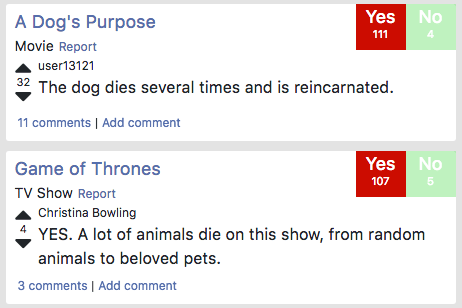
It’s humorous. It’s helpful. It’s horrific. Here’s a short screen grab to show you what entries looks like (note, it’s not the prettiest web design):

3fa53c75-9daf-41aa-b438-3b09f616fa24-screen-shot-2019-03-21-at-105648-am.png

Some more reader reports about dogs dying onscreen at Does the Dog Die:

  • “The Babadook” — “For anyone who DOESN’T WANT TO WATCH THE DEATH OF THE DOG, don’t watch from 1:09:20 to 1:11:20.”
  • “I Am Legend” — “Dog is infected by a zombie-esque virus and is killed by her owner.”
  • “The Witch” — “Dog disemboweled in the woods.”
  • “The Good Place” (TV) — “A dog is kicked into the sun.”
  • “The Thing” — “Many dogs die on and off camera. One looks like it got doused in acid and is still moving around.”
  • “John Wick” — “Yes, and it’s terrible, BUT John Wick spends the rest of the movie deliberately, gloriously, and violently avenging the dog, so it feels really pro-dog overall.”
  • “Old Yeller” — “Yes the dog dies. He’s shot by his owner after contracting rabies.”
Old Yeller. You bet your life the dog dies..jpg
“Old Yeller” — he’s either shaving or he has rabies. Yep: He dies.

Does the Dog Die goes well beyond dog deaths, featuring 50 queasy-making topics, things you might want to know before flipping on the TV or entering the multiplex. Some topics and contributor comments:

Does a kid die?

  • “Game of Thrones” (TV) — “Season 2, Episode 1: For goodness’ sake, don’t watch this episode if you can’t stand a child being hurt. A baby is murdered.”

Is someone burned alive?

  • “Thor Ragnarok” — “Someone is literally melted.”

Are there clowns?

  • “It” — “Shockingly, there are clowns.”

Does a head get squashed?

  • “Venom” — “Does a head getting eaten count as squashed? I’d say yeah, but some may disagree.”

Is Santa spoiled?

  • “Bojack Horseman” (TV) — “In the Christmas special, Bojack’s character admits that Santa is a lie in a way that is phrased to deny the existence of God.”

Are any teeth damaged?

  • “Room” — “Ma has a ‘bad tooth’ which hurts her when she eats. It eventually falls out and she gives it to her son.”

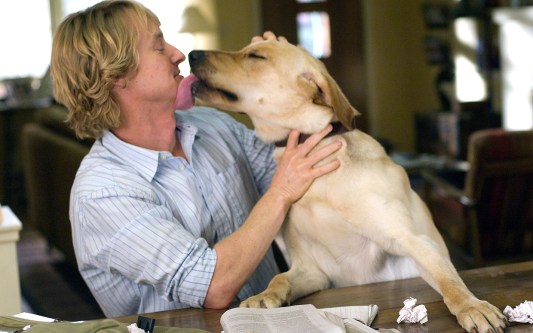
I can handle clowns, squashed heads and rotten teeth, but I hate it when the dog dies. Hate it. It’s one reason I call canine-killing movies like “Where the Red Fern Grows” and “Marley & Me” doggie-death porn. They all but fetishize the dog’s demise, milking the moment as they twist a knife in your heart, probably snickering as they do it. Sadists.

And so we have this neat site to tell us when to cover our eyes, leave the room, or skip a movie, show or book altogether. It’s not just a clever concept, it’s a public service.

Marley-and-Me-FTR.jpg
Sorry, Marley — you’re doomed.

Good movies right now

Before summer’s prequels, sequels and tweak-quels bombard us, I offer this eclectic spread of late-spring cinema surprises, all worth a look:

booksmart.jpg

 “Booksmart”

Barreling forth with raunchy vigor and unbridled zest, this breakneck coming-of-age comedy, actress Olivia Wilde’s impressive directorial debut, screams fun. Almost literally: There’s a lot of screaming — in surprise, horror and explosive joy. It’s damn near contagious.

An amplified spin on school-days greats — “Dazed and Confused,” John Hughes’ oeuvre and last year’s “Lady Bird” and “Eighth Grade” — “Booksmart” piles on twists and layers with a sharp, knowing eye that zooms in on the timely and topical, from female power and LGBTs, to bullying and the corrosive effects of cliques — and of course the liberating if daunting pull of sexual exploration.

Beanie Feldstein and Kaitlyn Dever play best friends Molly and Amy, super-nerds at their high school who are maligned for their almost pathological goodie-goodie-ism. They’re all books and no bacchanal and are certain that’s the only way to make it through college and life.

Molly, who has a crush on an unattainable pretty boy, and Amy, who has a crush on a scrappy skate-girl — sort of the story’s dual heroes’ journey — recklessly decide to shed their image and go all out on the night before graduation. The upshot is an epic party-hopping misadventure festooned with the silly, surreal and psychedelic, aided by riotously inspired side players who should get their own movies (including Carrie Fisher’s daughter, the scene-stealing Billie Lourd).

“Booksmart” radiates the crazy anarchic spirit of party-hearty teen classics like “Superbad,” and indeed “crazy” might be the movie’s one-word elevator pitch. Hang on for the insta-classic “doll scene.” It’s a little bit Barbie, a little bit “Team America,” and all warped genius.

In theaters. Watch the trailer HERE.

*nonfiction-actual-final-poster.pngNon-Fiction”

French writer-director Olivier Assayas‘ new dramedy is a tireless, tonic gabfest that had me speed-reading the flurry of subtitles more than drinking in the warm faces and colors of the bustling scenes.

That’s no complaint. The profusion of words — intelligent, eloquent, biting — brim with ideas, humor, pain and pathos, for an enveloping artful experience. You want to know the fork-tongued characters, led by a ravishing Juliette Binoche, because of the literary, arty cosmos in which these writers, editors and actors orbit. It’s intoxicating and deeply human: They’re just people, with all of our people-ly problems, and it’s more exciting than you think.

Part tart publishing-world satire, part feast of infidelity, part anatomy of midlife crises, “Non-Fiction” is light on plot, more enmeshed in ideas about love and life, loyalty between friends and lovers, and, in a topical concession, a pointed conversation about new media vs. the printed word. It’s like a Gallic Woody Allen comedy, without the tootling clarinet and stammering, gesticulating neuroses (though there’s plenty of neuroses to go around). 

Assayas, one of our most talented and inventive living filmmakers — like Michael Winterbottom and the late Kubrick, he’s a virtuoso of versatility — has made a comedy of manners that has more in common with his wonderful, verbose family drama “Summer Hours” than his masterly supernatural genre-buster “Personal Shopper.” Like the best of his movies, it’s brightly observant and conspicuously literate — as rich as a great novel, kind of ironic for a picture titled “Non-Fiction.”

In theaters. Watch the trailer HERE.

*

p16607639_v_v8_aa.jpg

“The Souvenir”

Not an easy film, Joanna Hogg‘s elusive, divisive relationship drama is boobytrapped with qualities that repel people away from the arthouse. It’s glacial, elliptical, remote, woolly. It makes you work with loosely hanging scenes, a jagged structure and oblique characterizations. I broke a small sweat trying to solder the plot together, identify with the actors and figure out where Hogg was taking me. (“Hogg,” writes one critic, “has the courage of her incoherence.”) Mostly I succeeded, finally granting this vaguely experimental flick a shaky B+.

The main entry point is young film student Julie, played with winsome diffidence by Honor Swinton Byrne, daughter of indie eminence Tilda Swinton, who has a small role as, who else, Julie’s flittering mother, her face a pinched mask of imperious disquiet.

Julie’s lover Anthony (Tom Burke) is a heroin addict, a secret until it’s not, which inevitably tangles their relationship. The story is mostly scenes of the couple muddling through their unconventional, occasionally off-putting upper-middle-class affair. With drugs. And spats. And sex. And dinner parties. And the making of a student film. And an IRA bombing. Hogg’s disparate elements somehow fall together.

There were two huffy walkouts at my recent screening, and online reviews are tetchy. “I found this film to be tedious and unrewarding,” one gripes. “I want my money back,” harrumphs another. And this: “The only movie I’ve ever walked out of in my life. I’m amazed I stayed awake and endured it for over an hour.”

With a giggle, I take those as good signs — chance-taking auteurism is always encouraging — more reasons to stick with this exacting film and reap its chilly virtues.

In theaters. Watch the trailer HERE.

*

WhatsMyName_Ali_KeyArt_lreb.jpeg

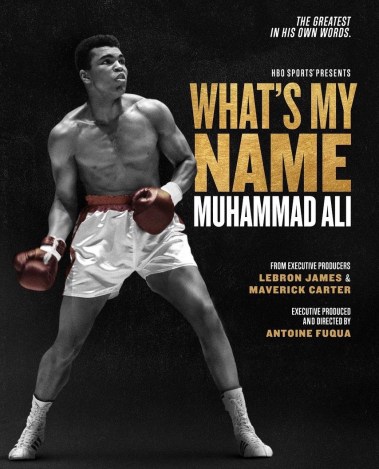
 “What’s My Name: Muhammad Ali”

Eyes wide, mouth agape, a fist pounding the table, Muhammad Ali is unleashed, free-associative verse tumbling from his unstoppable maw. Harnessing vainglory and the gift of gab, Ali is showboating, again, his audience of press and promoters rapt and laughing. And then he winds down, admitting exhaustion, the pugilist at rest.

The sudden calm is a rare state for the heavyweight champ, self-anointed The Greatest, whose taunting poetic prattle — “I’m so bad, I make medicine sick!” — earned him both infamy and adulation. “He talks too damn much! Put your fist in his mouth!” Ali recalls a ringside heckler shouting in this HBO documentary, a transfixing, rap-rattling trip through the fighter’s professional life told almost exclusively in his own words. It’s a beautifully edited stream of vintage press conferences, TV and radio interviews, with ribbons of color from managers and trainers, magazine covers and newspaper headlines.  (“He could never keep his big mouth shut,” reads one.)

The two-part, near-three-hour film, directed by Antoine Fuqua (“Training Day,” “Southpaw”) and co-produced by LeBron James, whomps with exhilarating fight footage, and so much more. If Ali was a raving icon in the ring, he was perhaps more of one outside it. He used his supersize personality and cascading eloquence to speak out for civil rights and Islam and against segregation and the Vietnam War. This keen portrait of social decency and athletic supremacy is also a voyage through late 20th-century history and culture, in which an African-American became an international hero.

On HBO and HBO GO. Watch the trailer: HERE. 

*

8f516a76-5047-42a5-9337-be30f22332c4.jpg

“The Biggest Little Farm”

If John and Molly Chester learn a few things while building their farm from the sun-baked dirt up, it’s that birds decimate crops, pigs get sick, coyotes feast on chickens, organic eggs sell crazy-fast and manure is magic.

Stars of this inspiring, sometimes harrowing auto-doc, thirty-something couple John and Molly chronicle what happens over seven years when they ditch their tiny Santa Monica apartment for 200 neglected acres an hour outside L.A. to miraculously conjure a working, biodiverse farm. It’s a quixotic, back-to-the-land quest made of heedless ambition and fashionable enlightenment.

“Everyone told us that attempting to farm in harmony with nature would be reckless if not impossible,” says John, this enchanting film’s director and narrator.

Well, almost impossible. John, a wildlife cinematographer — blame him for the movie’s plush nature imagery — and Molly, a chef and food blogger, seek purpose via this sustainable farm. Molly yearns to grow everything she cooks in conservational fashion, as if from a “traditional farm from the past,” dutifully echoing the Earth-friendly ethos of the likes of chef Alice Waters and responsible-foodie manifesto-writer Michael Pollan.

Over years battling pests, drought and the elements, the Chesters’ apparent folly assumes the mantle of glorious accomplishment. (How they pay for it is another question entirely.) Through toil and struggle, heartache and heartbreak, they cultivate a luminous idyll, a practically paradisiacal spread bounding with life, joy and abundance. You almost can’t believe your eyes.

In theaters. Watch the trailer HERE.

*

0a78b0b4cb26ac831ac16ac5d7e6cceada6c69ee.jpg

  • Bonus pre-summer movie: I haven’t seen it yet, but I know a masterpiece when it has a barrel pressed against my head: “John Wick: Chapter 3 — Parabellum. Taciturn and hitman-cool, the Keanu Reeves vehicle has been called bloody, balletic, exhilarating and “a refresher course, and a liberating one, in the nature of escapist entertainment.” If you haven’t caught the first two John Wick flicks, you have my sympathy. The trailer’s HERE.

A pungent parting shot for ‘Game of Thrones’

“Game of Thrones” is over — thank god.

And yet the chatter sputters on. Fans can’t clam it. Of all the “GOT” noise — a FOMO racket, a bellyaching din — this might be my favorite snippet, courtesy of clear-eyed Washington Post critic Hank Stuever, whose healthy cynicism is gleefully cathartic:

It’s likely you’re already aware of the dissatisfaction with the conclusion tweeted hither and yon — six weeks of nitpicking complaints, first-class nerd whining and an ungodly amount of postgame analyses. Consider all those hastily posted diatribes or that pointless online petition with a million deluded signatures on it, demanding (demanding!) to have Season 8 scrubbed and remade. In some ways, “Game of Thrones” had grown so popular that it made its viewers look embarrassingly out of touch with life itself.

This can only happen when we love our popular culture a little too hard, crossing some line of personal investment, forgetting when a TV show is only just that. It was our fault for coming to regard the show as the apogee of the medium itself.

It’s also why I’m glad some unnamed, unwitting hero left a coffee cup in the camera shot in the episode that aired May 5. That one coffee cup humanized the whole endeavor. It reminded us that a TV show, no matter how absorbing, is a folly, a fake, a job that someone is hired to do, so that an HBO subscription can be sold to you. The coffee cup will be scrubbed away with a quick flick of magic technology; but before it’s entirely gone, I hope they give it an Emmy.”

p-1-whatand8217s-that-coffee-cup-on-game-of-thrones-worth-to-starbucks.gif.jpeg